Video Loading
Want more images or videos?
Request additional images or videos from the seller
1 of 13
Jose Maria Tuser Vazquezbullfighter and bull oil on board paintingc.1980
c.1980
$670.77List Price
About the Item
- Creator:Jose Maria Tuser Vazquez (1919 - 1986, Spanish)
- Creation Year:c.1980
- Dimensions:Height: 18.12 in (46 cm)Width: 14.97 in (38 cm)
- Medium:
- Movement Style:
- Period:
- Condition:
- Gallery Location:Sitges, ES
- Reference Number:1stDibs: LU1155215193642
About the Seller
5.0
Platinum Seller
Premium sellers with a 4.7+ rating and 24-hour response times
Established in 2007
1stDibs seller since 2019
471 sales on 1stDibs
Typical response time: 1 hour
Authenticity Guarantee
In the unlikely event there’s an issue with an item’s authenticity, contact us within 1 year for a full refund. DetailsMoney-Back Guarantee
If your item is not as described, is damaged in transit, or does not arrive, contact us within 7 days for a full refund. Details24-Hour Cancellation
You have a 24-hour grace period in which to reconsider your purchase, with no questions asked.Vetted Professional Sellers
Our world-class sellers must adhere to strict standards for service and quality, maintaining the integrity of our listings.Price-Match Guarantee
If you find that a seller listed the same item for a lower price elsewhere, we’ll match it.Trusted Global Delivery
Our best-in-class carrier network provides specialized shipping options worldwide, including custom delivery.You May Also Like
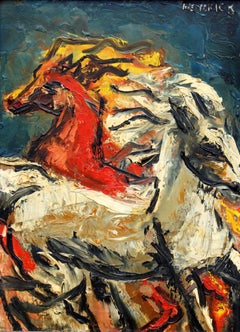
Running Horses Abstract Impressionist Oil Painting
Located in Rochester, NY
"Horses Running", a bold abstract impressionist oil painting with heavy impasto. By Sheila Hedricks. Oil on board. In a period hand...
Category
Mid-20th Century Impressionist Animal Paintings
Materials
Oil, Board
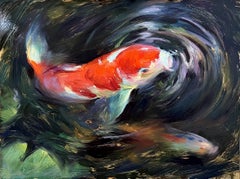
"I Will Bring You Good Luck, " Oil Painting
By Suchitra Bhosle
Located in Denver, CO
Suchitra Bhosle's "I Will Bring You Good Luck" is an original, handmade oil painting that depicts white and orange koi fish mingling and surfacing in the shallow blue water of a koi ...
Category
2010s Impressionist Animal Paintings
Materials
Oil, Board
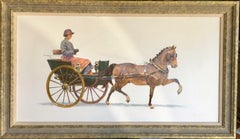
Pair of English Impressionist Horse and Buggy scenes with drivers
Located in Woodbury, CT
When Johnny left school, there were many interests which ran alongside his career at the time in the City of London as an Aviation Insurance Broker at Lloyds – writing music, playing with a band, tinkering with Vintage cars, marketing various inventions and making painting trips when possible – it wasn’t long before the Arts beckoned and at twenty six he won a place at the Fine Arts Academy in Florence where he moved in 1972.
A year later, moving near Lake Trasimeno, he continued his studies at the Fine Arts Academy in Perugia. Again on the move, he travelled to Pietrasanta near Carrara with some sculptors and stayed on this coast for nearly a year before moving eventually to Grimaldi, just inside Italy – a small medieval village about three hundred yards from the Italian /French frontier close to Monte Carlo.
Here he began a series of backstage paintings – at the Opera and Orchestra rehearsals, fashion shows, at the Circus, Jazz and Cabaret – exhibiting regularly along the coast in Monaco, Nice, Cannes and Antibes.
In 1984, circumstances changed and it was necessary to return to England – where a chance invitation to the races triggered a whole new series ‘At the Races’ which in time produced a wider series entitled ‘The British Sporting Year’ of Polo, The Henley Regatta, Derby Day, Wimbledon, Bowls, Cricket, Golf – even Jousting at Hever Castle...
Category
1990s Impressionist Animal Paintings
Materials
Oil, Board
$3,295 Sale Price
50% Off
Free Shipping
H 18 in W 26 in
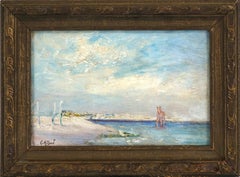
Early 20th Century Allegorical Figurative -- Pale Horse Coming to Shore
Located in Soquel, CA
Charming impressionistic painting with allegorical theme of pale horse coming to shore by Cash Arthur Bond (American, 1876 - 1952), circa 1900. Signed "C.A. Bond" lower left corner. ...
Category
Early 1900s American Impressionist Animal Paintings
Materials
Oil, Board, Cardboard
$760 Sale Price
20% Off
H 8.75 in W 12 in D 1 in
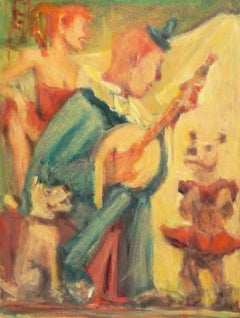
Dancing Dogs
, Impressionist Mid-century Circus Scene, Banjo Man, Acrobat
Located in Santa Cruz, CA
An interesting, American School Mid-century tempera painting showing a view of a seated clown rehearsing his dogs for a dance routine while a bareback rider in costume observes in th...
Category
1950s Impressionist Figurative Paintings
Materials
Egg Tempera, Illustration Board
$875
H 24 in W 18 in D 0.13 in
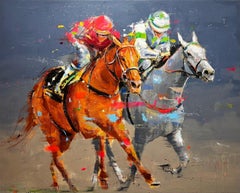
David Noalia, "Nose to Nose" 36x45 Bold Colorful Horse Race Oil Painting
Located in Saratoga Springs, NY
This vibrant piece, "Nose to Nose" is a 36x45" oil painting on canvas by artist David Noalia. Featured is an up-close cropping two horses, one grey and one chestnut, with their jocke...
Category
2010s Impressionist Animal Paintings
Materials
Canvas, Oil
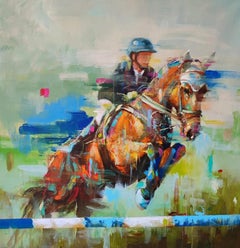
J.M. Reyes, "Clean Round", 47x47 Colorful Equine Horse Dressage Oil Painting
Located in Saratoga Springs, NY
This colorful piece, "Clean Round", is a 47x47 equine oil painting on canvas featuring a bay horse mid jump during a jumping competition. Bright pinks, purples, and blues dance aroun...
Category
2010s Impressionist Animal Paintings
Materials
Canvas, Oil
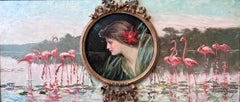
Flamingo Portrait of Lady of the Everglades
By Frederick Stuart Church
Located in Fredericksburg, VA
"Lady of the Everglades" by Frederick Stuart Church is a captivating portrait that combines the grace of a poised lady with the exotic beauty of flamingos, set against the lush backd...
Category
Early 20th Century American Impressionist Figurative Paintings
Materials
Canvas, Oil
L
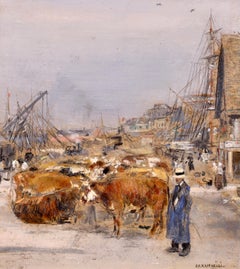
embarquement de boeufs - Impressionist Oil, Cattle by Jean Francois Raffaelli
By Jean-Francois Raffaelli
Located in Marlow, Buckinghamshire
Wonderful signed oil on panel cattle and figures in landscape by French impressionist painter Jean-Francois Raffaelli. The work depicts oxen being loaded onto ships in Honfleur, France en route to England.
Signature:
Signed lower right
Dimensions:
Framed: 18"x16"
Unframed: 9"x8"
Provenance:
Exhibition Jean Francois Raffaélli held at Galerie Simonson, 19 Rue Caumartin Paris - October 1929 (number 44)
Jean-François Raffaëlli's father was a failed Italian businessman and Raffaëlli himself was, among other things, a church chorister, actor and theatre singer. He then studied under Gérôme at the École des Beaux-Arts in Paris. He travelled to Italy, Spain and Algeria and on his return to France settled in Asnières.
In 1876, on a trip to Brittany, he first saw the potential of realist subject matter, if treated seriously. He became involved in meetings of artists at the Café Guerbois, where the Impressionist painters used to gather. As a result, Degas, contrary to the advice of the group, introduced Raffaëlli to the Impressionist exhibitions - according to one uncertain source as early as the very first exhibition, at the home of Nadar, and certainly to those of 1880 and 1881.
In 1904, Raffaëlli founded the Society for Original Colour Engraving. He first exhibited at the Salon de Paris in 1870 and continued to exhibit there until he joined the Salon des Artistes Français in 1881, where he earned a commendation in 1885, was made Chevalier of the Légion d'Honneur in 1889 and in the same year was awarded a gold medal at the Exposition Universelle. In 1906 he was made Officier of the Légion d'Honneur. He was also a member of the Société Nationale des Beaux-Arts. In 1884, a private exhibition of his work cemented his reputation.
He contributed to several newspapers such as The Black Cat (Le Chat Noir) in 1885 and The French Mail (Le Courrier Français) in 1886 and 1887. He published a collection entitled Parisian Characters, which captured his favourite themes of the street, the neighbourhood and local people going about their lives. In 1880 he participated, with Forain, on the illustration of Joris Karl Huysmans' Parisian Sketches (Croquis Parisiens). He also illustrated Huysman's Works. As well as working as an illustrator, he also made etchings and coloured dry-points.
His early attempts at painting were genre scenes, but once he was settled in Asnières he started to paint picturesque views of Parisian suburbs. From 1879 onwards, his subject matter drew on the lives of local people. These popular themes, which he treated with humanity and a social conscience, brought him to the attention of the social realist writers of the time such as Émile Zola. In addition to his realist style, Raffaëlli's dark palette, which ran contrary to the Impressionist aesthethic, helped to explain the opposition of those painters to his participation in their exhibitions. More concerned with drawing than colour, he used black and white for most of his paintings. Towards the end of his life, he lightened his palette, but without adopting any other principles of the Impressionist technique.
After painting several portraits, including Edmond de Goncourt and Georges Clémenceau, he returned to genre painting, particularly scenes of bourgeois life. Later in his career, he painted mainly Breton-inspired sailors and views of Venice. His views of the Paris slums and the fortifications, sites which have almost completely disappeared, went some way towards establishing a genre in themselves and perpetuated the memory of the area: The Slums, Rag-and-Bone Man, Vagabond, Sandpit, In St-Denis, Area of Fortifications. His realistic and witty portrayal of typical Parisian townscapes accounts for his enduring appeal.
Born in Paris, he was of Tuscan descent through his paternal grandparents. He showed an interest in music and theatre before becoming a painter in 1870. One of his landscape paintings was accepted for exhibition at the Salon in that same year. In October 1871 he began three months of study under Jean-Léon Gérôme at the École des Beaux-Arts in Paris; he had no other formal training.
Raffaëlli produced primarily costume pictures until 1876, when he began to depict the people of his time—particularly peasants, workers, and ragpickers seen in the suburbs of Paris—in a realistic style. His new work was championed by influential critics such as J.-K. Huysmans, as well as by Edgar Degas.
The ragpicker became for Raffaëlli a symbol of the alienation of the individual in modern society. Art historian Barbara S. Fields has written of Raffaëlli's interest in the positivist philosophy of Hippolyte-Adolphe Taine, which led him to articulate a theory of realism that he christened caractérisme. He hoped to set himself apart from those unthinking, so-called realist artists whose art provided the viewer with only a literal depiction of nature. His careful observation of man in his milieu paralleled the anti-aesthetic, anti-romantic approach of the literary Naturalists, such as Zola and Huysmans.
Degas invited Raffaëlli to participate in the Impressionist exhibitions of 1880 and 1881, an action that bitterly divided the group; not only was Raffaëlli not an Impressionist, but he threatened to dominate the 1880 exhibition with his outsized display of 37 works. Monet, resentful of Degas's insistence on expanding the Impressionist exhibitions by including several realists, chose not to exhibit, complaining, "The little chapel has become a commonplace school which opens its doors to the first dauber to come along."An example of Raffaëlli's work from this period is Les buveurs d'absinthe (1881, in the California Palace of Legion of Honor Art Museum in San Francisco). Originally titled Les déclassés, the painting was widely praised at the 1881 exhibit.
After winning the Légion d'honneur in 1889, Raffaëlli shifted his attention from the suburbs of Paris to city itself, and the street scenes that resulted were well received by the public and the critics. He made a number of sculptures, but these are known today only through photographs.[2] His work was also part of the painting event in the art competition at the 1912 Summer Olympics. In the later years of his life, he concentrated on color printmaking. Raffaëlli died in Paris on February 11, 1924
Museum and Gallery Holdings:
Béziers: Peasants Going to Town
Bordeaux: Bohemians at a Café
Boston: Notre-Dame; Return from the Market
Brussels: Chevet of Notre-Dame; pastel
Bucharest (Muz. National de Arta al României): Market at Antibes; Pied-à-terre
Copenhagen: Fishermen on the Beach
Douai: Return from the Market; Blacksmiths
Liège: Absinthe Drinker...
Category
1880s Impressionist Animal Paintings
Materials
Oil, Panel
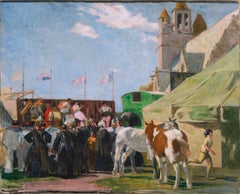
Fête Foraine
, Circus, Brittany, Breton, Société Nationale des Beaux-Arts
Located in Santa Cruz, CA
Signed lower left, 'L. Simon' for Lucien Simon (French, 1861-1945) and painted circa 1919. Partially titled, verso, on old label.
Provenance: Austin Hills estate, San Francisco.
Pre...
Category
1910s Impressionist Figurative Paintings
Materials
Canvas, Oil
$28,500
H 32 in W 39.25 in D 0.75 in
More From This Seller
View AllBullfighting Scene oil on board painting
Located in Sitges, Barcelona
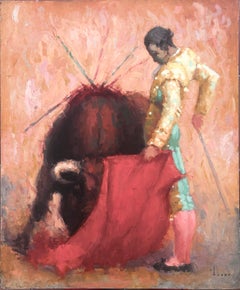
Title: Bullfighting Scene
Artist: José María Tuser Vázquez (1919-1986)
Technique: Oil on board
Dimensions: 25.6 x 21.3 in (65 x 54 cm) Frameless
Period: Second half of the 20th century
Art Movement: Figurative Expressionism with Impressionist influences
Condition: Good, with visible signs of aging on the surface
DESCRIPTION OF THE WORK
This painting captures a crucial moment in a bullfight, where the matador, dressed in a dazzling traje de luces (suit of lights), elegantly holds the red cape (muleta) while facing a wounded bull. The scene conveys tension and drama through energetic and loose brushwork, with strong contrasts of light and color that enhance its expressiveness.
The abstract background, built with gestural brushstrokes in warm, earthy tones, reinforces the dynamism and immediacy of the moment. The thick texture of the paint and the vibrant colors in the matador's attire and cape are characteristic of Figurative Expressionism, giving the work a strong emotional impact.
Tuser masterfully captures the essence of movement and the intensity of the bullfight through a painterly approach reminiscent of Impressionism, but with a greater emphasis on gesture and expressive color, making his work stand out for its raw energy and dramatic depth.
ARTIST BIOGRAPHY
José María Tuser Vázquez (Barcelona, 1919 - 1986) was a Spanish painter specialized in bullfighting themes, gaining recognition in the 20th-century art scene for his expressive depictions of the corrida (bullfight). He studied at the School of Arts and Crafts in Barcelona, where he developed a strong mastery of color and composition.
From 1947 onwards, his work focused almost entirely on bullfighting, creating posters, illustrations, and paintings that capture the emotion and spectacle of the arena. He was a frequent collaborator with El Ruedo magazine, where his illustrations and covers solidified his reputation. Additionally, in the 1940s, he designed series of postcards featuring traditional Spanish costumes for the Artigas Publishing House.
His work has been auctioned in several art houses and is highly valued among collectors of bullfighting paintings. His influence and legacy in tauromaquia (bullfighting art...
Category
1950s Impressionist Figurative Paintings
Materials
Board, Oil
$778 Sale Price
45% Off
oil on board painting Bullfighting Scene
Located in Sitges, Barcelona
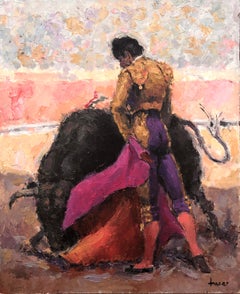
Title: Bullfighting Scene
Artist: José María Tuser Vázquez (Barcelona, 1919 - 1986)
Medium: Oil on panel
Dimensions: 18.1 x 15 inches
Signed: Yes, lower right corner "Tuser"
Framed: ...
Category
1960s Impressionist Figurative Paintings
Materials
Oil, Board
$778 Sale Price
45% Off
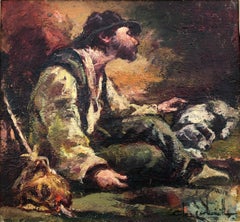
The Vagabond and His Dog oil on board painting
Located in Sitges, Barcelona
Technical details of the painting
- Title: "The Vagabond and His Dog"
- Artist: Rosendo González Carbonell
- Technique: Oil on panel ...
Category
1970s Impressionist Figurative Paintings
Materials
Oil, Board
$550 Sale Price
42% Off
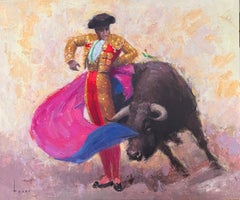
Cape Maneuver bullfighter oil painting
Located in Sitges, Barcelona
Title: Cape Maneuver
Artist: José María Tuser Vázquez (Barcelona, 1919 – 1986)
Technique: Oil on canvas mounted on board
Dimensions: 19.7 x 23.6 in (50 x 60 cm)
Date: Circa 1980s
Signature: Signed "Tuser" in the lower left corner
Condition: Excellent; thick, vibrant brushwork and vivid colors well preserved.
📝 Description
This painting captures a dramatic moment in the bullfight — the classic verónica — as the matador gracefully halts the bull’s charge with a sweeping motion of the cape. The vivid contrast of magentas, blues, and golds intensifies the theatrical tension between man and beast. The composition is dynamic yet controlled, emphasizing the poise of the torero against the raw force of the bull.
The expressive brushstrokes and thick impasto enhance the sense of movement, while the abstracted background ensures focus remains on the central figures. The piece is a striking blend of figuration and emotional energy, characteristic of Tuser’s taurine works.
👤 About the Artist: José María Tuser Vázquez
José María Tuser Vázquez was a Spanish painter born in Barcelona in 1919. He studied at the Barcelona School of Arts and Crafts and began exhibiting in the 1940s. By 1947, he had fully devoted his career to bullfighting scenes, developing a distinctive figurative expressionist style with impressionist influences.
He collaborated with the magazine El Ruedo, creating numerous illustrations and covers, and designed collectible postcards for Editorial Artigas. His work became well-known in Spanish artistic circles and is now part of both private and institutional collections, including the Club Taurino of London.
His paintings have been auctioned internationally, reaching up to $3,000 depending on size and subject. His legacy is that of a painter who masterfully captured the emotion, tradition, and drama of the Spanish corrida.
🎨 Similar Artists
José María Tuser Vázquez’s work shares thematic and stylistic elements with:
Roberto Domingo – A pioneer of bullfighting art...
Category
1970s Expressionist Figurative Paintings
Materials
Canvas, Oil, Board
$1,018 Sale Price
43% Off
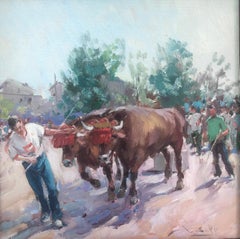
plowing with oxen oil on board painting Spain
By Juan Soler
Located in Sitges, Barcelona
Oil measures 30x30 cm.
Frame measures 52x52 cm.
He was born in 1951. Under the direction of the teacher Pedro Bermejo, he began his artistic career, quickly standing out and observing in his works an unusual mastery of drawing.
A highly mature painter who has known how to stop time in all his works. His themes are preferably costumbrist, although in his work it is usual to see 18th century themes, with horse carriages, hats, umbrellas and still lifes.
Observing his work reminds us, due to the theme, of Maestro Palmero...
Category
21st Century and Contemporary Post-Impressionist Animal Paintings
Materials
Oil, Board
$347 Sale Price
51% Off
Bullfighting Scene oil on board painting
Located in Sitges, Barcelona
Artist: José María Tuser Vázquez (1919-1986)
Title: Bullfighting Scene
Technique: Oil on board
Dimensions: 25.6 x 21.3 inches
Period: 20th century
Art Movement: Figurative Expression...
Category
1950s Expressionist Animal Paintings
Materials
Oil, Board

$718 Sale Price
50% Off