Want more images or videos?
Request additional images or videos from the seller
1 of 18
Marcel François LeprinLe Bal de Moulin Rouge - Modernist Figurative Oil by Marcel Francois Leprin1921
1921
$15,089.69List Price
About the Item
- Creator:Marcel François Leprin (1891 - 1933, French)
- Creation Year:1921
- Dimensions:Height: 19 in (48.26 cm)Width: 26 in (66.04 cm)
- Medium:
- Movement Style:
- Period:
- Condition:Very good original condition.
- Gallery Location:Marlow, GB
- Reference Number:Seller: LFA03101stDibs: LU415315539692
About the Seller
5.0
Vetted Professional Seller
Every seller passes strict standards for authenticity and reliability
Established in 2001
1stDibs seller since 2016
713 sales on 1stDibs
Typical response time: 3 hours
Authenticity Guarantee
In the unlikely event there’s an issue with an item’s authenticity, contact us within 1 year for a full refund. DetailsMoney-Back Guarantee
If your item is not as described, is damaged in transit, or does not arrive, contact us within 7 days for a full refund. Details24-Hour Cancellation
You have a 24-hour grace period in which to reconsider your purchase, with no questions asked.Vetted Professional Sellers
Our world-class sellers must adhere to strict standards for service and quality, maintaining the integrity of our listings.Price-Match Guarantee
If you find that a seller listed the same item for a lower price elsewhere, we’ll match it.Trusted Global Delivery
Our best-in-class carrier network provides specialized shipping options worldwide, including custom delivery.You May Also Like
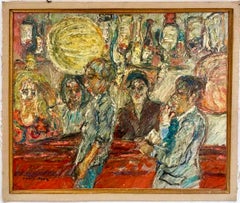
Israeli French David Azuz Naive Oil Painting Paris Bar Scene Colorful Fauvist
By David Azuz
Located in Surfside, FL
David Azuz (1942-)
Bar scene with five people, drinking and talking.
Hand signed lower left
Oil on canvas
Dimensions: (Frame) H 20" x W 23" (Canvas) H 18.5" x W 22"
Tel Aviv, 1942...
Category
20th Century Modern Figurative Paintings
Materials
Canvas, Oil
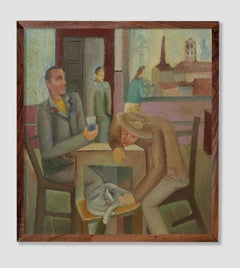
Mid Century Interior Scene Animals Figures Rare Cityscape Oil Painting 1963
Located in Buffalo, NY
A fantastic MidCentury interior scene painted in 1963 and signed illegibly.
This work comes in a contemporary wood frame.
Category
1960s Modern Interior Paintings
Materials
Canvas, Oil
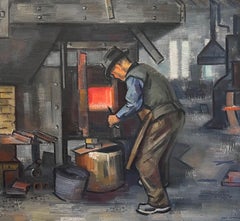
Blacksmith (Untitled)
By Erle Loran
Located in Los Angeles, CA
Blacksmith (Untitled), 1936, oil on canvas, signed and dated lower right, 28 x 30 inches
Erle Loran was an influential American painter, art historian, and educator, renowned for h...
Category
1930s American Modern Figurative Paintings
Materials
Canvas, Oil
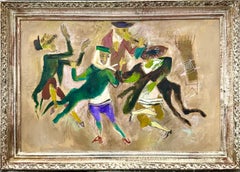
Large Oil Painting Klezmer Wedding Rabbis Judaica WPA Jewish Art William Gropper
By William Gropper
Located in Surfside, FL
William Gropper (1897- 1977)
Oil on canvas
Hand signed lower right
Dimensions: 24 h x 36 w in (61 x 91 cm) Framed 29.25 X 41.25
Dancing Chassidim with Klezmer musician, Menorah and T...
Category
Mid-20th Century Modern Figurative Paintings
Materials
Canvas, Oil
$12,000
H 29.25 in W 41.25 in
20th Century German Modernist Oil Painting Pianist in Concert Hall with Audience
Located in Cirencester, Gloucestershire
Artist: Elisabeth Hahn (German 1924-2021)
Elisabeth Hahn was born in Dortmund, Germany, where she began her artistic studies. In 1953, she moved to Paris. She continued her studies ...
Category
20th Century Modern Figurative Paintings
Materials
Canvas, Oil
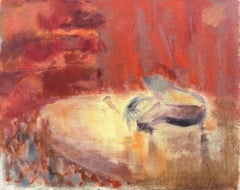
$709 Sale Price
20% Off
H 13 in W 16 in
Large 1970
s French Modernist Oil Painting The Card Game Players Casino Interior
Located in Cirencester, Gloucestershire
The Card Game in the Casino
French Modernist, circa 1970's
oil on canvas, unframed
canvas: 21.5 x 25.5 inches
provenance: private collection, France
condition: very good and sound co...
Category
Mid-20th Century Modern Figurative Paintings
Materials
Oil, Canvas
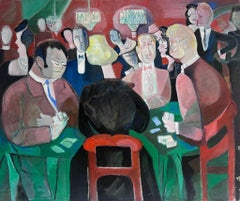
$2,396 Sale Price
20% Off
H 21.5 in W 25.5 in
French North African Orientalist Oil Painting Hareem Interior Two Ladies
Located in Cirencester, Gloucestershire
The Hareem Interior
French Orientalist School, late 20th century
(painted after an earlier style)
oil on canvas, framed
framed: 30 x 34 inches
canvas: 20 x 24 inches
provenance: priv...
Category
20th Century Modern Figurative Paintings
Materials
Oil, Canvas
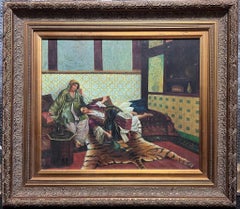
$2,456 Sale Price
20% Off
H 30 in W 34 in D 2 in
Mid Century Abstract Expressionist Figurative -- Nude Woman and Red Chair
By Honora Berg
Located in Soquel, CA
Wonderful mid century abstract figurative nude at night with red chair by Honora Berg (American, 1897-1985). A nocturnal setting adds more interest and dimension. Signed on verso "H Berg." Unframed. 36"H x 30"W.
Honora Berg an early Bay Area Figurative and Abstract Expressionist painter. She studied at the San Francisco Art Institute with David Park, Elmer Bischoff, and James Budd Dixon. Berg's friend Edith Truesdell...
Category
1960s American Modern Figurative Paintings
Materials
Oil, Canvas
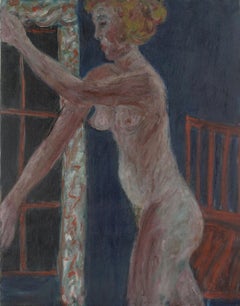
$2,850
H 36 in W 30 in D 1.25 in
Fine 1950
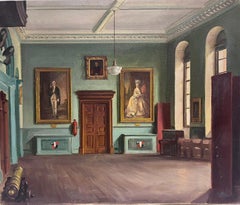
s English Oil Grand Interior Room Scene Ancestral Portraits signed
Located in Cirencester, Gloucestershire
The Guildhall, Worcester
English School, mid 20th century
indistinctly signed verso
oil on canvas
canvas: 20 x 24 inches
provenance: private collection, UK
condition: very good and sound condition
The Worcester Guildhall was originally built as a meeting place for Worcester merchants around 1227. As with many other guildhalls, it became the centre for civic administration, a role it maintained after the merchant guild had disappeared.
The present Worcester Guildhall is a superb Queen Anne building, begun in 1722 by Thomas White, a pupil of Sir Christopher Wren. White was badly paid for his efforts, and he died in poverty in 1738, bestowing the money he was owed on the Worcester Royal Infirmary. The city finally paid its debt in 1753.
The exterior of the Guildhall is brick, dressed with stone. White himself is said to have carved the figure of Queen Anne over the entry, as well as those of Charles I and II, a reminder of the city's long history of royal support. The interior is superb, boasting exceptional period decoration. The Tourist Information Centre is now located in the Guildhall.
HISTORY
In 1227 Henry III granted the citizens of Worcester a royal charter granting them the right to establish a guild of merchants. The guild was responsible for controlling trade in the city, but their meeting place gradually became the main centre of administration for city government and acted as a courthouse. So, in effect, the Guildhall was the town hall, and though the city guilds have long since vanished, the Guildhall name lives on.
The medieval guild merchants would not recognise the building that faces onto High Street now. Their guildhall was a large timber-framed building, occupying the same site, with a piazza for shops fronting the street, courts of justice at each end, and a prison to the north of the building.
Part of the prison was a cell called 'the peephole', which gained a notorious reputation. There was a gaoler's house, and attached to it an alehouse from which the gaoler sold ale at extremely high prices to any prisoner who could afford the cost.
In 1717 the city administration decided on a new Guildhall, and they knew just who to call; upon to build it. Thomas White was not an architect in the way we think of it today, but a stonemason. In 1705 he had carved a statue of Queen Anne to stand in front of the medieval Guildhall and was made a Freeman of the City. The total cost of the fashionable new red-brick building was £3727. The Corporation only put forward £800, and the rest had to be raised by public subscription.
The centre section of the new Guildhall was finished by 1724 and has remained almost unchanged since then. The central facade is a wonderful example of early Georgian style, with three bays flanked by Corinthian pillars.
Over the entrance is a huge carving incorporating the Hanoverian royal arms. White's earlier statue of Queen Anne was placed in a niche over the door, and on either side were statues of Charles I, depicted holding a church, and Charles II, with an orb and royal sceptre. On the rooftop are figures of Labour, Peace, Justice, Plenty, and Chastisement.
North and south wings were added within a few years of the central block. The south wing was used as a judge's lodging when the assizes were taking place, but throughout the rest of the year it housed a coffee shop.
The most striking external feature of the Guildhall is a set of iron gates...
Category
Mid-20th Century Modern Interior Paintings
Materials
Oil, Canvas
$1,310 Sale Price
20% Off
H 20 in W 24 in
The Artist
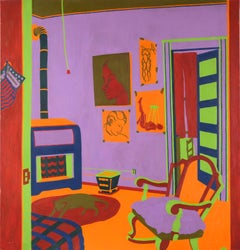
s Apartment Mid-Century Fauvist Interior Scene Original Oil on Canvas
Located in Soquel, CA
The Artist's Apartment Mid-Century Fauvist Interior Scene Original Oil on Canvas
Vibrant interior scene by Santa Cruz California artist Frances Rinaldo (American, b. 1943). A bright...
Category
1960s American Modern Figurative Paintings
Materials
Canvas, Oil, Stretcher Bars
$3,550
H 48 in W 48 in D 0.75 in
More From This Seller
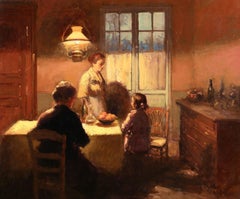
View AllInterieur - Effet de Lampe - Impressionist Interior Oil by Edouard Cortes
By Édouard Leon Cortès
Located in Marlow, Buckinghamshire
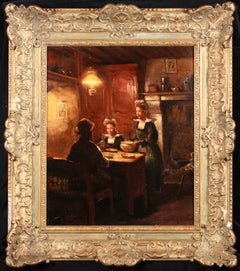
Signed figures in interior oil on canvas circa 1920 by sought after French impressionist painter Edouard Leon Cortes. This charming and nostalgic work depicts a family in a typical Breton kitchen scene. An elderly lady is seated at the table with her back to the artist and a young girl also sits at the table beside a bowl of oranges and a carafe of red wine. Another lady stands at the table under the light of the lamp.
Signature:
Signed lower right
Dimensions:
Framed: 29.5"x34"
Unframed: 21.5"x26"
Provenance:
Salon des Independants - 1922 exhibition
Galleries Maurice Sternberg - Chicago
Original artists label with title and number "9" on the reverse.
Edouard Leon Cortes, the son of the painter Antonio Cortès, was sent to the front during World War I to sketch enemy positions. In civilian life, his base was in Lagny in the former studio of Cavallo-Peduzzi. Although he travelled extensively in France. Notably in Normandy, Brittany, the Champagne region and Savoy painting...
Category
1920s Impressionist Figurative Paintings
Materials
Canvas, Oil
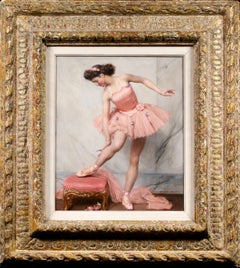
Une Ballerine - Realist Figurative Oil Painting by Auguste Leroux
Located in Marlow, Buckinghamshire
Signed oil on canvas figure in interior circa 1930 by French realist painter Jules Marie Auguste Leroux. The work depicts a brunette ballerina wearing a pink tutu and pointe shoes st...
Category
1930s Realist Figurative Paintings
Materials
Canvas, Oil
A Breton Interior - Impressionist Interior Oil Painting by Edouard Cortes
By Édouard Leon Cortès
Located in Marlow, Buckinghamshire
Signed figures in interior oil on canvas circa 1910 by sought after French impressionist painter Edouard Leon Cortes. This charming and nostalgic work depicts a family enjoying dinne...
Category
Early 20th Century Impressionist Interior Paintings
Materials
Canvas, Oil
The Piano Recital - Impressionist Figurative Interior Oil by Frederick Frieseke
By Frederick Carl Frieseke
Located in Marlow, Buckinghamshire
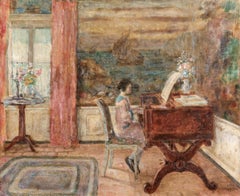
Signed and dated oil on canvas figure in interior painting by American impressionist painter Frederick Carl Frieseke. The piece depicts a young girl in a pink dress seated at a piano...
Category
1920s American Impressionist Figurative Paintings
Materials
Oil, Canvas
La Famille - Impressionist Interior Figurative Oil Painting by Edouard Cortes
By Édouard Leon Cortès
Located in Marlow, Buckinghamshire
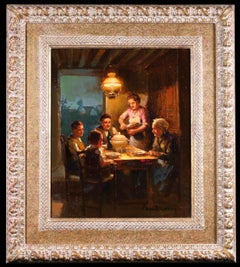
Signed and titled figures in interior oil on panel circa 1920 by sought after French impressionist painter Edouard Leon Cortes. This charming and nostalgic work depicts a family enjo...
Category
1920s Impressionist Figurative Paintings
Materials
Oil, Panel
Deux vieillards aux chatons - Impressionist Figurative Oil by J F Raffaelli
By Jean-Francois Raffaelli
Located in Marlow, Buckinghamshire
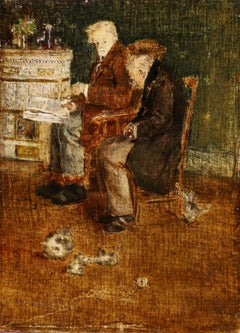
Signed figures in interior oil on panel by French impressionist painter Jean-Francois Raffaelli. The piece depicts two old men seated in an interior. One is reading his paper as the other naps and there are several kittens on the floor. Painted in the artist's distinctive style.
Signature:
Signed lower left
Dimensions:
Framed: 9.5"x8"
Unframed: 5.5"x4"
Provenance:
Brame & Lorenceau have confirmed the authenticity of this work and it will be included in the digital catalogue raisonne of the painter which is under preparation
A certificate of authenticity fromBrame & Lorenceau accompanies this painting
Private collection - United States
Original artists label verso
Jean-François Raffaëlli's father was a failed Italian businessman and Raffaëlli himself was, among other things, a church chorister, actor and theatre singer. He then studied under Gérôme at the École des Beaux-Arts in Paris. He travelled to Italy, Spain and Algeria and on his return to France settled in Asnières.
In 1876, on a trip to Brittany, he first saw the potential of realist subject matter, if treated seriously. He became involved in meetings of artists at the Café Guerbois, where the Impressionist painters used to gather. As a result, Degas, contrary to the advice of the group, introduced Raffaëlli to the Impressionist exhibitions - according to one uncertain source as early as the very first exhibition, at the home of Nadar, and certainly to those of 1880 and 1881.
In 1904, Raffaëlli founded the Society for Original Colour Engraving. He first exhibited at the Salon de Paris in 1870 and continued to exhibit there until he joined the Salon des Artistes Français in 1881, where he earned a commendation in 1885, was made Chevalier of the Légion d'Honneur in 1889 and in the same year was awarded a gold medal at the Exposition Universelle. In 1906 he was made Officier of the Légion d'Honneur. He was also a member of the Société Nationale des Beaux-Arts. In 1884, a private exhibition of his work cemented his reputation.
He contributed to several newspapers such as The Black Cat (Le Chat Noir) in 1885 and The French Mail (Le Courrier Français) in 1886 and 1887. He published a collection entitled Parisian Characters, which captured his favourite themes of the street, the neighbourhood and local people going about their lives. In 1880 he participated, with Forain, on the illustration of Joris Karl Huysmans' Parisian Sketches (Croquis Parisiens). He also illustrated Huysman's Works. As well as working as an illustrator, he also made etchings and coloured dry-points.
His early attempts at painting were genre scenes, but once he was settled in Asnières he started to paint picturesque views of Parisian suburbs. From 1879 onwards, his subject matter drew on the lives of local people. These popular themes, which he treated with humanity and a social conscience, brought him to the attention of the social realist writers of the time such as Émile Zola. In addition to his realist style, Raffaëlli's dark palette, which ran contrary to the Impressionist aesthethic, helped to explain the opposition of those painters to his participation in their exhibitions. More concerned with drawing than colour, he used black and white for most of his paintings. Towards the end of his life, he lightened his palette, but without adopting any other principles of the Impressionist technique.
After painting several portraits, including Edmond de Goncourt and Georges Clémenceau, he returned to genre painting, particularly scenes of bourgeois life. Later in his career, he painted mainly Breton-inspired sailors and views of Venice. His views of the Paris slums and the fortifications, sites which have almost completely disappeared, went some way towards establishing a genre in themselves and perpetuated the memory of the area: The Slums, Rag-and-Bone Man, Vagabond, Sandpit, In St-Denis, Area of Fortifications. His realistic and witty portrayal of typical Parisian townscapes accounts for his enduring appeal.
Born in Paris, he was of Tuscan descent through his paternal grandparents. He showed an interest in music and theatre before becoming a painter in 1870. One of his landscape paintings was accepted for exhibition at the Salon in that same year. In October 1871 he began three months of study under Jean-Léon Gérôme at the École des Beaux-Arts in Paris; he had no other formal training.
Raffaëlli produced primarily costume pictures until 1876, when he began to depict the people of his time—particularly peasants, workers, and ragpickers seen in the suburbs of Paris—in a realistic style. His new work was championed by influential critics such as J.-K. Huysmans, as well as by Edgar Degas.
The ragpicker became for Raffaëlli a symbol of the alienation of the individual in modern society. Art historian Barbara S. Fields has written of Raffaëlli's interest in the positivist philosophy of Hippolyte-Adolphe Taine, which led him to articulate a theory of realism that he christened caractérisme. He hoped to set himself apart from those unthinking, so-called realist artists whose art provided the viewer with only a literal depiction of nature. His careful observation of man in his milieu paralleled the anti-aesthetic, anti-romantic approach of the literary Naturalists, such as Zola and Huysmans.
Degas invited Raffaëlli to participate in the Impressionist exhibitions of 1880 and 1881, an action that bitterly divided the group; not only was Raffaëlli not an Impressionist, but he threatened to dominate the 1880 exhibition with his outsized display of 37 works. Monet, resentful of Degas's insistence on expanding the Impressionist exhibitions by including several realists, chose not to exhibit, complaining, "The little chapel has become a commonplace school which opens its doors to the first dauber to come along."An example of Raffaëlli's work from this period is Les buveurs d'absinthe (1881, in the California Palace of Legion of Honor Art Museum in San Francisco). Originally titled Les déclassés, the painting was widely praised at the 1881 exhibit.
After winning the Légion d'honneur in 1889, Raffaëlli shifted his attention from the suburbs of Paris to city itself, and the street scenes that resulted were well received by the public and the critics. He made a number of sculptures, but these are known today only through photographs.[2] His work was also part of the painting event in the art competition at the 1912 Summer Olympics. In the later years of his life, he concentrated on color printmaking. Raffaëlli died in Paris on February 11, 1924
Museum and Gallery Holdings:
Béziers: Peasants Going to Town
Bordeaux: Bohemians at a Café
Boston: Notre-Dame; Return from the Market
Brussels: Chevet of Notre-Dame; pastel
Bucharest (Muz. National de Arta al României): Market at Antibes; Pied-à-terre
Copenhagen: Fishermen on the Beach
Douai: Return from the Market; Blacksmiths
Liège: Absinthe Drinker...
Category
1890s Impressionist Figurative Paintings
Materials
Oil, Panel
Still Thinking About These?
All Recently ViewedMore Ways To Browse
Moulin Rouge
Moulin Rouge Paris
1920 Modernist Painting
Moulin Rouge Paintings
Marcel Leprin
Abraham Isaac
Assumption Of The Virgin
Bacchus Paintings
Boudoir Painting
Boxing Oil Painting
Bullfight Paintings
Chen Yiching
Christy Brown
Colorful Spanish Art
Couple Dancing Painting
Depression Era Art
Dolly Paintings
Emmanuel Ojebola