Items Similar to Martin Saldaña 20th-Century Mexican Folk Art “Seated Girl and Hummingbird”
Video Loading
Want more images or videos?
Request additional images or videos from the seller
1 of 16
Martin SaldanaMartin Saldaña 20th-Century Mexican Folk Art “Seated Girl and Hummingbird”circa 1960
circa 1960
$2,750
£2,076.98
€2,399.24
CA$3,874.36
A$4,149.44
CHF 2,230.71
MX$50,397.36
NOK 28,186.11
SEK 25,806.48
DKK 17,926.71
About the Item
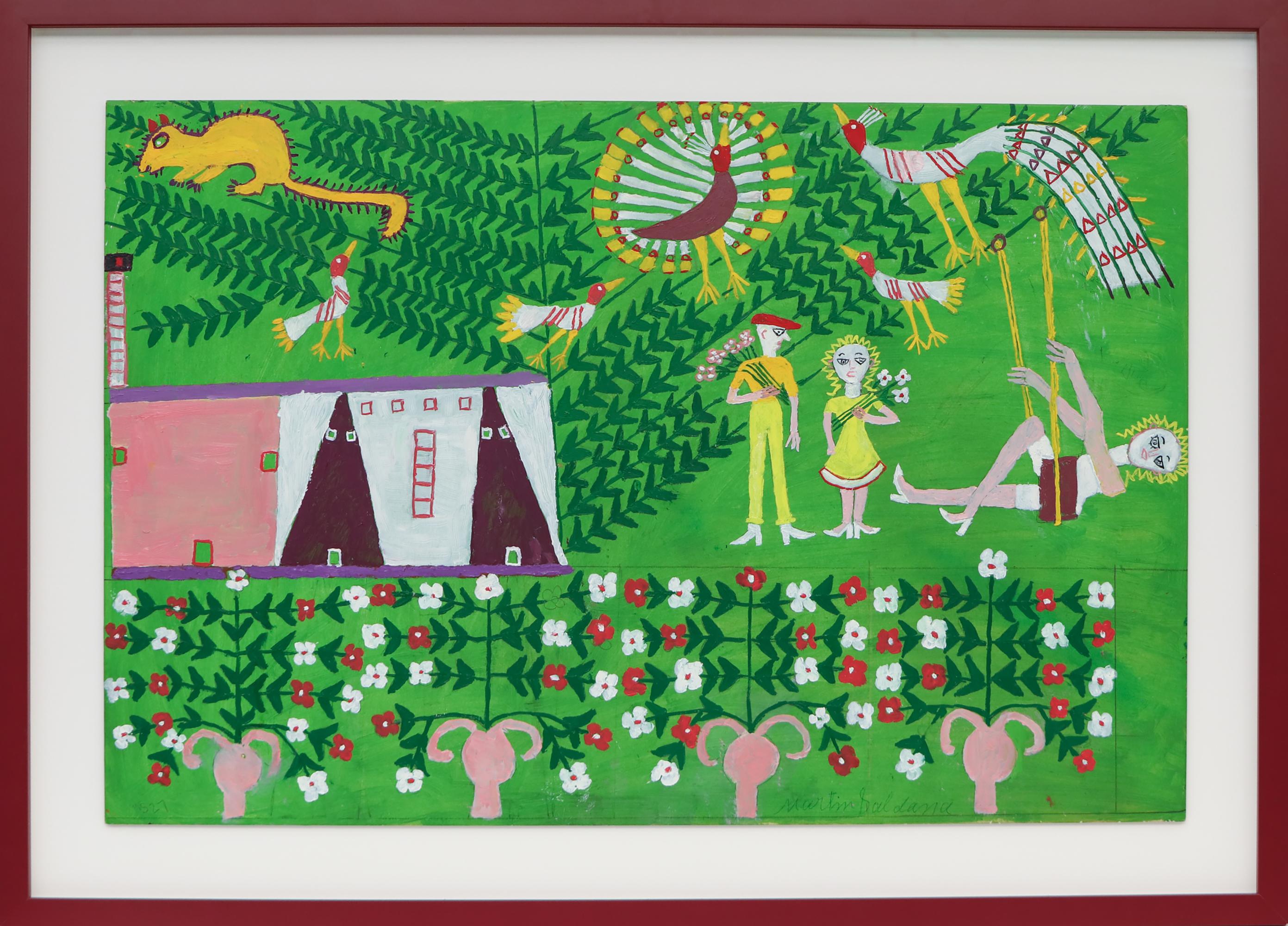
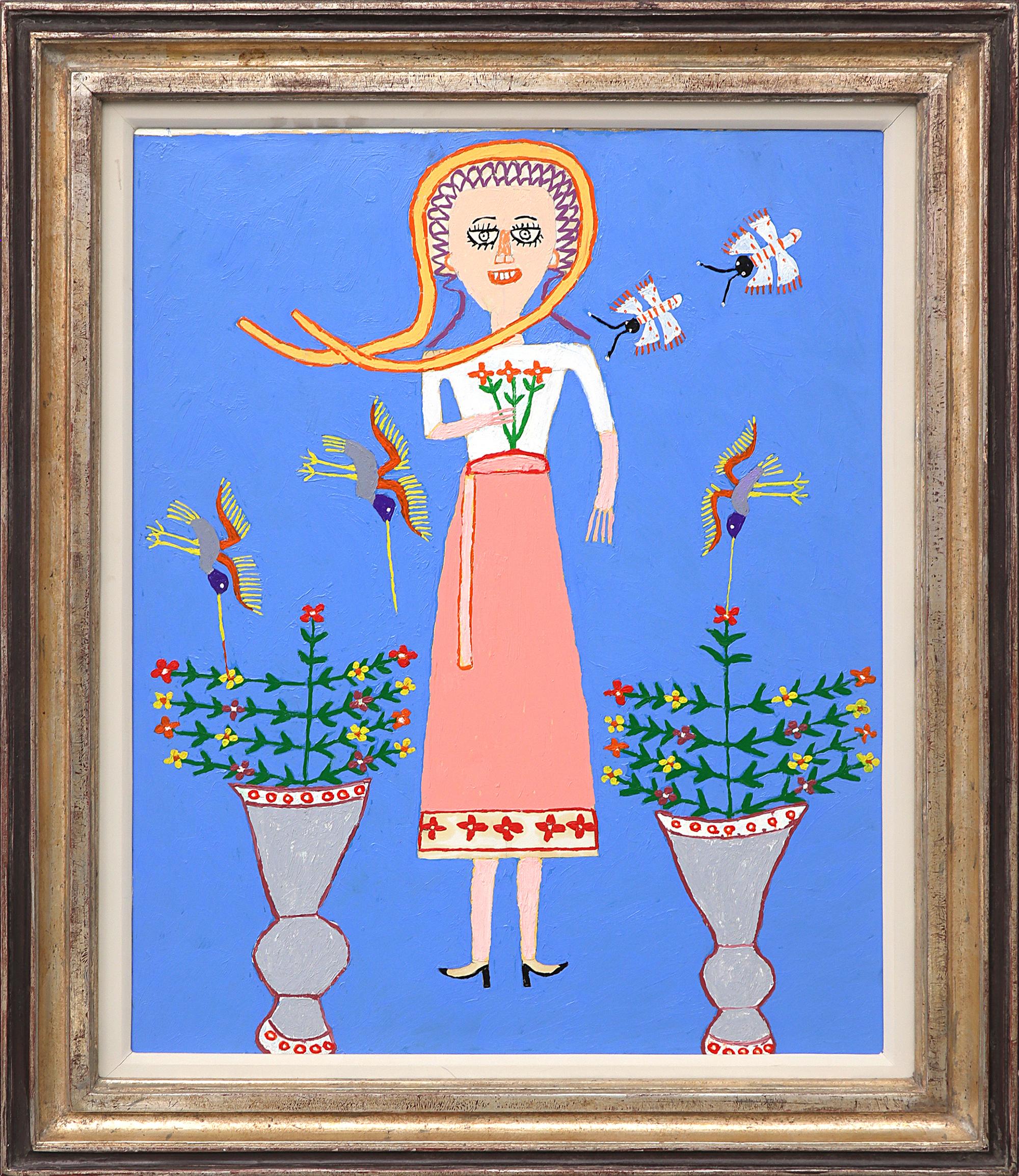
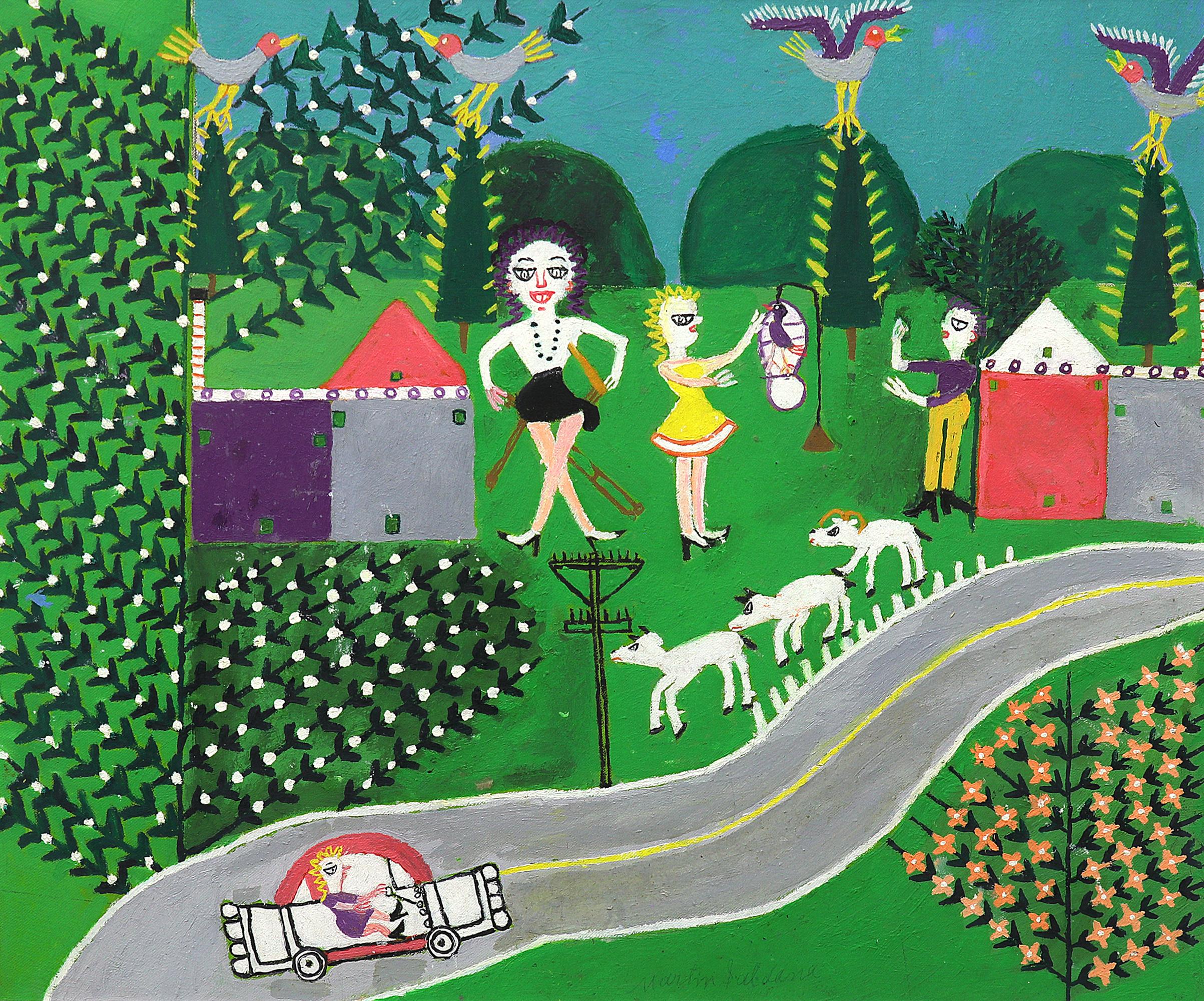
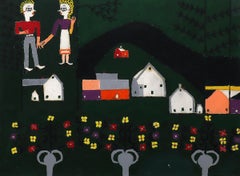
"Seated Girl and Hummingbird" is a vibrant oil on board painting by Mexican folk artist Martin Saldaña (1874–1965). This captivating work depicts three figures near a house, surrounded by lush greenery, birds, and playful details, rendered in bold shades of green, red, yellow, black, and gray. Signed by the artist at the lower center, the composition highlights Saldaña’s distinctive folk art style, combining geometric forms, vivid colors, and whimsical storytelling.
Measuring 18 x 24 inches and presented in custom framing, the painting is in very good condition; detailed condition reports are available upon request.
About the Artist:
Born in 1874 in Mexico, Martin Saldaña grew up on Rancho Neuvo, where rural landscapes and local traditions profoundly influenced his art. A self-taught artist, Saldaña began formal art studies at age 76 in children’s classes at the Denver Art Museum, launching a 15-year career capturing ranch life, animals, and everyday scenes from his childhood in San Luis Potosí. His works are celebrated for their vibrant color palettes, geometric figures, and charming simplicity, reflecting Mexican tapestries and folk traditions.
Saldaña’s paintings are part of prestigious collections, including the Denver Art Museum, University of Wyoming Art Museum, Colorado Springs Fine Art Center, and the International Folk Art Museum. Seated Girl and Hummingbird is a joyful, visually striking example of Mexican folk art, making it an exceptional addition to any collection of folk, Mexican, or 20th-century art.
- Creator:Martin Saldana (1874 - 1965, Mexican)
- Creation Year:circa 1960
- Dimensions:Height: 25 in (63.5 cm)Width: 20.5 in (52.07 cm)Depth: 1.25 in (3.18 cm)
- Medium:
- Movement Style:
- Period:
- Framing:Frame IncludedFraming Options Available
- Condition:
- Gallery Location:Denver, CO
- Reference Number:Seller: 261271stDibs: LU27312274322
Martin Saldana
Born in 1874, Saldaña grew up at Rancho Neuvo in Mexico. In 1950, at the age of 76, he began attending children's art classes at the Denver Art Museum. For the next fitfteen years, Saldaña Imaginatively documented whimsical memories from his childhood in San Luis Potosi, Mexico, portraying ranch life, landscapes, and his great love of animals. The prolific artist painted every day, completing a new piece about every three days and amassing an impressive body of work for the former cook at the Denver landmark, the Brown Palace Hotel. Saldaña’s vibrant palette and geometric figures are reminiscent of the tapestries of his Mexican heritage and the paintings, primarily in oil, are innocent and endearing. Saldaña is considered to be a outsider artist, a folk artist who is self-taught, whose work is simple, direct, and high personal. Works Held: Denver Art Museum, University of Wyoming Art Museum, The Colorado Springs Fine Art Center, International Folk Art Museum, Neuss In Aberthor Museum, Stedelijk Museum ©David Cook Galleries, LLC
About the Seller
5.0
Gold Seller
Premium sellers maintaining a 4.3+ rating and 24-hour response times
Established in 1979
1stDibs seller since 2013
300 sales on 1stDibs
Typical response time: 1 hour
- ShippingRetrieving quote...Shipping from: Denver, CO
- Return Policy
More From This Seller
View All1960s Mexican-American Folk Art Oil Painting, Girl on Swing, Birds, Bright Color
By Martin Saldana
Located in Denver, CO
This vibrant 1950s-1960s oil painting by renowned Mexican-American folk artist Martin Saldaña (1874–1965) depicts a whimsical outdoor scene with a young girl on a swing, accompanied ...
Category
Mid-20th Century Folk Art Landscape Paintings
Materials
Oil
Martin Saldaña “Lovely Gal” Oil on Board, Vibrant Mexican Folk Art, 20th Cent.
By Martin Saldana
Located in Denver, CO
“Lovely Gal” is a delightful oil on board painting by Martin Saldaña (1874–1965), a self-taught Mexican-American outsider artist celebrated for his vivid, whimsical depictions of childhood, rural life, and nature. This semi-abstract figurative work bursts with bold colors, featuring lively flowers and birds that reflect Saldaña’s deep connection to his Mexican heritage and love for the natural world.
The painting is presented in a custom frame, measuring 30 ¾ x 25 ⅜ x 1 ⅝ inches, with an image size of 24 ½ x 19 ⅛ inches. Its charming composition and vibrant palette exemplify Saldaña’s signature folk art style, offering a joyful, nostalgic glimpse into his personal memories and cultural roots.
About the Artist:
Born in Rancho Nuevo, Mexico, Martin Saldaña led a modest life and worked as a cook at Denver’s iconic Brown Palace Hotel. Remarkably, he began his artistic career at age 76, attending children’s art classes at the Denver Art Museum, which sparked a prolific creative period lasting 15 years.
Saldaña’s paintings are noted for their bold geometric forms, vivid colors, and naïve, folk art aesthetic, often reminiscent of traditional Mexican tapestries. Producing a new work nearly every three days, he captured landscapes, ranch life, animals, and childhood memories with heartfelt simplicity. Today, Saldaña’s enchanting artworks continue to captivate collectors, celebrating the rich visual culture and charm of Mexican-American folk art.
©David Cook Galleries...
Category
20th Century Folk Art Figurative Paintings
Materials
Oil
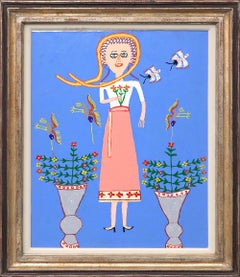
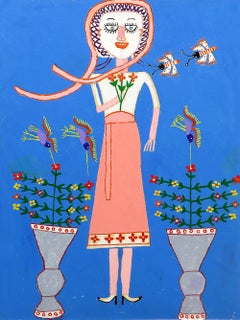
Pinky – Original Naïve Folk Art Oil Painting by Martin Saldaña, Framed
By Martin Saldana
Located in Denver, CO
Bring charm, color, and heartfelt nostalgia into your space with “Pinky,” an enchanting original oil painting on board attributed to acclaimed Naïve folk artist Martin Saldaña. This ...
Category
1950s Folk Art Figurative Paintings
Materials
Oil
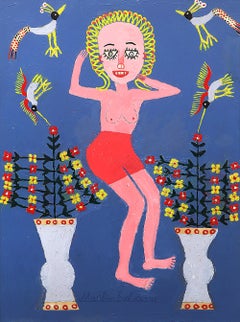
Colorful Mid-Century Folk Art Oil Painting by Martin Saldaña, "Small Nude", 1960
By Martin Saldana
Located in Denver, CO
"Small Nude" is a vibrant, semi-abstract oil painting by Mexican-American artist Martin Saldaña (1874–1965). This whimsical mid-century work features a stylized female nude surrounde...
Category
Mid-20th Century Folk Art Figurative Paintings
Materials
Oil
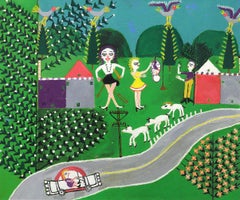
Girl with Sheep and Car – Original Folk Art Oil Painting by Martin Saldaña
By Martin Saldana
Located in Denver, CO
Step into a world of color, memory, and rural charm with “Girl with Sheep and Car,” a joyful and visually rich original oil painting on board by renowned Mexican-American folk artist...
Category
Mid-20th Century Folk Art Landscape Paintings
Materials
Oil
Mexican American Folk Art Oil Painting – Figures, Houses
Landscape, 20th C.
By Martin Saldana
Located in Denver, CO
A charming and colorful oil on board painting by acclaimed Mexican American folk artist Martin Saldaña (1874–1965), titled “Farm and Figures.” This unique 20th-century outsider artwo...
Category
Mid-20th Century Folk Art Figurative Paintings
Materials
Oil
You May Also Like
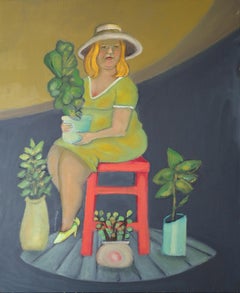
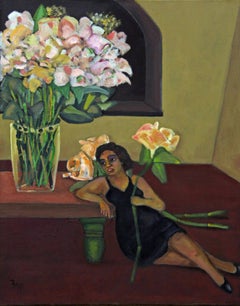
Spotlight, seated female figure with plants warm and cool green combinations
By Stephen Basso
Located in Brooklyn, NY
This is an oil on linen painting signed and dated on reverse.
Category
2010s Expressionist Interior Paintings
Materials
Linen, Oil
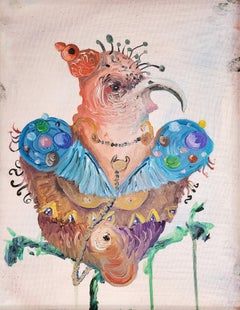
Wee One 8 (Hummingbird, Portrait, Storytelling, Oil Painting)
By Joseph Broghammer
Located in Kansas City, MO
Joseph Broghammer
Wee One 8 (Hummingbird, Portrait, Storytelling, Oil Painting)
Oil on Canvas
Year: 2023
Size: 14x11in
Framed: 15x12x1in
Signed by hand
COA provided
Ref.: 924802-1902...
Category
2010s Contemporary Figurative Paintings
Materials
Canvas, Oil
Girl
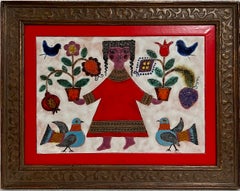
Plants Enamel Glazed Ceramic Plaque Israeli Artist Awret Naive Folk Art
By Irene Awret
Located in Surfside, FL
This is a rare ceramic plaque painted with enamel glaze by famed Israeli German artist Irene Awret (these are generally hand signed Awret Safed on the verso. I just have not opened the frame to check) the actual glazed ceramic is 10.25 X 14.75 inches.
It depicts a girl or woman with potted plants, birds, pomegranates and other fruits and flowers in a naif, folk art style.
Irène Awret was born to a Jewish family in Berlin called Spicker, the youngest of three children. Her mother died in 1927, when Irène was six years old. In 1937 she was forced to stop high school, due to the Nazi race laws. Because she could not continue her regular studies, her father sent her to study drawing, painting and art restoration with a Jewish painter. Among his students were a large number of German Jews who knew they would have to leave Germany within a short time and would require a profession to enable them to support themselves.
When the situation grew worse, following the Kristallnacht (the first major attack on German and Austrian Jews in November 1938), her uncle decided to move to Belgium. In 1939 the situation became even worse - her father was fired from his job and the family were forced to leave their home. As a result, Awret's father tried to send her and her sister to Belgium, with the help of smugglers. The first smuggler proved to be a double agent and they were sent back from Aachen to Berlin. Two weeks later they made a second, successful, attempt to sneak across the border.
Awret worked for a Dutch Jewish family as a maid. As she had her room and board there, she was able to save enough money to study art part-time at Brussels' Académie Royal des Beaux-Arts. A few months later Awret's father joined her and her financial situation became easier. She left her job and studied full-time, helping support herself with restoration work when it was available and by painting portraits to order.
Later, Awret found a hiding place on a farm in Waterloo with a Jewish family who were connected with the underground. In January 1943 she had to return to Brussels, living with a false identity card which stated she was a married woman with two children. Awret succeeded in renting an attic without informing the police where she was - she told her landlady that she had been forced to flee her husband because he beat her. While there, she supported herself by restoring wooden sculptures.
A Jewish informer gave her up to the Gestapo, accompanying the two Gestapo men who arrested her. Awret was able to take a bag containing food and drawing materials. She was detained in the Gestapo cellars in Brussels where she drew. Because there was nothing there to draw, she sketched her own hand (view this work). Awret was interrogated in order to reveal the hiding place of her father who was still in Brussels. The National Socialist regime was determined to persecute him, even though he had fought for Germany in World War I and been permanently disabled. They stepped up their torture and brought Awret before Hartmann, the head of the Gestapo in Brussels. When Hartmann saw her block of drawings, he asked her where she had studied art and halted the interrogation.
Awret was placed in a narrow cell and then transferred to Malines camp, which the Belgian's called Mechelen. Malines was a transit camp to Auschwitz, regularly sending 2000 people at a time. Although she arrived just before Transport No. 20, Irène Awret avoided being included. Instead she was put to work in the leather workshop, decorating broaches. While she was there, Hartmann visited the camp and spotted her: "I could have discovered where your father is hiding," he told her. When her artistic talents became known, she was transferred to the Mahlerstube (artist's workshop) where she worked producing graphics for the Germans until the end of the war. When Carol (Karel) Deutsch (whose works are now on view at Yad Vashem) was sent from Mechelen to his death with his wife, he left young Irene his paintbox. Irene also recalls seeing the great painter Felix Nussbaum and his wife being pushed into a boxcar bound for the gas, and tells of the aftermath of the famous 20th Train incident, when a young Jewish doctor armed only with a pistol and helped by two unarmed friends with a lantern ambushed one of Mechelen's Auschwitz-bound trains carrying 1,618 Jews, most of whom had fled Eastern Europe for Belgium.
Awret's job enabled her to paint and draw - mainly in pencil, but also in watercolors and oils. In the artists' workshop she met a Jewish refugee from Poland - Azriel Awret - who would later become her husband. Among the other artists in the workshop were Herbert von Ledermann-Vütemberg, a sculptor from an aristocratic family with Jewish roots, Léon Landau, and Smilowitz, who perished in the camps in the East. Irène and Azriel tried to bribe a German officer to prevent Smilowitz's deportation. Not only were they unsuccessful, but they were almost put onto the same train. Jacques Ochs was another artist with whom they became friends in the camp. Ochs, a French-born Protestant who lived in Belgium, was interned as a political prisoner. He remained in Belgium after liberation.
After the war the Awrets immigrated to Israel and made their home in Safed. They continued to work, and were instrumental in founding Safed's artists' quarter.
The Beit Lohamei Haghetaot (Ghetto Fighters' House Museum) art collection holds works donated by Awret. These date from her time in Malines camp and from her stay in Brussels after the war, when she was in the company of orphans who had hidden while their parents were sent to Auschwitz. Her highly expressive works have made their way to exhibitions at theTel Aviv Museum, the Haifa Museum of Modern Art and the Modern Art Gallery in Washington, D.C., as well as into the private collections of such individuals as Dr. Jonas Salk...
Category
1950s Expressionist Figurative Paintings
Materials
Enamel
Wonderland small scale seated woman with large bouquet soft green colors
By Stephen Basso
Located in Brooklyn, NY
ABOUT Stephen Basso
Stephen Basso's highly original pastels and oil paintings are romantic, yet thought provoking fantasies. His whimsical works are alive with boundless imaginat...
Category
2010s Expressionist Interior Paintings
Materials
Canvas, Oil
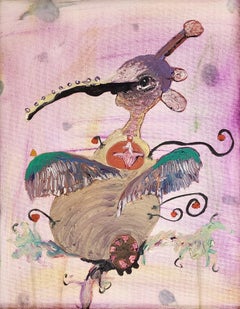
Wee One 15 (Hummingbird, Portrait, Storytelling, Oil Painting)
By Joseph Broghammer
Located in Kansas City, MO
Joseph Broghammer
Wee One 15 (Hummingbird, Portrait, Storytelling, Oil Painting)
Oil on Canvas
Year: 2023
Size: 14x11in
Framed: 15x12x1in
Signed by hand
COA provided
Ref.: 924802-190...
Category
2010s Contemporary Figurative Paintings
Materials
Canvas, Oil
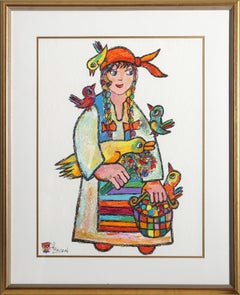
Woman with Birds, Folk Art Acrylic Painting on paper by Jovan Obican
By Jovan Obican
Located in Long Island City, NY
Jovan Obican, French/Yugoslavian (1918 - 1986) - Woman with Birds, Medium: Acrylic on paper, signed lower left, Size: 27 x 21 in. (68.58 x 53.34 cm), Frame Size: 36.5 x 30.5 inches
Category
Mid-20th Century Folk Art Figurative Paintings
Materials
Acrylic
More Ways To Browse
Mexican Art Oil Painting
Early Folk Art Paintings
Girl Folk Art
Mexican Folk Art Painting
Mexican Girl
Mexican Tapestry
Mexican Girl Painting
San Luis Potosi
Leyendecker Oil Painting
Peter Max Acrylic
The Birth Of Venus Painting
Alexander Litvinov
Fabric Artwork
Grand Masters
Oil Painting Bather
Oil Paintings Dutch Master
Renaissance Painting Frame
Turkish Artist