Items Similar to Organ Grinder with Parrot Modern Judaica Oil Painting WPA Jewish artist
Want more images or videos?
Request additional images or videos from the seller
1 of 6
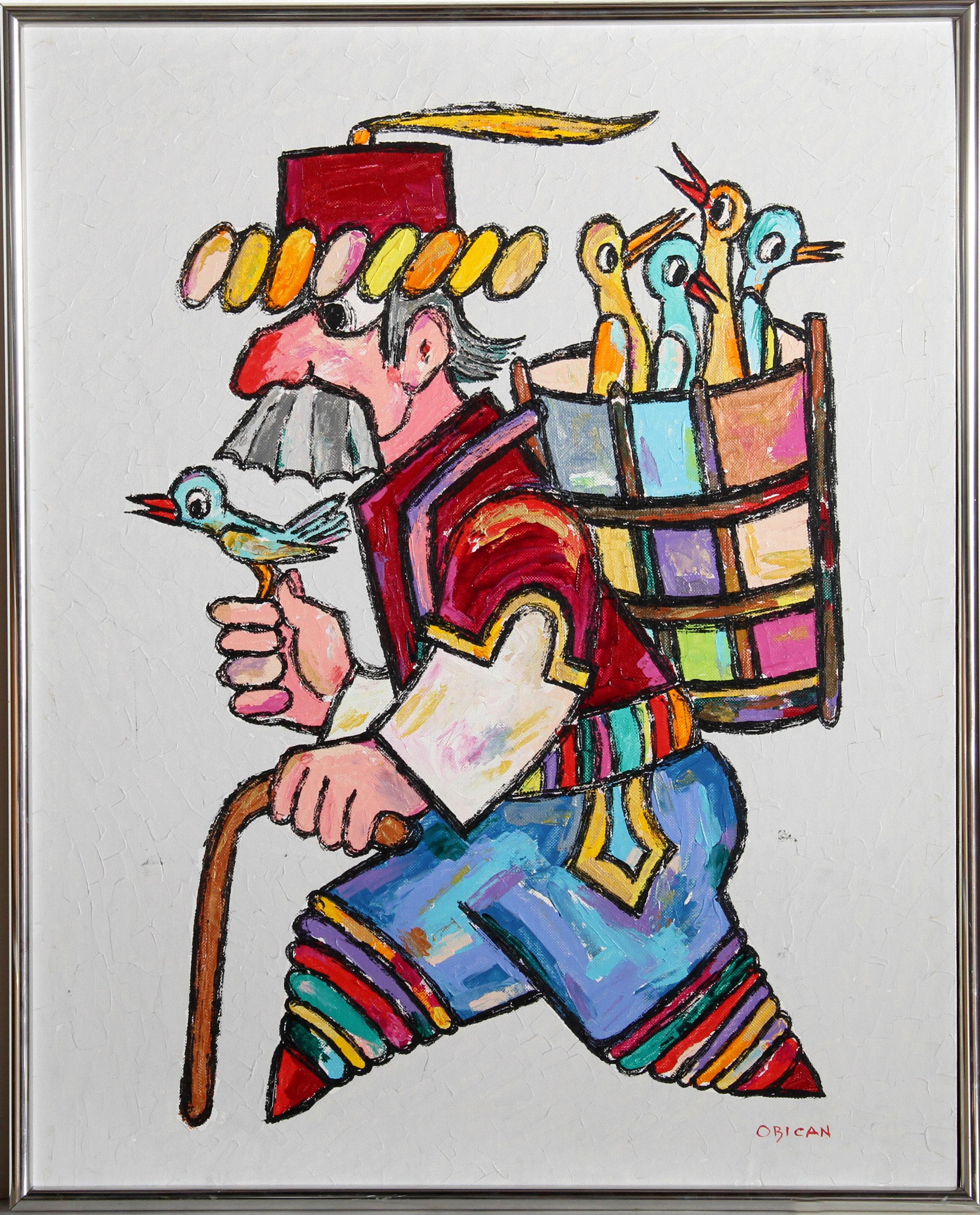
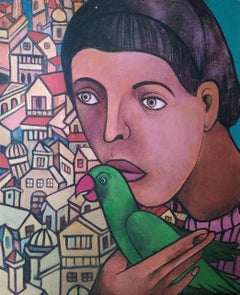
Maurice KishOrgan Grinder with Parrot Modern Judaica Oil Painting WPA Jewish artist
$3,000
£2,272.22
€2,609.57
CA$4,203.98
A$4,570.58
CHF 2,423.32
MX$54,789.61
NOK 30,799.21
SEK 28,216.26
DKK 19,503.22
About the Item
Genre: Modern
Subject: Organ grinder with parrot
Medium: Oil
Surface: Board, size includes artist decorated frame
Country: United States
The imagery of Maurice Kish (1895-1987), whether factories or carousels, reliably subverts expectations. His vision hovers just around the unraveling edge of things, where what is solid and clear becomes ambiguous. He is fascinated, often delighted, by the falling apart. This unexpected, fresh perspective results in oddly affecting pictures of a now long-gone New York.
Born Moishe in a town called Dvinsk, Russia (what is now Daugavpils, Latvia), Kish came with his family to New York when he was in his teens. The family settled in Brownsville, and for the rest of Kish’s life Brooklyn remained his home, though he moved from one neighborhood to another. He was close to his parents, who recognized his talent and supported his desire to become an artist.
Kish attended the National Academy of Design as well as Cooper Union. His fellow students included many other immigrants and children of immigrants who were particularly receptive to the Modernism coming from Europe. As his career progressed, Kish himself applied different strains of Modernism to different purposes. For him, the story was held above all else.
For years, Kish used the skills he acquired in art school to earn his living at a Manhattan glass factory where he painted floral designs on vases. During the Depression, Kish became a WPA painter in the Federal Art Project (FAP). FAP artists were given a mandate to create works that celebrated labor. The artists tended to be socially progressive, as Kish certainly was. Kish's work from this period, with its dark colors and rolling clouds, reveals the influence of Social Realists like Thomas Hart Benton. Apparent, too, is Kish's interest in the urban monumentality of Charles Sheeler. Kish's structures, however, lack Sheeler's almost dehumanized precision. Rather than the soulless, sleek machines of a typical modern urban dystopia, Kish's factories are shaggy old beasts as worn out as the laborers who troop through their doors. In End of Day's Toil, now at the Smithsonian, the viewer feels some affection for that rambly grandfather of a building all the tired small workers are leaving behind.
Much of Kish's work, for the FAP and elsewhere, undermines received truths in a similar way. Some early works with themes from Yiddish culture are overtly humorous: a painting of a big jolly wedding guest, looking invitingly over her shoulder; a Rabbi, a big fiddler on a small roof. Later, the humor becomes more ironic and reflective. In another work, the rather imposing organ grinder of the late 1930s looms above a child, yet his intermediary the cockatoo is bright and appealing, and offers the girl a fortune with his beak. This could read as an allegory for capitalism as easily as a straightforward colorful street scene. A small painting of a snowy day in Washington Square gives a bird's eye view of people bent against the wind walking alone or in pairs. The huge triumphal arch at the middle of it has no connection to their movements or their lives. Kish makes its size and centrality a quiet joke about the futility of grandiose gestures. Like the buildings in his FAP works, the arch has a personality. It is a landmark that looks a bit lost.
A favorite location for Kish was Coney Island. For the laborers of the city, this was a place of great freedom and possibility. There were no bosses! Anyone could go to ride the rides and swim in the sea. For Kish, Coney Island, and especially Luna Park, became a place richly symbolic of workers’ rights. For the dreamlike paintings he set there, Kish looked past the Social Realists to the Expressionists. His colors are brilliant and his lines are wild. These images, joyfully unrestrained, give full voice to an anarchic vision merely hinted at in other works. If the structures of the earlier pictures came further out of the background than expected, these Coney Island structures completely take over the scene.
Kish made several variations on the theme of the carousel as a site of revolution. In the moonlight, the horses have broken from their poles and spin away from the calm center. The workers have come to manic life, have released themselves from the yoke of labor and have abandoned their master, the merry-go-round. They escape to different corners of the pleasure park, dance together and ride the ferris wheel. One horse pretends to be a ticket seller. It is another allegory, one that depicts a worker's holiday paradise in carnival fashion.
A painter who embraced ambiguity, Kish was himself a man who occupied many worlds simultaneously. Even during the period when he had shows at prestigious galleries and belonged to several artists' groups, he identified most strongly as an outsider, a Yiddischer. He wrote poetry in Yiddish throughout his life. In 1968, he published a volume of fifty years of these poems, Di Velt ist Mayn Lid (The World is My Song) in Yiddish, with no English translation, for his peers. Kish also translated English-language poetry into Yiddish and acted as a guide to help other Yiddish writers. Long after the art organizations ceased to provide meaning and fulfillment, Kish was a devoted member of the Yiddish Culture Association.
In addition to painting and poetry, Kish was a dancer who taught during the summers at various Jewish resorts in the Catskills. Small but lithe, he also spent some years as an amateur boxer. Well into his eighties, Kish was proud of the quality of his handball game.
By the 1940s, Kish’s career was going well, but his descriptive style of working began to fall out of fashion, supplanted by a more formal Abstraction. Kish was never able to support himself solely through his art, yet in the midst of all of his other activities, Kish continued to create his distinctive images of an immigrant's New York. He departed far from the mainstream, and in later years, seldom showed his work, preferring to keep it for himself (although he sometimes traded paintings for rent).
Of making art, Kish said, "It is a sacred mission to enrich, to elevate and to make our lives more complete." His works, though frequently playful, encourage a second look at ordinary things. His irreverence elevates by revealing flaws where his audience, all workers and outsiders of a kind, can get a purchase. Kish's art fondly celebrates the beauty of the irregular.
- Creator:Maurice Kish (1895-1987, American)
- Dimensions:Height: 14.5 in (36.83 cm)Width: 9.5 in (24.13 cm)
- Medium:
- Movement Style:
- Period:
- Condition:minor wear. wear to frame. size includes frame.
- Gallery Location:Surfside, FL
- Reference Number:1stDibs: LU38212773662
About the Seller
4.9
Platinum Seller
Premium sellers with a 4.7+ rating and 24-hour response times
Established in 1995
1stDibs seller since 2014
1,855 sales on 1stDibs
Typical response time: <1 hour
- ShippingRetrieving quote...Shipping from: Surfside, FL
- Return Policy
More From This Seller
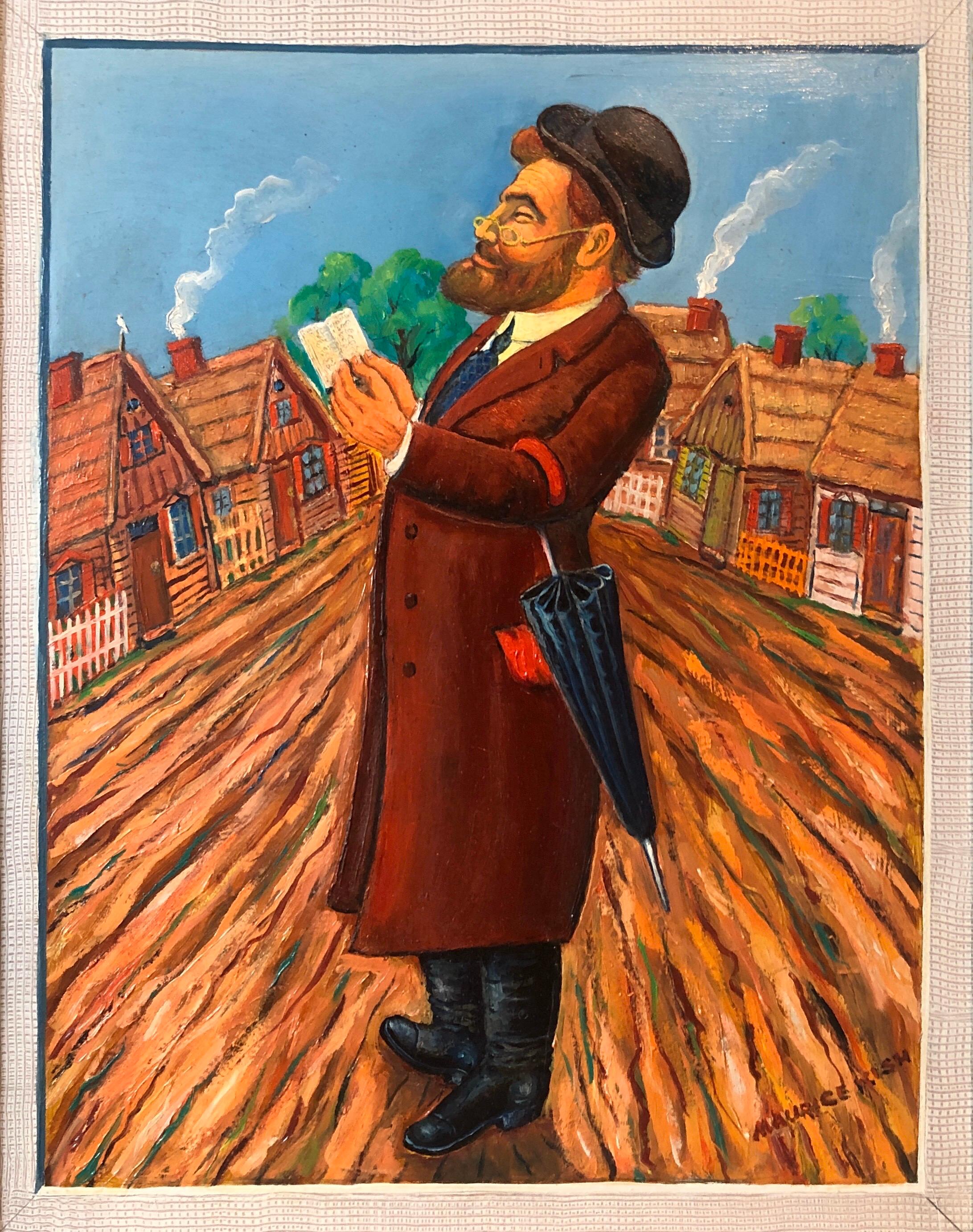
View AllWhimsical Judaica Shtetl Shadchan Matchmaker Oil Painting WPA Jewish Folk Artist
By Maurice Kish
Located in Surfside, FL
Genre: Modern
Subject: Fiddler on the roof, Shtetl matchmaker
Medium: Oil
Surface: Board, size includes artist decorated frame
Country: United States
The imagery of Maurice Kish (18...
Category
Mid-20th Century Folk Art Figurative Paintings
Materials
Oil, Board
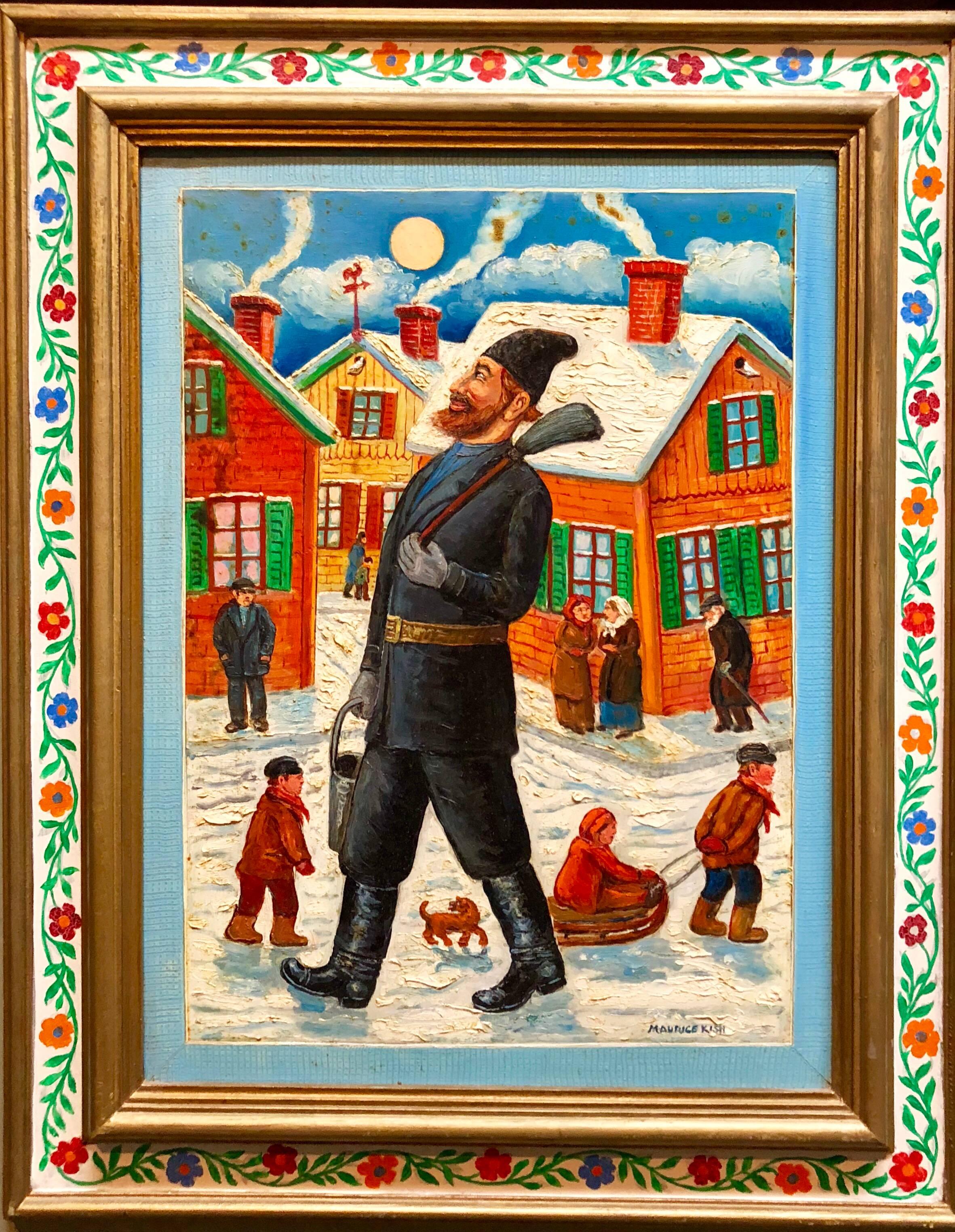
Proud Chimney Sweep Modern Judaica Shtetl Oil Painting WPA Jewish artist
By Maurice Kish
Located in Surfside, FL
Genre: Modern
Subject: Klezmer Musicians
Medium: Oil
Surface: Board, size includes artist decorated frame
Country: United States
The imagery of Maurice Kish (1895-1987), whether fa...
Category
Mid-20th Century Modern Figurative Paintings
Materials
Oil
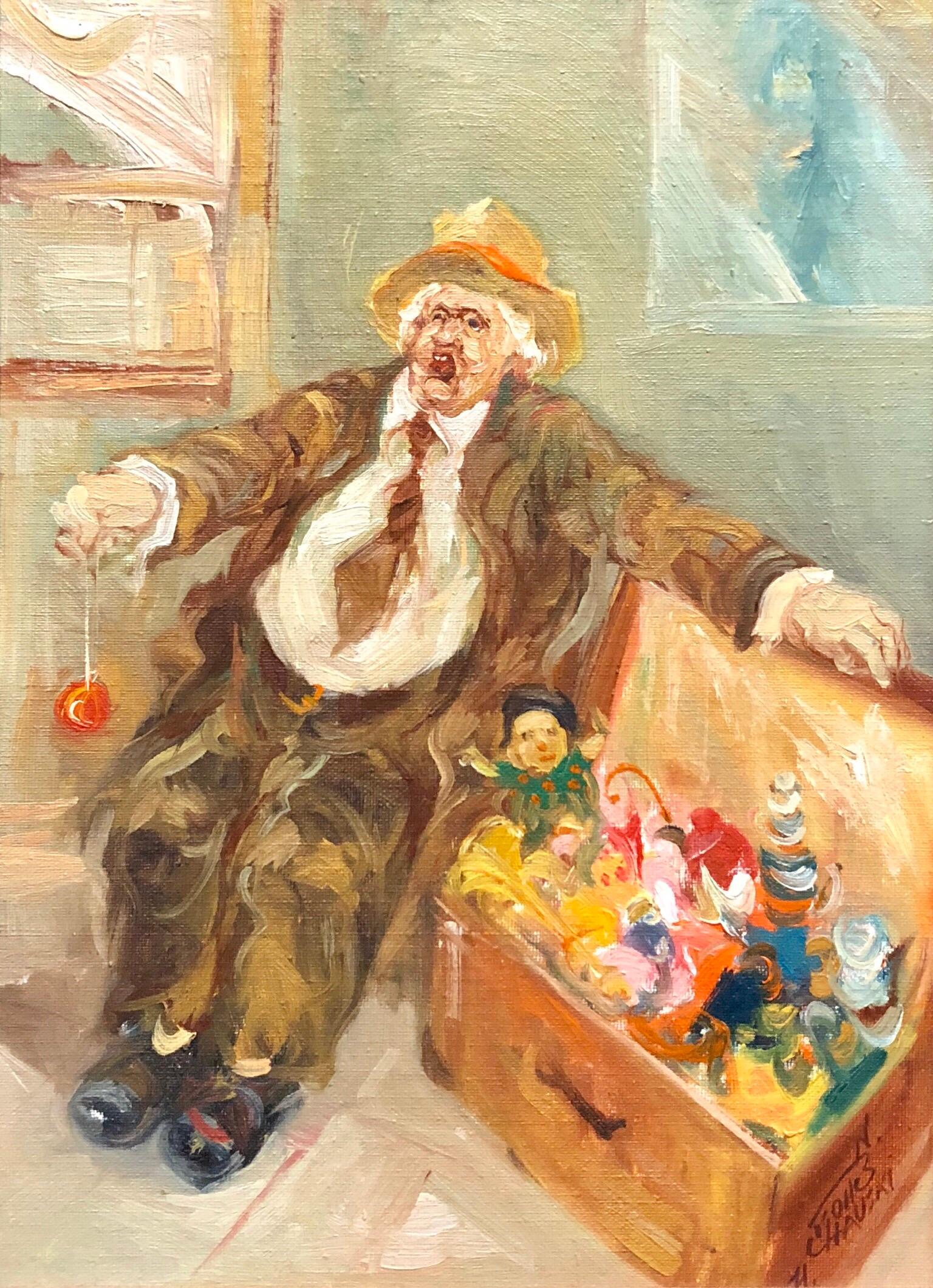
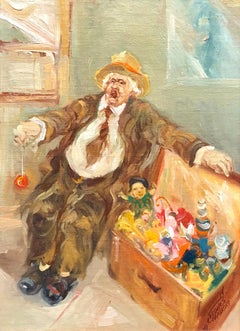
Israeli Oil Painting Modernist Impressionist Candy Man Toy Chest
By Moshe Chauski
Located in Surfside, FL
Moshe Chauski (b. 1935)
Born in Lithuania, Chauski studied at the Vilna Art Academy.
Post-graduate studies, Warsaw He received the first prize for young artists in 1953.
He immi...
Category
20th Century Impressionist Figurative Paintings
Materials
Oil, Board
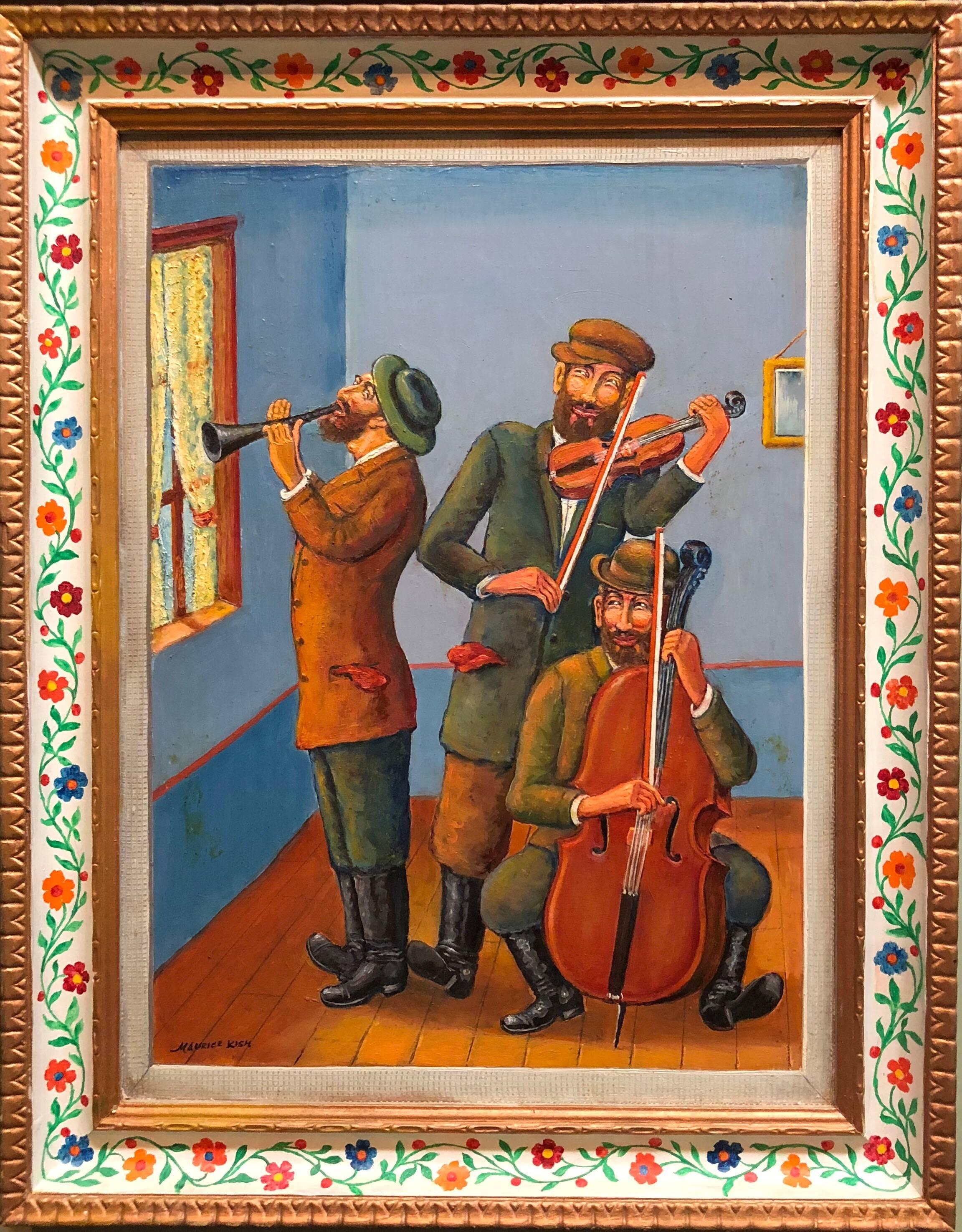
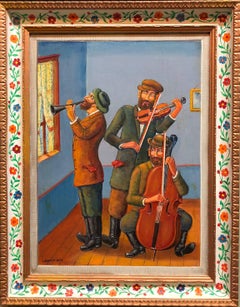
Three Klezmer Musicians Modern Judaica Shtetl Oil Painting WPA Jewish artist
By Maurice Kish
Located in Surfside, FL
Genre: Modern
Subject: Klezmer Musicians
Medium: Oil
Surface: Board, size includes artist decorated frame without frame 16X12
Country: United States
The imagery of Maurice Kish (189...
Category
Mid-20th Century Modern Figurative Paintings
Materials
Oil
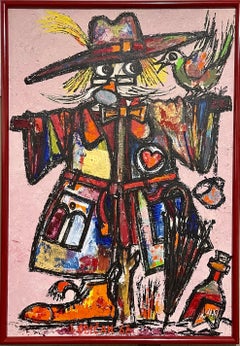
Large Naive European Folk Art Oil Painting Lazar Obican French Scarecrow Clown
Located in Surfside, FL
Lazar Obican 1944-2004
Genre: Other
Subject: People
Medium: Oil
Surface: Canvas
Dimensions: 35" x 16.5
Dimensions w/Frame: 35.5" x 17.25
An impasto composition that depicts a colorful scarecrow clown with a bird perched on his shoulder with a bottle of French Vin (wine)
Artist signature L OBICAN to bottom and dated 1968. Title to verso.
Work Size: 36 x 25 in. Framed 37.5 x 26 x 1 in
The artist Lazar Obican iconic style is child-like yet masterfully adult; a style that tells a story with sociological overtones. His funny little people are always colorful, full of spirit, living with music and birds to bring them happiness.
Lazar Obican artist, painter, sculpture and mosaic ceramic artisan was born in Cannes, France, to his Yugoslavian family. He finished his training, imbued with the spirit of his native country, the people, their legends, and their philosophy. It has been said that his work has a "timeless quality" and a naive, folk art, outsider art brut quality, child-like primitive style. Obican is identified with his style the world over, a style that is simple yet sophisticated; child-like yet masterfully adult; a style that tells a story with psychological, philosophical or sociological overtones. His funny little people are always colorful, full of spirit, living with music and birds to bring them happiness. Best known for his depictions of folklore and traditional costumes rendered in a playful, childlike style and for his happy Jewish wedding scenes. He often used bright colors and black outlines in his renderings of figures and animals, giving his work an illustration-like quality. Thematically, the artist’s work is similar to Marc Chagall and Jean Dubuffet for its dreamlike images and so-called naïve style of painting. Over the course of his career, the artist maintained a studio in Boca Raton, Florida and Dubrovnik, Croatia—part of former Yugoslavia— where he developed an interest in Eastern Europe’s Jewish culture. Many of his mature works depict Jewish traditions and ceremonies, including traditional Jewish weddings, the dancing of the Hora, and traditional music. There is a display of his works in his former Dubrovnik studio.
His style is a unique conglomerate of tradition, history, legends, heroes, old customs and folklore. It is a self-standing style, recognizable, cheerful, whimsical and a happy creation. Naïve art is any form of visual art that is created by a person who lacks the formal education and training that a professional artist undergoes (in anatomy, art history, technique, perspective, ways of seeing). Unlike folk art, naïve art does not necessarily evince a distinct cultural context or tradition. Naïve art is recognized, and often imitated, for its childlike simplicity and frankness. Paintings of this kind typically have a flat rendering style with a rudimentary expression of perspective.
One particularly influential painter of "naïve art" was Henri Rousseau (1844–1910), a French Post-Impressionist who was discovered by Pablo Picasso. Naïve art is often seen as outsider art that is by someone without formal (or little) training or degree. While this was true before the twentieth century, there are now academies for naïve art. Naïve art is now a fully recognized art genre, represented in art galleries worldwide.
Museums devoted to naïve art now exist in Kecskemét, Hungary; Riga, Latvia; Jaen, Spain; Rio de Janeiro, Brasil; Vicq France and Paris. "Primitive art" is another term often applied to art by those without formal training, but is historically more often applied to work from certain cultures that have been judged socially or technologically "primitive" by Western academia, such as Native American, sub saharan African or Pacific Island art (see Tribal art). This is distinguished from the self-conscious, "primitive" inspired movement primitivism. Another term related to (but not completely synonymous with) naïve art is folk art. There also exist the terms "naïvism" and "primitivism" which are usually applied to professional painters working in the style of naïve art (like Paul Gauguin, Mikhail Larionov, Paul Klee).
At all events, naive art can be regarded as having occupied an "official" position in the annals of twentieth-century art since - at the very latest - the publication of the Der Blaue Reiter, an almanac in 1912. Wassily Kandinsky and Franz Marc, who brought out the almanac, presented 6 reproductions of paintings by le Douanier' Rousseau (Henri Rousseau), comparing them with other pictorial examples. However, most experts agree that the year that naive art was "discovered" was 1885, when the painter Paul Signac became aware of the talents of Henri Rousseau and set about organizing exhibitions of his work in a number of prestigious galleries. The Earth Group (Grupa Zemlja) were Croatian artists, architects and intellectuals active in Zagreb from 1929 to 1935. The group included the painters Krsto Hegedušić, Edo Kovačević, Omer Mujadžić, Kamilo Ružička, Ivan Tabaković, and Oton Postružnik, the sculptors Antun Augustinčić, Frano Kršinić, and the architect Drago Ibler. A term applied to Yugoslav (Croatian) naive painters working in or around the village of Hlebine, near the Hungarian border, from about 1930. Some of the best known naive artists are Dragan Gaži, Ivan Generalić, Josip Generalić, Krsto Hegedušić, Mijo Kovačić, Ivan Lacković-Croata, Franjo Mraz, Ivan Večenaj and Mirko Virius. Camille Bombois (1883–1970) Ferdinand Cheval, known as 'le facteur Cheval' (1836–1924) Henry Darger (1892–1973) L. S. Lowry (1887–1976) Grandma Moses, Anna Mary Robertson...
Category
1960s Folk Art Figurative Paintings
Materials
Canvas, Oil
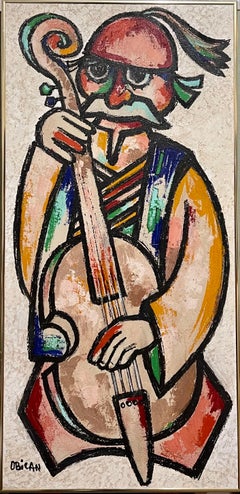
Large Naive European Folk Art Oil Painting Jovan Obican Klezmer Jazz Musician
By Jovan Obican
Located in Surfside, FL
Genre: Other
Subject: People
Medium: Oil
Surface: Canvas
Dimensions: 35" x 16.5
Dimensions w/Frame: 35.5" x 17.25
This depicts a Jazz or Klezmer musician. This one is a bass player.
The last photo shows it in a group of three that I have available. This listing is for the one painting.
The artist Jovan Obican iconic style is child-like yet masterfully adult; a style that tells a story with sociological overtones. His funny little people are always colorful, full of spirit, living with music and birds to bring them happiness.
JOVAN OBICAN
Cannes, France, b. 1918, d. 1986
Jovan Obican (1918-1986) artist, painter, sculpture and mosaic ceramic artisan was born in Cannes, France, to his Yugoslavian parents. From childhood on, Jovan practically devoted himself to art, scratching designs into the dirt when paper was unavailable. He trained with many recognized teachers and with many styles. He finished his training, imbued with the spirit of his native country, the people, their legends, and their philosophy. It has been said that his work has a "timeless quality" and a naive, folk art, outsider art brut quality, child-like primitive style. Obican is identified with his style the world over, a style that is simple yet sophisticated; child-like yet masterfully adult; a style that tells a story with psychological, philosophical or sociological overtones. His funny little people are always colorful, full of spirit, living with music and birds to bring them happiness. Best known for his depictions of folklore and traditional costumes rendered in a playful, childlike style and for his happy Jewish wedding scenes. He often used bright colors and black outlines in his renderings of figures and animals, giving his work an illustration-like quality. Thematically, the artist’s work is similar to Marc Chagall and Jean Dubuffet for its dreamlike images and so-called naïve style of painting. Over the course of his career, the artist maintained a studio in Boca Raton, Florida and Dubrovnik, Croatia—part of former Yugoslavia— where he developed an interest in Eastern Europe’s Jewish culture. Many of his mature works depict Jewish traditions and ceremonies, including traditional Jewish weddings, the dancing of the Hora, and traditional music. There is a display of his works in his former Dubrovnik studio.
His style is a unique conglomerate of tradition, history, legends, heroes, old customs and folklore. It is a self-standing style, recognizable, cheerful, whimsical and a happy creation. Naïve art is any form of visual art that is created by a person who lacks the formal education and training that a professional artist undergoes (in anatomy, art history, technique, perspective, ways of seeing). Unlike folk art, naïve art does not necessarily evince a distinct cultural context or tradition. Naïve art is recognized, and often imitated, for its childlike simplicity and frankness. Paintings of this kind typically have a flat rendering style with a rudimentary expression of perspective.
One particularly influential painter of "naïve art" was Henri Rousseau (1844–1910), a French Post-Impressionist who was discovered by Pablo Picasso. Naïve art is often seen as outsider art that is by someone without formal (or little) training or degree. While this was true before the twentieth century, there are now academies for naïve art. Naïve art is now a fully recognized art genre, represented in art galleries worldwide.
Museums devoted to naïve art now exist in Kecskemét, Hungary; Riga, Latvia; Jaen, Spain; Rio de Janeiro, Brasil; Vicq France and Paris. "Primitive art" is another term often applied to art by those without formal training, but is historically more often applied to work from certain cultures that have been judged socially or technologically "primitive" by Western academia, such as Native American, sub saharan African or Pacific Island art (see Tribal art). This is distinguished from the self-conscious, "primitive" inspired movement primitivism. Another term related to (but not completely synonymous with) naïve art is folk art. There also exist the terms "naïvism" and "primitivism" which are usually applied to professional painters working in the style of naïve art (like Paul Gauguin, Mikhail Larionov, Paul Klee).
At all events, naive art can be regarded as having occupied an "official" position in the annals of twentieth-century art since - at the very latest - the publication of the Der Blaue Reiter, an almanac in 1912. Wassily Kandinsky and Franz Marc, who brought out the almanac, presented 6 reproductions of paintings by le Douanier' Rousseau (Henri Rousseau), comparing them with other pictorial examples. However, most experts agree that the year that naive art was "discovered" was 1885, when the painter Paul Signac became aware of the talents of Henri Rousseau and set about organizing exhibitions of his work in a number of prestigious galleries. The Earth Group (Grupa Zemlja) were Croatian artists, architects and intellectuals active in Zagreb from 1929 to 1935. The group included the painters Krsto Hegedušić, Edo Kovačević, Omer Mujadžić, Kamilo Ružička, Ivan Tabaković, and Oton Postružnik, the sculptors Antun Augustinčić, Frano Kršinić, and the architect Drago Ibler. A term applied to Yugoslav (Croatian) naive painters working in or around the village of Hlebine, near the Hungarian border, from about 1930. Some of the best known naive artists are Dragan Gaži, Ivan Generalić, Josip Generalić, Krsto Hegedušić, Mijo Kovačić, Ivan Lacković-Croata, Franjo Mraz, Ivan Večenaj and Mirko Virius. Camille Bombois (1883–1970) Ferdinand Cheval, known as 'le facteur Cheval' (1836–1924) Henry Darger (1892–1973) L. S. Lowry (1887–1976) Grandma Moses, Anna Mary Robertson...
Category
20th Century Folk Art Figurative Paintings
Materials
Canvas, Oil
You May Also Like
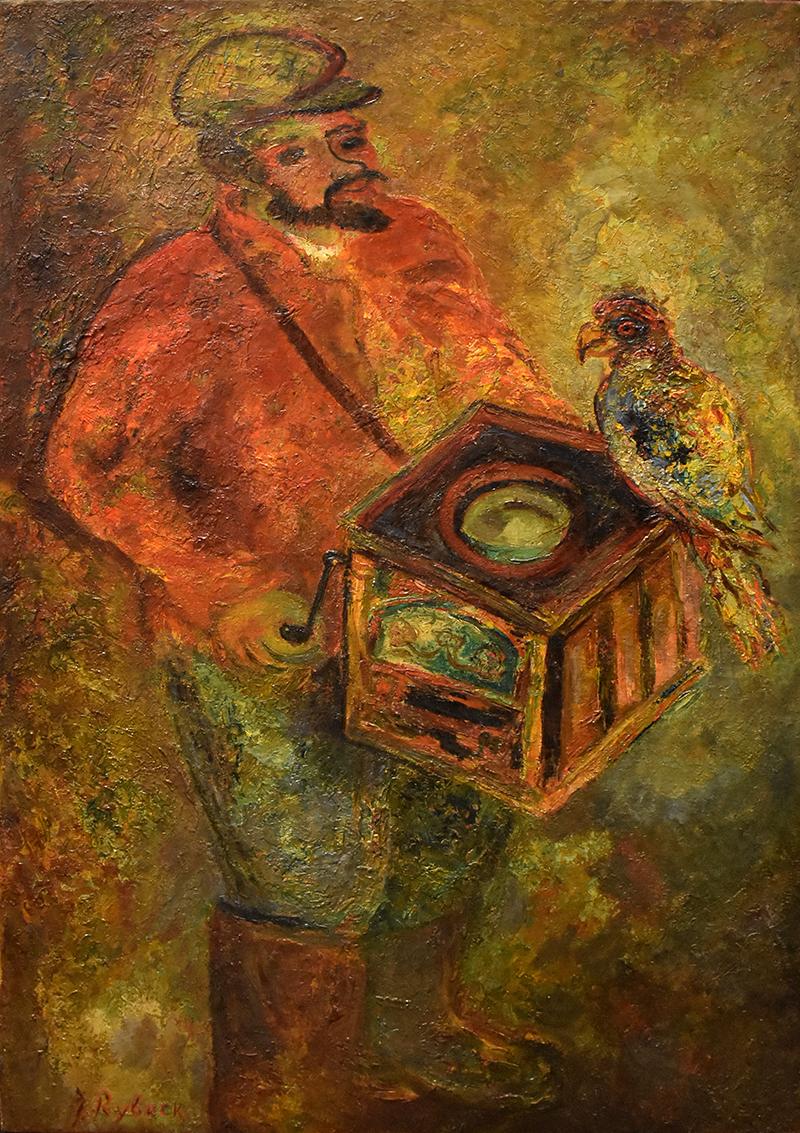
The Organ Grinder with a Parrot
By Issachar Ryback
Located in London, GB
ISSACHAR RYBACK 1897-1935
Yelizavetgrad 1897-1935 Paris (Ukrainian /Russian /French)
Title: The Organ Grinder with a Parrot, 1932
Technique: Signed Oi...
Category
1930s Figurative Paintings
Materials
Oil
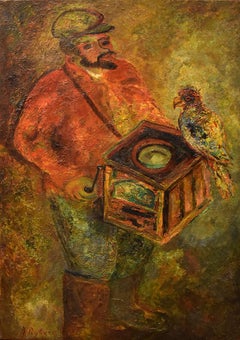
Traveler with Birds, Signed Oil on Board by Jovan Obican
By Jovan Obican
Located in Long Island City, NY
Traveler with Birds
Jovan Obican
French/Yugoslavian (1918–1986)
Date: circa 1980
Oil on board, signed
Size: 29.5 x 23.5 in. (74.93 x 59.69 cm)
Frame Size: 31 x 25 inches
Category
1980s Folk Art Paintings
Materials
Oil
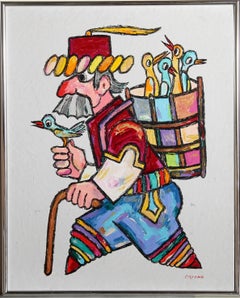
Roy Ray (1936-1921) - 1971 Oil, The Penzance Organ Grinder
Located in Corsham, GB
A charming oil portrait featuring a richly detailed figure set against a warm, rustic background. The artist's expressive brushwork and earthy palette bring depth and character to th...
Category
Mid-20th Century Portrait Paintings
Materials
Oil
$253 Sale Price
20% Off
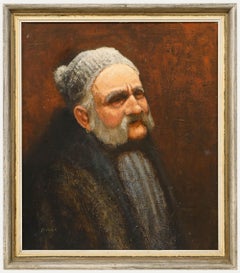
Man with Flower and Bird, Signed Oil on Board by Jovan Obican
By Jovan Obican
Located in Long Island City, NY
Man with Flower and Bird
Jovan Obican
French/Yugoslavian (1918–1986)
Date: circa 1980
Oil on board
Size: 28 x 22 in. (71.12 x 55.88 cm)
Frame Size: 30 x 24 inches
Category
1980s Folk Art Paintings
Materials
Oil

Man with Yellow Bird, Signed Oil on Board by Jovan Obican
By Jovan Obican
Located in Long Island City, NY
Man with Yellow Bird
Jovan Obican
French/Yugoslavian (1918–1986)
Oil on Board, signed l.l.
Size: 29.5 x 23.5 in. (74.93 x 59.69 cm)
Frame Size: 32 x 25.5 inches
Category
1980s Folk Art Paintings
Materials
Oil
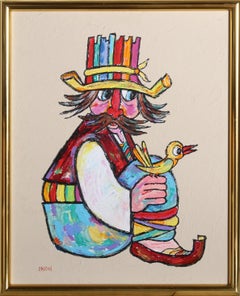
Child Playing with Parrot, Oil and Acrylic on Canvas Board, Contemporary Artist
Located in Kolkata, West Bengal
Gurucharan Singh - Untitled
Oil and Acrylic on Canvas Board ; 11.8 x 14.5 inches
Born
1949
Exhibitions :
Selected Solo Exhibitions
2012 'Twilight Tales', The Viewing Room, Mumb...
Category
2010s Contemporary Figurative Paintings
Materials
Acrylic, Canvas, Oil, Board
More Ways To Browse
Paintings Of Old Man And The Sea
Midcentury European Street Scene Painting
Coney Island Vintage
End Of The Day Vase
Monumental Old Masters Oil Paintings
Jewish Mid Century Art
Vintage Cockatoo
Ferris Wheel
Vintage Merry Go Round
Handball Vintage
Organ Grinder
Fiddler On The Roof
Vintage Manhattan Glass
M Stewart
Monique Van
Paintings Of Musicians
Realism Painting Mid Century
Red Dress Painting