Items Similar to The Clumber Maestris: A Pair of Bacchantes
Want more images or videos?
Request additional images or videos from the seller
1 of 12
Michelangelo MaestriThe Clumber Maestris: A Pair of Bacchantesc.1790
c.1790
$30,029.23
£22,000
€25,882.19
CA$41,814.20
A$44,933.75
CHF 24,109.56
MX$529,292.14
NOK 303,151.05
SEK 276,926.52
DKK 193,433.26
About the Item
Michelangelo Maestri (c.1741-1812)
The Clumber Maestris: A Pair of Bacchantes, after frescoes from the Villa of Cicero, Pompei
c.1790
Pastel on paper
23 ½ x 17 ¼
Provenance
In the collection of Henry Pelham-Clinton, seventh Duke of Newcastle (1864-1928) at Clumber House, Nottinghamshire, by 1885;
By descent within the family, Clumber House, Nottinghamshire;
Christie’s, London, Pictures by Old Masters, 4 June 1937, lot 5 (as J. E. Liotard, Two Female Models, in white drapery – a pair), where purchased for £11.11 (Christie's stencils verso);
The van Zuylen van Nijevelt van de Haar family;
Until acquired privately therefrom by Whiteman’s Fine Art, 2025.
Note
This exquisite pair of pastels by Michelangelo Maestri (c.1741-1812), as remarkable for their condition as for their provenance, depicts two full-length female figures – bacchantes, those followers of Bacchus who went about with him in song and dance. Presented poised against a black background, they move in dance, one to the left, the other to the right, their loose garments flowing about them with the rhythm of revelry.
The designs for these figures derive from two in a series of twelve frescoes uncovered in the triclinium of the so-called Villa of Cicero in Pompei on the 18th of January 1749 [1] and correspond to those now in the Museo Archelogico Nazionale di Napoli (inv. 9297). Writing about these figures in 1762, Johann Joachim Winckelmann (1717-1768) praised them for being ‘flüchtig wie ein Gedanke, und schön wie von der Hand der Gratien ausgeführet’ [2] – that is, as fluid as thought and as beautiful as if executed by the hands of the Graces. It was in this spirit of artistic wonderment that the discoveries made in Pompei and Herculaneum in the eighteenth century attracted painters, poets, sculptors, and scholars.[3] As Rosaria Ciardiello explains, it is Winckelmann who can largely be credited with the widespread popularisation and dissemination of the discoveries at these sites, none more so than the designs of the danzatrici – dancers – in the Villa of Cicero, which became a central motif in Neoclassical aesthetics in the eighteenth and nineteenth centuries.[4] Reproductions of these designs grew quickly in popularity, particularly among those on the Grand Tour, and artists such as Maestri worked to cater for this market.
In the present pair, Maestri captured the figures’ grace of form and refinement of line, splendidly reproducing the character of the Third Style of Pompeiian painting (c.15 B.C.-50 A.D.), a period distinguished by its figurative and ornamental elegance. The figures move lightly and deftly through space, their white dresses loose, ungirt, and billowing behind them. They are identifiable as bacchantes by their costume, though subtle differences in detail distinguish one from the other in point of character.[5] For instance, the dancer with cymbals wears the characteristic crown of ivy, while her counterpart wears one of cornstalks. Instead of cymbals, too, the latter holds a tray in her left hand and a basket in her right, perhaps performing the cernophorum, a dance in which participants held cups and other vessels.[6]
Collection labels and inventory tags on the verso of both frames reveal that the present pair was once part of what was one of the most significant collections of art in England, that of the dukes of Newcastle at Clumber House in Nottinghamshire. As Leonard Jacks put it, in his 1881 survey of the great houses of that county, ‘Perhaps no home of title in the whole country is so well known as Clumber […] a house which for size and situation can hold its own with any of those other palaces that are occupied by the wealthy of this land, and treasures the like of which the riches of England would not purchase.'[7] Indeed, among its paintings, the collection boasted great works by Titian, Van Dyck, and Andrea del Sarto. Accordingly, Jacks went on to say, ‘Among the pleasure-houses of England, very few can rival Clumber in pictorial and sculptural wealth.'[8]
It is unknown how or when the present pair came to be at Clumber. But it is possible that Henry Pelham-Clinton, fourth Duke of Newcastle (1785-1851), a contemporary of Maestri’s, purchased them while abroad between 1803-1806. This theory is, however, called somewhat into question given the Duke’s detainment at Tours for the majority of this period as a result of the collapse of the Peace of Amiens and the resumption of hostilities between Britain and France. Nevertheless, based on surviving inventories of Clumber House, the pair was certainly in the Newcastle collection by 1885. Furthermore, it is likely they hung in the Lincoln Sitting Room, forming part of a large group of pastels, all depicting similar female figures.[9] This suggestion is strengthened by descriptions of the other pictures in this room. Aside from an engraving of Charles I and a portrait of a soldier, the Lincoln Sitting Room was comprised of a pair of pastels of cupids, seven drawings of ancient buildings and landscapes, four mythological scenes, and one Roman scene.[10] This points to a broad thematic unity in the decoration of this room with most of the pictures depicting Classical subjects. In light of this, one can begin to imagine a room in which the grace and elegance of decoration found in a Pompeiian villa had been transposed into the setting of a nineteenth-century English stately home.
After the death of the seventh Duke of Newcastle in 1928, the house was closed. To cover debts, its contents were sold at various auctions in 1937, and the house was subsequently demolished the following year. The present pair was attributed erroneously to the eighteenth-century pastellist, Jean-Étienne Liotard (1702-1789).[11] An important rediscovery by Whiteman's, the Clumber Maestris are exceptional examples of Maestri working on a relatively large scale and form an important part of his extant oeuvre.
Footnotes
[1] Ottavio Antonio Baiardi, The Antiquities of Herculaneum, trans. by Thomas Martyn and John Lettice (London: S. Leacroft, 1773), p. 77
[2] Johann Joachim Winckelmann, Sendschreiben von den herculanischen Entdeckungen (Dresden: George Conrad Walther, 1762), p. 30
[3] See, for example, Antonio Canova, Dancer, 1809-1812, marble, Bode-Museum, Berlin. Unsigned.
[4] Rosaria Ciardiello, ‘Influenza, ricezione e fortuna delle decorazioni dalla Villa di Cicerone a Pompei’, Rivista di Studi Pompeiani, 30 (2019), pp. 79-90 (p. 82)
[5] See, for example, Euripides, The Bacchae, trans. by Gilbert Murray (London: George Allen, 1906), p. 10 – ‘[…] a band of fifteen Eastern Women, the light of the sunrise streaming upon their long white robes and ivy-bound hair. They wear fawn-skins over their robes, and carry some of them trimbels, some pipes and other instruments.’
[6] Baiardi, The Antiquities of Herculaneum, p. 99
[7] Leonard Jacks, The Great Houses of Nottinghamshire and the County Families (Nottingham: W. and A. S. Bradshaw, 1881), p. 42
[8] Ibid., p. 44
[9] Nottingham, Manuscripts and Special Collections (MSS), Ne 6 1/6, ‘Inventory of the Furniture, Pictures, Plated Articles, Linen, China, Glass, Articles of Vertu, etc, contained in Clumber House…’, 1885, p. 82
[10] Ibid.
[11] Christie’s, Pictures by Old Masters: 4 June 1937, lot 5
- Creator:Michelangelo Maestri (1722, Italian)
- Creation Year:c.1790
- Dimensions:Height: 24 in (60.96 cm)Width: 15 in (38.1 cm)
- Medium:
- Period:
- Condition:
- Gallery Location:Oxford, GB
- Reference Number:1stDibs: LU2912217470212
About the Seller
New to 1stDibs
Joined in the past six months.
No Reviews Yet
Vetted Professional Seller
Every seller passes strict standards for authenticity and reliability
1stDibs seller since 2025
- ShippingRetrieving quote...Shipping from: Oxford, United Kingdom
- Return Policy
More From This Seller
View AllPortrait of Prince Charles Edward Stuart, ‘Bonnie Prince Charlie’
Located in Oxford, GB
After Maurice-Quentin de la Tour (1704-1788), Portrait of Prince Charles Edward Stuart (1720-1788), Bonnie Prince Charlie (later Jacobite 'King C...
Category
Mid-18th Century Portrait Paintings
Materials
Pastel
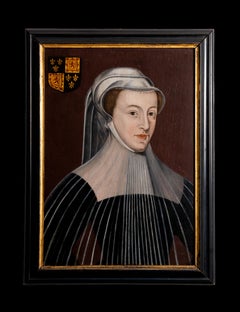
En Deuil Blanc Portrait of Mary, Queen of Scots (1542-87)
Located in Oxford, GB
English School
‘En Deuil Blanc’ Portrait of Mary, Queen of Scots (1542-87)
Oil-on-panel
14 x 10 in.
c.1600
Provenance
Christie’s, South Kensington, November, 2011;
Private collecti...
Category
16th Century Portrait Paintings
Materials
Oil
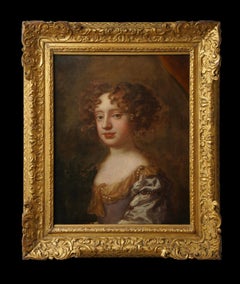
Studio of Sir Peter Lely, Portrait of Lady Anne (later Queen Anne)
By Studio of Sir Peter Lely
Located in Oxford, GB
Studio of Sir Peter Lely (1618-1680)
Portrait of Lady Anne (1665–1714), later Queen
Oil on canvas
20⅞ x 16¾ in.
c.1678
Provenance
Capt. H. A. N. Forte of Polock, West Somerset;
Chri...
Category
17th Century Old Masters Portrait Paintings
Materials
Oil
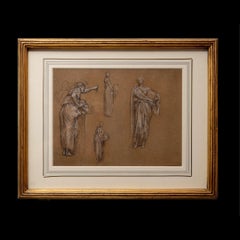
Lord Leighton (1830-1896), Studies for Captive Andromache
By Frederic Leighton
Located in Oxford, GB
Frederic Leighton, 1st Baron Leighton, P.R.A. (1830-1896)
Studies for Captive Andromache
With the artist studio stamp (Lugt 1741a) (lower left); inscribed 'Andromache' (lower right)
...
Category
1880s Figurative Drawings and Watercolors
Materials
Chalk, Charcoal
You May Also Like
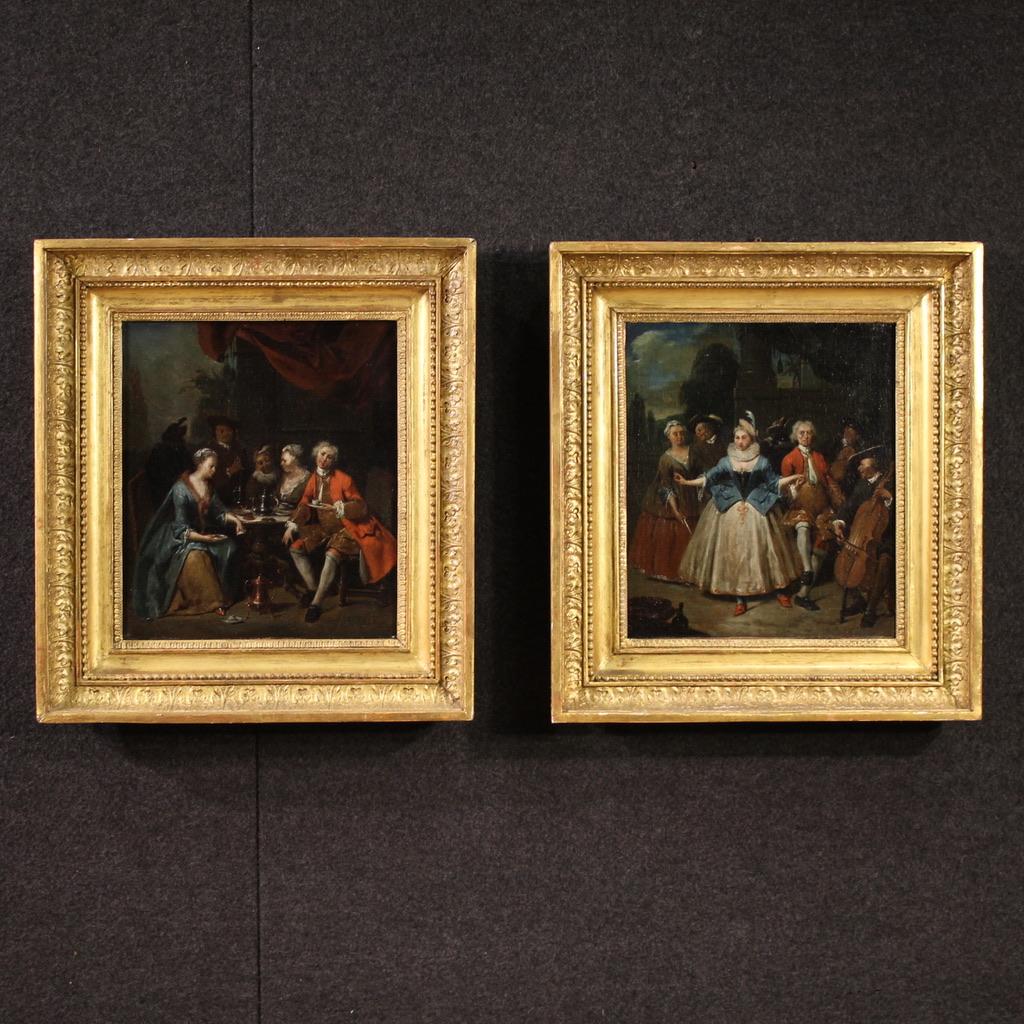
Pair of 18th Century Oil on Canvas Flemish Antique Gallant Scenes Paintings 1720
Located in Vicoforte, IT
A refined pair of antique paintings from the first half of the 18th century. Oil on canvas artworks depicting splendid romantic scenes, a banquet with gentlemen, and a dance scene du...
Category
1720s Figurative Paintings
Materials
Canvas, Oil
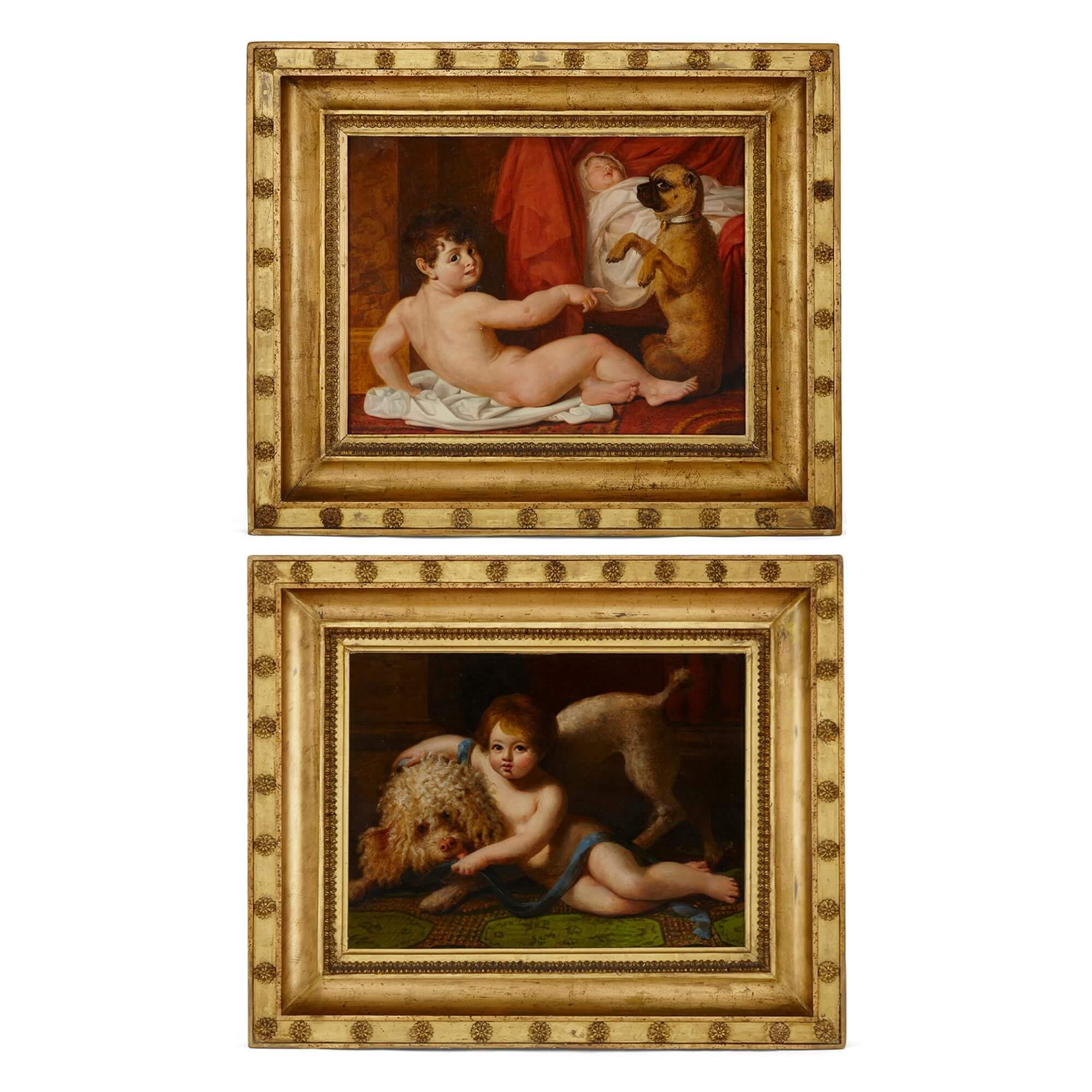
Pair of French Neoclassical oil paintings by Dubost
By Antoine Dubost
Located in London, GB
Pair of French Neoclassical oil paintings by Dubost
French, 1809/11
Frame: Height 70.5cm, width 86cm, depth 9cm
Panel: Height 45cm, width 61c...
Category
1810s Baroque Figurative Paintings
Materials
Oil, Panel
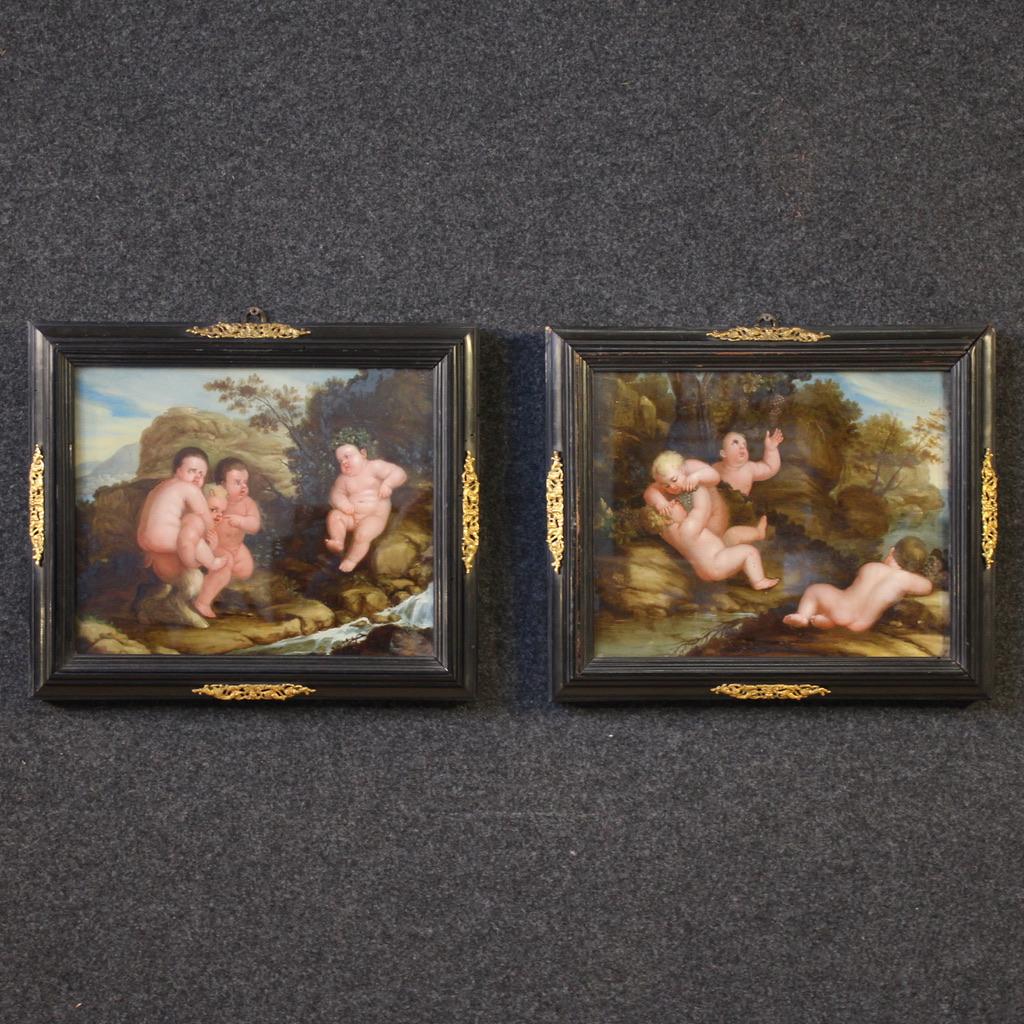
Pair of 17th Century Oil on Glass Italian Antique Paintings Bacchanal, 1680
Located in Vicoforte, IT
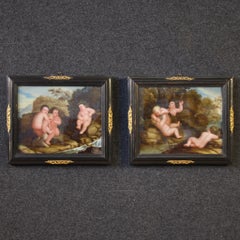
A rare pair of 17th-century Italian paintings. Oil on glass artworks depicting a mythological subject, cherubs and satyrs playing in an Arcadian landscape, of remarkable pictorial qu...
Category
1680s Figurative Paintings
Materials
Glass, Oil
Pair of Gallant Scenes - Oil on Canvas - 18th Century
Located in Roma, IT
Pair of Gallant scenes is a pair of artworks realized by the French School in 18th Century.
Oil on canvas. It Includes 2 ancient gilded frames.
Scen...
Category
18th Century French School Figurative Paintings
Materials
Canvas, Oil

Pair of 17th Century Oil on Canvas Italian Antique Paintings Sibyls, 1670s
Located in Vicoforte, IT
Rare pair of Italian paintings from the second half of the 17th century. Oil on canvas artworks depicting two splendid female figures recognizable thanks to the inscriptions at the b...
Category
1670s Figurative Paintings
Materials
Canvas, Oil
$94,709
Free Shipping
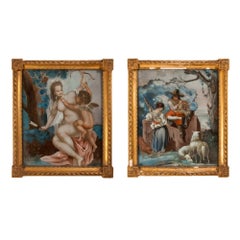
Pair of antique reverse glass paintings
Located in London, GB
Pair of antique reverse glass paintings
Continental, 18th Century
Frame: Height 46cm, width 40cm, depth 3.5cm
Glass: Height 38cm, width 32cm
T...
Category
18th Century Renaissance Figurative Paintings
Materials
Glass