Items Similar to 19th Century Neoclassical Scene - Psyche, Oil on Canvas
Want more images or videos?
Request additional images or videos from the seller
1 of 12
Otto Bache19th Century Neoclassical Scene - Psyche, Oil on Canvas1864
1864
$16,020.79
£11,934.35
€13,500
CA$22,272.52
A$24,004.18
CHF 12,834.35
MX$285,378.79
NOK 161,362.94
SEK 147,476.38
DKK 102,891.35
About the Item
In this neoclassical oil on canvas signed and dated “Otto Bache 1864”, the artist depicts Psyche standing with her back turned to the viewer beside a red draped table. Her hair is arranged in a tight knot, secured with a hairpin adorned with two large pearls. She holds a light drapery that covers her legs, while the rest of her body remains nude. With her head turned toward the right, she gazes downward toward the table, where a blue gown or drapery lies, the garment she is about to put on.
Her softly illuminated profile emerges as she turns in the light falling from the upper left, creating a striking backlight that heightens the contrast along the contours of her body. On the richly red draped table before her rest her jewellery and, to her left, a large amphora-shaped jug and a tazza bowl. The light descending from above to the left defines the composition with sharp contrasts between brightness and shadow, revealing the delicate modelling of Psyche’s form and lending the scene a quiet sense of introspection and grace.
Exhibited: Winkel
Magnussen October 1915 no. 5, ill. p. 5.
Otto Bache was born in 1839 in Roskilde, Denmark, and died in 1927 in Copenhagen.
At the age of only eleven he was admitted to the Royal Danish Academy of Fine Arts in Copenhagen where he studied drawing and painting under the supervision of artists such as Wilhelm Marstrand. His early training gave him a basis in the Danish “Golden Age” tradition of realism and naturalism, but he went on to travel and extend his horizons. In 1866 he received an Academy travel-scholarship and went to Paris, then Italy (1867–68).
The influence of Paris is often noted: his palette became richer, his handling freer, his light stronger, and his subjects broader. Later in his career, from around 1887, he held the post as professor and on various occasions director of the Royal Danish Academy.
Bache’s early work reflects his rigorous academic training: careful drawing, subdued palette and interest in genre scenes and rural life. After his travel in Paris and Italy he adopted a somewhat more robust handling of color and light, but still remained essentially realist and narrative in approach.
He painted portraits, animal and hunting subjects, genre scenes, and large history-paintings depicting key moments from Danish history.
In particular, during the 1880s and 1890s when he was commissioned to execute large history canvases for the Museum of National History at Frederiksborg Castle and similar institutions, depicting events such as the exploits of Danish soldiers or royal processions.
Bache’s works were shown on many occasions. He exhibited extensively at the Charlottenborg Spring Exhibitions in Copenhagen from the 1850s onward (from 1856 to 1923 by one account).
Internationally, he exhibited in Munich. He won various honours.
Bache’s works are represented in major Danish institutions. For example the Statens Museum for Kunst (Denmarks National Museum of Art) and Nivaagaard museum holds several of his works.
The painting of Psyche (1864) is a somewhat atypical subject for Bache, rather than his usual rural genre scene or historical tableau, here he opts for a mythological and classical subject, executed in a calm neoclassical mode: the standing nude female figure, the amphora and bowl, the drapery, the clear lighting from above left creating strong contrast. The date 1864 places the work just after his first travels and just as his career was maturing, perhaps this reflects his engagement with classical motifs or academic exercises. The depiction emphasises poised stillness, formal composition, and an allegorical sense. One might consider how this connects to his broader realism: even when engaging a mythic subject, his approach remains restrained, clear and intelligible, perhaps less dramatic than his large history pictures, but offering a window into his versatility.
The figure of Psyche, from classical mythology, has held great fascination for artists. In Greek, her name means “soul” or “breath of life”.
According to the story preserved in The Golden Ass by Apuleius (2nd century AD), Psyche was a mortal woman whose beauty so rivalled that of the goddess Aphrodite (Venus) that the goddess became jealous. Aphrodite commanded her son Eros (Cupid) to make Psyche fall in love with a monster, but instead Eros himself fell in love with her. Throughout the story she must undertake a series of nearly impossible tasks (sorting seeds, retrieving beauty from the Underworld, etc) to win back his trust and be united with him, eventually she is granted immortality and becomes the goddess of the soul.
In art, Psyche is often depicted as a delicate, beautiful young woman — sometimes with butterfly wings (an attribute linking her to the soul) and in scenes pairing her with Cupid or alone in a moment of waiting or suffering. The subject was especially popular in Neoclassical and Romantic art of the 19th century, as symbol of love, soul, transformation, trial and redemption.
In the present painting by Otto Bache, the choice of subject suggests an interest in classical form and mythic subject matter, and the quiet, posed, illuminated figure of Psyche fits well into a neoclassical idiom: poised, contemplative, and evocative of the soul’s journey.
Thus, by depicting Psyche at the moment before she clothes herself, with her jewelry laid aside, the artist invites reflection on the liminal moment, between naked vulnerability and outward appearance, between soul and body. In the broader mythic context, Psyche stands for transformation, perseverance, and the union of human and divine love.
- Creator:Otto Bache (1839 - 1927, Danish)
- Creation Year:1864
- Dimensions:Height: 59.85 in (152 cm)Width: 30.71 in (78 cm)Depth: 1.58 in (4 cm)
- Medium:
- Period:
- Condition:It is in good condition and has recently been cleaned by a professional restorer. The frame is later.
- Gallery Location:Stockholm, SE
- Reference Number:1stDibs: LU2608217160782
About the Seller
5.0
Gold Seller
Premium sellers maintaining a 4.3+ rating and 24-hour response times
1stDibs seller since 2023
34 sales on 1stDibs
Typical response time: <1 hour
- ShippingRetrieving quote...Shipping from: Stockholm, Sweden
- Return Policy
More From This Seller
View AllRussian Princess Olga Meyendorff, born Gorchakov, 19th Century Portrait
Located in Stockholm, SE
Portrait of Princess Olga Gorchakov by female 19th century artist Elise Hügel.
An oval portrait of Princess Olga Gortschakoff (1838–1926), here pictured soon after her marriage to Baron Friedrich Adeldagus Felix von Meyendorff, becoming Baroness von Meyendorff, signed Elise Hügel and dated 1858. Executed in oil on canvas, the work shows a young Olga in her early 20´s...
Category
1850s Other Art Style Portrait Paintings
Materials
Canvas, Oil
Portrait Study of a Young Woman, Oil on paper, 19th Century
Located in Stockholm, SE
This is a sensitive small-scale study portrait of a young girl, executed in warm monochrome brown tones. Painted during the second half of the 19th century, oil on paper and mounted ...
Category
19th Century Naturalistic Portrait Paintings
Materials
Paper, Oil, Cardboard
Haga Pavilion Painting, Signed Oil on Canvas, Mid-19th Century
Located in Stockholm, SE
Swedish King Gustav III´s summer castle, the Haga pavilion, by Carl Abraham Rothstén, (1826 - 1877). Oil on canvas, signed with monogram CAR. Probably painted in the third quarter of...
Category
Mid-19th Century Other Art Style Landscape Paintings
Materials
Canvas, Oil
$2,705 Sale Price
40% Off
Free Shipping
Cloud Study, 19th Century Oil on Paper, Framed, Mythological Figures
Located in Stockholm, SE
Cloud study by a rocky coastline overlooking the sea. To the right of the composition stands a large maritime marker, while in the lower left a few ship masts emerge in the distance....
Category
19th Century Other Art Style Landscape Paintings
Materials
Paper, Oil, Wood Panel
Equestrian Artist Baptista Schreiber Graphite Drawing, Circa 1915
Located in Stockholm, SE
This impressionistic and atmospheric graphite drawing by Gösta von Hennigs (1866–1941) portrays the celebrated equestrian artist Baptista Schreiber within the charged setting in a ci...
Category
1910s Impressionist Figurative Drawings and Watercolors
Materials
Paper, Graphite
Swedish Landscape, Oil Painting, 19th Century, Framed
Located in Stockholm, SE
Autumn landscape attributed to Arvid Mauritz Lindström (1849-1923)
On a path winding between trees and stones beside a lake, a woman is walking. The work is painted in a relatively f...
Category
Late 19th Century Naturalistic Landscape Paintings
Materials
Oil, Canvas
$1,578 Sale Price
30% Off
Free Shipping
You May Also Like
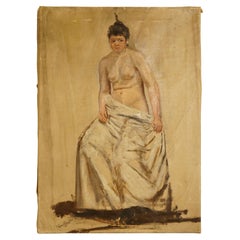
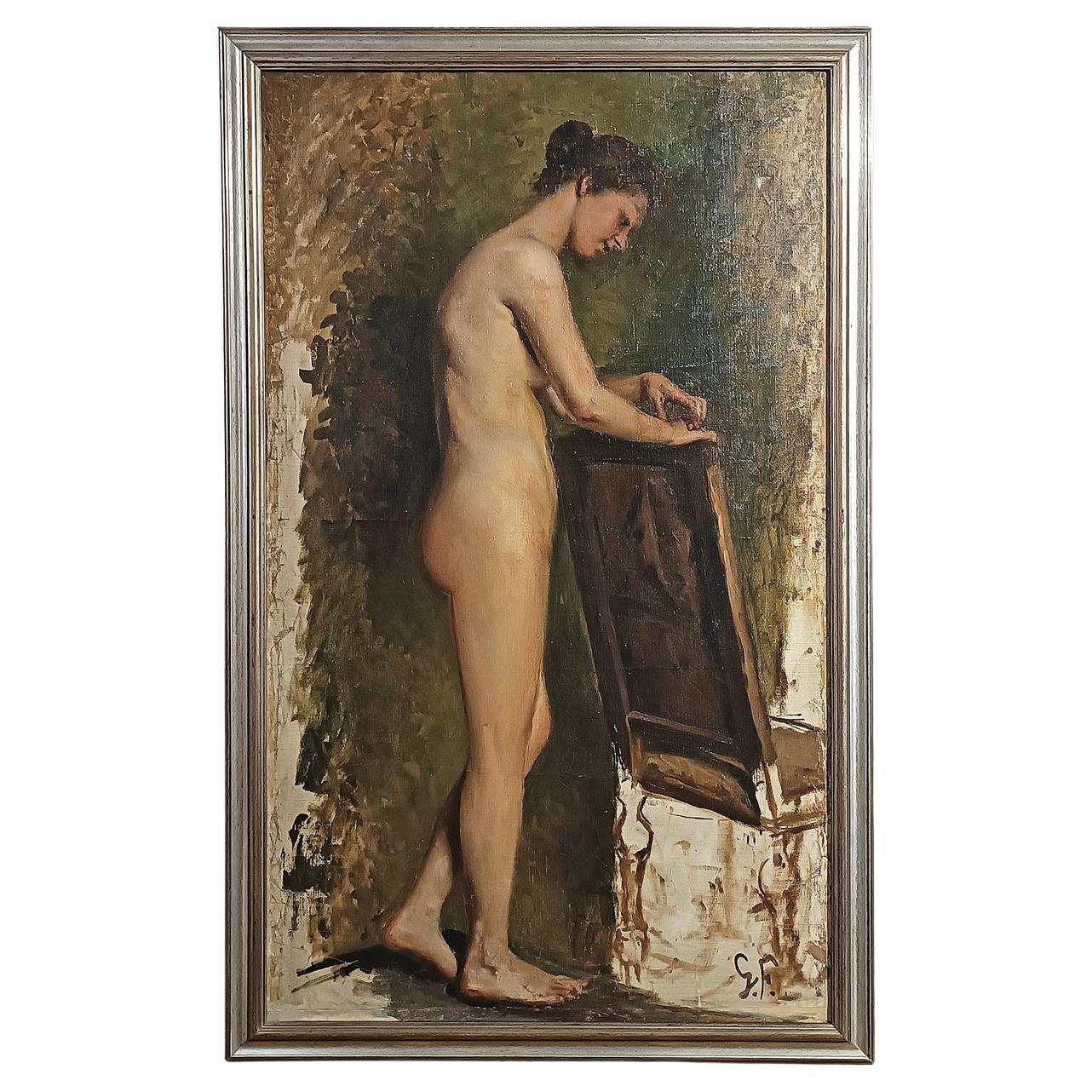
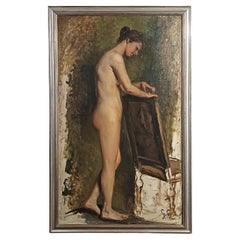
SECOND HALF OF THE 19th CENTURY PAINTING OF A FEMALE NUDE
Located in Firenze, FI
Elegant oil painting on canvas, embellished with a carved and silvered wooden frame. The painting depicts a study of a female nude, a typical drawing from the Academy of Fine Arts. T...
Category
Antique Late 19th Century Italian Paintings
Materials
Wood, Paint, Canvas
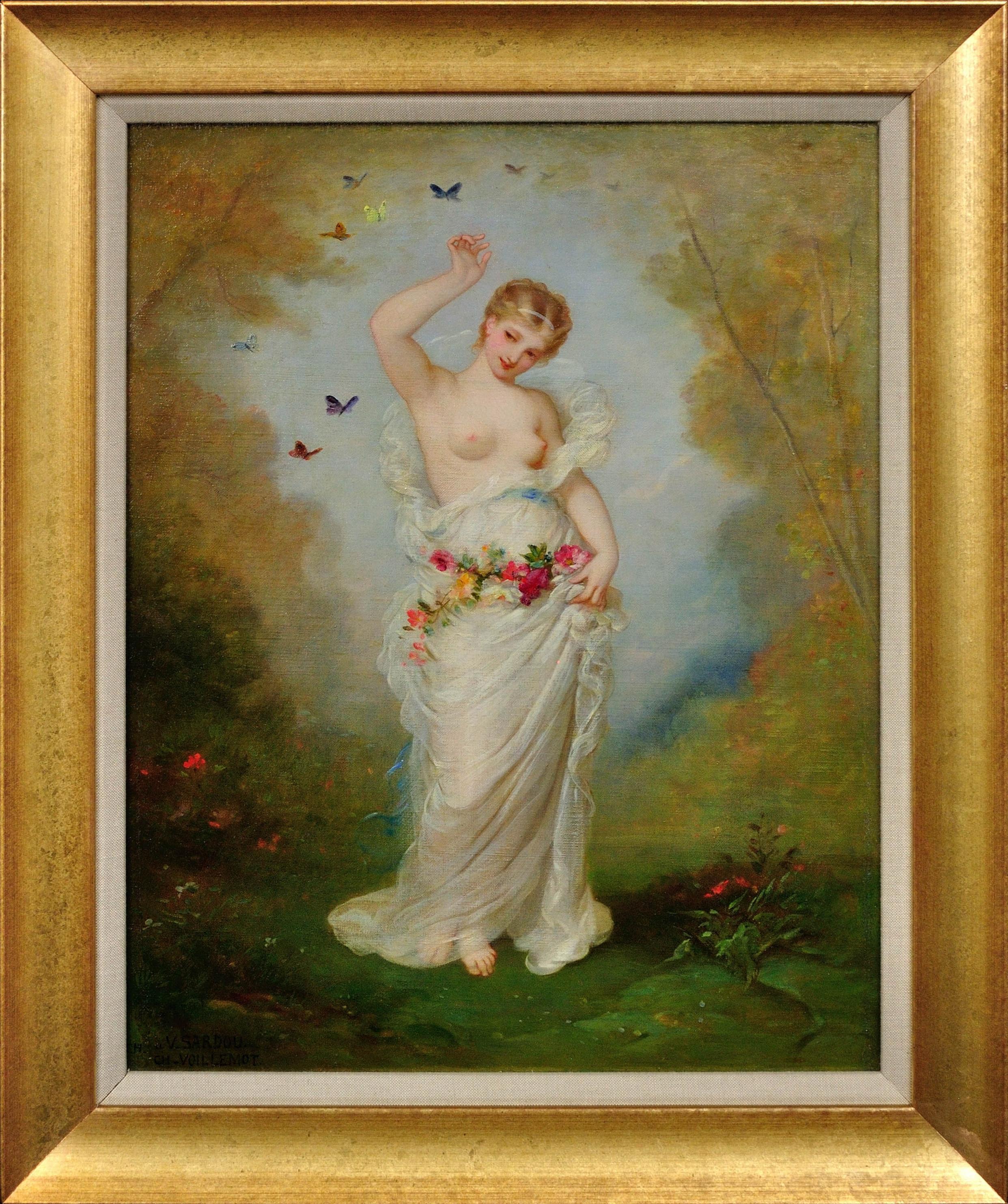
Framed 1860s French Academic Style Oil Painting Romantic
Mythological Themes
By André Charles Voillemot
Located in Sutton Poyntz, Dorset
André Charles Voillemot.
French ( b.1822 - d.1893 ).
Allegory Of Summer.
Oil On Canvas.
Signed Lower Left.
Dedication Lower Left To Victorien Sardou (1831 – 1908).
Image size 18.1 in...
Category
Mid-19th Century Academic Nude Paintings
Materials
Canvas, Oil
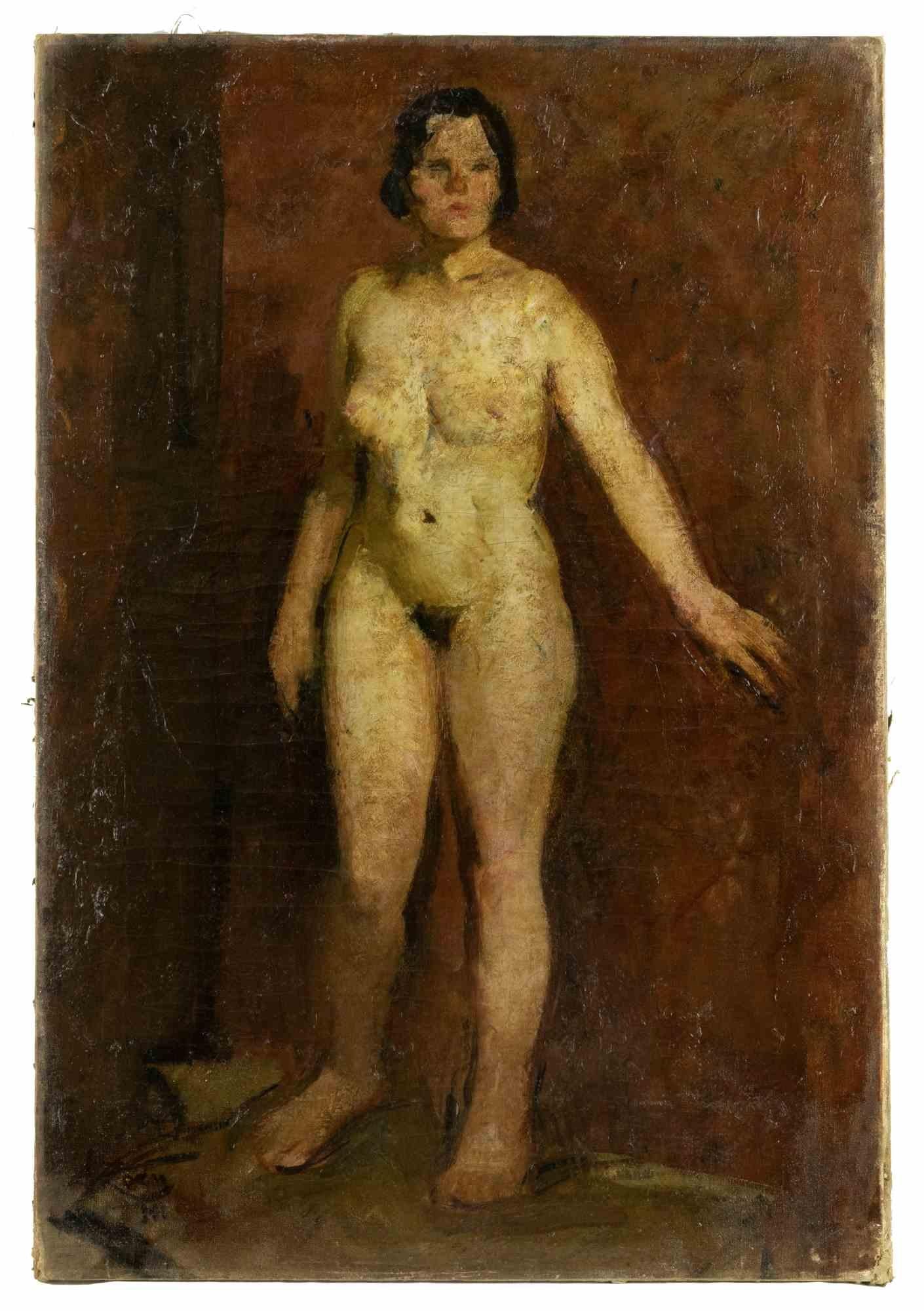
Nude Model - Oil Painting - Mid-20th Century
Located in Roma, IT
Nude Model is an original modern artwork realied by Artist of the mid-20th Century.
Mixed colored oil painting.
Signature of the artist on the lower margin.
Fair conditions due to...
Category
Mid-20th Century Contemporary Figurative Paintings
Materials
Oil
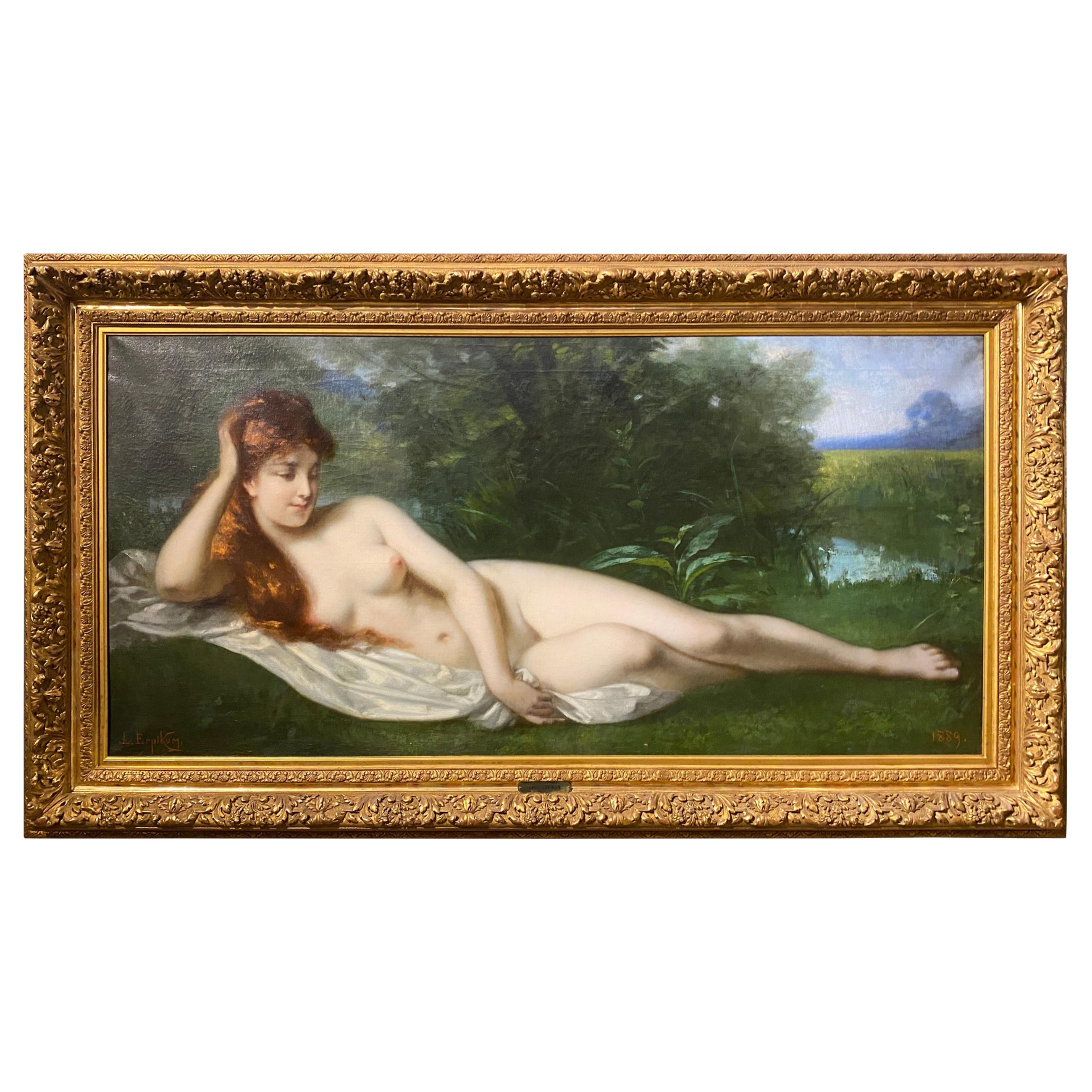
L. Erpikum, Reclining Nude in a Landscape (Venus Resting), 1889
Located in Tarzana, CA
L. Erpikum, Venus Resting by a Woodland Pool, 1889
Artist: L. Erpikum (active late 19th century)
Nationality: Likely Belgian or French regional school (the surname suggests Flemish/...
Category
Antique 19th Century Belgian Belle Époque Paintings
Materials
Canvas

Huge 1900
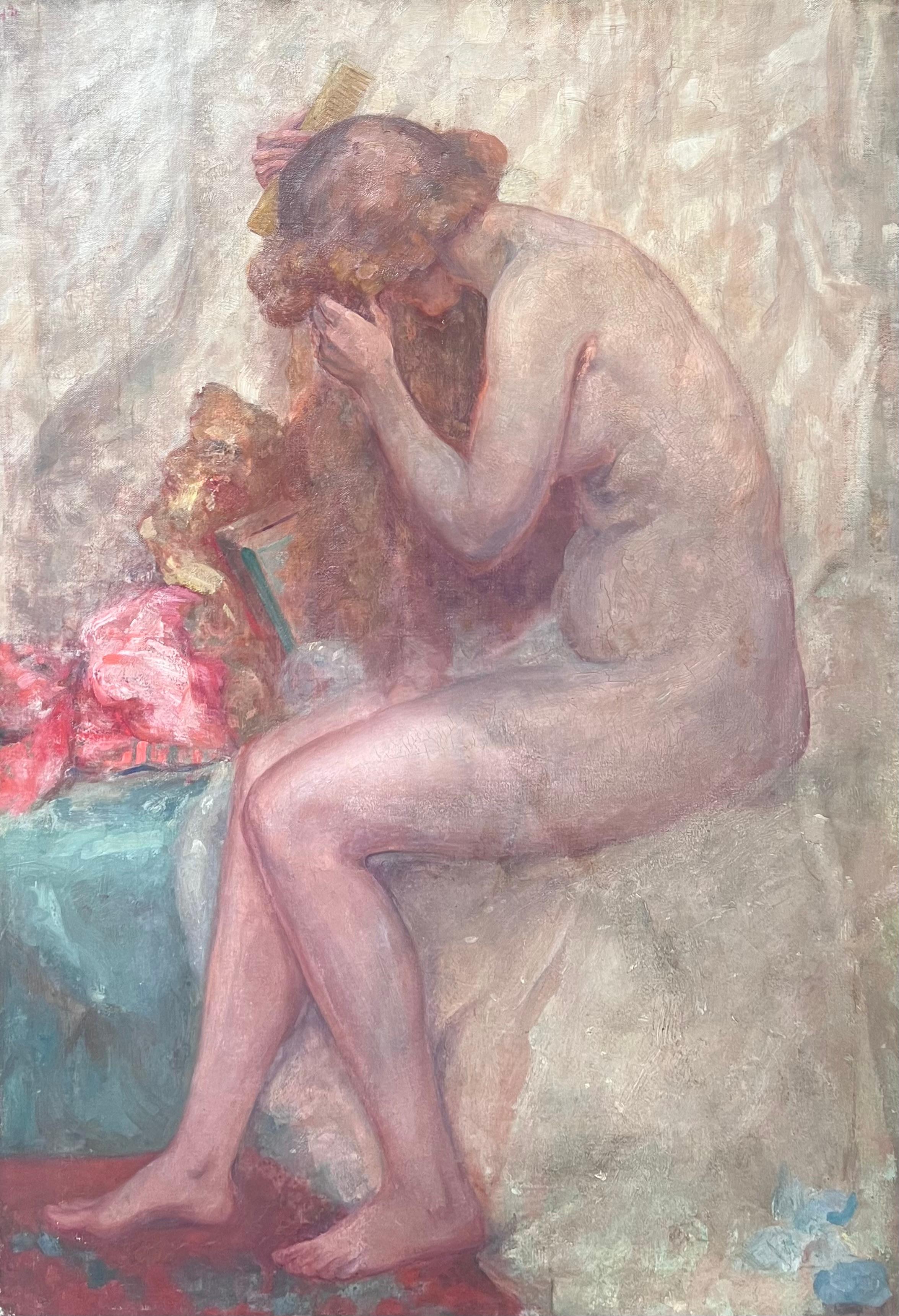
s French Impressionist Oil on Canvas Nude Model Artists Interior
Located in Cirencester, Gloucestershire
The Artists Model
French Impressionist, circa 1900's
oil on canvas, unframed
indistinctly signed with initials to the corner
canvas: 51.5 x 35.5 inches
Provenance: private collection...
Category
Early 20th Century Impressionist Portrait Paintings
Materials
Oil, Canvas
$1,588 Sale Price
20% Off
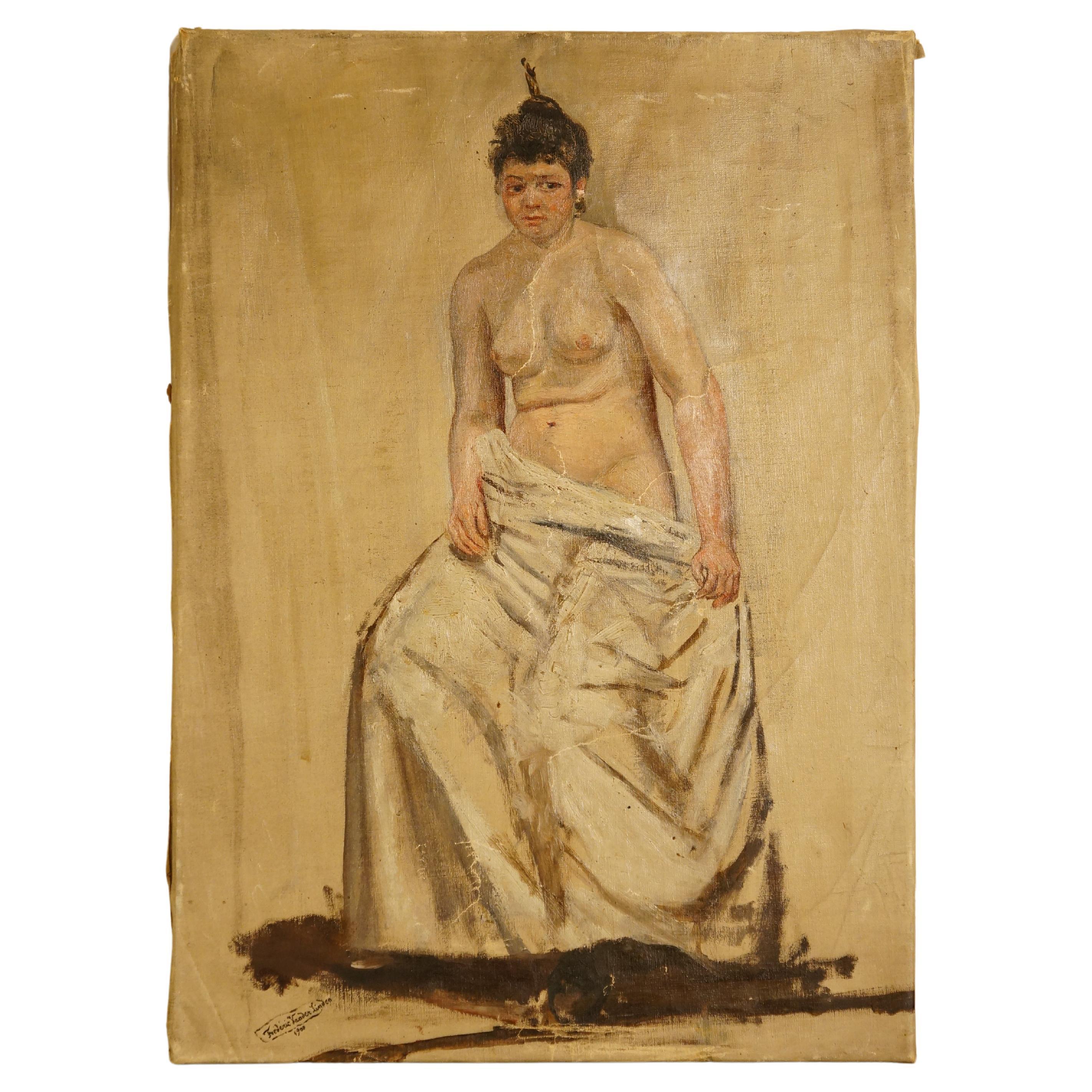
Frederic Van Der Linden Oil on Canvas
Located in Munich, DE
Frederic Van der Linden trained at the Fine Art Academy in Mons and his work tends to feel impressionistic in style. The painting is signed in the lower right. Medium: Oil on canvas ...
Category
Early 20th Century Belgian Other Paintings
Materials
Canvas, Paint