Want more images or videos?
Request additional images or videos from the seller
1 of 17
Patricia NixLarge Figurative Abstract Expressionist Queen Collage Oil Painting Patricia Nix1984
1984
Price:$10,000
$12,500List Price
About the Item
- Creator:Patricia Nix (1937, American)
- Creation Year:1984
- Dimensions:Height: 55 in (139.7 cm)Width: 37.25 in (94.62 cm)Depth: 2.5 in (6.35 cm)
- Medium:
- Movement Style:
- Period:
- Condition:good. canvas is loose in frame.
- Gallery Location:Surfside, FL
- Reference Number:1stDibs: LU38211128792
undefined
About the Seller
4.9
Platinum Seller
Premium sellers with a 4.7+ rating and 24-hour response times
Established in 1995
1stDibs seller since 2014
1,843 sales on 1stDibs
Typical response time: 1 hour
Authenticity Guarantee
In the unlikely event there’s an issue with an item’s authenticity, contact us within 1 year for a full refund. DetailsMoney-Back Guarantee
If your item is not as described, is damaged in transit, or does not arrive, contact us within 7 days for a full refund. Details24-Hour Cancellation
You have a 24-hour grace period in which to reconsider your purchase, with no questions asked.Vetted Professional Sellers
Our world-class sellers must adhere to strict standards for service and quality, maintaining the integrity of our listings.Price-Match Guarantee
If you find that a seller listed the same item for a lower price elsewhere, we’ll match it.Trusted Global Delivery
Our best-in-class carrier network provides specialized shipping options worldwide, including custom delivery.You May Also Like
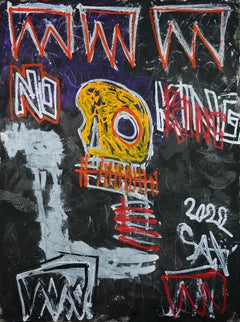
"No King: One Route". Contemporary Neo Expressionist Oil Painting
By Sax Berlin
Located in Brecon, Powys
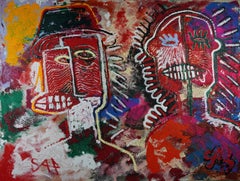
Sharp edged and sassy from Sax Berlin.
A bang on trend, urban street painting with an undercurrent of the darkness of the city.
Oil and acrylic on canvas
Category
2010s Neo-Expressionist Figurative Paintings
Materials
Canvas, Oil, Acrylic
$17,009
H 48 in W 36 in
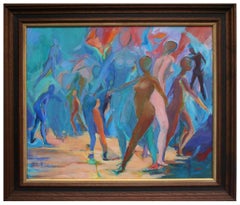
Mid-Century Modern Dancers Figurative Abstract, Bay Area Figurative School 1960s
Located in Soquel, CA
Mid-Century Modern Dancers Figurative Abstract, Bay Area Figurative School 1960s
A gorgeous and colorful mid-century modern figurative abst...
Category
1960s Neo-Expressionist Figurative Paintings
Materials
Canvas, Oil
$1,436 Sale Price
20% Off
H 25 in W 29 in D 3 in
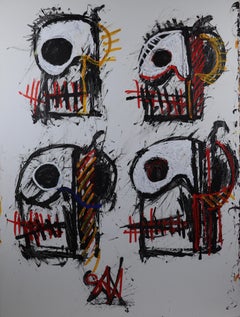
Skulls (Mortality)
By Sax Berlin
Located in Brecon, Powys
What better time than now to introduce Sax Berlin's Mortality series. Since people started creating art works there have been representations of human (and animal) bones; skeletons a...
Category
2010s Neo-Expressionist Abstract Paintings
Materials
Canvas, Oil, Acrylic
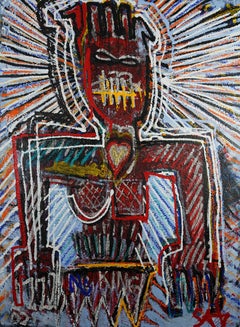
"Westside Watchdawg : The Golden Hearted". Large Neo Expressionist Oil Painting
By Sax Berlin
Located in Brecon, Powys
The New York subway network has seen dark and dangerous times over the last few decades.Now we can ride the subway thoughtlessly, the trains are clean, the stations are brightly lit ...
Category
2010s Neo-Expressionist Figurative Paintings
Materials
Canvas, Oil, Acrylic
$13,607 Sale Price
20% Off
H 48 in W 36 in
"Stop The Hatred". Contemporary Neo Expressionist Oil Painting
By Sax Berlin
Located in Brecon, Powys
This is such a pertinent piece from Sax Berlin. Nobody else painting today melds generations and genres in this way; 60's colours, 70's glam, 80's street, 90's hip- hop and 21st cen...
Category
2010s Neo-Expressionist Figurative Paintings
Materials
Canvas, Oil, Acrylic
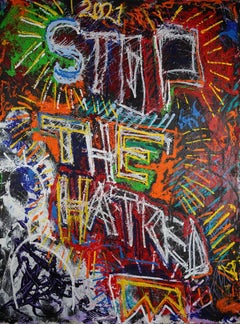
$17,009
H 48 in W 36 in
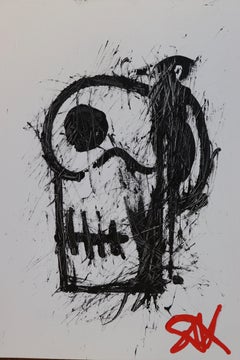
Skull. Contemporary Neo Expressionist Oil Painting
By Sax Berlin
Located in Brecon, Powys
What better time than now to introduce Sax Berlin's Mortality series. Since people started creating art works there have been representations of human (and animal) bones; skeletons a...
Category
2010s Neo-Expressionist Abstract Paintings
Materials
Canvas, Oil, Acrylic
Abstract Expressionist Seated Man Figurative
By Daniel David Fuentes
Located in Soquel, CA
Abstract Expressionist Seated Man Figurative
Evocative seated figure highlighted with dynamic brushstrokes in electric blue by San Francisco area artist Daniel David Fuentes (Americ...
Category
2010s Neo-Expressionist Figurative Paintings
Materials
Cotton Canvas, Oil, Stretcher Bars
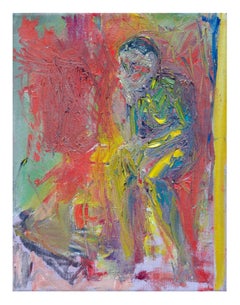
$1,480 Sale Price
20% Off
H 14 in W 11 in D 1 in
Large Scale Neo-Expressionist Figurative Composition in Oil on Canvas
By Daniel David Fuentes
Located in Soquel, CA
Large Scale Neo-Expressionist Figurative Composition in Oil on Canvas
Compelling and large scale neo-expressionist figurative painting by San Jose, California area artist Daniel Dav...
Category
1990s Neo-Expressionist Abstract Paintings
Materials
Canvas, Oil
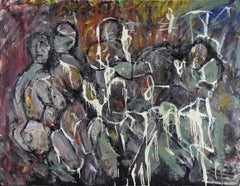
$5,200 Sale Price
20% Off
H 50 in W 65 in D 1.25 in
"Holy Trinity" Painting 90.5" x 83" inch by Vera Kochubey
By Vera Kochubey
Located in Culver City, CA
"Holy Trinity" Painting 90.5" x 83" inch by Vera Kochubey
Medium: Oils and acrylic on canvas
ATTENTION: please contact us if you want this painting to be shipped rolled to lower ...
Category
21st Century and Contemporary Neo-Expressionist Figurative Paintings
Materials
Canvas, Mixed Media, Oil, Acrylic

$5,600 Sale Price
49% Off
H 90.5 in W 83 in D 1 in
Neo Expressionism Renaissance. Volume 1
By Sax Berlin
Located in Brecon, Powys
Neo-Expressionism has a justified place in the art pantheon and is currently experiencing a revival on both sides of the Atlantic. The human condition is laid out in this piece which...
Category
2010s Neo-Expressionist Figurative Paintings
Materials
Canvas, Oil, Acrylic
More From This Seller
View AllLarge Colorful 1983 Neo Expressionist Roberto Juarez Oil Painting Tron Family
By Roberto Juarez
Located in Surfside, FL
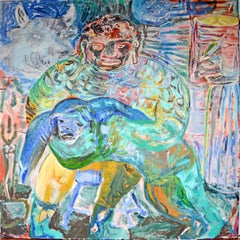
Roberto Juarez, (American, 1952- )
Tron Family.
1983. Signed, dated & titled.
Oil and oil stick on canvas.
Provenance: Robert Miller Gallery, NY., Mira Godard Gallery, Toronto, Ontario, CA
Roberto Juarez (born 1952) is an American visual artist known for his paintings, murals, and mixed-media works.
Born in Chicago, (parents of both Mexican and Puerto Rican Latino heritage) Juarez received his B.F.A. at the San Francisco Art Institute (1977) and pursued graduate studies in Television and Film at the University of California, Los Angeles. Juarez frequently employs painterly floral motifs, which are inspired by the traditions of Hispanic, Latin American and non-Western painting. Roberto Juarez has been a significant presence in the art worlds of New York, Miami, Colorado, and beyond since the early 1980s. In 1978, Juarez completed his graduate thesis for UCLA in Paris and decided not to return to L.A. Juarez relocated to New York City, where in 1981, Ellen Stewart offered Juarez a former garage owned by La MaMa Experimental Theatre Club as an artist studio. The space, which had no water or electricity, was offered to Juarez rent-free, provided that he clean and maintain it. He was active in the Neo Expressionist era of the the late 1980's along with Julian Schnabel and David Salle.
Throughout the 80s and 90s Juarez painted the branching forms of trees and flowers. While living in Miami in the 90s, Juarez began to incorporate peat moss, rice paper, and other natural materials in his canvases. Since 2000, and his move from Miami back to New York, Juarez's imagery turned more abstract, typically featuring geometric forms and systems. In a review from this period, art critic Grace Glueck noted that his works feature “a contrast between the softness of the grounds – blends of transparent and opaque materials in muted colors – and their strong geometric-organic motifs." In his use of elements of nature to portray an idyllic unity, Juarez looks back to such early-20th-century painters as Franz Marc and Henri Matisse.
He has done prints with Shark’s Ink Studios in Lyons and Anderson Ranch Arts Center as well as Tamarind Institute.
Roberto Juarez is a visual artist who has been active in the areas of painting, printmaking, drawing, and large-scale public commissions throughout his career.
His work has been exhibited throughout the United States and Mexico, and is included in major museum collections such as the Brooklyn Museum, the Metropolitan Museum of Art, El Museo del Barrio, the Denver Art Museum, the Kemper Museum of Contemporary Art, the Los Angeles County Museum of Art, Pérez Art Museum Miami, the Newark Museum, and the Speed Art Museum. He has completed public art projects and murals for the Miami International Airport, Grand Central Terminal, the Miami-Dade County Courthouse, Whitman College, and the University of Michigan College of Engineering.
Juarez won the Prix de Rome in 1997 and was a Guggenheim Fellow in 2001-2002.
Select Solo Exhibitions
Boulder Museum of Contemporary Art, Boulder, CO
La MaMa Galleria, New York, NY
Pace Prints New York, NY
Charles Cowles Gallery, New York, NY
Kemper Museum of Contemporary Art, Kansas City, KS
Museum of Contemporary Art, North Miami, FL, Bonnie Clearwater, Curator and Author
Robert Miller Gallery, New York, NY
Fredric Snitzer Gallery, Miami, FL
Galeria Ramis Barquet, Monterrey, Mexico
Richard Green Gallery, Santa Monica, CA
Stephen Wirtz Gallery, San Francisco, CA
Andre Emmerich Gallery, Zurich
Mira Godard Gallery, Toronto, Canada
San Francisco Art Institute, San Francisco, CA
Select Group Exhibitions
2018 May China 2018, China National Academy of Painting, Beijing, China
2017 Love Among the Ruins, 56 Bleecker Gallery and Late 80's New York, Howl! Arts Incorporated, New York, NY
2015 Inside the Episode: curated by Jack Pierson, Launch F18 Gallery, New York, NY
2015 MTA Arts Design Illustrates the City, The Museum of American Illustration at The Society of Illustrators, New York
2015 The Annual; National Academy Museum, New York, NY
2008 One of a Kind; Monoprints & Monotypes, Spencertown Academy Art Center, Spencertown, New York
2001 Roberto Juarez and Julio Galan...
Category
1980s Neo-Expressionist Abstract Paintings
Materials
Canvas, Oil Crayon, Oil
Large Venezuelan Expressionist Oil Painting Diego Barboza Latin American Master
Located in Surfside, FL
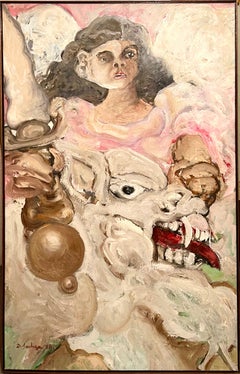
Diego Barboza - 1945-2003
Hand signed and dated 1988 Oil on Canvas
Diego Barboza was born the Carabobo street of Maracaibo, Venezuela on February 4, 1945. He was a Venezuelan Neo Figurative Painter who is among the most famous and influential figures in Venezuelan art history. Diego Barboza opened a new chapter in Latin America, beyond the surreal or the magical realism of the Modern Latin American Masters. He created a new language of dislocation and transgression. Personages became distorted to the point that was very exaggerated forms His figures twisted and contorted without losing their presence or their pull. Extremities muscles, and bones burst into an explosive compound of divergent and convergent lines. Through eruptive brushstrokes and fractured outlines. Barboza created a world of illusions.
Barboza was born into a upper-middle-class family. He stopped going to school at 12 years old, and he registered himself at the School of Visual Art in the City of Maracaibo Venezuela. Barboza studied at the School of Visual Arts in Caracas, Venezuela. Barboza began his training as an artist at age 12 in his native Maracaibo when he left formal education to enroll in the then School of Plastic Arts of Zulia, then Julio Arraga School of Plastic Arts, where he was a student in the modeling, collage and Drawing of Angelina Curiel. His first collages, in the sixties, show the influence of American Pop Art. In 1967 he exhibited at the Ateneo de Caracas his series 'Los Ratones', a proposal then 'criticized by critics as unprecedented in Venezuela'. In his tribute to the film "Nosferatu" Friedrich Murnau included 32 drawings as well as two-dimensional objects. In 1968 he moved to London where he studied at the London College of Printing. From that time is his '30 Girls with Nets', an action in which 30 students of the London College of Printing, dressed in black and covered by white nets, toured London public places, behaving naturally. His 'street expressions', which he later called 'poetic actions', symbolized a breakdown of social restraints through unusual behaviors that sought to provoke public reactions. Upon his return to Venezuela in 1973, Barboza continues with this line of work, being recognized as one of the initiators of Venezuelan conceptual art. In the 1980's Diego Barboza turned to painting, the New Venezuelan Figuration. Here belongings and the feminine figure fill the work of that time, in which he embodied his intimacy and daily life through scenes of furnishings and flowers that included objects from his workshop and home. His nudes were made from live model, then to follow the path of distortion resulting in their unmistakable females: a figure that represented their personal way of appreciating beauty. Barboza presented his first individual exhibition at the Centro de Bellas Artes of Maracaibo Venezuela. In 1963, he traveled to London when the Conceptual Art movement started, he had the support of the London New Art Lab Gallery. On March 7, 1970 Barboza displayed his first work on Conceptual Art, which he called Art of Action. In London with the performance of 30 Girls with nets (30 Muchachas con redes). His second work was Nets and Hats in markets and restaurants (Con sombreros y redes en mercados y restaurantes). In London UK. His third The Centerpiece (El Ciempies) and the fourth Expression on a laundry-mat (Expresiones en una lavandería)
In 1974. Baboza returned to Venezuela. Where he presented two very important Conceptual Art works: The Armadillo Box (La Caja del Cachicamo) and from the School of Athens to the New School of Caracas (De la Escuela de Atenas a la Nueva Escuela de Caracas). Closing his cycle of Conceptual Art creation. IN Venezuela a sort of impromptu academy started up at Claudio Perna’s house. Eugenio Espinoza, Roberto Obregón, Antonieta Sosa, Alfred Wenemoser, Yeni and Nan, Sigfredo Chacón, Diego Barboza, Luis Villamizar, Margherita D’Amico, Pedro Terán, Alfredo del Mónaco, as well as international figures who happened to be visiting Venezuela such as Antoni Muntadas, Charlotte Moorman, and Roman Polanski would gather there. Venezuela, especially Caracas, was a rich field of action for modernism in South America. Venezuelan Geometric Abstraction, Op art and Kinetic Art dominated through crucial figures like Jesús Rafael Soto, Gego, Alejandro Otero, and Carlos Cruz Diez, the country’s kinetic art made a fundamental contribution internationally. The Greater London Arts Association and the Arts Council of Great Britain did several exhibitions of (North, Central, South, London, Wales, Scotland and Ulster) to show the actual Visual Arts in all of the United Kingdom and Diego Barboza was invited for this event with a solo exhibition, expressions around a cylinder (Expresiones alrededor de un cilindro).
Diego has made numerous solo and group exhibitions, obtaining rewards since 1963. He is represented in the most important museums of Venezuela, as well as in England, Brazil, Colombia and Cuba. In 1986 he was awarded the Municipal Visual Arts Award of the Municipal Council of the Federal District and in 1997 he received the National Prize for Plastic Arts granted by the National Council of Culture, CONAC.
Select Group Exhibitions
1964 Ateneo de Caracas, Caracas, Venezuela
1965 Salón Arturo Michelena, Valencia, Venezuela
1968 Salón Oficial Museo de Bellas Artes, Caracas, Venezuela
1971 Art Spectrum London, London, Great Britain
1972 Serpentine Gallery, London, Great Britain
1973 Midland Group Gallery, London, Great Britain
1974 Galería BANAP, Caracas, Venezuela
1975 Casa de Las Américas, La Habana, Cuba
Museo de Bellas Artes, Caracas
Galería de Arte Nuevo, Buenos Aires, Argentina
1976 Museo de Arte Moderno, Bogotá, Colombia
Museo de Arte Contemporáneo, Sao Paulo, Brazil
Museo de la Tertulia, Cali, Colombia
Bienal de Venecia, Venecia, Italy
1979 Centro de Artes y Comunicación, Buenos Aires, Argentina
1980 Galería NBC, Memphis, Tennessee, USA
1981 Galería de Arte Nacional, Caracas, Venezuela
Museo de Arte Contemporáneo, Medellín, Colombia
Museo de Bellas Artes, Caracas, Venezuela
1986 Museo de Arte La Rinconada, Caracas, Venezuela
1989 Galería Venzor, Chicago, Illinois, USA
1990 Museo Bellas Artes, Santiago de Chile, Chile
1992 Ambrosino Gallery, Coral Gables, Florida, USA
1993 Museo de Arte de Petare, Caracas, Venezuela
Centro de Arte Lia Bermúdez...
Category
1980s Neo-Expressionist Figurative Paintings
Materials
Canvas, Oil
Matthias Alfen German Sculptor Modern Expressionist Painting Psychogram
By Matthias Alfen
Located in Surfside, FL
Matthias Alfen’s series of Janus figures are an innovation in figural art predicated on the advances made by the Futurist sculptor and painter Umberto Boccioni and the Modernist Alberto Giacometti. The qualities of chance and spontaneity, necessarily excluded in the sculptural work, are clearly evident in his drawings and paintings. “Psychograms” of unchoreographed hand movements display wide variation, repeatedly playing through one form after another. In the end, this multitude of variation serves to enhance the logic, consistency, and seductively rich appearance of Alfen’s designed sculptural works. Represented by Gallery Schuckin in New York, Paris, France, and Moscow, Russia.
Matthias Alfen’s was strongly influenced by his family’s experience during World War II. His grandfather Klemens Alfen (1894-1955) was an accomplished painter and photographer, recognized for his landscape photography and for his technique (Special Honors for Excellence in Photo-Print Technology, 1932). He enjoyed the friendship and support of many in the artistic community, a community largely influenced by its German Jewish members. Having lost his entire circle of friends under Nazi oppression. Klemens, although not Jewish, also suffered under the Nazis for refusing to join them and struggling in post-war Germany, which had nothing to offer an artist like him, Klemens took his own life.
At around the age of 16 he worked for some weeks as an assistant at his uncle’s art studio. Fritz Koenig...
Category
Late 20th Century Neo-Expressionist Abstract Paintings
Materials
Plywood, Oil
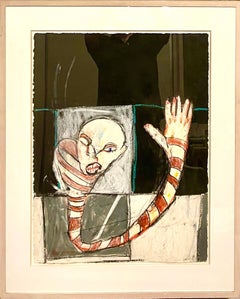
Michael Hafftka Figurative Neo Expressionist Oil Pastel Painting The Wave
By Michael Hafftka
Located in Surfside, FL
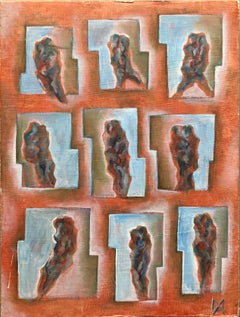
MICHAEL HAFFTKA
"The Wave"
Hand signed lower right "Hafftka"
Oil and pastel on paper, 30.5" x 22.25". Framed 39" x 31.5".
Michael Hafftka (born 1953) is an American figurative exp...
Category
1980s Neo-Expressionist Figurative Paintings
Materials
Oil Pastel, Archival Paper
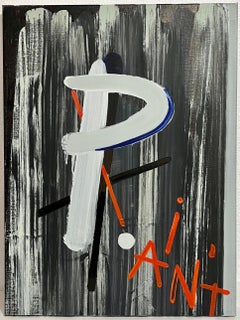
PAINT Abstract Belgian Contemporary Oil Painting Ellen De Meutter Woman Artist
Located in Surfside, FL
Ellen De Meutter
Paint 2, 2007
Acrylic, ink and oil on canvas
31.5 x 23.6 in (80.0 x 59.9 cm)
Provenance: Secrets & Lies show at her American gallery Roberts & Tilton, LA in 2007
Ellen De Meutter (1981) teaches painting at the Royal Academy of Fine Arts of Antwerp. In 2006-2007 she followed the HISK programme in Ghent, in 2013-2014 she did a residency at the Jan Van Eyck Academy in Maastricht.
De Meutter is represented by Tim Van Laere Gallery since 2006. (they represent Tal R, Marcel Dzama, Tomasz Kowalski and Franz West) Her work has been shown in various exhibitions in Belgium, the United States, Italy, Spain, the Netherlands, Germany and Japan. In 2010 she had her first solo museum exhibition in Museum Dhondt-Dhaenens.
Ellen De Meutter alters her viewer's reality by presenting a language in which she classifies the figures, shapes and colors from her personal world into a captivating utopia. Contrary to current trends in Flemish art, De Meutter is not simply relaying an anecdote; she composes unique imagery that allows her to experiment with the placement of the subject and unique treatments of her medium. De Meutter's repertoire of vivid, semi-neon colors contrast the muted grays blacks and grays on which they lay. These seemingly energetic colors are at once enhanced by the dark undertones of the canvas below, while simultaneously insinuating a concealed gravity of subject. Belgian art critic and curator, Luk Lambrecht remarks on De Meutter's painting: "she folds back 'her' world onto itself, into a solid mass of color from which, very slowly, vague contours emerge, which safeguard our expectations about looking at an image." De Meutter's scenes are reminiscent of schoolyard games, incorporating a series of text and symbols. By combing figurative imagery with basic abstraction, Ellen De Meutter creates wildly successful compositions that allude to her comprehensive understanding of contemporary painting. She was included in the show, Tomorrow is a long time: Ellen De Meutter, Gelitin, Kati Heck, Anton Henning, Friedrich Kunath...
Category
Early 2000s Contemporary Abstract Paintings
Materials
Canvas, Ink, Oil, Acrylic
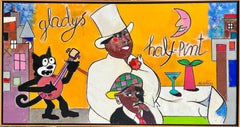
Large Richard Merkin Painting Harlem Jazz Club, New Yorker Magazine Cover Artist
By Richard Merkin
Located in Surfside, FL
Richard Marshall Merkin (American, 1938-2009)
Gladys and Half-Pint
Hand signed 'Merkin' (center right),
Titled, inscribed, dated, and initialed 'GLADYS BENTLEY AND FRANKIE 'HALF-PINT' JAXON 1997/R.M.' verso.
Oil on canvas
37 1/2 x 72 in. (95.3 x 182.9 cm)
framed 39 1/4 x 74 x 2 in.
Gladys Alberta Bentley (August 12, 1907 – January 18, 1960) was an American blues singer, pianist, and entertainer during the Harlem Renaissance. Her career skyrocketed when she appeared at Harry Hansberry's Clam House, a well-known gay speakeasy in New York in the 1920s, as a black, lesbian, cross-dressing performer. She headlined in the early 1930s at Harlem's Ubangi Club, where she was backed up by a chorus line of drag queens. She dressed in men's clothes (including a signature tailcoat and top hat), played piano, and sang her own raunchy lyrics to popular tunes of the day in a deep, growling voice while flirting with women in the audience. On the decline of the Harlem speakeasies with the repeal of Prohibition, she relocated to southern California, where she was billed as "America's Greatest Sepia Piano Player" and the "Brown Bomber of Sophisticated Songs". She was frequently harassed for wearing men's clothing. She tried to continue her musical career but did not achieve as much success as she had had in the past. Bentley was openly lesbian early in her career, but during the McCarthy Era she started wearing dresses and married, claiming to have been "cured" by taking female hormones.
Frankie "Half-Pint" Jaxon, born Frank Devera Jackson was an African American vaudeville singer, stage designer and comedian, popular in the 1920s and 1930s. He was born in Montgomery, Alabama, orphaned, and raised in Kansas City, Missouri. His nickname of "Half Pint" referred to his 5'2" height. He started in show business around 1910 as a singer in Kansas City, before travelling extensively with medicine shows in Texas, and then touring the eastern seaboard. His feminine voice and outrageous manner, often as a female impersonator, established him as a crowd favorite. By 1917 he had begun working regularly in Atlantic City, New Jersey and in Chicago, often with such performers as Bessie Smith and Ethel Waters, whose staging he helped design.
He served slightly less than a year in the United States Army in 1918–1919 and rose to the rank of sergeant. In the late 1920s he sang with top jazz bands when they passed through Chicago, working with Bennie Moten, King Oliver, Freddie Keppard and others. He performed and recorded with the pianists Cow Cow Davenport, Tampa Red and "Georgia Tom" Dorsey, recording with the latter pair under the name of The Black Hillbillies. He also recorded with the Harlem Hamfats. In the 1930s, he was often on radio in the Chicago area, and led his own band, titled Frankie "Half Pint" Jaxon and His Quarts of Joy. Jaxon appeared with Duke Ellington in a film short titled Black and Tan (1929), and with Bessie Smith in "St. Louis Blues" (1929). Cab Calloway's "Minnie the Moocher" (1931) is based both musically and lyrically on Jaxon's "Willie the Weeper" (1927).
Richard Merkin, Sometimes described as Rhode Island’s most famous New York artist, Richard Merkin has led a dual life for nearly 40 years - teaching at RISD while enjoying a celebrated painting career based in New York City. He has exhibited in countless gallery and museum shows in the US and abroad and is represented in the permanent collections of the Smithsonian Institution, The Museum of Modern Art, the Whitney Museum, the RISD museum and many others. In addition to contributing drawings and paintings to The New Yorker (along with, Art Spiegelman, Saul Steinberg, Harper’s, The New York Times Sunday Magazine and several books on Erotica and Baseball, he is a contributing editor for Vanity Fair and a former style columnist for GQ. Merkin’s honors include a Tiffany Foundation Fellowship and the Rosenthal Foundation Award from the American Academy of Arts and Letters.
Museums and Selected Collections :
The American Federation of Arts, New York, NY
Brooklyn Museum, Brooklyn, NY
Chrysler Museum of Art, Norfolk, VA
First city Bank, Chicago, Ill
Fisk University Art Gallery, Nashville, TN
Hallmark Collections, Kansas City, MO
Massachusetts Institute of Technology, Cambridge, MA
Maimi-Dade Junior College, Miami, FL
Michigan State University, East Lansing, MI
Minnesota Museum of Art, Minneapolis, MN
Museum of Modern Art, New York, NY
Museum of Art, Rhode Island School of Design, RI
McClung Museum, University of Tennessee, Knoxville, TN
Pennsylvania Acadamy of the Arts, Philadelphia PA
Prudential Insurance Company, Boston, Ma
Prudential Insurance Company, Newark, NJ
Rose Art Museum, Brandeis University, Waltham, MA
Sara Robey Foundation, New York, NY
Smithsonian Institution, Washington, DC
State University of Brockport, Brockport, NY
Whitney Museum of American Art, New York, NY
Selected Publications :
1986-Present Contributing Editor, Vanity Fair ..1988-Present, New Yorker... 1988-Present, style column, GQ...1997, Text and Illustration for The Tijuana Bibles, published by Simon & Shuster, 1995, Illustrated book, Leagues Apart: the Men and Times of the Negro Baseball Leagues published by Morrow.
1967 Cover of the Beatles “Sgt. Peppers Lonely Hearts Club Band” Album (Mr. Merkin appears in the back row, right of center)
RISD: MFA in Painting, 1963; Professor, Department of Painting
special skill: Merging his role as flaneur (connoisseur of city life) with his role as painter and social historian, Merkin retrieves lost cultural artifacts – a Turkish cigarette, a gangster, a bowler and generally “things most people don’t know about” – and reconstitutes their Jazz Age virtues on canvas in cubist, comic-laced landscapes of tropical color. (ala Robert Crumb and Ben Katchor)
breaking in: Perpetually on the fly from his middle-class Brooklyn background, Merkin found the perfect escape in the mid ‘60s in George Frazier, a dapper Boston columnist who inspired the emerging New York painter’s overnight reinvention of himself. The elements of structure, stability and surprise he admired in this well-dressed dandy – a cool linen suit, a splash of suspender, a polka dot scarf and pearl-handled walking stick – soon surfaced in paintings peopled by impeccable underdogs of café society along with his personal pop heroes: William Burroughs, Bobby Short and Krazy Kat...
Category
1990s American Modern Abstract Paintings
Materials
Canvas, Oil Pastel, Oil
Recently Viewed
View AllMore Ways To Browse
Mexican Church
Jacqueline Lamba
Sophie Taeuber Arp
Man Ray Photograph
Fat Lady Vintage
Fred Samuelson
Patricia Nix
Double Bass
Dior 1987
Oil Paintings Signed By Stuart
Rococo Oil Paintings
Native American Indian Oil Paintings
New York City Subway Light
Roma E
Nursery Rhyme
Old Man Oil Painting 19th Century
Super Hero
Iran Paintings