Items Similar to Art Nouveau Watercolour on Paper. Classical Centaur. Classical figure.
Video Loading
Want more images or videos?
Request additional images or videos from the seller
1 of 16
Paul HoggArt Nouveau Watercolour on Paper. Classical Centaur. Classical figure.1918
1918
$1,147.45
$1,434.3120% Off
£853.89
£1,067.3720% Off
€960
€1,20020% Off
CA$1,587.86
CA$1,984.8220% Off
A$1,704.41
A$2,130.5220% Off
CHF 907.51
CHF 1,134.3920% Off
MX$20,186.87
MX$25,233.5920% Off
NOK 11,468.49
NOK 14,335.6120% Off
SEK 10,473.93
SEK 13,092.4120% Off
DKK 7,315.07
DKK 9,143.8420% Off
About the Item
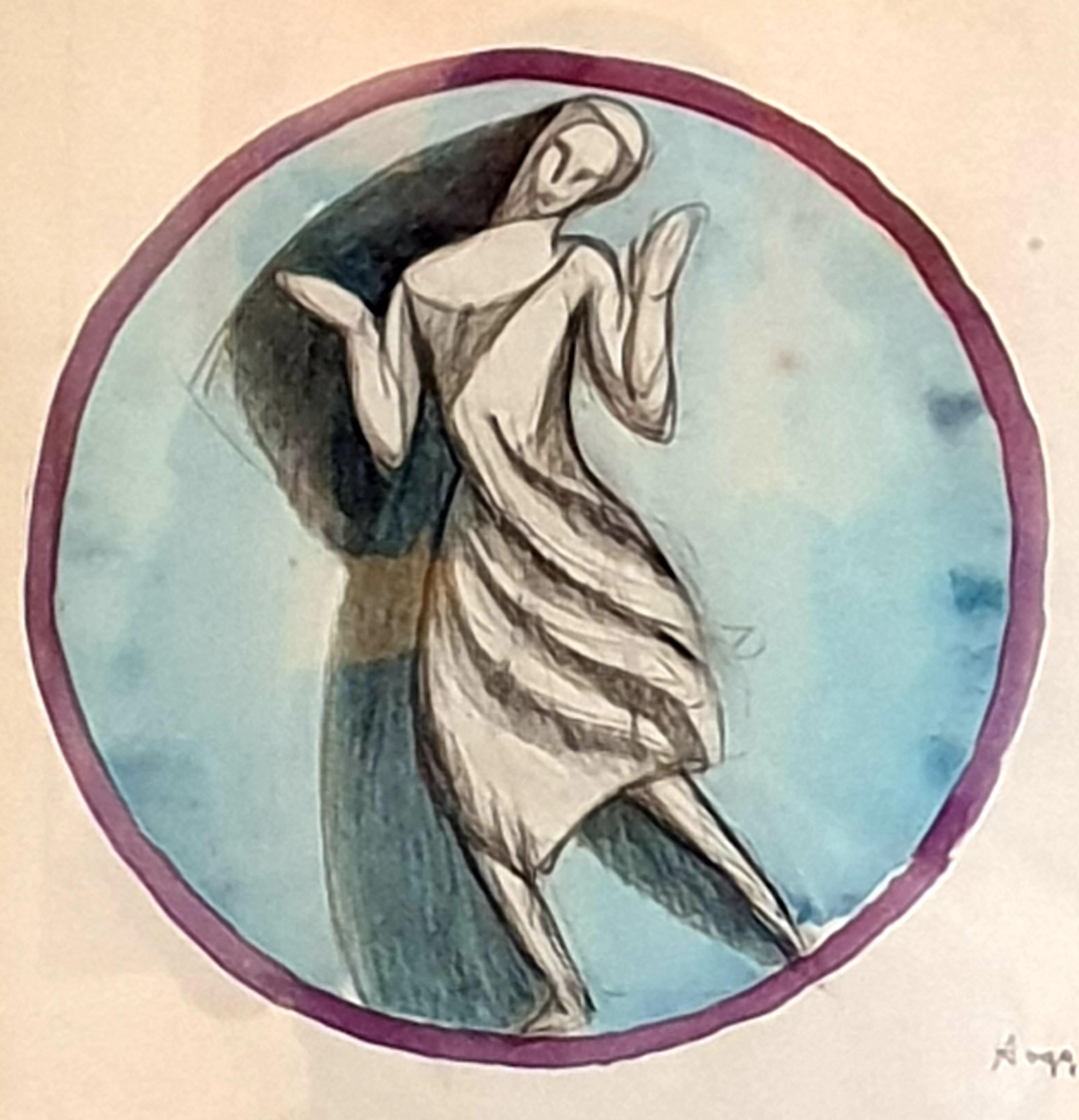
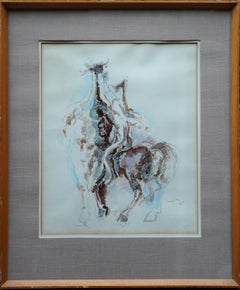
An early 20th century art nouveau watercolour of a male centaur by French artist Paul Hogg. Signed and dated 1919 to the bottom right. Presented in fine custom frame with mount.
A fresh and light representation of a classical male centaur. There is great movement in this image. The figure is in mid trot with front leg raised and right arm aloft as if dancing. The clever use of the darker blue shadow behind brings the figure in white to the forefront, set against a beautiful sky blue and encircled in aubergine. The encircling of the figure is reminiscent of the decorative medallions found over doors and adorning walls during Roman times, however the style and period of this watercolour is Art Nouveau.
This is an early work by the artist and may have been a sketch for a larger painting or project.
A thoroughly charming painting and one of three similar works by Paul Hogg available on 1stdibs which would make a lovely grouping.
Born in Herisau but originally from Fribourg, Paul Hogg grew up on the banks of the Sarine before enrolling at the Cantonal Technicum. He quickly felt cramped there and, in 1910, left for Paris in the company of the painter Anton Schmid. He studied first at the École Nationale Supérieure des Arts Décoratifs, then with Fernand Cormon at the École des Beaux-Arts, in the same class as the Russian Chaïm Soutine. Hogg was made a member of the Salon d'Automne in 1924; at the same time, he exhibited regularly at both the Salon des Tuileries and the Salon des Indépendants. He also made numerous stays in Tunis, as well as in Algeria and Libya. In 1926, he married Berthe Affagard, a dramatic artist whose stage name was Simone Fargette. In 1937, he received the rank of Knight of the Order of the Alaouite Ouissam, equivalent to the Legion of Honor, for his work in Morocco. At the dawn of the Second World War, he left Paris and moved to Provence, to Sanary-sur-Mer. There he rubbed shoulders with Eugène Baboulène, Yves Brayer, Léonard Foujita. He also frequented Ossip Zadkine. However, he regularly returned to exhibit in Fribourg, notably with the local section of the Society of Swiss Painters, Sculptors and Architects, at the Salon permanent du Capitole, as well as at the Museum of Art and History.
Even before he had known North Africa and the ochre of its dunes, Hogg was already giving his colours Mediterranean accents. A painter of the sun, he uses few cold colours and gives his canvases a velvety texture that seems to result from the vibrations of light. Despite his love for the landscapes of the South, he remained attached to the canton of Fribourg, where he returned every summer, and was particularly fond of Gruyère, whose green landscapes he tirelessly painted. If his works are so intimate, it is because he prefers easel painting to large studio formats. Outside the major pictorial movements, Paul Hogg briefly tried his hand at Cubism in the wake of André Lhote, but quickly gave it up to return to a more traditional painting. He was closer to the painters of Poetic Reality, Roland Oudot, Maurice Brianchon and Jules Cavaillès. In addition to the Mediterranean and Gruyère landscapes, which he is particularly fond of, Hogg also enjoys staging still lifes and the representation of figures, self-portraits, bathers and Berber women.
- Creator:Paul Hogg
- Creation Year:1918
- Dimensions:Height: 18.9 in (48 cm)Width: 18.9 in (48 cm)Depth: 0.6 in (1.5 cm)
- Medium:
- Movement Style:
- Period:
- Condition:Small area of faint writing coming through from the back of the paper to the left of the image. Not detracting from the image.
- Gallery Location:Cotignac, FR
- Reference Number:Seller: GB/Hogg/Classical.1stDibs: LU1430214803012
About the Seller
5.0
Platinum Seller
Premium sellers with a 4.7+ rating and 24-hour response times
Established in 2000
1stDibs seller since 2020
295 sales on 1stDibs
Typical response time: 1 hour
- ShippingRetrieving quote...Shipping from: Cotignac, France
- Return Policy
More From This Seller
View AllArt Nouveau Watercolour on Paper, A Classical figure.
Located in Cotignac, FR
Early 20th century art nouveau watercolour on paper of a classical female figure by French artist Paul Hogg. Signed and dated 1919 bottom right. Presented in fine custom frame with m...
Category
Early 20th Century Art Nouveau Figurative Paintings
Materials
Paper, Watercolor

$1,147 Sale Price
20% Off
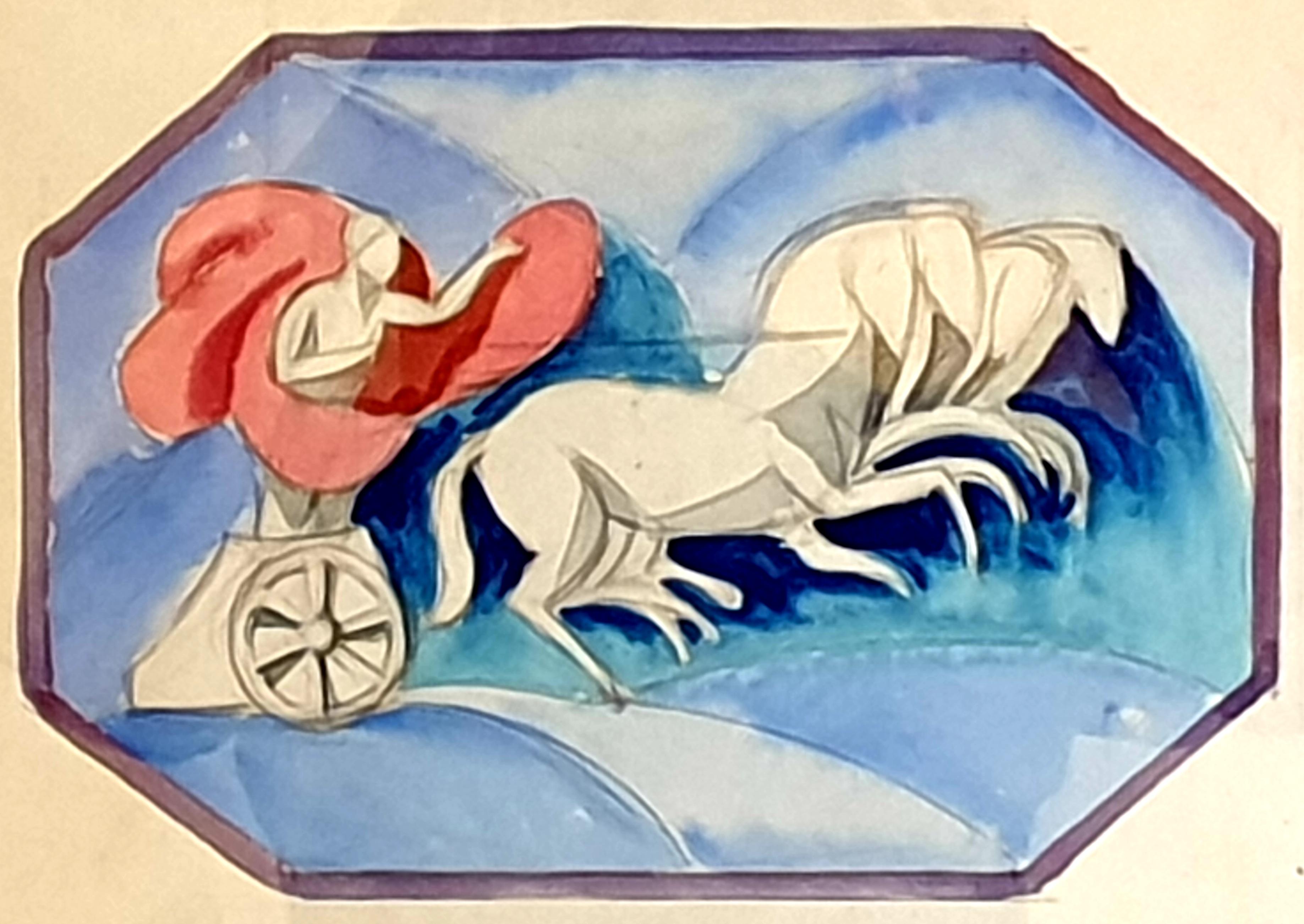
Art Nouveau Watercolour on Paper, Classical Chariot and Horses.
Located in Cotignac, FR
An early 20th century art nouveau watercolour of a classical chariot rider and horses by French artist Paul Hogg. Signed and dated 1919 to the bottom right. Presented in a fine custo...
Category
Early 20th Century Art Nouveau Figurative Paintings
Materials
Paper, Watercolor

$1,051 Sale Price
26% Off
Surrealist Gouache Watercolour on Paper.
Located in Cotignac, FR
Late 20th century gouache and watercolour on paper by British artist Derek Carruthers. The painting is signed to the bottom right and signed and dated 1985 to the reverse.
An impos...
Category
Late 20th Century Surrealist Figurative Paintings
Materials
Paper, Watercolor, Gouache
Horse and Trap. Gouache and Watercolor.
Located in Cotignac, FR
Early 20th century watercolour and gouache of a horse and trap. Signed to the bottom left but artist unknown.
This dynamic artwork showcases a striking horse pulling a two-wheeled c...
Category
Early 20th Century Outsider Art Drawings and Watercolor Paintings
Materials
Ink, Watercolor, Gouache, Paper
Expressionist Gouache and Watercolour Study for
Alexander and His Army
.
Located in Cotignac, FR
French late 20th century watercolour and gouache study for the series 'Alexander and His Army' by Stephane Lovighi-Bourgogne. Presented in plain wood frame.
A strong and forceful de...
Category
Late 20th Century Expressionist Figurative Drawings and Watercolors
Materials
Paper, Watercolor, Gouache
Mother Nature
, Lyrical Surrealist Abstract Watercolour on Paper.
Located in Cotignac, FR
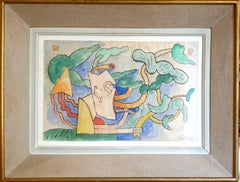
Mid-century lyrical surrealist abstract watercolour on paper by French artist Jean Clerté, signed and dated bottom right. Presented in mid-century frame.
Jean Clerté , born in 1930 in Saint-Savin-sur-Gartempe in Vienne, is a French painter, engraver, draftsman, watercolourist and sculptor . This work is a great example of his more humorous and expressive work influenced by Alechinsky from the late 1960s onwards. There is a light playfulness and yet the watercolours are more vivid than his previous palette.
Jean Clerté works in series. His sequential narrations testify both to a youthful spontaneity and to a perfect mastery in the distribution of forms and images on the painted surface. The narration is not only an accumulation of juxtaposed fragments and symbols, it forms a whole, it takes on and gives meaning. In general, we can say of Clerté that he practices an “eco-art” that feeds on primary hungers: the feeling of being united with nature, the vegetable, the mineral, the aquatic. In his colourful canvases, his inks, his boxes, his objects, like a shaman on the path of his dreams, the painter Clerté mounts an assault on beasts and demons, elves and gnomes. From the Poitevin marshes to the tropical forests emerges a fauna caught in the meanders of a design that marvels at the appearance of these grotesque idols.
Jean Clerté began to draw and paint at a very young age, and at the age of 15 he enrolled at the École des Beaux-Arts in Poitiers. Then in 1949, curious about the capital, he moved to Paris. Having very few financial resources, he could not continue his studies at first, worked as a model to survive, and met other artists; he was then admitted to the studio of Ossip Zadkine and, from 1952, he was also able to study engraving at Atelier 17 of Stanley William Hayter, an English engraver and printer living in Paris associated in the 1930s with surrealism.
At the end of the 1960s, he worked alongside Pierre Alechinsky, founding member of the Cobra movement, engraving Alechinsky's originals, benefiting from his advice, and discovering acrylic as a medium.
From 1976, Jean Clerté became associate professor at Hayter. Clerté had taught previously, in 1971 at the Salzburg Summer University and in 1972 he gave courses at the Paris-Sorbonne University . In 1981, he was appointed professor at the School of Decorative Arts , where he had Maïlys Seydoux-Dumas as a student and, from 1983 to 1988, he was Alechinsky's assistant professor at the Paris School of Fine Arts.
His first works are part of the current of lyrical abstraction, and are nourished by impressions of nature (landscape motifs, e.g. forest fires, waterscapes), then around 1968, encouraged by Alechinsky, he rejects abstraction, and his work becomes more figurative with expressive and humorous elements. From this period his colours are more subdued, often with pastel tones, he works on series. Jean Clerté has created a world in a space where drawing, painting, objects participate in a playful figuration. From his drawings were born sculptures and sometimes mobiles (Le Moulin à dessin). If it is the artist who makes astonishing, polychrome, whimsical “toys”, it is the painter who appeals to adults through his caustic and satirical humour.
His first exhibitions in France took place at the Galerie Massol , then at the Galerie Pascal...
Category
Mid-20th Century Expressionist Figurative Drawings and Watercolors
Materials
Paper, Watercolor
You May Also Like
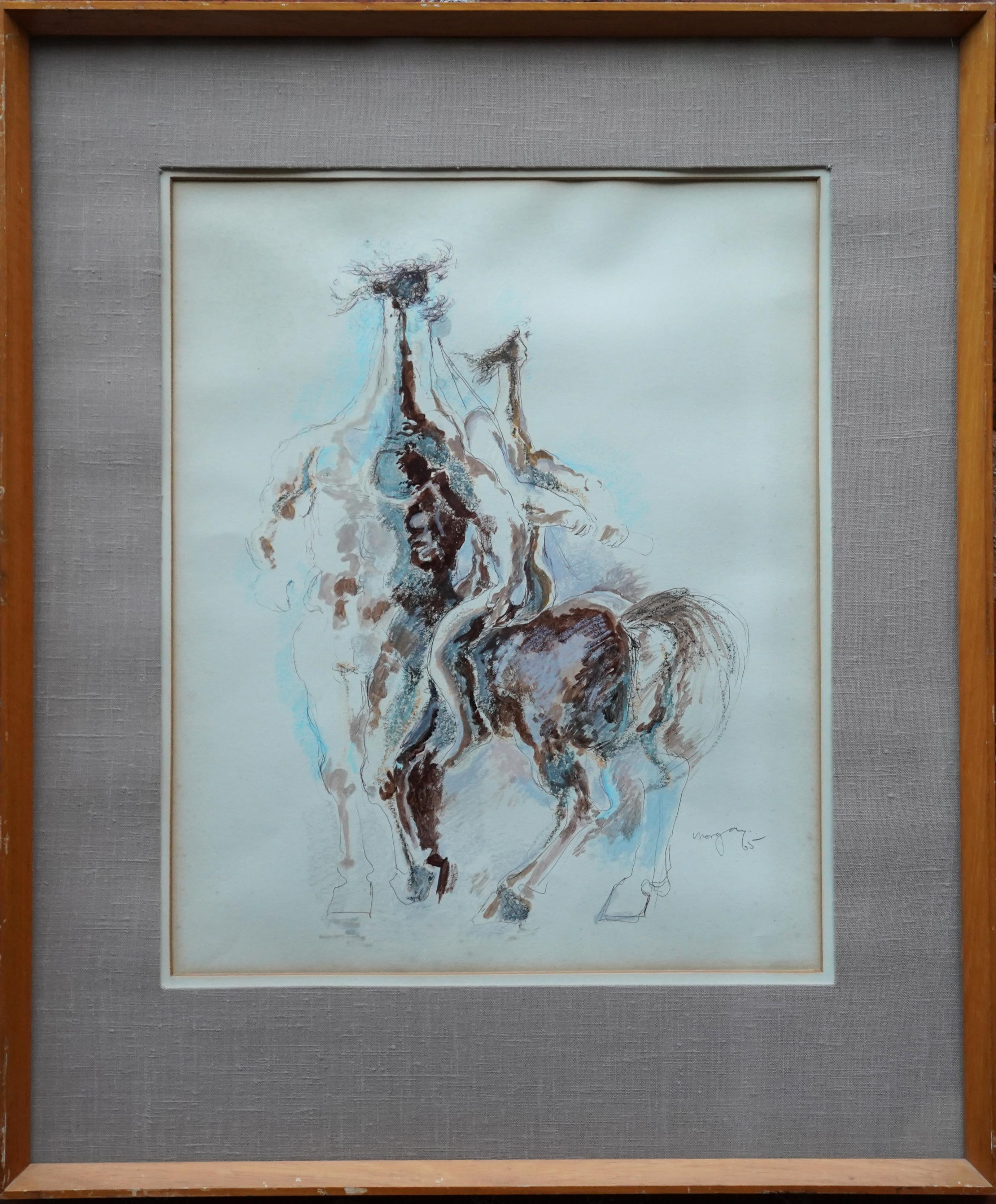
Achilles and Centaur - Welsh Greek Mythology art 1965 water colour painting
By Glyn Morgan
Located in Hagley, England
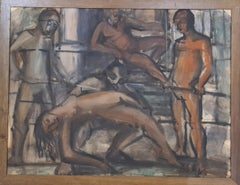
This interesting mythological watercolour painting on paper is by noted Welsh artist Glyn Morgan. Morgan was a noted Welsh artist, initially taught by Ceri Richards in Cardiff and la...
Category
1960s Surrealist Animal Drawings and Watercolors
Materials
Watercolor
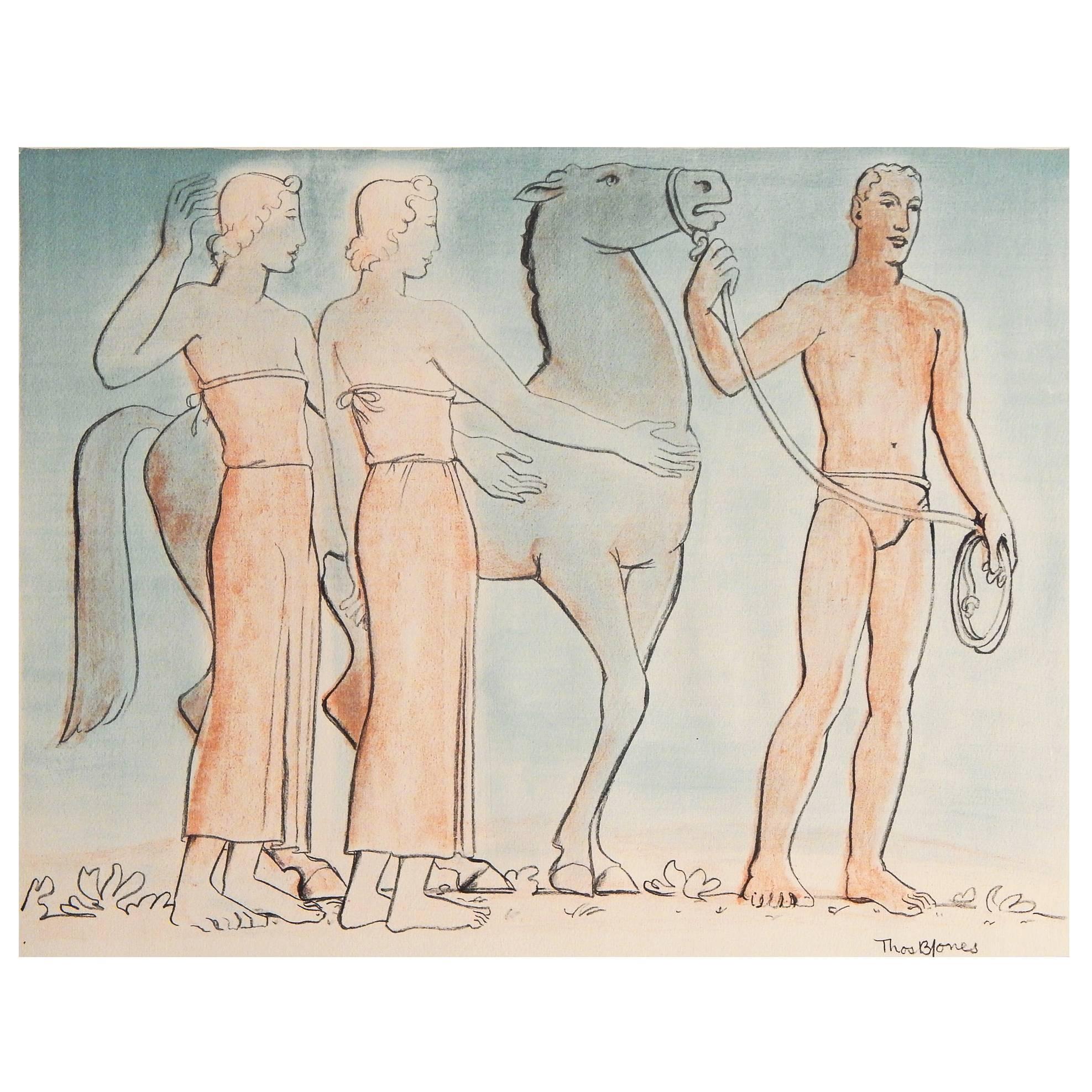
"Modern Greek Frieze with Horse, " Extremely Rare WPA-Period Watercolor, 1930s
Located in Philadelphia, PA
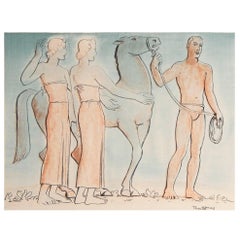
Beautifully composed and subtly colored in hues of pale, pale blue and rusty red, this frieze-like composition features two female figures in Classical Greek robes...
Category
Vintage 1930s American Art Deco Drawings
Materials
Paper
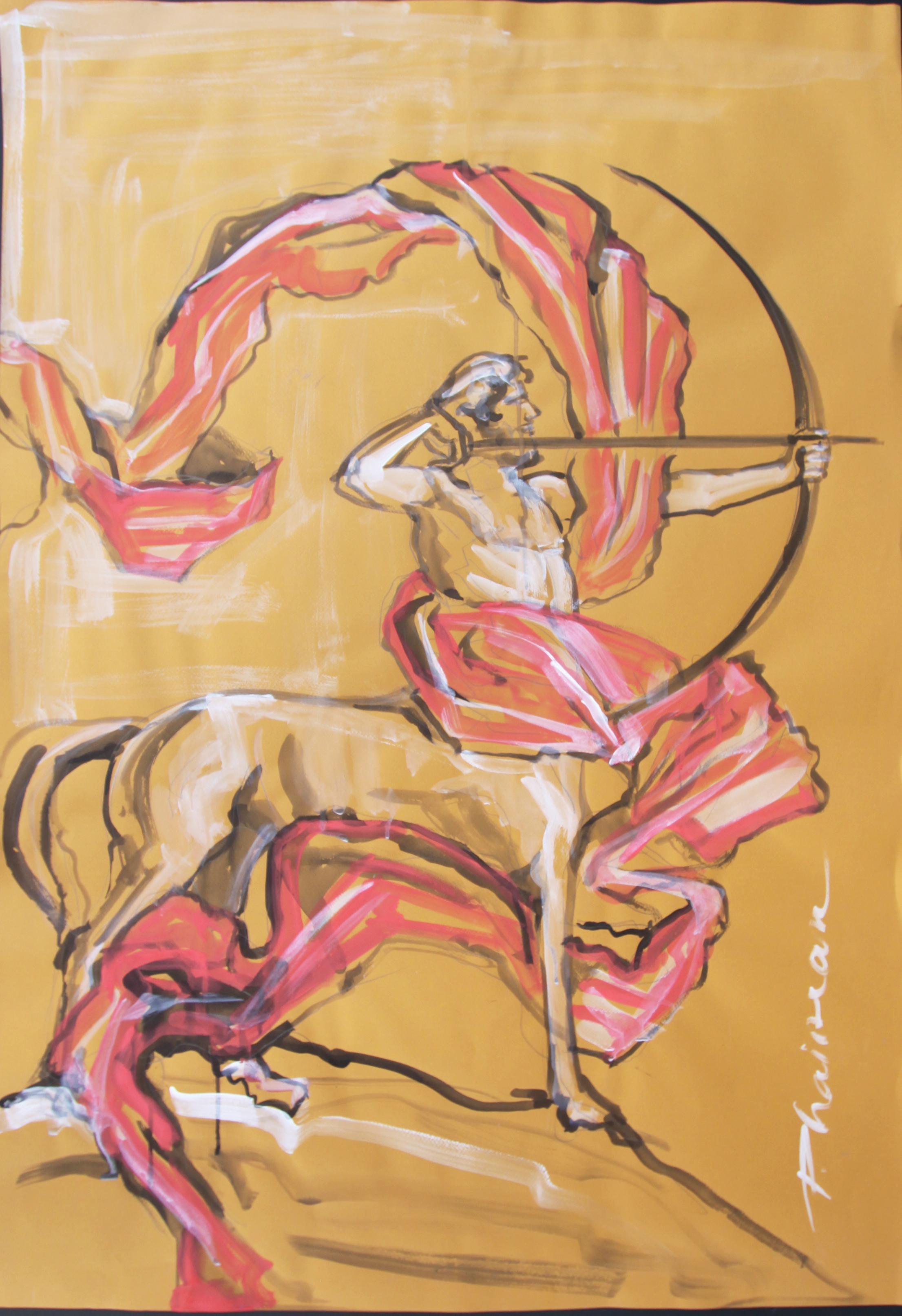
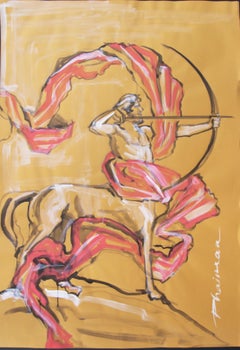
CENTAUR with ARCH - original large art by Paula Craioveanu - New Mythology
By Paula Craioveanu
Located in Forest Hills, NY
Centaur with Arch
100x70cm / 30x27in
ink, graphite, tempera on paper
large size, shipped rolled in a tube directly from the artist's studio
Antiquity is an endless inspiration res...
Category
2010s Contemporary Portrait Drawings and Watercolors
Materials
Ink, Tempera, Pencil
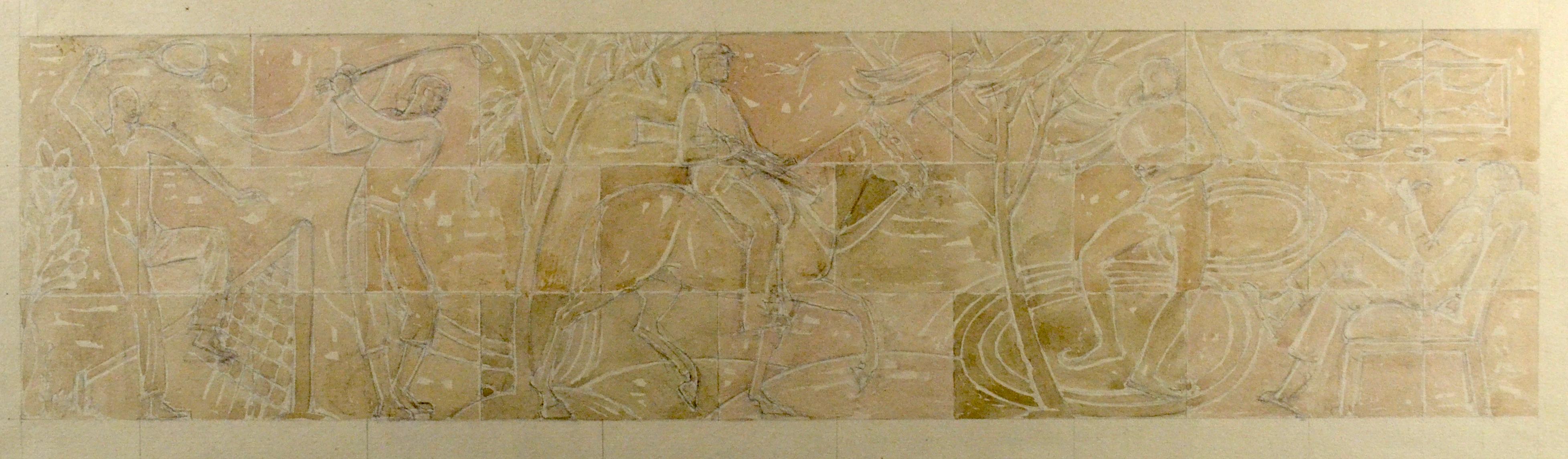
Gilbert Ledward - 1930s Watercolour Design for a Decorative Sculptural Frieze
Located in London, GB
GILBERT LEDWARD, RA, PRBS
(1888-1960)
Tennis, Golf, Shooting, Ice-Skating, Dreaming – Proposed Design for Decorative Frieze in the Italian Drawing Room at Eltham Palace, commissioned by Stephen Courtauld
Signed and dated July 9th 1933
Watercolour and pencil
12.5 by 49.5 cm., 5 by 19 ½ in.
(frame size 36 by 67 cm., 14 ¼ by 26 ¼ in.)
Exhibited:
The artist’s daughter;
London, The Fine Art Society, A Centenary Tribute, Feb 1988, no. 43.
Gilbert Ledward was born in London. He was educated at St Mark’s College, Chelsea. In 1905 he entered the Royal College of Art to study sculpture under Edouard Lanteri and in 1910 he entered the Royal Academy Schools. In 1913 he won the Prix de Rome for sculpture, the Royal Academy’s travelling award and gold medal, which allowed him to travel in Italy until the outbreak of the Wold War I. During the war he served as a lieutenant in the Royal Garrison Artillery and was appointed as an official war artist in 1918.
Following the war he was largely occupied as a sculptor of war memorials including the Guards Division memorial in St James’s Park and the Household Division’s memorial in Horse Guards Parade. In 1934, supported by Eric Gill and Edwin Lutyens, he established a company called Sculptured Memorials and Headstones, which promoted better design of memorials in English churchyards. His war memorials after World War II include one in Westminster Abbey to the Submarine Service, Commandos and Airborne Forces.
Ledward was Professor of Sculpture at the Royal College of Art (1927-1929) and in 1937 was elected at Royal Academician. He became President of the Royal Society of British Sculptors and a trustee of the Royal Academy.
The present work is a design for an intended decorative frieze for the Italian Drawing Room of Eltham Palace. In 1935 the remains of the medieval royal palace of Eltham was rescued from decay by Stephen and Virginia Courtald who built an ultra modern Art Deco house to adjoin the existing Great Hall. They employed the architects John Seeley and Paul Edward Paget and the fashionable Mayfair interior designer the Marchese Peter Malacrida to design the strikingly glamorous 1930s interiors of the new house. The dramatic entrance hall was created by the Swedish designer Rolf Engstromer...
Category
1930s Art Deco Figurative Sculptures
Materials
Watercolor
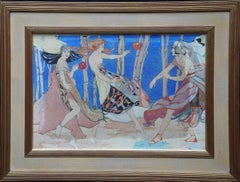
Caerulea - British Art Deco c1935 watercolour and ink figurative painting
Located in Hagley, England
This beautiful British Art Deco 1930's water colour and ink painting on paper is by well respected artist Averil Mary Burleigh. Painted circa 1935 the composition is of three female figures with flowing robes and head dresses with slender tree trunks beyond them and vivid blue of the sky meeting the sea. (Caerula pertains to the colour of the sky and sea). They are playing between them with two balls or globes. A beautiful painting full of fun and movement and that amazing blue.
Signed lower left, and inscribed on a label verso.
Provenance: Surrey estate.
Condition. Water colour and ink on paper. Image size is 24 inches by 16 inches and in excellent condition.
Frame. Housed in a gilt frame. Framed size is 30 inches by 22 inches and in good condition.
Averil Mary Burleigh born Averil Mary Dell (1883 – 1949) was a British artist and painter. Based in Sussex, Burleigh was known for painting in egg tempera with the subject usually involving a central figure. Her husband and daughter also painted but she is the best regarded of the three. Burleigh was born in 1883 in Hassocks in West Sussex and went on to study at the Brighton School of Art. She married the painter Charles Burleigh and they lived and worked together as artists in Hove and Sussex. They designed a house with a large sun-lit top floor studio. Their daughter Veronica, who would also become a notable artist, was born there in 1909. The family never became rich from their works, and often relied on Burleigh's flair for buying and selling shares. In 1911 Burleigh illustrated a book of John Keats' poetry and went on to illustrate plays by Shakespeare. In 1913 she was featured in Studio magazine. In 1927 Burleigh illustrated Thistledown by Leolyn Louise Everett. From 1939 she was a member of the Royal Society of Painters in Watercolours. Burleigh became very ill in the 1940s, dying in 1949. Shortly before she died, Burleigh was elected an associate of the Royal Watercolour Society. Burleigh specialised in tempera painting, although she also worked in chalk and watercolour. Her works tend to have a bright colour palette with contrasting colours to lead the eye around the picture. A sharp luminosity and strong sense of design govern Burleigh's tempera and watercolour paintings. Frequently, her works portray decorative renaissance subjects, usually dominated by a female figure who is regularly modelled on her daughter, Veronica Burleigh...
Category
1930s Art Deco Figurative Drawings and Watercolors
Materials
Ink, Watercolor
Mythical Creatures II Psychedelic Pencil
Watercolor on Paper by Dimitri Petrov
By Dimitri Petrov
Located in Long Island City, NY
Dimitri Petrov, American (1919 - 1986) - Untitled - Mythical Creatures II, Year: 1976, Medium: Pencil and Watercolor on Paper, signed, Size: 22 x 30 in. (55.88 x 76.2 cm)
Category
1970s Surrealist Figurative Drawings and Watercolors
Materials
Watercolor, Pencil
