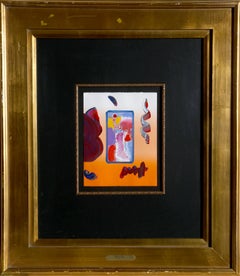
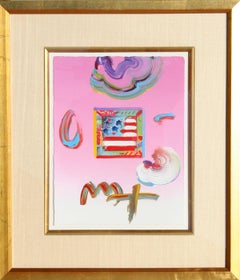
Beautifully framed - ready to hang
Peter Max
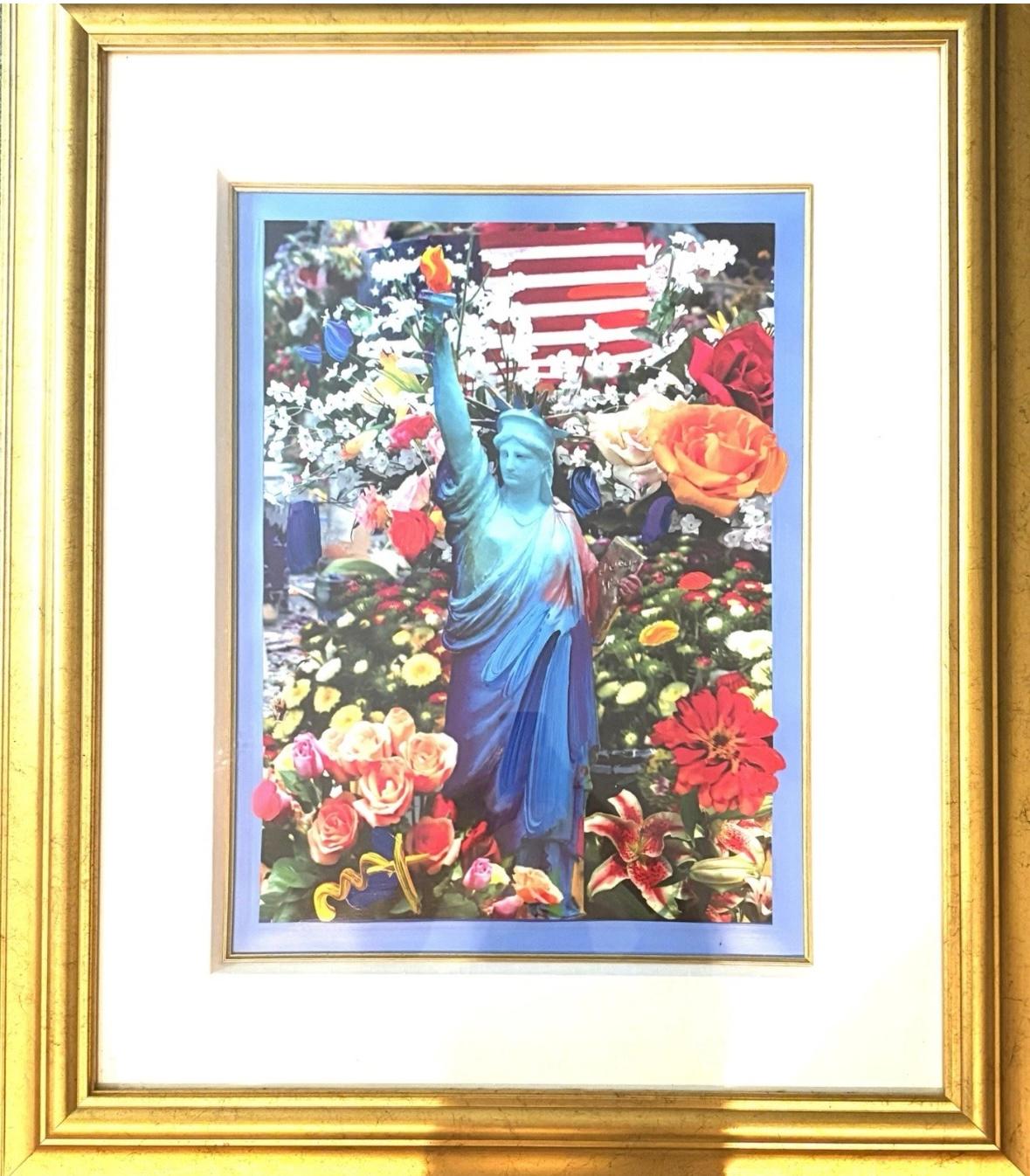
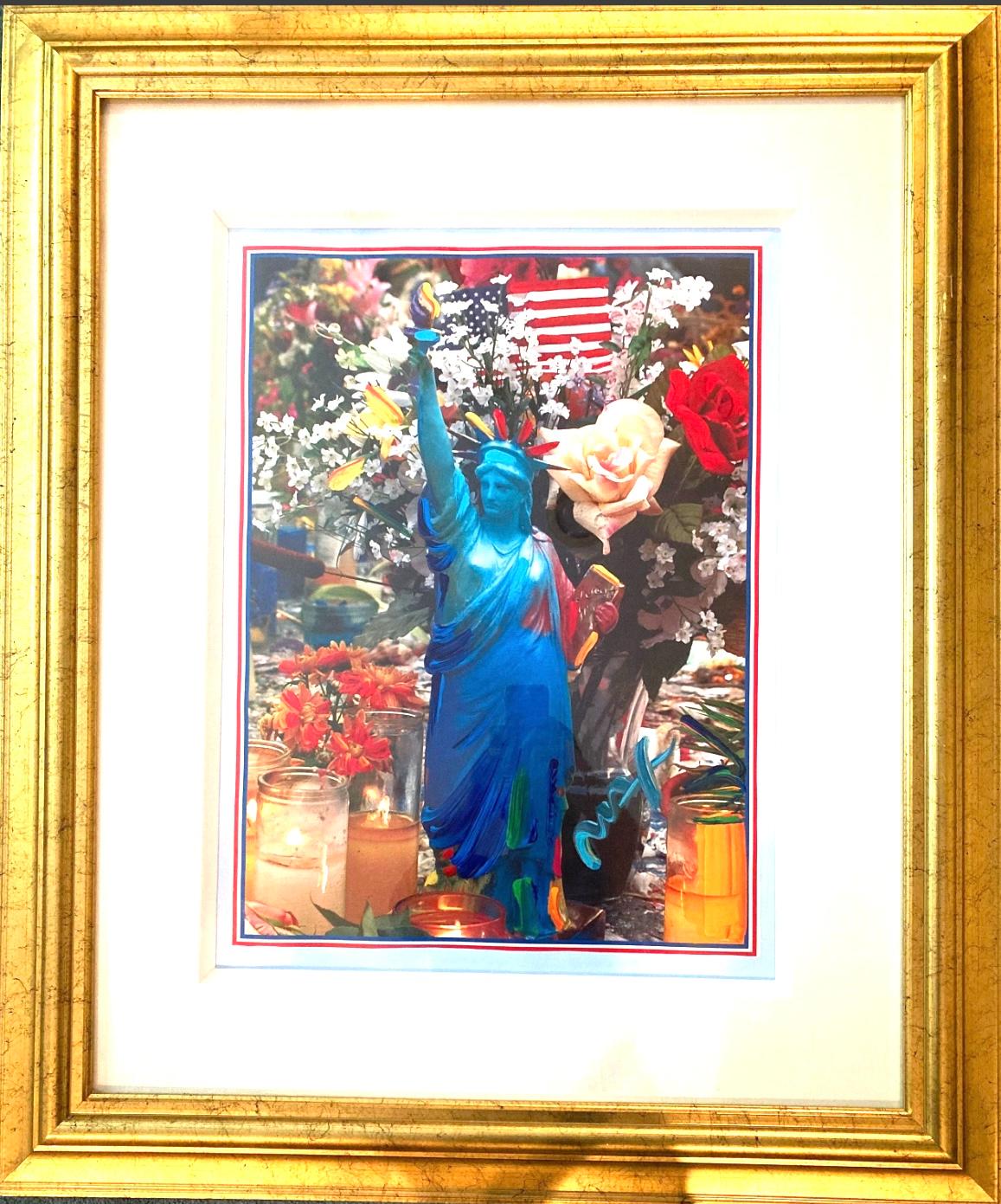
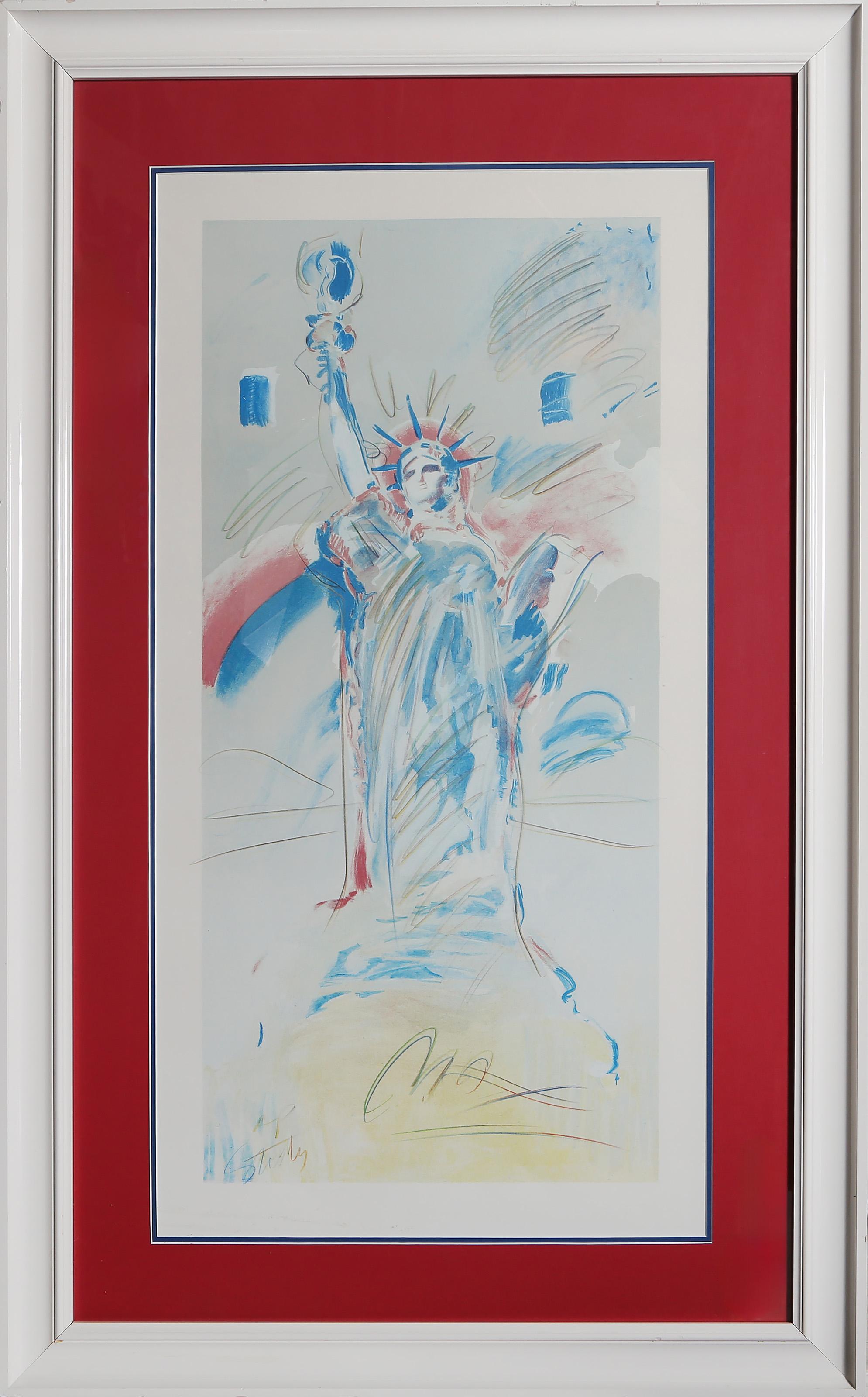
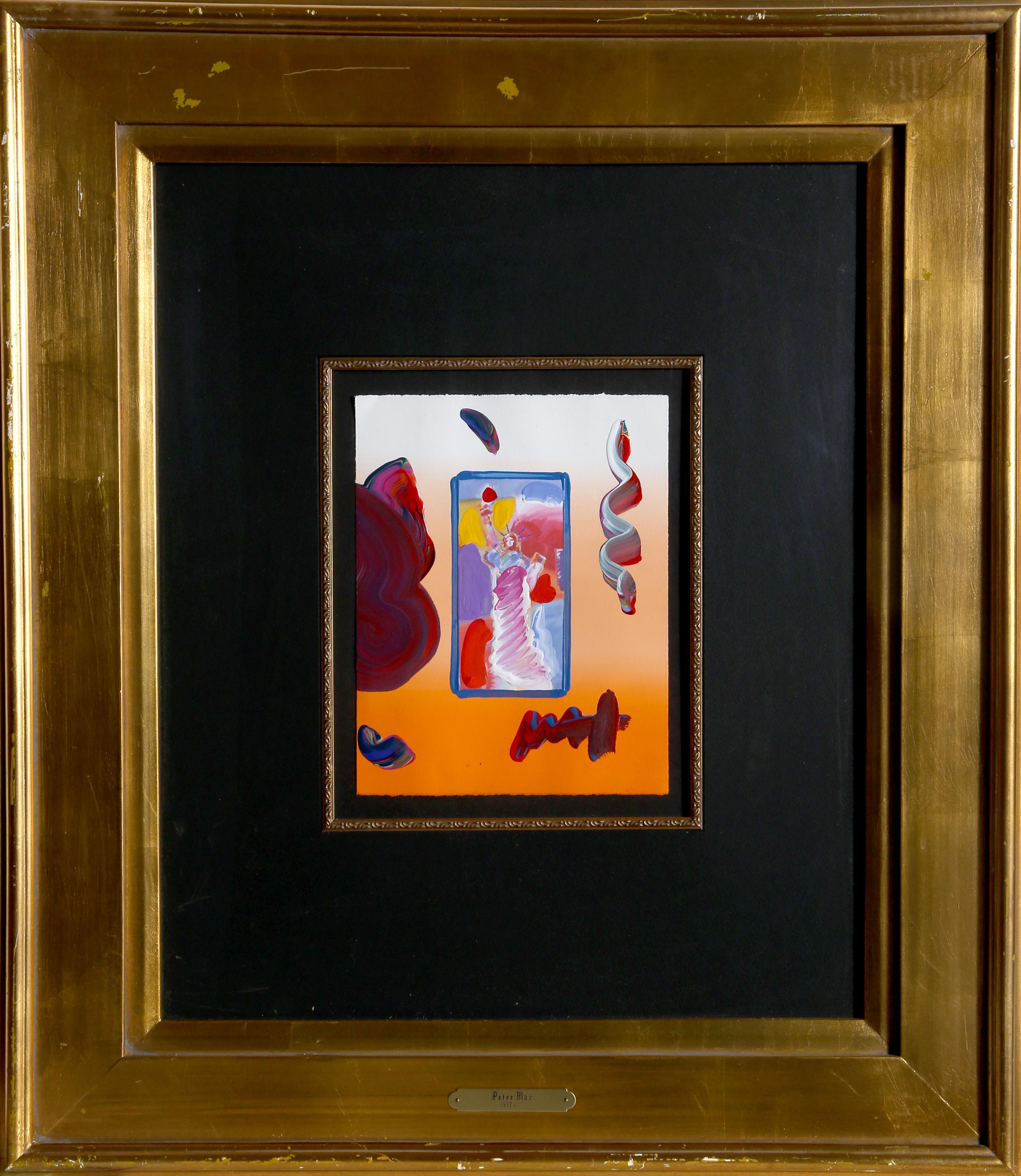
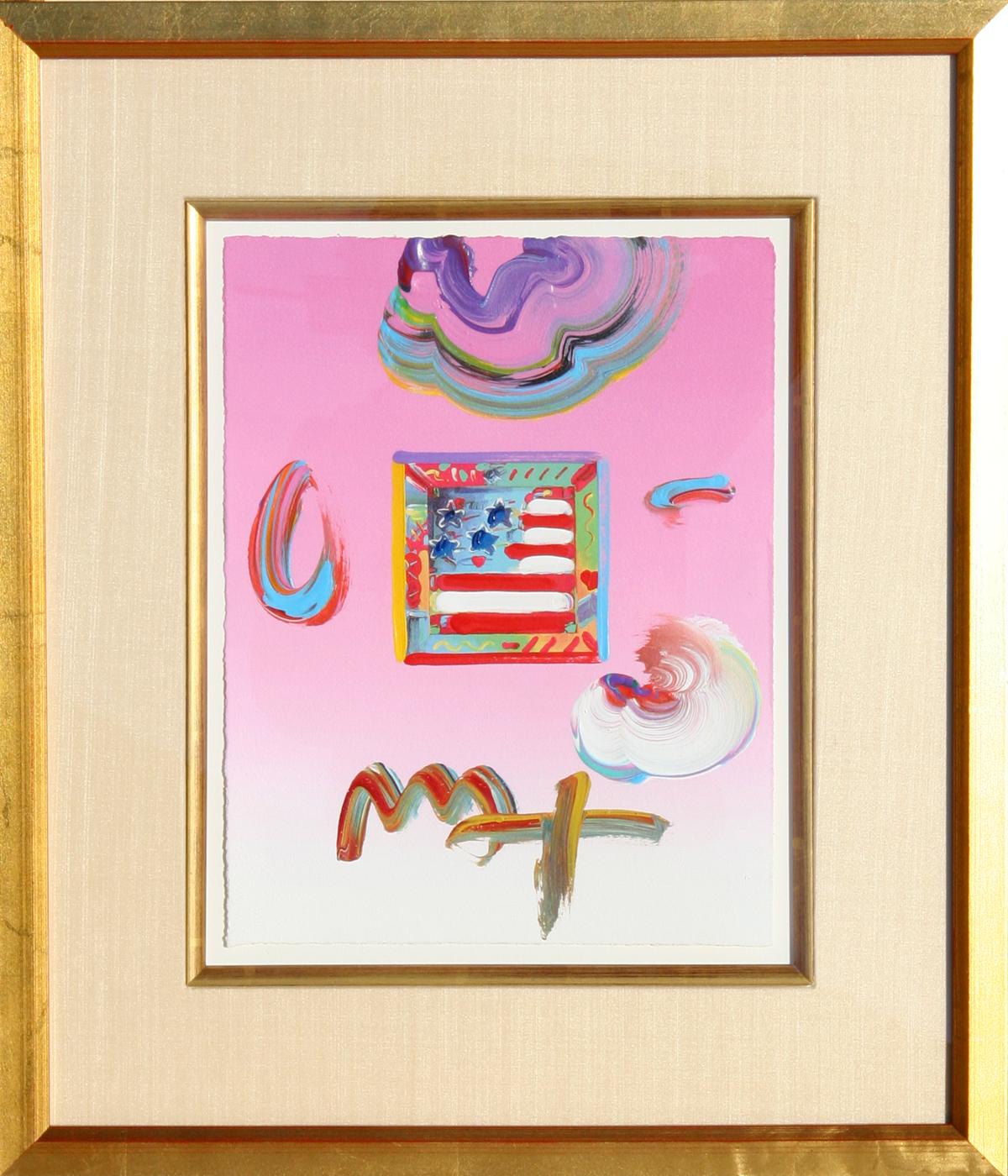
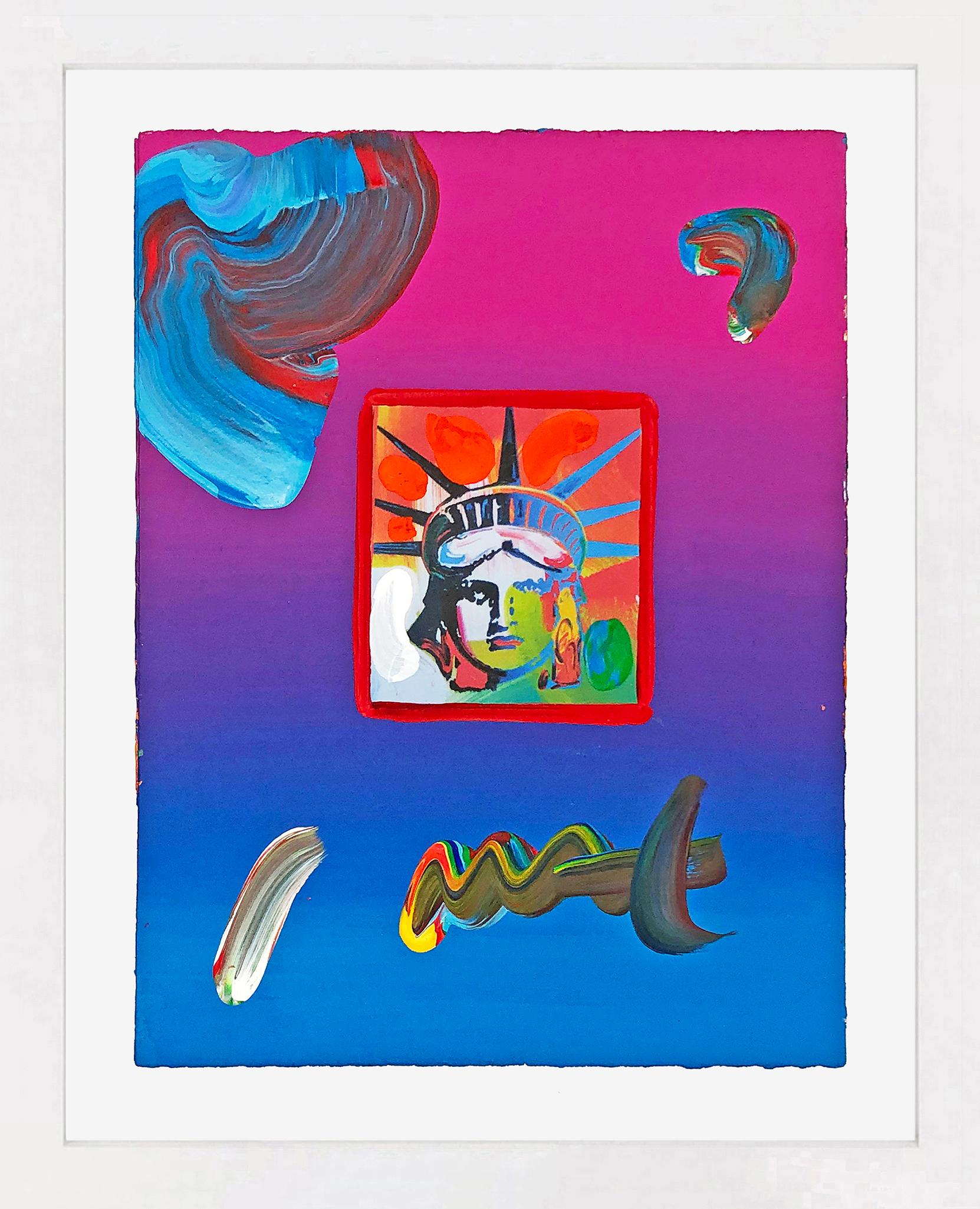
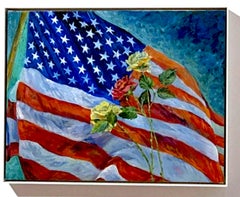
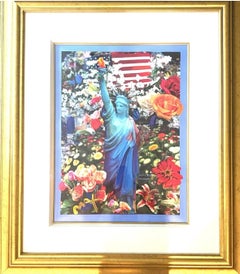
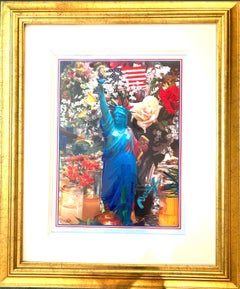
Land of the Free, Home of the Brave, 2005
Acrylic and collage on heavy art paper
Hand signed in acrylic paint on the front, the back bears the artist's copyright and unique catalogue/inventory #
This work is elegantly framed with a raised float - a gorgeous aesthetic touch in a handmade white wood museum frame under UV plexiglass.
Land of Free, Home of the Brave, is an original signed painting, an acrylic and collage on heavy art paper, that was part of a series the artist did in response to the 9/11 terrorist attacks in New York City, with each variation in the series unique. It is hand signed in acrylic paint on the front and bears the artist copyright and stamp and the Peter Max unique inventory/catalogue on the back.
Measurements:
Framed
28 inches vertical by 22 inches horizontal by 2 inches
Painting
24 inches vertical by 18 inches
No artist of our time has reached such a vast global audience and influenced so many others who paint and draw than the legendary Peter Max. On a level comparable to Andy Warhol, but appealing to a broader base of art lovers, Max is the celebrity painter par excellence, an inescapable presence on the cultural consciousness since he burst on the scene in the 1960s. His art is in the collections of more than a hundred museums, many of which have given him solo exhibitions, as well as United States embassies, corporate headquarters and prominent private collections.
Max was the first rock-star-scale artist. Even when he was only in his twenties, he was featured on the cover of Life magazine and appeared on late-night talk shows. Now revered as an “Old Master” of Neo-Expressionism, Max’s legacy has gone way past his graphic design origins and inspired generations of artists, including many gathered under the Park West umbrella.
An instant media sensation when he made his debut in the 1960s as the go-to artist for the leading rock bands in the heyday of the Woodstock era, Max’s career became ever more public over the decades. At the invitation of the White House, he has made the portraits of six sitting United States presidents and scores of world leaders. He was named the official artist for the Grammies as well as the United States 2006 Winter Olympics team, the World Cup, the U.S. Open tennis championships, the Super Bowl and several music festivals, high-profile events that carried his signature style literally to billions of viewers.
Peter Max’s amazing life story, as captivating as his art, was shaped by world events from the start to this day. The literal journey around the world has all the drama of an epic movie. He was born in Berlin in the perilous year of 1937. The next year, his father Jacob recognized that the family could narrowly escape the Nazis by taking the long ocean voyage to join the extensive Jewish refugee community in Shanghai. He has vivid memories living in an old villa across the street from the bright red columns in front of a Buddhist temple where the bells and incense made an indelible impression on him. He watched in fascination as they practiced their calligraphy with giant, five-foot long brushes that made huge Chinese characters on pieces of paper they laid on the ground. The young Peter was given brightly colored crayons and paper to play with by his mother Salla, but when she left the room, he started to draw on her beautiful set of Louis Vuitton steamer trunks. He was fascinated by the rippling sound they made on the corrugated texture. She was appalled at first, but then laughed and realized that her three-year-old son was in love with art and particularly with color.
In cosmopolitan Shanghai, where the expatriate community was so vibrant, Max fell in love with American comic books, movies, and jazz. At the end of their stay in China, his family took a long voyage to Tibet, where they encountered even deeper religious devotion among monks in prayer and meditation.
That year the family continued their migration by way of India and South Africa, to Haifa, joining some of the first European settlers to reach Israel. Max learned Hebrew and took an ever more serious interest in art. The years in Israel also ignited the young Peter’s curiosity about astronomy, one of the early entries in an encyclopedia he was reading. As with the Tibetan monks, the cosmos became a resource for the imagery of Max’s paintings for the rest of his life.
Like so many others displaced from Europe, Max’s family nourished a dream of reaching America. In 1953, they reached Brooklyn, where Max’s cousins welcomed the family. Max was sixteen as they sailed past the Statue of Liberty, the icon that would later figure so prominently in his fame. After high school, Max enrolled in the prestigious Art Students League in 1956. He received classical training in drawing, anatomy and painting technique from the realist Frank J. Reilly, a contemporary of Norman Rockwell at the League. Max’s early realist paintings, including one that became the cover image for a Western novel, were accomplished examples of this academic approach to illustration.
Timing is everything in the art world. Record labels, magazines, and ad agencies were in need of graphic design that had punch and captured the fun-loving spirit of the times. Right out of school, Max started his own studio and almost overnight became a star of the New York ad world. As the foremost expert on the art of Peter Max, the museum director and scholar Charles A. Riley PhD observes in the definitive monograph on the artist, “The medium of the moment was the poster, owing in no small part to the work of Max himself. He became a pioneer in the printing techniques by which modestly priced yet high-quality posters could be produced in an unprecedented range and intensity of colors, utilizing stat-of-the-art commercial presses that expanded the spectrum of available hues.”
Max’s posters, album and magazine covers (Time, Business Week, and his own face was on Life), t-shirts, scarves, calendars, neckties, mugs, bed sheets, watches and alarm clocks that were licensed to a network of 72 major companies and made everywhere in America. He appeared on Ed Sullivan and Johnny Carson’s shows, his ads were on the side of city buses and on billboards, he drew ovations at music festivals.
At the height of his commercial success as a graphic designer, in 1970 Max hit pause. He took his young family on holiday, borrowing John Wayne’s villa in Mexico to devote himself to painting. He spent the next 18 years savoring the slower pace and the freedom of the easel. Recognition as an artist came rapidly when the de Young Museum in San Francisco gave him a solo exhibition in 1971. He walked onstage at a rally for Earth Day to auction off a painting and realized that a new chapter in his life had begun. In the 1980s, a flurry of major commissions for portraits followed, everyone from President Ronald Reagan and Mikhail Gorbachev to the Dalai Lama and Mick Jagger, David Bowie, Sting, Steven Tyler, Andre Agassi, Derek Jeter, Michael Jordan, Joe Montana. Using photographs over which he would vigorously paint, Max found a way to enliven the traditional head shot. Park West Gallery began representing him at that moment of his resurgence, and continues to be the artist’s largest and longest-running dealer in the world.
At the forefront of Peter Max’s public persona is a patriotic strain that includes not only the portraits of American presidents but a remarkable series of paintings, each eight feet tall by four feet wide, of the Statue of Liberty. The riotous colors in the paintings reflect the play of light reflected by the Statue during the July 4 fireworks. He painted a section of the Berlin Wall that was brought to New York in 1989, and created six posters in response to the September 11th attacks and a series of portraits of the first responders lost that day.
Style and Influences
The periods of Max’s career have been characterized by different styles. The earliest paintings, some done during his training at the Art Students League, are examples of traditional realism in the style of American illustrators such as Norman Rockwell.
In the 1960s his clean outlines and bright colors for album covers, magazines, advertisements and t-shirts are referred to as Pop style, similar to the work of Andy Warhol, Roy Lichtenstein, James Rosenquist and other painters of the period. As with their work, it was heavily influenced by comic strip techniques. During the 1970s and later, Max turned to a brushier, more Neo-Expressionist style that he calls Neo-Fauvist after the great French movement, led by Henri Matisse and Andre Derain, that blew away the public with its glowing colors. Most of his later paintings in acrylic, as well as his prints, continue to work within this style, which is characterized by loose brushstrokes, a very bright palette that softens into pastels in some of the profiles of women but unleashes the full spectrum of bold tones in the Statue of Liberty and portrait paintings.
Max works in several media: acrylic painting, line drawing, etching, lithography, serigraphy, collage and sculpture. Many of his paintings are acrylic on silkscreen prints from photographic originals. Max’s invention of the split-fountain ink technique made his posters important examples of the art of printing in the 1960s.
Max signs paintings with a brush using colors from the palette used, and drawings, posters or books with a pen (including metallic silver or gold ink), often dated by year or accompanied by small drawings and inscriptions.
Recurring Themes
The early Pop period featured characters he created such as the Sage, Dega Man, Zero Megalopolis, and The Umbrella Man.
Portraits of world leaders as well as celebrities became a part of his oeuvre beginning in the 1980s, often painted over with heavy impasto acrylic, their borders especially characterized by brushstrokes using strong colors.
The Neo-Fauve period introduced the Blushing Beauty woman in profile, floral still lifes, variations on the theme of the heart and other motifs. These portraits of women are inspired by real women he has encountered.
Patriotic American icons, especially the Statue of Liberty and flag, recur in the works from 1976 to the present.
Peter Max: Accomplishments
Peter Max has been featured in more than 46 museums and 50 galleries worldwide.
Max was featured on “The Tonight Show” with Johnny Carson in 1968 and on the cover of LIFE Magazine in 1969.
Peter Max designed four posters for the Grammy Awards, was one of the artists chosen to redesign NBC’s peacock logo between 1993 and 2002, was appointed as the official artist for five Super Bowls, the World Cup USA in 1994, the NHL all-star game in 1996.
Max created the official artwork for the U.S. Tennis Open in 1997 and 2017
Max was commissioned by the U.S. Post Office to make the first ever environmental 10-cent stamp, commemorating the 1974 World’s Fair in Spokane, Washington.
In 1981, Max was invited by then-First Lady Nancy Reagan to paint portraits of the Statue of Liberty at the White House.
In May 1991, a Peter Max retrospective featuring more than 300 works of art opened at the Hermitage Museum in St. Petersburg, Russia.
Peter Max designed the stage for the 1999 Woodstock Festival, celebrating the music festival’s 30-year anniversary.
In 2000, Max was commissioned to paint a Continental Airlines Boeing 777 super jet.
Max has been the subject of numerous books throughout his career. “Peter Max Paints America” (1976), “The Art of Peter Max,” by Charles A. Riley II, Ph. D. (2002), and “The Universe of Peter Max” (2013)
In 2006, Max was selected to be the official artist for the U.S. Winter Olympic Team
Peter Max was commissioned in 2011 to paint the hull of the Norwegian Breakaway cruise ship.
In 2015, the Rock and Roll Hall of Fame commissioned Max to create posters and program cover art for its 30th annual induction ceremony.
In 2016, the Tampa Museum of Art presented the full-scale retrospective “Peter Max: 50 Years of Cosmic Dreaming”