Want more images or videos?
Request additional images or videos from the seller
1 of 12

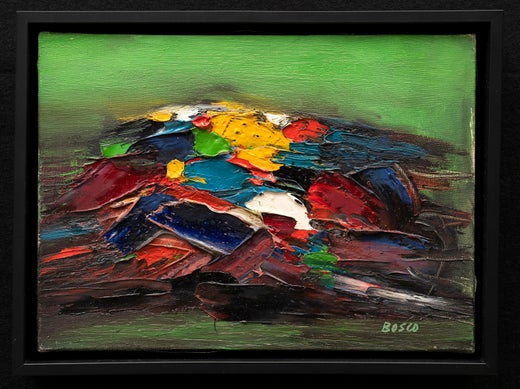
Pierre Bosco
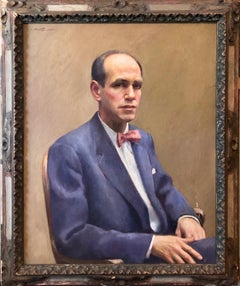
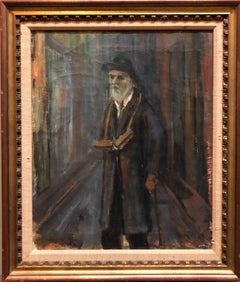
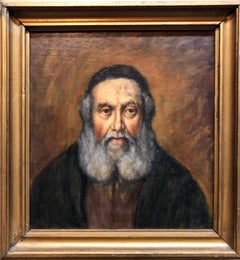
Harlequin, Circus Performer Modern French Oil Painting

Price:$2,400
$3,600List Price

You May Also Like

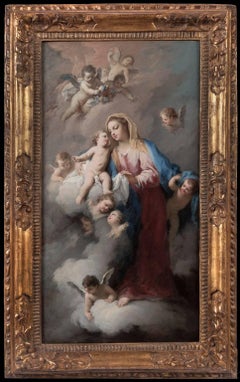
Madonna and Child with Angels in the Clouds
Located in New York, NY
Provenance: Charles H. and Virginia Baldwin, Claremont, Colorado Springs, Colorado ca. 1907-1934; thence by descent until sold in 1949 to: Charles Blevins Davis, Claremont (renamed Trianon), Colorado Springs 1949 -until gifted in 1952 to: The Poor Sisters of Saint Francis, Trianon, Colorado Springs, 1952 until acquired, 1960, by: John W. Metzger, Trianon, renamed as the Trianon School of Fine Arts, Colorado Springs, 1960-1967; when transferred to: The Metzger Family Foundation, Trianon Art Museum, Denver, 1967 - 2004; thence by descent in the Metzger Family until 2015 Exhibited: Trianon Art Museum, Denver (until 2004) The present work is a spectacular jewel-like canvas by Amigoni, rich in delicate pastel colors, most likely a modello for an altarpiece either lost or never painted. In it the Madonna stands firmly upon a cloud in the heavens, her Child resting on a delicate veil further supported by a cloud, as he gently wraps his arm around his mother’s neck. From above angels prepare to lower flowers and a wreath, while other angels and seraphim surrounding the two joyfully cavort. Dr. Annalisa Scarpa, author of the forthcoming monograph on Jacopo Amigoni...
Category

18th Century and Earlier Figurative Paintings

Materials

Canvas, Oil

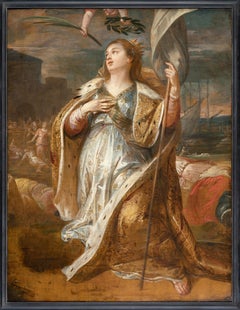
Boeckhorst, Rubens, Saint Ursula, Decorative Old Master, Woman, Baroque, Flemish
By Jan Boeckhorst
Located in Greven, DE
Johann Boeckhorst (Münster 1604 - Antwerp 1668) Saint Ursula Oil on canvas, 112 x 86 cm Provenance: New York, Christe's, 20.3.1981, lot 88 (as Van Diepenbeeck's circle) The presen...
Category

17th Century Baroque Figurative Paintings

Materials

Canvas, Oil

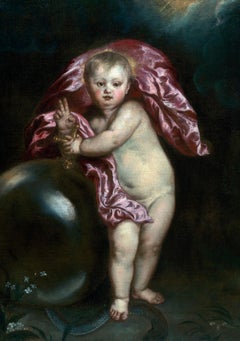
Christ as Salvator Mundi, Circle Van Dyck, Flemish Old Master, Christ Child
By Anthony van Dyck
Located in Greven, DE
The Christ Child as Redeemer of the World Oil on Canvas, 69.3 x 49.7 cm Provenance Private Collection, Belgium The present painting is known in different versions. One of them is ...
Category

17th Century Baroque Figurative Paintings

Materials

Canvas, Oil

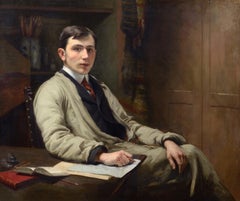
Portrait of young man - The artist s son
Located in BELEYMAS, FR
Auguste-Joseph Delécluse (Roubaix 1855 - Paris 1928) Portrait of the artist's son, Eugène Delécluse Oil on canvas H. 98 cm; W. 116 cm Signed lower right 1903 Exhibition: 1903, Salon...
Category

Early 1900s French School Portrait Paintings

Materials

Canvas, Oil

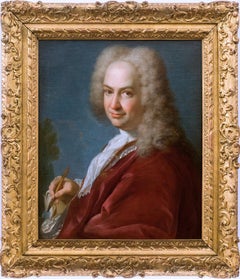
Presumed artist self-portrait
Located in BELEYMAS, FR
Louis-Gabriel BLANCHET (Versailles, 1701 – Rome, 1772) Presumed self-portrait of the artist Oil on canvas H. 73 cm; W. 60 cm Circa 1730 Originally presented in a Restoration period frame with a "Mignard" cartouche, this beautiful painting initially appeared to us as a work from northern Italy. However, it exuded a rather French form of refinement, suggesting that its artist may have assimilated a dual influence from both sides of the Alps. We thank our colleague and friend Philippe Mendès for spontaneously and judiciously "bringing out" the name of Louis-Gabriel Blanchet, a Romanized French portraitist, whose spirit and stylistic characteristics we clearly recognize here. Blanchet's "French" years, before his final departure for Rome in 1728, following his winning of the second Grand Prix for painting after Subleyras in 1727, are extremely poorly documented. His father, Gabriel, was valet to Blouin, himself Louis XIV's first valet at the time. According to Thierry Lefrançois, Blanchet was one of the few students of Nicolas Bertin (1667-1736), whose studio he is said to have joined in the early 1720s. At a baptism on March 24, 1724, where he was godfather, he is mentioned as a painter in the picture store of the Duke of Antin, the director of buildings between 1708 and 1736. At this time, he was probably already married to Jeanne Quément, with whom he had a daughter also named Jeanne, who would marry Nicolas Aviet, the son of a valet in the queen's wardrobe, in Versailles in 1738. When Blanchet arrived in Rome in October 1728, he was accompanied by Subleyras, Trémolières, and Slodtz. He enjoyed the goodwill of Vleughels, the director of the Académie de France, which had been based at the Palazzo Mancini since 1725, even though the latter was not always kind to our resident. From 1732, he was under the protection of the Duke of Saint-Aignan when he took up his post as ambassador to Rome. Along with Slodtz and Subleyras, they formed a trio of friends, joined by Joseph Vernet shortly after his arrival in Rome in 1734. Slodtz and Blanchet, on the occasion of Subleyras's marriage in 1739, were there to attest that their friend was not bound by any marital commitment, and Blanchet was a witness at Vernet's wedding in 1745. It is most likely from these early years in Rome that our portrait of the artist dates, the expression and turn of his face irresistibly reminiscent of a self-portrait. The still relatively youthful features may correspond to Blanchet's thirty-something years, and the fluffy wig was still fashionable at this time. The painting fits well with the depiction of a young painter wanting to display both the beginnings of success and a certain simplicity or restraint. A slight smile expresses a form of assurance in this man with a gentle, sincere gaze and a face radiating a keen sense of wit. We find here the air of intimacy present in almost all of Blanchet's portraits, even those from the 1750s and 1760s, as well as an almost complicity with the viewer. The spirit of the painting is quite close to that of the presumed portrait of Bouchardon (painted around 1730) and the portrait of Pannini, painted in 1736, but it possesses a more natural quality, notably thanks to the absence of decorum. Our work exhibits the characteristics of Blanchet's paintings: elegance, luminosity (especially in the whites), vibrant and refined colors (here, the harmony of the garnet of the garment and the slate blue of the background, whose uniformity is tempered by a very sketched landscape and a grove of greenery), light complexions, rather rosy cheekbones, often full lips, and rather tight framing. According to the Academy's rules, Blanchet's stay should have ended in the spring of 1732, but, for reasons unknown, he remained in the Eternal City until his death, as did his friend Subleyras, with whom he shared accommodation until the late 1730s. The latter regularly called upon him to collaborate on his paintings, such as The Meal at Simon's. Through Saint-Aignan's intervention, Blanchet was employed in the late 1730s by the Stuart princely family, then exiled in Italy. He notably produced copies (now lost) after Liotard of the portraits of Charles Edward and Henry Benedict, the sons of James III Stuart. The latter also commissioned three other portraits (now in the National Portrait Gallery in London), whose more formal character contrasts with the intimate spirit of Blanchet's portraits. Blanchet frequented English painters, such as the landscape painter Richard Wilson, and studied with the Scottish portraitist Katherine Read...
Category

1730s French School Portrait Paintings

Materials

Oil, Canvas

Portrait of a man in armor
Located in BELEYMAS, FR
Attributed to Jacques DUMONT aka DUMONT LE ROMAIN (Paris 1701 - 1781) Presumed portrait of Louis-Joseph de Formanoir (?-1732) Oil on canvas H. 91.5 cm; L. 73 cm Signed on the helmet:...
Category

1750s French School Portrait Paintings

Materials

Canvas, Oil

Portrait of a man in armor
$14,433
H 36.03 in W 28.75 in
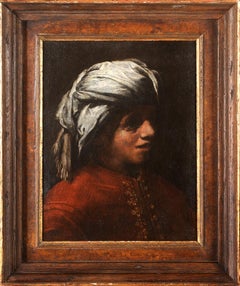
Portrait of a young man with a turban
Located in BELEYMAS, FR
Circle of Adam de Coster (Mechelen 1586 – Antwerp 1643) Portrait of a Young Man with a Turban, Dressed in Oriental Style Oil on canvas H. 43 cm ; W. 33 cm Unsigned This portrait of ...
Category

1620s Flemish School Portrait Paintings

Materials

Oil, Canvas

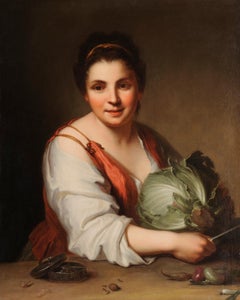
The cabbage cutter
Located in BELEYMAS, FR
Jean-Baptiste SANTERRE (Magny-en-Vexin, 1658- Paris, 1717) The cabbage cutter Oil on canvas H. 86 cm; L. 70 cm Jean-Baptiste Santerre began his apprent...
Category

Early 1700s French School Portrait Paintings

Materials

Canvas, Oil

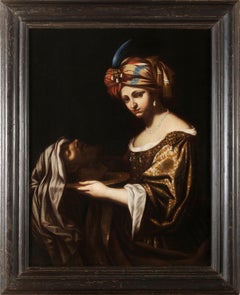
Salome and the Head of Saint John the Baptist
Located in BELEYMAS, FR
Italian School, late 17th century Salome and the Head of Saint John the Baptist Oil on canvas H. 109 cm; W. 83 cm Unsigned The theme of Salome receiving the head of Saint John the B...
Category

1680s Italian School Portrait Paintings

Materials

Canvas, Oil

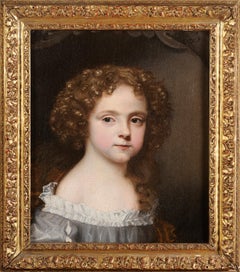
Young girl portrait
By Jacob Ferdinand Voet 1
Located in BELEYMAS, FR
Circle of Jacob Ferdinand Voet Portrait of a Little Girl Oil on canvas H. 44 cm; W. 38 cm Unsigned This delicate portrait of a child, from the circle of Jacob Ferdinand Voet, demons...
Category

1690s French School Portrait Paintings

Materials

Canvas, Oil

Young girl portrait
$9,608
H 17.33 in W 14.97 in

More From This Seller

View All
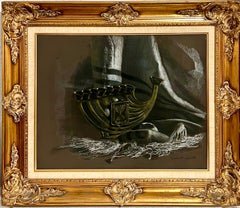
Oil Painting Israeli Bronze Menorah Tallit Judaica Still Life Bar Mitzvah Scene
By Roberto Lupetti
Located in Surfside, FL
Frame is 23 X 27, Canvas is 16 X 20 Born in Milan, Italy Lupetti studied at the Royal Academy in Rome where he received classical training and was apprenticed to the school of restoration at the Vatican. At the age of fourteen he was accepted to attend Brera Liceo Artistico, one of the most prestigious art academies in Italy, graduating at age eighteen and then went on to win honors from the Royal Academy of Fine Arts in Rome eventually receiving the degree of Professor of Fine Arts. In Milan, he helped restore the famed La Scala Opera House, and in Rome he earned the right to help in the restoration of the Masters' Works in the Vatican's Sistine Chapel. Following service in WWII, Roberto came to America sponsored by the famous conductor Arturo Toscanini. A painting he did of the maestro was purchased by the San Francisco Art Commission. He moved to San Francisco where he taught at the Art Institute. Roberto Lupetti (1918 - 1997) was active/lived in California / Italy. Roberto Lupetti is known for Figure, ship, still life painting. Particularly judaic rabbi paintings and Jewish genre scenes. Lupetti earned five degrees from the Italian Royal Academy of Fine Arts, was a team member for the refurbishment of the Vatican's Sistine Chapel, and immigrated to the U.S after World War II. Known for his Renaissance art and large murals, he created a few western genre pieces, including a Day in the Life of A Cowboy (5) 5'x10' murals were painted oil on masonite in 1959. He was born in 1917. He painted very few seascapes, preferring to paint scenes of fishermen on ships, usually in a storm setting. He lived all his life in America on the west coast, mostly in Carmel and Carmel Valley, California. As well as decorating churches throughout the U.S., he also painted portraits of such celebrities as Ingrid Bergman, Barbara Stanwyck, and General George Marshall. Roberto Lupetti earned five degrees at the Royal Academy of Fine Arts. Roberto was married to fellow artist Lynn Lupetti...
Category

20th Century Realist Portrait Paintings

Materials

Canvas, Oil

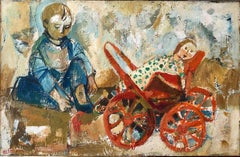
Israeli Oil Painting Ruth Schloss Child, Doll, Wagon, Kibbutz Social Realist Art
By Ruth Schloss
Located in Surfside, FL
Large magnificent colorful Ruth Schloss oil painting of a child with a wagon with a doll or a baby in a carriage stroller.. Signed in Hebrew size measures 31x43 with frame , 23x35.25 without the frame. (this is being sold unframed). Ruth Schloss (22 November 1922 – 2013) was an Israeli painter and illustrator who mainly depicted neglected scenes such as Arabs, transition camps, children and women at eye-level as egalitarian, socialist view via social realism style painting and drawing. Schloss became Israeli painting’s sensitive, conscious, remembering eye. Ruth Schloss was born on 22 November 1922, in Nuremberg, Germany, to Ludwig and Dian Schloss, as the second of three daughters of bourgeois assimilationist Jewish family well-integrated into German culture. As the Nazis came into power in 1933, her family immigrated to Israel in 1937, and settled in Kfar Shmaryahu, then an agricultural settlement. Schloss studied at the Department of Schloss graphic design at "Bezalel" from 1938 to 1942 alongside Friedel Stern and Joseph Hirsch. She was a realistic painter who focused on disadvantaged people in the society and social matters as an egalitarian. Her realism was thus an “inevitable realism,” motivated by an inner necessity: the need to observe reality as it is. Her painting repeatedly addressed the door pulled from its frame, employing drawing’s unique ability to stop time and prolong the image’s persistence in the retina, she repeatedly committed to paper - in a matter-of-fact, non-evasive manner devoid of mystery – man’s tendency to generate chaos, suffering and pain. Throughout her life, Schloss remained minimalist. Painting about human fate was the main subject of her artworks. Her natural inclination was to describe the darker aspect of human existence. 1930s The Schloss household was characterized by open, liberal spirit, in keeping with the parents’ progressive views. It deeply influenced Ruth’s mental development, as she learned to tie culture and art with sensitivity towards the weak and underprivileged. In Jerusalem, she joined a commune of Hashomer Hatzair in which she shaped her socialist views, which she maintained throughout her long career. 1940s In this period she mainly depicted landscapes of kibbutz and wretched women living hard life, children in huger, older people, refugees. After completing her art studies, Schloss joined a training group at Kibbutz Merhavia in 1942, and after two years moved to Karkur region, the nucleus established Kibutz Lehavot Habashan in the Upper Galilee. Through this time, she fell in love with the surroundings and drew landscapes. They are simple and direct with fresh, lucid lines. These paintings were selected as the main works of her first exhibition in 1949. In early 1945, Schloss started to draw illustrations in the children’s magazine Mishmar Leyeladim, and designed the logo of Al Hamishmar, the paper’s new name in 1948. In 1948, upon the founding of Mapam (United Workers’ Party), she designed her party’s emblem, which became a well-known icon. She kept working as an illustrator for Mishmar Layeladim until 1949. "Mor the Monkey" project yielded financial profits and this income was used for a study trip to Paris for two years. She was succesfull as illustrator however, she had inner conflicts of her identity as witnessed painter toward neglected class in Israeli society. First Exhibition at Mikra-Studio Gallery, 1949 She presented forty drawings on paper in her first solo exhibition, representing a selection of the themes of kibbutz landscape, its lifestyle. Schloss confidently proposed her direction through simplicity without using colors in her drawings. 1950s Between 1949 and 1951, she studied at the Académie de la Grande Chaumière in Paris. She began working in oils, with which she continued throughout the 1960s. The exhibition “Back from Paris” opened in November 1951 at Mikra-Studio Gallery . In 1951 she married Benjamin Cohen, who served as chairman of the national leadership of Hashomer Hatzair Workers Party in Tel Aviv. He was a theoretician and a man of principle, highly esteemed by its leaders who became a professor of history at Tel Aviv University. In 1953, following the Mordechai Oren affair and the publication of Moshe Sneh 's followers from Kibbutz Artzi, she and her husband left the kibbutz and moved to the agricultural farm, Kfar Shmaryahu, where she lived until her death. At a certain point in Israeli history, segments of the socialist movement felt that Israel should become part of the Communist bloc, rather than seek the support of the western world. Because the Schloss couple support of Moshe Sneh’s left-wing party, they had to leave the kibbutz. She loved to depict ordinary women as figurative on her painting without hiding or making up anything. The poet Natan Zach wrote about her works in 1955: “Her motto remains that which has been all these years: life as it is, without bluffing." Schloss’s “Pietà” (1953) became a universal cry expressing the pain of mothers on either side of the divide. In the late 1950s, she was the mother of two daughters. When she drew her daughters, unlike the universal babies she depicted, naked and with clenched fists, the painting of her children employed babyish sweetness to the full in a quiet, peaceful and heart-stirring filling rather than urgency. She also painted children in the transition camp and Jaffa in the 1950s and 1960s. 1960s-1980s – The period of Studio in Jaffa Schloss painted at a studio in Jaffa from 1962 till 1983. In this time, she turned her interest to people around her more than kibbutz – the children, mothers, and poor workers, the alleys and houses. She opened the space to the street and its dwellings, built interactions around it, and was nurtured by the presence of the outside in her work. 1960s Schloss familiarized to an Arab woman, Nabava, lived in poor. Schloss returned to painting images of old people later, and she called her painting figurative elderly people in the old age homes “waiting”. In the late 1960s, Ruth discovered acrylic paint and never turn back to oil painting. In 1965 Schloss devoted a series “Area 9 (1965)”, dedicated to the demolition of Israeli-Arab houses and the expropriation of the land, and carried a definite socio-political messages. The series was exhibited at Beit Zvi, Ramat Gan, in 1966. She was the only artist who addressed the result of the Six-Day War immediately afterward. In 1968, Schloss and Gansser-Markus presented “Drawing of War” in Zurich gallery. She expressed the war as an ultimate expression of destruction and ruin, regardless of victors and vanquished. 1970s In late 1970s Schloss began printing the selected photograph directly on the canvas, posterior reworking it in acrylic. She decided to print her work at Har-El Printers in Jaffa, and these became the surface of her painting. This technique was mainly adopted in two large series: Anne Frank (1979-1980) and Borders (1982). Through this technique she placed the figure of elder Frank next to that of the famous young Frank, and released it at the exhibition at Bet Ariela Cultural Center, Tel Aviv, in 1981. The series touched upon the Nazi Holocaust. 1980s The Lebanon War raised the question of “The Good Fence” and the effect of the war. She dedicated a large series Boarders, one of the most powerful image linked to the series is the figure of Yemenite woman raising her hand. She was the first to raise the Black Panthers demonstration to the level of a social icon. In the 1980s and again in 2000, the Intifada uprisings also led Schloss to the easel to render a good number of representational and symbolic works that in their way denounced Israel's political and military actions. 1990s – 2000s Ruth Schloss never had an exhibition in a major Israeli museum. Her works were presented in private galleries and small museums. The main museums, the Tel Aviv Museum of Art and the Israel Museum, included her works only in group exhibitions, and only in 1991 was her retrospective exhibited at the Herzliya Museum. In the 2000s, Schloss’s metaphors turned into animal kingdom and Bedouins in the south. A huge rhinoceros, birds of prey, and other "bad animals," as Cohen Evron, daughter of Ruth, calls them and "I connected this to the Nazis," said Schloss. Schloss' work after she didn't find human expression able to transmit the endless cruelty she saw in Israel's political mentality. Schloss also continued to follow and collect documentary photographs of destructions of houses from the war, the Intifada, the sequence of her work about ruin from 1949 to 2005, was a cumulative testimony about the painful history of Israel and Palestine. In 2006, a large retrospective exhibition of her work was presented at the Museum of Art in Ein Harod, curated by Tali Tamir. Education 1938-41 Bezalel Art Academy, Jerusalem, with Mordecai Ardon 1946 painting course for Kibbutz Artzi artists with Yohanan Simon and Marcel Janco 1949-51 Académie de la Grande Chaumière, Paris Awards and recognition 1965 Silver Medal, International exhibition in Leipzig, Germany 1977 Artist-in-Residence, The Cité Internationale Universitaire de Paris Selected solo exhibitions 2004 “Micha...
Category

Mid-20th Century Realist Figurative Paintings

Materials

Canvas, Oil

Itzhak Holtz (Judaica Master) Oil Painting Portrait John Sloan Ashcan Artist WPA
By Itshak Holtz
Located in Surfside, FL
Oil Painting Portrait of Ashcan Artist John Sloan. Signed I. Holtz. The youngest of four children, Holtz was born and spent his early childhood in Skierniewice, Poland, a small town near Warsaw. His father was a hat maker and a furrier. In 1935, prior to World War II, when Holtz was ten years old, his family moved to Jerusalem, Israel, where they settled in the Geula neighborhood near Meah Shearim. Itzhak Holtz's passion for art began early. When he was five years old, in Poland, his father first drew a picture of a horse and sled in the snow for him. The young Holtz looked at the drawing and studied it in wonderment. From that moment on, Holtz remembers, he constantly begged his father to draw for him. His enthusiasm for art grew and Holtz longed to study art. In 1945, he enrolled at the Bezalel Academy of Art and Design in Jerusalem, where he primarily studied lettering and poster work in a program geared toward commercial art Holtz became interested in painting, prompting him to move to New York City in 1950 to study at the Art Students League of New York under Robert Brackman and Harry Sternberg, and then at the National Academy of Design under Robert Philipp. Holtz has stated that his artwork, which primarily but not exclusively, depict scenes of Jewish spirituality and tradition, is driven by his Orthodox Jewish beliefs: "You have to live that religious life to fully capture it on canvas." He has been classified in the school of genre painting, often depicting street scenes of ordinary people in everyday Jewish life in the back alleys and markets of Jerusalem neighborhoods such as Me'ah Shearim and Geula; and in New York neighborhoods and hamlets such as Monsey, Boro Park and Williamsburg. Along with street scenes, his work includes portraits of scribes, tailors, cobblers and fishmongers, and images such as shtetls, lighthouses, and wedding scenes. He started out painting mostly portraits in order to support his family, before expanding to include street scenes. His beloved subject matter is painting scenes of Jewish life, his childhood memories when his mother took him along shopping for the Sabbath to the markets of Meah Shearim, has left a deep impression on him and influenced many of his works. Holtz has experimented in the abstract, but then reverted to representational and figurative art to which he devoted himself exclusively. His Israeli street scenes are said to combine “an affectionate recollection of the past with the brilliance of the color of modern Israel.” Holtz has stated that he struggled at first when he arrived to the USA because of financial reasons and because he only knew Polish, Yiddish and Hebrew, but then made good ties with his instructor who greatly influenced him Robert Philipp who helped him make friends and referred him to paint portraits. Examples of Holtz's work throughout the years include: Yerusalem Wedding (2010), depicting a Chuppa in Jerusalem on early evening, oil on canvas; The Funeral(1966), depicting five stoic Hasidim carrying a body on a bier over to a gravesite, with the people behind them crying, in charcoal on paper and oil on canvas; Rejoicing (1974), an image of religious men dancing, in felt pen and marker on paper; and the oil painting Shamash Learning in Shul (2003), a portrait of a pious Jew studying the Talmud inside a claustrophobic synagogue scene. Throughout the years Holtz has created hundreds of works in many art mediums, including, genre scenes, portraits, still lifes and landscape scenery, his works are sought after by art collectors worldwide, and he has been called the greatest living Jewish artist. It is said that no artist ever explored the Jewish subject like Holtz. Today some of his oil paintings have been commanding over $100,000. Holtz creates his scenes after researching locations, and often uses locals as models. He paints slowly and with great care, but with a swift Impressionistic style. The people in his portraits and scenes are generally more cheerful and optimistic than standard portraits of Hassidic individuals. He paints oils and watercolors, and also does felt pen, pastel, marker, ink and charcoal drawings, as well as woodcuts. His oil paintings typically have a brown hue, while his work with felt pen is often in sepia tones, and on some of his works he used very bright colors, with a strong emphasis on the interplay of light and shadow. He is heavily influenced by the ancient staircases and alleyways of Jerusalem, with its modest religious population, which has made a strong impression on him in his youth, the streets of Tzfat, and the works of Rembrandt, Johannes Vermeer and Peter Bruegel, as well as Jewish artists Moritz Daniel Oppenheim...
Category

1940s Realist Portrait Paintings

Materials

Canvas, Oil

Oil Painting "The Rabbi" Sensitive Judaica Portrait by Italian American master
By Roberto Lupetti
Located in Surfside, FL
Born in Milan, Italy Lupetti studied at the Royal Academy in Rome where he received classical training and was apprenticed to the school of restoration at the Vatican. At the age of fourteen he was accepted to attend Brera Liceo Artistico, one of the most prestigious art academies in Italy, graduating at age eighteen and then went on to win honors from the Royal Academy of Fine Arts in Rome eventually receiving the degree of Professor of Fine Arts. In Milan, he helped restore the famed La Scala Opera House, and in Rome he earned the right to help in the restoration of the Masters' Works in the Vatican's Sistine Chapel. Following service in WWII, Roberto came to America sponsored by the famous conductor Arturo Toscanini. A painting he did of the maestro was purchased by the San Francisco Art Commission. He moved to San Francisco where he taught at the Art Institute. As well as decorating churches throughout the U.S., he also painted portraits of such celebrities as Ingrid Bergman, Barbara Stanwyck, and General George Marshall. Roberto Lupetti earned five degrees at the Royal Academy of Fine Arts. Roberto was married to fellow artist Lynn Lupetti...
Category

20th Century Realist Portrait Paintings

Materials

Canvas, Oil

Judaica Oil Painting 1945 Palestine Old Jewish Man Polish Israeli Artist
By Ozer Shabat
Located in Surfside, FL
Ozer Shabat 1978-1901 Ozer Shabbat was an Israeli painter, a resident of Haifa. Belonged to the Palestine Expressionist group of the late 1920s and early 1930s. Shabbat was born in Wolbrom, Poland. At the end of the First World War he went to Holland for agricultural training in the framework of the HeChalutz movement, prior to his immigration to Palestine. In 1920 he immigrated to Eretz Israel and joined the Hulda group. Later he joined the Merhavia group and there he began painting. Because of his desire to study drawing, he left the group and moved to Jerusalem. In 1921, he wrote articles in the newspaper "HaSadeh" on the subject of agriculture and Dutch cheese. Ozer Shabath won the first prize in a competition for the design of the Dutch Consulate's Garden in Jerusalem, enabling him to travel to Paris in 1923 to study painting. Until 1925 he studied painting at the Grande Chaumiere Academy in Paris. This year he returned to Eretz Israel and settled in Haifa, where he lived until his death. In 1928 he participated for the first time in an exhibition of Eretz Israel artists at the Tower of David. Since then he has participated in all the general exhibitions of Israeli artists. In 1934, together with painters Menachem Shemi, Avraham Mohar, Zvi Meirovitch and others, he founded the Haifa Artists' Group. In 1935-36 he toured Europe and visited Italy, France and England. During his visit, he maintained contacts with artists from the Jewish school of Paris. He has exhibited in several solo exhibitions, represented Israel in exhibitions in Europe and participated in international exhibitions in New York, Johannesburg and Zurich. In 1958 he represented Israel in the Venice Biennale. In 1960, Shabat, together with Elchanan Halpern he represented the Israeli Painters Association at the International Congress of Plastic Arts held in Vienna, Austria . In the 40s and 50s he focused on landscape pictures. However, despite the focus on the Israeli landscape, the approach is universal in the framework of the post-Impressionist painting school. In the 1960s, his approach changed and he turned more to abstraction. The abstract direction gradually evolved. The point of departure of the abstract approach is the architectural landscape, but this view loses its real character and becomes only imaginary: the buildings lose their real character and turn into exclusive geometric areas that are usually set against a dark background. Over time, architecture captured the lion's share of his paintings. Cities like Safed, Jaffa and Jerusalem are the subject of many pictures. He taught painting and art at the schools of the kibbutzim in Ramat Yochanan and Kfar Yehoshua, in high schools in Haifa and in the IDF and Gordon seminars. His paintings were purchased and are in the permanent collection of the Bezalel National Museum (now the Israel Museum), Haifa Museum of Art, Haifa Maritime Museum, Acre Municipal Museum. Select Solo exhibitions 1936 - Nadler Gallery, Haifa. 1943 - The Tel Aviv Museum of Art. 1952 - Artists House, Haifa. 1953 - Bezalel House, Jerusalem. 1955 - Gallery in Geneva, Switzerland. 1955 - The Writers' Club, Haifa. 1959 - Artists House, Haifa. 1960 - Museum of Modern Art, Haifa. 1962 - Museum of Modern Art, Haifa. 1963 - Gallery 220, Tel Aviv. 1968 - The Municipal Museum of Beit Emanuel, Ramat Gan. 1979 - Memorial exhibition marking the first anniversary...
Category

1940s Post-Impressionist Figurative Paintings

Materials

Canvas, Oil

Judaica "The Rebbe " European Hasidic Rabbi Portrait Oil Painting
By Charles Hannaford
Located in Surfside, FL
Signed with monogrammed initials and has his name written on verso. Realistic portrait of an older rabbi. CHARLES E. HANNAFORD, English; 1863-1955, Hannaford was a British waterco...
Category

20th Century Realist Portrait Paintings

Materials

Canvas, Oil

Still Thinking About These?

All Recently Viewed