Video Loading
Want more images or videos?
Request additional images or videos from the seller
1 of 6
Pierre Louis De La RiveTwo countrywomen with a donkey - Melancholy in an atmosphere of colour -around 1790
around 1790
$3,225.91List Price
About the Item
- Creator:Pierre Louis De La Rive (1753 - 1817, Swiss)
- Creation Year:around 1790
- Dimensions:Height: 10.63 in (27 cm)Width: 7.88 in (20 cm)
- Medium:
- Movement Style:
- Period:1790-1799
- Condition:
- Gallery Location:Berlin, DE
- Reference Number:1stDibs: LU2438211895842
About the Seller
5.0
Vetted Professional Seller
Every seller passes strict standards for authenticity and reliability
Established in 2014
1stDibs seller since 2023
23 sales on 1stDibs
Authenticity Guarantee
In the unlikely event there’s an issue with an item’s authenticity, contact us within 1 year for a full refund. DetailsMoney-Back Guarantee
If your item is not as described, is damaged in transit, or does not arrive, contact us within 7 days for a full refund. Details24-Hour Cancellation
You have a 24-hour grace period in which to reconsider your purchase, with no questions asked.Vetted Professional Sellers
Our world-class sellers must adhere to strict standards for service and quality, maintaining the integrity of our listings.Price-Match Guarantee
If you find that a seller listed the same item for a lower price elsewhere, we’ll match it.Trusted Global Delivery
Our best-in-class carrier network provides specialized shipping options worldwide, including custom delivery.You May Also Like
A 17th c. Italian school, Capriccio with the Colosseum, circle of V. Codazzi
Located in PARIS, FR
A capriccio with the Colosseum in Roma
17th century Italian school
Circle of Viviano Codazzi (1604-1670)
Oil on canvas
Dimensions: h. 35.43 in, w. 51.18 in
Modern 17th century style ...
Category
17th Century Old Masters Landscape Paintings
Materials
Canvas, Oil
$12,927
H 40.94 in W 57.09 in
17th century Italian school, The Virgin and Child with Saint John the Baptist
Located in PARIS, FR
17th century Italian School
The Virgin and Child with Saint John the Baptist
Oil on canvas
Dimensions: h. 106 cm, l. 77 cm
Important 17th century Italian carved giltwood frame
Fram...
Category
17th Century Old Masters Figurative Paintings
Materials
Canvas, Oil
$25,261
H 53.54 in W 42.13 in
Peasants in a Cornfield (Boer in het veld) by David Teniers the Younger
By David Teniers the Younger
Located in Stockholm, SE
Remembering the magic of everyday life moments in the art of David Teniers:
The art of David Teniers the Younger (1610–1690) coincided with the heyday of the Flemish Baroque and cap...
Category
Late 17th Century Old Masters Landscape Paintings
Materials
Canvas, Oil
$28,463
Free Shipping
H 12.6 in W 10.04 in
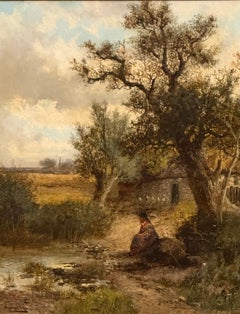
‘Near Sutton, Surrey’ stream and old cottage, 19th C/early 20th C oil on canvas
By Abraham Hulk the Younger
Located in Hillsborough, NC
Dutch/English artist Abraham Hulk the Younger (1851-1922) is most known for landscapes of the British countryside. This work is one of a pair (the second work is also available by s...
Category
Late 19th Century Old Masters Landscape Paintings
Materials
Canvas, Oil
$2,800
H 27 in W 22.75 in D 2.13 in
The Knight - painting - XVII century
Located in Roma, IT
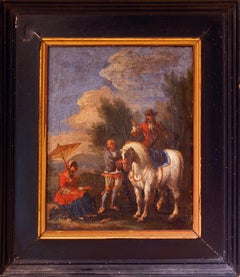
The Knight is an original oil painting on canvas realized during the XVII century by an anonymous artist.
Provenance: Pecci-Blunt collection. Good condition...
Category
17th Century Old Masters Figurative Paintings
Materials
Canvas, Oil
Peasants in a Cornfield (Boer in het veld) by David Teniers the Younger
By David Teniers the Younger
Located in Stockholm, SE
Remembering the magic of everyday life moments in the art of David Teniers:
The art of David Teniers the Younger (1610–1690) coincided with the heyday of the Flemish Baroque and captured a great variety of motifs of his time. In this painting of a seemingly simple peasant scene lies keys to understanding both the imaginative mind of Teniers as well as why this time period produced some of the most iconic works in all of art history.
As indicated by the name, Teniers was more or less born into his profession. As the son of David Teniers the elder, himself a painter who studied under Rubens, the younger David received training in art from a very young age and had no less than three brothers who also became painters. Because of his father’s frequent financial failures that even at times saw him imprisoned, David the younger helped to rescue the family from ruin through painting copies of old masters. Essentially, the young Teniers was confronted with painting as both a passion and creative expression as well as a necessity during difficult times, an experience that would shape much of his capacity and sensitivity in his coming life.
Despite the hardships, the talent and determination of Teniers was recognized and quickly expanded his possibilities. He had already spent time in France and possibly also England when he was hired by his father’s former teacher Rubens to help with a prestigious commission with mythological paintings, now considered lost, for Philip IV the king Spain. In 1644–54 Teniers was appointed dean of the Antwerp Guild of Saint Luke, manifesting his esteemed position within the artistic community. A few years afterwards he took an important step when relocating to Brussels, where Teniers yet again found new career opportunities that would prove to be very successful.
As the keeper of the collections of Archduke Leopold Wilhelm, a role similar to what we now refer to as an art advisor, Teniers purchased hundreds of important artworks that manifested the prominent status of the Archduke’s collection while at the same time providing an unusual access to inspiration and knowledge for Teniers himself. Since he kept on painting during the same time, his creative scope must have seemed almost bewildering in the great variety of images and stories that he surrounded himself with.
Regardless of how glamorous and culturally stimulating the career of Teniers was, he was as open to the charm and existential importance of everyday life as he was to works of great masters and luxurious collectibles. In his impressive repertoire of genres with everything from exquisite royal portraits, interiors, landscapes and history paintings he always added something new and inventive, highlighting the possibilities of art and importance of an experimental and intuitive mind. It is difficult to single out one aspect or genre to summarize his legacy, since it lies much more in the broad virtuosity across many motifs, although he is particularly remembered for farm scenes and meticulously depicted interiors where other paintings and artworks are captured with an astonishing precision. However, the fact that he is still today one of the most known and celebrated names of the Dutch Golden Age is a proof to the magic of his work, which continues to spark dialogue and wonder in the contemporary viewer of his works.
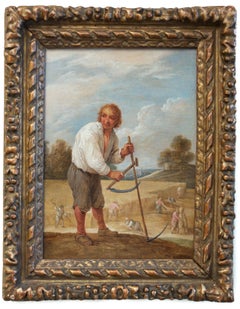
The farm boy in the field in this painting, which likely dates to the mature part of his career, is a wonderful entry into the mind of Teniers. In the tightly cropped motif, we see him standing right in the middle of the busy harvest when men, women and everyone capable were sent out in the field to collect the crop that formed the very core of their diet and survival. In the background we see a fresh blue sky interspersed with skillfully painted clouds, some trees reaching their autumnal colours and in the far distance the glimpse of a small church and village. The presence of a church in a landscape, so typical of Dutch art, served both a symbolic and visual function as a representation of faith while at the same time defining scale and distance.
In the field, the work is in full action with the farmers spread out in various positions, all in the midst of hard and sweaty labour. While they are portrayed as having nothing else than the work on their mind, our farm boy seems to have his attention directed elsewhere. Standing there with his white, half open shirt, flowy curls and strong, sturdy body; his gaze is directed away, out of the picture and the scythes in his hands. He looks almost smirking, expressed with tremendous subtlety in the slight smile of his lips and big eyes, being just in the middle of losing focus on the work. What is it that steals his attention? What has he seen, or realized, or felt – to break him free of the arduous task of harvesting, if but for a moment?
Here starts the wondering and the questions that are the hallmark of a great piece of art. Instead of explicitly locking in the motif in overly clear symbolism Teniers has chosen an open ended, subtle yet striking moment for us to consider. While it of course can be related to numerous other farm scene depictions of this time, and clever usages of gazes and real-life scenes to underscore various moral or symbolic meanings, the painting can be much more of a contemplation than an explanation or illustration. The ordinary nature and understated yet emotionally textured composition of the motif gives greater space for our own reactions and thoughts. Has he seen a pretty farm girl just passing by? Is he fed up with the farm life, joyously dreaming away for a minute, imagining another future? Or is he simply in need of distraction, looking away and ready for anything that can steal his attention?
One quality that never seem to have escaped Teniers was that of curiosity. During all of his career he constantly investigated, expanded and experimented with not only the style and technique of painting, but with the vision of art itself. Being credited with more or less introducing farm motifs for a broader audience not only tells us of his ability to understand the demand for different motifs, but the sensitivity to transform seemingly ordinary parts of life into deep aesthetic experiences, far beyond their expected reach. The farm boy in this painting is, of course, exactly that. But with the help of one smirk the entire picture is charged with a different energy, awakening many contrasts and relationships between the calm landscape, the hard work and his own breach of effectivity, holding sharp scythes while thinking or seeing something else.
It is no wonder Teniers chose to work with farm scenes as a way of investigating these intricate and delicate plays on expectations and surprises, clarity and ambivalence. It invites us to an appreciation of human everyday life that connects us with the people of 17th century...
Category
Late 17th Century Old Masters Landscape Paintings
Materials
Canvas, Oil
$28,463
Free Shipping
H 12.6 in W 10.04 in
18th century French Garden or Féte a Bride and musicians playing music
Located in Woodbury, CT
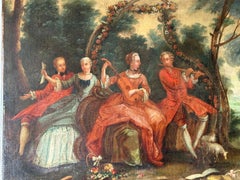
This enchanting 18th-century French fête galante captures the elegance and joy of aristocratic leisure, set amidst a lush garden adorned with flowers. A scene of refined celebration,...
Category
1780s Old Masters Figurative Paintings
Materials
Canvas, Oil
$2,710
Free Shipping
H 24 in W 28.5 in
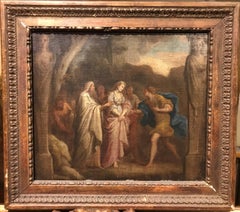
18th Century Neoclassical Oil Painting of the Trojan War: Briseis
Achilles
By James Thornhill
Located in London, GB
James Thornhill (1674-1735)
Oil on canvas
12 x 14 inches;
16 ½ x 18 ½ in. Inc. frame
The subject matter and inclusion of herms on both sides shows the influence of Louis...
Category
Early 18th Century Old Masters Figurative Paintings
Materials
Canvas, Oil
$24,428
H 16.5 in W 18.5 in
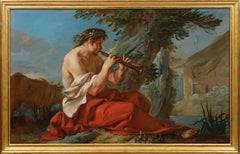
Mercury and Io, a rediscovered painting by Jean-Baptiste Marie Pierre (ca. 1740)
Located in PARIS, FR
We would like to thank Mr. Nicolas Lesur for confirming the autograph nature of the entire composition after a direct examination of the painting on November 27, 2024.
This painting...
Category
1740s Old Masters Figurative Paintings
Materials
Canvas, Oil
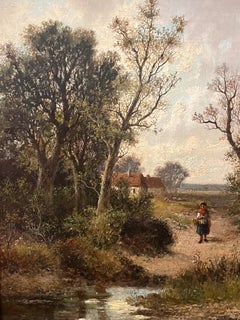
Landscape Near Felday, Surrey
By Abraham Hulk the Younger
Located in Hillsborough, NC
Dutch/English artist Abraham Hulk the Younger (1851-1922) is most known for landscapes of the British countryside. This work is one of a pair (the second work is also available by s...
Category
Late 19th Century Old Masters Landscape Paintings
Materials
Canvas, Oil
$1,960 Sale Price
30% Off
H 27 in W 22.75 in D 2.13 in
More From This Seller
View AllForest landscape bathed in sunlight / - The Monumentality of the Forest -
Located in Berlin, DE
Wilhelm Feldmann (1859 Lüneburg - 1932 Lübeck), Sunny forest landscape, c. 1900. Oil on canvas, marouflaged on wood, 37 cm x 48 cm (inside dimensions), 42.5 cm x 53.5 cm (frame), sig...
Category
Early 1900s Impressionist Landscape Paintings
Materials
Oil
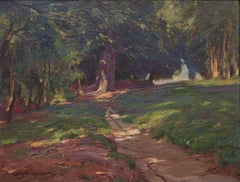
Autumn Landscape in Sunlight - Indian Summer -
Located in Berlin, DE
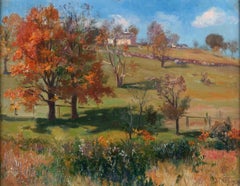
Frederick Vezin (1859 Torresdale Philadelphia - 1933 Düsseldorf), Autumn Landscape in the Sunlight, oil on canvas, mounted on cardboard, 32 x 41 cm (inside measurement), 44 x 51 cm (frame), signed and dates lower right "F. Vezin. [19]05".
- Cardboard slightly curved, small inconspicuous retouch at the centre of the upper edge of the picture.
About the artwork
Although the painting appears to be a sketch, Frederick Vezin considered it to be a finished work of art, as evidenced by his signature on the lower right. And it is precisely this sketchy quality that leads to an understanding of the painting, which was certainly created in the landscape itself: the natural phenomena were to be depicted artistically at the moment of their observation. This is not done by meticulously sketching nature, but - and here Vezin follows the teaching of French Impressionism - by illustrating nature in its visual fullness. The artist's eye is, as it were, immersed in the visuality of nature, which is made visible by his hand. The painting is therefore not a reflection of the landscape, but its artistic intensification.
This intensification also includes the fact that the foreground of the painting - corresponding to the field of vision - eludes a detail-oriented close-up view. Instead, the spatula-like application of paint, the vertical structure of which corresponds to the structure of the floral growth, has the effect of making nature tangible in its colourful substance.
At the same time, the foreground, which remains indeterminate in its concrete objectivity, creates an atmospheric space that connects with the actual protagonist of the picture, the group of trees, which flares up in shades of red and brown. Here, too, the leaves are more speckled than clearly outlined. It is precisely this 'sketchiness' that opens up a visual experience that makes the landscape accessible in its visual fullness, thus revealing its essence.
In addition to this abundance, the landscape is presented as a structure of order in that the composition of the picture makes the composition of the landscape visible. For example, the group of trees forms a distinct dark green shadow, which is repeated in the shadows cast by the trees behind it. A patterned diagonal axis is created in the picture, which is composed in this way by the landscape itself.
Strictly speaking, this is a cultivated landscape: a fence at the bottom and a low stone wall at the top, running from left to right, are two elements that also have a strong compositional effect. And on the top of the hill, a stone house is embedded in the landscape as the brightest surface in the picture. Nature and culture here form a harmonious synthesis, giving the painting an Arcadian touch.
In order to give the landscape as much space as possible, the horizon line is raised, but the design of the sky is also crucial. The clouds, combined with the shapes of the trees, create a bright blue sky. To the European eye, such a sky is reminiscent of a summer landscape. Accordingly, within the seasonal cycle, the blue sky is reserved for summer, and French Impressionism is also primarily an ode to summer. In Vezin's painting, however, the brilliant blue sky stands above an autumnal landscape, some of the trees even defoliated. It can therefore be assumed that the painting was made not in Europe but in the United States, and that it illustrates the proverbial Indian summer, making Frederick Vezin a pioneer of American landscape painting.
About the artist
Frederick Vezin was the son of a French immigrant to the United States and a German-born mother. This predestined him to promote artistic exchange between the old and new worlds. Having spent part of his schooling in Germany, in 1876, at the age of 20, he enrolled at the Düsseldorf Academy of Art, where he studied with Peter Janssen the Elder, Eduard von Gebhardt and Wilhelm Sohn, among others. He graduated in 1883, settled in Munich and returned to Düsseldorf in 1895, where he lived until his death in 1933.
A native of the United States, he travelled to the country frequently and became a popular portrait and society painter. His artistic talent, however, was most evident in his landscape paintings. Trained in French Impressionism, he developed a virtuoso use of colour and a free brushwork that remained tied to the landscape motif, opening up the landscape itself in a new way. Frederick Vezin turned his attention primarily to the landscape of his homeland, becoming a pioneer of modern American landscape...
Category
Early 1900s Impressionist Landscape Paintings
Materials
Oil, Cardboard
$2,087 Sale Price
20% Off
Sheltering from the storm / - Romantic landscape illuminated by lightning bolt -
By George Morland
Located in Berlin, DE
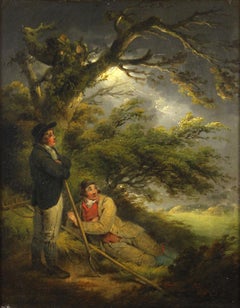
George Morland (1763 London - 1804 Brighton). Sheltering from the Storm. Oil on canvas, relined, 37.5 x 29.5 cm (visible size), 53.5 x 45.5 cm (...
Category
1790s Romantic Landscape Paintings
Materials
Oil
Late Summer River Landscape / - Realistic Impression -
By Jan Hillebrand Wijsmüller
Located in Berlin, DE
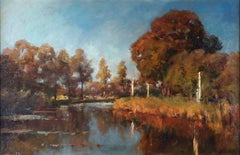
Jan Hillebrand Wijsmuller (1855 Amsterdam - 1925 ibid.), Late Summer River Landscape, oil on canvas, relined, 34 x 56 cm (inside measurement), 43 x 64 cm (frame), signed J[an] H[illebrand] Wijsmuller at lower right.
- in good condition, the frame with isolated bumped spots
- Realistic Impression -
About the artwork
The panoramic landscape format shows a river landscape, with the course of the river, which curves to the right, leading the eye into the depths of the picture and tempting it to continue the landscape in the imagination beyond the visible area. At the same time, however, the fact that the landscape is not visible through the bend in the river focuses our gaze on the entirety of the landscape depicted, without prompting us to focus on distant details. Accordingly, the brushstroke is not designed to render details with realistic precision. In the front left area of the river there is even a completely free brushwork, trained by Impressionism, which nevertheless remains committed to representational and convincingly suggests the movement of the water.
Regardless of the distance of the observer, the entire picture is painted with the same broad brushstroke, so that the landscape is given as an impression. And yet this impression is not ephemeral, as in the case of French Impressionism, to put it exaggeratedly, but reveals to us the essence of the landscape in all its richness. This is why the Dutch variant of Impressionism is always also a realism, although the pictures appear less progressive, but still contain a dimension of landscape painting that is lost with progress.
In the impression, the reality of the landscape is revealed, and this happens as we experience the landscape in the visual impression. Wijsmuller does not depict houses or people in order to allow the experience of the landscape to fully unfold. The experience is determined first and foremost by the river, which does not flow into the picture from our point of view, but towards us. Where the river begins to bend, the water is churned by a rapids. Toward us, the riverbed widens and the water comes to rest, covering the entire width of the foreground like a mirror.
The stillness of the water corresponds to the evening mood of the late summer landscape, in which the warm tones of the evening light blend with the yellow and brown tones of the plants. A gentle, almost idyllic reality, carried by the brushstroke, yet animated by a liveliness that is also made visible by the brushstroke. The broad, dynamically placed brushstrokes evoke the movement of the treetops and animate even the immobile reeds, while the trunks on the right bank, executed in virtuoso white strokes that seem like markings, make the sunlight shine. On the other bank, a carpet of light also spreads out, its energetic effect again expressed in the brushstroke. The dynamic of the landscape is further enhanced by the complementary color contrasts between the greens, yellows, and browns on the one hand and the blue of the all-encompassing sky on the other. A contrast that is intensified by the reflection in the water.
The evening coming to rest of the landscape is thus at the same time an all-encompassing contrasting and yet in itself harmonious movement. This reality becomes accessible to us as an experience in the impression of the landscape.
About the artist
Jan Hillebrand Wijsmuller entered the Royal Academy of Arts in Amsterdam in 1876 and studied under the innovative Professor August Allebé, who was famous for the Amsterdam Impressionism, also known as the Allebé School.
In 1877, Wijsmuller transferred to the Hague Academy of Art, and thus to the Hague School, and then completed his studies at the Brussels Academy of Art. Returning to the Netherlands, Wijsmuller opened his own studio in Amsterdam.
In 1883 he won the prestigious Young Artist Award, donated by Willink van Collen, which made Wijsmuller a well-known and sought-after artist.
Wijsmuller was a member of the Societät Arti et Amicitiae Amsterdam and the Pulchri Studio in The Hague.
Wijsmuller belongs to the second generation of the Hague School. While Vincent van Gogh described the protagonists of the first generation to his brother Theo as "the great gray people," the second generation, and Wijsmuller in particular, used a much more colorful palette. His oeuvre makes him a major player in Dutch Impressionism...
Category
1890s Impressionist Landscape Paintings
Materials
Canvas
$3,605 Sale Price
20% Off
Impressionist Autumn Landscape with Lake / - Diffuse Concretion -
Located in Berlin, DE
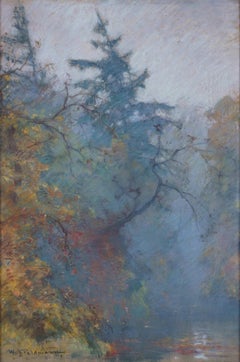
Wilhelm Feldmann (1859 Lüneburg - 1932 Lübeck), Impressionist autumn landscape with lake, around 1905. Pastel on cardboard, 46 cm x 31 cm (inside dimension), 52 cm x 37 cm (frame), s...
Category
Early 1900s Impressionist Landscape Paintings
Materials
Gouache
The gift of flowers / - The depth of allegory -
By Conrad Kiesel
Located in Berlin, DE
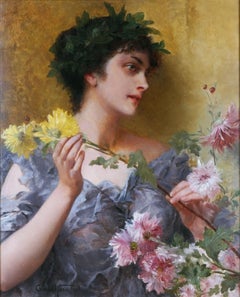
Conrad Kiesel (1846-1921), The gift of flowers. Oil on wood, 43 x 35 cm, 69 x 61 cm (frame), signed at lower left "Conrad Kiesel pxt [pinxit]", about 1900. In a magnificent gilt stuc...
Category
1890s Academic Nude Paintings
Materials
Oil
Still Thinking About These?
All Recently ViewedMore Ways To Browse
Bay Area Figurative Art
Bull Oil Painting
Jacques Louis David
19th Century Children Paintings
Anne Marie Migette Perard
Jazz Club
Oil Painting Musician
Tel Aviv Painting
Painting Bicycle
Twin Paintings
Two Young Girls
Charlie Chaplin
17th Century Wood Panels
Minnie Mouse
Woman Large Painting
88 Gallery
Dasha Pogodina
Family Photo