Want more images or videos?
Request additional images or videos from the seller
1 of 14
Pietro SassiCalvary - Large 19th Century Oil Painting Jerusalem City
Crucifixion of JesusCirca 1870
Circa 1870
$68,185.01List Price
About the Item
- Creator:Pietro Sassi (Italian)
- Creation Year:Circa 1870
- Dimensions:Height: 55 in (139.7 cm)Width: 86 in (218.44 cm)Depth: 3 in (7.62 cm)
- Medium:
- Movement Style:
- Period:
- Condition:
- Gallery Location:Gerrards Cross, GB
- Reference Number:1stDibs: LU741315159532
About the Seller
5.0
Platinum Seller
Premium sellers with a 4.7+ rating and 24-hour response times
Established in 2012
1stDibs seller since 2017
158 sales on 1stDibs
Typical response time: 1 hour
Associations
LAPADA - The Association of Arts
Antiques DealersInternational Confederation of Art and Antique Dealers
Associations
Authenticity Guarantee
In the unlikely event there’s an issue with an item’s authenticity, contact us within 1 year for a full refund. DetailsMoney-Back Guarantee
If your item is not as described, is damaged in transit, or does not arrive, contact us within 7 days for a full refund. Details24-Hour Cancellation
You have a 24-hour grace period in which to reconsider your purchase, with no questions asked.Vetted Professional Sellers
Our world-class sellers must adhere to strict standards for service and quality, maintaining the integrity of our listings.Price-Match Guarantee
If you find that a seller listed the same item for a lower price elsewhere, we’ll match it.Trusted Global Delivery
Our best-in-class carrier network provides specialized shipping options worldwide, including custom delivery.You May Also Like
Stag Hunting in the Vicinity of Nuremberg by a German Artist Peter von Bemmel
Located in PARIS, FR
This small landscape shows a hunting scene: two riders are chasing a stag with their dogs at the edge of a forest. Signed by Peter von Bemmel, it is typical of the production of this...
Category
1720s Old Masters Landscape Paintings
Materials
Copper
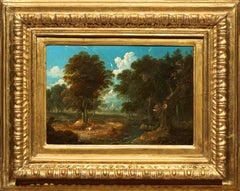
Mercury and Io, a rediscovered painting by Jean-Baptiste Marie Pierre (ca. 1740)
Located in PARIS, FR
We would like to thank Mr. Nicolas Lesur for confirming the autograph nature of the entire composition after a direct examination of the painting on November 27, 2024.
This painting...
Category
1740s Old Masters Figurative Paintings
Materials
Canvas, Oil

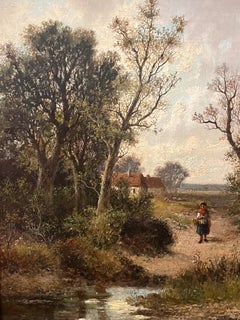
Landscape Near Felday, Surrey
By Abraham Hulk the Younger
Located in Hillsborough, NC
Dutch/English artist Abraham Hulk the Younger (1851-1922) is most known for landscapes of the British countryside. This work is one of a pair (the second work is also available by s...
Category
Late 19th Century Old Masters Landscape Paintings
Materials
Canvas, Oil
$1,960 Sale Price
30% Off
H 27 in W 22.75 in D 2.13 in
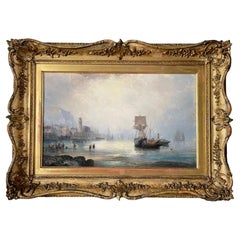
Period Marine Landscape Credited to Warren Sheppard
By Warren W. Sheppard
Located in Roma, IT
This beautiful painting, due to its very high quality of execution, style and era, can be referred to the great artist Warren Sheppard, who specialized in seascapes.
Of great evocati...
Category
19th Century Old Masters Landscape Paintings
Materials
Canvas, Oil
$3,343
H 15.75 in W 21.46 in D 2.76 in
Landscape with Gentleman on Horseback and Peasant Woman Receiving Alms
By Philips Wouwerman
Located in Stockholm, SE
Workshop / Circle of Philips Wouwerman (1619-1668)
Landscape with Gentleman on Horseback and Peasant Woman Receiving Alms
oil on oak panel
12.40 x 14.17 inches (31.5 x 36 cm)
wit...
Category
17th Century Old Masters Landscape Paintings
Materials
Oak, Oil, Wood Panel

$17,913
H 12.41 in W 14.18 in
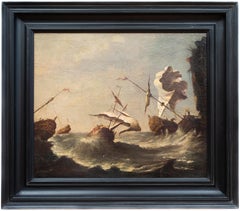
Shipping in Stormy Waters, Attributed to Italian Artist Francesco Guardi
By Francesco Guardi
Located in Stockholm, SE
The splendour of the tragic sea
Francesco Guardi and maritime painting in Venetian art
No Venetian painter was a stranger to the sea. After all, Venice was not only one of the most prominent ports of the Mediterranean, but indeed a city literally submerged in the ocean from time to time. Curiously however, the famous Venetian school of painting showed little interest in maritime motifs, favouring scenes from the iconic architecture of the city rather than seascapes. That is why this painting is a particularly interesting window into not only the painter Francesco Guardi himself – but to the significance of the element of water in art history, in absence as well as in the centre of attention.
Whether it be calm, sunny days with stunning views of the palaces alongside the canals of Venice or – more rarely – stormy shipwrecking tragedies at sea, water as a unifying element is integral to the works of painter Francesco Guardi (1712–1793). During his lifetime, Venetian art saw many of its greatest triumphs with names like Tiepolo or Canaletto gaining international recognition and firmly establishing Venice as one of the most vibrant artistic communities of Europe. While the city itself already in the 18th century was something of an early tourist spot where aristocrats and high society visited on their grand tour or travels, the artists too contributed to the fame and their work spread the image of Venice as the city of romance and leisure to an international audience, many of whom could never visit in person.
Still today, the iconic image of Venice with its whimsical array of palaces, churches and other historic buildings is much influenced by these artists, many of whom have stood the test of time like very well and remain some of the most beloved in all of art history. It was not primarily subtility, intellectual meanings or moral ideals that the Venetian art tried to capture; instead it was the sheer vibrancy of life and the fast-paced city with crumbling palaces and festive people that made this atmosphere so special. Of course, Venice could count painters in most genres among its residents, from portraiture to religious motifs, history painting and much else. Still, it is the Vedutas and views of the city that seems to have etched itself into our memory more than anything else, not least in the tradition of Canaletto who was perhaps the undisputed master of all Venetian painters.
Born into his profession, Francesco lived and breathed painting all his life. His father, the painter Domenico Guardi (1678–1716) died when Francesco was just a small child, yet both he and his brothers Niccolò and Gian Antonio continued in their fathers’ footsteps. The Guardi family belonged to the nobility and originated from the mountainous area of Trentino, not far from the Alps. The brothers worked together on more challenging commissions and supported each other in the manner typical of family workshops or networks of artists. Their sister Maria Cecilia married no other than the artist Giovanni Battista Tiepolo himself, linking the family to the most renowned Venetian name of the time. During almost a decade, Guardi worked in the studio of Michele Giovanni Marieschi, sometimes simply known as Michiel, a painted similar in both style and motif. Canaletto is, however, the artist Guardi is most often compared to since they shared a mutual fascination for depicting the architecture and cityscape of Venice.
During the course of his career, Guardi tried his hand in many different genres. He was as swift in painting landscapes, Vedutas of Venice, sacred motifs, interiors and architectural compositions as he was in a number of other motifs. His style is typical of the Venetian school but also distinct and personal once we look a little closer. There is an absolute certainty in the composition, the choice of which sometimes feels like that of a carefully calculated photograph – yet it is also very painterly, in the best sense of the word: fluid, bold, sensitive and full of character. The brushwork is rapid, intense, seemingly careless and extraordinarily minute at the same time; fresh and planned in a very enjoyable mixture. His interiors often capture the breath-taking spacious glamour of the palaces and all their exquisite decor. He usually constructed the motif through remarkably simple, almost spontaneous yet intuitively precise strokes and shapes. The result was a festive, high-spirited atmospheric quality, far away from the sterile and exact likeness that other painters fell victim to when trying to copy Canaletto.
The painting here has nothing of the city of Venice in it. On the contrary, we seem to be transported far away into the solitary ocean, with no architecture, nothing to hold on to – only the roaring sea and the dangerous cliffs upon which the ships are just moments away from being crushed upon. It is a maritime composition evoking both Flemish and Italian precursors, in the proud tradition of maritime painting that for centuries formed a crucial part of our visual culture.
This genre of painting is today curiously overlooked, compared to how esteemed and meaningful it was when our relationship to the sea was far more natural than it is today. When both people and goods travelled by water, and many nations and cities – Venice among them – depended entirely on sea fare, the existential connection to the ocean was much more natural and integrated into the imagination. The schools and traditions of maritime art are as manifold as there are countries connected to the sea, and all reflect the need to process the dangers and wonders of the ocean.
It could symbolize opportunity, the exciting prospects of a new countries and adventures, prospering trade, beautiful scenery as well as war and tragedy, loss of life, danger and doom. To say that water is ambivalent in nature is an understatement, and these many layers were something that artists explored in the most wondrous ways. Perhaps it takes a bit more time for the modern eye to identify the different nuances and qualities of historic maritime paintings, they may on first impression seem hard to differentiate from each other. But when allowing these motifs to unfold and tell stories of the sea in both fiction and reality – or somewhere in between – we are awarded with an understanding of how the oceans truly built our world.
In Guardi’s interpretation, we see an almost theatrically arranged shipwrecking scene. No less than five ships are depicted right in the moment of utter disaster. Caught in a violent storm, the waves have driven them to a shore of sharp cliffs and if not swallowed by the waves, crushing against the cliffs seems to be the only outcome. The large wooden ships are impressively decorated with elaborate sculpture, and in fact relics already during Guardi’s lifetime. They are in fact typical of Dutch and Flemish 17th century ships, giving us a clue to where he got the inspiration from. Guardi must have seen examples of Flemish maritime art, that made him curious about these particular motifs. One is reminded of Flemish painters like Willem van de Velde and Ludolf Backhuysen, and this very painting has indeed been mistakenly attributed to Matthieu van Plattenberg...
Category
18th Century Old Masters Landscape Paintings
Materials
Canvas, Oil
$70,458
Free Shipping
H 25.79 in W 29.14 in
Abraham and the Sacrifice of His Son Isaac by Adriaen Van Stalbemt, C. 1605-1610
Located in Stockholm, SE
Artist: Adriaen van Stalbemt (Stalbempt) 1580-1662
Title: Abraham and the Sacrifice of His Son Isaac “Das Opfer des Abraham”
According to the Old...
Category
Early 1600s Old Masters Landscape Paintings
Materials
Copper
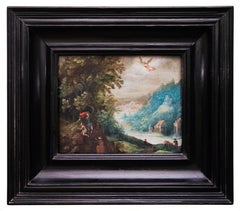
$46,574
Free Shipping
H 8.08 in W 9.97 in
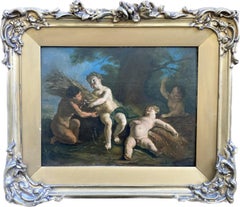
Old master painting of Cherubs cavorting in a woodland setting
By Jean-Honoré Fragonard
Located in Harkstead, GB
A charming image of cherubs cavorting with sheaths of wheat in a woodland setting.
Follower of Jean-Honoré Fragonard
Cherubs cavorting before a tree
Oil on panel
10¾ x 14 inches exc...
Category
Early 19th Century Old Masters Landscape Paintings
Materials
Oil, Wood Panel
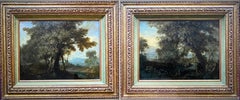
A Pair of Forest Landscapes
by Philipp H. Brinckmann (1709 – 1761) Old Master
Located in Knokke, BE
Brinckmann Philipp Hieronymus
Spire 1709 – 1761 Manheim
Old Master
'A Pair of Forest Landscapes with River and Boat in the Foreground'
Signature: signed "Ph. Brinckm" bottom lower ...
Category
18th Century Old Masters Landscape Paintings
Materials
Copper
$11,703
H 13.78 in W 16.54 in D 1.58 in
Bedouin at Prayer, Orientalist Oil Painting on Panel by Rudolf Ernst
By Rudolf Ernst
Located in Long Island City, NY
This painting by Orientalist artist Rudolf Ernst depicts a Muslim man in quiet contemplation during prayer. He kneels in solitude in the vast desert as the light fades around him. Ma...
Category
1890s Old Masters Figurative Paintings
Materials
Oil, Wood Panel

Price Upon Request
H 22 in W 27.75 in
More From This Seller
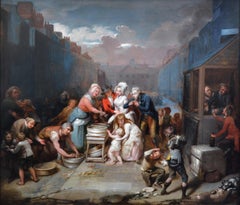
View AllVery Large 18th Century Royal Academy Oil Painting of Georgian London Festival
Located in Gerrards Cross, GB
‘St. James’ Day’ by Richard Morton Paye (1750-1820). This very large and fine 18th century oil on canvas depicts a diverse crowd of Londoners at an oyster stand on a summer’s evening...
Category
1780s Old Masters Figurative Paintings
Materials
Oil
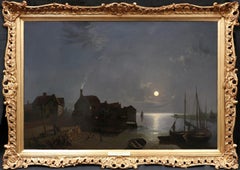
River Thames at Leigh by Moonlight - 19th Century Oil Painting Nocturne 1851
By Henry Pether
Located in Gerrards Cross, GB
‘The River Thames at Leigh by Moonlight’ by Henry Pether (1800-1880).
The painting is signed by the artist and dated 1851 and is presented in a bespoke gold metal leaf frame.
• Vi...
Category
1850s Old Masters Landscape Paintings
Materials
Oil
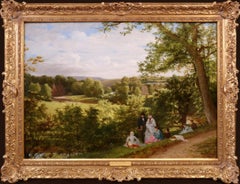
A Day in the Country - 19th Century Royal Academy Oil Painting Summer Landscape
Located in Gerrards Cross, GB
‘A Day in the Country’ by William Frederick Witherington R.A. (1785-1865).
Academy Fine Paintings is fully conversant with the latest US Government import duties and the legal exemp...
Category
1850s English School Landscape Paintings
Materials
Oil
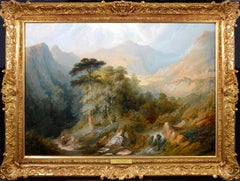
Vale of the Conwy - Large 19th Century Oil Painting Landscape of North Wales
Located in Gerrards Cross, GB
‘Vale of the Conwy’ by Samuel Lines (1778-1863).
Academy Fine Paintings is fully conversant with the latest US Government import duties and the legal exemptions under the US Consti...
Category
Early 19th Century English School Landscape Paintings
Materials
Oil
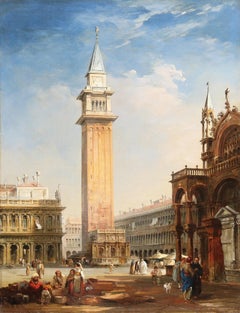
19th Century Oil Painting of St Mark
s Square in Venice from the Ducal Palaca
By Edward Pritchett
Located in Gerrards Cross, GB
‘Piazza San Marco from the Palazzo’ by Edward Pritchett RWS (1807-1876).
The painting – which depicts St. Mark’s Square and the Campanile seen from the Porto della Carta entrance to...
Category
Mid-19th Century English School Landscape Paintings
Materials
Oil
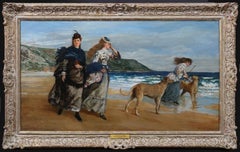
19th Century English Impressionist Oil Painting Girls
Dogs on Beach in Spring
Located in Gerrards Cross, GB
‘A Breeze after a Bathe’ by Walter Duncan ARWS (1847-1932). The painting – which depicts three young Victorian ladies and their dogs on Bournemouth beach after a swim – is signed by ...
Category
1870s Impressionist Figurative Paintings
Materials
Oil
Still Thinking About These?
All Recently ViewedMore Ways To Browse
Vintage Beach Girls
Battle Scene Oil Painting
Canvas Tent
Chinese Girl Painting
Figurative Crowd Paintings
Gambling Painting
George Little
Indian Masters Paintings
Juliane Hundertmark
Kimon Nicolaides
Matador Paintings
Meat Painting
Mermaid Oil Paintings
Mother And Baby Art
Norman Lewis
Original Book Covers
Salzburg Festival
Street Urchin