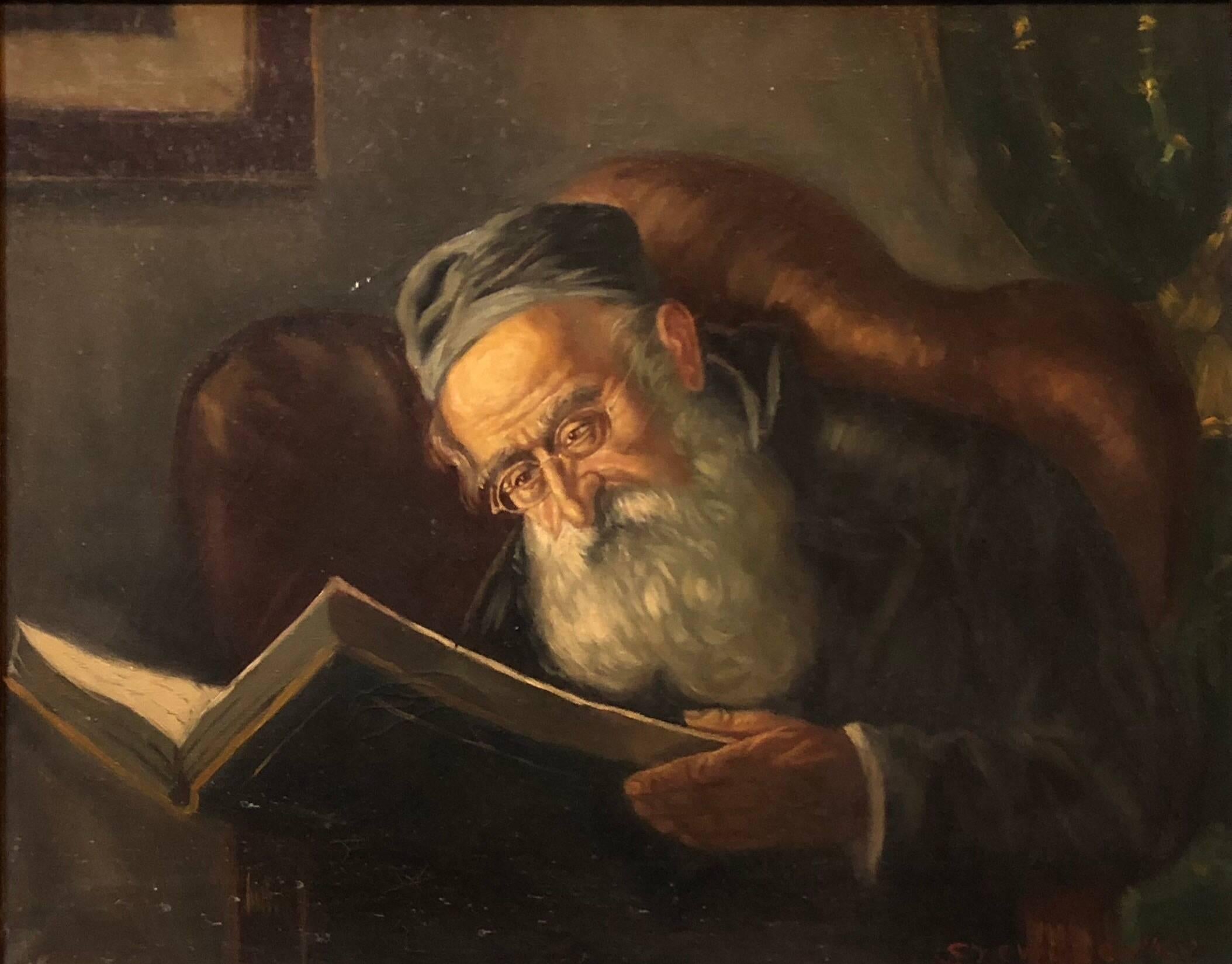
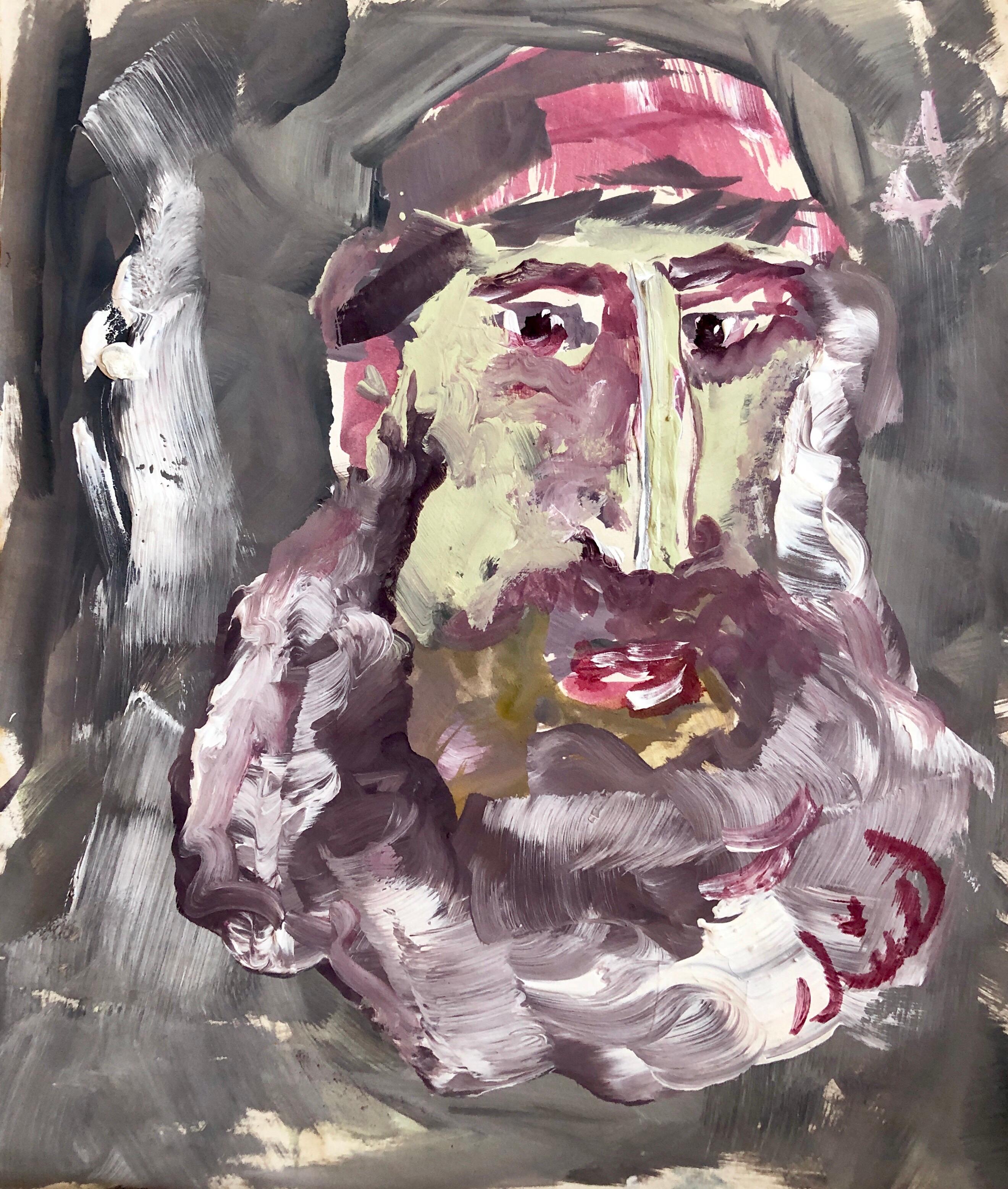
Items Similar to Bearded man, Jewish King or Rabbi Polish Israeli Folk Art Modernist Oil Painting
Want more images or videos?
Request additional images or videos from the seller
1 of 6
Pinchas ShaarBearded man, Jewish King or Rabbi Polish Israeli Folk Art Modernist Oil Paintingc.1960
c.1960
$2,600
£1,979.85
€2,279.74
CA$3,684.43
A$3,963.13
CHF 2,118.01
MX$46,714.01
NOK 26,703.17
SEK 24,411.76
DKK 17,033.50
About the Item
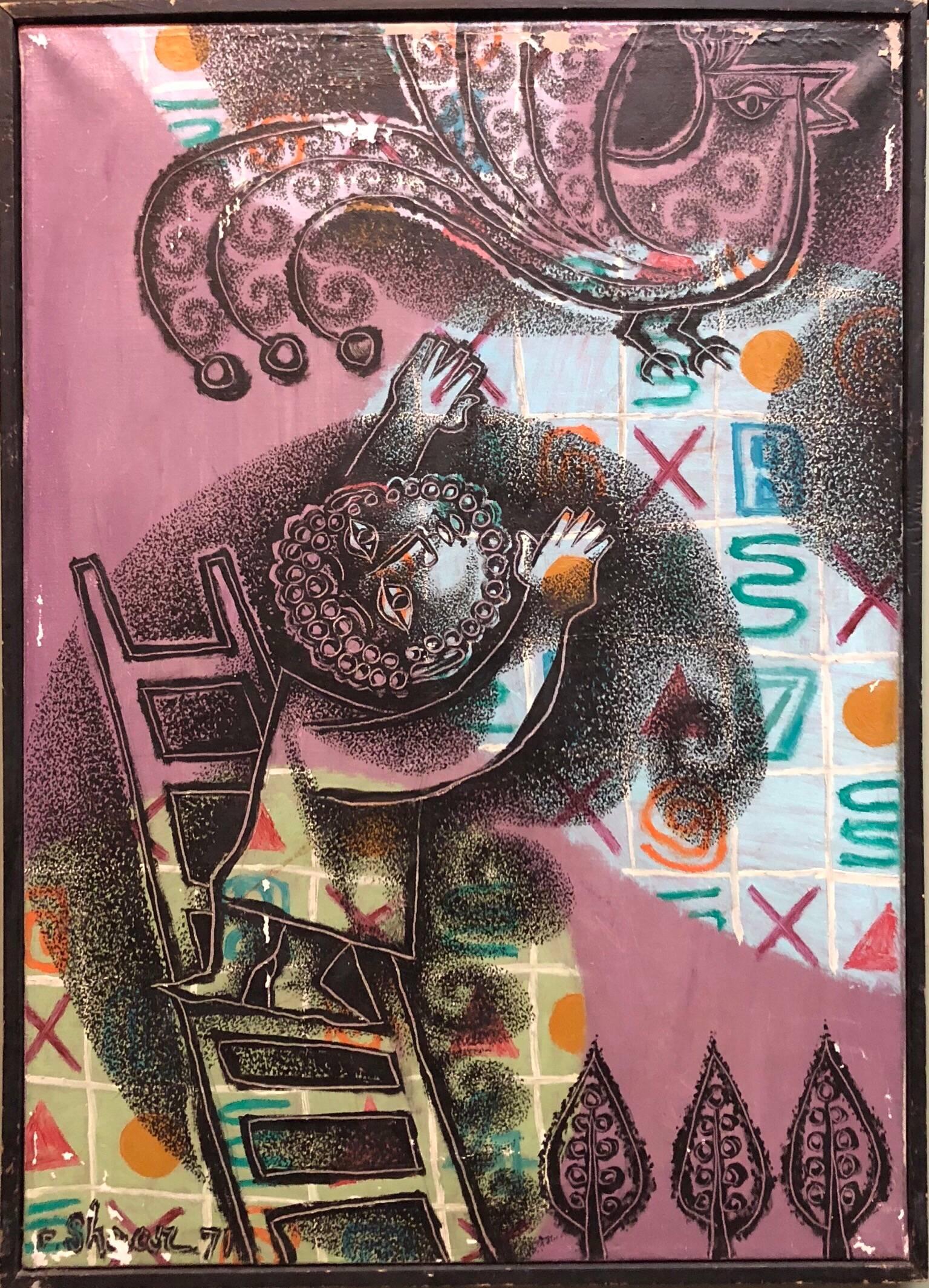
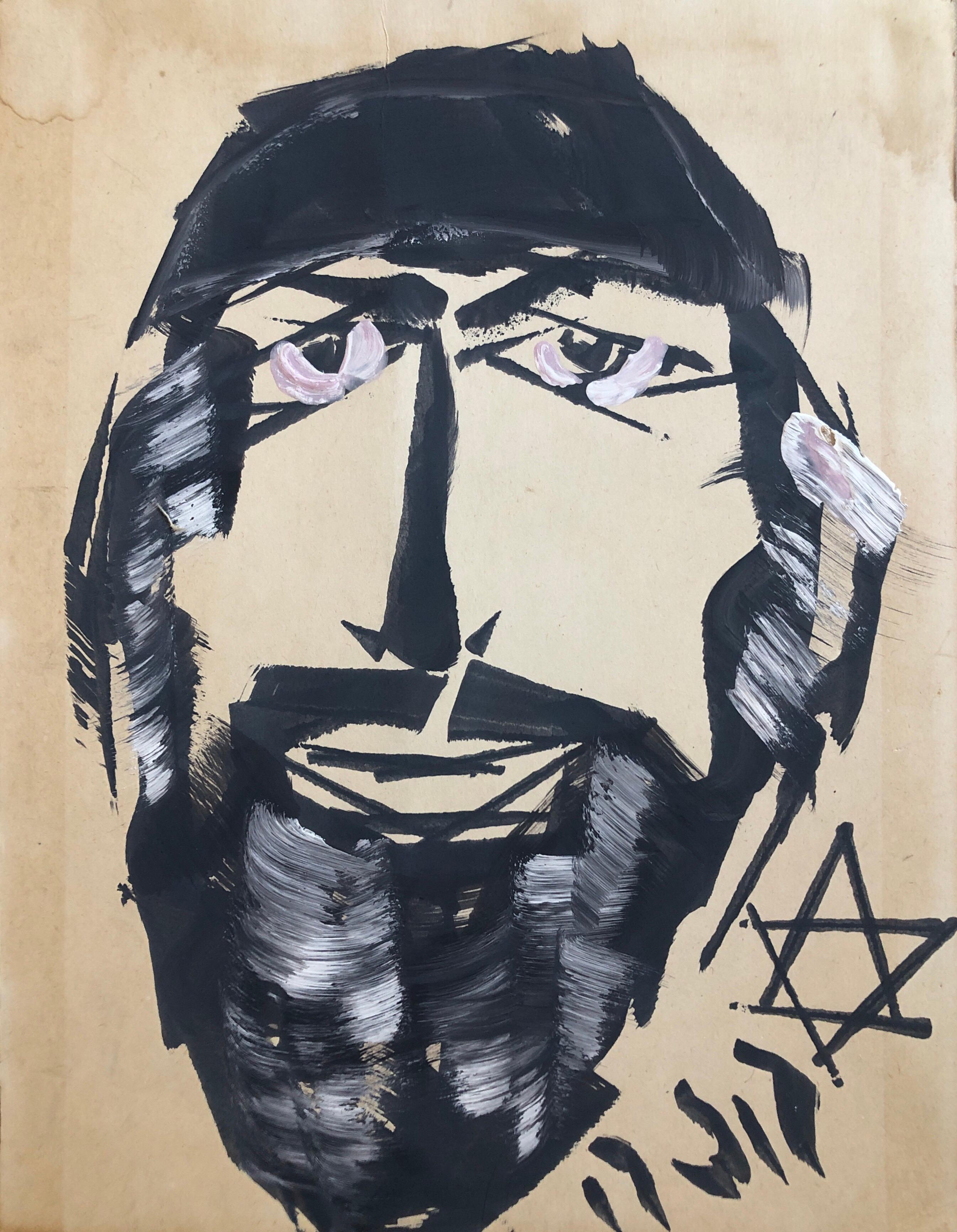
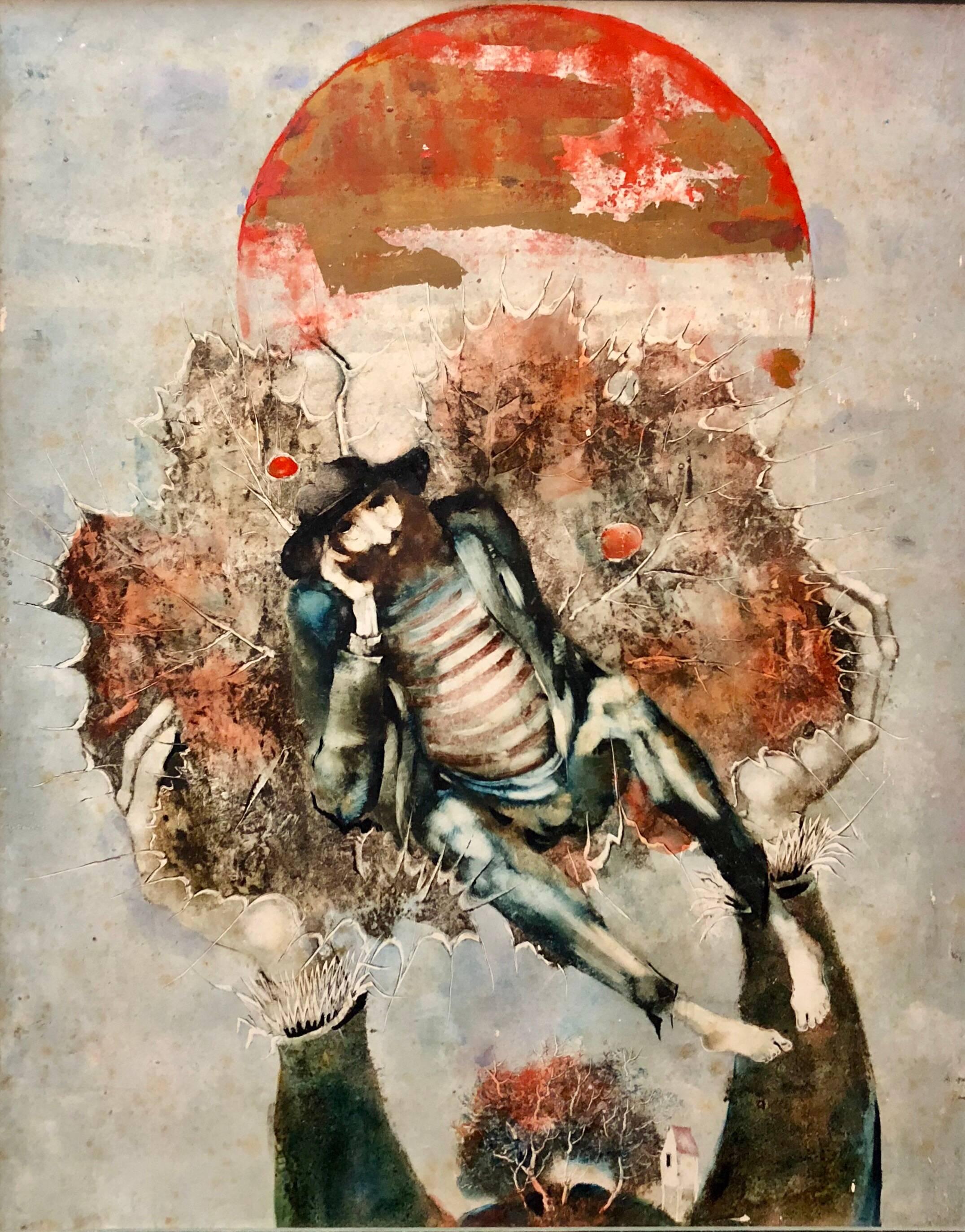
This painting is iconic of Pichas Shaar's aesthetic, and stylistic influences. A ceramic mosaicist and sculptor as well as a painter, Shaars strong decorative sense was evident in his colorful canvas, with their frequent rectilinear geometry, depicting stylized figures, often mythological or biblical subjects. 23.75 X15.75 inches without frame.
Pinchas Shaar (born Szwarc, later Shaar) was born in Lodz, Poland in 1923. already at a young age he drew small graffiti and characters of fairy tales. at sixteeen he met the Polish painter Wladyslaw Strzeminski, a disciple of the Russian painter Kazimir Malevich, who encouraged Pinchas’ artistic education. Strzeminski encouraged Pinchas' artistic education and introduced him to the works of such painters as Picasso, Leger, Matisse, and Mondrian. Pinchas had his first exhibition in 1938 and also completed photomontages for a poetry book by Moshe Broderson that was published in 1939. Then, in September 1939, Nazi Germany invaded Poland. On February 1940 the Jews of Lodz had to move to a ghetto and perform forced labor. The artist experienced the horrors of war and the Nazi holocaust concentration camps. Pinchas worked in a prefabricated furniture factory. However, after his artistic abilities were discovered, he became a draftsman. He also designed decorations for the ghetto's theater. In 1944 the Germans liquidated the Lodz ghetto and deported its inhabitants to concentration camps. Pinchas, his brothers and his father were sent to Sachsenhausen. After his liberation by the Soviet Army in 1945, Pinchas was fortunate to reunite with his parents and his two brothers. Unfortunately Pinchas' sister and her child perished in a Nazi camp. After the war, he spent a few years in Munich Germany, where he painted stage sets. In 1951 he returned to Israel. In 1974, he decided to go live in Paris, France In Paris, he studied at the Grande Chaumière and the Ecole des Beaux-Arts. It is in Paris that he begins to paint the little fantastic folk art characters of his Jewish childhood. His work reads like poetry. Indeed, the artist gives great importance to writing that can be both graphics and thought. There is in the artist a certain spontaneity, a true freedom of expression. His paintings are like stories in which little fairy figures move, such as queens of Sheba, prophets, magi, or animals belonging to a fabulous bestiary. Pinchas Shaar reveals the meanders of his consciousness and gives us an imaginary universe that sometimes refers to Jewish folklore. The work of Pinchas Shaar is comparable to an inner world, tinged with both humor and sadness. But unlike the German Expressionists, Pinchas Shaar does not paint the "horror". The anxiety of the artist is rather of the order of metaphysics.
His work is in many museums and galleries and was included in the show Israel - Entre Reve et Realite at the Musée Juif de Belgique, Brussels, Belgium along with
Bergner, Yosl Pann, Abel, Rubin, Reuven, Tumarkin, Igael Lilien, Ephraim Moses Agam, Yaacov, Pins, Jacob Kadishman, Menashe amongst others.
- Creator:Pinchas Shaar (1923-1996, Israeli)
- Creation Year:c.1960
- Dimensions:Height: 32 in (81.28 cm)Width: 24 in (60.96 cm)
- Medium:
- Movement Style:
- Period:
- Condition:wear to frame.
- Gallery Location:Surfside, FL
- Reference Number:1stDibs: LU38212481822
About the Seller
4.9
Platinum Seller
Premium sellers with a 4.7+ rating and 24-hour response times
Established in 1995
1stDibs seller since 2014
1,863 sales on 1stDibs
Typical response time: <1 hour
- ShippingRetrieving quote...Shipping from: Surfside, FL
- Return Policy
More From This Seller
View AllJudaica Polish Israeli Folk Art Biblical Modernist Oil Painting
By Pinchas Shaar
Located in Surfside, FL
This painting is iconic of Pichas Shaar's aesthetic, and stylistic influences. A ceramic mosaicist and sculptor as well as a painter, Shaars strong decorative sense was evident in his colorful canvas, with their frequent rectilinear geometry, depicting stylized figures, often mythological or biblical subjects.
Pinchas Shaar (born Szwarc, later Shaar) was born in Lodz, Poland in 1923. already at a young age he drew small graffiti and characters of fairy tales. at sixteeen he met the Polish painter Wladyslaw Strzeminski, a disciple of the Russian painter Kazimir Malevich, who encouraged Pinchas’ artistic education. Strzeminski encouraged Pinchas' artistic education and introduced him to the works of such painters as Picasso, Leger, Matisse, and Mondrian. Pinchas had his first exhibition in 1938 and also completed photomontages for a poetry book by Moshe Broderson that was published in 1939. Then, in September 1939, Nazi Germany invaded Poland. On February 1940 the Jews of Lodz had to move to a ghetto and perform forced labor. The artist experienced the horrors of war and the Nazi holocaust concentration camps. Pinchas worked in a prefabricated furniture factory. However, after his artistic abilities were discovered, he became a draftsman. He also designed decorations for the ghetto's theater. In 1944 the Germans liquidated the Lodz ghetto...
Category
1960s Folk Art Figurative Paintings
Materials
Canvas, Oil
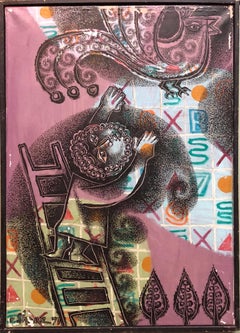
Outsider Folk Art Expressionist Rabbi Israeli Painting Signed Hebrew Jewish Star
Located in Surfside, FL
This is a signed portrait painting done in an outsider, folk art, expressionist style. it is signed in Hebrew, also marked with a Jewish star. this is from a collection of works by the same hand. they are all signed. Some have markings to the back of the paper. they have some age to them. They bear similarities to artists as dissimilar as Moshe tamir, Mane Katz and an Israeli version of Purvis Young. In this piece the artist choice of colors is muted yet powerful.
Israel has had a Vibrant Folk Art, Naive art scene for a long time now, artists like Yisrael Paldi, Nahum Guttman, Reuven Rubin and even Yefim Ladyzhensky had naive periods. The most well know of the strict naive artists are Shalom of Safed, Irene Awret, Gabriel Cohen, Natan Heber, Michael Falk and Kopel Gurwin.
Naïve art is any form of visual art that is created by a person who lacks the formal education and training that a professional artist undergoes (in anatomy, art history, technique, perspective, ways of seeing). Unlike folk art, naïve art does not necessarily evince a distinct cultural context or tradition. Naïve art is recognized, and often imitated, for its childlike simplicity and frankness. Paintings of this kind typically have a flat rendering style with a rudimentary expression of perspective.
One particularly influential painter of "naïve art" was Henri Rousseau (1844–1910), a French Post-Impressionist who was discovered by Pablo Picasso.
Naïve art is often seen as outsider art that is by someone without formal (or little) training or degree. While this was true before the twentieth century, there are now academies for naïve art. Naïve art is now a fully recognized art genre, represented in art galleries worldwide.
Museums devoted to naïve art now exist in Kecskemét, Hungary; Riga, Latvia; Jaen, Spain; Rio de Janeiro, Brasil; Vicq France and Paris. "Primitive art" is another term often applied to art by those without formal training, but is historically more often applied to work from certain cultures that have been judged socially or technologically "primitive" by Western academia, such as Native American, sub saharan African or Pacific Island art (see Tribal art). This is distinguished from the self-conscious, "primitive" inspired movement primitivism. Another term related to (but not completely synonymous with) naïve art is folk art.
There also exist the terms "naïvism" and "primitivism" which are usually applied to professional painters working in the style of naïve art (like Paul Gauguin, Mikhail Larionov, Paul Klee).
At all events, naive art can be regarded as having occupied an "official" position in the annals of twentieth-century art since - at the very latest - the publication of the Der Blaue Reiter, an almanac in 1912. Wassily Kandinsky and Franz Marc, who brought out the almanac, presented 6 reproductions of paintings by le Douanier' Rousseau (Henri Rousseau), comparing them with other pictorial examples. However, most experts agree that the year that naive art was "discovered" was 1885, when the painter Paul Signac became aware of the talents of Henri Rousseau and set about organizing exhibitions of his work in a number of prestigious galleries.
The Earth Group (Grupa Zemlja) were Croatian artists, architects and intellectuals active in Zagreb from 1929 to 1935. The group included the painters Krsto Hegedušić, Edo Kovačević, Omer Mujadžić, Kamilo Ružička, Ivan Tabaković, and Oton Postružnik, the sculptors Antun Augustinčić, Frano Kršinić, and the architect Drago Ibler. Art brut, primitive art, primitive, art naïf, naïve art. Outsider art. A term applied to Yugoslav (Croatian) naive painters working in or around the village of Hlebine, near the Hungarian border, from about 1930. Some of the best known naive artists are Dragan Gaži, Ivan Generalić, Josip Generalić, Krsto Hegedušić, Mijo Kovačić, Ivan Lacković-Croata, Franjo Mraz, Ivan Večenaj and Mirko Virius.
Camille Bombois (1883–1970) Ferdinand Cheval, known as 'le facteur Cheval' (1836–1924)
Henry Darger (1892–1973) L. S. Lowry (1887–1976) Grandma Moses, Anna Mary Robertson (1860–1961) Nikifor (1895–1968) Poland, Horace Pippin (1888–1946) Jon Serl (1894-1993) United States
Alfred Wallis (1855–1942) Scottie Wilson (1890–1972) Gesner Abelard (b. 1922) Jan Balet (1913–2009) Michel Delacroix (b. 1933) France Howard Finster (1916–2001) Ivan Rabuzin (1921–2008)
Spontaneous Art Museum in Brussels
Art en Marge Museum in Brussels
MADmusée in Liege
International Museum of Naive Art of Brazil in Cosme Velho, Rio de Janeiro
Gallery Jacques Ardies in São Paulo
Musée international d'art naïf de Magog in Magog
Croatian Museum of Naïve Art in Zagreb
Gallery of Croatian Naïve Art...
Category
20th Century Outsider Art Portrait Paintings
Materials
Gouache
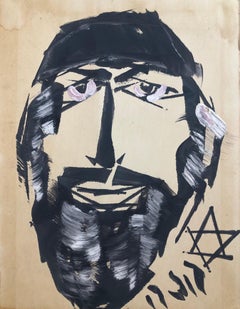
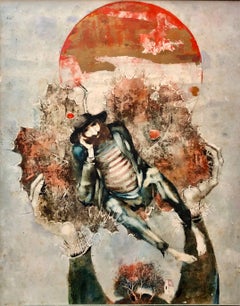
Mid Century Hungarian Gilt Oil Painting on Board Modern Judaica
Located in Surfside, FL
From a collection by a long time Miami Beach art dealer on the old Lincoln Rd. This is a piece he brought back from hungary. from a collection of good Hungarian artists and Illustrat...
Category
20th Century Modern Figurative Paintings
Materials
Oil, Board
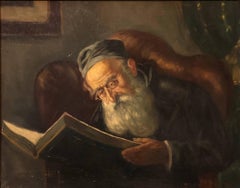
Polish Jewish Art, The Rabbi, Judaica Oil Painting
By Konstanty Szewczenko
Located in Surfside, FL
Konstanty Swewczenko (1910-1991), signed oil Judaica Oil Painting, Polish.
Konstantin Shevchenko studied at the Institute of Fine Arts in Warsaw in the years 1927 - 1928. Then, in 19...
Category
Mid-20th Century Modern Portrait Paintings
Materials
Canvas, Oil
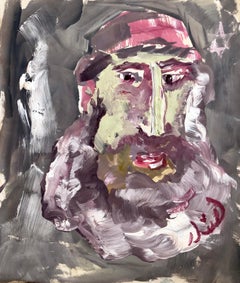
Outsider Folk Art Expressionist Rabbi Israeli Painting Signed Hebrew Jewish Star
Located in Surfside, FL
This is a signed portrait painting done in an outsider, folk art, expressionist style. it is signed in Hebrew, also marked with a Jewish star. this is from a collection of works by the same hand. they are all signed. Some have markings to the back of the paper. they have some age to them. They bear similarities to artists as dissimilar as Moshe Tamir, Mane Katz and an Israeli version of Purvis Young. In this piece the artist choice of colors is muted yet powerful.
Israel has had a Vibrant Folk Art, Naive art scene for a long time now, artists like Yisrael Paldi, Nahum Guttman, Reuven Rubin and even Yefim Ladyzhensky had naive periods. The most well know of the strict naive artists are Shalom of Safed, Irene Awret, Gabriel Cohen, Natan Heber, Michael Falk and Kopel Gurwin.
Naïve art is any form of visual art that is created by a person who lacks the formal education and training that a professional artist undergoes (in anatomy, art history, technique, perspective, ways of seeing). Unlike folk art, naïve art does not necessarily evince a distinct cultural context or tradition. Naïve art is recognized, and often imitated, for its childlike simplicity and frankness. Paintings of this kind typically have a flat rendering style with a rudimentary expression of perspective.
One particularly influential painter of "naïve art" was Henri Rousseau (1844–1910), a French Post-Impressionist who was discovered by Pablo Picasso.
Naïve art is often seen as outsider art that is by someone without formal (or little) training or degree. While this was true before the twentieth century, there are now academies for naïve art. Naïve art is now a fully recognized art genre, represented in art galleries worldwide.
Museums devoted to naïve art now exist in Kecskemét, Hungary; Riga, Latvia; Jaen, Spain; Rio de Janeiro, Brasil; Vicq France and Paris. "Primitive art" is another term often applied to art by those without formal training, but is historically more often applied to work from certain cultures that have been judged socially or technologically "primitive" by Western academia, such as Native American, sub saharan African or Pacific Island art (see Tribal art). This is distinguished from the self-conscious, "primitive" inspired movement primitivism. Another term related to (but not completely synonymous with) naïve art is folk art.
There also exist the terms "naïvism" and "primitivism" which are usually applied to professional painters working in the style of naïve art (like Paul Gauguin, Mikhail Larionov, Paul Klee).
At all events, naive art can be regarded as having occupied an "official" position in the annals of twentieth-century art since - at the very latest - the publication of the Der Blaue Reiter, an almanac in 1912. Wassily Kandinsky and Franz Marc, who brought out the almanac, presented 6 reproductions of paintings by le Douanier' Rousseau (Henri Rousseau), comparing them with other pictorial examples. However, most experts agree that the year that naive art was "discovered" was 1885, when the painter Paul Signac became aware of the talents of Henri Rousseau and set about organizing exhibitions of his work in a number of prestigious galleries.
The Earth Group (Grupa Zemlja) were Croatian artists, architects and intellectuals active in Zagreb from 1929 to 1935. The group included the painters Krsto Hegedušić, Edo Kovačević, Omer Mujadžić, Kamilo Ružička, Ivan Tabaković, and Oton Postružnik, the sculptors Antun Augustinčić, Frano Kršinić, and the architect Drago Ibler. Art brut, primitive art, primitive, art naïf, naïve art. Outsider art. A term applied to Yugoslav (Croatian) naive painters working in or around the village of Hlebine, near the Hungarian border, from about 1930. Some of the best known naive artists are Dragan Gaži, Ivan Generalić, Josip Generalić, Krsto Hegedušić, Mijo Kovačić, Ivan Lacković-Croata, Franjo Mraz, Ivan Večenaj and Mirko Virius.
Camille Bombois (1883–1970) Ferdinand Cheval, known as 'le facteur Cheval' (1836–1924)
Henry Darger (1892–1973) L. S. Lowry (1887–1976) Grandma Moses, Anna Mary Robertson (1860–1961) Nikifor (1895–1968) Poland, Horace Pippin (1888–1946) Jon Serl (1894-1993) United States
Alfred Wallis (1855–1942) Scottie Wilson (1890–1972) Gesner Abelard (b. 1922) Jan Balet (1913–2009) Michel Delacroix (b. 1933) France Howard Finster (1916–2001) Ivan Rabuzin (1921–2008)
Spontaneous Art Museum in Brussels
Art en Marge Museum in Brussels
MADmusée in Liege
International Museum of Naive Art of Brazil in Cosme Velho, Rio de Janeiro
Gallery Jacques Ardies in São Paulo
Musée international d'art naïf de Magog in Magog
Croatian Museum of Naïve Art in Zagreb
Gallery of Croatian Naïve Art...
Category
20th Century Outsider Art Portrait Paintings
Materials
Gouache
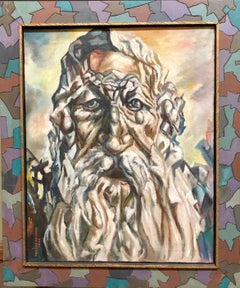
Holocaust Memorial Oil Painting Judaica Rabbi Composed of Figures Artists Frame
By Maurice Newman
Located in Surfside, FL
Maurice Newman was active/lived in Massachusetts / Lithuania. Maurice Newman is known for sculpture-abstraction, impressionist landscape painting, diorama.
Born in Lithuania, Mauric...
Category
1960s American Modern Portrait Paintings
Materials
Oil
You May Also Like
Rabbi, 1970s Oil Painting by Donald Roy Purdy
By Donald Roy Purdy
Located in Long Island City, NY
Artist: Donald Roy Purdy, American (1924 - )
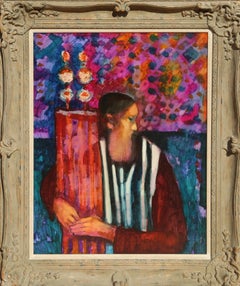
Title: Rabbi with Torah
Year: circa 1970
Medium: Oil on Masonite, signed l.r.
Size: 30 x 22.5 in. (76.2 x 57.15 cm)
Frame Size: 38 x 31 i...
Category
1970s Modern Figurative Paintings
Materials
Masonite, Oil
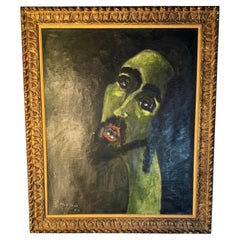
David Azuz, Israeli/French (1942 - "Abstract Head oil on canvas Painting c1960
By David David
Located in Buffalo, NY
Oil Painting on canvas. Hand signed and stamped with artist studio stamp. Very minor damage (tiny rip) not through canvas (see photo) mouth.. Amazing use of color and space,,
Tel A...
Category
Vintage 1960s French Folk Art Paintings
Materials
Canvas, Wood, Paint
Rabbi with Torah, Framed Oil Painting Portrait by Abraham Straski
By Abraham Straski
Located in Long Island City, NY
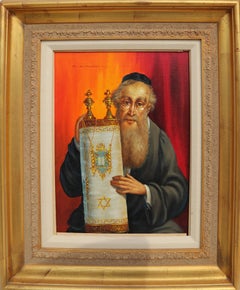
Artist: Abraham Straski, Polish (1903 - 1987)
Title: Rabbi with Torah (15-F)
Year: circa 1957
Medium: Oil on Canvas, signed l.r.
Image Size: 16 x 12 inches
Frame Size: 26 x 20 inches
Category
1950s Post-War Portrait Paintings
Materials
Canvas, Oil
Rabbi 3, 1970s Framed Modern Oil Painting by Donald Roy Purdy
By Donald Roy Purdy
Located in Long Island City, NY
Artist: Donald Roy Purdy, American (1924 - )
Title: Rabbi 3
Year: circa 1970
Medium: Oil on Masonite, signed l.r.
Size: 24 x 30 in. (60.96 x 76.2 cm)
Frame Size: 34 x 39 inches
Category
1970s Modern Figurative Paintings
Materials
Masonite, Oil
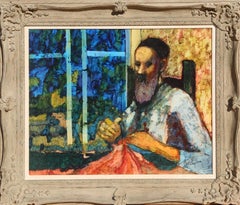
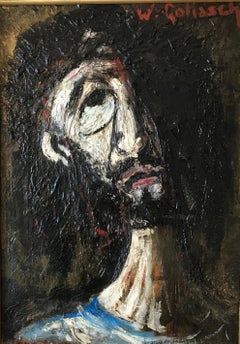
Bearded man by William Goliasch - Oil on canvas
By William Goliasch
Located in Geneva, CH
Work on canvas
Gilded wood frame
41 x 30,2 x 2,5 cm
Category
Late 20th Century Modern Portrait Paintings
Materials
Oil
$696 Sale Price
63% Off
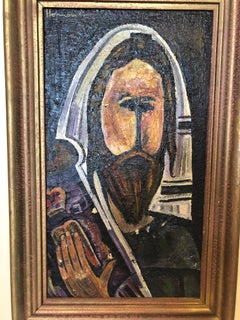
Attributed To Benjamin Kopman "The Rabbi"
By Benjamin Kopman
Located in San Francisco, CA
Benjamin Kopman: 1887-1965. Well listed artist born in Russia, but came to U.S. in 1903. He studied at the National Academy of Design in NYC. He has had auction results over $5000 bu...
Category
1960s Expressionist Figurative Paintings
Materials
Oil
More Ways To Browse
Folk Art Man
Polish Folk Art
Jewish Oil Painting
Drew Young
Bearded Painting
Jewish Folk Art
Bearded Man Painting
Jewish Oil Canvas
Jewish Rabbi Painting
Polish Jewish Art
Shaar Pinchas
Polish Folk Art Painting
African Children
Framed Native American
Bangladesh Art
Bennett Oil Paintings
Children Book Illustrations
Dan Mccaw