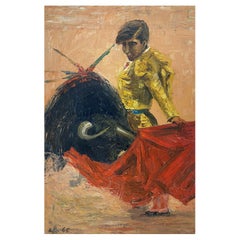
Items Similar to "El Cordobés" Spain Bullfighter, Matador Action Scene Beautiful Bull Fight

Want more images or videos?
Request additional images or videos from the seller
1 of 10
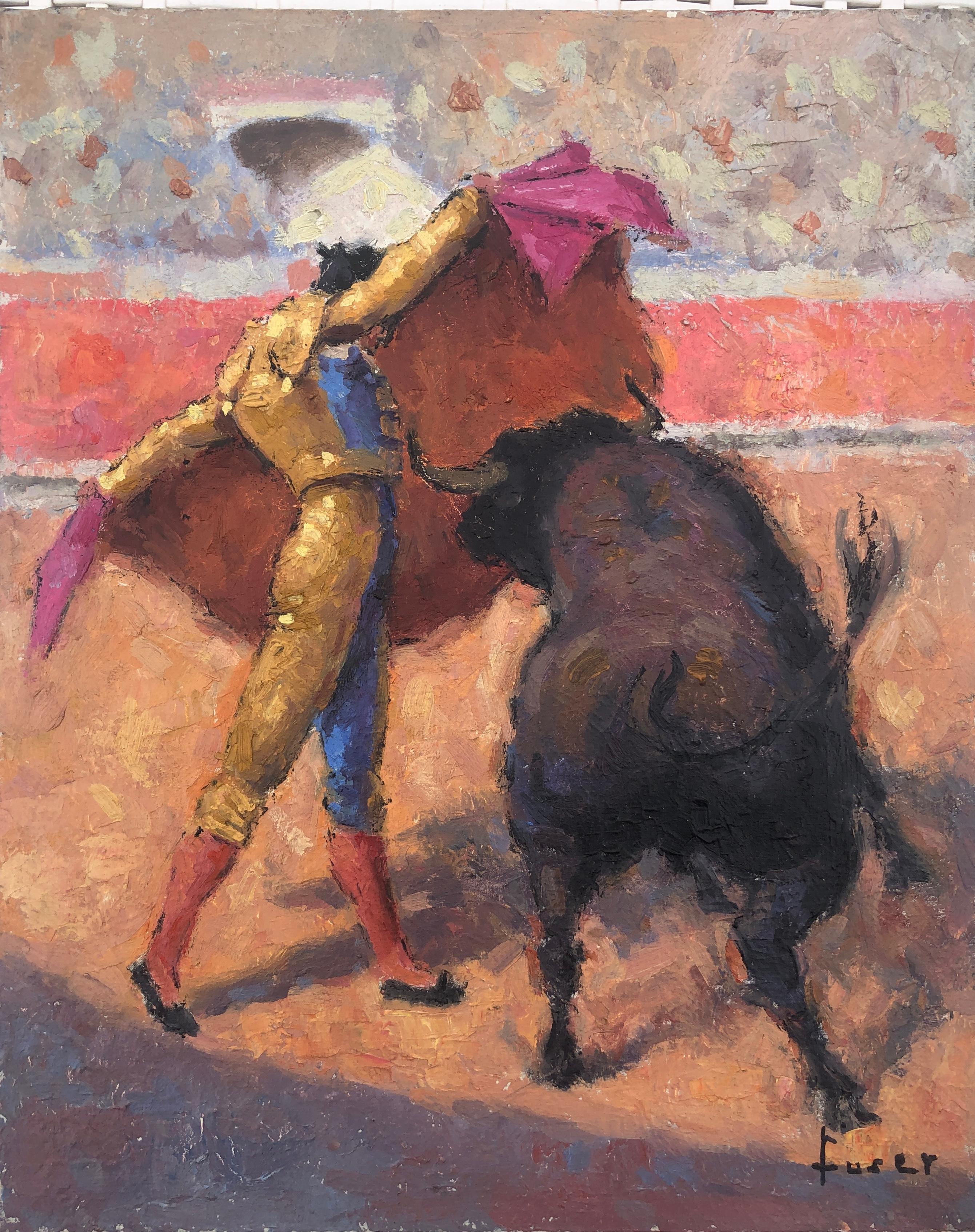
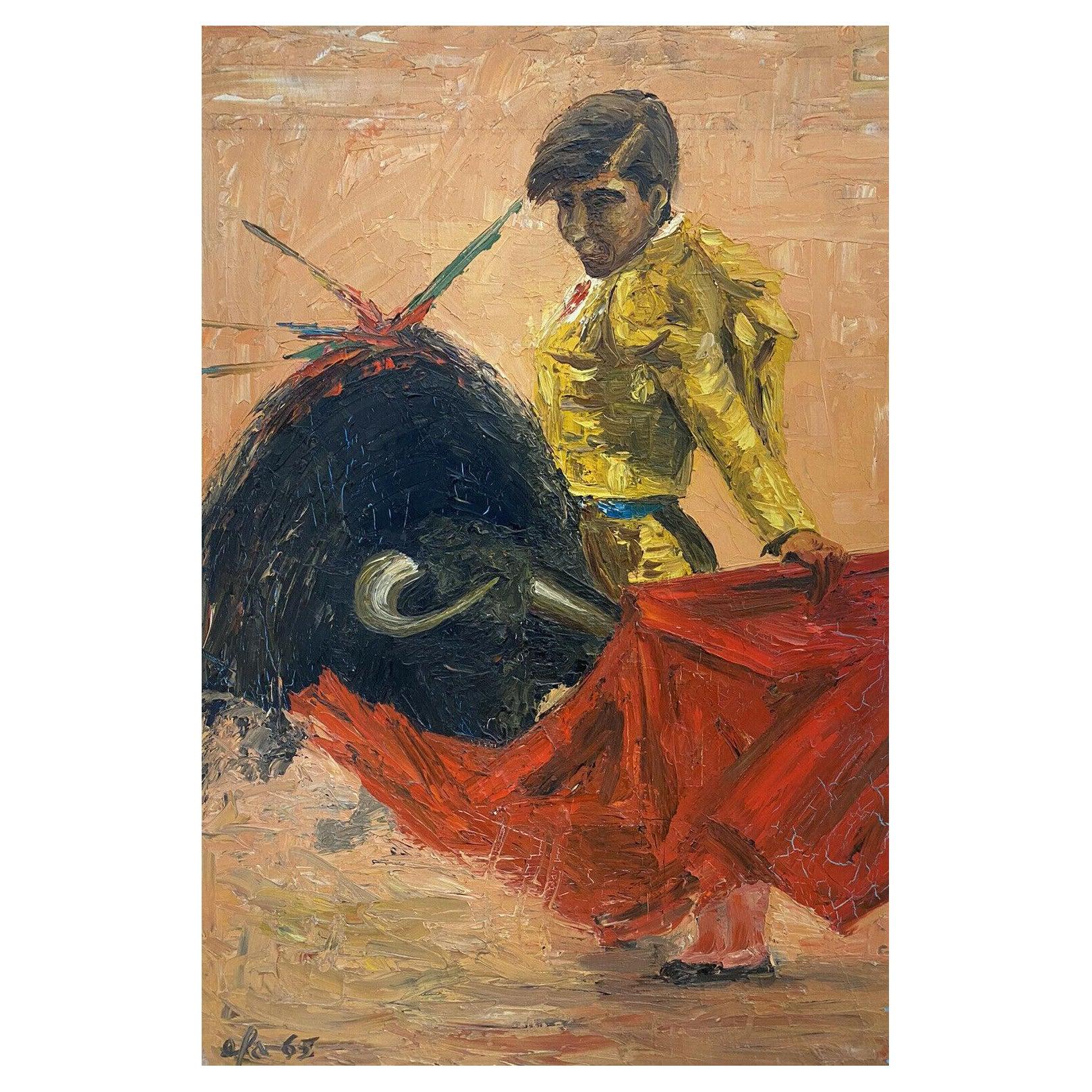
Porfirio Salinas"El Cordobés" Spain Bullfighter, Matador Action Scene Beautiful Bull FightCirca 1967
Circa 1967
$9,200
£7,005.79
€8,000.17
CA$12,927.14
A$14,183.53
CHF 7,471.20
MX$168,728.06
NOK 95,705.21
SEK 87,391.93
DKK 59,768.97
About the Item
Porfirio Salinas
(1910-1973)
San Antonio Artist
Image Size: 16 x 12
Frame Size: 22 x 18
Medium: Oil
Circa 1967
"El Cordobés" Spain, Bullfighter Matador
Manuel Benítez Pérez (born 4 May 1936), more commonly known as El Cordobés (The Cordovan), is a Spanish matador, and actor active in the 1960s who brought an unorthodox acrobatic and theatrical style to the bullring. Career
One of the original techniques practiced by El Cordobés was first shown at Anjucar. He waved his banderilla (Columpio) away, broke his banderillas down to 'pencil length', and standing with his back to the bull as it charged, moved his right leg out moments before the bull was upon him, causing the bull to swerve and allowing El Cordobés a moment to slam in the banderillas from just behind the left horn. This maneuver was repeated in bullfights across Spain, sometimes with even more dangerous variations, such as standing with his back to the barerra and driving in the banderillas after the horns passed either side of him. On May 20, 1964, when he made his first appearance at Las Ventas in Madrid, the bullfight ended with the near-fatal goring of El Cordobés on the horns of the bull Impulsivo. Twenty-two days later El Cordobés fought again.
By the time of his first retirement, in 1971, El Cordobés had become the highest-paid matador in history. After eight years of retirement, he returned to bullfighting in 1979. Following an incident in 1983, when a bull that he was about to fight killed an espontáneo (bystander who jumps into bullring), El Cordobés was criticized by the press for allowing it to happen.
El Cordobés continued to make occasional appearances as a matador until 2000, when he retired permanently. He also acted in several motion pictures. El Cordobés lives in near seclusion near Córdoba. In 2016 he appeared with the woman bullfighter Conchi Rios and Antonio Puerta in Cehegin in Murcia.
In art, entertainment, and media
An early biography, Or I'll Dress You in Mourning, by journalists Larry Collins and Dominique Lapierre, was published in 1968 by Simon
Schuster. In 1966, Italian-French singer Dalida released an album titled "El Cordobés" with the first track called Manuel Benitez "El Cordobés". The song is available in two languages: Spanish and French. El Cordobés' story was also the basis for the musical Matador (1987) by Mike Leander and Eddie Seago. Poet Mike O'Connor included "Canción del Cordobés", about the matador's breakout performances in Mexico City in 1964, in his poetry volume When the Tiger Weeps, (2005). A song titled "El Cordobés" was performed by the Norwegian rap artist Diaz.
Biography
Porfirio Salinas (1910-1973)
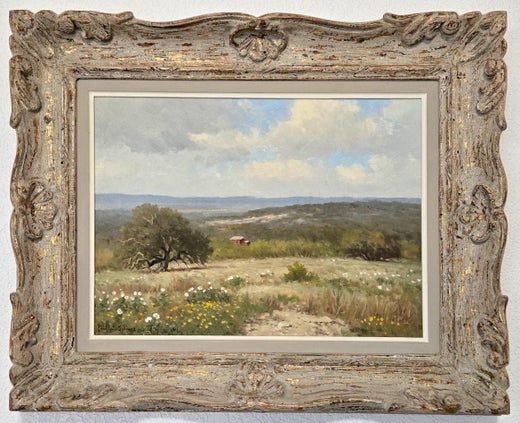
Porfirio Salinas was a self-taught artist who painted landscapes of Central Texas with an emphasis on the vast bluebonnet fields that grow there in the springtime. Born in 1910 in Bastrop, Texas, he attended public schools in San Antonio. He also observed works in progress by the director of the San Antonio Art School, Jose Arpa, as well as landscape painter, Robert Wood. Wood is said to have paid Salinas five dollars a picture to paint bluebonnets because "he hated to paint bluebonnets". Salinas served in the military from 1943 to 1945. Although he was assigned to Fort Sam Houston, he was allowed to live at home. At the fort, Colonel Telesphor Gottchalk assigned him to paint murals for the officer's lounge and various other projects, and Salinas continued to be able to paint during his entire conscripted period. Even before he achieved notoriety among galleries, dealers, and museums, Salinas was widely followed and appreciated by many Texans, including former President Lyndon B. Johnson, who may be considered responsible for launching Salinas popularity beyond the boundaries of Texas. In 1973, Texas capital, Austin, honored Salinas for having "done much to bring the culture of Mexico and Texas closer together with his paintings". Salinas died in April 1973 in San Antonio, Texas.
From
the years of the Great Depression through President Lyndon Johnson's
Great Society of the 1960s, Texan Porfirio Salinas (1910-1973) remained
one of the Lone Star State's most popular artists. Today, his works
remain popular with Texas collectors and those who love landscapes of
the beautiful "Hill Country" that lies in the center of the
state. One of the first Mexican American painters to become
widely recognized for his art, Salinas was a favorite of President
Lyndon Johnson and his wife, Lady Bird Johnson, as well as of Sam
Rayburn, the longest-serving Speaker of the House of Representatives,
and Texas Governor John Connelly. In fact, President Johnson was so
enamored with his Salinas paintings that the artist will forever be
associated with America's first Texas-born President. Works by Porfirio
Salinas is in a number of museum collections, grace the halls of the
Texas State Capitol and the Governor's Mansion in Austin, and are
included in virtually every major private collection of Early Texas Art.
Porfirio
Salinas was born on November 6, 1910, near the small town of Bastrop,
Texas, about thirty miles from Austin. His father, Porfirio G. Salinas
(1881-1967), and his mother, Clara G. Chavez, struggled to make a
hardscrabble living as tenant farmers, but eventually were forced to
give up farming. The family moved to San Antonio, where Salinas' father
was able to get a job working as a laborer for the railroad, but the
scenic area around Bastrop, with its pine trees and the wide expanse of
the Rio Grande River, would forever remain a touchstone for the artist.
For the rest of his life, Salinas and his brothers went back frequently
to visit their grandmother in her little farmhouse. When in Bastrop,
Porfirio painted on the banks of the Rio Grande or in the groves of
pine trees. The Salinas family was close-knit, and Porfirio was the
middle child of five children, so he had an older brother and sister as
well as a younger brother and sister. His mother was a native of
Mexico, so throughout his childhood the family made the long drive to
Mexico to visit Clara Salinas' family.
As a child growing up in
the bi-lingual section of San Antonio, Salinas drew and painted
incessantly and by the time he was ten, he was already producing work
that was mature enough to sell to his schoolteachers. Many years later
in an article in the New York Times he was described as a "boy whose
textbooks were seldom opened and whose sketchbook was never closed."
Instead of studying, the young artist spent his spare time watching
artists paint in and around San Antonio. As an aspiring painter,
Salinas was fortunate to grow up in the historic city, which had the
most active art scene in Texas. It was his exposure to older,
professional painters that encouraged the precocious young painter to
leave school early in order to help his family and pursue a career as a
professional artist, despite his father's inability to see art as a
career with any future for his son.
When Salinas was about
fifteen he came to know the artist Robert W. Wood (1889-1979). He met
Wood while he was employed in an art supply store and he soon began to
work as an assistant to the English-born painter, who had moved from
Portland to San Antonio in 1924. Although the diminutive Englishman was
already an established professional artist, he did not have a great
deal of formal art training and so he was then studying with the
academically trained Spanish painter Jose Arpa (1858-1952) in order to
augment his knowledge and give his work a more polished look. Salinas
was an eager young man, and while working in Wood's downtown San
Antonio studio he learned to stretch canvases, frame paintings and to
sketch in larger compositions from small plein-air studies for the
English artist. He began to accompany Wood and Arpa to the hills
outside San Antonio, where they painted small Plein-air studies of
fields of blue lupin - the state flower, the famous "Bluebonnets" of
Texas - in the springtime and scenes of the gnarled Red Oaks as they
changed color in the fall. He was soon assisting Wood in the tedious
work of painting the tiny blue flowers that collectors wanted to see in
the landscapes they purchased of central Texas. According to a
1972 newspaper story, "Legend has it that one day in the 1920s artist
Robert Wood decided he could not bear to paint another bluebonnet in
one of his landscapes. He hired young Porfirio Salinas to paint
them in for him at five dollars a painting." Whether this story is
accurate or apocryphal isn't clear, but the ambitious and independent
young Salinas wasn't destined to be anyone's assistant for very long.
The
formative event of Porfirio Salinas' teenage years was the Texas
Wildflower Competitive Exhibitions, a Roaring-Twenties dream of the
eccentric oilman Edgar B. Davis (1873-1951). These competitive shows of
paintings of wildflowers and Texas life were mounted in San Antonio
from 1927 to 1929. Held at the newly opened Witte Museum each spring,
the exhibition featured large cash prizes donated by the philanthropic
Davis, which were an inducement for artists to travel from all over the
United States to paint in the Hill Country of Texas. The "Davis
Competitions," as they were known, helped to cement San Antonio's
reputation as an art center, a legacy that remains with the "River
City" today. The shows generated a great deal of excitement in the
area, helping to make celebrities of the some of the artists who had
already settled there and encouraging others to make San Antonio their
home. Over the three years that the wildflower competitions were held,
more than 300 paintings were exhibited, and many thousands of viewers
saw the paintings at the Witte Museum and on tours throughout the state
and in New York. Each year Davis would generously purchase the winning
paintings and then donate them to the San Antonio Art League. Young
Porfirio Salinas would have been able to not only watch his two mentors
- Robert W. Wood and Jose Arpa - paint the works that they entered in
the Davis Competitions, he would have been able to see Arpa take
several of the major prizes, receiving the judge's accolades for
"Verbena," "Cactus Flower" and "Picking Cotton," works that are still
on view at the San Antonio Art League Museum today. Unfortunately,
Davis eventually put his donations to work in other charitable
endeavors, bringing to an end the wildflower events, but only after
they inspired Salinas and other young painters and had helped to make
wildflower paintings the most sought-after subject for traditionalist
Texas collectors.
In 1930, when he was only twenty, Salinas
hung out a shingle and began to paint professionally, augmenting the
sales of his easel paintings with what little business he could garner
by painting signs for local concerns. It was a struggle for the young
artist to make a living, as the effects of the Great Depression were
settling in. His early works are very similar to those of Robert
Wood's, both in subject matter and treatment. Salinas did small
paintings of Bluebonnets for the tourists who visited San Antonio to
see the famous Alamo as well as paintings of the Texas missions. While
a few of his early works have a soft, tonalist quality, with subtle
gradations of sunset colors, most were painted in a style that fits
well within the currents of the late American Impressionist style, with
solid drawing and a warm, chromatic palette. Like Robert Wood's works
of the 1930s, the paintings Salinas produced as a young man were
usually well composed and detailed views of the spring wildflowers in
full bloom in the Texas countryside. In contrast to Wood's work,
however, early Salinas compositions were usually pure landscapes
without the pioneer farms or dilapidated fences that Wood often used to
add visual interest to his wildflower scenes, and he also painted
scenes of San Antonio itself as his mentor Jose Arpa had done. To
residents of the Hill Country, Salinas was especially adept at
accurately capturing the palette of the region and its unique
atmosphere.
In 1939 Salinas began working with Dewey Bradford
(1896-1985), one of the great characters of Texas art. Bradford was a
second-generation dealer whose family operated the Bradford Paint
Company in Austin, where they sold art supplies, framed artwork,
restored paintings and exhibited paintings by Texas artists. Salinas
was struggling when he met Bradford, but the older man took the young
artist under his wing and began to sell his work reliably, even though
the prices that people would pay for a painting were still low due to
the lingering effects of the Great Depression. Bradford was a born
salesman with a gift for storytelling, and truth be told, a bit of
embroidery. The relationship between Bradford and Salinas was often
rocky, but it was to last the rest of the artist's life and give him a
modest sense of loyalty and security, things which are all too rare in
the art world. While Bradford could be critical of his work, Salinas
knew that he had a dealer who encouraged him, believed in him and was
not shy about singing his praises to anyone who entered Bradford's
store on Guadalupe Street.
During the early years of World
War II Salinas met a pretty Mexican woman from Guadalajara named Maria
Bonillas, who was working as a secretary for the Mexican National
Railways office in San Antonio. While he was walking downtown with a
painting of a bullfighter under his arm, he started a conversation with
the young woman, and things progressed rapidly. The couple were married
on February 15, 1942 and settled into life in bi-lingual San Antonio
and they eventually purchased a tidy stone home on Buena Vista street
that had a detached studio in back. By the time the United States
entered World War II, Salinas was starting to make a decent living
selling his art and beginning to garner recognition across Texas.
However, in 1943, like millions of other young men, he was drafted into
the service of his country. Fortunately, as an older Army draftee with
special talents, after his training he was assigned to Fort Sam
Houston, right in San Antonio, allowing him to remain at home while
still completing his obligation to "Uncle Sam." Because of his artistic
abilities, Salinas was asked to do paintings for the Army as well as a
mural for the Officer's Club, which has been re-discovered in recent
years. In his spare time he kept working on landscapes and when the war
ended in 1945, he was not faced with the same rocky transition from
military to civilian life as many veterans. That same year, Salinas
became a father as he and Maria celebrated the birth of his only child,
Christina Maria Salinas.
Like most landscape artists of the
era, Salinas was an avid Plein-air painter, and he took his easel and
paint box with him on trips throughout Texas and into Mexico. He and
his wife traveled deep into her native country, where the artist
painted the majestic volcanic peaks of Iztaccihuatl (known as the
"Sleeping Woman" because of its unique shape) and Popocatepetl (called
the "smoking mountain" because the volcano is still active), south of
Mexico City. Salinas also painted studies of rustic villages and their
residents. While his most popular paintings were always the scenes of
the Texas Bluebonnets and other wildflowers that bloom all over the
Hill Country in the spring, he also painted scenes of the twisted Texas
oak trees of central Texas, the more arid landscapes of the Texas
panhandle and West Texas, and the historic Texas missions; he even sold
rapidly executed scenes of bullfights and cockfights for
Mexican-American collectors.
By the late 1940s, the American
economy was finally growing again and wealthier Texans began to collect
Salinas paintings, purchasing them from galleries in San Antonio and
Dallas and at Dewey Bradford's County Store Gallery in Austin. Salinas
also sold work to the Atlanta dealer Dr. Carlton Palmer, who
represented Robert W. Wood for many years. In 1948 Palmer sold two
large Salinas paintings to the Citizen National Bank in Abilene, Texas.
Because Austin was the state capitol, Bradford counted many of the
state's elite among his patrons, and due to his interest in history and
literature, he played a large role in the cultural history of central
Texas. Bradford introduced a number of the major Texas political
figures to Salinas' work, including Lyndon Baines Johnson (1908-1973),
who was then in the House of Representatives and on his way to winning
a controversial election that vaulted him in the United States Senate.
Johnson became an enthusiastic collector, as did his political mentor,
the legendary House Speaker Sam Rayburn (1882-1961). Johnson decorated
his Washington offices with Salinas paintings and he brought a number
of them home to his vast LBJ Ranch, near Johnson City, Texas. In spite
of his important patrons, Salinas went through a fallow and difficult
period in the late 1950s. He had a volatile temperament, which made
relationships difficult, and it took great patience for his wife to
help him manage his career.
As Salinas entered middle age his
work began to sell steadily, but except for tourists who purchased his
paintings in San Antonio, he was known primarily only to Texas art
collectors. All that changed in 1961 with the election of John F.
Kennedy (1917-1963) to the Presidency of the United States and his
running mate Lyndon Johnson to the Vice Presidency. Johnson was an
expansive, larger-than-life character and his status as a long, tall
Texan in a cowboy hat was a large part of his imposing political image.
During his storied career in the House of Representatives and the
United States Senate, Johnson and Lady Bird Johnson (1912-2007) spent
their time in Washington in a modest house on the edge of Rock Creek
Park, but this home would not do for a Vice President. So, in 1961, the
Johnsons purchased a French chateau-styled home in the Spring Valley
section of the Capitol. Obtained from the famed socialite and
ambassador Perle Mesta (1889-1975), the house came with a fine
collection of French furniture and tapestries, and the designer
Genevieve Hendricks was hired to meld the French look with objects from
the Johnsons' overseas travels and paintings of the flora and fauna of
their native Texas. Featured prominently in the foyer were the
paintings of Porfirio Salinas. Because of the Johnsons' patronage, his
work was mentioned in Time Magazine and other national publications.
Lady Bird Johnson loved her landscapes of the Texas Hill Country and
told reporters that, "I want to see them when ever I open the door, to
remind me where I come from."
After President Kennedy's death
thrust Lyndon Johnson into the Presidency, he brought his Salinas
paintings into the historic halls of the White House, further enhaning
the Texas painter's national reputation. At the time of the President
Kennedy's assassination, Salinas had completed a scene of a horse
drinking titled "Rocky Creek" that was to have been presented to
Kennedy during his ill-fated visit to Dallas. Instead, in an effort to
memorialize the fallen President, Salinas painted a symbolic work of a
lone horse depicted against foreboding clouds. During his tenure in the
White House, President Johnson presented a Salinas landscape as a state
gift to the President of Mexico, Gustavo Diaz Ordaz (1911-1979). During
the 1960s, Salinas paintings sold briskly and, thanks to Presidential
patronage, for escalating prices. In an interview with a writer from
the New York Times, President Johnson enthused about the work of "his
favorite artist" and said that, "his work reminds me of the country
around the ranch." Salinas was invited to the LBJ Ranch frequently
during the Johnson administration and his paintings were hung
throughout the ranch, in the President's offices and even in the
private quarters of the White House. The connection to President
Johnson was a great boon to sales of Salinas paintings, and in 1964,
when the demand was at its height, Texas Governor John Connelly
(1917-1993) was told that all Salinas'work was sold and that he would
have to wait for a painting.
In 1960, a half century after his
birth, Salinas was honored by his home town of Bastrop, a celebration
that touched the modest artist. In 1962 Salinas was given a solo
exhibition at the Witte Museum in San Antonio that featured more than
twenty of his works. By the early 1960s, sales of reproductions of the
artist's landscapes by the New York Graphic Society and other
publishers grew rapidly, enlarging his audience throughout the United
States. In 1967, Dewey Bradford helped to organize the production of a
book of Texas stories titled "Bluebonnets and Cactus" (Austin:
Pemberton Press: 1967), which was profusely illustrated with paintings
by Salinas. His works were still popular when Salinas died after a
brief illness in April of 1973, just a few months after former
President Johnson's passing. He was memorialized in the City of Austin
by Porfirio Salinas Day, which honored him for having "done much to
bring the culture of Mexico and Texas together with his paintings."
Bastrop, Texas, the city of the artist's birth, has been holding a
Salinas Art Exhibition annually since 1981.
He painted hundreds of scenes of the wildflowers,
including the various varieties of Blue Lupin, the state flower, as
well as other flowering flora. These show the influence of his artistic
mentors Robert W. Wood and Jose Arpa Y Perea. Salinas also painted a
number of scenes of Prickly Pear Cactus that show the influence of the
English painter Dawson Dawson-Watson (1864-1939), who painted many such
works during his tenure in Texas. He painted the more arid Texas
landscape infrequently and these works are very rare today and sought
after by collectors from the Texas Panhandle and West Texas. Salinas
also painted many river landscapes along the Guadalupe, Rio Frio, the
San Antonio and the Rio Grande. On trips to his wife's homeland of
Mexico, he painted a number of scenes of the volcanic peaks as well as
scenes of peasant villages and villagers. Figurative paintings are rare
among Salinas' works and these scenes of bullfights, fandangos and cock
fights are probably the least sought after of his paintings. There are
also a small number of modest marines, painted on trips to the Texas
and California coast. Salinas paintings are highly prized by collectors
of early Texas art, with the paintings of wildflowers in greatest
demand.
Works by Porfirio Salinas can be found in a number of
public collections, including the Panhandle Plains Historical Museum in
Canyon, Texas; the Texas State Capitol; the Texas Governor's Mansion;
the Lyndon Baines Johnson Ranch; the Sam Rayburn Library and Museum in
Bonham, Texas; Amarillo High School; the Witte Museum in San Antonio;
the historic Joan and Price Daniel House in San Antonio; the Stark
Museum in Orange, Texas; the R.W. Norton Art Gallery in Shreveport,
Louisiana; the Sangre de Cristo Arts Center in Pueblo, Colorado; Texas
A
M University and the Modern Art Museum of Fort Worth.
Salinas has been featured in a number of reference works as well as
anthologies devoted to American Western Art. Salinas has been the
subject of a modest biography by Ruth Goddard (Porfirio Salinas, Rock
House Press: 1975) that was based on interviews with the artist.
PORFIRIO SALINAS
Porfirio Salinas, Jr., painter, son of Porfirio G. Salinas and Clara G. Chávez, was born in Bastrop, Texas, on November 6, 1910. He attended the public schools of San Antonio for three years and was largely self-taught as an artist. He learned from watching José Arpa, director of the San Antonio Art School, sketch in the streets and fields of San Antonio. He also learned from Robert Wood, a prolific landscape painter, who paid him five dollars a picture to paint in bluebonnets on his canvases because "he hated to paint bluebonnets."
Salinas dedicated himself to painting landscapes of Central Texas with particular attention to the bluebonnets that grow in abundance in the springtime. Although Salinas did not receive the attention of the professional art establishment-art galleries and museums, and art critics and art historians-he achieved a popular following among many Texans as well as the political leaders of Texas and the United States, among them Sam Rayburn and Lyndon B. Johnson, who began to collect his work in the 1940s.
The recognition of his work beyond the borders of Texas dates from Johnson's presidency. This popularity allowed Salinas to command high prices for his work. Salinas was conscripted and served in the army from October 12, 1943, to 1945. He was assigned to Fort Sam Houston in San Antonio, where he painted murals for the officers' lounge and other special assignments for Col. Telesphor G. Gottchalk, reception center commander. He was allowed to live at home, where he continued his easel painting for the entire duration of his tour of duty.
He married Maria Bonillas, a native of Guadalajara, on February 15, 1942. She was working in San Antonio as a secretary at the office of the Mexican National Railways when they met. She assisted him in all his dealings with his agent, Dewey Bradford, of Austin, who was primarily responsible for selling his work.
The Salinas had one child. Salinas was a Catholic. The city of Austin celebrated a Porfirio Salinas Day in 1973. The painter was honored for having "done much to bring the culture of Mexico and Texas closer together with his paintings."
Salinas lived his entire life in San Antonio, where he died on April 18, 1973.
- Creator:Porfirio Salinas (1910-1972, American)
- Creation Year:Circa 1967
- Dimensions:Height: 16 in (40.64 cm)Width: 12 in (30.48 cm)Depth: 3 in (7.62 cm)
- More Editions Sizes:Image Size: 16 x 12 Frame Size: 22 x 18Price: $9,200
- Medium:
- Movement Style:
- Period:
- Framing:Frame IncludedFraming Options Available
- Condition:Please check my 1stdibs storefront to see other Vintage, Mid Century Contemporary Texas American art and Pottery.
- Gallery Location:San Antonio, TX
- Reference Number:1stDibs: LU769317206932
Porfirio Salinas
(1910-1973)
Porfirio Salinas was a self-taught artist who painted landscapes of Central Texas with an emphasis on the vast bluebonnet fields that grow there in the springtime. Born in 1910 in Bastrop, Texas, he attended public schools in San Antonio. He also observed works in progress by the director of the San Antonio Art School, Jose Arpa, as well as landscape painter, Robert Wood. Wood is said to have paid Salinas five dollars a picture to paint bluebonnets because "he hated to paint bluebonnets". Salinas served in the military from 1943 to 1945. Although he was assigned to Fort Sam Houston, he was allowed to live at home. At the fort, Colonel Telesphor Gottchalk assigned him to paint murals for the officers lounge and various other projects, and Salinas continued to be able to paint during his entire conscripted period. Even before he achieved notoriety among galleries, dealers, and museums, Salinas was widely followed and appreciated by many Texans, including former President Lyndon B. Johnson, who may be considered responsible for launching Salinas popularity beyond the boundaries of Texas. In 1973, Texas capital, Austin, honored Salinas for having "done much to bring the culture of Mexico and Texas closer together with his paintings". Salinas died in April 1973 in San Antonio, Texas.
About the Seller
5.0
Vetted Professional Seller
Every seller passes strict standards for authenticity and reliability
Established in 1974
1stDibs seller since 2017
104 sales on 1stDibs
Typical response time: 1 hour
- ShippingRetrieving quote...Shipping from: Fredericksburg, TX
- Return Policy
More From This Seller
View All"Jim Whiteman Riding a Bull" Rodeo Champion Late 30s Early 40s
Located in San Antonio, TX
Pepper Brown
(1926-1999)
Alpine Artist
Image Size: 9.5 x 13.25
Frame Size: 15.5 x 19
Medium: Ink Drawing
Dated 1942
"Jim Whiteman Riding a Bull"
Category
1940s Impressionist Animal Drawings and Watercolors
Materials
Ink
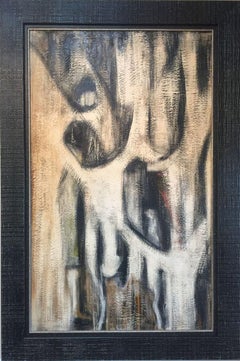
"Corrida" Abstract The Bullfight
By Leopoldo Gonzales Jr.
Located in San Antonio, TX
Leopoldo Gonzales Jr
Born 1921
San Antonio Artist
Size: 36 x 22
Frame: 42.5 x 28
Medium: Casein
Circa 1958 Mid Century Modern
"Corrida"
Unsigned
Biography
Leopoldo Gonzales Jr Born ...
Category
1950s Abstract Abstract Paintings
Materials
Oil
"Roy Matthews Calf Roping" Famous 1930s/40s Rodeo Rider
Located in San Antonio, TX
Pepper Brown
(1926-1999)
Alpine Artist
Image Size: 9 x 13
Frame Size: 15 x 18.75
Medium: Ink Drawing
Dated 1942
"Roy Matthews Calf Roping"
Category
1940s Impressionist Animal Drawings and Watercolors
Materials
Ink
"Boots Mansfield Calf Roping" Tie- Down Roping World Champion
Located in San Antonio, TX
Pepper Brown
(1926-1999)
Alpine Artist
Image Size: 9.5 x 9.25
Frame Size: 15.5 x 19
Medium: Ink Drawing
Dated 1942
"Boots Mansfield Calf Roping" Tie- Dow...
Category
1940s Impressionist Animal Drawings and Watercolors
Materials
Ink
"RIDIN
HIGH" COWBOY HORSE WESTERN ACTION MOTION NICE!!!
Located in San Antonio, TX
E. Salazar
Texas Artist
Image Size: 15 x 13
Frame Size: 19 x 17
Medium: Oil on Canvas
"Riding High"
Category
2010s Realist Landscape Paintings
Materials
Oil
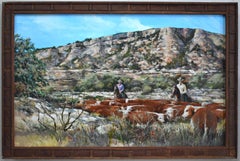
"HEREFORD TIME" CATTLE AND COWBOYS
Located in San Antonio, TX
Edward Lee Reichert
(1919-2011)
Texas Artist
Image Size: 21 x 33
Frame Size: 24.75 x 36.75
Medium: Oil
"Hereford Time"
Biography
Edward Lee Reichert (1919-2011)
Edward Reichert, architect, designer and artist, is a native Texan who has combined regional, national and international study and practice of the visual art and architecture since 1936. He is a versatile artist and designer, skilled in creating quality landscapes, portraits, architectural, western, religious and varied work in all media. After 36 years of architectural practice based in Houston in which he was involved in the design of more than 400 regional and international projects, he now devotes full time to painting.
Best known of his art works are his designs of stained and faceted art glass which include 100 panels designed for the First United Methodist Church of Houston. In 1983, he wrote and jointly published with the Church, Windows Sharing God’s Caring, an art book with photographs by his wife Elizabeth, illustrating and describing these panels and the historic sanctuary windows.
While attending The University of Texas in Austin he served as art editor of the university publication Architecture, Engineering and Industry (1938-41). After receiving his Bachelor of Architecture Degree and the Alpha Rho Chi Architectural Medal in 1941, he was awarded scholarships for continued studies a M.I.T., Harvard, and Yale. As a Naval Reserve Officer during World II, he authored and illustrated Naval Intelligence publications. He became a Registered Architect in Texas in 1947, AIA member since 1951 and NCARB certified since 1974. He has worked and studied in England, Europe and Canada.
Invitational study and travel with Master Painter, Lajos Markos...
Category
21st Century and Contemporary American Impressionist Landscape Paintings
Materials
Oil
You May Also Like
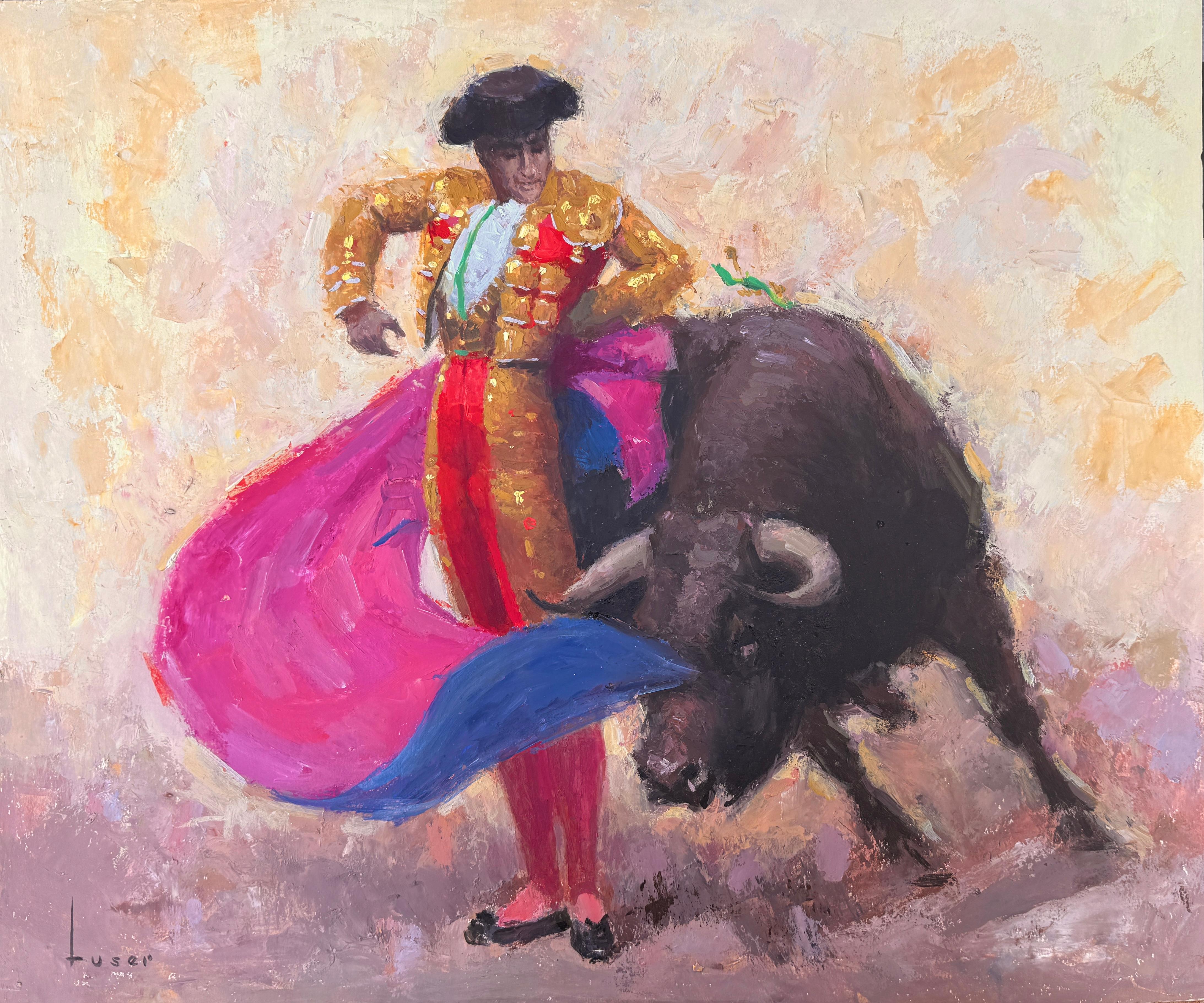
Cape Maneuver bullfighter oil painting
Located in Sitges, Barcelona
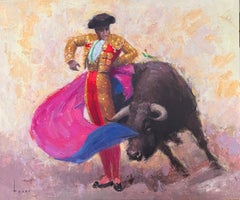
Title: Cape Maneuver
Artist: José María Tuser Vázquez (Barcelona, 1919 – 1986)
Technique: Oil on canvas mounted on board
Dimensions: 19.7 x 23.6 in (50 x 60 cm)
Date: Circa 1980s
Signature: Signed "Tuser" in the lower left corner
Condition: Excellent; thick, vibrant brushwork and vivid colors well preserved.
📝 Description
This painting captures a dramatic moment in the bullfight — the classic verónica — as the matador gracefully halts the bull’s charge with a sweeping motion of the cape. The vivid contrast of magentas, blues, and golds intensifies the theatrical tension between man and beast. The composition is dynamic yet controlled, emphasizing the poise of the torero against the raw force of the bull.
The expressive brushstrokes and thick impasto enhance the sense of movement, while the abstracted background ensures focus remains on the central figures. The piece is a striking blend of figuration and emotional energy, characteristic of Tuser’s taurine works.
👤 About the Artist: José María Tuser Vázquez
José María Tuser Vázquez was a Spanish painter born in Barcelona in 1919. He studied at the Barcelona School of Arts and Crafts and began exhibiting in the 1940s. By 1947, he had fully devoted his career to bullfighting scenes, developing a distinctive figurative expressionist style with impressionist influences.
He collaborated with the magazine El Ruedo, creating numerous illustrations and covers, and designed collectible postcards for Editorial Artigas. His work became well-known in Spanish artistic circles and is now part of both private and institutional collections, including the Club Taurino of London.
His paintings have been auctioned internationally, reaching up to $3,000 depending on size and subject. His legacy is that of a painter who masterfully captured the emotion, tradition, and drama of the Spanish corrida.
🎨 Similar Artists
José María Tuser Vázquez’s work shares thematic and stylistic elements with:
Roberto Domingo – A pioneer of bullfighting art...
Category
1970s Expressionist Figurative Paintings
Materials
Canvas, Oil, Board
$1,016 Sale Price
43% Off
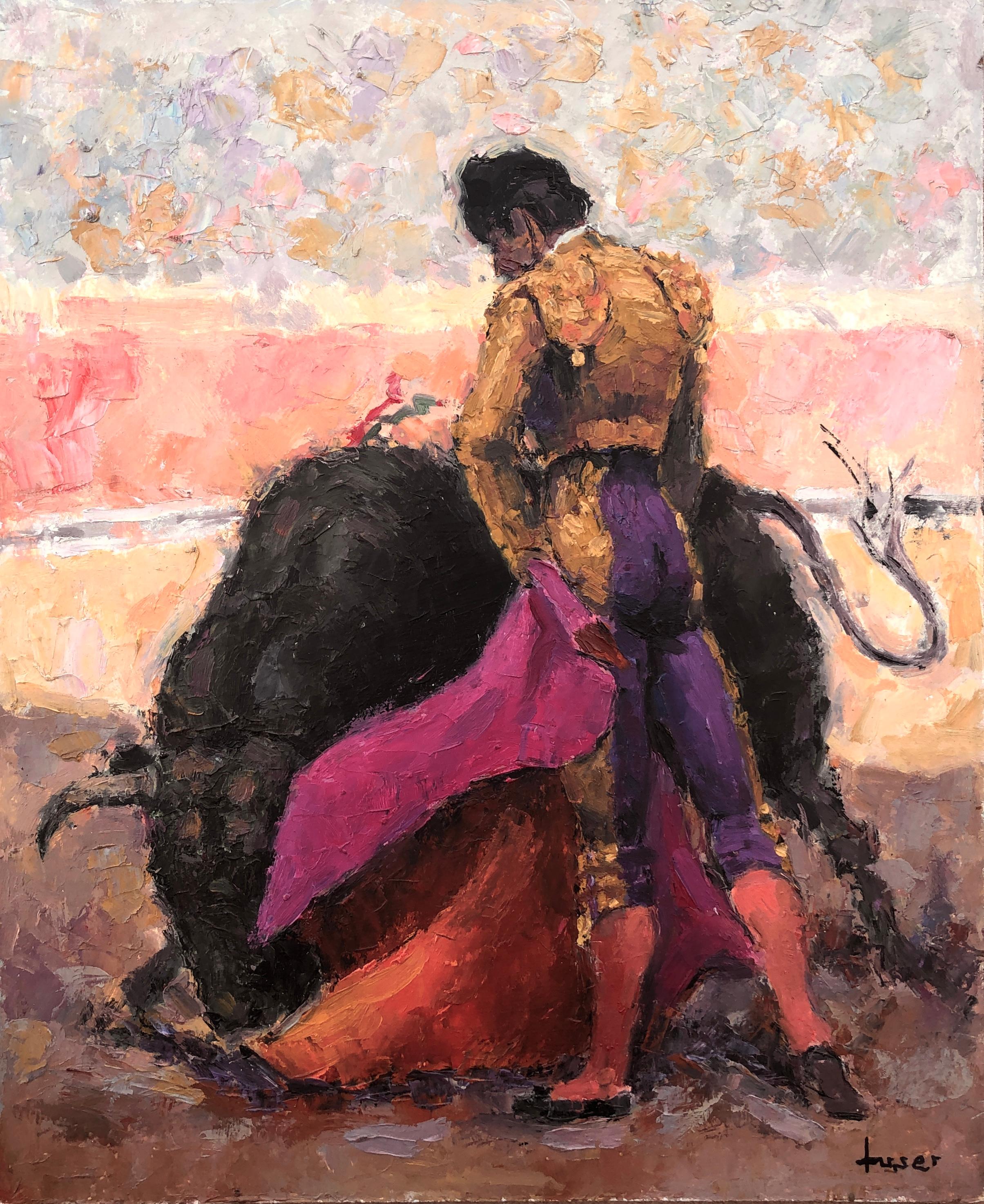
Bullfighting Scene oil on board painting
Located in Sitges, Barcelona
Title: Bullfighting Scene
Artist: José María Tuser Vázquez (1919-1986)
Technique: Oil on board
Dimensions: 25.6 x 21.3 in (65 x 54 cm) Frameless
Period: Second half of the 20th century
Art Movement: Figurative Expressionism with Impressionist influences
Condition: Good, with visible signs of aging on the surface
DESCRIPTION OF THE WORK
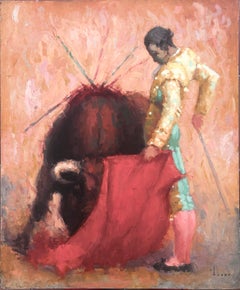
This painting captures a crucial moment in a bullfight, where the matador, dressed in a dazzling traje de luces (suit of lights), elegantly holds the red cape (muleta) while facing a wounded bull. The scene conveys tension and drama through energetic and loose brushwork, with strong contrasts of light and color that enhance its expressiveness.
The abstract background, built with gestural brushstrokes in warm, earthy tones, reinforces the dynamism and immediacy of the moment. The thick texture of the paint and the vibrant colors in the matador's attire and cape are characteristic of Figurative Expressionism, giving the work a strong emotional impact.
Tuser masterfully captures the essence of movement and the intensity of the bullfight through a painterly approach reminiscent of Impressionism, but with a greater emphasis on gesture and expressive color, making his work stand out for its raw energy and dramatic depth.
ARTIST BIOGRAPHY
José María Tuser Vázquez (Barcelona, 1919 - 1986) was a Spanish painter specialized in bullfighting themes, gaining recognition in the 20th-century art scene for his expressive depictions of the corrida (bullfight). He studied at the School of Arts and Crafts in Barcelona, where he developed a strong mastery of color and composition.
From 1947 onwards, his work focused almost entirely on bullfighting, creating posters, illustrations, and paintings that capture the emotion and spectacle of the arena. He was a frequent collaborator with El Ruedo magazine, where his illustrations and covers solidified his reputation. Additionally, in the 1940s, he designed series of postcards featuring traditional Spanish costumes for the Artigas Publishing House.
His work has been auctioned in several art houses and is highly valued among collectors of bullfighting paintings. His influence and legacy in tauromaquia (bullfighting art...
Category
1950s Impressionist Figurative Paintings
Materials
Board, Oil
$777 Sale Price
45% Off
oil on board painting Bullfighting Scene
Located in Sitges, Barcelona
Title: Bullfighting Scene
Artist: José María Tuser Vázquez (Barcelona, 1919 - 1986)
Medium: Oil on panel
Dimensions: 18.1 x 15 inches
Signed: Yes, lower right corner "Tuser"
Framed: ...
Category
1960s Impressionist Figurative Paintings
Materials
Oil, Board
$777 Sale Price
45% Off
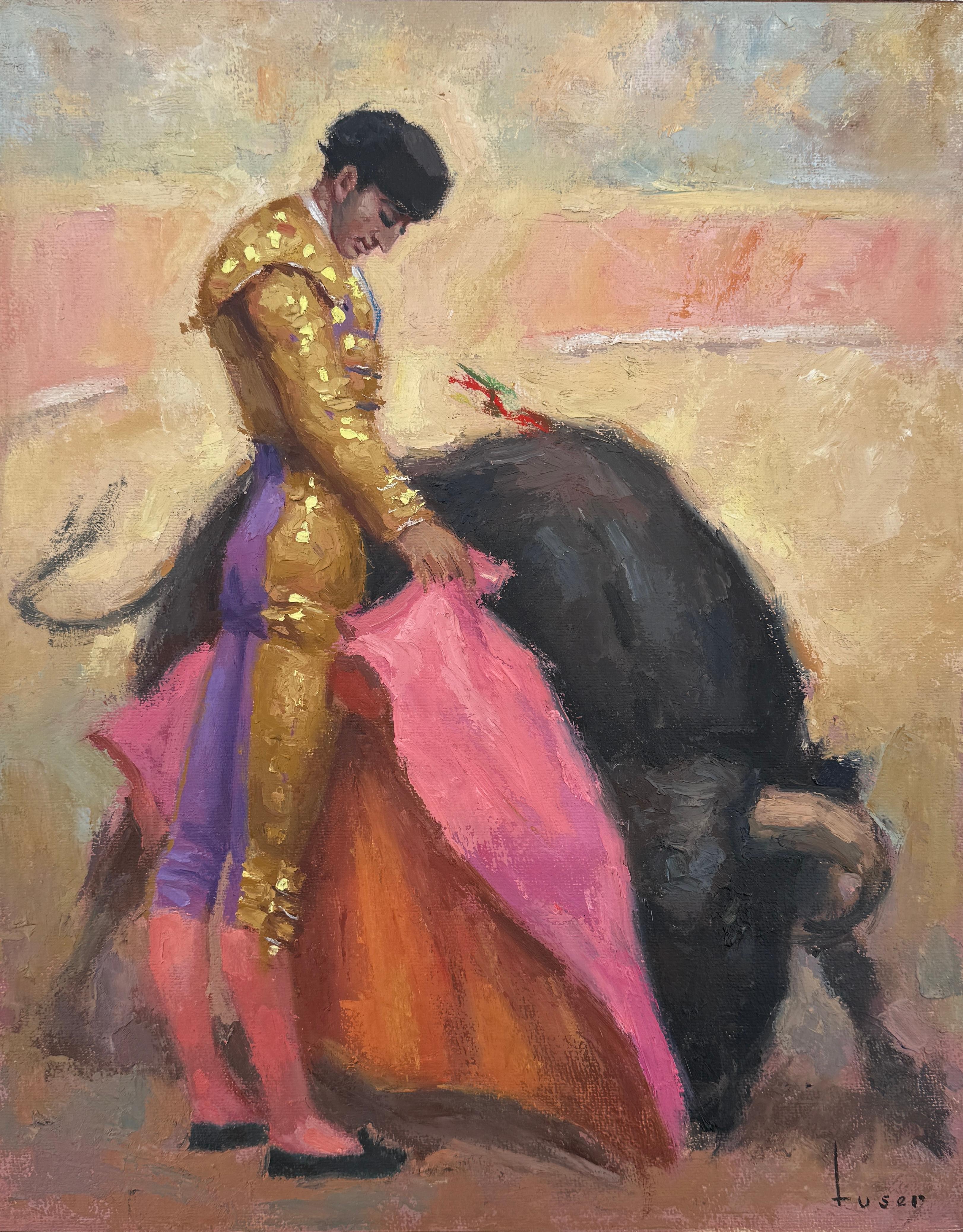
Torero and Bull bullfighter bullfighting oil painting
Located in Sitges, Barcelona
Title: Torero and Bull
Artist: José María Tuser Vázquez (1919-1986)
Technique: Oil on canvas mounted on board
Dimensions: 18.9 x 15 inches
Framing: Unframed
Art Movement: Costumbrismo, Figurative Expressionism
Theme: Bullfighting
Date of Creation: Second half of the 20th century
DESCRIPTION
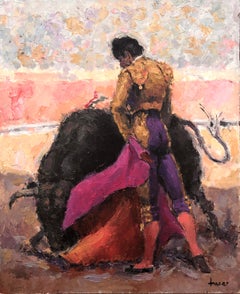
The painting Torero and Bull depicts a classic bullfighting scene, where a matador, elegantly dressed in a golden and violet traje de luces, performs a pass with the cape while the bull, wounded with banderillas, bows toward the ground. The composition conveys dynamism and tension, emphasizing the drama of the moment with loose and expressive brushstrokes.
The background is rendered in warm, diffused tones, contrasting with the deep black of the bull and the vivid hues of the cape. The thick brushwork and vibrant oil application enhance the sense of movement and emotion in the scene, a distinctive feature of Tuser Vázquez’s bullfighting paintings.
ARTIST'S BIOGRAPHY
José María Tuser Vázquez (Barcelona, 1919 - 1986) was a Spanish painter specializing in bullfighting themes. He trained at the School of Arts and Crafts in Barcelona, where he developed a strong foundation in drawing and painting. From 1947 onwards, he dedicated his artistic production to tauromaquia, creating posters, illustrations, and paintings that captured the intensity of the bullfighting spectacle.
He was a regular contributor to the magazine El Ruedo and designed a series of postcards featuring traditional Spanish costumes for Editorial Artigas in the 1940s. His work has been auctioned numerous times and is highly valued by collectors of bullfighting art...
Category
1960s Expressionist Figurative Paintings
Materials
Canvas, Oil, Board
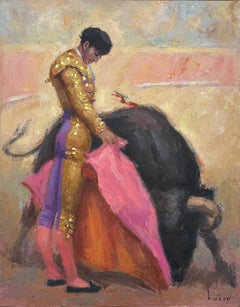
$658 Sale Price
44% Off
Bullfighting Scene oil on canvas painting
Located in Sitges, Barcelona
Title: Bullfighting Scene
Artist: José María Tuser Vázquez (1919-1986)
Technique: Oil on canvas
Dimensions: 16.1 x 13 inches (unframed)
Date: c. 1950-1960
Condition: Good
Provenance:...
Category
1960s Expressionist Animal Paintings
Materials
Oil, Canvas
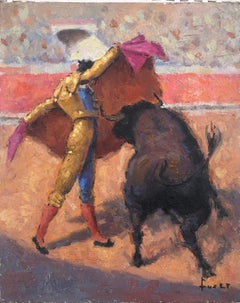
$717 Sale Price
50% Off
Fernand Audet French Impressionist Oil, The Matador
Bull Fight
Located in Cirencester, Gloucestershire
"The Matador"
by Fernand Audet (French, Tarascon 1923- Mulhouse 2016)
signed bottom left
oil painting on board, unframed
painting: 28.75 x 19.5 inches
A fine 20th century oil paint...
Category
Mid-20th Century Figurative Paintings
Materials
Acrylic