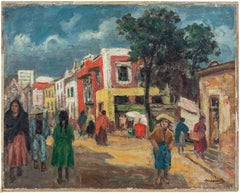
Items Similar to Jewish Peddlers on Market Day Modernist Judaica OIl Painting Cubist Abstraction
Want more images or videos?
Request additional images or videos from the seller
1 of 7
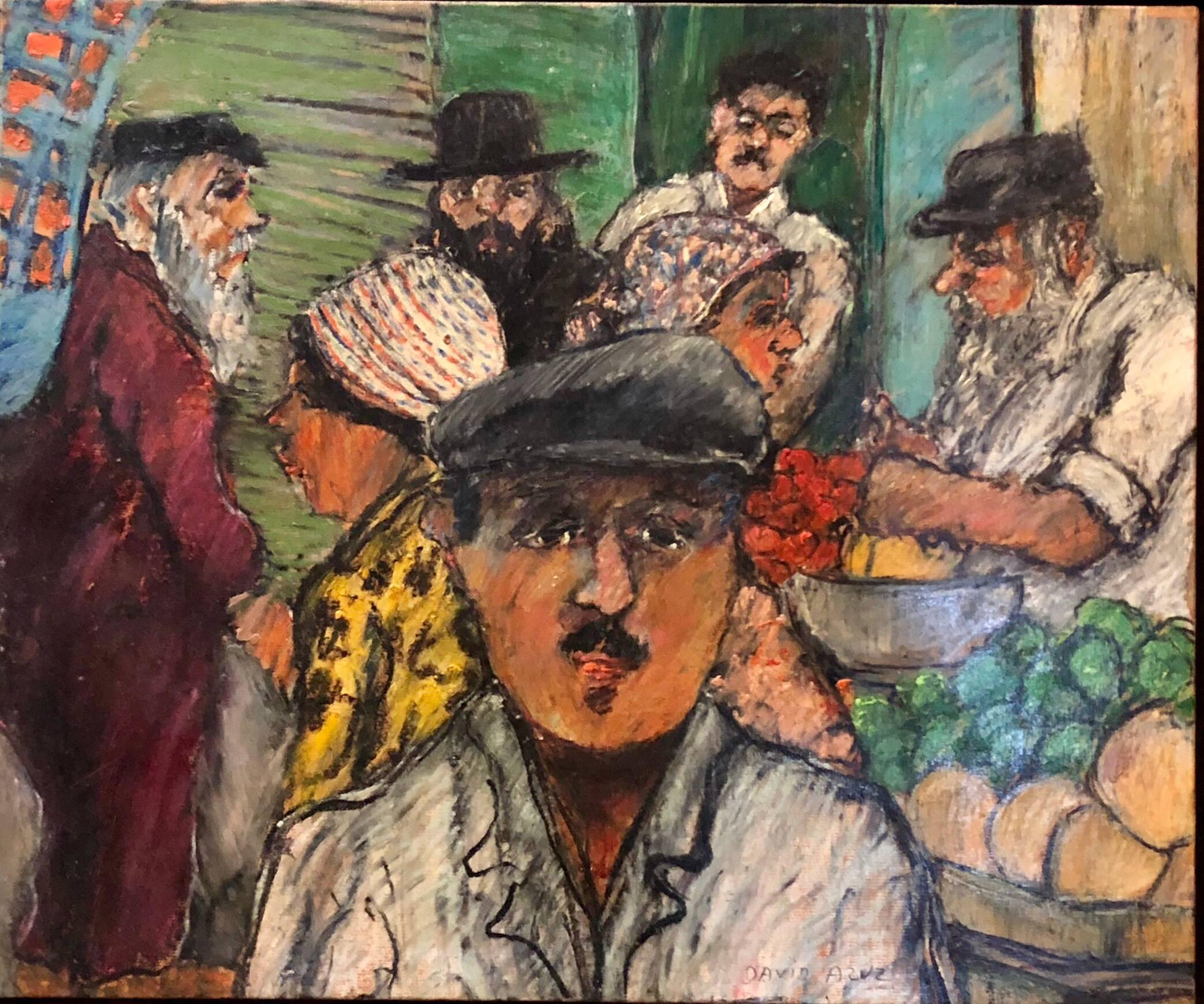
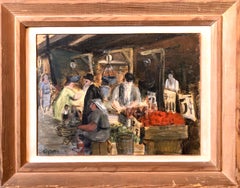
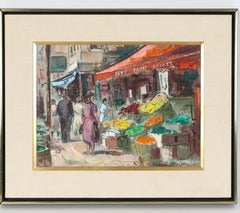
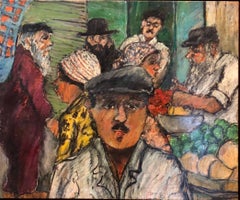
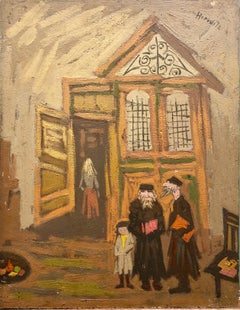
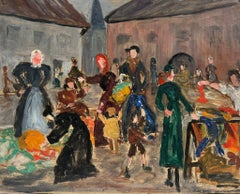
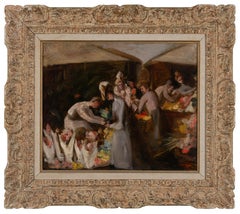
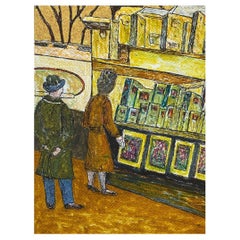
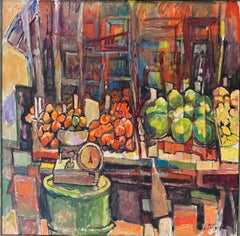
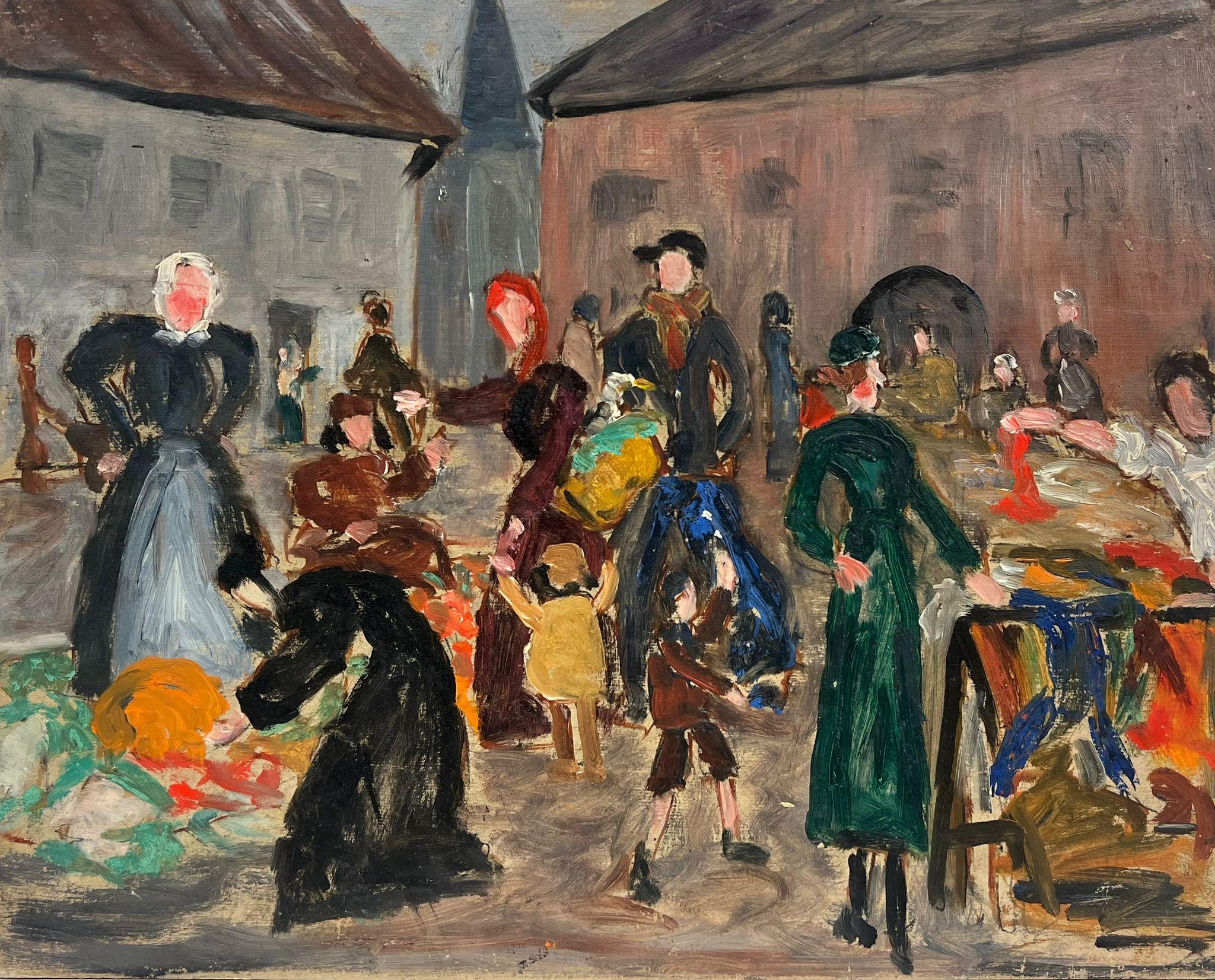
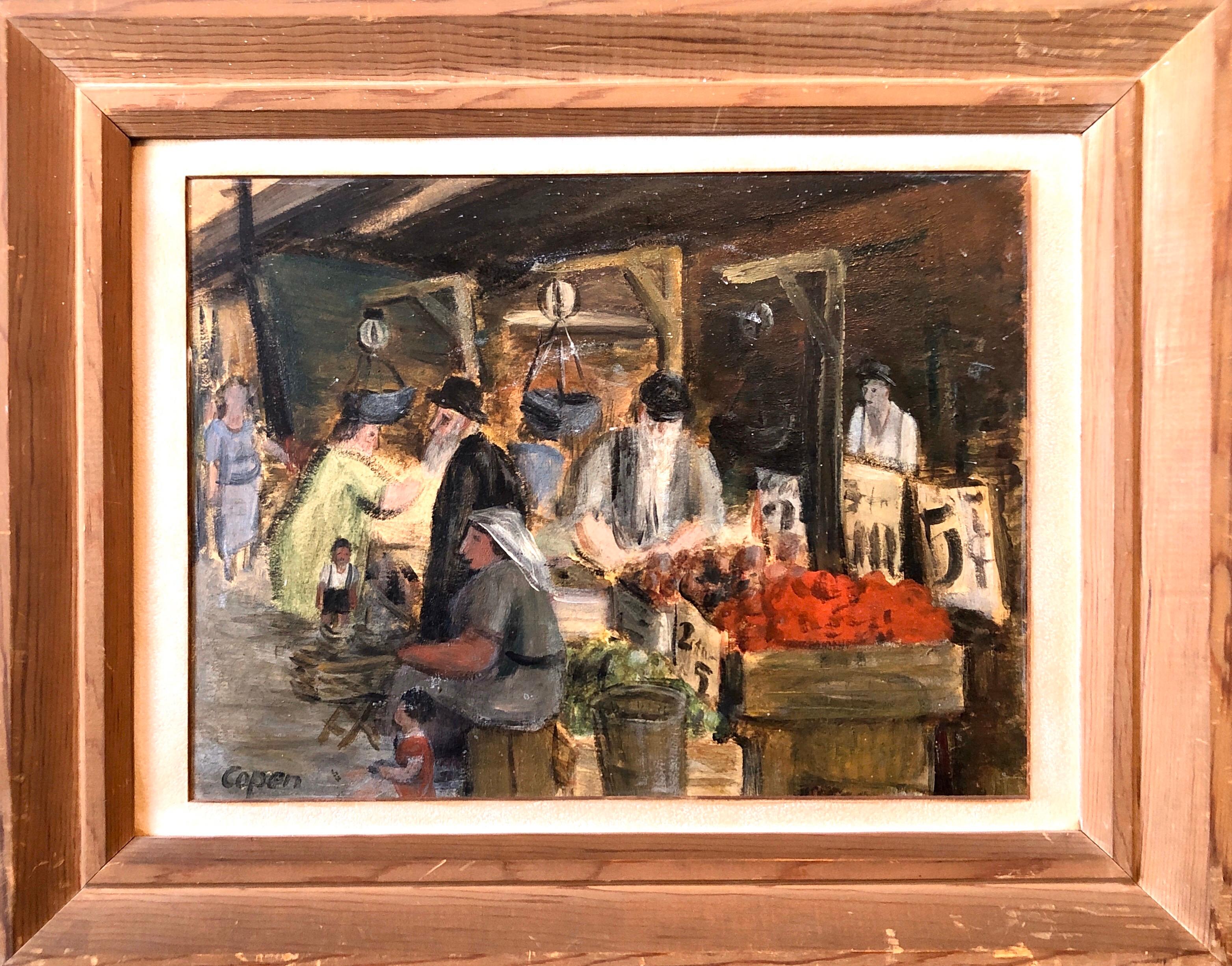
Samuel SigaloffJewish Peddlers on Market Day Modernist Judaica OIl Painting Cubist Abstraction
$1,600
£1,223.72
€1,400.43
CA$2,277.24
A$2,465.59
CHF 1,310.84
MX$29,736.67
NOK 16,484.54
SEK 15,368.28
DKK 10,459.40
About the Item
Sam Sigaloff (1895-1987) signed in the lower right. Vibrant market scene oil on canvas.
- Creator:Samuel Sigaloff
- Dimensions:Height: 20 in (50.8 cm)Width: 24 in (60.96 cm)
- Medium:
- Period:
- Condition:
- Gallery Location:Surfside, FL
- Reference Number:1stDibs: LU38217316672
About the Seller
4.9
Platinum Seller
Premium sellers with a 4.7+ rating and 24-hour response times
Established in 1995
1stDibs seller since 2014
1,842 sales on 1stDibs
Typical response time: 1 hour
- ShippingRetrieving quote...Shipping from: Surfside, FL
- Return Policy
More From This Seller
View AllNaive London Street Scene Folk Art Oil Painting Big Ben, Parliament, Union Jack
By Andrew Murray
Located in Surfside, FL
Big Ben, House of Parliament with Union Jack flag, Thames River, boats, barges, airplane and double decker red bus. Classic London street scene.
24 inches by 11 inches in a frame 24....
Category
20th Century Folk Art Figurative Paintings
Materials
Canvas, Oil
Israeli Oil Painting Ruth Schloss Child, Doll, Wagon, Kibbutz Social Realist Art
By Ruth Schloss
Located in Surfside, FL
Large magnificent colorful Ruth Schloss oil painting of a child with a wagon with a doll or a baby in a carriage stroller.. Signed in Hebrew
size measures 31x43 with frame , 23x35.25 without the frame. (this is being sold unframed).
Ruth Schloss (22 November 1922 – 2013) was an Israeli painter and illustrator who mainly depicted neglected scenes such as Arabs, transition camps, children and women at eye-level as egalitarian, socialist view via social realism style painting and drawing.
Schloss became Israeli painting’s sensitive, conscious, remembering eye.
Ruth Schloss was born on 22 November 1922, in Nuremberg, Germany, to Ludwig and Dian Schloss, as the second of three daughters of bourgeois assimilationist Jewish family well-integrated into German culture. As the Nazis came into power in 1933, her family immigrated to Israel in 1937, and settled in Kfar Shmaryahu, then an agricultural settlement. Schloss studied at the Department of Schloss graphic design at "Bezalel" from 1938 to 1942 alongside Friedel Stern and Joseph Hirsch. She was a realistic painter who focused on disadvantaged people in the society and social matters as an egalitarian. Her realism was thus an “inevitable realism,” motivated by an inner necessity: the need to observe reality as it is.
Her painting repeatedly addressed the door pulled from its frame, employing drawing’s unique ability to stop time and prolong the image’s persistence in the retina, she repeatedly committed to paper - in a matter-of-fact, non-evasive manner devoid of mystery – man’s tendency to generate chaos, suffering and pain.
Throughout her life, Schloss remained minimalist. Painting about human fate was the main subject of her artworks. Her natural inclination was to describe the darker aspect of human existence.
1930s
The Schloss household was characterized by open, liberal spirit, in keeping with the parents’ progressive views. It deeply influenced Ruth’s mental development, as she learned to tie culture and art with sensitivity towards the weak and underprivileged.
In Jerusalem, she joined a commune of Hashomer Hatzair in which she shaped her socialist views, which she maintained throughout her long career.
1940s
In this period she mainly depicted landscapes of kibbutz and wretched women living hard life, children in huger, older people, refugees. After completing her art studies, Schloss joined a training group at Kibbutz Merhavia in 1942, and after two years moved to Karkur region, the nucleus established Kibutz Lehavot Habashan in the Upper Galilee. Through this time, she fell in love with the surroundings and drew landscapes. They are simple and direct with fresh, lucid lines. These paintings were selected as the main works of her first exhibition in 1949.
In early 1945, Schloss started to draw illustrations in the children’s magazine Mishmar Leyeladim, and designed the logo of Al Hamishmar, the paper’s new name in 1948. In 1948, upon the founding of Mapam (United Workers’ Party), she designed her party’s emblem, which became a well-known icon. She kept working as an illustrator for Mishmar Layeladim until 1949.
"Mor the Monkey" project yielded financial profits and this income was used for a study trip to Paris for two years. She was succesfull as illustrator however, she had inner conflicts of her identity as witnessed painter toward neglected class in Israeli society.
First Exhibition at Mikra-Studio Gallery, 1949
She presented forty drawings on paper in her first solo exhibition, representing a selection of the themes of kibbutz landscape, its lifestyle. Schloss confidently proposed her direction through simplicity without using colors in her drawings.
1950s
Between 1949 and 1951, she studied at the Académie de la Grande Chaumière in Paris.
She began working in oils, with which she continued throughout the 1960s.
The exhibition “Back from Paris” opened in November 1951 at Mikra-Studio Gallery .
In 1951 she married Benjamin Cohen, who served as chairman of the national leadership of Hashomer Hatzair Workers Party in Tel Aviv. He was a theoretician and a man of principle, highly esteemed by its leaders who became a professor of history at Tel Aviv University. In 1953, following the Mordechai Oren affair and the publication of Moshe Sneh 's followers from Kibbutz Artzi, she and her husband left the kibbutz and moved to the agricultural farm, Kfar Shmaryahu, where she lived until her death.
At a certain point in Israeli history, segments of the socialist movement felt that Israel should become part of the Communist bloc, rather than seek the support of the western world. Because the Schloss couple support of Moshe Sneh’s left-wing party, they had to leave the kibbutz.
She loved to depict ordinary women as figurative on her painting without hiding or making up anything. The poet Natan Zach wrote about her works in 1955: “Her motto remains that which has been all these years: life as it is, without bluffing."
Schloss’s “Pietà” (1953) became a universal cry expressing the pain of mothers on either side of the divide. In the late 1950s, she was the mother of two daughters. When she drew her daughters, unlike the universal babies she depicted, naked and with clenched fists, the painting of her children employed babyish sweetness to the full in a quiet, peaceful and heart-stirring filling rather than urgency. She also painted children in the transition camp and Jaffa in the 1950s and 1960s.
1960s-1980s – The period of Studio in Jaffa
Schloss painted at a studio in Jaffa from 1962 till 1983. In this time, she turned her interest to people around her more than kibbutz – the children, mothers, and poor workers, the alleys and houses. She opened the space to the street and its dwellings, built interactions around it, and was nurtured by the presence of the outside in her work.
1960s Schloss familiarized to an Arab woman, Nabava, lived in poor. Schloss returned to painting images of old people later, and she called her painting figurative elderly people in the old age homes “waiting”.
In the late 1960s, Ruth discovered acrylic paint and never turn back to oil painting.
In 1965 Schloss devoted a series “Area 9 (1965)”, dedicated to the demolition of Israeli-Arab houses and the expropriation of the land, and carried a definite socio-political messages. The series was exhibited at Beit Zvi, Ramat Gan, in 1966. She was the only artist who addressed the result of the Six-Day War immediately afterward. In 1968, Schloss and Gansser-Markus presented “Drawing of War” in Zurich gallery. She expressed the war as an ultimate expression of destruction and ruin, regardless of victors and vanquished.
1970s In late 1970s Schloss began printing the selected photograph directly on the canvas, posterior reworking it in acrylic. She decided to print her work at Har-El Printers in Jaffa, and these became the surface of her painting. This technique was mainly adopted in two large series: Anne Frank (1979-1980) and Borders (1982). Through this technique she placed the figure of elder Frank next to that of the famous young Frank, and released it at the exhibition at Bet Ariela Cultural Center, Tel Aviv, in 1981. The series touched upon the Nazi Holocaust.
1980s The Lebanon War raised the question of “The Good Fence” and the effect of the war. She dedicated a large series Boarders, one of the most powerful image linked to the series is the figure of Yemenite woman raising her hand. She was the first to raise the Black Panthers demonstration to the level of a social icon. In the 1980s and again in 2000, the Intifada uprisings also led Schloss to the easel to render a good number of representational and symbolic works that in their way denounced Israel's political and military actions.
1990s – 2000s Ruth Schloss never had an exhibition in a major Israeli museum. Her works were presented in private galleries and small museums. The main museums, the Tel Aviv Museum of Art and the Israel Museum, included her works only in group exhibitions, and only in 1991 was her retrospective exhibited at the Herzliya Museum.
In the 2000s, Schloss’s metaphors turned into animal kingdom and Bedouins in the south. A huge rhinoceros, birds of prey, and other "bad animals," as Cohen Evron, daughter of Ruth, calls them and "I connected this to the Nazis," said Schloss. Schloss' work after she didn't find human expression able to transmit the endless cruelty she saw in Israel's political mentality.
Schloss also continued to follow and collect documentary photographs of destructions of houses from the war, the Intifada, the sequence of her work about ruin from 1949 to 2005, was a cumulative testimony about the painful history of Israel and Palestine.
In 2006, a large retrospective exhibition of her work was presented at the Museum of Art in Ein Harod, curated by Tali Tamir.
Education
1938-41 Bezalel Art Academy, Jerusalem, with Mordecai Ardon
1946 painting course for Kibbutz Artzi artists with Yohanan Simon and Marcel Janco
1949-51 Académie de la Grande Chaumière, Paris
Awards and recognition
1965 Silver Medal, International exhibition in Leipzig, Germany
1977 Artist-in-Residence, The Cité Internationale Universitaire de Paris
Selected solo exhibitions
2004 “Micha...
Category
Mid-20th Century Realist Figurative Paintings
Materials
Canvas, Oil
Large Judaica Jerusalem Oil Painting Israeli Jewish Rabbi Artist Tzvi Raphaely
By Zvi Raphaeli
Located in Surfside, FL
Rabbi Portrait, Oil Painting
Framed: 37.5 x 26. Canvas: 31.5 X 20
Bears original label verso from Safrai Gallery
Lovely Israeli Chassidic Rabbi portrait oil painting, vibrant colorful painting. Hand signed in Hebrew and English. Done in a style similar and influenced by Marc Chagall.
Svi Raphaely (also known as Tzvi Raphaeli...
Category
20th Century Post-Impressionist Figurative Paintings
Materials
Canvas, Oil
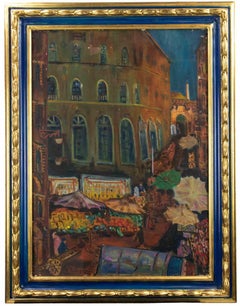
The Kabbalists, Hassidic Rabbis Judaica Colorful Modernist Painting
By Joseph Wolins
Located in Surfside, FL
Joseph Wolins
1915-1999
Wolins was born in Atlantic City, New Jersey. He studied at the National Academy of Design from 1935 to 1941 under Leon Kroll. He also studied in Europe in ...
Category
20th Century American Modern Figurative Paintings
Materials
Canvas, Oil
PAINT Abstract Belgian Contemporary Oil Painting Ellen De Meutter Woman Artist
Located in Surfside, FL
Ellen De Meutter
Paint 2, 2007
Acrylic, ink and oil on canvas
31.5 x 23.6 in (80.0 x 59.9 cm)
Provenance: Secrets & Lies show at her American gallery Roberts & Tilton, LA in 2007
Ellen De Meutter (1981) teaches painting at the Royal Academy of Fine Arts of Antwerp. In 2006-2007 she followed the HISK programme in Ghent, in 2013-2014 she did a residency at the Jan Van Eyck Academy in Maastricht.
De Meutter is represented by Tim Van Laere Gallery since 2006. (they represent Tal R, Marcel Dzama, Tomasz Kowalski and Franz West) Her work has been shown in various exhibitions in Belgium, the United States, Italy, Spain, the Netherlands, Germany and Japan. In 2010 she had her first solo museum exhibition in Museum Dhondt-Dhaenens.
Ellen De Meutter alters her viewer's reality by presenting a language in which she classifies the figures, shapes and colors from her personal world into a captivating utopia. Contrary to current trends in Flemish art, De Meutter is not simply relaying an anecdote; she composes unique imagery that allows her to experiment with the placement of the subject and unique treatments of her medium. De Meutter's repertoire of vivid, semi-neon colors contrast the muted grays blacks and grays on which they lay. These seemingly energetic colors are at once enhanced by the dark undertones of the canvas below, while simultaneously insinuating a concealed gravity of subject. Belgian art critic and curator, Luk Lambrecht remarks on De Meutter's painting: "she folds back 'her' world onto itself, into a solid mass of color from which, very slowly, vague contours emerge, which safeguard our expectations about looking at an image." De Meutter's scenes are reminiscent of schoolyard games, incorporating a series of text and symbols. By combing figurative imagery with basic abstraction, Ellen De Meutter creates wildly successful compositions that allude to her comprehensive understanding of contemporary painting. She was included in the show, Tomorrow is a long time: Ellen De Meutter, Gelitin, Kati Heck, Anton Henning, Friedrich Kunath...
Category
Early 2000s Contemporary Abstract Paintings
Materials
Canvas, Ink, Oil, Acrylic
Dancers, Haitian Naive Painting
By Saincilus Ismael
Located in Surfside, FL
SAINCILUS ISMAEL
Petite Rivière de l'Artibonite, Haiti, b. 1940, d. 2000
Saincilus Ismael was born in Petite Riviere de l’Artibonite, Haiti.
He began to paint in 1958, after visiting the Centre d’Art in Port-au-Prince. In 1967, he was one of a group of artists commissioned to paint the community exhibition hall at Deschapelles.
His work bears the influence of Byzantine art he saw in books. Like Gerard...
Category
20th Century Folk Art Figurative Paintings
Materials
Canvas, Oil
You May Also Like
Orientalist Oil Painting Depicting the Trade of a Horse by Pilny
By Otto Pilny
Located in London, GB
Orientalist oil painting depicting the trade of a horse by Pilny
Swiss, 1913
Canvas: Height 80cm, width 121cm
Frame: Height 102cm, width 142cm, depth 6cm
This beautiful Orientalist...
Category
Early 20th Century Figurative Paintings
Materials
Canvas, Oil
$114,266 Sale Price
30% Off
Antique Danish Orientalist Oil Painting of a Military Scene by Niels Simonsen
Located in London, GB
Antique Danish Orientalist oil painting of a military scene by Niels Simonsen
Danish, 1860
Canvas: Height 27cm, width 35cm
Frame: Height 43cm, width 52cm, depth 4cm
This very fine O...
Category
1860s Victorian Figurative Paintings
Materials
Oil, Canvas
$14,283 Sale Price
30% Off
Announcement in Village Square mid 19th century
Located in Hillsborough, NC
Fine 19th century oil painting of a bustling Austrian/Germanic village with horse, rider and various figures outside an Inn, attributed to Arthur Georg Ramberg (1819-1879), well known for figurative genre paintings. The rider is carrying a bugle, apparently announcing news to the people; men are sitting by the table drinking, one with a raised stein. Women walking by stop to listen, a man carrying a sack has stopped to watch the rider, people are in the Inn doorway, and one is looking out the window. Children pause their playing. The scene is under a large tree beside the Inn; a whole community waiting for news.
There is a great deal of detail in the scene, tree and Inn house...
Category
19th Century Victorian Figurative Paintings
Materials
Canvas, Oil
$1,300 Sale Price
50% Off
Boat Ashore - Oil Paint by Pino Romanò - 1990s
Located in Roma, IT
Oil on canvas realized by Pino Romanò (1934) in 1990s.
Hand signed. Titled on rear.
Very good condition.
Category
1990s Contemporary Figurative Paintings
Materials
Canvas, Oil
View of Trinità dé Monti - Rome - Oil Paint by Pino Romanò - 1990s
Located in Roma, IT
Oil on canvas realized by Pino Romanò (1934) in 1990s.
Hand signed. Titled on rear.
Very good condition.
Category
1990s Contemporary Figurative Paintings
Materials
Canvas, Oil
Houses by the Sea in Chianalea - Oil Paint by Pino Romanò - 1990s
Located in Roma, IT
Oil on canvas realized by Pino Romanò (1934) in 1990s.
Hand signed. Titled on rear.
Very good condition.
Category
1990s Contemporary Figurative Paintings
Materials
Canvas, Oil
$427 Sale Price
20% Off