Want more images or videos?
Request additional images or videos from the seller
1 of 15
UnknownAntique Greek Orthodox 17thCentury Icon Gilded Egg Tempera Saint Athanasios 1650Circa 1650
Circa 1650
$5,995List Price
About the Item
- Creation Year:Circa 1650
- Dimensions:Height: 21.5 in (54.61 cm)Width: 18.5 in (46.99 cm)Depth: 2.25 in (5.72 cm)
- Medium:
- Movement Style:
- Period:
- Condition:
- Gallery Location:Portland, OR
- Reference Number:Seller: C8621stDibs: LU136628933042
About the Seller
5.0
Gold Seller
Premium sellers maintaining a 4.3+ rating and 24-hour response times
Established in 1990
1stDibs seller since 2020
65 sales on 1stDibs
Authenticity Guarantee
In the unlikely event there’s an issue with an item’s authenticity, contact us within 1 year for a full refund. DetailsMoney-Back Guarantee
If your item is not as described, is damaged in transit, or does not arrive, contact us within 7 days for a full refund. Details24-Hour Cancellation
You have a 24-hour grace period in which to reconsider your purchase, with no questions asked.Vetted Professional Sellers
Our world-class sellers must adhere to strict standards for service and quality, maintaining the integrity of our listings.Price-Match Guarantee
If you find that a seller listed the same item for a lower price elsewhere, we’ll match it.Trusted Global Delivery
Our best-in-class carrier network provides specialized shipping options worldwide, including custom delivery.You May Also Like
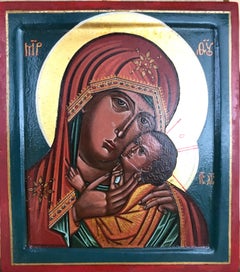
Icon of The Holy Virgin of Tenderness (Korsunskaya).
Located in Segovia, ES
Icon of THE KORSUN VIRGIN (KORSUNSKAYA), egg tempera, and gold leave on gesso, over a piece of wood.
Dimensions: (H) 26.5 x (W) 23.5 x (D) 3 cm.
Also called The Holy Virgin of Tenderness, represents the Mother of God and infant Christ in a tender cheek-to-cheek embrace.
The Virgin's hands tenderly surround the head and hands of the Child Jesus while he takes the cloak of the Mother of God with his left hand and plays with the fingers of his right hand, between his mother's neck and his own.
Two very old icons, from the 12th and 13th Centuries, painted on the same theme, are respectively in the Uspenskii Cathedral in Moscow and in the Russian Museum in St. Petersburg.
This is how the artist sums up the technique used by him to create the icon:
“The aim of these steps is to create a durable painting. The icon is eternal.
The first step is to choose a support, traditionally made of wood, from the center of the trunk to avoid warping it. For this purpose, two hardwood bolts were often used on the back to give the picture panel additional stability.
Often a frame is milled out. Then the image carrier is sanded smooth and now 12 or 14 thin layers of gesso are applied and sanded smooth as well.
Then the preliminary drawing is applied and the drawing board is prepared with a special preparation called bolus. This bolus can be polished to a high gloss. Afterward, the gold leaf is
"shot" with special brushes. It dries up within a few hours and can now be polished with agate. Gold leaf is real 24-carat gold.
Now, the actual process of painting begins. Egg tempera is made fresh from egg yolk, water and a little vinegar. This is used to prepare the color pigments.
Tempera painting is done in numerous layers from dark to light.
When the icon is finished, it is left to dry for a few months and varnished with a special varnish called Olifa made from boiled linseed oil and other ingredients”.
ABOUT THE ARTIST
Oliver Samsinger...
Category
1990s Byzantine Figurative Paintings
Materials
Gold Leaf
$780
H 10.44 in W 9.26 in D 1.19 in
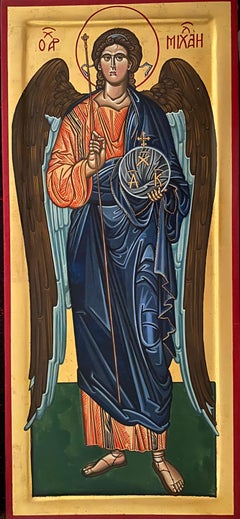
The archangel Saint Michael, after an icon of the 14th century
Located in Segovia, ES
Archangel Saint Michael after an icon from Constantinople of the 14th Century.
Artist: Oliver Samsinger
Technique: Egg tempera on gesso and wood, with application of gold leaf
Dimens...
Category
2010s Byzantine Figurative Paintings
Materials
Gold Leaf
$2,162
H 25.2 in W 11.42 in D 1.78 in
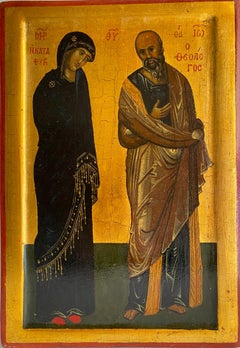
Virgin of Kataphyge and St. John, after a Byzantine Bulgarian Icon 14th Century
Located in Segovia, ES
The Virgin of Kataphyge with Saint John the Evangelist, after a Bulgarian Byzantine icon of the 14th Century.
Egg tempera and gold leaf on gesso and wood.
Author: Oliver Samsinger...
Category
Early 1900s Byzantine Figurative Paintings
Materials
Gold Leaf
$2,639
H 15.36 in W 10.63 in D 0.99 in
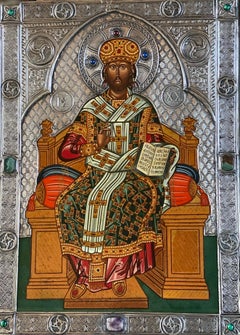
Christ, the Great High Priest. Greek-Italian style Icon with silver oklad
Located in Segovia, ES
Christ, the Great High Priest. Greek-Italian style Icon with silver filigreed oklad.
Egg tempera, over gesso on wood with a silver cover, "oklad", with pol...
Category
1990s Byzantine Figurative Paintings
Materials
Silver
$3,171 Sale Price
20% Off
H 21.26 in W 15.36 in D 0.79 in
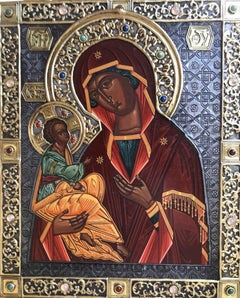
Icon of Our Lady of Jerusalem with oklad by Oliver Samsinger
Located in Segovia, ES
Icon of Our Lady of Jerusalem.
Egg tempera on gesso and over a wooden board.
Dimensions in centimeters: 42 x 34 x 2 cm / In inches: 16.54 x 13-39 x 0-79 "
Author: Oliver Samsinger...
Category
1990s Byzantine Figurative Paintings
Materials
Brass
$2,767 Sale Price
20% Off
H 16.54 in W 13.39 in D 0.79 in
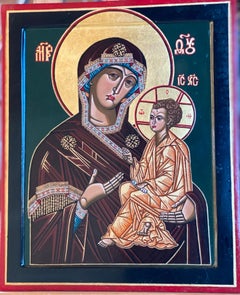
The Virgin of Tijvin (after a Russian Icon in the style of the 18th century).
Located in Segovia, ES
The Virgin of Tijvin (after a Russian icon in the style of the 18th Century).
Egg tempera and gold leaf on gesso over wood.
Measurements in centimeters: 45 x 36.5 x 3 cm / In inch...
Category
1990s Byzantine Figurative Paintings
Materials
Gold Leaf
$1,729 Sale Price
27% Off
H 17.72 in W 14.38 in D 1.19 in
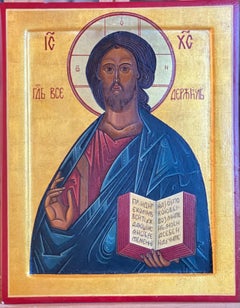
Christ Pantocrator" After an Icon in the style of the Moscow School
Located in Segovia, ES
"Christ Pantocrator". After an Icon in the style of the Moscow school (15th century). Somewhat similar to that of Rublev.
Author: Oliver Samsinguer
Egg tempera and gold leaf on gesso and on wood.
Dimensions; (H) 42 x (W) 33.5 x (D) 3.5 cm.
(H) 16.54 x (W) 13.19 x (D) 1.38 in.
This is how the artist sums up the technique used by him to create the icon:
“The aim of these steps is to create a durable painting. The icon is eternal.
The first step is to choose a support, traditionally made of wood, from the center of the trunk to avoid warping it. For this purpose, two hardwood bolts were often used on the back to give the picture panel additional stability.
Often a frame is milled out. Then the image carrier is sanded smooth and now 12 or 14 thin layers of gesso are applied and sanded smooth as well.
Then the preliminary drawing is applied and the drawing board is prepared with a special preparation called bolus. This bolus can be polished to a high gloss. Afterwards, the gold leaf is
"shot" with special brushes. It dries up within a few hours and can now be polished with an agate. Gold leaf is real 24-carat gold .
Now, the actual process of painting begins. Egg tempera is made fresh from egg yolk, water, and a little vinegar. This is used to prepare the color pigments.
Tempera painting is done in numerous layers from dark to light.
When the icon is finished, it is left to dry for a few months and varnished with a special varnish called Olifa made from boiled linseed oil and other ingredients”.
ABOUT THE ARTIST
Oliver Samsinger...
Category
1990s Byzantine Figurative Paintings
Materials
Gold Leaf
$1,729 Sale Price
20% Off
H 16.54 in W 13.19 in D 1.38 in
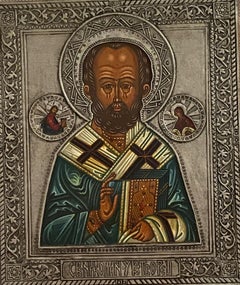
Saint Nicolas in the style of Russian icons of the 18th century. With Oklad
Located in Segovia, ES
Icono of Saint Nicolas in the style of Russian icons of the 18th century.
Egg tempera and gesso on wood, covered by a metal oklad made by the artist himself. The oklad, in principle, were made to cover damaged parts of highly revered ancient icons...
Category
1990s Byzantine Figurative Paintings
Materials
Gesso, Wood, Egg Tempera
$1,249 Sale Price
33% Off
H 11.82 in W 10.04 in D 0.79 in
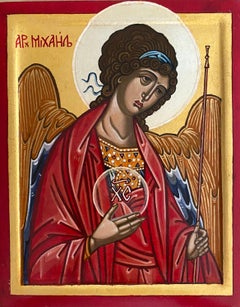
The Archangel Michael (after the one by Rubliev in the Tretyakov Gallery-Moscow)
Located in Segovia, ES
The Archangel Michael (after the one by Rubliev in the Tretyakov Gallery-Moscow). This icon is an original work by the Viennese iconographer Oliver Samsinger.
According to the artis...
Category
2010s Byzantine Figurative Paintings
Materials
Gold Leaf
$1,177
H 10.24 in W 8.27 in D 1.19 in
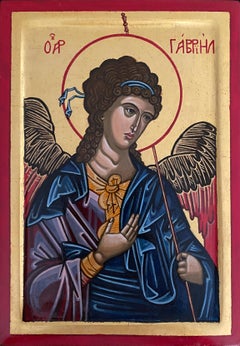
"The Archangel Gabriel" (after a 10th-century Icon from Hilandar Monastery).
Located in Segovia, ES
"The Archangel Gabriel", after a 10th‑century icon from the Hilandar Monastery on Mount Athos
Artist: Oliver Samsinger.
Technique: Egg tempera on gesso and wood, with gold leaf appli...
Category
2010s Byzantine Portrait Paintings
Materials
Gold Leaf
$1,201
H 11.82 in W 8.27 in D 1.19 in
More From This Seller
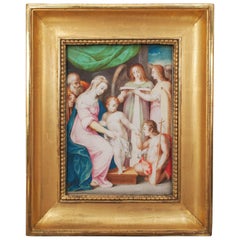
View AllItalian Renaissance Tempera on Parchment Painting Holy Family by Giuseppe Cesari
Located in Portland, OR
A rare & important Italian Renaissance tempera on parchment painting, Giuseppe Cesari Il Cavalier d'Arpino (Giuseppe Cesari, 1568-1640), the painting c...
Category
16th Century Renaissance Figurative Paintings
Materials
Parchment Paper, Egg Tempera
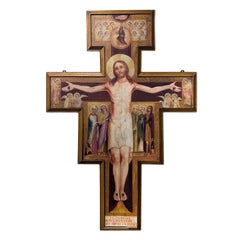
Monumental Antique French Oil Painting San Damiano Crucifix Christ St. Francis
Located in Portland, OR
A fine & monumental antique French oil painting of the San Damiano Crucifix, circa 1820.
This monumental oil painting on canvas is very finely painted and is housed in a wooden cruc...
Category
1820s Medieval Figurative Paintings
Materials
Canvas, Oil
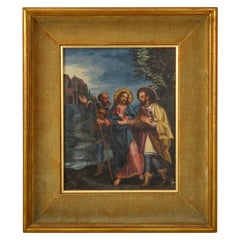
18th Century Italian Old Master Tempera on Panel Painting "Jesus Road to Emmaus"
Located in Portland, OR
An important 18th century Italian Old Master tempera on copper panel Baroque painting, "The Road to Emmaus", circa 1700.
The painting represents the early resurrection biblical story...
Category
Early 18th Century Baroque Figurative Paintings
Materials
Copper
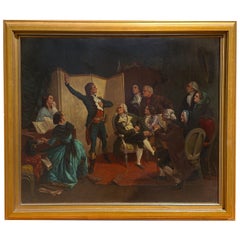
Antique French Oil Painting Claude Rouget de LiIsle Singing "La Marseillaise"
By Isidore Alexandre Augustin Pils
Located in Portland, OR
A fine antique French oil painting on canvas by Isidore Alexandre Augustin Pils (1815–1875), the painting depicting Claude Joseph Rouget de Lisle (1760-1836) singing "La Marseillaise", circa 1849.
Isidore Pils was an academic painter, very often painting military subjects. Claude Rouget de Lisle was a French army officer from the French Revolutionary Wars and famously wrote the words to "La Marseillaise" and first performed it to the Mayor of Strasbourg; Baron Philippe-Frederic de Dietrich. This painting dates to the middle of the 19th century and could be by the hand of Pils or possibly a talented copyist who was also a classically trained artist, the work appears to be unsigned.
The painting is in excellent condition and is housed in a gilded frame.
Isidore Pils produced a number of paintings with this famous scene and one such painting is housed in the collection of The Louvre in Paris.
At sight without frame 26.50" x 22"
Pils was born in Paris as the son of a soldier François Pils. At the age of twelve, he studied with Guillaume Guillon-Lethière for four years.
In 1831 he became a student at the École des Beaux-Arts and studied under François-Édouard Picot. He competed for the Prix de Rome, which he won in 1838 for a history painting, St. Peter Healing a Lame Man at the Door of the Temple. Although in poor health, Pils then spent the customary three years at the French Academy in Rome at the Villa Medici, which then had Jean Auguste Dominique Ingres as its director. While in Italy he visited Naples, Venice, and Florence.
Pils's earlier paintings have religious themes. In 1849 he completed his most famous work, Rouget de L'Isle Singing La Marseillaise, which now resides at the Musée historique de Strasbourg. After experiences travelling with French troops through the Crimea, his themes took on military and nationalistic subjects. He later produced many military scenes during the siege of Paris during the Franco-Prussian War of 1870.
Pils was appointed professor of painting at the École des Beaux-Arts in 1863 but left the same year for two years in Algeria. In 1868 he was elected to seat #14 of the Académie des Beaux-Arts. Among his students were Adrien Moreau, Paul Adolphe Rajon, Julien Dupré, Luc-Olivier Merson, Ludovic Piette...
Category
1840s French School Figurative Paintings
Materials
Oil, Canvas
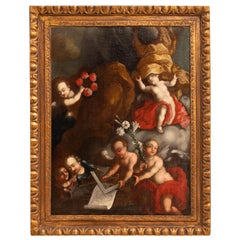
Austrian Old Master Baroque Oil Canvas Painting Architecture Allegory Cherubs
Located in Portland, OR
An important & large oil on canvas Baroque painting by the Bohemian Old Master artist, Franz Xaver Karl Palko (1724-1767), an allegory of architecture, circa 1750.
The painting depic...
Category
1750s Baroque Figurative Paintings
Materials
Canvas, Oil
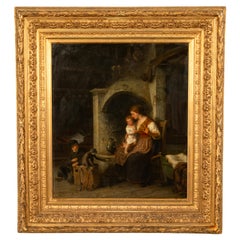
Antique Swedish Oil Canvas Painting Romantic Interior Family Scene Monkey 1883
Located in Portland, OR
A fine & large antique oil on canvas painting by Bengt Nordenberg (1822-1902), Sweden, dated 1883.
Nordenberg is recognized as one of Sweden's most celebrated 19th century artists, his work epitomizes Swedish Romanticism and this painting is a wonderful representation of that style. The painting depicts an interior scene of a mother holding an infant in front of an open heath, with a fire burning in the grate, above the fire there are racks of meat hanging and above that are hams hanging. The infant has evidently just woken from a nap and his cradle sits next to his mother's chair, his brother sitting on the floor with his monkey & the carrying case he transports the animal to beg for money, the monkey humorously sits with his begging plate outstretched to the boy's mother, much to her consternation!
The painting is signed and dated lower left, it is in very good condition and is housed in the original gilded composition and limewood frame, Nordenberg's record for a painting at auction is over $91,500, this is a fine example of the artist's work and is ready to hang on your wall. Bloomsbury Fine Art & Antiques ship globally, very well packed & insured to ensure safe delivery.
Bengt Nordenberg (1822-1902) was a master of Swedish Romanticism. He belonged to the Düsseldorf school of painting & is best known for his genre paintings with everyday life scenes from the Dalarna, Skåne and Blekinge areas of Sweden. He moved to Düsseldorf in the 1850s. Nordenberg was born at Jämshög in Blekinge County, Sweden, he was one of nine siblings born to Per Jönsson Nord (1785-1854) and his wife Sissa Bengtsdotter (b. 1792). He grew up in poverty and became an apprentice to a painter in Sölvesborg.
In 1843 he studied at the Royal Swedish Academy of Arts in Stockholm, In the autumn of 1851 he went to the Düsseldorf Academy, where first Theodor Hildebrandt and then later, Adolph Tidemand...
Category
1880s Romantic Figurative Paintings
Materials
Canvas, Oil