Want more images or videos?
Request additional images or videos from the seller
1 of 7
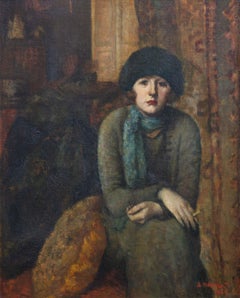
Unknown"Lady in Red" Framed Oil Portrait Circa 1950
Price:$1,000
$1,150List Price
About the Item
- Dimensions:Height: 24 in (60.96 cm)Width: 20 in (50.8 cm)Depth: 2 in (5.08 cm)
- Medium:
- Period:
- Condition:
- Gallery Location:Rochester, NY
- Reference Number:Seller: 59008 antique Hollywood regency mcm mid century modern painting1stDibs: LU1650210448432
About the Seller
5.0
Vetted Professional Seller
Every seller passes strict standards for authenticity and reliability
1stDibs seller since 2021
41 sales on 1stDibs
Authenticity Guarantee
In the unlikely event there’s an issue with an item’s authenticity, contact us within 1 year for a full refund. DetailsMoney-Back Guarantee
If your item is not as described, is damaged in transit, or does not arrive, contact us within 7 days for a full refund. Details24-Hour Cancellation
You have a 24-hour grace period in which to reconsider your purchase, with no questions asked.Vetted Professional Sellers
Our world-class sellers must adhere to strict standards for service and quality, maintaining the integrity of our listings.Price-Match Guarantee
If you find that a seller listed the same item for a lower price elsewhere, we’ll match it.Trusted Global Delivery
Our best-in-class carrier network provides specialized shipping options worldwide, including custom delivery.You May Also Like
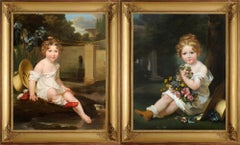
Portraits of two sisters
Located in BELEYMAS, FR
Bernard GAILLOT
(Versailles 1780 – Paris, 1847)
Portraits of two sisters
Pair of oil on canvas
H. 92 cm; L. 73 cm
One signed
Student of David, he presented his first works at the Sa...
Category
1810s French School Portrait Paintings
Materials
Canvas, Oil
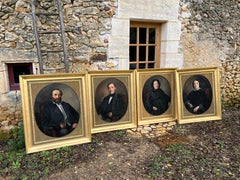
Four large French family portraits
Located in BELEYMAS, FR
Suite of four large family portraits, kept together to this day. Created around 1840 by the painter Théophile Morel, who presented portraits at the Salon des Artistes Français from t...
Category
1840s French School Portrait Paintings
Materials
Canvas, Oil
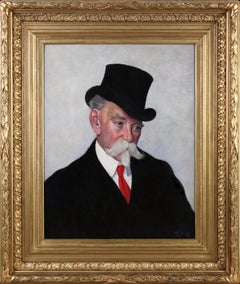
Portrait of A Man Wearing A Top Hat , attributed to Tom Roberts 1888
By Tom Roberts
Located in Gavere, BE
Portrait of A Man Wearing A Top Hat , attributed to Tom Roberts 1888
Thomas William Roberts ( 1856 – 1931) was an English-born Australian artist and a key member of the Heidelberg S...
Category
1880s Realist Portrait Paintings
Materials
Gold Leaf
$8,428
H 36.23 in W 30.71 in D 3.94 in
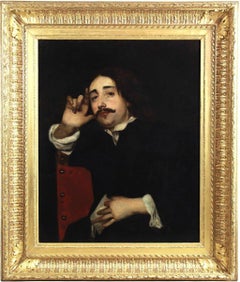
Portrait of a seated man , oil on canvas painting from the 19th century
Located in Gavere, BE
Portrait of a seated man , oil on canvas painting from the 19th century
Wonderful and large oil on canvas of a seated man, Flemish school from the end of the 19th century.
Sold with...
Category
1880s Flemish School Figurative Paintings
Materials
Gold Leaf
$12,268 Sale Price
20% Off
Free Shipping
H 42.92 in W 36.62 in D 3.94 in
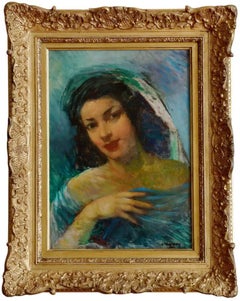
Pere Creixams Spanish Woman, Oil on Canvas
By Pere Créixams Picó
Located in Saint Amans des cots, FR
Oil on canvas by Pere Creixams Pico (1893-1965), School of Paris, ca.1920. Beautiful Spanish woman. Provenance: Charpentier Gallery, 76 rue du Faubourg Saint Honore, Paris (Sotheby's...
Category
1920s Modern Figurative Paintings
Materials
Canvas, Oil
$4,000
H 24.81 in W 19.49 in D 2.96 in
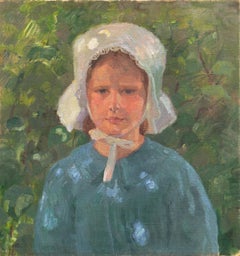
The White Bonnet
, Paris, Royal Academy of Fine Arts, Copenhagen Art Museum
By Henrik Schouboe
Located in Santa Cruz, CA
Initialed lower left, 'H.S.' for Henrik Schouboe (Danish, 1876-1949) and painted circa 1915.
Henrik Schouboe first studied at the Copenhagen's Royal Academy of Fine Arts from 1894-1...
Category
1910s Portrait Paintings
Materials
Canvas, Oil
$4,500
H 20.25 in W 18.75 in D 0.75 in
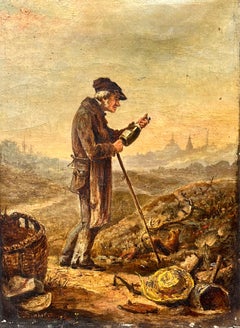
Enjoying Old Times
Located in Fredericksburg, VA
"Enjoying Old Times" by Charles Baker captures a poignant and joyful moment in the life of an older man, immersed in the beauty of nature. The painting features the man in the midst of a hike, his weathered walking stick in one hand, and a bottle of champagne in the other. His gaze is fixed on the bottle, a focused and content expression playing on his lips, suggesting a celebration of memories or perhaps a spontaneous toast to the present moment.
Baker’s use of warm, earthy tones highlights the natural surroundings, with the man standing against a backdrop of greenery, a rocky path, and a clear, open sky. The composition is rich in detail, from the rugged texture of the man’s clothes...
Category
Mid-19th Century Hudson River School Figurative Paintings
Materials
Canvas, Oil
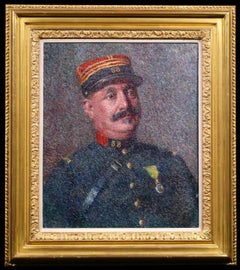
Le Chef de Gare - Neo Impressionist Portrait Oil Painting by Achille Lauge
By Achille Laugé
Located in Marlow, Buckinghamshire
Signed portrait oil on canvas circa 1898 by French neo-impressionist painter Achille Lauge. The piece is a beautifully textured with impasto and is a portrait of a French station mas...
Category
1890s Impressionist Portrait Paintings
Materials
Canvas, Oil
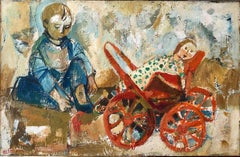
Israeli Oil Painting Ruth Schloss Child, Doll, Wagon, Kibbutz Social Realist Art
By Ruth Schloss
Located in Surfside, FL
Large magnificent colorful Ruth Schloss oil painting of a child with a wagon with a doll or a baby in a carriage stroller.. Signed in Hebrew
size measures 31x43 with frame , 23x35.25 without the frame. (this is being sold unframed).
Ruth Schloss (22 November 1922 – 2013) was an Israeli painter and illustrator who mainly depicted neglected scenes such as Arabs, transition camps, children and women at eye-level as egalitarian, socialist view via social realism style painting and drawing.
Schloss became Israeli painting’s sensitive, conscious, remembering eye.
Ruth Schloss was born on 22 November 1922, in Nuremberg, Germany, to Ludwig and Dian Schloss, as the second of three daughters of bourgeois assimilationist Jewish family well-integrated into German culture. As the Nazis came into power in 1933, her family immigrated to Israel in 1937, and settled in Kfar Shmaryahu, then an agricultural settlement. Schloss studied at the Department of Schloss graphic design at "Bezalel" from 1938 to 1942 alongside Friedel Stern and Joseph Hirsch. She was a realistic painter who focused on disadvantaged people in the society and social matters as an egalitarian. Her realism was thus an “inevitable realism,” motivated by an inner necessity: the need to observe reality as it is.
Her painting repeatedly addressed the door pulled from its frame, employing drawing’s unique ability to stop time and prolong the image’s persistence in the retina, she repeatedly committed to paper - in a matter-of-fact, non-evasive manner devoid of mystery – man’s tendency to generate chaos, suffering and pain.
Throughout her life, Schloss remained minimalist. Painting about human fate was the main subject of her artworks. Her natural inclination was to describe the darker aspect of human existence.
1930s
The Schloss household was characterized by open, liberal spirit, in keeping with the parents’ progressive views. It deeply influenced Ruth’s mental development, as she learned to tie culture and art with sensitivity towards the weak and underprivileged.
In Jerusalem, she joined a commune of Hashomer Hatzair in which she shaped her socialist views, which she maintained throughout her long career.
1940s
In this period she mainly depicted landscapes of kibbutz and wretched women living hard life, children in huger, older people, refugees. After completing her art studies, Schloss joined a training group at Kibbutz Merhavia in 1942, and after two years moved to Karkur region, the nucleus established Kibutz Lehavot Habashan in the Upper Galilee. Through this time, she fell in love with the surroundings and drew landscapes. They are simple and direct with fresh, lucid lines. These paintings were selected as the main works of her first exhibition in 1949.
In early 1945, Schloss started to draw illustrations in the children’s magazine Mishmar Leyeladim, and designed the logo of Al Hamishmar, the paper’s new name in 1948. In 1948, upon the founding of Mapam (United Workers’ Party), she designed her party’s emblem, which became a well-known icon. She kept working as an illustrator for Mishmar Layeladim until 1949.
"Mor the Monkey" project yielded financial profits and this income was used for a study trip to Paris for two years. She was succesfull as illustrator however, she had inner conflicts of her identity as witnessed painter toward neglected class in Israeli society.
First Exhibition at Mikra-Studio Gallery, 1949
She presented forty drawings on paper in her first solo exhibition, representing a selection of the themes of kibbutz landscape, its lifestyle. Schloss confidently proposed her direction through simplicity without using colors in her drawings.
1950s
Between 1949 and 1951, she studied at the Académie de la Grande Chaumière in Paris.
She began working in oils, with which she continued throughout the 1960s.
The exhibition “Back from Paris” opened in November 1951 at Mikra-Studio Gallery .
In 1951 she married Benjamin Cohen, who served as chairman of the national leadership of Hashomer Hatzair Workers Party in Tel Aviv. He was a theoretician and a man of principle, highly esteemed by its leaders who became a professor of history at Tel Aviv University. In 1953, following the Mordechai Oren affair and the publication of Moshe Sneh 's followers from Kibbutz Artzi, she and her husband left the kibbutz and moved to the agricultural farm, Kfar Shmaryahu, where she lived until her death.
At a certain point in Israeli history, segments of the socialist movement felt that Israel should become part of the Communist bloc, rather than seek the support of the western world. Because the Schloss couple support of Moshe Sneh’s left-wing party, they had to leave the kibbutz.
She loved to depict ordinary women as figurative on her painting without hiding or making up anything. The poet Natan Zach wrote about her works in 1955: “Her motto remains that which has been all these years: life as it is, without bluffing."
Schloss’s “Pietà” (1953) became a universal cry expressing the pain of mothers on either side of the divide. In the late 1950s, she was the mother of two daughters. When she drew her daughters, unlike the universal babies she depicted, naked and with clenched fists, the painting of her children employed babyish sweetness to the full in a quiet, peaceful and heart-stirring filling rather than urgency. She also painted children in the transition camp and Jaffa in the 1950s and 1960s.
1960s-1980s – The period of Studio in Jaffa
Schloss painted at a studio in Jaffa from 1962 till 1983. In this time, she turned her interest to people around her more than kibbutz – the children, mothers, and poor workers, the alleys and houses. She opened the space to the street and its dwellings, built interactions around it, and was nurtured by the presence of the outside in her work.
1960s Schloss familiarized to an Arab woman, Nabava, lived in poor. Schloss returned to painting images of old people later, and she called her painting figurative elderly people in the old age homes “waiting”.
In the late 1960s, Ruth discovered acrylic paint and never turn back to oil painting.
In 1965 Schloss devoted a series “Area 9 (1965)”, dedicated to the demolition of Israeli-Arab houses and the expropriation of the land, and carried a definite socio-political messages. The series was exhibited at Beit Zvi, Ramat Gan, in 1966. She was the only artist who addressed the result of the Six-Day War immediately afterward. In 1968, Schloss and Gansser-Markus presented “Drawing of War” in Zurich gallery. She expressed the war as an ultimate expression of destruction and ruin, regardless of victors and vanquished.
1970s In late 1970s Schloss began printing the selected photograph directly on the canvas, posterior reworking it in acrylic. She decided to print her work at Har-El Printers in Jaffa, and these became the surface of her painting. This technique was mainly adopted in two large series: Anne Frank (1979-1980) and Borders (1982). Through this technique she placed the figure of elder Frank next to that of the famous young Frank, and released it at the exhibition at Bet Ariela Cultural Center, Tel Aviv, in 1981. The series touched upon the Nazi Holocaust.
1980s The Lebanon War raised the question of “The Good Fence” and the effect of the war. She dedicated a large series Boarders, one of the most powerful image linked to the series is the figure of Yemenite woman raising her hand. She was the first to raise the Black Panthers demonstration to the level of a social icon. In the 1980s and again in 2000, the Intifada uprisings also led Schloss to the easel to render a good number of representational and symbolic works that in their way denounced Israel's political and military actions.
1990s – 2000s Ruth Schloss never had an exhibition in a major Israeli museum. Her works were presented in private galleries and small museums. The main museums, the Tel Aviv Museum of Art and the Israel Museum, included her works only in group exhibitions, and only in 1991 was her retrospective exhibited at the Herzliya Museum.
In the 2000s, Schloss’s metaphors turned into animal kingdom and Bedouins in the south. A huge rhinoceros, birds of prey, and other "bad animals," as Cohen Evron, daughter of Ruth, calls them and "I connected this to the Nazis," said Schloss. Schloss' work after she didn't find human expression able to transmit the endless cruelty she saw in Israel's political mentality.
Schloss also continued to follow and collect documentary photographs of destructions of houses from the war, the Intifada, the sequence of her work about ruin from 1949 to 2005, was a cumulative testimony about the painful history of Israel and Palestine.
In 2006, a large retrospective exhibition of her work was presented at the Museum of Art in Ein Harod, curated by Tali Tamir.
Education
1938-41 Bezalel Art Academy, Jerusalem, with Mordecai Ardon
1946 painting course for Kibbutz Artzi artists with Yohanan Simon and Marcel Janco
1949-51 Académie de la Grande Chaumière, Paris
Awards and recognition
1965 Silver Medal, International exhibition in Leipzig, Germany
1977 Artist-in-Residence, The Cité Internationale Universitaire de Paris
Selected solo exhibitions
2004 “Micha...
Category
Mid-20th Century Realist Figurative Paintings
Materials
Canvas, Oil
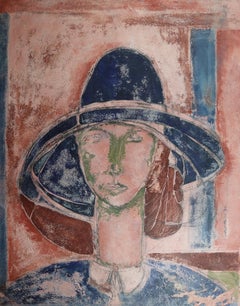
La Grande Parisienne. Contemporary Figurative Oil Painting
By Sax Berlin
Located in Brecon, Powys
When this beautiful piece was created Berlin had been staging a one man renaissance of the early 20th Century School of Paris. For 8 years in this wing of study he used the shapes of...
Category
2010s Contemporary Figurative Paintings
Materials
Marble
$4,800 Sale Price
20% Off
H 30 in W 24 in D 2 in
More From This Seller
View AllImpressionist Painting of a Bohemian Woman Budapest 1925 Bertha De Hellebranth
Located in Rochester, NY
Bohemian woman Budapest, Hungary 1925 by Bertha De Hellebranth. Fabulous period painting brings to life the bohemian intelligentsia of Europe in the 1920's. I believe the painting is of the artists sister Elena Maria De Hellebranth. Both sisters were accomplished artist and worked and exhibited together. See the photo of the sisters Elena on the left and Bertha on the right. Oil on canvas. In a period frame. Signed lower right. Inscribed on reverse. Provenance: label from Newman Galleries Philadelphia.
BIOGRAPHY ; Bertha de Hellebranth and her sister Elena were born into a cultured upper-class family in Budapest, Bertha in 1899, Elena in 1897. Their father was a lawyer and their mother a student of Franz Liszt's last living pupil. Both sisters showed artistic potential early, beginning to paint at four or five years of age. Their parents encouraged them, and had the means to send them to the best art schools of the time. They studied at the Academy of Fine Art in Budapest, at the Académie Julian and the Académie de la Grande Chaumière in Paris, and painted portraits of European nobility. As Patricia Fazekas points out, "Growing up in a family of privilege, they seemed to have unusual access to many illustrious people." So we should not be surprised to find among their subjects members of high society, such as Count Andrássy Gyula, the Russian-born Princess Baby Galitzine, and Admiral Horthy Miklós, the Regent. Later on, their subjects included American heiress Gladys Vanderbilt (Countess László Széchenyi), President Theodore Roosevelt's granddaughter Paulina Longworth and former President Dwight D. Eisenhower.Often, the sisters would paint the same subject at the same time, offering the sitter a choice of portraits. Most often, the sitter wanted both renditions.While Elena concentrated on working in oil and watercolor, Bertha used gouache and oil to achieve her effects. Elena gave lectures and workshops, was a writer and also wrote popular and ecclesiastical music, while Bertha also went in for sculpture and handicrafts.From the mid-thirties until World War II, Bertha and Elena divided their time between their home in Budapest and a home on the ocean at Ventnor, NJ. In 1925, they showed their work at the Nemzeti Szalon in Budapest, and in 1926, they had a joint exhibition of their portraits in the US. Both exhibited their work at the Art Institute of Chicago, the Brooklyn Museum of Art, the Pennsylvania Academy of Fine Arts and most major museums and galleries in the US. Bertha also had exhibits at the Metropolitan Museum of Art. Both Bertha and Elena were Fellows of the Royal Society of Art (London), and garnered numerous prizes. Bertha was awarded First Prize by the National Academy of the American Water Color Society one year, and the Grand Prize of the Audubon Society. She was one of the founders of the now defunct World League of Hungarian Artists Abroad (Külföldi Magyar Képz?m?vészek Világszövetsége), and received a Gold Medal from the Cleveland Árpád Akadémia in 1963. (Elena also received the Akadémia's gold medal in 1965.) Their work is found in museums and galleries too numerous to mention.The de Hellebranth sisters were devout Catholics, and this is evident in their many portraits of clerics...
Category
Early 20th Century Impressionist Figurative Paintings
Materials
Fabric, Canvas, Oil
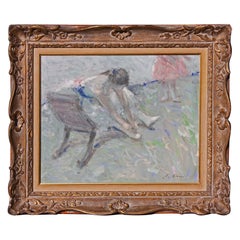
Impressionist Painting "Ballerina" by Andre Gisson
By André Gisson
Located in Rochester, NY
"Ballerinas" impressionist painting by Andre Gisson (1921-2003). Soft colors and bright light are hallmarks of Gisson's work. This is rare subject manor for the artist. Although Am...
Category
20th Century Impressionist Figurative Paintings
Materials
Fabric, Canvas, Wood, Oil
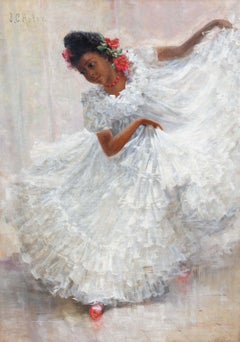
Impressionist Painting of a Young Spanish Flamenco Dancer by J.C. Arter
By John Charles Arter
Located in Rochester, NY
Wonderful impressionist painting. Full of light, color, and movement. "The Flamenco Dancer by J. Charles Arter ( American 1860-1923). Oil on canvas. Signed upper left. Circa 1900. Unframed.
Born in Hanoverton, Ohio, Charles Arter studied in Cincinnati and Paris at the Academie Julian. He had studios in Venice, London and New York and painted portraits of many famous personages including Pope Pius X...
Category
Early 20th Century Impressionist Figurative Paintings
Materials
Canvas, Oil
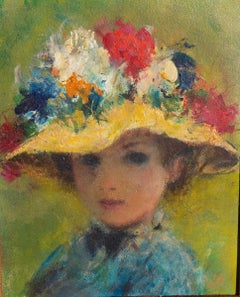
French Impressionist Painting Portrait of a Young Girl Paris School
Located in Rochester, NY
Striking French impressionist portrait of a young girl. Oil on board. Original carved frame. Circa 1950's. Signed illegibly lower right.
Category
Mid-20th Century Impressionist Figurative Paintings
Materials
Oil
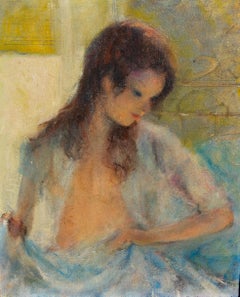
French Impressionist Painting Portrait of a Young Girl Paris School
Located in Rochester, NY
French impressionist boudoir portrait of a young woman. Oil on board. Original carved frame. Circa 1950's. Signed illegibly lower right.
Category
Mid-20th Century Figurative Paintings
Materials
Oil
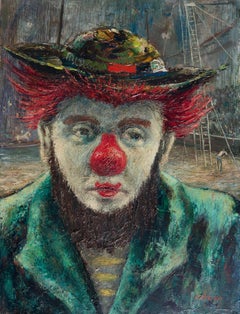
Impressionist Portrait Painting of Circus Clown 1950
Located in Rochester, NY
Bold portrait of an introspective circus clown. Rich colors. Detailed circus background. Oil on masonite. Signed Klotz. Dated 1950. Unfarmed.
period sculpted artist sculpture Egyptian gold
collection collector american large carved paris rome new york salon important provenance historical fine
not signed. museum original unique rare
american Emmett Kelly...
Category
Mid-20th Century Impressionist Figurative Paintings
Materials
Masonite, Oil
Recently Viewed
View AllMore Ways To Browse
Red In
Womens Hats
Lady In Red
Retro Hat Women
Academic 19th Century Painting
Elegant Oil Painting
Oil Painting Couple
Toys Painting
Art Deco Gouache
Large Black Figurative Art
Angels Canvas Painting
Framed African Art
Painting Sisters
Egypt Painting
Mythology Painting
Buckingham Palace
Louvre Painting
Mother Child Painting