Want more images or videos?
Request additional images or videos from the seller
1 of 11
UnknownLamentation of Christ - 16th century Antwerp school, Flemish
$14,087.97List Price
About the Item
- Dimensions:Height: 26 in (66.04 cm)Width: 21.26 in (54.01 cm)
- Medium:
- Movement Style:
- Period:
- Condition:
- Gallery Location:PARIS, FR
- Reference Number:1stDibs: LU2433215403412
About the Seller
No Reviews Yet
Vetted Professional Seller
Every seller passes strict standards for authenticity and reliability
1stDibs seller since 2023
17 sales on 1stDibs
Authenticity Guarantee
In the unlikely event there’s an issue with an item’s authenticity, contact us within 1 year for a full refund. DetailsMoney-Back Guarantee
If your item is not as described, is damaged in transit, or does not arrive, contact us within 7 days for a full refund. Details24-Hour Cancellation
You have a 24-hour grace period in which to reconsider your purchase, with no questions asked.Vetted Professional Sellers
Our world-class sellers must adhere to strict standards for service and quality, maintaining the integrity of our listings.Price-Match Guarantee
If you find that a seller listed the same item for a lower price elsewhere, we’ll match it.Trusted Global Delivery
Our best-in-class carrier network provides specialized shipping options worldwide, including custom delivery.You May Also Like
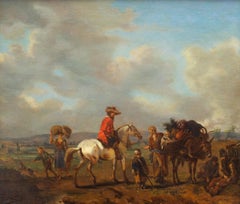
Landscape with Gentleman on Horseback and Peasant Woman Receiving Alms
By Philips Wouwerman
Located in Stockholm, SE
Workshop / Circle of Philips Wouwerman (1619-1668)
Landscape with Gentleman on Horseback and Peasant Woman Receiving Alms
oil on oak panel
12.40 x 14.17 inches (31.5 x 36 cm)
wit...
Category
17th Century Old Masters Landscape Paintings
Materials
Oak, Oil, Wood Panel
$17,751
H 12.41 in W 14.18 in
Titian
s Studio
Located in Milford, NH
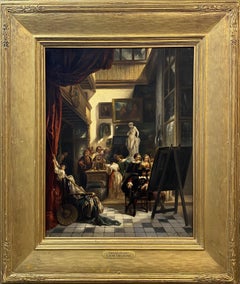
A wonderfully detailed interior genre oil painting by Flemish artist Louis Tielemans (1826-1856). Tielemans was born in Anvers, and became known for his active genre scenes, emulatin...
Category
Mid-19th Century Old Masters Interior Paintings
Materials
Oil, Wood Panel
Rebecca at the Well
Located in New York, NY
Provenance:
Dr. James Henry Lancashire, Manchester-by-the-Sea, Massachusetts, by 1925; probably by descent to:
Private Collection, Cumberland Foreside, Maine, until 2018
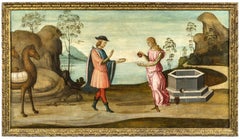
This unpublished panel is a characteristic work of the Master of the Apollo and Daphne Legend, an anonymous Florentine painter in the circle of Bartolommeo di Giovanni, Domenico Ghirlandaio, and Sandro Botticelli. The artistic personality of the Master of the Apollo and Daphne Legend was independently recognized by Everett Fahy and Federico Zeri at roughly the same moment in time. Fahy originally dubbed this artist the Master of the Ryerson Panels but later adopted Zeri’s name for the artist, which derives from his eponymous works from the Samuel H. Kress collection (Figs. 1-2). Fahy posited that the artist was most likely a pupil of Ghirlandaio active from roughly 1480 to 1510, and that he may be identifiable with one of Ghirlandaio’s documented pupils to whom no works have been securely attributed, such as Niccolò Cieco, Jacopo dell’Indaco, or Baldino Baldinetti. The present painting was first attributed to this master by Everett Fahy in 1989, who became aware of its existence only after publishing his definitive studies on the artist.
The surviving body of work by the Master of the Apollo and Daphne Legend is largely composed of series of panels treating the same theme. In addition to the works illustrating the legend of Apollo and Daphne, there are also series on the themes of Susanna and the Elders and the story of Saint Joseph, among others. The subject of the present panel is drawn from Genesis 24, the story of Isaac. It is possible that our painting relates to another work by the artist depicting the Sacrifice of Isaac formerly in the collection of E. A. McGuire in Dublin, Ireland (Fig. 3), and that these two panels were originally part of a decorative scheme based on the story of Isaac.
Although the Master’s paintings of this type have traditionally been considered painted fronts of wedding chests, known as cassoni, the scale of these paintings and the fact that they are often part of a series indicates that they are more likely spalliera panels—paintings set into furniture or the wainscoting of a room. The biblical episode depicted in this painting centers on the theme of marriage, which suggests that this work was likely commissioned for the domestic interior of a newly married couple. The Master has transcribed into paint even the minute details of this Old Testament story, in which Abraham sends a servant to travel by camel to the land of his father and seek out a wife for his son Isaac. The servant is here shown at the well...
Category
15th Century and Earlier Old Masters Figurative Paintings
Materials
Oil, Tempera, Wood Panel
Study of a dog
Located in Amsterdam, NL
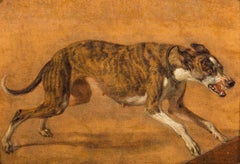
Study of a dog
Oil on paper laid down on panel, 17.5 x 25.5 cm
Provenance
Private collection, the Netherlands
Note:
We are grateful to Mr Fred Meijer for his attribution to Ludolf de Jongh
Ludolf de Jongh was the son of a shoemaker. When his father moved to Rotterdam, the young Ludolf decided to learn art rather than shoemaking and became a pupil of Cornelis Saftleven. Later he studied under Anthony Palamedes in Delft and still later with Jan van Bijlert in Utrecht.
In 1635 he travelled to France with Francis Bacon. Seven years later, in 1642, he returned to the Netherlands when he heard that his mother had fallen ill. He set up a shop in Rotterdam, and his earliest signed paintings date from that year.
According to Houbraken, his travels had caused him to speak French so fluently, that his parents had to learn French in order to speak with him.
De Jongh’s work shows a strong influence from the Utrecht school of Caravaggio admirers, especially Jacob Duck...
Category
Mid-17th Century Old Masters Animal Paintings
Materials
Paper, Oil, Wood Panel
Francesco Albani Circle Italian Mythological Painting
Located in Roma, IT
Francesco Albani Circle Italian Mythological Painting
This important oil painting on wood depicts a subject that is very rare in the iconography of ancient mythological paintings: the birth of Erittonio. Erichthonius who succeeded Amphictyon becoming the fourth mythological king of Athens and married the naiad Praxithea who made him the father of Pandion.
The extremely high quality of this very rare painting suggests that it was painted by an artist who frequented Francesco Albani's studio.
The period, the mythological subject, the harmony of the colours and, above all, the sublime quality of the flesh tones all point in this direction.
This artwork, never before on the market, comes from an important Italian private collection
Every item of our Gallery, upon request, is accompanied by a certificate of authenticity issued by Sabrina Egidi official Expert in Italian furniture for the Chamber of Commerce of Rome and for the Rome Civil Courts.
ERYTHTONIOS (᾿Ερυχϑόνιος, Erychthonios)
Born of Hephaestus' love for Athena, from the breast of Ghe, who was impregnated by the god; welcomed by Athena, who placed him in a basket together with one or two snakes, entrusting him to the care of Cecrops' three daughters.
Against the goddess's wishes, they opened the chest, from which emerged, according to different versions of the myth, either the child wrapped in snakes or a snake, which, in some versions, killed the girls, while in others, they threw themselves from the Acropolis in fear. Erittonio, in the form of a snake, is welcomed by Athena into her temple and curls up under the goddess's shield. Alongside this myth, of Ionian origin, are others due to the doubling of the figures of E. and Erechtheus
The scene of the birth appears in figurative tradition: in a Melian terracotta relief from the early 5th century, Ghe, half-emerging, holds out the baby Erittonio. to Athena, who welcomes him in the presence of Cecrops; the same scene appears on various painted vases, such as a red-figure kölix by the Painter of Kodros, from Tarquinia, in the Berlin Museums, dating from around 440 BC, where Hephaestus also appears alongside Cecrops.
A modest red-figure vase from Camiro, in the British Museum, depicts the moment when the fleeing Cecropids discover the cista, from which the infant Erittonio. emerges between two snakes, greeting Athena.
The moment when the chest was opened was depicted by Phidias on the xiii and xiv S metopes of the Parthenon, where Cecrops and Pandrosus appear in the first and Erisichthon and Aglaurus with the chest uncovered in the second.
A kölix in the style of the Brygos Painter in Frankfurt, on the other hand, depicts the large snake E. chasing the fleeing Cecropids towards their father's palace.
Luciano (De dom., 27) recalls a painting depicting the scene of the birth and the representation of the myth in pantomime on the theatre (De salt., 39).
Bibliography: Engelmann, in Roscher, cc. 1303-1308, s. v. Erichthonios; P. Jacobstahl, Die Melischen Reliefs, Berlin 1931, pp. 96-98, plate 75 a; W. Züchner, in Jahrbuch, LXV-LXVI, 1950-51, p. 200 ff., figs. 34-35; J. D. Beazley, Red-fig., p. 720; G. Becatti, Problemi fidiaci, Florence 1951, p. 22.
Questo
Francesco Albani (Bologna, August 17, 1578 – Bologna, October 4, 1660) was an Italian painter.
Albani was born in Bologna, Papal States, in 1578.
His father was a silk merchant who intended his son to go into his own trade. By the age of twelve, however, he had become an apprentice to the competent mannerist painter Denis Calvaert, in whose studio he met Guido Reni. He soon followed Reni to the so-called "Academy" run by Annibale, Agostino, and Ludovico Carracci.
This studio fostered the careers of many painters of the Bolognese school, including Domenichino, Massari, Viola, Lanfranco, Giovanni Francesco Grimaldi...
Category
Late 17th Century Old Masters Figurative Paintings
Materials
Oil, Wood Panel
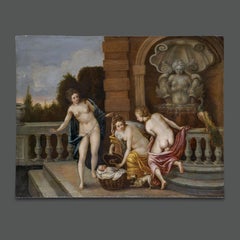
$18,934
H 19.3 in W 24.81 in D 0.79 in
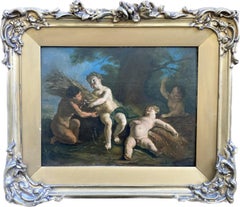
Old master painting of Cherubs cavorting in a woodland setting
By Jean-Honoré Fragonard
Located in Harkstead, GB
A charming image of cherubs cavorting with sheaths of wheat in a woodland setting.
Follower of Jean-Honoré Fragonard
Cherubs cavorting before a tree
Oil on panel
10¾ x 14 inches exc...
Category
Early 19th Century Old Masters Landscape Paintings
Materials
Oil, Wood Panel
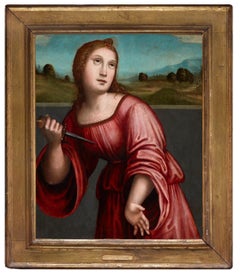
Lucretia, by Giacomo Raibolini Francia. Detto il Francia. Oil on panel, framed
Located in New York, NY
Giacomo used to paint with his brother Giulio, identifying their works with the monogram «I I». The strong influence of his father, Francesco, is undeniable in all his works, althoug...
Category
16th Century Old Masters Figurative Paintings
Materials
Oil, Wood Panel
$18,000
Free Shipping
H 25.6 in W 19.3 in D 1.19 in
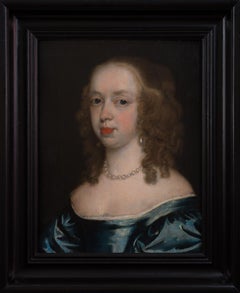
Portrait of a lady in blue dress ”Countess of Peterborough”
Located in Stockholm, SE
This exquisite portrait, with its new attribution to Theodore Russel, is believed to depict Lady Penelope O'Brien, daughter of Barnabas O'Brien, the sixth Earl of Thomond, and wife of the Earl of Peterborough, whom she married in 1644. The painting thus belongs to a historically significant period, capturing the refined elegance of the time.
The portrait has a prestigious provenance from Elleholms Hofgård, a historic estate in Mörrums socken, Blekinge, Sweden. Elleholms Hofgård, whose two-story, timber-framed main building was constructed in 1730 and expanded in 1804, has changed ownership several times since the 17th century. The ancestors of the present owners acquired the estate in 1915, and from the 20th century until 2023, this painting was prominently displayed in the estate’s main building, making it an integral part of the estate’s history.
Theodore Russel, an English portrait artist born in 1614, studied under the renowned Sir Anthony van Dyck, whose influence can be seen in Russel’s meticulous style. Russel often painted on cabinet-sized panels, such as this one, which measures approximately 39 x 31 cm. This preference for panels is a notable characteristic that sets him apart from contemporary artists like Sir Peter Lely, who exclusively used canvas. The size of the panel is a key reason for the reattribution to Russel from Peter lely, as Lely never used panels for his works. This distinctive format, along with Russel’s characteristic style, strongly supports the new attribution.
Russel, the son of Nicasius Rousseel, a goldsmith and jeweler to James I and Charles I, refined his skills under the mentorship of his uncle, the famous portrait painter Cornelis Janssen. He also worked as an assistant and copyist for van Dyck, further honing his artistic style. This captivating portrait exemplifies Russel’s craftsmanship, reflecting the elegance of the period’s fashion and the artist's refined techniques.
oil on wood panel
with indistinct inscription Countess of Peter[...] upper left.
with inscription on the reverse: ”Countess of Peterborough. P. Lely 1670. S Beatty Picture Restorer [...] Warwick”.
unframed 39 x 31 cm = 15.35 x 12.2 inches
framed 52 x 41.5 cm = 20.47 x 16.34 inches
Condition:
The portrait has just been restored by a professional art conservator in Stockholm and is now in a very good condition. The colors are vivid, and the skin tones appear more natural than before. It is a very fine painting. The frame is newly made and included.
Provenance:
Elleholms Hofgård, Mörrums socken, Blekinge, Sweden **;
Stockholms Auktionsverk, Fine Art & Antiques Autumn...
Category
17th Century Old Masters Portrait Paintings
Materials
Oil, Wood Panel
$11,246
H 20.48 in W 16.34 in
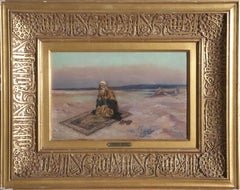
Bedouin at Prayer, Orientalist Oil Painting on Panel by Rudolf Ernst
By Rudolf Ernst
Located in Long Island City, NY
This painting by Orientalist artist Rudolf Ernst depicts a Muslim man in quiet contemplation during prayer. He kneels in solitude in the vast desert as the light fades around him. Ma...
Category
1890s Old Masters Figurative Paintings
Materials
Oil, Wood Panel
Price Upon Request
H 22 in W 27.75 in
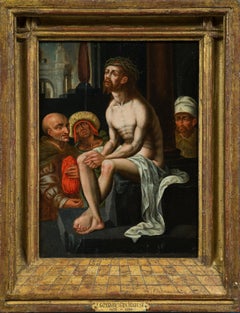
Christ on the Cold Stone – After Jan Gossaert (Mabuse)
Located in Stockholm, SE
This striking devotional image, painted by a follower of Jan Gossaert, represents one of the most influential compositions of the Northern Renaissance: Christ on the Cold Stone, or C...
Category
16th Century Old Masters Figurative Paintings
Materials
Oil, Wood Panel
More From This Seller
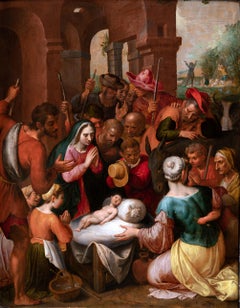
View AllCercle of Ambrosius Francken, Adoration of the shepherds, 17th century Antwerp
Located in PARIS, FR
Adoration of the shepherds,
Cercle of Ambrosius Francken,
Early 17th century Antwerp school
Oil on oak panel: h. 55 cm, w. 43 cm (21.65 in x 16.93 in)
17th c. ebonized and moulded f...
Category
Early 17th Century Old Masters Figurative Paintings
Materials
Oil, Wood Panel
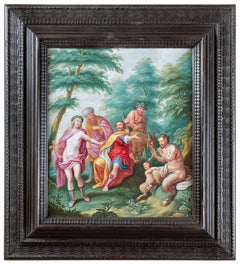
The Musical Contest between Apollo and Marsyas, signed P. Sion, Antwerp 17th c.
Located in PARIS, FR
The Musical Contest between Apollo and Marsyas,
by Peter Sion (Antwerp, 1624-1695)
Signed in the lower right corner P. Sion
17th century Antwerp School
Oil on copper, dim. h. 53 cm, ...
Category
17th Century Old Masters Figurative Paintings
Materials
Oak, Oil, Wood Panel
Allegory of Autumn with Bacchus, studio of Louis de Caullery, 17th c. Antwerp
Located in PARIS, FR
Allegory of Autumn with worship of Bacchus
Studio of Louis de Caullery (Caullery, vers 1580 - Anvers, 1621/22)
17th century Antwerp school
Not signed
Oil on oak panel
Dimensions : p...
Category
Early 17th Century Old Masters Figurative Paintings
Materials
Oil, Wood Panel
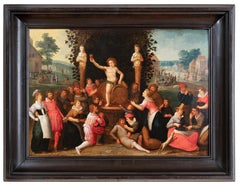
The Rape of Europa, signed Peter Sion (1624-1695), Antwerp, 17th century
Located in PARIS, FR
The Rape of Europa
By Peter Sion (Antwerp, 1624-1695)
Signed in the lower right corner P. Sion
17th century Antwerp School
Oil on copper, dim. h. 53 cm, w. 45 cm
Moulded and ebonized...
Category
17th Century Old Masters Figurative Paintings
Materials
Oak, Oil, Wood Panel
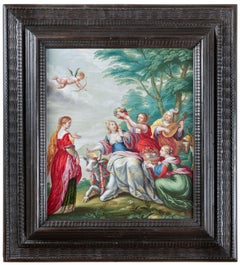
Virgin
Child in a Flower Garland, Flemish, 17th century, studio of F. Francken
By Frans Francken II
Located in PARIS, FR
Virgin and Child in a Garland of Flowers
Studio of Frans Francken II (1581-1642)
This work is unsigned
17th century Antwerp School
Oil on oak panel
Dimensions: h. 63 cm, w. 48,5 cm (...
Category
Early 17th Century Old Masters Figurative Paintings
Materials
Oil, Wood Panel
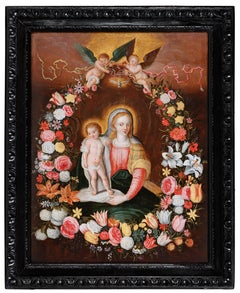
Feast in the Garden of Love, 17th century Antwerp, Louis de Caullery
Located in PARIS, FR
Louis de Caullery (1582-1621)
Antwerp School early 17th century
Oil on oak panel
Dimensions: h. 51 cm (20.08 in), w. 43 cm (16.93 in)
Ebonized wooden frame
Framed: h. 67 cm (26.38 in...
Category
Early 17th Century Old Masters Figurative Paintings
Materials
Oil, Wood Panel
Still Thinking About These?
All Recently ViewedMore Ways To Browse
Painting Of The Virgin
Christ Of Saint John Of The Cross
Flemish 16th Century Painting
Jesus Descent From The Cross
Lamentation Of Christ
Igbo Nigeria
Jean Julien
Lapin Agile
M F Husain
Malaga Painting
Oil Painting Girl White
Oil Paintings Of Game
Oil Paintings Rubens
Old Masters Renaissance Paintings
Rene Jerome
Rene Romero Schuler
Rene Romero
Rossi Oil Paintings