Want more images or videos?
Request additional images or videos from the seller
1 of 9
Auction endedBrowse Current Auctions
UnknownMichelangelo
s Pieta - Tempera on velvet paper
Price:$125
$1,283.86List Price
About the Seller
4.8
Vetted Professional Seller
Every seller passes strict standards for authenticity and reliability
1stDibs seller since 2017
178 sales on 1stDibs
Typical response time: 20 hours
Authenticity Guarantee
In the unlikely event there’s an issue with an item’s authenticity, contact us within 1 year for a full refund. DetailsMoney-Back Guarantee
If your item is not as described, is damaged in transit, or does not arrive, contact us within 7 days for a full refund. Details24-Hour Cancellation
You have a 24-hour grace period in which to reconsider your purchase, with no questions asked.Vetted Professional Sellers
Our world-class sellers must adhere to strict standards for service and quality, maintaining the integrity of our listings.Price-Match Guarantee
If you find that a seller listed the same item for a lower price elsewhere, we’ll match it.Trusted Global Delivery
Our best-in-class carrier network provides specialized shipping options worldwide, including custom delivery.You May Also Like
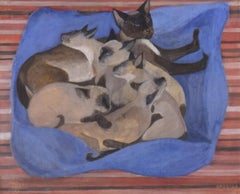
Siamese Cat with Kittens by Orovida Pissarro - Egg tempura painting
By Orovida Pissarro
Located in London, GB
Siamese Cat with Kittens by Orovida Pissarro (1893-1968)
Egg tempera on linen
39 x 48 cm (15³/₈ x 18⁷/₈ inches)
Signed lower right Orovida and dated lower left 1934
Provenance
J Ankri, 8th October 1967
Literature
K L Erickson, Orovida Pissarro: Painter and Print-Maker with A Catalogue Raisonné of Paintings, (doctoral thesis), Oxford, 1992, Appendices, no. 51, p. 56 (illustrated)
Exhibition
London, The Leicester Galleries, Paintings by Orovida, February 1935, no. 6
Women’s International Art Club, 20th February - 13th March 1937, no. 273
London, Redfern Gallery, Ten Years of Work by Orovida, 5th-28th May 1938, no. 7
London, The Royal Society of British Artists, Summer Exhibition, 1947, no. 281 (possibly the etching)
London, O’Hana Gallery, Paintings, Drawings and Coloured Etchings: Orovida, 3rd-18th October 1957, no. 13
Artist biography
Orovida Camille Pissarro, Lucien and Esther Pissarro’s only child, was the first woman in the Pissarro family as well as the first of her generation to become an artist. Born in Epping, England in 1893, she lived and worked predominantly in London where she became a prominent member of several British arts clubs and societies.
She first learned to paint in the Impressionist style of her father, but after a brief period of formal study with Walter Sickert in 1913 she renounced formal art schooling. Throughout her career, Orovida always remained outside of any mainstream British art movements. Much to Lucien's disappointment she soon turned away from naturalistic painting and developed her own unusual style combining elements of Japanese, Chinese, Persian and Indian art. Her rejection of Impressionism, which for the Pissarro family had become a way of life, together with the simultaneous decision to drop her famous last name and simply use Orovida as a ‘nom de peintre’, reflected a deep desire for independence and distance from the weight of the family legacy.
Orovida's most distinctive and notable works were produced from the period of 1919 to 1939 using her own homemade egg tempera applied in thin, delicate washes to silk, linen or paper and sometimes embellished with brocade borders. These elegant and richly decorative works generally depict Eastern, Asian and African subjects, such as Mongolian horse...
Category
1930s Modern Animal Paintings
Materials
Linen, Egg Tempera
$24,493
H 15.36 in W 18.9 in
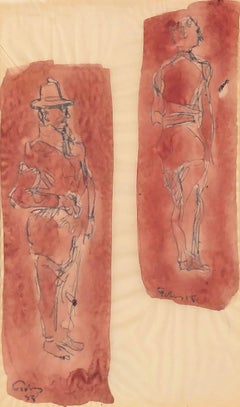
"Men at the Seattle Public Market" (Two Figures)
By Mark Tobey
Located in Missouri, MO
Mark Tobey
"Men at the Seattle Public Market" (Two Figures) 1958
Ink and Tempera on Silk
Signed and Dated Lower Left
*This is a rare and important work. See attached images with book...
Category
Mid-20th Century Modern Figurative Paintings
Materials
Silk, Ink, Tempera
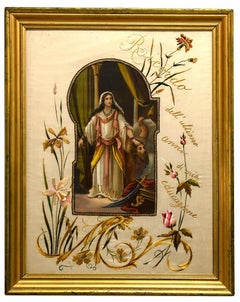
Salomè - Painting - 19th Century
Located in Roma, IT
Salomè is an original mixed colored painting realized by Anonymous artist in the XIX century.
Tempera on silk.
Bearing embroidered border and iscribed 'Ricordo dell’ultimo anno di ...
Category
19th Century Modern Portrait Paintings
Materials
Tempera, Silk
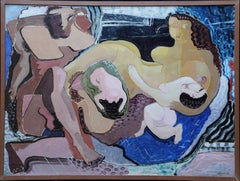
Myth III - British 1936 Modern art tempera painting Ida Graves poet family
By Blair Hughes-Stanton
Located in Hagley, England
This superb British 1930's modern art tempera painting is by noted interwar artist Blair Hughes-Stanton. Painted in 1936 it is part of the myth se...
Category
1930s Modern Figurative Paintings
Materials
Egg Tempera
Blair Hughes-StantonMyth III - British 1936 Modern art tempera painting Ida Graves poet family, 1936
$19,594 Sale Price
20% Off
H 32 in W 40 in D 1 in
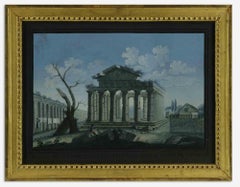
The Valley of the Temples - Mixed Colored Tempera on Paper - Mid-19th Century
Located in Roma, IT
The Valley of the Temples is an original modern artwork realized in 19th century.
Mixed colored tempera on paper.
Includes frame.
Titled on the lower margin: Veduta del tempio esa...
Category
Mid-19th Century Modern Figurative Paintings
Materials
Tempera, Paper
$6,894
H 16.93 in W 21.26 in D 1.19 in
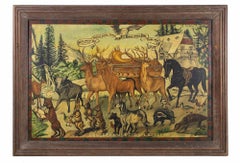
Hunter
s funeral - Drawing in Tempera - Early 20th Century
Located in Roma, IT
Hunter's funeral is a modern artwork realized in the early 20th Century.
Tempera painting on board.
Hand signed on the lower margin.
Includes frame: 60 x 86 cm
Category
Early 20th Century Modern Figurative Paintings
Materials
Tempera
$1,176
H 19.1 in W 29.14 in D 0.04 in
Rabbit Hunters
By Roger Medearis
Located in Los Angeles, CA
Rabbit Hunters, egg tempera on Masonite, 12 x 9 inches, 1947, signed and dated lower left, signed, titled and dated verso “Rabbit Hunters Egg Tempera Roger Medearis 1947,” exhibited at Medearis' solo show at Kende Galleries, New York, in 1949 (Medearis’ record book, a copy of which is held by Vose Galleries in Boston, MA, indicates this is painting “No. 23” and that is was completed in 1947 and sold via Kende Galleries (at Gimbel Brothers...
Category
1940s American Modern Landscape Paintings
Materials
Tempera, Board

The Magician oil and tempera painting by Julio de Diego
By Julio de Diego
Located in Hudson, NY
Julio De Diego’s Atomic Series paintings made an extraordinary statement regarding the shock and fear that accompanied the dawn of the nuclear age. In the artist’s own words, “Scientists were working secretly to develop formidable powers taken from the mysterious depths of the earth - with the power to make the earth useless! Then, the EXPLOSION! . . . we entered the Atomic Age, and from there the neo-Atomic war begins. Explosions fell everywhere and man kept on fighting, discovering he could fight without flesh.”
To execute these works, De Diego developed a technique of using tempera underpainting before applying layer upon layer of pigmented oil glazes. The result is paintings with surfaces which were described as “bonelike” in quality. The forms seem to float freely, creating a three-dimensional visual effect. In the 1954 book The Modern Renaissance in American Art, author Ralph Pearson summarizes the series as “a fantastic interpretation of a weighty theme. Perhaps it is well to let fantasy and irony appear to lighten the devastating impact. By inverse action, they may in fact increase its weight.”
Exhibited
1964 Marion Koogler McNay Art Institute, San Antonio, Texas
This work retains its original frame which measures 54" x 42" x 2"
About this artist: Julio De Diego crafted a formidable persona within the artistic developments and political struggles of his time. The artist characterized his own work as “lyrical,” explaining, “through the years, the surrealists, the social-conscious painters and the others tried to adopt me, but I went my own way, good, bad or indifferent.” [1] His independence manifested early in life when de Diego left his parent’s home in Madrid, Spain, in adolescence following his father’s attempts to curtail his artistic aspirations. At the age of fifteen he held his first exhibition, set up within a gambling casino. He managed to acquire an apprenticeship in a studio producing scenery for Madrid’s operas, but moved from behind the curtains to the stage, trying his hand at acting and performing as an extra in the Ballet Russes’ Petrouchka with Nijinsky. He spent several years in the Spanish army, including a six-month stretch in the Rif War of 1920 in Northern Africa. His artistic career pushed ahead as he set off for Paris and became familiar with modernism’s forays into abstraction, surrealism, and cubism.
The artist arrived in the U.S. in 1924 and settled in Chicago two years later. He established himself with a commission for the decoration of two chapels in St. Gregory’s Church. He also worked in fashion illustration, designed magazine covers and developed a popular laundry bag for the Hotel Sherman. De Diego began exhibiting through the Art Institute of Chicago in 1929, and participated in the annual Chicago Artists Exhibitions, Annual American Exhibitions, and International Water Color Exhibitions. He held a solo exhibition at the Art Institute of Chicago in the summer of 1935. Though the artist’s career was advancing, his family life had deteriorated. In 1932 his first marriage dissolved, and the couple’s young daughter Kiriki was sent to live with friend Paul Hoffman.
De Diego continued to develop his artistic vocabulary with a growing interest in Mexican art. He traveled throughout the country acquainting himself with the works of muralists such as Carlos Merida, and also began a collection of small native artifacts...
Category
1940s American Modern Abstract Paintings
Materials
Masonite, Oil, Tempera
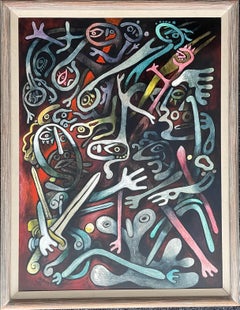
St. Atomic oil and tempera painting by Julio de Diego
By Julio de Diego
Located in Hudson, NY
Julio De Diego’s Atomic Series paintings made an extraordinary statement regarding the shock and fear that accompanied the dawn of the nuclear age. In the artist’s own words, “Scientists were working secretly to develop formidable powers taken from the mysterious depths of the earth - with the power to make the earth useless! Then, the EXPLOSION! . . . we entered the Atomic Age, and from there the neo-Atomic war begins. Explosions fell everywhere and man kept on fighting, discovering he could fight without flesh.”
To execute these works, De Diego developed a technique of using tempera underpainting before applying layer upon layer of pigmented oil glazes. The result is paintings with surfaces which were described as “bonelike” in quality. The forms seem to float freely, creating a three-dimensional visual effect. In the 1954 book The Modern Renaissance in American Art, author Ralph Pearson summarizes the series as “a fantastic interpretation of a weighty theme. Perhaps it is well to let fantasy and irony appear to lighten the devastating impact. By inverse action, they may in fact increase its weight.”
Exhibited
1950 University of Illinois at Urbana "Contemporary American Painting"
1964 Marion Koogler McNay Art Institute, San Antonio, Texas
This work retains its original frame which measures 54" x 36" x 2".
About this artist: Julio De Diego crafted a formidable persona within the artistic developments and political struggles of his time. The artist characterized his own work as “lyrical,” explaining, “through the years, the surrealists, the social-conscious painters and the others tried to adopt me, but I went my own way, good, bad or indifferent.” [1] His independence manifested early in life when de Diego left his parent’s home in Madrid, Spain, in adolescence following his father’s attempts to curtail his artistic aspirations. At the age of fifteen he held his first exhibition, set up within a gambling casino. He managed to acquire an apprenticeship in a studio producing scenery for Madrid’s operas, but moved from behind the curtains to the stage, trying his hand at acting and performing as an extra in the Ballet Russes’ Petrouchka with Nijinsky. He spent several years in the Spanish army, including a six-month stretch in the Rif War of 1920 in Northern Africa. His artistic career pushed ahead as he set off for Paris and became familiar with modernism’s forays into abstraction, surrealism, and cubism.
The artist arrived in the U.S. in 1924 and settled in Chicago two years later. He established himself with a commission for the decoration of two chapels in St. Gregory’s Church. He also worked in fashion illustration, designed magazine covers and developed a popular laundry bag for the Hotel Sherman. De Diego began exhibiting through the Art Institute of Chicago in 1929, and participated in the annual Chicago Artists Exhibitions, Annual American Exhibitions, and International Water Color Exhibitions. He held a solo exhibition at the Art Institute of Chicago in the summer of 1935. Though the artist’s career was advancing, his family life had deteriorated. In 1932 his first marriage dissolved, and the couple’s young daughter Kiriki was sent to live with friend Paul Hoffman.
De Diego continued to develop his artistic vocabulary with a growing interest in Mexican art. He traveled throughout the country acquainting himself with the works of muralists such as Carlos Merida, and also began a collection of small native artifacts...
Category
1940s American Modern Abstract Paintings
Materials
Masonite, Oil, Tempera
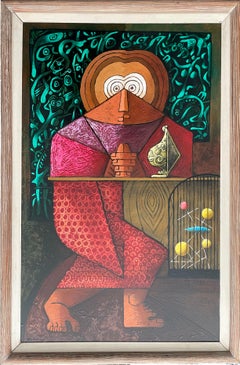
Inevitable Day – Birth of the Atom oil and tempera painting by Julio De Diego
By Julio de Diego
Located in Hudson, NY
Julio De Diego’s Atomic Series paintings made an extraordinary statement regarding the shock and fear that accompanied the dawn of the nuclear age. In the artist’s own words, “Scientists were working secretly to develop formidable powers taken from the mysterious depths of the earth - with the power to make the earth useless! Then, the EXPLOSION! . . . we entered the Atomic Age, and from there the neo-Atomic war begins. Explosions fell everywhere and man kept on fighting, discovering he could fight without flesh.”
To execute these works, De Diego developed a technique of using tempera underpainting before applying layer upon layer of pigmented oil glazes. The result is paintings with surfaces which were described as “bonelike” in quality. The forms seem to float freely, creating a three-dimensional visual effect. In the 1954 book The Modern Renaissance in American Art, author Ralph Pearson summarizes the series as “a fantastic interpretation of a weighty theme. Perhaps it is well to let fantasy and irony appear to lighten the devastating impact. By inverse action, they may in fact increase its weight.”
Bibliography
Art in America, April 1951, p.78
About this artists: Julio De Diego crafted a formidable persona within the artistic developments and political struggles of his time. The artist characterized his own work as “lyrical,” explaining, “through the years, the surrealists, the social-conscious painters and the others tried to adopt me, but I went my own way, good, bad or indifferent.” [1] His independence manifested early in life when de Diego left his parent’s home in Madrid, Spain, in adolescence following his father’s attempts to curtail his artistic aspirations. At the age of fifteen he held his first exhibition, set up within a gambling casino. He managed to acquire an apprenticeship in a studio producing scenery for Madrid’s operas, but moved from behind the curtains to the stage, trying his hand at acting and performing as an extra in the Ballet Russes’ Petrouchka with Nijinsky. He spent several years in the Spanish army, including a six-month stretch in the Rif War of 1920 in Northern Africa. His artistic career pushed ahead as he set off for Paris and became familiar with modernism’s forays into abstraction, surrealism, and cubism.
The artist arrived in the U.S. in 1924 and settled in Chicago two years later. He established himself with a commission for the decoration of two chapels in St. Gregory’s Church. He also worked in fashion illustration, designed magazine covers and developed a popular laundry bag for the Hotel Sherman. De Diego began exhibiting through the Art Institute of Chicago in 1929, and participated in the annual Chicago Artists Exhibitions, Annual American Exhibitions, and International Water Color Exhibitions. He held a solo exhibition at the Art Institute of Chicago in the summer of 1935. Though the artist’s career was advancing, his family life had deteriorated. In 1932 his first marriage dissolved, and the couple’s young daughter Kiriki was sent to live with friend Paul Hoffman.
De Diego continued to develop his artistic vocabulary with a growing interest in Mexican art. He traveled throughout the country acquainting himself with the works of muralists such as Carlos Merida, and also began a collection of small native artifacts...
Category
1940s American Modern Abstract Paintings
Materials
Masonite, Oil, Tempera
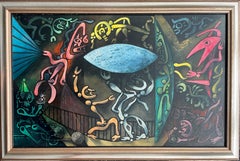
More From This Seller
View AllMYTHOLOGICAL SCENE- Italian School - Oil on canvas Painting.
By Alfonso Pragliola
Located in Napoli, IT
MYTHOLOGICAL SCENE Italian oil on canvas painting cm.100x100, Alfonso Pragliola Italia 2010
In this oil on canvas, the painter makes his own personal and modern interpretation of Ant...
Category
2010s Modern Figurative Paintings
Materials
Canvas, Oil

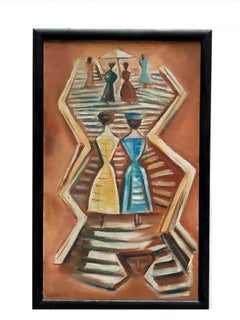
SCALINATA - Tribute to Massimo Campigli
By Massimo Campigli, 1895-1971
Located in Napoli, IT
delightful oil on canvas by unknown artist inspired by the works of master Massimo Campigli, in this case "La Scalinata " from the 1950s
Category
1980s Modern Figurative Paintings
Materials
Canvas, Oil
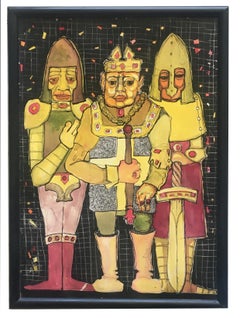
KING ARTHUR - Mixed technique on canvas cm.110x75 signed Vighi.
Located in Napoli, IT
King Arthur - Mixed technique on canvas cm.110x75 signed Vighi.
Category
Late 20th Century Modern Figurative Paintings
Materials
Canvas, Mixed Media
ROMANTIC SCENE - French School - Oil on Canvas Italian Figurative Painting
By Salvatore Testa
Located in Napoli, IT
Romantic Scene - Oil on canvas cm.80x100, Salvatore Testa, Italy, 2008
The painting by Salvatore Testa depicts a beautiful courting scene, the painting is inspired by the French Sch...
Category
Early 2000s French School Figurative Paintings
Materials
Canvas, Oil
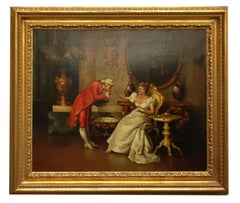
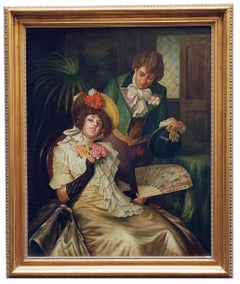
Romantic Scene - Italian Figurative Oil on Canvas Painting
Located in Napoli, IT
Romantic Scene - Figurative Oil on canvas painting cm.100x80
this painting is a reinterpretation of the painting 'a Cautious Approach' by Master Roberts ...
Category
Early 2000s English School Figurative Paintings
Materials
Canvas, Oil
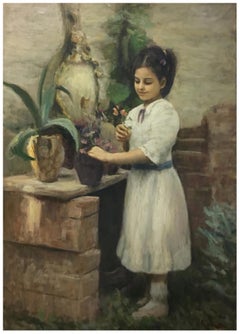
CHILD -Italian School - Figurative - Italy Oil on canvas Painting
Located in Napoli, IT
CHILD - Oil on canvas cm.70x50, Tonino Manna, Italy 2002
Frame available on request from our workshop.
in this wonderful painting we admire a girl in a white dress who takes care of ...
Category
Early 2000s Old Masters Figurative Paintings
Materials
Canvas, Oil
Recently Viewed
View AllMore Ways To Browse
Michelangelo Pieta
La Pieta
Ashcan Oil Painting
Cowgirl Art
Israeli Artists Painting
Raphael Oil Paintings
Steve Huston
Wpa Paintings Social Realism
Anne Marie Of France
Ballerina Antique
Beals Oil Painting
Brazil Artist Painting
Bukola Orioye
French School Masters
Philosophical Paintings
Senegal Art
Trapeze Artist
Western Cowboy Painting