Want more images or videos?
Request additional images or videos from the seller
1 of 6
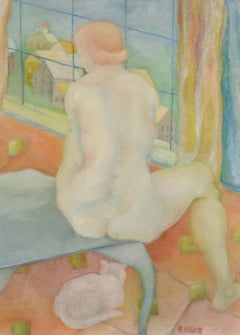
Willem (Willy) MartensMorning Walk
Price:$2,100
$2,900List Price
About the Item
- Creator:Willem (Willy) Martens (1856 - 1927, Dutch)
- Dimensions:Height: 24.63 in (62.57 cm)Width: 20.63 in (52.41 cm)
- Medium:
- Movement Style:
- Period:
- Condition:
- Gallery Location:Wiscasset, ME
- Reference Number:1stDibs: LU7522339491
About the Seller
5.0
Vetted Professional Seller
Every seller passes strict standards for authenticity and reliability
Established in 1985
1stDibs seller since 2014
172 sales on 1stDibs
Authenticity Guarantee
In the unlikely event there’s an issue with an item’s authenticity, contact us within 1 year for a full refund. DetailsMoney-Back Guarantee
If your item is not as described, is damaged in transit, or does not arrive, contact us within 7 days for a full refund. Details24-Hour Cancellation
You have a 24-hour grace period in which to reconsider your purchase, with no questions asked.Vetted Professional Sellers
Our world-class sellers must adhere to strict standards for service and quality, maintaining the integrity of our listings.Price-Match Guarantee
If you find that a seller listed the same item for a lower price elsewhere, we’ll match it.Trusted Global Delivery
Our best-in-class carrier network provides specialized shipping options worldwide, including custom delivery.You May Also Like
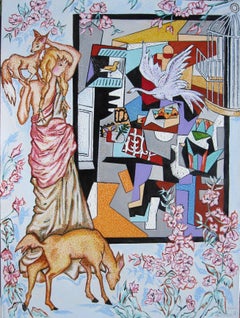
"Interior with Picasso, " Oil Painting
By Louis Recchia
Located in Denver, CO
Louis Recchia's (US based) "Interior with Picasso" is an original, handmade oil painting on canvas.
About the Artist:
Louis Recchia has been producing contemporary art in Denver fo...
Category
2010s Impressionist Figurative Paintings
Materials
Canvas, Oil
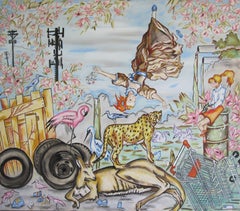
"Bystander, " Oil Painting
By Louis Recchia
Located in Denver, CO
Louis Recchia's (US based) "Bystander" is an original, handmade oil painting on canvas.
About the Artist:
Louis Recchia has been producing contemporary art in Denver for over three...
Category
2010s Impressionist Figurative Paintings
Materials
Canvas, Oil
"Renoir
s Boathouse with Silhouettes, " Oil Painting
By Louis Recchia
Located in Denver, CO
Louis Recchia's (US based) "Renoir's Boathouse with Silhouettes" is an original, handmade oil painting on canvas.
About the Artist:
Louis Recchia has been producing contemporary ar...
Category
2010s Impressionist Figurative Paintings
Materials
Canvas, Oil
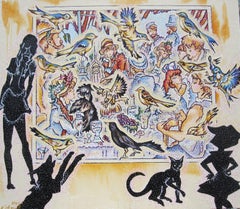
$2,400
H 42 in W 48 in D 1.5 in
"We are Star-Stuff, " Oil Painting
By Louis Recchia
Located in Denver, CO
Louis Recchia's (US based) "We are Star-Stuff" is an original, handmade oil painting on canvas.
About the Artist:
Louis Recchia has been producing contemporary art in Denver for ov...
Category
2010s Impressionist Figurative Paintings
Materials
Canvas, Oil
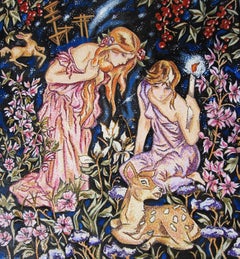
L
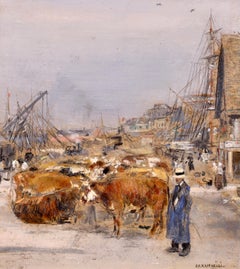
embarquement de boeufs - Impressionist Oil, Cattle by Jean Francois Raffaelli
By Jean-Francois Raffaelli
Located in Marlow, Buckinghamshire
Wonderful signed oil on panel cattle and figures in landscape by French impressionist painter Jean-Francois Raffaelli. The work depicts oxen being loaded onto ships in Honfleur, France en route to England.
Signature:
Signed lower right
Dimensions:
Framed: 18"x16"
Unframed: 9"x8"
Provenance:
Exhibition Jean Francois Raffaélli held at Galerie Simonson, 19 Rue Caumartin Paris - October 1929 (number 44)
Jean-François Raffaëlli's father was a failed Italian businessman and Raffaëlli himself was, among other things, a church chorister, actor and theatre singer. He then studied under Gérôme at the École des Beaux-Arts in Paris. He travelled to Italy, Spain and Algeria and on his return to France settled in Asnières.
In 1876, on a trip to Brittany, he first saw the potential of realist subject matter, if treated seriously. He became involved in meetings of artists at the Café Guerbois, where the Impressionist painters used to gather. As a result, Degas, contrary to the advice of the group, introduced Raffaëlli to the Impressionist exhibitions - according to one uncertain source as early as the very first exhibition, at the home of Nadar, and certainly to those of 1880 and 1881.
In 1904, Raffaëlli founded the Society for Original Colour Engraving. He first exhibited at the Salon de Paris in 1870 and continued to exhibit there until he joined the Salon des Artistes Français in 1881, where he earned a commendation in 1885, was made Chevalier of the Légion d'Honneur in 1889 and in the same year was awarded a gold medal at the Exposition Universelle. In 1906 he was made Officier of the Légion d'Honneur. He was also a member of the Société Nationale des Beaux-Arts. In 1884, a private exhibition of his work cemented his reputation.
He contributed to several newspapers such as The Black Cat (Le Chat Noir) in 1885 and The French Mail (Le Courrier Français) in 1886 and 1887. He published a collection entitled Parisian Characters, which captured his favourite themes of the street, the neighbourhood and local people going about their lives. In 1880 he participated, with Forain, on the illustration of Joris Karl Huysmans' Parisian Sketches (Croquis Parisiens). He also illustrated Huysman's Works. As well as working as an illustrator, he also made etchings and coloured dry-points.
His early attempts at painting were genre scenes, but once he was settled in Asnières he started to paint picturesque views of Parisian suburbs. From 1879 onwards, his subject matter drew on the lives of local people. These popular themes, which he treated with humanity and a social conscience, brought him to the attention of the social realist writers of the time such as Émile Zola. In addition to his realist style, Raffaëlli's dark palette, which ran contrary to the Impressionist aesthethic, helped to explain the opposition of those painters to his participation in their exhibitions. More concerned with drawing than colour, he used black and white for most of his paintings. Towards the end of his life, he lightened his palette, but without adopting any other principles of the Impressionist technique.
After painting several portraits, including Edmond de Goncourt and Georges Clémenceau, he returned to genre painting, particularly scenes of bourgeois life. Later in his career, he painted mainly Breton-inspired sailors and views of Venice. His views of the Paris slums and the fortifications, sites which have almost completely disappeared, went some way towards establishing a genre in themselves and perpetuated the memory of the area: The Slums, Rag-and-Bone Man, Vagabond, Sandpit, In St-Denis, Area of Fortifications. His realistic and witty portrayal of typical Parisian townscapes accounts for his enduring appeal.
Born in Paris, he was of Tuscan descent through his paternal grandparents. He showed an interest in music and theatre before becoming a painter in 1870. One of his landscape paintings was accepted for exhibition at the Salon in that same year. In October 1871 he began three months of study under Jean-Léon Gérôme at the École des Beaux-Arts in Paris; he had no other formal training.
Raffaëlli produced primarily costume pictures until 1876, when he began to depict the people of his time—particularly peasants, workers, and ragpickers seen in the suburbs of Paris—in a realistic style. His new work was championed by influential critics such as J.-K. Huysmans, as well as by Edgar Degas.
The ragpicker became for Raffaëlli a symbol of the alienation of the individual in modern society. Art historian Barbara S. Fields has written of Raffaëlli's interest in the positivist philosophy of Hippolyte-Adolphe Taine, which led him to articulate a theory of realism that he christened caractérisme. He hoped to set himself apart from those unthinking, so-called realist artists whose art provided the viewer with only a literal depiction of nature. His careful observation of man in his milieu paralleled the anti-aesthetic, anti-romantic approach of the literary Naturalists, such as Zola and Huysmans.
Degas invited Raffaëlli to participate in the Impressionist exhibitions of 1880 and 1881, an action that bitterly divided the group; not only was Raffaëlli not an Impressionist, but he threatened to dominate the 1880 exhibition with his outsized display of 37 works. Monet, resentful of Degas's insistence on expanding the Impressionist exhibitions by including several realists, chose not to exhibit, complaining, "The little chapel has become a commonplace school which opens its doors to the first dauber to come along."An example of Raffaëlli's work from this period is Les buveurs d'absinthe (1881, in the California Palace of Legion of Honor Art Museum in San Francisco). Originally titled Les déclassés, the painting was widely praised at the 1881 exhibit.
After winning the Légion d'honneur in 1889, Raffaëlli shifted his attention from the suburbs of Paris to city itself, and the street scenes that resulted were well received by the public and the critics. He made a number of sculptures, but these are known today only through photographs.[2] His work was also part of the painting event in the art competition at the 1912 Summer Olympics. In the later years of his life, he concentrated on color printmaking. Raffaëlli died in Paris on February 11, 1924
Museum and Gallery Holdings:
Béziers: Peasants Going to Town
Bordeaux: Bohemians at a Café
Boston: Notre-Dame; Return from the Market
Brussels: Chevet of Notre-Dame; pastel
Bucharest (Muz. National de Arta al României): Market at Antibes; Pied-à-terre
Copenhagen: Fishermen on the Beach
Douai: Return from the Market; Blacksmiths
Liège: Absinthe Drinker...
Category
1880s Impressionist Animal Paintings
Materials
Oil, Panel
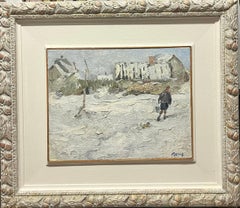
"Woman and dog on the snow" Oil cm. 40 x 32 1977
By Georgij Moroz
Located in Torino, IT
Snow,White,dog,winter
Georgij MOROZ (Dneprodzerzinsk, Ucraina, 1937 - St. Petersburg, 2015)
1937: he was born in Dneprodzerzinsk, Ucraina.
1949-56: he began artistic studies in Dnep...
Category
1970s Impressionist Figurative Paintings
Materials
Oil
$3,115 Sale Price
25% Off
Free Shipping
H 22.45 in W 25.6 in
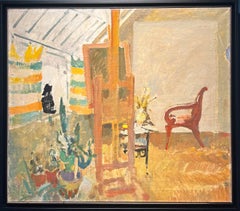
"Studio interior with black cat" Oil cm. 76 x 66 1983 Oil
By Gleb Savinov
Located in Torino, IT
Black Cat,Cat,yellow
Gleb SAVINOV (Kharkiv prov., Ua 1915 – St. Petersburg 2000)
Gleb Alexandrovich Savinov was born in Ukraine and spent part of his childhood in Saratov. His father, Alexander Ivanovich Savinov (1881–1942), a talented painter, draftsman and teacher, was a professor at the Academy of Fine Arts. In 1922 they moved from Saratov to Petrograd. In 1928-1930 Savinov started working in the studio of his father while still attending school. In 1934, after graduating from high school he enrolled at the painting department of the Leningrad Institute of Painting, Sculpture and Architecture, where he studied with, among many others, Alexander Osmerkin. In 1940 Savinov graduated and married his classmate and talented artist Olga Bogaevskaya. This happy family and creative union lasted sixty years. Since that year Gleb Savinov participated in art exhibitions with portraits, historical and genre paintings, landscapes, interior scenes, still lives. He served during the Great War and in 1944 he was admitted to the Leningrad Union of Soviet Artists. In 1945-1947 he taught in the Repin Institute, then from 1949 to 1979 in the Vera Mukhina...
Category
1980s Impressionist Animal Paintings
Materials
Canvas, Oil
$6,645 Sale Price
30% Off
Free Shipping
H 31.5 in W 27.56 in
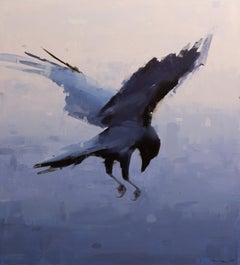
Krummi nr. 57 (2022) By Thorgrimur Einarsson, Original Animal Oil Painting
Located in Denver, CO
Thorgrimur Einarsson's "Raven nr. 57" is an original, handmade oil painting that depicts a raven flying through the air.
About the Artist:
Thorg...
Category
2010s Impressionist Animal Paintings
Materials
Oil, Panel
Thorgrimur EinarssonKrummi nr. 57 (2022) By Thorgrimur Einarsson, Original Animal Oil Painting, 2022
$2,880
H 24.5 in W 22.5 in
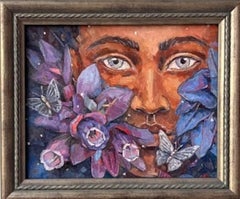
Colorful Oil Painting, "Curiosity"
By Charlene Mosley
Located in San Diego, CA
This is a one of a kind oil on canvas figurative painting by San Diego artist, Charlene Mosley. Its framed dimensions are 12" x 10"x 3". It is framed. A certificate of authenticity w...
Category
2010s Impressionist Figurative Paintings
Materials
Oil
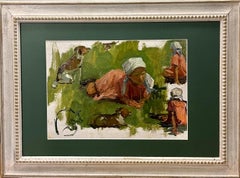
"Little girl with dog " Oil cm.35 x 25 1950
By Klara Vlassova
Located in Torino, IT
Dog,Child,Little girl,impressionisme
Signed in the lower right corner.
KLARA VLASOVA (Moscow, 1926)
MUSEUMS
St. Petersburg, State Russian Museum
Moscow, Pushkin Museum
Moscow, M...
Category
1950s Impressionist Animal Paintings
Materials
Oil
$4,153
Free Shipping
H 16.93 in W 22.84 in
More From This Seller
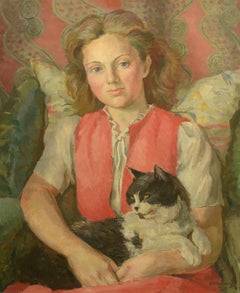
View All"A Girl with Her Cat, 1947, " EM Watts, oil on canvas, portrait
Located in Wiscasset, ME
"A Girl with Her Cat" was painted by EM Watts in 1947. The portrait is oil on canvas
The painting measures 26 3/4" x 22 3/4" with its frame.
Category
1940s Impressionist Figurative Paintings
Materials
Canvas, Oil
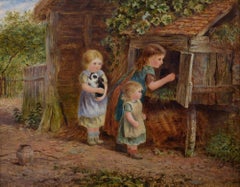
The Rabbit Hutch, Charles Hunt, Jr, British, Children, Animals
By Charles Hunt Jr.
Located in Wiscasset, ME
Charles Hunt, Jr. was born in Kensington, London, in 1829 and was part of a dynasty of painters. He was the son of the genre painter Charles Hunt (1803-1877) and father to four sons ...
Category
19th Century Realist Figurative Paintings
Materials
Oil, Panel
Sunlight and Shadows, American Impressionist, Cattle, Cows, Landscape, Pastoral
Located in Wiscasset, ME
"Sunlight and Shadows" is a beautifully composed pastoral landscape with cattle by a stream. An American Impressionist, Voelcker utilized broken brushstrokes and a warm and cool colo...
Category
20th Century Impressionist Animal Paintings
Materials
Oil, Board

In the Farmyard
By Nellie E. Brown
Located in Wiscasset, ME
Nellie E. Brown was a British artist who flourished in the late 19th century to early 20th century. Brown participated in exhibitions at the Walker Art Gallery in Liverpool and Royal...
Category
Early 20th Century Impressionist Animal Paintings
Materials
Canvas, Oil
"Nesting, " French 19th c Realist, Louvre Museum, Charming Small Oil of Chickens
By Charles-Emile Jacque
Located in Wiscasset, ME
Born in 1813 in Paris, Charles Emile Jacque began his training in etching as an apprentice to a map engraver. By 1833 he was painting and debuted at the Paris Salon and contributed r...
Category
19th Century Realist Animal Paintings
Materials
Oil, Wood Panel
Nude with Cat, Mid-20th Century, Modern, Oil on Board, Figural, Interior
Located in Wiscasset, ME
"Nude with Cat" by R. Walker is a charming portrait of a woman and cat posed by a window.
Category
Mid-20th Century Modern Nude Paintings
Materials
Oil, Board