Want more images or videos?
Request additional images or videos from the seller
1 of 7
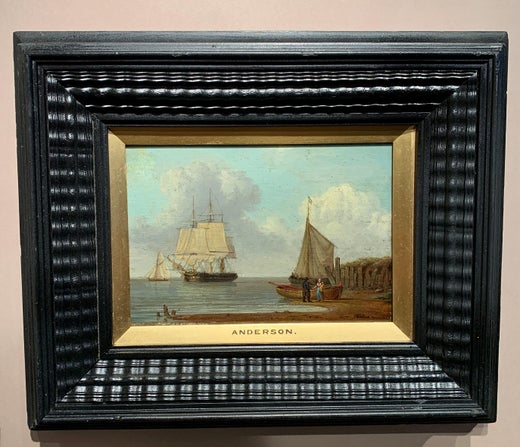
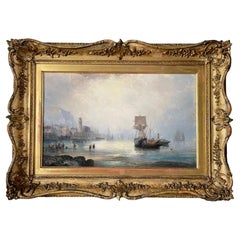
William Anderson18th century Dutch warships at sea off with fishing boats in full sail1780
1780
Price:$9,000
$14,500List Price
About the Item
- Creator:William Anderson (1757 - 1837, British)
- Creation Year:1780
- Dimensions:Height: 12 in (30.48 cm)Width: 16 in (40.64 cm)
- Medium:
- Movement Style:
- Period:1780-1789
- Condition:
- Gallery Location:Woodbury, CT
- Reference Number:1stDibs: LU50734094962
William Anderson
William (or Wiliam) Anderson (1757 – 27 May 1837) was a Scottish artist specializing in maritime and patriotic themes. He was well-regarded for his detailed and accurate portraits of ships under sail, exhibiting his works annually in London between 1787 and 1811 and then occasionally until 1834. Anderson influenced other artists, notably John Ward and others of the Hull school. Anderson's early life is obscure, but he is known to have trained as a shipwright before moving to London to become a maritime painter when he was about 30. His training served him well as a painter, providing "a practical nautical knowledge" of his subjects. He earned a reputation for "accuracy and refinement of detail" and was admired for his bright, clear colours. He worked in both oils and watercolours. He based his style on that of well-known Dutch maritime painters of the 17th century. He first exhibited at the Royal Academy in 1787 and the Royal Institution in 1810, and continued to exhibit annually until 1811. He then exhibited intermittently until 1834.[6] His best work was executed in the years 1790–1810, during the French Revolutionary and Napoleonic Wars, at which time the demand for naval paintings was high. His painting was not restricted to marine subjects and included an exhibit in 1822 of a painting depicting the Battle of Waterloo. Like other artists of the time, Anderson's paintings of marine incidents were often based on sketches by participants and were bought by individuals who had risen in social standing and wealth during the wars. Commissions that took Anderson back north introduced him to the Hull school of painters, notably influencing the young John Ward (1798–1849), who copied at least one of Anderson's paintings. He was also a friend and possibly a collaborator of the painter Julius Caesar Ibbetson (1759–1817). His work was influenced by his travels in the North, which led to depictions of Berwick-on-Tweed and Tynemouth. His last exhibit was of Lord Howe's fleet at Spithead at the Royal Academy in 1834, the last of 45 paintings that he exhibited there. He died in London on 27 May 1837.
About the Seller
5.0
Platinum Seller
Premium sellers with a 4.7+ rating and 24-hour response times
Established in 1983
1stDibs seller since 2016
532 sales on 1stDibs
Authenticity Guarantee
In the unlikely event there’s an issue with an item’s authenticity, contact us within 1 year for a full refund. DetailsMoney-Back Guarantee
If your item is not as described, is damaged in transit, or does not arrive, contact us within 7 days for a full refund. Details24-Hour Cancellation
You have a 24-hour grace period in which to reconsider your purchase, with no questions asked.Vetted Professional Sellers
Our world-class sellers must adhere to strict standards for service and quality, maintaining the integrity of our listings.Price-Match Guarantee
If you find that a seller listed the same item for a lower price elsewhere, we’ll match it.Trusted Global Delivery
Our best-in-class carrier network provides specialized shipping options worldwide, including custom delivery.You May Also Like
Stag Hunting in the Vicinity of Nuremberg by a German Artist Peter von Bemmel
Located in PARIS, FR
This small landscape shows a hunting scene: two riders are chasing a stag with their dogs at the edge of a forest. Signed by Peter von Bemmel, it is typical of the production of this...
Category
1720s Old Masters Landscape Paintings
Materials
Copper
Mercury and Io, a rediscovered painting by Jean-Baptiste Marie Pierre (ca. 1740)
Located in PARIS, FR
We would like to thank Mr. Nicolas Lesur for confirming the autograph nature of the entire composition after a direct examination of the painting on November 27, 2024.
This painting...
Category
1740s Old Masters Figurative Paintings
Materials
Canvas, Oil
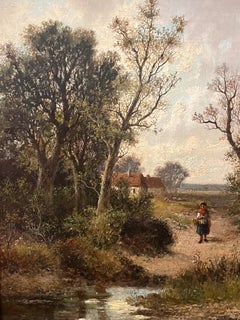
Landscape Near Felday, Surrey
By Abraham Hulk the Younger
Located in Hillsborough, NC
Dutch/English artist Abraham Hulk the Younger (1851-1922) is most known for landscapes of the British countryside. This work is one of a pair (the second work is also available by s...
Category
Late 19th Century Old Masters Landscape Paintings
Materials
Canvas, Oil
$1,960 Sale Price
30% Off
H 27 in W 22.75 in D 2.13 in
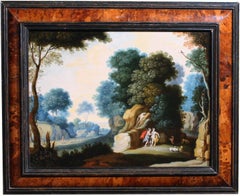
Landscape with figures, workshop of Paul Bril, Italian school 17th Century
By Paul Bril
Located in PARIS, FR
Idyllic landscape with myhological story of Cephalus and Procris
Early 17th century Italian school
Workshop Of Paul Bril (Antwerp, 1554 - Roma, 1626)
Oil on poplar panel: H. 28 cm (1...
Category
Early 17th Century Old Masters Landscape Paintings
Materials
Poplar, Oil
$5,284
H 15.35 in W 18.5 in
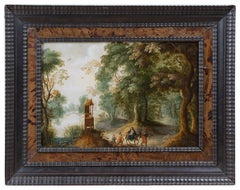
17th c. Flemish - Landscape with Flight to Egypt - Antwerp circa 1630
Located in PARIS, FR
LANDSCAPE WITH FLIGHT TO EGYPT,
JASPER VAN DER LANEN (ANTWERP, 1585 - 1634)
17TH CENTURY FLEMISH SCHOOL
ANTWERP CIRCA 1630
Oil on copper, dimensions: h. 10.23 in, w. 14.96 in
Flemish style frame in ebonized wood adorned with wavy moldings and wood veneer.
Framed dimensions: h. 17.32 in, w. 21.65 in
Provenance:
Philips auction...
Category
Early 17th Century Old Masters Figurative Paintings
Materials
Copper
$9,668 Sale Price
30% Off
H 17.32 in W 21.65 in
The Rape of Europa, signed Peter Sion (1624-1695), Antwerp, 17th century
Located in PARIS, FR
The Rape of Europa
By Peter Sion (Antwerp, 1624-1695)
Signed in the lower right corner P. Sion
17th century Antwerp School
Oil on copper, dim. h. 53 cm, w. 45 cm
Moulded and ebonized...
Category
17th Century Old Masters Figurative Paintings
Materials
Oak, Oil, Wood Panel
$13,812
H 31.5 in W 28.35 in
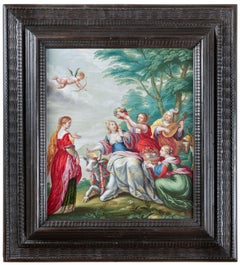
Allegory of Summer, workshop of Hendrick Van Balen 17th c. Antwerp school
By Hendrick van Balen
Located in PARIS, FR
Allegory of summer, personified by Ceres
Workshop of Hendrick Van Balen
Antwerp School, early 17th century.
Oil on copper,
Dimensions: h. 52 cm, l. 40cm
Antic giltwood frame
Framed dimensions: h. 74 cm, l. 60cm
Very good condition
Our delicately painted work is part of the pictorial tradition that is both allegorical and mythological in vogue in Antwerp, whose leaders are Jan Brueghel the Younger and Hendrick Van Balen. Numerous works emerging from their workshops illustrate mythological subjects, the seasons, the elements, the senses or intertwining the lush landscapes, animals and gods of Olympus.
At the heart of a green landscape dominated in its center by a generous apple tree, the beautiful Ceres, partially dressed in a large blue drape, is wearing a crown of ears of wheat, her symbol of the goddess of the earth and harvests. She holds the sickle in her right hand and carries sheaves of wheat. To her right a nymph holds the cornucopia while puttis pick and offer flowers.
In the foreground are the summer fruits: figs, cherries, apples and lemons. A squirrel munching on cherries symbolizes toil and foresight, themes that are echoed in the work of the harvesters on the wheat fields in the background.
The background is composed of vegetation, on the right a wild rose bush with its branches erect against a tree trunk, in the center of the trees with silvery green foliage.
Our painter, a student of Hendrick Van Balen, finds his inspiration in the works of the master such as this nymph in yellow drapery seen from behind, one of the figures which accompanies many of the master's paintings. The elegant gestures, the flesh...The indisputable influence of Jan Brueghel the Younger is revealed in the treatment of trees and flowers, wild roses, tulips as well as in the still life with the squirrel in the foreground.
The craze for this type of virtuoso painting where the mythological figures are only a pretext to better illustrate the landscape and plant species surrounding them, then generated orders from all over Europe.
Hendrick Van Balen, Flemish painter, born and died in Antwerp (1575-1632). A student of Adam Van Noort, he entered the guild of Saint-Luc in 1593, later trained in Italy and was Van Dyck's first master. He often painted small characters taken from scenes from the Bible or classical mythology, on paintings in which Josse de Momper...
Category
Early 17th Century Old Masters Figurative Paintings
Materials
Copper

$13,211
H 29.13 in W 23.62 in
Period Marine Landscape Credited to Warren Sheppard
By Warren W. Sheppard
Located in Roma, IT
This beautiful painting, due to its very high quality of execution, style and era, can be referred to the great artist Warren Sheppard, who specialized in seascapes.
Of great evocati...
Category
19th Century Old Masters Landscape Paintings
Materials
Canvas, Oil
$3,362
H 15.75 in W 21.46 in D 2.76 in
Landscape with Gentleman on Horseback and Peasant Woman Receiving Alms
By Philips Wouwerman
Located in Stockholm, SE
Workshop / Circle of Philips Wouwerman (1619-1668)
Landscape with Gentleman on Horseback and Peasant Woman Receiving Alms
oil on oak panel
12.40 x 14.17 inches (31.5 x 36 cm)
wit...
Category
17th Century Old Masters Landscape Paintings
Materials
Oak, Oil, Wood Panel
$18,016
H 12.41 in W 14.18 in
Shipping in Stormy Waters, Attributed to Italian Artist Francesco Guardi
By Francesco Guardi
Located in Stockholm, SE
The splendour of the tragic sea
Francesco Guardi and maritime painting in Venetian art
No Venetian painter was a stranger to the sea. After all, Venice was not only one of the most prominent ports of the Mediterranean, but indeed a city literally submerged in the ocean from time to time. Curiously however, the famous Venetian school of painting showed little interest in maritime motifs, favouring scenes from the iconic architecture of the city rather than seascapes. That is why this painting is a particularly interesting window into not only the painter Francesco Guardi himself – but to the significance of the element of water in art history, in absence as well as in the centre of attention.
Whether it be calm, sunny days with stunning views of the palaces alongside the canals of Venice or – more rarely – stormy shipwrecking tragedies at sea, water as a unifying element is integral to the works of painter Francesco Guardi (1712–1793). During his lifetime, Venetian art saw many of its greatest triumphs with names like Tiepolo or Canaletto gaining international recognition and firmly establishing Venice as one of the most vibrant artistic communities of Europe. While the city itself already in the 18th century was something of an early tourist spot where aristocrats and high society visited on their grand tour or travels, the artists too contributed to the fame and their work spread the image of Venice as the city of romance and leisure to an international audience, many of whom could never visit in person.
Still today, the iconic image of Venice with its whimsical array of palaces, churches and other historic buildings is much influenced by these artists, many of whom have stood the test of time like very well and remain some of the most beloved in all of art history. It was not primarily subtility, intellectual meanings or moral ideals that the Venetian art tried to capture; instead it was the sheer vibrancy of life and the fast-paced city with crumbling palaces and festive people that made this atmosphere so special. Of course, Venice could count painters in most genres among its residents, from portraiture to religious motifs, history painting and much else. Still, it is the Vedutas and views of the city that seems to have etched itself into our memory more than anything else, not least in the tradition of Canaletto who was perhaps the undisputed master of all Venetian painters.
Born into his profession, Francesco lived and breathed painting all his life. His father, the painter Domenico Guardi (1678–1716) died when Francesco was just a small child, yet both he and his brothers Niccolò and Gian Antonio continued in their fathers’ footsteps. The Guardi family belonged to the nobility and originated from the mountainous area of Trentino, not far from the Alps. The brothers worked together on more challenging commissions and supported each other in the manner typical of family workshops or networks of artists. Their sister Maria Cecilia married no other than the artist Giovanni Battista Tiepolo himself, linking the family to the most renowned Venetian name of the time. During almost a decade, Guardi worked in the studio of Michele Giovanni Marieschi, sometimes simply known as Michiel, a painted similar in both style and motif. Canaletto is, however, the artist Guardi is most often compared to since they shared a mutual fascination for depicting the architecture and cityscape of Venice.
During the course of his career, Guardi tried his hand in many different genres. He was as swift in painting landscapes, Vedutas of Venice, sacred motifs, interiors and architectural compositions as he was in a number of other motifs. His style is typical of the Venetian school but also distinct and personal once we look a little closer. There is an absolute certainty in the composition, the choice of which sometimes feels like that of a carefully calculated photograph – yet it is also very painterly, in the best sense of the word: fluid, bold, sensitive and full of character. The brushwork is rapid, intense, seemingly careless and extraordinarily minute at the same time; fresh and planned in a very enjoyable mixture. His interiors often capture the breath-taking spacious glamour of the palaces and all their exquisite decor. He usually constructed the motif through remarkably simple, almost spontaneous yet intuitively precise strokes and shapes. The result was a festive, high-spirited atmospheric quality, far away from the sterile and exact likeness that other painters fell victim to when trying to copy Canaletto.
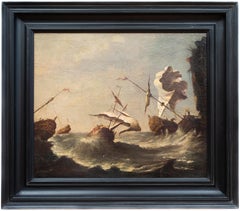
The painting here has nothing of the city of Venice in it. On the contrary, we seem to be transported far away into the solitary ocean, with no architecture, nothing to hold on to – only the roaring sea and the dangerous cliffs upon which the ships are just moments away from being crushed upon. It is a maritime composition evoking both Flemish and Italian precursors, in the proud tradition of maritime painting that for centuries formed a crucial part of our visual culture.
This genre of painting is today curiously overlooked, compared to how esteemed and meaningful it was when our relationship to the sea was far more natural than it is today. When both people and goods travelled by water, and many nations and cities – Venice among them – depended entirely on sea fare, the existential connection to the ocean was much more natural and integrated into the imagination. The schools and traditions of maritime art are as manifold as there are countries connected to the sea, and all reflect the need to process the dangers and wonders of the ocean.
It could symbolize opportunity, the exciting prospects of a new countries and adventures, prospering trade, beautiful scenery as well as war and tragedy, loss of life, danger and doom. To say that water is ambivalent in nature is an understatement, and these many layers were something that artists explored in the most wondrous ways. Perhaps it takes a bit more time for the modern eye to identify the different nuances and qualities of historic maritime paintings, they may on first impression seem hard to differentiate from each other. But when allowing these motifs to unfold and tell stories of the sea in both fiction and reality – or somewhere in between – we are awarded with an understanding of how the oceans truly built our world.
In Guardi’s interpretation, we see an almost theatrically arranged shipwrecking scene. No less than five ships are depicted right in the moment of utter disaster. Caught in a violent storm, the waves have driven them to a shore of sharp cliffs and if not swallowed by the waves, crushing against the cliffs seems to be the only outcome. The large wooden ships are impressively decorated with elaborate sculpture, and in fact relics already during Guardi’s lifetime. They are in fact typical of Dutch and Flemish 17th century ships, giving us a clue to where he got the inspiration from. Guardi must have seen examples of Flemish maritime art, that made him curious about these particular motifs. One is reminded of Flemish painters like Willem van de Velde and Ludolf Backhuysen, and this very painting has indeed been mistakenly attributed to Matthieu van Plattenberg...
Category
18th Century Old Masters Landscape Paintings
Materials
Canvas, Oil
$70,533
Free Shipping
H 25.79 in W 29.14 in
More From This Seller
View All19th Century English Antique, Two Country farmers drinking beer in a landscape
By George Morland
Located in Woodbury, CT
Attributed to George Morland.
19th Century English Antique, Two Country farmers drinking beer in a landscape.
Wonderful early 19th-century original oil on canvas.
A classic 'Morland' composition as the painter was a big fan of English Pub scenes...
Category
Early 1800s Old Masters Figurative Paintings
Materials
Canvas, Oil
$2,765 Sale Price
30% Off
Free Shipping
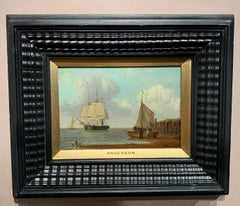
Antique English 19th century marine scene
By William Anderson
Located in Woodbury, CT
Outstanding English late 18th / early 19th century marine scene by one of Britain's best known and sought after painters.
William (or Wiliam) Anderson (1757 – 27 May 1837) was a Scottish artist specializing in maritime and patriotic themes. He was well-regarded for his detailed and accurate portraits of ships under sail, exhibiting his works annually in London between 1787 and 1811 and then occasionally until 1834. Anderson influenced other artists, notably John Ward and others of the Hull school.
Anderson's early life is obscure, but he is known to have trained as a shipwright before moving to London to become a maritime painter when he was about 30. His training served him well as a painter, providing "a practical nautical knowledge" of his subjects. He earned a reputation for "accuracy and refinement of detail" and was admired for his bright, clear colours. He worked in both oils and watercolours.
He based his style on that of well-known Dutch maritime...
Category
1810s Old Masters Figurative Paintings
Materials
Oil, Wood Panel
$5,167 Sale Price
35% Off
Free Shipping
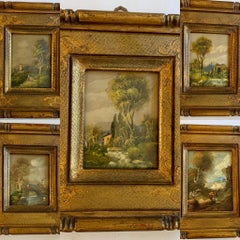
Five mid 20th century Italian oil landscapes with figures, castles, Churchs
Located in Woodbury, CT
A very interesting set of five mid-20th-century Italian oils on copper.
All five are classical landscape subjects and are signed Roger, though we don't know which artist with the n...
Category
1950s Old Masters Landscape Paintings
Materials
Copper
$4,517 Sale Price
35% Off
Free Shipping
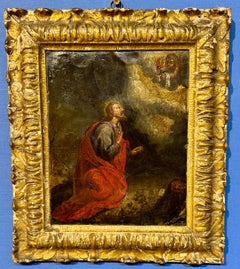
Italian School, Late 17th Century Christ in the Garden of Gethsemane
Located in Woodbury, CT
Italian School, Late 17th Century (circa 1670–1700)
Christ in the Garden of Gethsemane
Oil on panel, in a carved and gilded Baroque frame
The painting is unsigned
A moving devotiona...
Category
1650s Old Masters Figurative Paintings
Materials
Copper
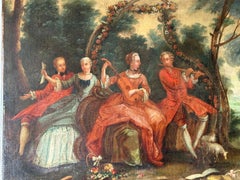
18th century French Garden or Féte a Bride and musicians playing music
Located in Woodbury, CT
This enchanting 18th-century French fête galante captures the elegance and joy of aristocratic leisure, set amidst a lush garden adorned with flowers. A scene of refined celebration,...
Category
1780s Old Masters Figurative Paintings
Materials
Canvas, Oil
Impressionist view of the Statue of Liberty on the East River, New York
By Charles Bertie Hall
Located in Woodbury, CT
Charles Bertie Hall (Anglo-American, 20th/21st Century)
View of the Statue of Liberty
Oil on board, unsigned, from the artist’s estate
This evocative painting by Charles Bertie Hall ...
Category
2010s Impressionist Landscape Paintings
Materials
Oil, Board