1 of 1
Friedel DzubasOver the Hill1954-44
1954-44
About the Item
- Creator:Friedel Dzubas (1915-1994, German)
- Creation Year:1954-44
- Dimensions:Height: 69.625 in (176.85 cm)Width: 106.25 in (269.88 cm)
- Medium:
- Movement Style:
- Period:
- Condition:
- Gallery Location:New York, NY
- Reference Number:1stDibs: LU106239292
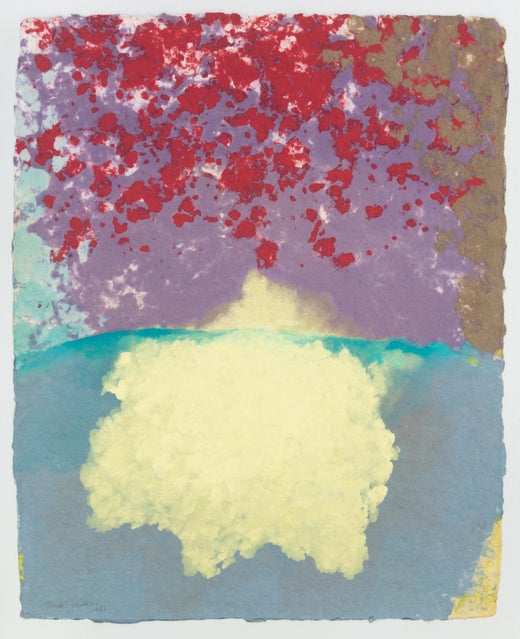
Friedel Dzubas
Friedel Dzubas was born April 20, 1915 in Berlin and studied at the Prussian Academy of Fine Art and under Paul Klee while in Düsseldorf from 1936 to 1939. In 1939, Dzubas fled Germany for London and the United States where he later became a citizen. In 1948, he he answered art critic Clement Greenberg's anonymous advertisement for a summer roommate. It was the height of the Abstract Expressionist Movement in New York, and through Greenberg Dzubas met Willem de Kooning, Jackson Pollock, Adolph Gottlieb and Barnett Newman. Later, in the early 1950s, Dzubas shared a studio with Helen Frankenthaler, associating with some of the younger generation of abstract painters in New York including Jules Olitski and Kenneth Noland. In the early 1950s, he began exhibiting his work in New York. In the 1960s, he started experimenting with color field painting. Dzubas' mature paintings since the 1960s assimilate his early interest in German Romanticism and Expressionism into post-war American abstraction. "He abandoned oil paint for Magna acrylic in 1965 when he found he could achieve with a brevity of gesture the brilliance and luminosity of oil paint applied in thin veils of color. He could thus effect the richness and variation of traditional glazed tones using a more expressive, immediate process. By the early 1980s, Dzubas abandoned his preliminary preparations of sketching and priming, thereby inviting spontaneity and accident into his painting process. Although he typically coated his canvas with a gesso primer before painting, he began to apply it so thinly that the pigment was almost immediately absorbed into the ground, making it impossible for him to revise and rework his compositions. Dzubas' change in technique reveals a thoroughly modernist sensibility: "I like that risk," he explained. "I think, to a certain degree, I have to make it mechanically difficult and unreliable for myself. If I can predict the effect too much, then I probably am not supposed to be doing it. I function better if my footing is not too sure, so to speak." The rich, velvety hues of Grade's reds, greens, and blues appear radiant in places. Dzubas heightened his color drama -- a drama characterized as quintessentially Baroque by some critics-- by varying the density of his paint. His rectangular forms appear to ebb and flow in an orchestrated movement across the surface of the picture plane." (Megan Bahr) A retrospective of Dzubas' work was shown at the Museum of Fine Art, Houston in 1974 and at the Museum of Fine Art, Boston the following year. In 1983, Dzubas was honored with an exhibition at the Hirshhorn Museum and Sculpture Garden, Washington, D.C. (ASKART)
Authenticity Guarantee
In the unlikely event there’s an issue with an item’s authenticity, contact us within 1 year for a full refund. DetailsMoney-Back Guarantee
If your item is not as described, is damaged in transit, or does not arrive, contact us within 7 days for a full refund. Details24-Hour Cancellation
You have a 24-hour grace period in which to reconsider your purchase, with no questions asked.Vetted Professional Sellers
Our world-class sellers must adhere to strict standards for service and quality, maintaining the integrity of our listings.Price-Match Guarantee
If you find that a seller listed the same item for a lower price elsewhere, we’ll match it.Trusted Global Delivery
Our best-in-class carrier network provides specialized shipping options worldwide, including custom delivery.You May Also Like
Häuser in einer Landschaft
Located in Wien, 9
In expressionist style, a house surrounded by trees and bushes is shown. The reduction to the essential reinforces the impression of the anonymous village. Henri Schäfer...
Category
20th Century Abstract Expressionist Landscape Paintings
Materials
Canvas, Oil
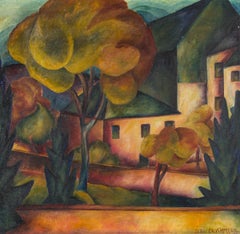
Landscape with houses
Located in Wien, 9
Gustav Hessing wurde am 20. Januar 1909 in Czernowitz (damals Österreich-Ungarn, heute Ukraine) geboren und starb am 8. Januar 1981 in Wien. Er zählt zu den bedeutenden österreichisc...
Category
Mid-20th Century Abstract Expressionist Landscape Paintings
Materials
Canvas, Oil
French Extra-Large Dark Blue And Red Abstract Dramatic Contemporary Painting
Located in Frederiksberg C, DK
Extra-large dramatic painting from 1985 by Francois Boissiere (1956 - )
Category
1980s Abstract Expressionist Landscape Paintings
Materials
Cotton Canvas, Oil
Francois BoissiereFrench Extra-Large Dark Blue And Red Abstract Dramatic Contemporary Painting, 1985
$4,200
H 51.19 in W 63.78 in
April 10, 1961
Located in Austin, TX
Waterline Fine Art, Austin, TX is pleased to present the following work:
Oil on canvas. Signed and dated lower right; signed, titled, dated verso.
48 x 60 in.
49.75 x 61.75 in. (framed)
Custom framed in a solid maple floater, with an heirloom white finish.
Provenance
Kootz Gallery, New York
Collection of John G. and Kimiko Powers, New York/Aspen, CO
Prentice-Hall Corporate Art Collection, New York
Kyle Morris was born in Des Moines, IA in 1918. After serving in the U.S. Air Force during World War II, he completed M.F.A. programs at both Northwestern and Cranbrook Academy of Art before settling in New York and renting a studio on Mercer Street in downtown Manhattan during the 1950s. Transitioning away from the figurative painting of his formal training, he began to create the bold gestural works that would serve as his hallmark in the ever-growing fraternity of the New York School.
Morris’ first major solo exhibition occurred at the Walker Art Center in Minneapolis in 1952. This show served as the catalyst for his recruitment onto the rosters of the prominent Stable and Kootz galleries in New York. In 1961, he was included in the Guggenheim’s landmark exhibition, American Abstract Expressionists and Imagists, which surveyed the abstract expressionist movement that would come to dominate contemporary American art...
Category
1960s Abstract Expressionist Abstract Paintings
Materials
Canvas, Oil
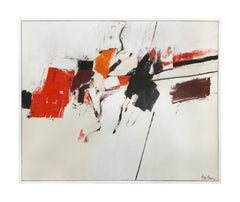
Untitled
Located in Austin, TX
Waterline Fine Art, Austin, TX is pleased to present the following work:
Oil on canvas. Estate stamped and numbered verso; initialed “SF22” verso.
48.25 x 34.25 in.
49.25 x 35 in. (framed)
Custom framed in a solid maple floater.
Provenance
Estate of Samuel Feinstein
McCormick Gallery, Chicago
Samuel Lawrence...
Category
1950s Abstract Expressionist Abstract Paintings
Materials
Canvas, Oil
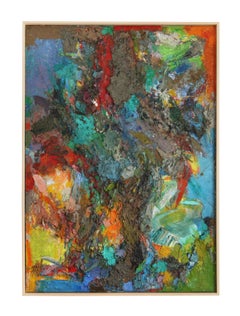
Komposition rot/schwarz
Located in Austin, TX
Waterline Fine Art, Austin, TX is pleased to present the following work:
Oil on canvas. Signed and dated lower left, inscribed label verso.
59.25 x 55.25 in.
61 x 57 in. (framed)
Custom framed in a wooden double tray frame, hand-painted white.
Provenance
Galerie Lovers of Fine Art, Gstaad, Switzerland
This work has been recorded under no. 1531 in the digital Catalogue Raisonné of the artist, prepared by Michel Reymondin, Montreux, Switzerland.
Carl Walter Liner was born in the Swiss canton of Appenzell, near the border with Liechtenstein, in 1914. The son of famed artist Carl August Liner, the younger Liner enjoyed more critical and commercial renown for his landscapes.
In 1938 at the age of 24, he undertook what would become the first of several residencies in Paris. This particular sojourn helped to establish the trajectory of his career, as Paris would provide the setting in which he became acquainted with early twentieth century masters Maurice de Vlaminck, Georges Braque, Ossip Zadkine, Gérard Schneider, and Erich Heckel. The stylistic and technical influence of his contemporaries is clearly evident in Liner’s work from this point forward.
Unfortunately, the dawn of the 1940s would bring about a number of challenges for Liner. With the outbreak of war, Liner was mobilized for the Swiss Border Guard, and returned home to Switzerland in 1939. He remained on active duty until 1945, only to lose his father the following year. The death of the elder Liner left a profound impact on his son, who eventually made his way back to Paris in 1947 and embarked upon what would become a very successful series of nudes.
By his own admission, 1948 was a pivotal year in Liner’s career, as a particularly spiritual trip to Algeria would foment the emotions led to the beginning of his practice with abstraction. Henceforth, Liner would vacillate between the figurative and abstract, creating parallel oeuvres. His abstraction from the 1950s and 60s mirrored...
Category
1960s Abstract Expressionist Abstract Paintings
Materials
Canvas, Oil
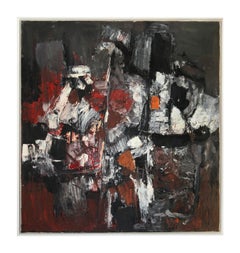
Untitled
Located in Austin, TX
Waterline Fine Art, Austin, TX is pleased to present the following work:
Oil on canvas. Signed lower right.
47.25 x 47 in.
48.5 x 48.5 in. (framed)
Custom framed in a solid maple ...
Category
1950s Abstract Expressionist Abstract Paintings
Materials
Canvas, Oil
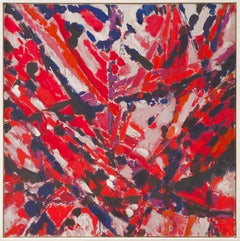
Untitled
Located in Austin, TX
Waterline Fine Art, Austin, TX is pleased to present the following work:
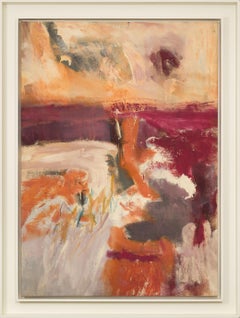
Oil on canvas. Signed verso. Some scratched out, illegible writing in paint and graphite verso, which may ha...
Category
1960s Abstract Expressionist Abstract Paintings
Materials
Canvas, Oil
July Fourth
Located in Austin, TX
Waterline Fine Art, Austin, TX is pleased to present the following work:
Oil on canvas. Signed and titled verso.
40.25 x 56.25 in.
40.75 x 56.75 in. (framed)
Custom framed in a wh...
Category
1960s Abstract Expressionist Abstract Paintings
Materials
Canvas, Oil
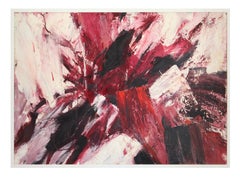
Untitled
By John Opper
Located in Austin, TX
Waterline Fine Art, Austin, TX is pleased to present the following work:
Oil on canvas. Signed lower right, signed and dated verso.
62.25 x 56.25 in.
64 x 58 in. (framed)
Custom framed in a natural cherry wood floater.
Provenance
Washburn Gallery, New York
Behnke Doherty Gallery, Washington Depot, CT
Born in 1908 in Chicago, John Opper moved with his family to Cleveland, Ohio, in 1916. In high school, he began studying art and attending classes at the Cleveland Museum of Art.
After graduation, he enrolled in the Cleveland School of Art (now Cleveland Institute of Art), only to withdraw after a year and move to Chicago, where he took classes at the Art Institute of Chicago. He eventually returned to Cleveland, enrolling at Western Reserve University (now Case Western Reserve), receiving his bachelor’s degree in 1931. The Depression has taken hold during this period, so Opper found work by teaching metalworking and sketching classes at the Karamu Settlement House, the oldest African American theater in the United States.
In 1933, Opper traveled to Gloucester, Massachusetts, eventually connecting with the artist Hans Hofmann, who was teaching at the school run by Ernest Thurn. Hofmann encouraged Opper to work “in a more modern vein and start finding what it’s all about.” Heeding this advice, Opper relocated to New York, co-founding a mail-order club of American and British prints for dissemination to schools and museums.
By the mid-1930s, he joined the Works Progress Administration (WPA) Easel Division, and also began attending the 57th Street school that Hans Hofmann had established after leaving the Art Students League. Looking back at his time at the school, Opper felt that beyond Hofmann’s teaching, most advantageous was his contact with fellow artists, including Byron Browne, Rosalind Bengelsdorf, and George McNeil. At the time, he also met Giorgio Cavallon and the sculptor Wilfrid Zogbaum.
In 1936, Opper became a founding member of the American Abstract Artists, along with Balcomb and Gertrude Greene. The organization was formed to provide an opportunity for artists to show abstract works at a time when such opportunities were scarce. This led to his first solo show in 1937 at the Artists’ Gallery in New York.
During his summer in Gloucester in 1933, Opper came to know Milton Avery. Painting in Avery’s informal studio in New York City the following winter, he became acquainted with Adolph Gottlieb and Mark Rothko. Opper participated in a couple of shows during the 1930s of the American Artists Congress Against War and Fascism, whose president was Stuart Davis. About the same period, Opper joined the Artists’ Union and served as the business manager of its publication, Art Front.
During World War II, Opper worked for a ship design company creating drawings for piping systems used in PT boats...
Category
1950s Abstract Expressionist Abstract Paintings
Materials
Canvas, Oil
Still Thinking About These?
All Recently ViewedMore Ways To Browse
Desert Painting
Modern Original Oil Paintings
Oil Can
Oil Cans
Outsider Artist
Montmartre Paris
Pastoral Landscapes
19th Century Large French Oil Painting
African Art Canvas
Aix En Provence
New Orleans Artist
Scottsdale Arizona
The Clash
Used Greenhouses
A Pair Of Paintings
Impressionist Roses
Cubist Portraits
Framed Oil Painting 4 X 6