Want more images or videos?
Request additional images or videos from the seller
1 of 17
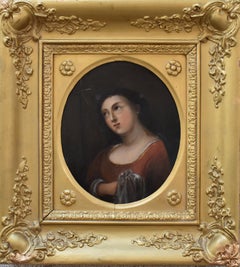
Bathsheba Religious Paint Oil on canvas 17/18th Century Italy Art Quality Canvas1680-1720
1680-1720
Price:$3,800
$7,261.54List Price
About the Item
- Creation Year:1680-1720
- Dimensions:Height: 22.05 in (56 cm)Width: 18.9 in (48 cm)
- Medium:
- Movement Style:
- Circle Of:Giuseppe Bartolomeo Chiari (1654 - 1727, Italian)
- Period:
- Condition:
- Gallery Location:Riva del Garda, IT
- Reference Number:1stDibs: LU98817854912
About the Seller
4.9
Platinum Seller
Premium sellers with a 4.7+ rating and 24-hour response times
Established in 2017
1stDibs seller since 2018
273 sales on 1stDibs
Authenticity Guarantee
In the unlikely event there’s an issue with an item’s authenticity, contact us within 1 year for a full refund. DetailsMoney-Back Guarantee
If your item is not as described, is damaged in transit, or does not arrive, contact us within 7 days for a full refund. Details24-Hour Cancellation
You have a 24-hour grace period in which to reconsider your purchase, with no questions asked.Vetted Professional Sellers
Our world-class sellers must adhere to strict standards for service and quality, maintaining the integrity of our listings.Price-Match Guarantee
If you find that a seller listed the same item for a lower price elsewhere, we’ll match it.Trusted Global Delivery
Our best-in-class carrier network provides specialized shipping options worldwide, including custom delivery.You May Also Like
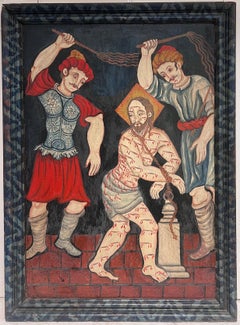
The Flagellation of Christ Antique Oil on Wood Panel Painting
Located in Cirencester, Gloucestershire
The Flagellation of Christ
Eastern European artist, late 19th century
oil on wood panel, framed
framed: 35 x 25.5 inches
panel: 32 x 21 inches
Provenance: private collection, Franc...
Category
Late 19th Century Old Masters Figurative Paintings
Materials
Oil
$1,652 Sale Price
30% Off
H 35 in W 25.5 in
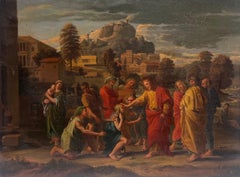
Antique French Old Master Oil Painting Christ Healing the Sick in Jersusalem
Located in Cirencester, Gloucestershire
Christ Healing the Sick
French School, 19th century
oil on canvas, unframed
canvas: 15 x 20.5 inches
Provenance: private collection, Europe
Condition: some craquelure throughout, mo...
Category
19th Century Old Masters Figurative Paintings
Materials
Oil
$1,719 Sale Price
30% Off
H 15 in W 20.5 in
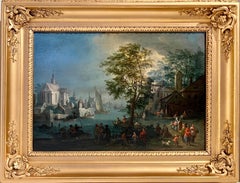
Bustling 17th century harbour landscape with fishermen, visitors and merchants
Located in Aartselaar, BE
A bustling scene of fishermen, merchants, and visitors in a peaceful and picturesque port village
This engaging painting offers a vivid and atmospheric glimpse into daily life in th...
Category
17th Century Old Masters Landscape Paintings
Materials
Oil, Canvas
$10,059
H 11.03 in W 13.78 in
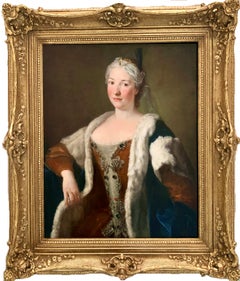
18th century French Old Master Portrait of a woman in oriental costume
Located in Aartselaar, BE
French 18th century old master portrait of a majestic lady dressed "à la Turque"
The sitter at the viewer with a kind and enigmatic smile and twinkling eyes. She looks elegant and kind, yet also has an intelligent and determined aura, reflecting the character of someone who is in charge of her own life and destiny.
De Silvestre paid great attention to her spectacular outfit, which is striking in its portrayal of the sumptuous fabrics and their decorative richness. She is wearing a luxurious royal blue robe à la...
Category
1740s Old Masters Portrait Paintings
Materials
Canvas, Oil
$21,893
H 31.89 in W 25.6 in D 0.4 in
Penitent Mary Magdalene c1750 Oil on Copper Old Master
Located in Holywell, GB
A finely painted picture, possibly of the penitent Mary Magdalene, painted in oil on to a copper plate and dating to c1750.
Condition
Two old touch ins, tiny chip to the forehead...
Category
1750s Old Masters Figurative Paintings
Materials
Oil
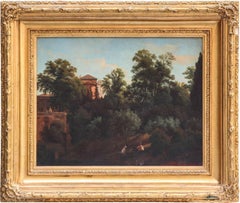
19th Century Roman Landscape oil on canvas with Giltwood Frame
Located in Rome, IT
Amaizing 19' century Roman landscape depicting a part of Villa Borghese with Trinità dei Monti.
With a finely carved gilt wood coeval frame.
Measurements with frame cm 65 x78 wit...
Category
19th Century Old Masters Landscape Paintings
Materials
Oil
$5,325
H 25.6 in W 30.71 in D 1.97 in
19th Century Roman Landscape oil on canvas with Giltwood Frame
Located in Rome, IT
Amaizing 19' century Roman landscape depicting a part of Villa Borghese with Trinità dei Monti.
With a finely carved gilt wood coeval frame.
Measurements with frame cm 65 x78 wit...
Category
19th Century Old Masters Landscape Paintings
Materials
Oil
$5,325
H 25.6 in W 30.71 in D 1.97 in
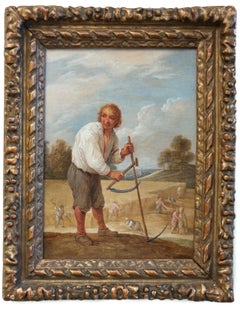
Peasants in a Cornfield (Boer in het veld) by David Teniers the Younger
By David Teniers the Younger
Located in Stockholm, SE
Remembering the magic of everyday life moments in the art of David Teniers:
The art of David Teniers the Younger (1610–1690) coincided with the heyday of the Flemish Baroque and cap...
Category
Late 17th Century Old Masters Landscape Paintings
Materials
Canvas, Oil
$28,402
Free Shipping
H 12.6 in W 10.04 in
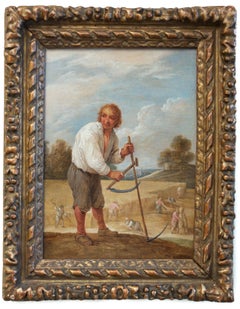
Peasants in a Cornfield (Boer in het veld) by David Teniers the Younger
By David Teniers the Younger
Located in Stockholm, SE
Remembering the magic of everyday life moments in the art of David Teniers:
The art of David Teniers the Younger (1610–1690) coincided with the heyday of the Flemish Baroque and captured a great variety of motifs of his time. In this painting of a seemingly simple peasant scene lies keys to understanding both the imaginative mind of Teniers as well as why this time period produced some of the most iconic works in all of art history.
As indicated by the name, Teniers was more or less born into his profession. As the son of David Teniers the elder, himself a painter who studied under Rubens, the younger David received training in art from a very young age and had no less than three brothers who also became painters. Because of his father’s frequent financial failures that even at times saw him imprisoned, David the younger helped to rescue the family from ruin through painting copies of old masters. Essentially, the young Teniers was confronted with painting as both a passion and creative expression as well as a necessity during difficult times, an experience that would shape much of his capacity and sensitivity in his coming life.
Despite the hardships, the talent and determination of Teniers was recognized and quickly expanded his possibilities. He had already spent time in France and possibly also England when he was hired by his father’s former teacher Rubens to help with a prestigious commission with mythological paintings, now considered lost, for Philip IV the king Spain. In 1644–54 Teniers was appointed dean of the Antwerp Guild of Saint Luke, manifesting his esteemed position within the artistic community. A few years afterwards he took an important step when relocating to Brussels, where Teniers yet again found new career opportunities that would prove to be very successful.
As the keeper of the collections of Archduke Leopold Wilhelm, a role similar to what we now refer to as an art advisor, Teniers purchased hundreds of important artworks that manifested the prominent status of the Archduke’s collection while at the same time providing an unusual access to inspiration and knowledge for Teniers himself. Since he kept on painting during the same time, his creative scope must have seemed almost bewildering in the great variety of images and stories that he surrounded himself with.
Regardless of how glamorous and culturally stimulating the career of Teniers was, he was as open to the charm and existential importance of everyday life as he was to works of great masters and luxurious collectibles. In his impressive repertoire of genres with everything from exquisite royal portraits, interiors, landscapes and history paintings he always added something new and inventive, highlighting the possibilities of art and importance of an experimental and intuitive mind. It is difficult to single out one aspect or genre to summarize his legacy, since it lies much more in the broad virtuosity across many motifs, although he is particularly remembered for farm scenes and meticulously depicted interiors where other paintings and artworks are captured with an astonishing precision. However, the fact that he is still today one of the most known and celebrated names of the Dutch Golden Age is a proof to the magic of his work, which continues to spark dialogue and wonder in the contemporary viewer of his works.
The farm boy in the field in this painting, which likely dates to the mature part of his career, is a wonderful entry into the mind of Teniers. In the tightly cropped motif, we see him standing right in the middle of the busy harvest when men, women and everyone capable were sent out in the field to collect the crop that formed the very core of their diet and survival. In the background we see a fresh blue sky interspersed with skillfully painted clouds, some trees reaching their autumnal colours and in the far distance the glimpse of a small church and village. The presence of a church in a landscape, so typical of Dutch art, served both a symbolic and visual function as a representation of faith while at the same time defining scale and distance.
In the field, the work is in full action with the farmers spread out in various positions, all in the midst of hard and sweaty labour. While they are portrayed as having nothing else than the work on their mind, our farm boy seems to have his attention directed elsewhere. Standing there with his white, half open shirt, flowy curls and strong, sturdy body; his gaze is directed away, out of the picture and the scythes in his hands. He looks almost smirking, expressed with tremendous subtlety in the slight smile of his lips and big eyes, being just in the middle of losing focus on the work. What is it that steals his attention? What has he seen, or realized, or felt – to break him free of the arduous task of harvesting, if but for a moment?
Here starts the wondering and the questions that are the hallmark of a great piece of art. Instead of explicitly locking in the motif in overly clear symbolism Teniers has chosen an open ended, subtle yet striking moment for us to consider. While it of course can be related to numerous other farm scene depictions of this time, and clever usages of gazes and real-life scenes to underscore various moral or symbolic meanings, the painting can be much more of a contemplation than an explanation or illustration. The ordinary nature and understated yet emotionally textured composition of the motif gives greater space for our own reactions and thoughts. Has he seen a pretty farm girl just passing by? Is he fed up with the farm life, joyously dreaming away for a minute, imagining another future? Or is he simply in need of distraction, looking away and ready for anything that can steal his attention?
One quality that never seem to have escaped Teniers was that of curiosity. During all of his career he constantly investigated, expanded and experimented with not only the style and technique of painting, but with the vision of art itself. Being credited with more or less introducing farm motifs for a broader audience not only tells us of his ability to understand the demand for different motifs, but the sensitivity to transform seemingly ordinary parts of life into deep aesthetic experiences, far beyond their expected reach. The farm boy in this painting is, of course, exactly that. But with the help of one smirk the entire picture is charged with a different energy, awakening many contrasts and relationships between the calm landscape, the hard work and his own breach of effectivity, holding sharp scythes while thinking or seeing something else.
It is no wonder Teniers chose to work with farm scenes as a way of investigating these intricate and delicate plays on expectations and surprises, clarity and ambivalence. It invites us to an appreciation of human everyday life that connects us with the people of 17th century...
Category
Late 17th Century Old Masters Landscape Paintings
Materials
Canvas, Oil
$28,402
Free Shipping
H 12.6 in W 10.04 in
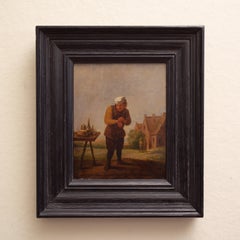
A Peasant Removing a Plaster: The Sense of Touch. By a Follower of David Teniers
By David Teniers the Younger
Located in Stockholm, SE
David Teniers the Younger (1610-1690) Follower of
A Peasant Removing a Plaster: The Sense of Touch
signed T on the table
oil on panel
panel size 7,20 x 5,55 inches (18,3 x 14,4 cm)...
Category
Early 18th Century Old Masters Figurative Paintings
Materials
Oil, Panel
$7,633
Free Shipping
H 11.23 in W 9.85 in
More From This Seller
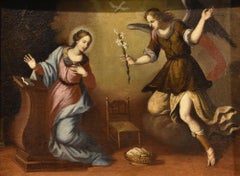
View AllAnnunciation Tuscan School 17th Century Paint Oil on canvas Old master Religious
Located in Riva del Garda, IT
Tuscan school,17th century
The Annunciation
Oil on canvas 55 x 73 cm In antique lacquered frame 73 x 92 cm
NB: The darker strip at the top of the canvas is the shadow of the ...
Category
17th Century Old Masters Paintings
Materials
Oil
$6,030 Sale Price
20% Off
Landscape Garden Knight De Moucheron Paint 17/18yh Century Oil on canvas
Located in Riva del Garda, IT
Isaac de Moucheron (Amsterdam 1667 - 1744) circle
Renaissance garden with knightly festival
Oil on canvas 70 x 98 cm. In frame 106 x 133 cm.
We present this delightful compos...
Category
17th Century Old Masters Figurative Paintings
Materials
Oil

$10,830 Sale Price
20% Off
Rape Of Europa Albani Paint 17/18th Century Oil on table Old master Landscape
Located in Riva del Garda, IT
Francesco Albani (Bologna 1578 - 1660) Follower of
The Rape (or Abduction) of Europa
Oil on panel
44 x 53 cm with gilded wooden frame (19th century) 61 x 71 cm
The work de...
Category
17th Century Old Masters Landscape Paintings
Materials
Oil

$5,907 Sale Price
20% Off
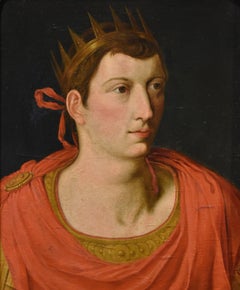
Portrait Augustus Emperor Flemish school 17/18th Century Paint Oil on canvas Art
Located in Riva del Garda, IT
Flemish painter of the 17th/18th century
Portrait of Augustus, first Roman emperor
Oil on canvas 61 x 49 cm Framed 77.5 x 65 cm
The portrait depicts Augustus, founder and fi...
Category
17th Century Old Masters Portrait Paintings
Materials
Oil
$5,415 Sale Price
20% Off
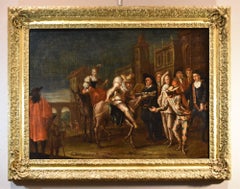
Carnival IVenice Harlequin Landscape Marcola paint 18th Century Oil on canvas
Located in Riva del Garda, IT
Marco Marcola (Verona, 1711 - 1780)
Carnival scene with masks from the commedia dell'arte with Harlequin
Oil on canvas, 60 x 82 cm In frame 77 x 100 cm
The canvas reflects ty...
Category
18th Century Old Masters Landscape Paintings
Materials
Oil
$8,000 Sale Price
20% Off
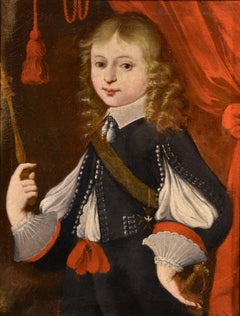
Portrait Louis XIV Child King 17/18th Century Paint Oil on canvas French school
Located in Riva del Garda, IT
Portrait of Louis XIV as a child (Saint-Germain-en-Laye, 1638 – Versailles, 1715)
French painter active between the 17th and 18th centuries
Oil on canvas 64 x 49 cm. In frame 79...
Category
17th Century Old Masters Figurative Paintings
Materials
Oil
$6,030 Sale Price
20% Off
Still Thinking About These?
All Recently ViewedMore Ways To Browse
Oil Paintings 17 Century
Adoration Magi
Adoration Of The Magi
Old Religious Painting
Old Masters Religious Paintings
Giuseppe Chiari
David Bathsheba
Reni Aurora
Miniature Framed
Spanish Impressionist Painting
19th Century Painting Of Castle
Oil Painting Snow And Mountains
Provence Oil Painting
Used Church Windows
Vintage Painting Of European Cities
19th Century Oil Painting Of Women
Ile De France
Large Flowers Art