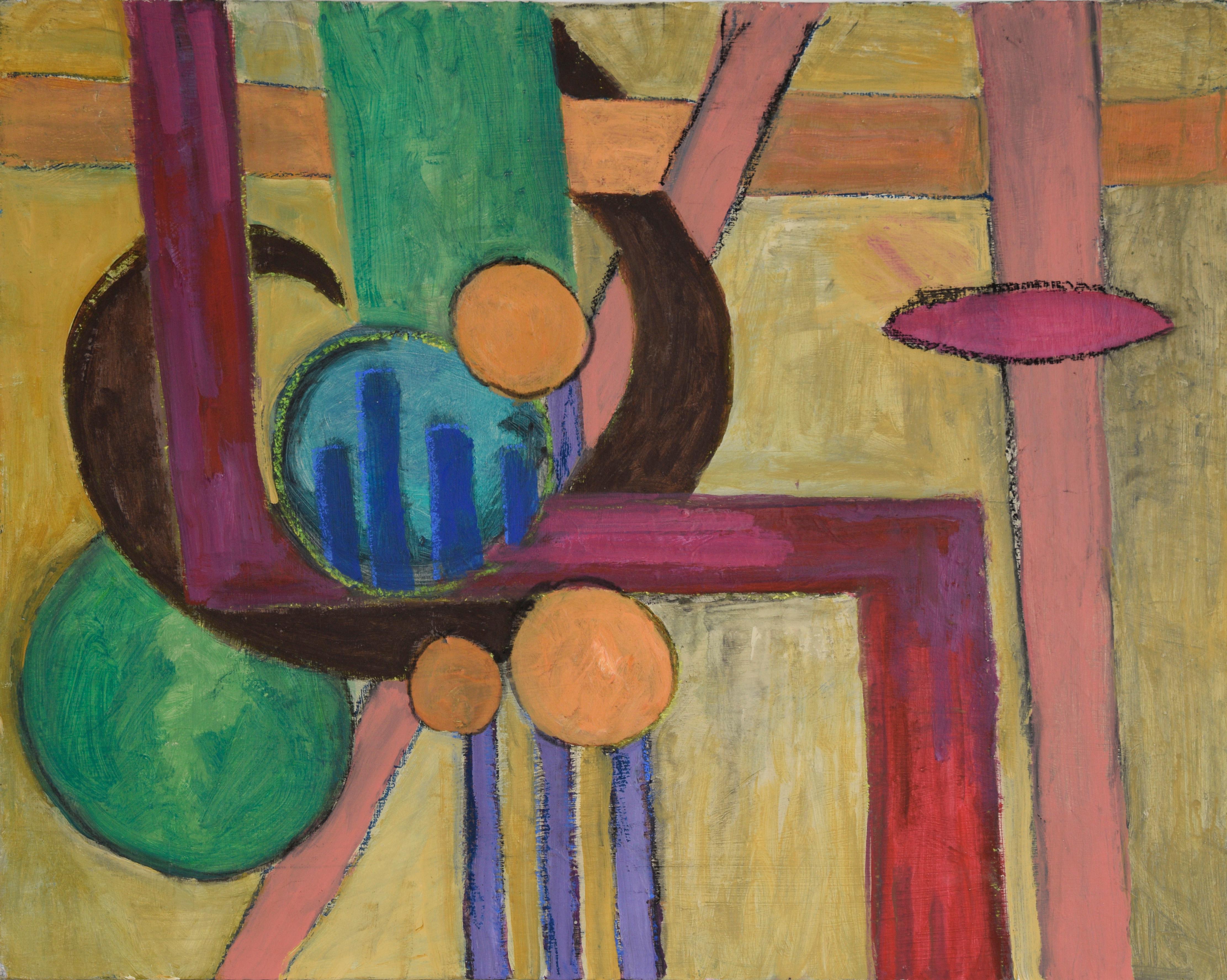
Items Similar to Arc in Register, 1970 - Oil, Bold Abstract Painting
Want more images or videos?
Request additional images or videos from the seller
1 of 3
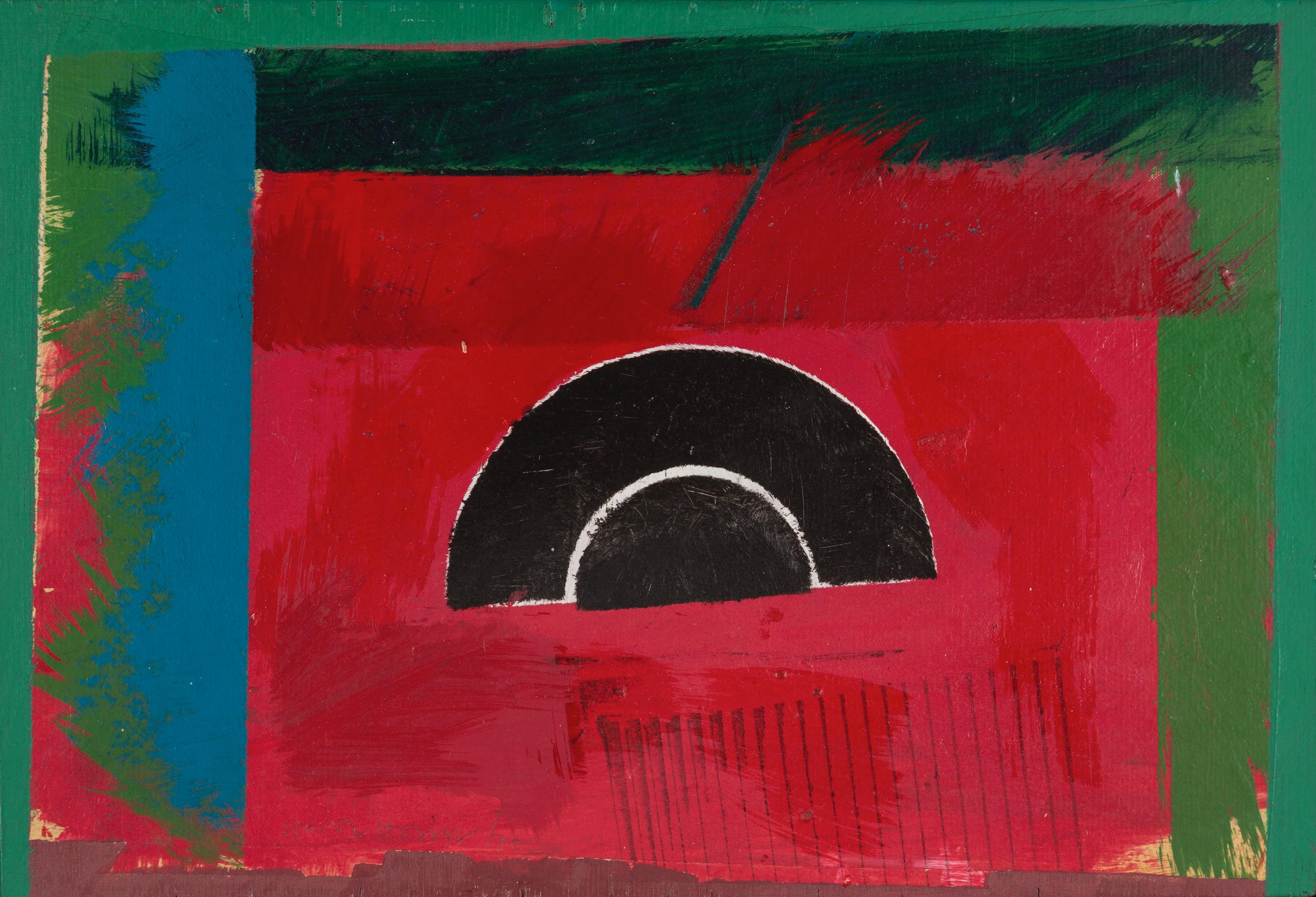
Gordon HouseArc in Register, 1970 - Oil, Bold Abstract Painting1970
1970
$7,502.26
£5,500
€6,388.43
CA$10,336.23
A$11,273.12
CHF 5,971.74
MX$135,148.65
NOK 76,053.38
SEK 69,545.17
DKK 47,727.86
About the Item
Gordon House was born in 1932 in Pontardawe, South Wales. Early exposure to art on trips to the Glynn Vivian Art Gallery as a young boy inspired House towards creative endeavors and at the age of fourteen he was awarded a grant to enter art school which he accepted. From 1947 to 1950 he studied at Luton School of Art, Bedfordshire, and St. Albans School of Art, Hertfordshire. House's contemporaries included Richard Smith and John Plumb with whom he remained close. During the early fifties, after finishing art school, House began work as assistant to the ecclesiastical sculptor Theodore Kern. He also spent time at an advertising studio where he honed his burgeoning skills in typography and graphic design. In 1952 House was offered the position of designer for Imperial Chemical Industries Plastics Division where he stayed until 1959. This was followed by two years spent as graphic designer for the Kynoch Press in London. In 1961 House set out on his own as a self-employed designer and typographer. Initially this was supplemented by part-time teaching at art schools in and around London but by 1964 House was able to devote himself entirely to his design work which freed up valuable time to concentrate on his own artistic output in the studio.
In the late fifties, informed by the new art emerging from America and that of his contemporaries in England, House began to create large-scale abstract works which he was invited to show in 1959 at Dennis Bowen's legendary New Vision Centre in Marble Arch.
House was an active participant in the vibrant London art scene of the sixties, regularly attending lectures, exhibitions and discussions. In 1960 he exhibited in 'Situation' the key abstract exhibition of the decade held at the RBA Galleries. Other participating artists included Robyn Denny, Bernard and Harold Cohen, Gillian Ayres, John Hoyland, Richard Smith and William Turnbull among others. These artists, united by a common admiration for American Abstract Expressionism, were frustrated by the lack of exposure given to large-scale abstract works in commercial galleries so they organised their own exhibition. The name was derived from the participants' idea that an abstract painting that occupied the whole field of vision would involve the spectator in an 'event' or 'situation'. This exhibition was followed by 'New London Situation' in 1961 and a nationwide touring Arts Council presentation in recognition of the significance of the two earlier shows.
In 1961 House began producing his first prints at the Kelpra Studio, run by Chris and Rose Prater, where he made the earliest fine art screenprint ever to be produced in Britain. Artists such as Paolozzi and Hamilton followed in his footsteps and together they started a printmaking revolution in Britain. They cemented the medium of the screenprint in the world of fine art as opposed to the commercial sphere and secured the reputation of Kelpra in the process. Later, together with Cliff White, House set up the White Ink (Ltd.) print studio in London, where he produced etchings and wood engravings on a series of magnificent antique printing presses he had collected. White Ink soon gained a reputation for innovative and high quality printmaking, attracting artists such as R. B. Kitaj, Richard Smith, Joe Tilson, Sidney Nolan, Victor Pasmore, Eduardo Paolozzi, Bernard Cohen and Elizabeth Frink.
Printmaking was to remain a key part of House's oeuvre throughout the rest of his career, whether in the medium of screenprint, etching, woodcut, linocut or lithograph. In 1981 a retrospective exhibition of his graphic works opened at the Carnegie Institute, Pittsburgh, and in 1982 this travelled to the Brooklyn Museum, New York. These shows were instrumental in bringing House's prints to the attention of a wider American audience.
- Creator:Gordon House (1932, British)
- Creation Year:1970
- Dimensions:Height: 7.52 in (19.1 cm)Width: 10.75 in (27.3 cm)
- Medium:
- Period:
- Condition:
- Gallery Location:Kingsclere, GB
- Reference Number:1stDibs: LU2718215411052
Gordon House
The Guardian wrote of Gordon House, upon his death in 2004: Many of the works made during his last years by the painter and graphic designer Gordon House, who has died aged 71, referred back to his birthplace in the Swansea valley. He spent his earliest years in the steel town of Pontardawe. In Tin-pan Valley, the memoir he published earlier this year, he recalled "the clamour of steel mills ... the tinplate works and pithead gear" and "dynamite blasting as coal seams were struck higher up the valley". Unemployment and the depression of the 1930s led Gordon's parents to take him from the valleys of south Wales to the order and designed coherence of Letchworth, "Hertfordshire's first garden city". After leaving school at 14, he went to study, first, at Luton School of Art. For a while after that, he worked in a hospital, before, with the aid of a scholarship, moving on to St Albans School of Art. By 1961, Gordon had become established among a new generation of artists as an independently minded and adventurous painter and designer. The previous year, he had shown his large, bold, hard-edged canvasses at the important London "Situation" exhibition of large-scale abstract painting, and had designed the catalogue for that exhibition. As the 1960s moved on, Gordon designed for the pop world. He worked for the Beatles, designing their White album and the back of the Sergeant Pepper album, for which his longtime friend Peter Blake designed the front. Later, he designed Wings' first album. He delighted in the creative energy of others, and so could respond to the talents of musicians and artists alike. Gordon made paintings throughout his life as a designer. During the 1960s and 70s, his canvasses and prints reflected the dramatic tensions of his graphic design; by the 1980s, Wales had become his constant subject matter. The surface, texture and colour of his paintings softened. No doubt, he needed to pay homage to the places and the people who had shaped him, just as he always paid homage to the artists for whom he designed. His canvasses reduced in size, becoming palm-of-the-hand landscapes. He spent much time in Wales and, in his final years, he used his brush to walk a path through memories of collieries, valleys, smoking stacks, rows of cottages and the people who had first nurtured him.
About the Seller
No Reviews Yet
Vetted Professional Seller
Every seller passes strict standards for authenticity and reliability
Established in 2010
1stDibs seller since 2024
44 sales on 1stDibs
Typical response time: 7 hours
- ShippingRetrieving quote...Shipping from: Kingsclere, United Kingdom
- Return Policy
More From This Seller
View AllInner and Outer Arc, 1970 - Geometric Abstract Painting
By Gordon House
Located in Kingsclere, GB
Gordon House was born in 1932 in Pontardawe, South Wales. Early exposure to art on trips to the Glynn Vivian Art Gallery as a young boy inspired House towards creative endeavors and ...
Category
1970s Abstract Paintings
Materials
Oil, Board
Bajazet Encag
d, Oil on Canvas Painting by Jack Knox, circa 1965
Located in Kingsclere, GB
Bajazet Encag'd, Oil on Canvas Painting by Jack Knox 1936-2015, circa 1965
Additional information:
Medium: Oil on canvas
122 x 153 cm
48 1/8 x 60 1/4 in
Signed; with title and Artist's address verso
Provenance
Acquired from the below by a private collector
Exhibitions
Royal Scottish Academy, 1965, cat. no.219
Jack Knox was a Scottish painter and teacher.
Born in Kirkintilloch, East Dunbartonshire in 1936, Knox studied at Glasgow School of Art 1953-57, with teachers such William Armour and David Donaldson, before spending a year at the Paris atelier of the French painter André L'hote. Combining what he took from this experience with the impact of seeing the first show of American Abstract Expressionists in Europe in 1959, he began a diverse career which saw constantly changing styles, from gestural abstraction to still lifes and portraits.
In 1965 he was appointed lecturer at Duncan of Jordanstone College of Art where he worked alongside fellow artists such as Alberto Morrocco...
Category
20th Century Abstract Paintings
Materials
Canvas

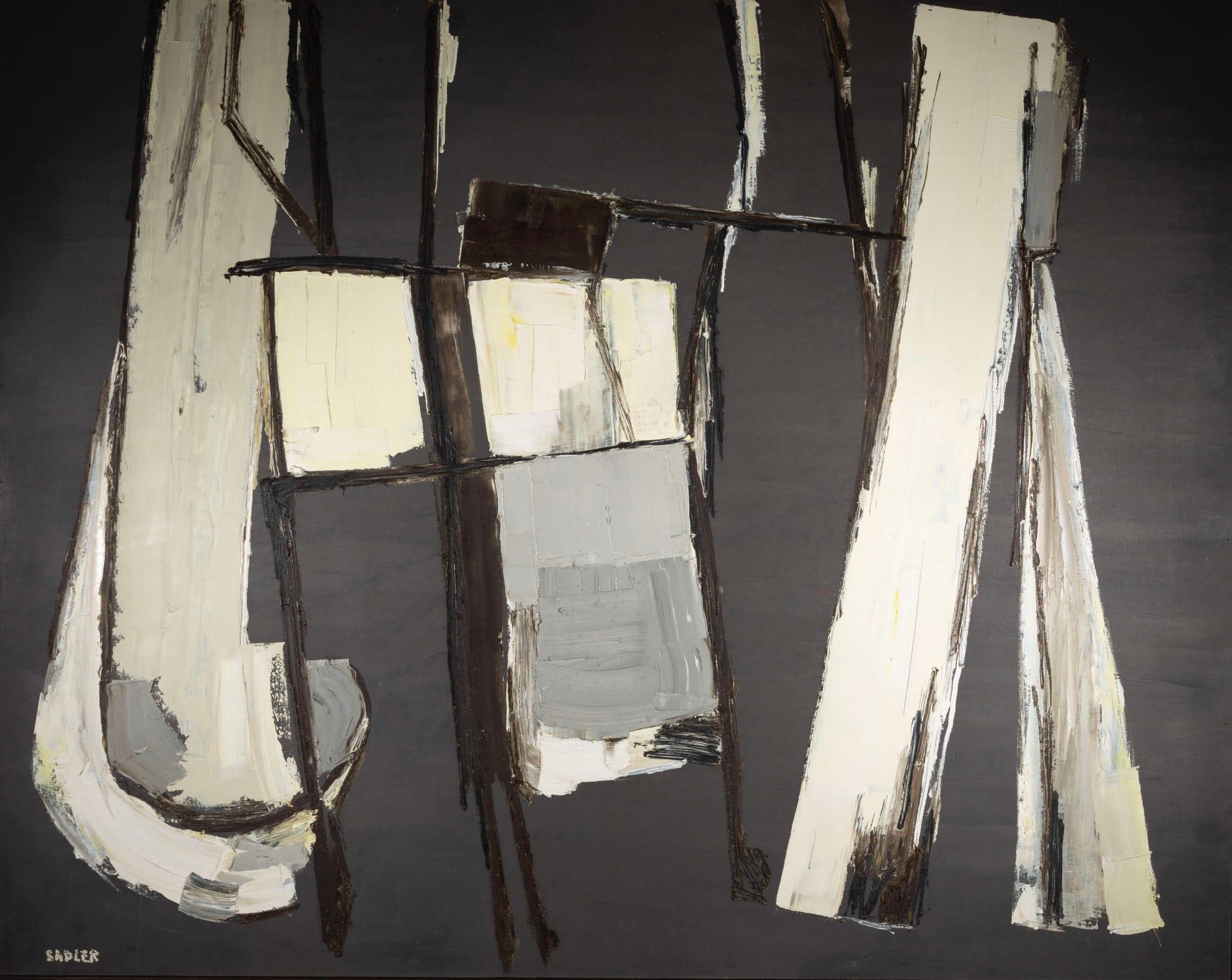
Painting, November, Oil on Board Painting by Robert Sadler, 1957
By Robert Sadler
Located in Kingsclere, GB
Painting, November, Oil on Board Painting by Robert Sadler, 1957
Additional information:
Medium: Oil on board
48 x 61 in
121.9 x 154.9 cm
Signed; titled on support bars
(William) Robert Sadler produced abstract works in varying sizes with a spare poise and strong use of colour.
The son of a noted racehorse trainer, Sadler was born at Falmouth House (now demolished) at the northern edge of Newmarket, Suffolk. By the age of fourteen he was drawing and painting aeroplanes, horses, houses and landscapes. After studying at Eastbourne College and Sidney Sussex College, Cambridge, where he read Mechanical Engineering, in 1930 he joined the Royal Air Force as a pilot.
In 1942, whilst posted to the Air Ministry as Director of Plans, he attended art school in London and spent the following year in Turkey on special duties where he lectured at the Turkish Air Staff College and painted and rode race horses. At the end of the war he returned to the UK and took up the post of Station Commander at RAF Binbrook in Lincolnshire. In 1947 he moved to Denmark as Air Attache to the British Embassy in Copenhagen where he attended art school and two years later, whilst Vice-President of the RAF Officers' Selection Board, set-up a studio in Stockbridge whilst attending art school in Winchester.
In 1953 he moved to the USA to take up the post as representative on the NATO Joint Chiefs of Staff Intelligence Committee during which period he attended the Corcoran School of Art in Washington DC where he first encountered the work of the American Abstract Expressionists. Returning to the UK in 1955 he moved back to Newmarket, having retired from the RAF 'to devote the rest of my life to painting.' He attended Heatherley's School of Fine Art in London, Cambridge Technical College and became a member of the Winchester Art Society and the Cambridge Society of Painters & Sculptors.
His first one-man show was at Swaffham Prior, Cambridge and from then until 1963 he lived and painted in a largely abstract expressionist style influenced by the Ecole de Paris Tachisme of Poliakoff and de Stael and by the contemporary British work of Peter Lanyon, William Scott, Bryan Wynter...
Category
20th Century Abstract Paintings
Materials
Board
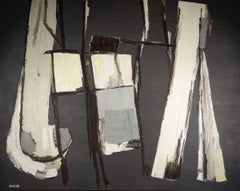
Untitled, Oil and Pencil Painting by Adrian Heath, 1968
By Adrian Heath
Located in Kingsclere, GB
Untitled, Oil and Pencil Painting by Adrian Heath 1920-1992, 1968
Additional information:
Medium: Oil and pencil
56 x 76.5 cm
22 x 30 1/8 in
Signed with initials and dated
Category
20th Century Abstract Paintings
Materials
Pencil
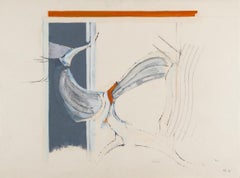
Red Forms with Small Green Segment - Bold 1960s Abstract Oil Painting, Sixties
By Gordon House
Located in Kingsclere, GB
Gordon House was born in 1932 in Pontardawe, South Wales. Early exposure to art on trips to the Glynn Vivian Art Gallery as a young boy inspired House towards creative endeavors and at the age of fourteen he was awarded a grant to enter art school which he accepted. From 1947 to 1950 he studied at Luton School of Art, Bedfordshire, and St. Albans School of Art, Hertfordshire. House's contemporaries included Richard Smith and John Plumb with whom he remained close. During the early fifties, after finishing art school, House began work as assistant to the ecclesiastical sculptor Theodore Kern. He also spent time at an advertising studio where he honed his burgeoning skills in typography and graphic design. In 1952 House was offered the position of designer for Imperial Chemical Industries Plastics Division where he stayed until 1959. This was followed by two years spent as graphic designer for the Kynoch Press in London. In 1961 House set out on his own as a self-employed designer and typographer. Initially this was supplemented by part-time teaching at art schools in and around London but by 1964 House was able to devote himself entirely to his design work which freed up valuable time to concentrate on his own artistic output in the studio.
In the late fifties, informed by the new art emerging from America and that of his contemporaries in England, House began to create large-scale abstract works which he was invited to show in 1959 at Dennis Bowen's legendary New Vision Centre in Marble Arch.
House was an active participant in the vibrant London art scene of the sixties, regularly attending lectures, exhibitions and discussions. In 1960 he exhibited in 'Situation' the key abstract exhibition of the decade held at the RBA Galleries. Other participating artists included Robyn Denny, Bernard and Harold Cohen, Gillian Ayres, John Hoyland, Richard Smith and William Turnbull among others. These artists, united by a common admiration for American Abstract Expressionism, were frustrated by the lack of exposure given to large-scale abstract works in commercial galleries so they organised their own exhibition. The name was derived from the participants' idea that an abstract painting that occupied the whole field of vision would involve the spectator in an 'event' or 'situation'. This exhibition was followed by 'New London Situation' in 1961 and a nationwide touring Arts Council presentation in recognition of the significance of the two earlier shows.
In 1961 House began producing his first prints at the Kelpra Studio, run by Chris and Rose Prater, where he made the earliest fine art screenprint ever to be produced in Britain. Artists such as Paolozzi and Hamilton followed in his footsteps and together they started a printmaking revolution in Britain. They cemented the medium of the screenprint in the world of fine art as opposed to the commercial sphere and secured the reputation of Kelpra in the process. Later, together with Cliff White, House set up the White Ink (Ltd.) print studio in London, where he produced etchings and wood engravings on a series of magnificent antique printing presses...
Category
20th Century Abstract Paintings
Materials
Oil, Board
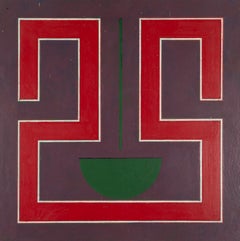
Untitled Abstract, Oil on Board Painting by John Plumb, 1956/57
By John Plumb
Located in Kingsclere, GB
Untitled Abstract, Oil on Board Painting by John Plumb, 1956/57
Additional information:
Medium: Oil on board
81.3 x 121.9 cm
32 x 48 in
Category
20th Century Landscape Paintings
Materials
Board
You May Also Like
Painting 1960
By George Dannatt
Located in Bournemouth, Dorset
George Dannatt (1915-2009)
Painting 1960
1960
Gouache on paper
Image: 25.4 x 28.9 cm
Frame: 48.0 x 50.3 cm
Provenance: The George and Ann Dannatt Estate, The George Dannatt Trust...
Category
1960s Abstract Abstract Paintings
Materials
Gouache
John Harvey McCracken Minimalist Abstract Oil on Canvas, 1973
By John McCracken
Located in Phoenix, AZ
Bright, exciting painting by well known New York/New Mexico/California artist John McCracken.
Framed simply and in excellent condition. Signed on the verso and dated 1973.
Painting m...
Category
Late 20th Century Abstract Paintings
Materials
Paint
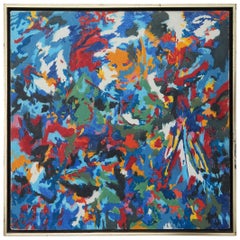
Colorful Geometric Abstract - 1969 Original Oil On Canvas
Located in Soquel, CA
Colorful Geometric Abstract - 1969 Original Oil On Canvas
Rich 1969 abstract oil painting by Bay Area artist Helen Konkoff (American, 1912-1988). Geometric shapes consisting of hues...
Category
1960s Contemporary Abstract Paintings
Materials
Canvas, Oil
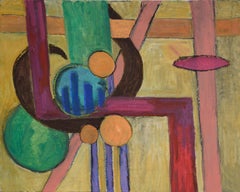
After Friedel Dzubas "Arch" 1962 Abstract Acrylic Painting on Canvas
Located in Dallas, TX
An anonymous contemporary copy of the famous Dzubas painted titled Arch. The original was executed in 1962 and this example was made in the 80s.
Friedel Dzubas was a German-born Amer...
Category
Mid-20th Century Abstract Paintings
Materials
Canvas, Acrylic
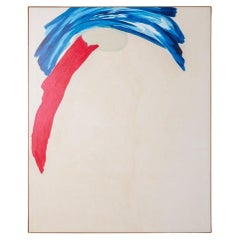
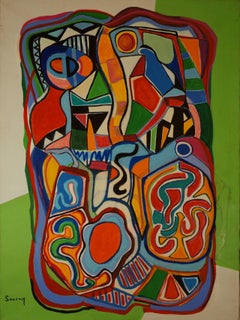
Abstract Composition SII, 1960-65 - oil paint, 130x98 cm
By Gérard Souzay
Located in Nice, FR
Oil on canvas, signed lower left.
Gérard Souzay (né Gérard Marcel Tisserand le 8 décembre 1918 à Angers, Maine-et-Loire, et mort le 17 août 2004 à Antib...
Category
Mid-20th Century Abstract Abstract Paintings
Materials
Oil
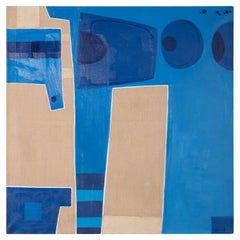
Painting by Janet Lippincott, 1975, Acrylic on Linen
Located in Dallas, TX
“My art is all I can give to the world, it is all I have to offer.” Abstract painting by Janet Lippincott, 1975, acrylic on linen.
Born in New York in 1918, Lippincott had attended t...
Category
1970s Abstract Paintings
Materials
Linen, Acrylic
More Ways To Browse
Gordon Oil Painting
R B Kitaj
John Smith Vintage
Gillian Ayres
Vintage House Keys
Cliff House
Sidney Nolan
Large British Landscape Oil Paintings
Dutch Still Life
Old Masters Landscape
Reclining Nude
Vintage Oil Still Life Flowers
Impressionist Boat Oil
Early 20th Century Realism Paintings
Oil Still Life Florals
American Scene Paintings
Waves Crashing
Art By Indian Artists