Want more images or videos?
Request additional images or videos from the seller
1 of 11
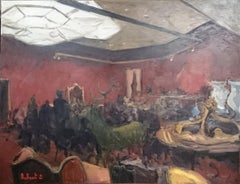
Gonzalez BRAVOGadix2014
2014
Price:$21,840
About the Item
- Creator:Gonzalez BRAVO (1944, Spanish)
- Creation Year:2014
- Dimensions:Height: 64 in (162.56 cm)Width: 58 in (147.32 cm)Depth: 1.5 in (3.81 cm)
- Medium:
- Movement Style:
- Period:
- Condition:
- Gallery Location:Atlanta, GA
- Reference Number:1stDibs: LU155528305582
About the Seller
5.0
Vetted Professional Seller
Every seller passes strict standards for authenticity and reliability
Established in 2008
1stDibs seller since 2021
20 sales on 1stDibs
Authenticity Guarantee
In the unlikely event there’s an issue with an item’s authenticity, contact us within 1 year for a full refund. DetailsMoney-Back Guarantee
If your item is not as described, is damaged in transit, or does not arrive, contact us within 7 days for a full refund. Details24-Hour Cancellation
You have a 24-hour grace period in which to reconsider your purchase, with no questions asked.Vetted Professional Sellers
Our world-class sellers must adhere to strict standards for service and quality, maintaining the integrity of our listings.Price-Match Guarantee
If you find that a seller listed the same item for a lower price elsewhere, we’ll match it.Trusted Global Delivery
Our best-in-class carrier network provides specialized shipping options worldwide, including custom delivery.You May Also Like
Boxes, Still Life
By Eugene Pizzuto
Located in San Francisco, CA
This artwork titled "Boxes, Still Life" 1963-64 is an oil painting on canvas by noted Seattle artist Eugene Pizzuto, 1925-2004 It is inscribed "Eugene ...
Category
Mid-20th Century Abstract Expressionist Still-life Paintings
Materials
Oil
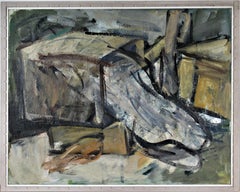
Transformed box #2
By Eugene Pizzuto
Located in San Francisco, CA
This artwork titled "Transformed Box #2" 1963-64 is an oil painting on canvas by noted Seattle artist Eugene Pizzuto, 1925-2004 It is inscribed "Eugene...
Category
Mid-20th Century Abstract Expressionist Still-life Paintings
Materials
Oil
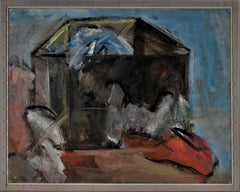
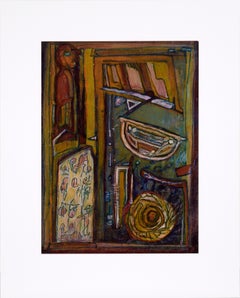
Psychedelic Abstract Interior in Oil on Paper
Located in Soquel, CA
Psychedelic Abstract Interior in Oil on Paper
Moody abstract by Jennie T. Rafton (American, b. 1925). There is a figure in the upper left corner of this piece, looking out over the scene. There appear to be architectural elements such as windows, doors, and stairs, but the composition is highly abstracted, bordering on psychedelic. Of particular note are the symbols inscribed into the yellow shape in the lower left corner.
Inscribed in the lower right corner and acquired with a collection of the artist's work.
Presented in a new white mat.
Mat size: 20"H x 16"W
Jennie T. Rafton (American, b. 1925) is a well-known California artist, primarily for her abstract compositions. She and her husband Michael were ardent supporters of the arts, especially the Oakland Symphony Guild.
Exh: 1982 - Magnin Gallery (solo), Walnut Creek...
Category
Late 20th Century Abstract Expressionist Abstract Paintings
Materials
Oil, Paper
$650
H 20 in W 16 in D 0.25 in
Important and Large Antique American Abstract Expressionist Framed Oil Painting
Located in Buffalo, NY
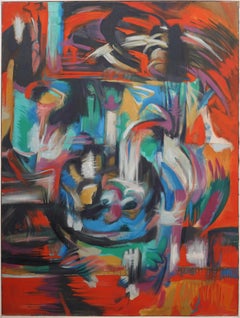
Nicely painted mid century abstract oil painting by Ken Munowitz. Oil on canvas. Framed.
Category
1950s Abstract Expressionist Abstract Paintings
Materials
Canvas, Oil
$6,000 Sale Price
20% Off
H 48 in W 36 in D 2 in
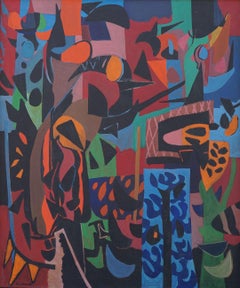
Magic Garden, vibrant mid-century abstract expressionist colorful geometric work
By Richard Andres
Located in Beachwood, OH
Richard Andres (American, 1927-2013)
Magic Garden, c. 1962
oil on canvas
signed lower left, signed and titled verso
50 x 42 inches
Richard Andres was born in Buffalo, New York in 19...
Category
1960s Abstract Expressionist Abstract Paintings
Materials
Oil
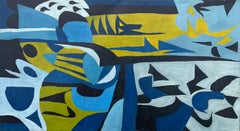
Abstract expressionist blue, black
green mid-century geometric painting
By Richard Andres
Located in Beachwood, OH
Richard Andres (American, 1927-2013)
Untitled, c. 1949
oil on canvas
18 x 32 inches
Richard Andres was born in Buffalo, New York in 1927. A graduate of the Cleveland Institute of Art in 1950, he was immediately drafted and served for two years in the army as a mural painter. He received his Master of Arts from Kent State in 1961. A frequent exhibitor at galleries and museums and winner of multiple May Show prizes, Andres taught art in the Cleveland Public Schools for 28 years, as well as teaching the University of Buffalo, the Cleveland Institute of Art and the Western Reserve University.
Very little in Richard Andres’ childhood would have predicted his love of classical music, mid-century-modern architecture and certainly not his lifelong passion for art and in particular abstract art. Richard’s father, Raymond, had no more than a third-grade education, and his mother, Clara, was one of thirteen children – only three of whom lived into adulthood and none of whom attended high school.
They lived, when Richard was a boy, in a dingy area of Buffalo, NY in a walk-up apartment situated above a tavern. Raymond and Clara supplemented the income from their factory jobs in the bar downstairs with Raymond playing ragtime on the piano and Clara serving drinks. This often left Richard and his two older brothers at home alone to fend for themselves. The two older boys, Raymond and Russell, were - unlike Richard- rather rough and tumble and entertained themselves with stickball, boxing and the like. Richard, on the other hand, from a very young age liked to draw, or better yet even, to paint with the small set of watercolors he received for Christmas one year. Paper, however, at the height of the depression, was hard to come by. Luckily, Clara used paper doilies as decoration for the apartment and Richard would contentedly paint and then cut up doilies, gluing the pieces together to create collages.
At eight-years-old, he discovered the Albright-Knox Museum (then known as the Albright Art Gallery) and spent several hours a week there studying the paintings. He was particularly fond of Charles Burchfield‘s landscapes, enamored with their ‘messiness’ and thinking that they somehow captured more ‘feeling’ than works he was previously familiar with. For his tenth Christmas, he asked for and received a ‘how-to’ paint book by Elliot O’Hare. Through this self-teaching, he assembled the portfolio needed for acceptance to Buffalo Technical High School where he studied Advertising Arts. In his Junior year, he was encouraged to enter a watercolor painting, “Two Barns,” in the national 1944-45 Ingersoll Art Award Contest and was one of twelve grand prize winners – each one winning one hundred dollars. More importantly the painting was exhibited at the Carnegie Institute Galleries, which resulted in his winning a national scholarship to the Cleveland School of Art (The Cleveland Art Institute).
He flourished at the art school under the tutelage of faculty members such as Carl Gaertner, as well as that of visiting artists such as William Sommer and Henry George Keller. He would say in later years that Gaertner, in particular, influenced his attitude toward life as well as art. “Gaertner,” Andres said, “believed that there was no need to be a ‘tortured artist’, that an artist should rather enjoy beauty, family, and life in general.” Free to spend his days as he chose, he wandered the Cleveland Art Museum for most of the hours he was not attending classes or painting; the remaining time was spent drinking coffee at a local hangout with art school friends – which is where he met fellow Henry Keller scholarship winner, Avis Johnson. Richard was immediately smitten with Avis, but being rather shy, it took him the entire summer of 1948 to build up his courage to ask her out. Over that summer he ‘thought about Avis’ and worked in a diner to save money. He also used the hundred-dollar prize money won in High School to visit the first Max Beckmann retrospective in the United States at the City Art Museum in St. Louis. Over a half century later he spoke of that exhibit with a reverence usually reserved for spiritual matters, “I walked in and it was like nothing I had ever seen before... the color...It just glowed.”
Returning to campus in the Fall, the first thing he did was go to the coffee shop in hopes of finding Avis. He did, and she, upon seeing him, realized that she was also smitten with him. They quickly became known as ‘the couple’ on campus, and a year later, with Richard being drafted for the Korean war, they were quickly married by a Justice of the Peace, celebrating after with family at Avis’s Cleveland home. As a gift, faculty member John Paul Miller designed and made the simple gold wedding ring Avis wore for their 65 years of marriage. During those 65 years neither wavered in their mutual love, nor in the respect they shared for one another’s art.
The couple lived in a converted chicken coop in Missouri while Richard was in boot camp. At the camp, he would volunteer for any job offered and one of those jobs ended up being painting road signs. His commander noticed how quickly and neatly he worked and gave him more painting work to do - eventually recommending him for a position painting murals for Army offices in Panama. Until her dying day, Avis remained angry that “The army got to keep those fabulous murals and they probably didn’t even know how wonderful they were.” In Panama, their first son, Mark, was born. After Richard’s discharge in 1953, they moved back to the Cleveland area and used the GI bill to attend Kent State gaining his BA in education. The small family then moved briefly to Buffalo, where Richard taught at the Albright Art School and the University of Buffalo – and their second son, Peter, was born. Richard had exhibited work in the Cleveland May Show and the Butler Art Museum during his art school years, and during the years in Buffalo, his work was exhibited at the gallery he had so loved as a child, the Albright Art Gallery.
In 1956, the family moved back to the Cleveland area and Richard began teaching art at Lincoln West High School during the day while working toward his MA in art at Kent State in the evenings. Avis and Richard, with the help of an architect, designed their first home - a saltbox style house in Hudson, Ohio, and in 1958, their third son, Max (after Max Beckmann) was born. Richard enjoyed the consistency of teaching high school as well as the time it gave him to paint on the weekends and during the summer months. In 1961, he received his MA and his daughter, Claire, was born. With a fourth child, the house was much too small, and Avis and Richard began designing their second home. An admirer of MCM architecture, Richard’s favorite example of the style was the Farnsworth house – he often spoke of how the concepts behind this architectural style, particularly that of Mies van der Rohe, influenced his painting.
Andres described himself as a 1950’s...
Category
1940s Abstract Expressionist Abstract Paintings
Materials
Oil
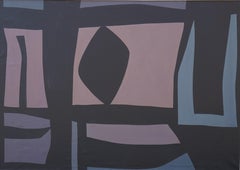
Blue Wall, mid-century abstract expressionist, geometric blue, black
pink work
By Richard Andres
Located in Beachwood, OH
Richard Andres (American, 1927-2013)
Blue Wall, c. 1959
oil on canvas
signed and titled verso
42 x 60 inches
Richard Andres was born in Buffalo, New York in 1927. A graduate of the Cleveland Institute of Art in 1950, he was immediately drafted and served for two years in the army as a mural painter. He received his Master of Arts from Kent State in 1961. A frequent exhibitor at galleries and museums and winner of multiple May Show prizes, Andres taught art in the Cleveland Public Schools for 28 years, as well as teaching the University of Buffalo, the Cleveland Institute of Art and the Western Reserve University.
Very little in Richard Andres’ childhood would have predicted his love of classical music, mid-century-modern architecture and certainly not his lifelong passion for art and in particular abstract art. Richard’s father, Raymond, had no more than a third-grade education, and his mother, Clara, was one of thirteen children – only three of whom lived into adulthood and none of whom attended high school.
They lived, when Richard was a boy, in a dingy area of Buffalo, NY in a walk-up apartment situated above a tavern. Raymond and Clara supplemented the income from their factory jobs in the bar downstairs with Raymond playing ragtime on the piano and Clara serving drinks. This often left Richard and his two older brothers at home alone to fend for themselves. The two older boys, Raymond and Russell, were - unlike Richard- rather rough and tumble and entertained themselves with stickball, boxing and the like. Richard, on the other hand, from a very young age liked to draw, or better yet even, to paint with the small set of watercolors he received for Christmas one year. Paper, however, at the height of the depression, was hard to come by. Luckily, Clara used paper doilies as decoration for the apartment and Richard would contentedly paint and then cut up doilies, gluing the pieces together to create collages.
At eight-years-old, he discovered the Albright-Knox Museum (then known as the Albright Art Gallery) and spent several hours a week there studying the paintings. He was particularly fond of Charles Burchfield‘s landscapes, enamored with their ‘messiness’ and thinking that they somehow captured more ‘feeling’ than works he was previously familiar with. For his tenth Christmas, he asked for and received a ‘how-to’ paint book by Elliot O’Hare. Through this self-teaching, he assembled the portfolio needed for acceptance to Buffalo Technical High School where he studied Advertising Arts. In his Junior year, he was encouraged to enter a watercolor painting, “Two Barns,” in the national 1944-45 Ingersoll Art Award Contest and was one of twelve grand prize winners – each one winning one hundred dollars. More importantly the painting was exhibited at the Carnegie Institute Galleries, which resulted in his winning a national scholarship to the Cleveland School of Art (The Cleveland Art Institute).
He flourished at the art school under the tutelage of faculty members such as Carl Gaertner, as well as that of visiting artists such as William Sommer and Henry George Keller. He would say in later years that Gaertner, in particular, influenced his attitude toward life as well as art. “Gaertner,” Andres said, “believed that there was no need to be a ‘tortured artist’, that an artist should rather enjoy beauty, family, and life in general.” Free to spend his days as he chose, he wandered the Cleveland Art Museum for most of the hours he was not attending classes or painting; the remaining time was spent drinking coffee at a local hangout with art school friends – which is where he met fellow Henry Keller scholarship winner, Avis Johnson. Richard was immediately smitten with Avis, but being rather shy, it took him the entire summer of 1948 to build up his courage to ask her out. Over that summer he ‘thought about Avis’ and worked in a diner to save money. He also used the hundred-dollar prize money won in High School to visit the first Max Beckmann retrospective in the United States at the City Art Museum in St. Louis. Over a half century later he spoke of that exhibit with a reverence usually reserved for spiritual matters, “I walked in and it was like nothing I had ever seen before... the color...It just glowed.”
Returning to campus in the Fall, the first thing he did was go to the coffee shop in hopes of finding Avis. He did, and she, upon seeing him, realized that she was also smitten with him. They quickly became known as ‘the couple’ on campus, and a year later, with Richard being drafted for the Korean war, they were quickly married by a Justice of the Peace, celebrating after with family at Avis’s Cleveland home. As a gift, faculty member John Paul Miller designed and made the simple gold wedding ring Avis wore for their 65 years of marriage. During those 65 years neither wavered in their mutual love, nor in the respect they shared for one another’s art.
The couple lived in a converted chicken coop in Missouri while Richard was in boot camp. At the camp, he would volunteer for any job offered and one of those jobs ended up being painting road signs. His commander noticed how quickly and neatly he worked and gave him more painting work to do - eventually recommending him for a position painting murals for Army offices in Panama. Until her dying day, Avis remained angry that “The army got to keep those fabulous murals and they probably didn’t even know how wonderful they were.” In Panama, their first son, Mark, was born. After Richard’s discharge in 1953, they moved back to the Cleveland area and used the GI bill to attend Kent State gaining his BA in education. The small family then moved briefly to Buffalo, where Richard taught at the Albright Art School and the University of Buffalo – and their second son, Peter, was born. Richard had exhibited work in the Cleveland May Show and the Butler Art Museum during his art school years, and during the years in Buffalo, his work was exhibited at the gallery he had so loved as a child, the Albright Art Gallery.
In 1956, the family moved back to the Cleveland area and Richard began teaching art at Lincoln West High School during the day while working toward his MA in art at Kent State in the evenings. Avis and Richard, with the help of an architect, designed their first home - a saltbox style house in Hudson, Ohio, and in 1958, their third son, Max (after Max Beckmann) was born. Richard enjoyed the consistency of teaching high school as well as the time it gave him to paint on the weekends and during the summer months. In 1961, he received his MA and his daughter, Claire, was born. With a fourth child, the house was much too small, and Avis and Richard began designing their second home. An admirer of MCM architecture, Richard’s favorite example of the style was the Farnsworth house – he often spoke of how the concepts behind this architectural style, particularly that of Mies van der Rohe, influenced his painting.
Andres described himself as a 1950’s...
Category
1950s Abstract Expressionist Abstract Paintings
Materials
Oil
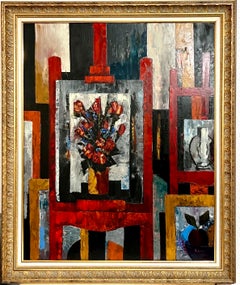
Large Modernist Colorful Atelier French Expressionist Oil Painting Tony Agostini
By Tony Agostini
Located in Surfside, FL
Tony Agostini (French, 1916 - 1990)
Large oil painting on canvas depicting a still life scene with flowers on a canvas and easel titled "L'Atelier".
Hand signed to lower right and ...
Category
1960s Abstract Expressionist Interior Paintings
Materials
Canvas, Oil
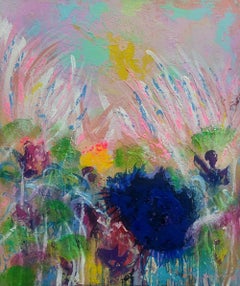
The Silent Awakening
Located in Zofingen, AG
This artwork is a vivid explosion of color and movement, capturing a sense of vibrant energy and celebration. Dominating the scene are dynamic brushstrokes in shades of pink, blue, a...
Category
2010s Abstract Expressionist Abstract Paintings
Materials
Oil, Acrylic
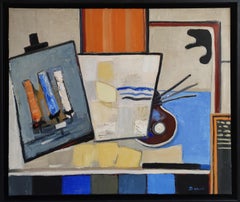
In the studio, Composition, Abstract, Geometric, Contemporary, Cubism, French
By SOPHIE DUMONT
Located in LANGRUNE-SUR-MER, FR
"In the Studio" is a compelling exploration of the artist's workspace, where the tools of creation are celebrated as subjects in their own right. Sophie Dumont captures the essence o...
Category
21st Century and Contemporary Abstract Expressionist Abstract Paintings
Materials
Oil
$3,280
H 21.26 in W 25.6 in D 0.79 in
More From This Seller
View AllPinhel
Located in Atlanta, GA
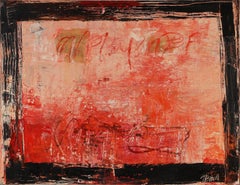
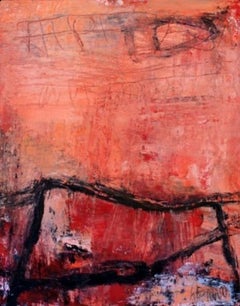
The painter Gonzalez Bravo lives and works in Lisbon since 1970. His paintings speak as equations to be solved, sharing an intimate and symbolic languag...
Category
21st Century and Contemporary Abstract Expressionist Interior Paintings
Materials
Oil
$14,950
Palencia
Located in Atlanta, GA
The painter Gonzalez Bravo lives and works in Lisbon since 1970. His paintings speak as equations to be solved, sharing an intimate and symbolic languag...
Category
21st Century and Contemporary Abstract Expressionist Interior Paintings
Materials
Oil
$14,950
Quelque Part en Russie
Located in Atlanta, GA
Jean Arcelin is a French and Swiss painter born in Paris in June 1962. He studied at Charpentier, a licensed art history school at the Sorbonne, where he developed an interest in sev...
Category
21st Century and Contemporary Impressionist Interior Paintings
Materials
Oil
Meridienne Rouge et Or
Located in Atlanta, GA
Jean Arcelin is a French and Swiss painter born in Paris in June 1962. He studied at Charpentier, a licensed art history school at the Sorbonne, where he developed an interest in sev...
Category
21st Century and Contemporary Impressionist Interior Paintings
Materials
Oil
Le restaurant
By Moreno Pincas
Located in Atlanta, GA
Moreno Pincas was born in Bulgaria in 1936 and immigrated to Israel in 1949. He participated in exhibitions in Paris, Buenos Aires, Milan and Tel Aviv. Moreno’s creative work has a c...
Category
20th Century Modern Interior Paintings
Materials
Oil
Paris Drout - Le Cerf en bronze aux enchères
By Jacques ROHAUT
Located in Atlanta, GA
Official Painter of the Navy appointed in 2010.
Official Painter of the Armies appointed in 2000.
Official Painter of Air and Space appointed in 1996.
It was friendship and then the discovery of the art of painting that prompted Jacques Rohaut to visit Philippe Lejeune's studio in Etampes in the 1970s during his law studies. He also worked for a restorer of paintings. Emulation within what has become the "Etampes School" allowed him to continue the necessary learning before making many personal exhibitions: the first in 1984, at the Taylor Foundation (Paris), then at the Orangerie de Villeroy, at the VIP lounge for ministerial air links in Villacoublay, in Düsseldorf, at the Saint-Roch gallery (Paris), at the Musée de l'Ordre des Avocats (Hôtel de la Porte in Paris), at the Hôtel du Conseil Général d'Eure et Loire (Chartres), in the Jehan de Beauce tower of Chartres cathedral, at the Etampes Museum, at the Inès Bonlieu gallery,
Guest of honor at several Salons in the provinces, he also regularly participates in major Parisian Salons: French Artists, Autumn, Comparisons.
His profession as a lawyer practiced in Paris for thirty years, within the firm Ader Jolibois, inspired him many paintings of which the judicial life and the courthouses were the pretext; his country of birth, Morocco, allowed him to rediscover the lights that usually make up his paintings; the air and the sea are another source of inspiration.
Among the main distinctions he has received: Bronze medal at the Salon de la Marine, Gold medal at the Salon des Artistes Français, Prix de la Fondation André et Berthe Noufflard...
Category
21st Century and Contemporary Modern Interior Paintings
Materials
Oil