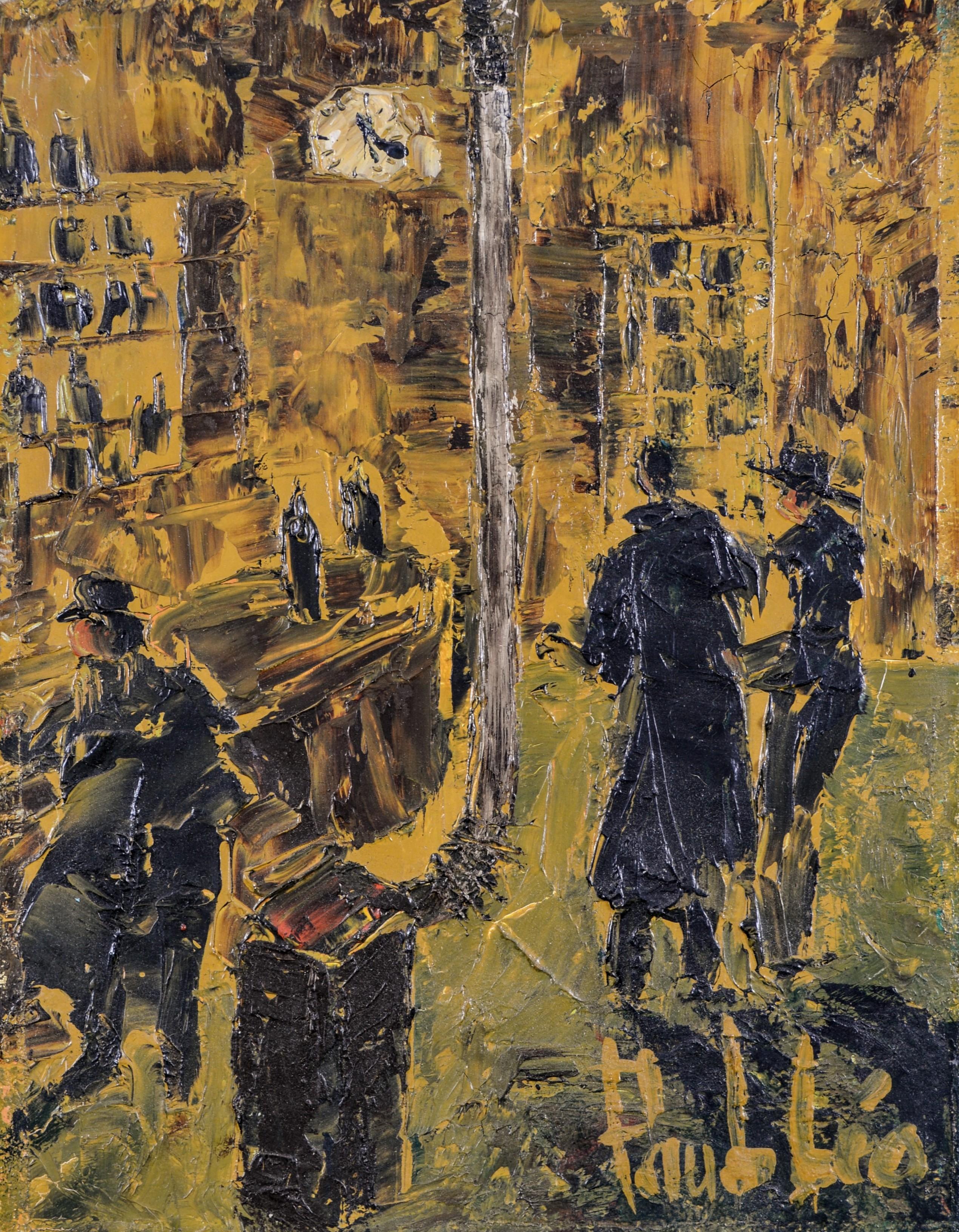
Items Similar to Large Modern Dutch Expressionist Oil Painting Vibrant Cafe Scene Jan Rylaarsdam
Want more images or videos?
Request additional images or videos from the seller
1 of 12
Jan RylaarsdamLarge Modern Dutch Expressionist Oil Painting Vibrant Cafe Scene Jan Rylaarsdamc.1940
s
c.1940 s
$3,600
£2,719.67
€3,118.87
CA$5,023.11
A$5,466.69
CHF 2,897.89
MX$65,768.46
NOK 36,754.52
SEK 33,627.81
DKK 23,300.31
About the Item
Jan Rijlaarsdam, Dutch 1911 - 2007
Hand signed lower right
Sight size: 23.5"h x 31.5"w
Overall: 33"h x 40.25"w
Jan Reylaarsdam was a Dutch Postwar
Contemporary painter who was born in Holland in 1911. He is known for Architectural Townscape, factory, industrial site and figure painting. A student of Albertus Gerhard Hulshoff Pol (1883-1957), a well-known painter and art teacher. The painter and draftsman was born in Nieuwkoop, but moved with his parents to Hilversum in 1924, where they opened a dairy. Jan delivered orders by bicycle and, during his travels, stumbled upon Dekker, a frame shop, where he met local painters and their work. There, he learned the framer's trade and, in his spare time, drew buildings and industrial complexes in Amsterdam. A painter of towns, figures, factories and industrial sites at the border of the cities and Parisian cafe scenes. Rijlaarsdam received a Royal allowance. He painted in a figurative expressionist style. Influenced by George Hendrik Breitner, a leading figure of Amsterdam Impressionism, as well as Willem Witsen, Eduard Karsen and Willem de Zwart. He was among the group of painters who depicted daily life in Amsterdam.
In 1928, he cycled to Bruges and Antwerp, Belgium to further develop his drawing skills. He returned there regularly. He gradually gained recognition, and in 1932, he received a Royal Grant, which allowed him to pay for lessons. He joined various painting associations in Hilversum, Amsterdam (Sint Lucas), and the Gooi region. His work has a distinctive style. It wasn't until the 1950s that he finally visited Paris, France. An informal member of the "École de Paris" School of Paris. This became his favorite destination; the vibrant Parisian city life drew him in. Later, Rijlaarsdam also spent a lot of time in Spain, especially Barcelona where he was exposed to the works of Pablo Picasso and Salvador Dali. Jan Rijlaarsdam left behind an impressive and highly versatile oeuvre, encompassing styles, materials, and techniques. Ranging from realistic to impressionist and expressionism, with even forays into abstraction and abstract expressionism. Rijlaarsdam consistently managed to surprise. Jan Rijlaarsdam's favorite subjects were gathering homeless people and prostitutes in cafés. In the tradition of Isaac Israëls and Henri de Toulouse-Lautrec, he was a true interpreter of city life. He was a member of St. Lucas, an art society in Amsterdam, The Gooise Art Society and the Society of Figurative Art in Hilversum (Vereniging van Beeldende Kunst).
Works by Rijlaarsdam are in possession of the Singer Museum in Laren.
The artist died February 16, 2007 in Baarn, Netherlands.
He showed and has been exhibited with Jan Knikker, Jean Lucebert, Henk Bos, Aris Knikker, Gustavo Novoa, Juan Bayon Salado, Marie Henrie MacKenzie, David Schulman, Michel Henry, Dirk Herman Willem Filarski, Karel Appel, Willem Van Den Berg, Jan Wittenberg, Freek Van Den Berg, Cornelis Noltee, Arnout Colnot, Matthieu Wiegman, Harm Henrick Kamerlingh Onnes, Jan Sierhuis, Jan Korthals, Erasmus Bernard Van Dulmen Krumpelman, Constantin Kluge, Albertus Verhoesen, Georg (Wilhelm Christian) Rueter
Name variants: Jan Rijlaardam, Jan Rylaarsdam
- Creator:Jan Rylaarsdam (1911 - 2007)
- Creation Year:c.1940 s
- Dimensions:Height: 33 in (83.82 cm)Width: 40.25 in (102.24 cm)
- Medium:
- Movement Style:
- Period:
- Condition:
- Gallery Location:Surfside, FL
- Reference Number:1stDibs: LU38216596192
About the Seller
4.9
Platinum Seller
Premium sellers with a 4.7+ rating and 24-hour response times
Established in 1995
1stDibs seller since 2014
1,850 sales on 1stDibs
Typical response time: <1 hour
- ShippingRetrieving quote...Shipping from: Miami, FL
- Return Policy
More From This Seller
View AllJewish Klezmer Musicians, Israeli Judaica Impasto Palette Knife Oil Painting
By Raoul Raymond
Located in Surfside, FL
Raoul Raymond was born in Bucharest, Romania in 1948 and he immigrated to Israel two years later.
In Israel, Mr. Raymond grew fond of the artist's palette, and at an early age, was...
Category
20th Century Figurative Paintings
Materials
Oil
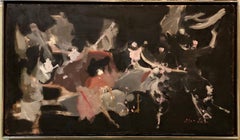
Polish Ecole De Paris Modernist Oil Painting Abstract Dancers
By Alfred Aberdam
Located in Surfside, FL
Alfred Aberdam (1894–1963) painter and graphic artist was a painter of School of Paris, born in Lvov, capital of Galicia, Austro-Hungarian Empire.
Born in Lviv, Krystonopol, East Galicia (now Chervonograd, Ukraine) and received a traditional Jewish education in a Heder while studying Hebrew with private teachers. In 1905–12 he lived in Lvov, where he finished high school. He decided to become an artist at the age of 14. At this time he came into contact with young Yiddish Judaic writers (Melech Ravitch, Abraham Moshe Fuks, and others) and with Zionist youth groups in Lvov. He attended their meetings and their lectures on Jewish Judaica artists. After graduating high school, he organized several conferences in his hometown on Italian and Flemish masters and on the first Jewish painters, including Josef Israels (1824-1911). In 1911 he started to study art at the Munich Royal Academy of Fine Arts, Akademie der Bildenden Künste München. Lemberg/Lwów (today Lviv), studies under Gabriel von Hackl (1843-1926). During World War I he was imprisoned by the Russians and stayed in the camp for prisoners of war in Siberia where he became acquainted with David Burliuk and other Russian futurists. In 1917, Aberdam was appointed People’s Commissar of the Department of Fine Arts by the local soviet, which assigned him the task of reorganizing artistic teaching. A year later, in Moscow, he befriended the poet Vladimir Mayakovski.
In 1921 in Poland, he began his studies at Kraków's Academy of Fine Arts under Professor Teodora Axentowicz, then lived in Paris. There he participated in numerous exhibitions, and in a Poland exhibition in the Gallery of Modern Art Editions in 1929. In the latter he organized the exhibition in 1931. In 1932 he exhibited in Warsaw and Lviv. From 1933 he belonged to a group of visual artists known as "Nowocześni". In 1923, while he was staying in Berlin, he met Menkes and Weingart in sculptor Alexander Archipenko’s studio. In 1924, he settled in Paris in the Montparnasse area. In the end of 1925, Jan Sliwinski held an exhibition in his gallery Au Sacre du Printemps, at 5 rue du Cherche-Midi, Paris. His work was exhibited alongside paintings by his Galician friends Leon Weissberg, Sigmund Menkes and Joachim Weingart...
Category
Mid-20th Century Modern Abstract Paintings
Materials
Oil
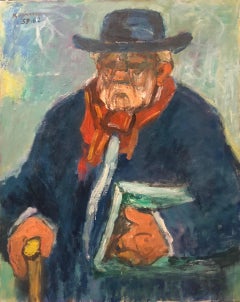
Portrait of a Gentleman, Large Modernist Oil Painting
By Benjamin Kopman
Located in Surfside, FL
BENJAMIN KOPMAN (1887 - 1965)
Painter, Illustrator and printmaker Benjamin Kopman was born in Vitebsk, Russia and emigrated to the United States with his family in 1903. It was a cen...
Category
Mid-20th Century Expressionist Portrait Paintings
Materials
Canvas, Oil
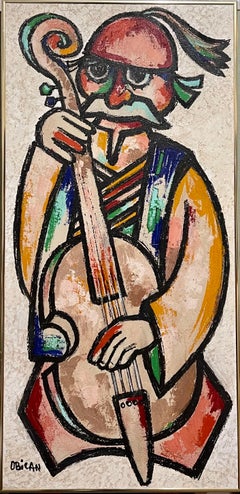
Large Naive European Folk Art Oil Painting Jovan Obican Klezmer Jazz Musician
By Jovan Obican
Located in Surfside, FL
Genre: Other
Subject: People
Medium: Oil
Surface: Canvas
Dimensions: 35" x 16.5
Dimensions w/Frame: 35.5" x 17.25
This depicts a Jazz or Klezmer musician. This one is a bass player.
The last photo shows it in a group of three that I have available. This listing is for the one painting.
The artist Jovan Obican iconic style is child-like yet masterfully adult; a style that tells a story with sociological overtones. His funny little people are always colorful, full of spirit, living with music and birds to bring them happiness.
JOVAN OBICAN
Cannes, France, b. 1918, d. 1986
Jovan Obican (1918-1986) artist, painter, sculpture and mosaic ceramic artisan was born in Cannes, France, to his Yugoslavian parents. From childhood on, Jovan practically devoted himself to art, scratching designs into the dirt when paper was unavailable. He trained with many recognized teachers and with many styles. He finished his training, imbued with the spirit of his native country, the people, their legends, and their philosophy. It has been said that his work has a "timeless quality" and a naive, folk art, outsider art brut quality, child-like primitive style. Obican is identified with his style the world over, a style that is simple yet sophisticated; child-like yet masterfully adult; a style that tells a story with psychological, philosophical or sociological overtones. His funny little people are always colorful, full of spirit, living with music and birds to bring them happiness. Best known for his depictions of folklore and traditional costumes rendered in a playful, childlike style and for his happy Jewish wedding scenes. He often used bright colors and black outlines in his renderings of figures and animals, giving his work an illustration-like quality. Thematically, the artist’s work is similar to Marc Chagall and Jean Dubuffet for its dreamlike images and so-called naïve style of painting. Over the course of his career, the artist maintained a studio in Boca Raton, Florida and Dubrovnik, Croatia—part of former Yugoslavia— where he developed an interest in Eastern Europe’s Jewish culture. Many of his mature works depict Jewish traditions and ceremonies, including traditional Jewish weddings, the dancing of the Hora, and traditional music. There is a display of his works in his former Dubrovnik studio.
His style is a unique conglomerate of tradition, history, legends, heroes, old customs and folklore. It is a self-standing style, recognizable, cheerful, whimsical and a happy creation. Naïve art is any form of visual art that is created by a person who lacks the formal education and training that a professional artist undergoes (in anatomy, art history, technique, perspective, ways of seeing). Unlike folk art, naïve art does not necessarily evince a distinct cultural context or tradition. Naïve art is recognized, and often imitated, for its childlike simplicity and frankness. Paintings of this kind typically have a flat rendering style with a rudimentary expression of perspective.
One particularly influential painter of "naïve art" was Henri Rousseau (1844–1910), a French Post-Impressionist who was discovered by Pablo Picasso. Naïve art is often seen as outsider art that is by someone without formal (or little) training or degree. While this was true before the twentieth century, there are now academies for naïve art. Naïve art is now a fully recognized art genre, represented in art galleries worldwide.
Museums devoted to naïve art now exist in Kecskemét, Hungary; Riga, Latvia; Jaen, Spain; Rio de Janeiro, Brasil; Vicq France and Paris. "Primitive art" is another term often applied to art by those without formal training, but is historically more often applied to work from certain cultures that have been judged socially or technologically "primitive" by Western academia, such as Native American, sub saharan African or Pacific Island art (see Tribal art). This is distinguished from the self-conscious, "primitive" inspired movement primitivism. Another term related to (but not completely synonymous with) naïve art is folk art. There also exist the terms "naïvism" and "primitivism" which are usually applied to professional painters working in the style of naïve art (like Paul Gauguin, Mikhail Larionov, Paul Klee).
At all events, naive art can be regarded as having occupied an "official" position in the annals of twentieth-century art since - at the very latest - the publication of the Der Blaue Reiter, an almanac in 1912. Wassily Kandinsky and Franz Marc, who brought out the almanac, presented 6 reproductions of paintings by le Douanier' Rousseau (Henri Rousseau), comparing them with other pictorial examples. However, most experts agree that the year that naive art was "discovered" was 1885, when the painter Paul Signac became aware of the talents of Henri Rousseau and set about organizing exhibitions of his work in a number of prestigious galleries. The Earth Group (Grupa Zemlja) were Croatian artists, architects and intellectuals active in Zagreb from 1929 to 1935. The group included the painters Krsto Hegedušić, Edo Kovačević, Omer Mujadžić, Kamilo Ružička, Ivan Tabaković, and Oton Postružnik, the sculptors Antun Augustinčić, Frano Kršinić, and the architect Drago Ibler. A term applied to Yugoslav (Croatian) naive painters working in or around the village of Hlebine, near the Hungarian border, from about 1930. Some of the best known naive artists are Dragan Gaži, Ivan Generalić, Josip Generalić, Krsto Hegedušić, Mijo Kovačić, Ivan Lacković-Croata, Franjo Mraz, Ivan Večenaj and Mirko Virius. Camille Bombois (1883–1970) Ferdinand Cheval, known as 'le facteur Cheval' (1836–1924) Henry Darger (1892–1973) L. S. Lowry (1887–1976) Grandma Moses, Anna Mary Robertson...
Category
20th Century Folk Art Figurative Paintings
Materials
Canvas, Oil
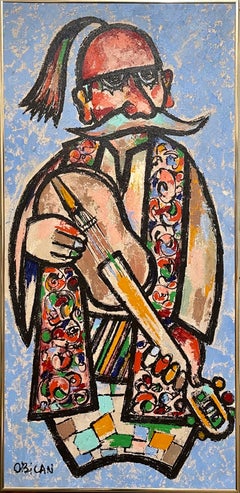
Large Naive European Folk Art Oil Painting Jovan Obican Klezmer Jazz Musician
By Jovan Obican
Located in Surfside, FL
Genre: Other
Subject: People
Medium: Oil
Surface: Canvas
Dimensions: 35" x 16.5
Dimensions w/Frame: 35.5" x 17.25
This depicts a Jazz or Klezmer musician. This one is a banjo or guitar player.
The last photo shows it in a group of three that I have available. This listing is for the one painting.
The artist Jovan Obican iconic style is child-like yet masterfully adult; a style that tells a story with sociological overtones. His funny little people are always colorful, full of spirit, living with music and birds to bring them happiness.
JOVAN OBICAN
Cannes, France, b. 1918, d. 1986
Jovan Obican (1918-1986) artist, painter, sculpture and mosaic ceramic artisan was born in Cannes, France, to his Yugoslavian parents. From childhood on, Jovan practically devoted himself to art, scratching designs into the dirt when paper was unavailable. He trained with many recognized teachers and with many styles. He finished his training, imbued with the spirit of his native country, the people, their legends, and their philosophy. It has been said that his work has a "timeless quality" and a naive, folk art, outsider art brut quality, child-like primitive style. Obican is identified with his style the world over, a style that is simple yet sophisticated; child-like yet masterfully adult; a style that tells a story with psychological, philosophical or sociological overtones. His funny little people are always colorful, full of spirit, living with music and birds to bring them happiness. Best known for his depictions of folklore and traditional costumes rendered in a playful, childlike style and for his happy Jewish wedding scenes. He often used bright colors and black outlines in his renderings of figures and animals, giving his work an illustration-like quality. Thematically, the artist’s work is similar to Marc Chagall and Jean Dubuffet for its dreamlike images and so-called naïve style of painting. Over the course of his career, the artist maintained a studio in Boca Raton, Florida and Dubrovnik, Croatia—part of former Yugoslavia— where he developed an interest in Eastern Europe’s Jewish culture. Many of his mature works depict Jewish traditions and ceremonies, including traditional Jewish weddings, the dancing of the Hora, and traditional music. There is a display of his works in his former Dubrovnik studio.
His style is a unique conglomerate of tradition, history, legends, heroes, old customs and folklore. It is a self-standing style, recognizable, cheerful, whimsical and a happy creation. Naïve art is any form of visual art that is created by a person who lacks the formal education and training that a professional artist undergoes (in anatomy, art history, technique, perspective, ways of seeing). Unlike folk art, naïve art does not necessarily evince a distinct cultural context or tradition. Naïve art is recognized, and often imitated, for its childlike simplicity and frankness. Paintings of this kind typically have a flat rendering style with a rudimentary expression of perspective.
One particularly influential painter of "naïve art" was Henri Rousseau (1844–1910), a French Post-Impressionist who was discovered by Pablo Picasso. Naïve art is often seen as outsider art that is by someone without formal (or little) training or degree. While this was true before the twentieth century, there are now academies for naïve art. Naïve art is now a fully recognized art genre, represented in art galleries worldwide.
Museums devoted to naïve art now exist in Kecskemét, Hungary; Riga, Latvia; Jaen, Spain; Rio de Janeiro, Brasil; Vicq France and Paris. "Primitive art" is another term often applied to art by those without formal training, but is historically more often applied to work from certain cultures that have been judged socially or technologically "primitive" by Western academia, such as Native American, sub saharan African or Pacific Island art (see Tribal art). This is distinguished from the self-conscious, "primitive" inspired movement primitivism. Another term related to (but not completely synonymous with) naïve art is folk art. There also exist the terms "naïvism" and "primitivism" which are usually applied to professional painters working in the style of naïve art (like Paul Gauguin, Mikhail Larionov, Paul Klee).
At all events, naive art can be regarded as having occupied an "official" position in the annals of twentieth-century art since - at the very latest - the publication of the Der Blaue Reiter, an almanac in 1912. Wassily Kandinsky and Franz Marc, who brought out the almanac, presented 6 reproductions of paintings by le Douanier' Rousseau (Henri Rousseau), comparing them with other pictorial examples. However, most experts agree that the year that naive art was "discovered" was 1885, when the painter Paul Signac became aware of the talents of Henri Rousseau and set about organizing exhibitions of his work in a number of prestigious galleries. The Earth Group (Grupa Zemlja) were Croatian artists, architects and intellectuals active in Zagreb from 1929 to 1935. The group included the painters Krsto Hegedušić, Edo Kovačević, Omer Mujadžić, Kamilo Ružička, Ivan Tabaković, and Oton Postružnik, the sculptors Antun Augustinčić, Frano Kršinić, and the architect Drago Ibler. A term applied to Yugoslav (Croatian) naive painters working in or around the village of Hlebine, near the Hungarian border, from about 1930. Some of the best known naive artists are Dragan Gaži, Ivan Generalić, Josip Generalić, Krsto Hegedušić, Mijo Kovačić, Ivan Lacković-Croata, Franjo Mraz, Ivan Večenaj and Mirko Virius. Camille Bombois (1883–1970) Ferdinand Cheval, known as 'le facteur Cheval' (1836–1924) Henry Darger (1892–1973) L. S. Lowry (1887–1976) Grandma Moses, Anna Mary Robertson...
Category
20th Century Folk Art Figurative Paintings
Materials
Canvas, Oil
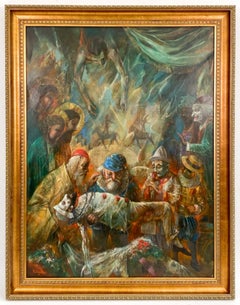
Large Oil Painting Circus Scene Clowns Rediscovered NY Artist Jonah Kinigstein
By Jonah Kinigstein
Located in Surfside, FL
Jonah Kinigstein
"Death of a Clown"
Large Oil on Board Painting of macabre circus scene with clowns
Hand signed lower left and signed and titled verso
Frame: 55 X 43 Image: 48 X 36
...
Category
20th Century Expressionist Portrait Paintings
Materials
Oil, Board
You May Also Like
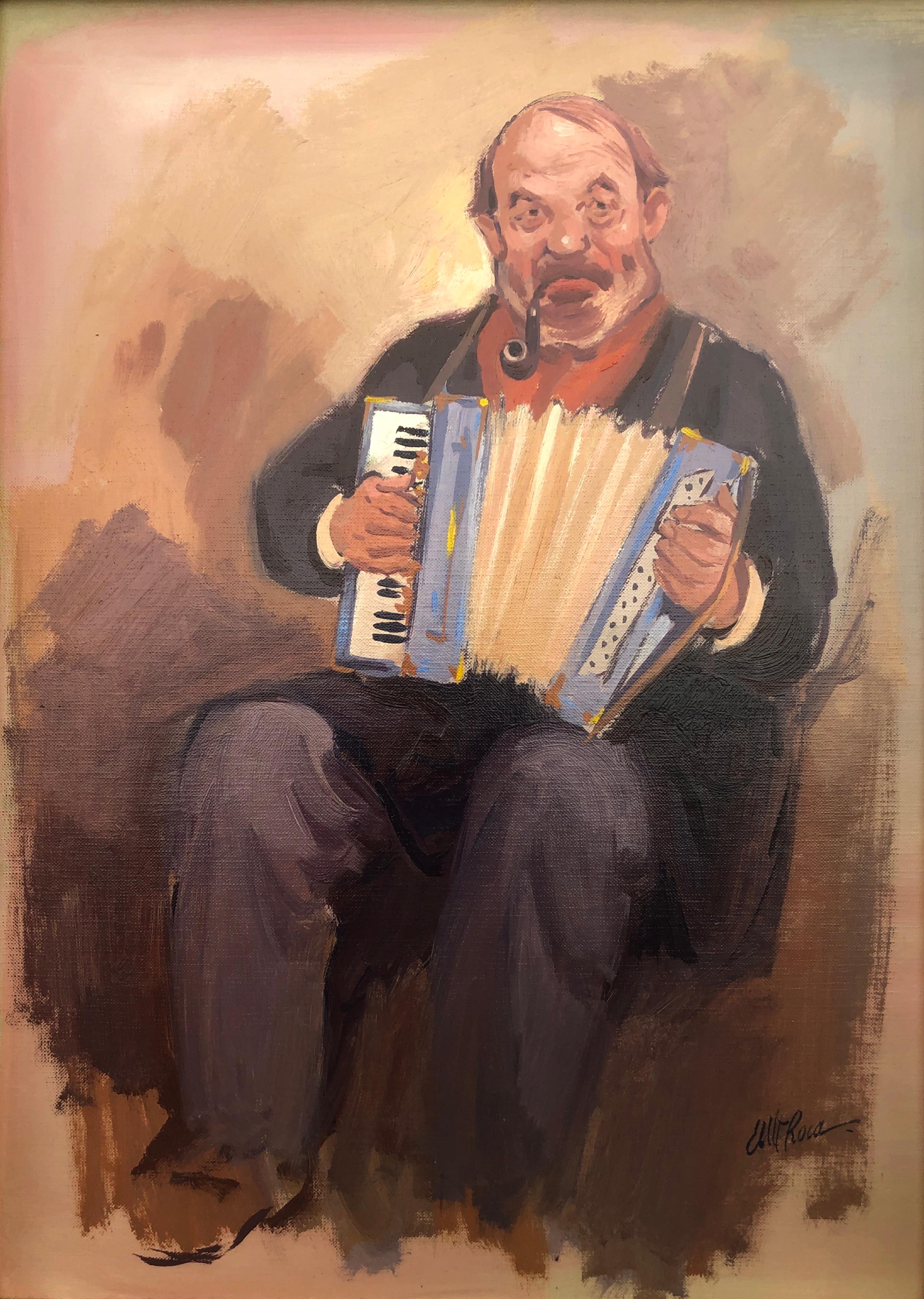
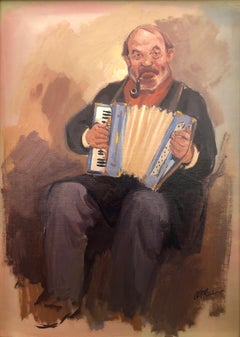
accordionist with pipe oil on board painting modernism art
Located in Sitges, Barcelona
Albert Roca (1945) - accordionist with pipe oil on board painting
Medidas óleo 47x34 cm.
Medidas marco 62x48 cm.
Painter of landscapes and figures, in who...
Category
1990s Modern Portrait Paintings
Materials
Oil, Board
$1,152 Sale Price
20% Off
1950
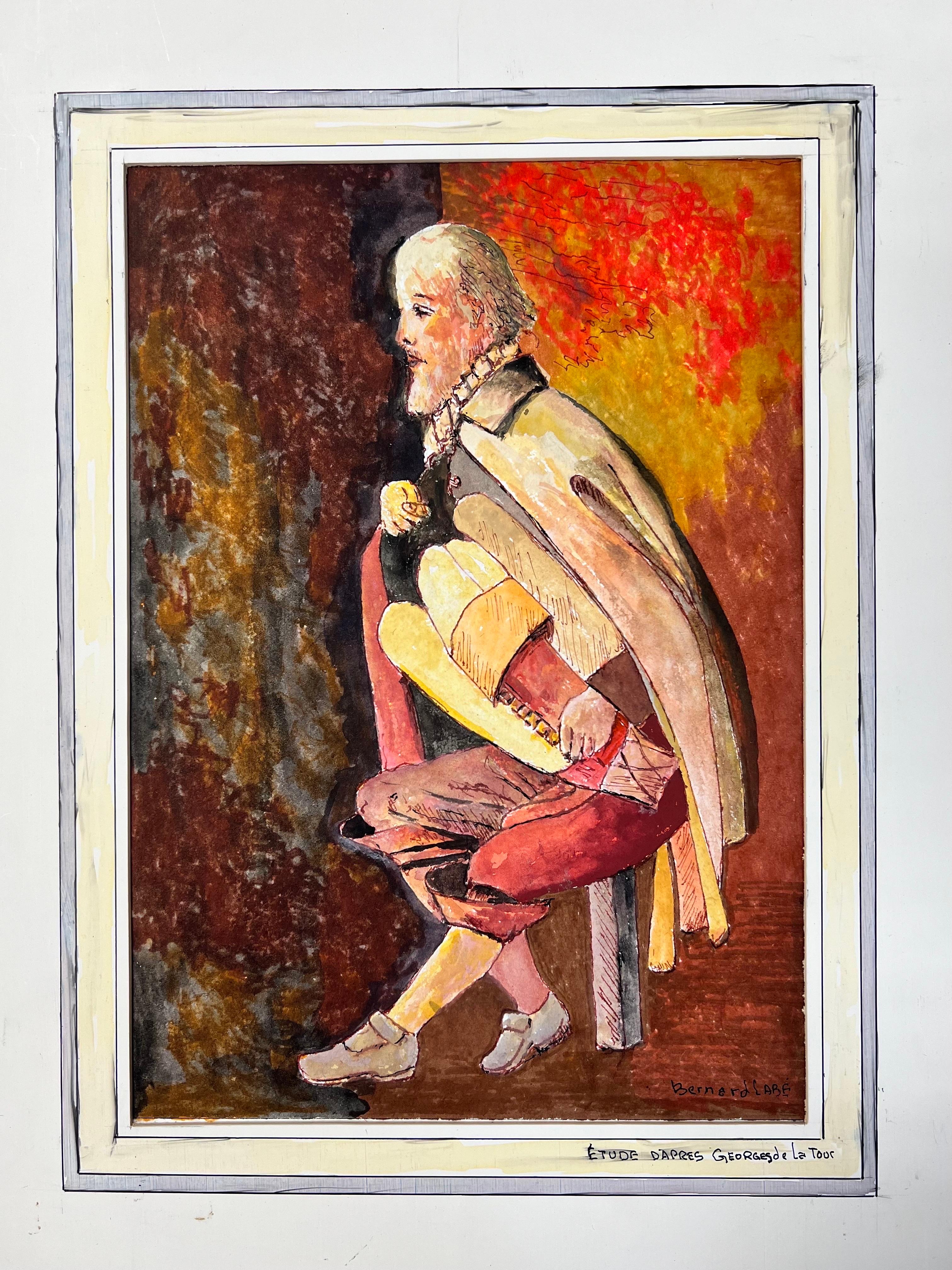
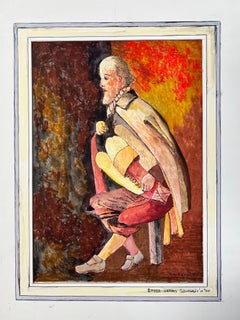
s Modernist/ Cubist Painting - Figure Playing The Accordion
By Bernard Labbe
Located in Cirencester, Gloucestershire
French Figure
by Bernard Labbe (French mid 20th century)
original gouache on paper mounted on card
size: 16.5 x 12.5 inches
condition: very good and ready to be enjoyed
provenance:...
Category
Mid-20th Century Modern Figurative Paintings
Materials
Gouache
$495 Sale Price
40% Off
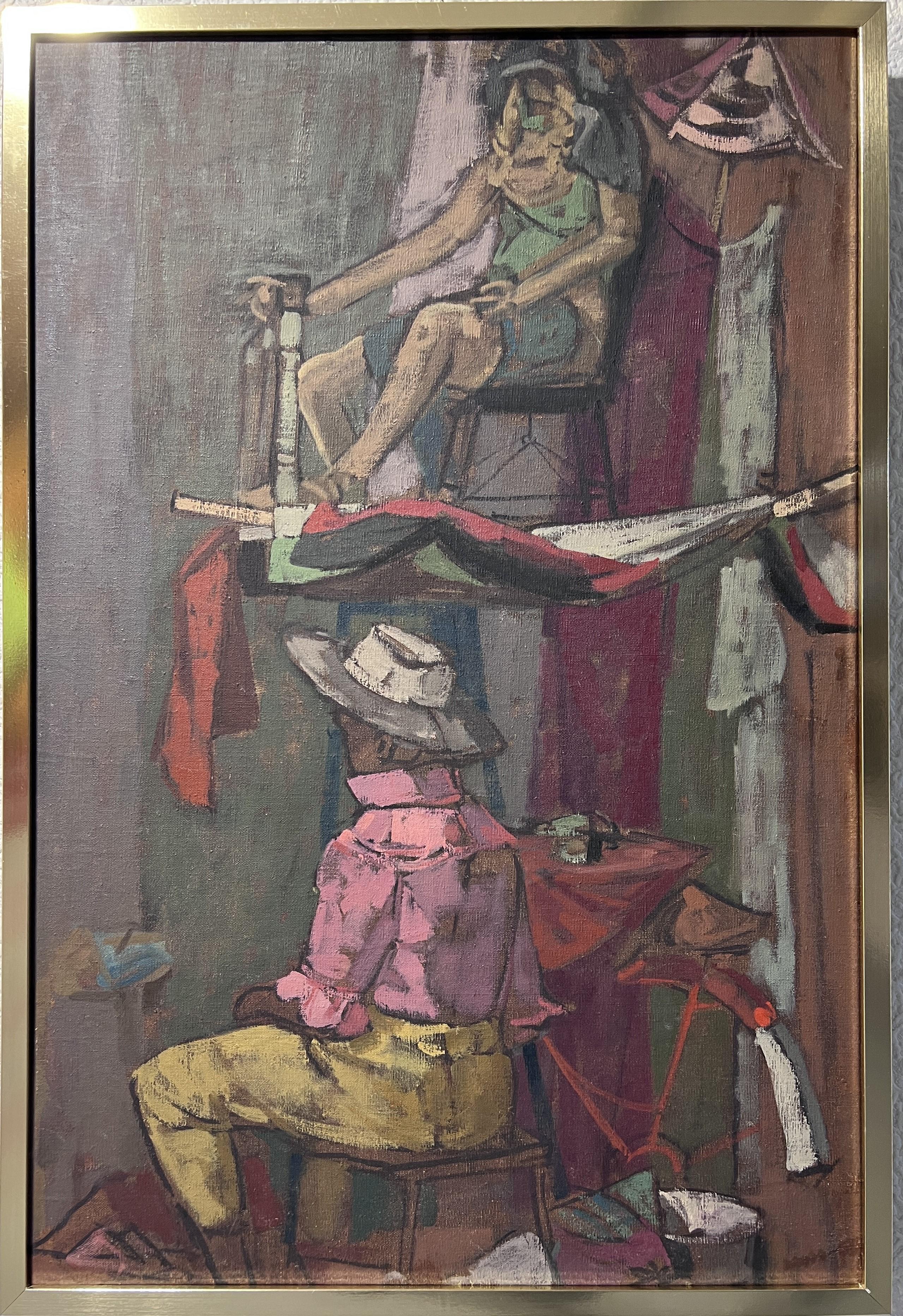
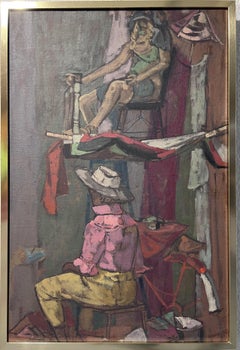
Large Original Vintage oil Painting on Canvas, Figures, Framed, Signed Colvin
Located in Palm Coast, FL
This is a one-on-kind vintage oil painting on canvas depicting two figures.
Presented in a nice gold frame The painting is in good vintage condition. Please see the photos.
Measur...
Category
Late 20th Century Abstract Impressionist Figurative Paintings
Materials
Oil
$520 Sale Price
20% Off
Café de la Gare - Mid 20th Century French Expressionist Figurative Oil Painting
Located in Sevenoaks, GB
A superb mid 20th century French expressionist oil on canvas depicting a café de la gare (station café) as inscribed on the reverse.
Numerous well dressed figures stand at the café ...
Category
Mid-20th Century Expressionist Landscape Paintings
Materials
Canvas, Oil
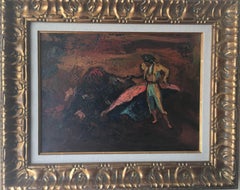
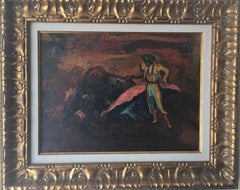
Creixams 122 Bullfighter and Bull original impressionist acrylic canvas painting
By Pere Créixams Picó
Located in CORAL GABLES - MIAMI, FL
Creixams PICÓ, Pere (Barcelona, 1893-1965). signed
Self - taught painter, Creixams began his career as a cabinetmaker and typographer. In 1918 he traveled to Paris and in contact wit...
Category
Early 20th Century Impressionist Figurative Paintings
Materials
Canvas, Oil
Creixams 122 Bullfighter and Bull original impressionist acrylic canvas painting
By Pere Créixams Picó
Located in CORAL GABLES - MIAMI, FL
Creixams PICÓ, Pere (Barcelona, 1893-1965).
Self - taught painter, Creixams began his career as a cabinetmaker and typographer. In 1918 he traveled to Paris and in contact with the ...
Category
Early 20th Century Impressionist Figurative Paintings
Materials
Canvas, Oil