Late 18th Century Interior Paintings
to
2
1
1
Overall Width
to
Overall Height
to
75
367
2,017
5,413
40
41
64
111
88
110
147
151
131
111
41
1
3
1
4
3
2
2
1
1
1
1
1
4
3
1
1
1
3
1
3
1
Period: Late 18th Century
Guido Reni follower - 18/19th century figure painting - Virgin Child
By Guido Reni
Located in Varmo, IT
Guido Reni (Bologna 1575 - Bologna 1642), follower of - Madonna and Child.
91.5 x 108 cm unframed, 134.5 x 150.5 cm with frame.
Ancient oil painting on canvas, in a 19th-century ca...
Category
Baroque Late 18th Century Interior Paintings
Materials
Canvas, Oil

Old Master Style Inn Interior with three men drinking around a table
Located in Woodbury, CT
This 18th-century painting, attributed to Christian Wilhelm Ernst Dietrich (1712–1774), depicts a rustic inn interior, a subject frequently explored by Dutch and German genre painter...
Category
Old Masters Late 18th Century Interior Paintings
Materials
Wood, Oil
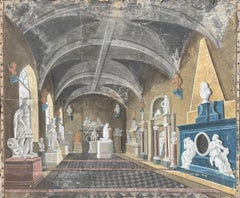
1795-1816 Interior Of The Museum of Monuments Français
Located in PARIS, FR
Interior Of The Musée Des Monuments Français
View Of The 17th Century Hall
Anonymous between 1795 - 1816
Gouache on paper mounted on cardboard
74 x 88 cm
According to the old label...
Category
Late 18th Century Interior Paintings
Materials
Gouache
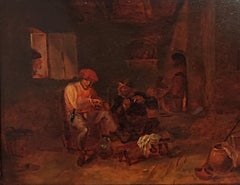
Interior and pipe smoker
Located in Genève, GE
Work on wood
Brown wooden frame
49 x 58 x 4 cm
Category
Dutch School Late 18th Century Interior Paintings
Materials
Oil

$1,483
Related Items
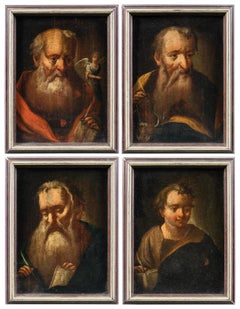
Baroque Italian painter - Set of four 18th century figure paintings - Evangelist
Located in Varmo, IT
Italian painter (early 18th century) - Four Evangelists.
25.5 x 19 cm without frame, 29 x 22.5 cm with frame.
Ancient oil painting on panel. in wooden frames (not signed).
Conditi...
Category
Old Masters Late 18th Century Interior Paintings
Materials
Oil, Panel
$1,794 Sale Price
40% Off
H 22.84 in W 17.72 in
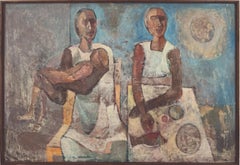
Mid-Century Modern Figural of Two Women and Child by Harold Kitner Kent State
Located in Soquel, CA
Expressive Mid-Century figural painting of two women and child in pastel hues by Harold Kitner (American, 1921 - 2004).
Image, 33"H x 48"W
Walnut frame, 34"H x 49"W x 2"D
Harold Kitner was born on May 18, 1921 in Cleveland, Ohio and was the son of Isaac and Frieda Kitner. He obtained his MA from Case Western Reserve University in 1947. Kitner was a postgraduate from Cleveland Institute, Ohio University, Cleveland College, Washington and Lee University. He obtained his Doctorate from Kent State University. Exhibition: Harold Kitner - Active / Figure / Exaltation at Kent State School of Art Gallery in Kent, Ohio in 2014.
Harold Kitner taught for over 30 years at the Kent State University School of Art.
Harold Kitner began teaching art and art history at Kent State University in 1947. During his career, he served as Director and Chairman of the Fine Arts Division. Kitner played a significant role in creating the Art School’s core program, organizing the Kent State Arts Festival, and the Blossom Festival School. He also served as President of the Kent chapter of the American Association of University Professors, and was an art critic for the Akron Beacon Journal. In 1967, Kitner became Kent State University’s first Faculty Ombudsman, officially titled Dean for Faculty Counsel. He held this position until 1974. At the time of the Kent State shootings, Kitner’s position as Ombudsman meant that he was involved in many of the decisions regarding University administration in the weeks and months following the Kent State shootings. Kitner began a partial retirement in 1980, and left Kent to become the director of the Institute of the South Florida Art...
Category
Modern Late 18th Century Interior Paintings
Materials
Masonite, Oil
$2,000 Sale Price
20% Off
H 34 in W 49 in D 2 in
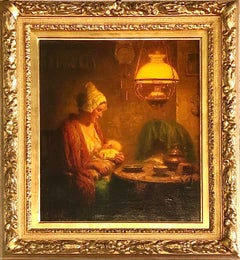
Feeding the Baby
Located in Wiscasett, ME
Oil on canvas, signed upper left. Provenance: Sothebys Amsterdam, Private collection London, Private collection Palm Beach.
His working period was from about 1894 to 1973, successively in Rotterdam, Heeze (Heeze-Leende), Hilversum and Laren. He was educated at the Craft School for decorative painters and received evening lessons at the Rotterdam Academy under the direction of A. van Maasdijk.
He was a member of the Vereeniging Sint Lucas...
Category
Dutch School Late 18th Century Interior Paintings
Materials
Oil
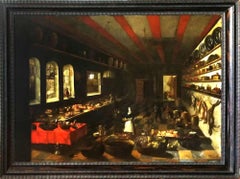
Interior Scene with Kitchen - Oil on Canvas - 1659
Located in Roma, IT
Signed and dated lower left.
Includes a beautiful later wooden frame cm. 137x8x182.
Very Good conditions.
Prov. Christie's London, February 15th 1974, n. 19.
This artwork is shippe...
Category
Baroque Late 18th Century Interior Paintings
Materials
Oil
$58,606
H 45.28 in W 63.78 in D 0.99 in
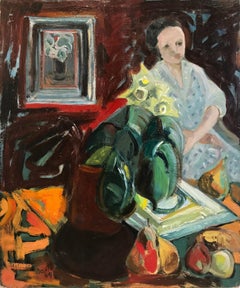
"Interior Scene with Figure" Expressionistic Style Oil Painting on Masonite
Located in New York, NY
A strong modernist oil painting depicted in 1969 by Russian painter Michael Baxte. Mostly known for his abstracted figures on canvas or street scenes, this piece is a wonderful representation of his bold still life paintings, with expressive use of color, shape, and form. Later in his career, Baxte explores Expressionism, infusing both European and North American stylistic trends. This piece is from later in his career, but we can feel this underlying style throughout.
Art measures 21.75 x 18 inches
Michael Posner Baxte was born in 1890 in the small town of Staroselje Belarus, Russia. For the first half of the 19th century it was a center of the Chabad movement of Hasidic Jews, but this group was gone by the middle of the 19th century. By the time the Baxte family immigrated to the United States at the beginning of the 20th century, the Jewish population numbered only on the hundreds. The native language of the Baxte family was Yiddish. It is likely that the death of Michael Baxte’s father triggered the family’s immigration. Three older brothers arrived in New York between 1903 and 1905. Michael and his mother, Rebecca, arrived in 1907. By 1910 Michael, his mother, and brother, Joseph, were living in New Orleans and may have spent some time on a Louisiana plantation. Around 1912, Michael Baxte returned to Europe to study the violin. In 1914 he, his mother, and Joseph moved to New York City.
Meanwhile, in Algeria, a talented young woman painter, Violette Mege, was making history. Since for the first time, a woman won the prestigious Beaux Art competition in Algeria. At first, the awards committee denied her the prize but, with French government intervention, Mege eventually prevailed. She won again 3 years later and, in 1916, used the scholarship to visit the United States of America. When Violette came to New York, she met Baxte, who was, by then, an accomplished violinist, teacher, and composer. Baxte’s compositions were performed at the Tokyo Imperial Theater, and in 1922 he was listed in the American Jewish Yearbook as one of the prominent members of the American Jewish community. As a music teacher he encouraged individual expression. Baxte stated, “No pupil should ever be forced into imitation of the teacher. Art is a personal experience, and the teacher’s truest aim must be to awaken this light of personality through the patient light of science.”
By 1920 Michael Baxte and Violette Mege were living together in Manhattan. Although they claimed to be living as husband and wife, it seems that their marriage did not become official until 1928. On their “unofficial” honeymoon around 1917, in Algiers, Baxte confided to her his ambition to paint. There and later in New Mexico where the wonderful steeped sunlight approximates the coloring of Algiers, she taught him his heart’s desire. He never had any other teacher. She never had any other pupil. For ten years she devoted all her time, energy, and ambition to teaching, encouraging, inspiring him. Then in 1928, their mutual strivings were rewarded, as his works were being chosen as one of the two winners in the Dudensing National Competition for American Painters. Out of 150 artists from across the country participated in the Dudensing, and Michael Posner Baxte and, Robert Fawcett...
Category
Expressionist Late 18th Century Interior Paintings
Materials
Oil, Masonite
$2,000
H 21.75 in W 18 in D 0.25 in
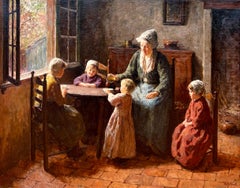
A Mother and Her Children
Located in Wiscasett, ME
This is an original unique oil painting by the artist Bernard Pothast, signed in the lower right corner, featuring a mother and her children sitting around the kitchen table. Measu...
Category
Dutch School Late 18th Century Interior Paintings
Materials
Oil
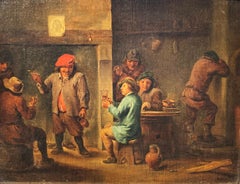
Circle Teniers, Flemish Art, Peasants smoking and drinking in a Tavern Interior
By David Teniers the Younger
Located in Greven, DE
Circle or Follower of David Teniers, Peasant in a Tavern Inn, drinking and smoking. Oil on canvas, Framed: 39 x 47 cm. Typical Flemish Baroque Interior...
Category
Baroque Late 18th Century Interior Paintings
Materials
Canvas, Oil
$2,631
H 13.78 in W 10.63 in
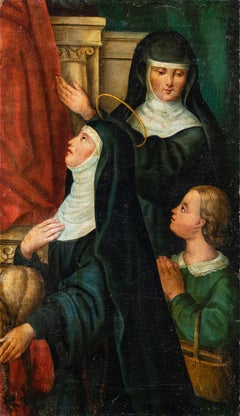
Religious Italian painter - 18th century figure painting - Saint Monica prayer
Located in Varmo, IT
Italian painter (18th century) - Saint Monica in prayer.
56 x 32 cm.
Antique oil painting on canvas, without frame (not signed).
Condition report: Good state of conservation of th...
Category
Old Masters Late 18th Century Interior Paintings
Materials
Canvas, Oil
$956 Sale Price
55% Off
H 22.05 in W 12.6 in
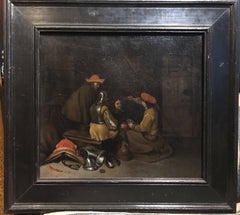
Dutch 17th Century Oil Painting - The Card Game by Ter Borch
By Gerard ter Borch the Younger
Located in London, GB
Gerard ter Borch
The Cards Game
Oil on canvas
14 x 15.5 inches unframed
19 3/4 x 21 1/2 inches framed
Gerard ter Borch (Dutch; December 1617 – 8 December 1681), also known as Gerard Terburg, was an influential and pioneering Dutch genre painter who lived in the Dutch Golden Age. He influenced fellow Dutch painters Gabriel Metsu...
Category
Old Masters Late 18th Century Interior Paintings
Materials
Oil
$20,604
H 19.75 in W 21.5 in
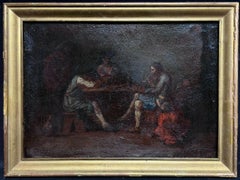
17th Century Flemish Old Master Oil Tavern Interior Drinkers Sloped over Tables
Located in Cirencester, Gloucestershire
Tavern Interior
Flemish School, 17th century
oil on canvas, framed
framed: 13.5 x 18
canvas: 11 x 16 inches
provenance: private collection, France
condition: very good and sound cond...
Category
Old Masters Late 18th Century Interior Paintings
Materials
Oil
$2,412 Sale Price
20% Off
H 13.5 in W 18 in D 1 in
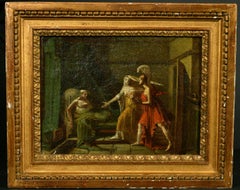
Fine 19th Century French Oil Painting Classical Roman Figures Interior Scene
Located in Cirencester, Gloucestershire
Attributed to Antoine Felix Boisselier (19th Century) French (unsigned)
'Classical figures in a bed chamber
Medium: oil on canvas, with inscription verso
S...
Category
Old Masters Late 18th Century Interior Paintings
Materials
Oil
$3,296
H 9.5 in W 12.75 in
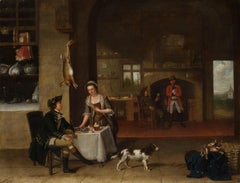
A Tavern Interior, 18th Century Old Master, Figurative Oil Painting by Schaak
Located in Greven, DE
A Tavern Interior - 18th Century Old Master, Figurative Oil Painting by Schaak
Little is known about the artist J.S.C. Schaak. He was active in England as a portraitist between 1760-1770. His name indicates his German or Dutch origin. Especially portraits of generals...
Category
Old Masters Late 18th Century Interior Paintings
Materials
Copper
$13,395 Sale Price
20% Off
H 18.9 in W 23.23 in
Previously Available Items
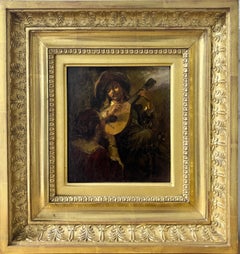
"Lute Player" 18th Century Dutch School, Signed oil on panel
Located in New York, NY
Dutch School
Late 18th century
Oil on panel
6 1/4 inches x 5 1/2 inches (15.9 x 14 cm)
Framed: 14 x 12 inches (35.5 x 30.5 cm)
Signed lower right
This delightful study of a lute pl...
Category
Dutch School Late 18th Century Interior Paintings
Materials
Oil, Panel
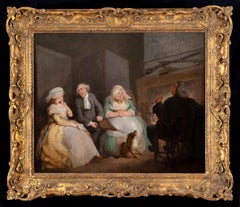
The Country Vicar’s Fireside
Located in Henley-on-Thames, England
Henry Wigstead (1760-1800)
The Country Vicar’s Fireside, c. 1786
Oil on canvas
In a period carved and gilded swept frame
63.5 x 76.1 cm.; (within frame) 81 x 93.8 cm.
Provenance:
Christie’s, King Street, where consigned on 20 March 1957; 3 May 1957, lot 81, as William Hogarth, ‘Figures before a fireplace’;
Private Collection, United States;
Sotheby’s, New York, Old Master & 19th Century European Art, 27 January 2012, lot 486;
Private Collection, United Kingdom.
Exhibition history:
The Royal Academy, London, 1786, no. 59
Literature:
Algernon Graves, The Royal Academy of Arts: A Complete Dictionary of Contributors and Their Work from Its Foundation in 1769 to 1904, 8 vols. (London: H. Graves and Company Ltd., 1905), p. 265
George Paston, Social Caricature in the Eighteenth Century (London: Methuen & Co., 1906), p. 137
The Royal Academy, The Exhibition of the Royal Academy of Arts, M.DCC.LXXXVI, The Eighteenth (London: T. Cadell, 1786), p. 4
Exhibited at the Royal Academy of 1786 and likely produced that same year, The Country Vicar’s Fireside is an exceedingly rare work in oil by the British caricaturist Henry Wigstead, belonging to the considerably small body of paintings produced by the artist, of which few remain. The work was conceived during the height of British caricature, culminating between the American Revolution and Waterloo, and typifies Wigstead’s ‘great feeling for ridiculous contrasts and the droll side of human relationships’, being a talented exponent of the art of ridicule that was satire (Old Print Shop, p. 223). The painting was engraved by E. Wilkins in 1788, though alterations in reproduction diverted from the original scheme: for example, whereas the Wilkins print shows a ‘Plan of the Parish of Barn’ over the hearth, Wigstead’s oil identifies it as that of Wakefield – an allusion to the 1766 novel, The Vicar of Wakefield. The work was until recently unknown, and was previously misattributed to the towering William Hogarth. It thus represents an important addition to the sparing oeuvre of an artist who, further to being a magistrate, publisher, and businessman, enjoyed royal patronage and friendships with the leading caricaturists, which placed him at the centre of London’s effervescent satire market.
A considered description of The Country Vicar’s Fireside is given by the literary critic George Paston (Emily Morse Symonds) in her 1906 commentary on 18th century caricature, who regards it as a fine example of Wigstead’s gentler mode of social satire. Paston writes, ‘In front of a roaring fire sits...
Category
Old Masters Late 18th Century Interior Paintings
Materials
Oil
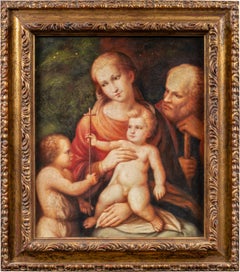
Antique Italian painter - 18th/19th century figure painting - Virgin Child
Located in Varmo, IT
Italian painter (18th-19th century) - Holy Family with St. John the Baptist.
65 x 55 cm without frame, 86.5 x 76.5 cm with frame.
Antique oil painting on canvas, in a carved and gi...
Category
Old Masters Late 18th Century Interior Paintings
Materials
Canvas, Oil
H 34.06 in W 30.12 in
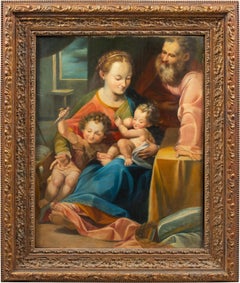
Follower of Federico Barocci(Rome) - 18th-19th century figure painting - Madonna
Located in Varmo, IT
Follower of Federico Barocci (18th-19th century) - Madonna del Latte.
102 x 80 cm without frame, 132 x 112 cm with frame.
Antique oil painting on wood, in a carved and gilded woode...
Category
Old Masters Late 18th Century Interior Paintings
Materials
Oil, Panel
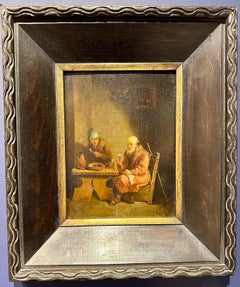
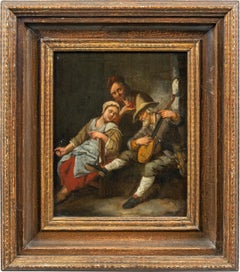
Antique Dutch painter - 18th century figure painting - Interior Tavern mandolin
Located in Varmo, IT
Dutch painter (18th century) - Interior of a tavern with a player.
35 x 28 cm without frame, 52 x 46 cm with frame.
Antique oil painting on wood, in wooden frame.
Condition report...
Category
Baroque Late 18th Century Interior Paintings
Materials
Oil, Panel
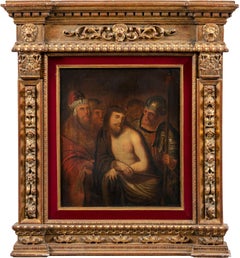
18th-19th century Italian figure painting - Ecce Homo - Oil canvas Baroque
Located in Varmo, IT
Italian painter (18th-19th century) - Ecce Homo.
36 x 31 cm without frame, 62.5 x 57.5 cm with frame.
Oil on canvas, in carved and gilded wooden tabernacle frame.
Condition report...
Category
Baroque Late 18th Century Interior Paintings
Materials
Canvas, Oil
H 24.61 in W 22.64 in
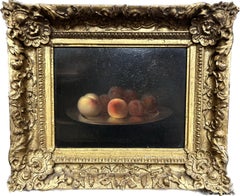
18th Century French Oil Painting Still Life of Peaches Fine Gilt Frame
Located in Cirencester, Gloucestershire
French artist, late 18th century
oil painting on wooden board, framed
framed: 15 x 17 inches
board: 9.5 x 11 inches
provenance: private collection, France
condition: overall very good
Category
Old Masters Late 18th Century Interior Paintings
Materials
Oil
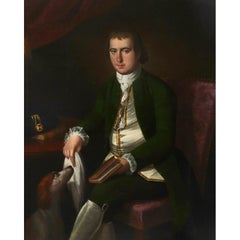
Huge 18th Century American Oil Portrait Gentleman in his Study with Spaniel Dog
By Ralph Earl
Located in Cirencester, Gloucestershire
Portrait of a Gentleman
depicted three-quarter-length, in a white waistcoat and green coat,
a book in his left hand, with a dog (Spaniel?), in a library/ study interior
circle of Ralph Earl...
Category
Old Masters Late 18th Century Interior Paintings
Materials
Oil, Canvas
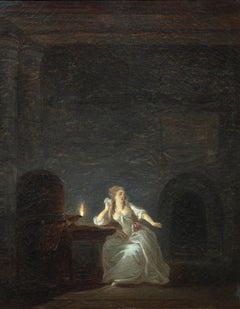
The Torture of the Vestal Virgin, a painting by Jean-Frédéric Schall (1752-1825)
Located in PARIS, FR
This atypical and terrifying painting by Jean-Frédéric Schall depicts the torture of a vestal virgin, condemned to be buried alive for having broken her vows. Dressed in a contemporary manner, our vestal provides a link between the gallant painting...
Category
Old Masters Late 18th Century Interior Paintings
Materials
Canvas, Oil
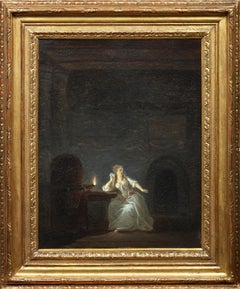
The Torture of the Vestal Virgin, a painting by Jean-Frédéric Schall (1752-1825)
Located in PARIS, FR
This atypical and terrifying painting by Jean-Frédéric Schall depicts the torture of a vestal virgin, condemned to be buried alive for having broken her vows. Dressed in a contemporary manner, our vestal provides a link between the gallant painting...
Category
Old Masters Late 18th Century Interior Paintings
Materials
Canvas, Oil
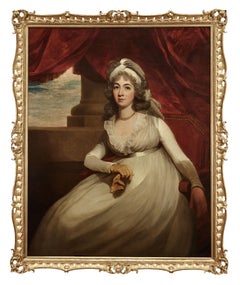
18th century English Portrait Painting of Anne, Duchess of Cumberland
By Sir Martin Archer Shee
Located in Bath, Somerset
Portrait of Anne, Duchess of Cumberland and Strathearn (1743-1808), three-quarter length, seated on a classical terrace in a white gown and headdress with yellow doeskin gloves. Circa 1795.
Oil on canvas in a giltwood frame.
Dimensions: 141 x 114cm (in frame)
Provenance:
Edmund de Rothschild (1916-2009), Exbury House, Hampshire, UK
Sotheby's London, 4 September 1997, lot 35
Sotheby's London, 14 March 1990, lot 68
Old Hall Gallery Ltd, Iden, Rye, Sussex (according to label on reverse)
Anne (née Luttrell; first married name Horton] Duchess of Cumberland and Strathearn (1743–1808), was born in Marylebone on 24 January 1743, the daughter of Simon Luttrell, Baron Irnham (1713–1787), and his wife, Judith Maria Lawes (d. 1798). Anne Luttrell's first husband was Christopher Horton (bap. 1741), the son of Christopher Horton and his wife, Frances, of Catton Hall, Derbyshire. They married on 4 August 1765, but Horton died on 5 August 1769.
Anne then married Henry Frederick, Prince, Duke of Cumberland and Strathearn, brother of George III on 2 October 1771, whom she had met at his Garter investiture ceremony at Windsor earlier that year. The Duke broke the news to George III on 2 November by presenting him with a letter announcing the marriage; the couple then departed for Calais. The marriage horrified George III, not only because of the Duchess's politically controversial family, but also because a marriage between a prince and a commoner was unequal in imperial law, barring any children from inheriting the electorate of Hanover. In Britain:
Cumberland refused to disavow the marriage and in consequence was barred from the king's presence. His mother, who was by now terminally ill, also refused to see him and they remained unreconciled at her death. Cumberland's failure to seek the King's permission for his marriage led to the King's forcing the Royal Marriages Act through parliament. It stipulated that no descendant of George II, other than the descendants of princesses who married into foreign families, could marry without the sovereign's consent.
Horace Walpole described the Duchess to Sir Horace Mann as 'Coquette beyond measure, artful as Cleopatra, and completely mistress of all her passions and projects' (Walpole, Corr., 23.345). It was probably her determination to be recognized as a princess that drove the couple forward, whereas the Duke was more relaxed about his social status. Excluded from the court of George III, the Cumberlands established a rival centre at Cumberland House in Pall Mall, which Cumberland acquired from the duke of Gloucester in 1772. They staged lavish entertainments, patronized musicians, had a succession of portraits painted, and travelled conspicuously in their state coach. Cumberland was still living on his original financial settlement and, beset by debts, the couple spent the period from summer 1773 to summer 1774 travelling in France and Italy. To the frustration of British diplomats attempting to execute George III's instructions that the Cumberlands should be allowed no precedence, the Duchess's claims to royal status were enhanced when she was received privately by Empress Maria Theresa at Vienna.
On their return to Britain the Duke and Duchess renewed their attempt to provide a livelier alternative to the court of George III. In 1775 Cumberland became patron of a boat club, the Cumberland Fleet, giving the Duke and Duchess the opportunity to sail down the Thames in a barge flying the royal standard at the centre of a well-attended social occasion. The society...
Category
Old Masters Late 18th Century Interior Paintings
Materials
Canvas, Oil
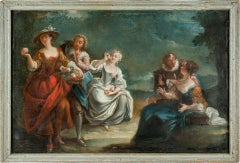
18th century French figure painting - Gallant scene - Oil on canvas Watteau
Located in Varmo, IT
18th century French painter - Gallant scene with ladies and suitors.
46 x 67.5 cm without frame, 48 x 69.5 cm with frame.
Oil on canvas, in wooden frame.
The author draws inspirat...
Category
French School Late 18th Century Interior Paintings
Materials
Canvas, Oil