1 of 11
John CallowSt Michael
s Mount, Cornwall - 19th century, old master, oil, Seascape painting19th century
19th century
$12,265.66List Price
About the Item
- Creator:John Callow (1822 - 1878)
- Creation Year:19th century
- Dimensions:Height: 31.11 in (79 cm)Width: 48.04 in (122 cm)Depth: 1.58 in (4 cm)
- Medium:
- Movement Style:
- Period:
- Condition:The painting is in fully restored condition and has been re-lined, cleaned and placed into a good quality gilt plaster and wooden frame ready to hang.
- Gallery Location:York, GB
- Reference Number:1stDibs: LU111323823312
Authenticity Guarantee
In the unlikely event there’s an issue with an item’s authenticity, contact us within 1 year for a full refund. DetailsMoney-Back Guarantee
If your item is not as described, is damaged in transit, or does not arrive, contact us within 7 days for a full refund. Details24-Hour Cancellation
You have a 24-hour grace period in which to reconsider your purchase, with no questions asked.Vetted Professional Sellers
Our world-class sellers must adhere to strict standards for service and quality, maintaining the integrity of our listings.Price-Match Guarantee
If you find that a seller listed the same item for a lower price elsewhere, we’ll match it.Trusted Global Delivery
Our best-in-class carrier network provides specialized shipping options worldwide, including custom delivery.You May Also Like
Oil on Canvas Painting Portrait of the Italian Noble Family of Zanardi Count
By Lucia Casalini Torelli
Located in Firenze, IT
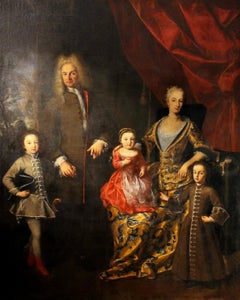
This museum quality old master oil on canvas formal portrait painting depicting the family of the Count Zanardi is signed by the artist- the female painter Lucia Casalini Torelli- and published in a book dedicated to Casalini Torelli’s workshop and academy.
This palatial masterpiece artwork comes directly from the ancient Villa Maraini Guerrieri - Palidano di Gonzaga (Mantua), an historic Italian heritage building owned by the descendants of the family portrayed for more than two centuries, until 1998.
The big scale of this oil on canvas masterpiece painting states the relevance of Lucia Casalini Torelli as a painter. The present artwork is a formal family portrait painting that aim to introduce the characters depicted according to their social role in the society. The noble family is all gathered under a loggia overlooking a park, the landscape in the background is partially covered by a beautiful red cloth on the right side.
The father stands up and holds the hand of his eldest son, proudly introducing his future heir. The son wears a light-blue dress and red boots, he is depicted in a serious pose holding a black tricorn hat under his arm and a rapier sword on his belt.
The mother wears an elegant gold and dark green brocade dress, she is sitting with her youngest daughter on her knees while her second son is by her side. The little daughter wears a lovely long red and dress with white lace and holds an apple on her hand. The son stands next to his mother and is dressed in a brown priestly clothes.
This palatial old masters piece was probably painted in 1740 due to the similarities with Cardinal Doria’ s portrait, now on display at the Doria Palace Museum, the official residence of the Prince of Genoa.
The painting features original canvas (“prima tela”) and antique original patina, it is in excellent overall condition considering the age, use and its large scale. A formal detailed condition report and the results of the inspection with the UV lamp accompanied by photos is available on request.
As well as for its exceptional quality and quite perfect state of conservation, this painting is particularly important and even more valuable both for the artist who painted it and for its absolutely exclusive provenance.
Lucia painted the most prominent and powerful noble families of her time, the location of these paintings is unknown to the art market as it is extremely likely that the portraits are still kept in private collections.
Furthermore, Lucia was one of the most appreciated artists of her time, so important that she was admitted as a member of the academy at a time when women were forbidden to attend these studies.
In 1706, Felice Torelli...
Category
18th Century Old Masters Portrait Paintings
Materials
Canvas, Oil
$173,682
H 94.49 in W 85.44 in D 1.19 in
Italian 18th Century Oval Religious Oil on Canvas Painting with Saint Dominic
By Francesco de Mura
Located in Firenze, IT
This beautiful Italian 18th Century old masters oil painting on oval canvas with giltwood frame is attributed to Solimena and features a religious scene.
In this splendid oval-shaped painting are depicted Saint Dominic...
Category
18th Century Old Masters Figurative Paintings
Materials
Canvas, Oil

$13,175
H 21.66 in Dm 15.75 in
Still Life with Squash, Gourds, Stoneware, and a Basket with Fruit and Cheese
Located in New York, NY
Provenance:
Selma Herringman, New York, ca. 1955-2013; thence by descent to:
Private Collection, New York, 2013-2020
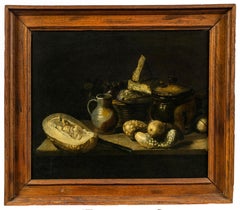
This seventeenth century Spanish still-life of a laden table, known as a bodegón, stands out for its dramatic lighting and for the detailed description of each object. The artist’s confident use of chiaroscuro enables the sliced-open squash in the left foreground to appear as if emerging out of the darkness and projecting towards the viewer. The light source emanates from the upper left, illuminating the array, and its strength is made apparent by the reflections on the pitcher, pot, and the fruit in the basket. Visible brush strokes accentuate the vegetables’ rough surfaces and delicate interiors. Although the painter of this striking work remains unknown, it is a characteristic example of the pioneering Spanish still-lifes of the baroque period, which brought inanimate objects alive on canvas.
In our painting, the knife and the large yellow squash boldly protrude off the table. Balancing objects on the edge of a table was a clever way for still-life painters to emphasize the three-dimensionality of the objects depicted, as well a way to lend a sense of drama to an otherwise static image. The knife here teeters on the edge, appearing as if it might fall off the table and out of the painting at any moment. The shape and consistency of the squash at left is brilliantly conveyed through the light brush strokes that define the vegetable’s fleshy and feathery interior. The smaller gourds—gathered together in a pile—are shrouded partly in darkness and stand out for their rugged, bumpy exterior. The stoneware has a brassy glaze, and the earthy tones of the vessels are carefully modulated by their interaction with the light and shadow that falls across them. The artist has cleverly arranged the still-life in a V-shaped composition, with a triangular slice of cheese standing upright, serving as its pinnacle.
Independent still-lifes only became an important pictorial genre in the first years of the seventeenth century. In Italy, and particularly through the revolutionary works of Caravaggio, painted objects became carriers of meaning, and their depiction and arrangement the province of serious artistic scrutiny. Caravaggio famously asserted that it was equally difficult to paint a still-life as it was to paint figures, and the elevation of this new art form would have profound consequences to the present day. In Spain Juan Sanchez Cotan...
Category
17th Century Old Masters Still-life Paintings
Materials
Canvas, Oil
$20,000
H 20.5 in W 24.5 in
Portrait of a Lady, After Sir Peter Lely (1610-1680) Oil Painting
By After Sir Peter Lely
Located in Uppingham, GB
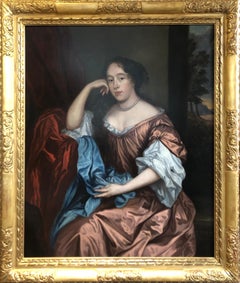
Oil Painting After Sir Peter Lely (1610-1680) Portrait of a Lady
Housed in a Lely gold Leaf Frame.
Peter Lely:
In 1647 he became a member of the Pain...
Category
17th Century Old Masters Portrait Paintings
Materials
Oil
$17,045
H 57 in W 47 in D 4 in
"Passage to Town, " Oil on Board
By Bruno Surdo
Located in Chicago, IL
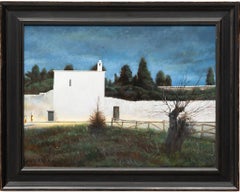
Chicago-based fine art painter Bruno A. Surdo is classically trained in drawing and oil painting in the tradition of Renaissance masters. With strong command of the human form, Surdo...
Category
21st Century and Contemporary Old Masters Landscape Paintings
Materials
Oil, Board
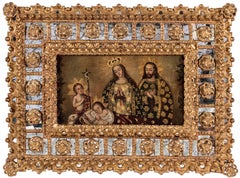
A Magnificent Gilt Wood Mirrored Frame
Located in New York, NY
Provenance: Private Collection, Argentina; there acquired by
Mr. and Mrs. Ernest T. Harper, New York, by 1960; by descent to:
Mr. and Mrs. Alan Harper, New York, until 2024.
This extraordinary mirrored frame is an exuberant and nearly perfectly preserved example of Andean 18th-century decorative art. Pierced mirrored rosettes surrounding floral motifs are set against mirrored surrounds along a broad frieze bordered within and without by elaborate raised moldings, inlaid by small, shaped mirrors. Repeating ornamental motifs reflecting both Spanish and indigenous designs surround both the inside panel and the exterior perimeter, the four corners of which are punctuated by mirrored rosettes.
Glass mirrors were unknown to the indigenous population of the Americas prior to the arrival of Europeans (obsidian mirrors...
Category
18th Century Old Masters Figurative Paintings
Materials
Canvas, Mirror, Wood, Oil
$135,000
H 37 in W 50 in
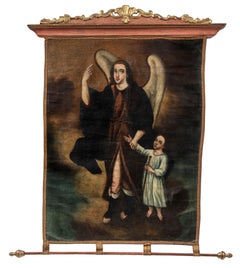
A Guardian Angel Leading a Child
Located in New York, NY
Provenance: Private Collection, Argentina; there acquired by
Mr. and Mrs. Ernest T. Harper, New York, by 1960; by descent to:
Mr. and Mrs. Alan Harper, New York, until 2024.
This s...
Category
18th Century Old Masters Figurative Paintings
Materials
Canvas, Oil
$82,500
H 30 in W 22.5 in
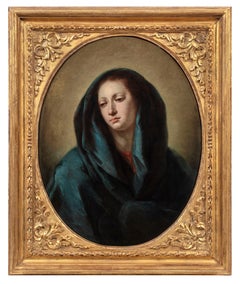
Head of the Virgin
Located in New York, NY
Provenance: Private Collection, Paraguay.
This unpublished Head of the Virgin is a new addition to the rich corpus of paintings by Giovanni Battista Tiepolo. While the artist freque...
Category
18th Century Old Masters Figurative Paintings
Materials
Oil, Canvas
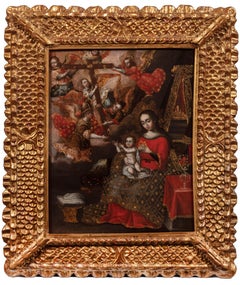
Virgin and Child with Angels Carrying the Cross (Vision of the Cross)
Located in New York, NY
Provenance: Fernandez Jimenez, Spain; part a family collection for over 80 years.
Prints transported to the New World for use in missionary work and religious instruction often serv...
Category
18th Century Old Masters Figurative Paintings
Materials
Canvas, Oil
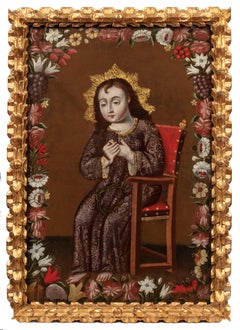
Young Christ Pricked by a Thorn (Niño de la Espina)
Located in New York, NY
Provenance: Private Collection, Paraguay, for at least the last 80 years
Painted in the Viceroyalty of Peru during the 18th century, the present work depicts the young Christ as the Niño de la Espina—a devotional representation of Christ as he looks down at his bleeding finger, which has been pricked by the crown of thorns resting on his lap. The subject of the Young Christ Pricked by a Thorn was especially popular in Cuzco, and the rich details and decorative elements of our work perfectly capture the essence and style of the Cuzco School of painting.
In our painting, Christ wears an intricately patterned floor-length robe trimmed with gilded cuffs and a gilded collar. The delicate gilding, including the halo of golden rays emanating from his head, are executed in brocateado, an ornamental over-gilding technique that is characteristic of the Cuzco School. The red chair on which Christ sits also includes brocateado in the decorative gilt elements. The form of the chair takes inspiration from those commonly used by friars both in Spain and the Andes, known as silla frailera or sillon frailero, and was also frequently employed in related depictions of the Virgin Mary Spinning. Here the young Christ is rendered with soft, elongated features that reflect the influence of the Italian Mannerist painters who were pivotal to the formation of the Cuzco School, including the Jesuit friar Bernardo Bitti and Matteo Pérez del Alesio. Additionally, while its origins can be traced to Northern European pictorial traditions, the lush flower garland that frames the work is a signature feature of Cuzqueño painting...
Category
18th Century Old Masters Figurative Paintings
Materials
Canvas, Oil
$82,500
H 35.75 in W 23.63 in
Still Thinking About These?
All Recently ViewedMore Ways To Browse
19th Century Seascape Paintings
St John Paintings
Oil Painting Cornwall
Antique St Michael
Old Master Seascape
St John Oil Paintings
St Michaels Mount
William Callow
Paris Scene Oil Painting 1950
African American Art
Iranian Artist
Painting Of Woman In Hat
Oil On Board Impressionist
Stream Paintings
The Pantheon
French Impressionist Still Life
Paris Marais
1975 Painting