Items Similar to The Garden Near Cailhau By Achille Laugé
Video Loading
Want more images or videos?
Request additional images or videos from the seller
1 of 11
Achille LaugéThe Garden Near Cailhau By Achille LaugéCirca 1896
Circa 1896
$985,000
£750,784.18
€865,950.93
CA$1,398,994.52
A$1,503,366.77
CHF 806,643.49
MX$17,708,741.73
NOK 10,142,647.44
SEK 9,265,242.93
DKK 6,471,775.05
About the Item
Achille Laugé
1861-1944 French
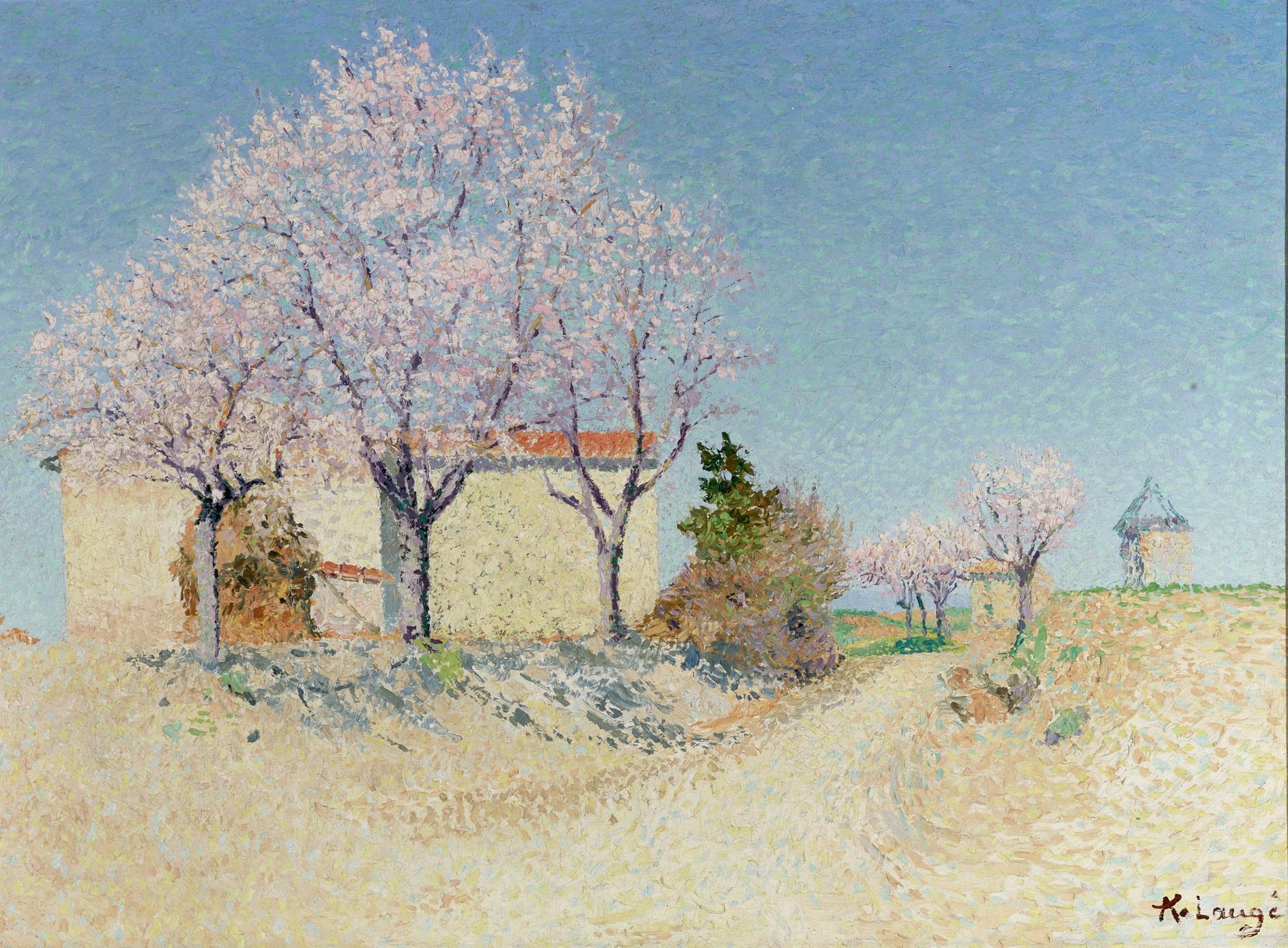
The Garden Near Cailhau
Signed "A. Laugé 96" (lower left)
Oil on canvas
“Laugé’s art is one of great sensitivity and controlled reason; he is a master of light.” — Antoine Bourdelle, French Artist, Esteemed Peer, June 1927
This incredible work by Achille Laugé entitled The Garden Near Cailhau showcases the masterful artist at his very best. During his lifetime, Achille Laugé was celebrated by his peers and the public alike for producing dazzling works with subtly divided southern light, pure tones and rigorous geometry. His reputation continued to grow after his death, and today the art market recognizes him as a master of Neo-Impressionism. Though his command of the pointillist and divisionist styles often draws comparison to his Neo-Impressionist peers like Seurat and Signac, Laugé approached the style with his own unique sensibility. Laugé‘s oeuvre showcases his taste for monumental, static art emphasizing rhythm, line and purity. More personally, Laugé was deeply inspired by his hometown's natural beauty and familiarity.
The Garden Near Cailhau depicts a quintessential scene from the artist — a touching tribute to his beloved home. Featuring a road flanked by trees and bathed in sunlight, the flowering trees that line the path merge with the pointillist dots to create a stunning visual effect. The tree-lined path recedes into the distance towards the commune of Cailhau on top of a hill. The composition masterfully combines all the principles of divisionism while staying true to Laugé’s roots. Marked by a luminous color palette and a robust paint application that causes the scene to emerge in three dimensions, it is among the finest of Laugé’s output, and the canvas remains in its original unlined state in perfect condition.
The son of a farmer, Achille Laugé initially opted for a career as a pharmacist before giving up his studies to enroll at the Toulouse School of Fine Arts in 1876. During his apprenticeship, he met Antoine Bourdelle, Henri Martin and Henri Marre, who encouraged him to go to Paris in 1882 to study at the École des Beaux-Arts. It was in Paris in the early 1890s that Laugé discovered the paintings of Seurat and Signac.
He was encouraged by Bourdelle, who told him, "You bring a very personal vision, a great deal of serene logic and a beautiful gift of unity in the love of the luminous air that reigns even in your shadows" — very high praise from a peer! After his sojourn to Paris, Laugé returned to his childhood home of Cailhau near Carcassonne in the Aude, establishing himself permanently in somewhat relative isolation and only exhibiting on the rare occasion at the Salon des Indépendants in Paris. It was within this strategic isolation that the artist refined his point of view and honed his individual stylistic language.
Born in 1861 to wealthy farmers, he moved to Toulouse at the age of 17 to study pharmacy. At this time, he also enrolled part-time at the school of the Beaux-Arts, where he befriended the artist Bourdelle. Three years later, he moved to Paris, where he studied under the famous masters Alexandre Cabanel and Aristide Maillol, making his debut at the Salon in 1884. Like many other artists of his generation, Laugé eventually rejected the conservative ideals of this teacher, falling under the Post-Impressionist influence of Georges Seurat. By 1888, his landscapes became assiduous experiments in complementary colors and light on canvas. He exhibited three paintings at the Salon des Indépendants in 1894, as well as with the Nabis that same year. In addition, Laugé held several one-man shows in Paris, Toulouse and Perpignan from 1907 to 1930.
It was after his departure from Paris that Laugé developed his divisionist technique, following the lead of Seurat and the Pointillists. Although Laugé never adopted Seurat’s scientific attitude, his interest in the primacy and division of color resulted in work with a vivid, translucent palette. From 1888 until about 1896, Laugé composed his pictures with small points of color. At the end of the century, he abandoned the dots and dabs and painted his landscapes, portraits and still-lifes with thin, systematically placed strokes resembling crosshatching. After 1905, he applied his pigments more freely, with enlarged strokes and thick impasto that brought him closer to a traditional impressionist technique whilst maintaining his ability to paint the effect of southern light. Today, his exceptional works can be found at the Museum of Fine Arts, Houston and museums throughout France, including the Musée d'Orsay in Paris.
Circa 1896
Canvas: 25 1/2" high x 32" wide, 64.77 x 81.28 cm
Frame: 31 1/2" high x 37 7/8" wide, 80.01 x 96.20 cm
Provenance:
Acquired directly from the artist
Private Collection
Private Collection, Paris
M.S. Rau, New Orleans
- Creator:Achille Laugé (1861-1944, French)
- Creation Year:Circa 1896
- Dimensions:Height: 31.5 in (80.01 cm)Width: 37.88 in (96.22 cm)Depth: 1.5 in (3.81 cm)
- Medium:
- Movement Style:
- Period:
- Condition:
- Gallery Location:New Orleans, LA
- Reference Number:Seller: 31-82761stDibs: LU18613932502
Achille Laugé
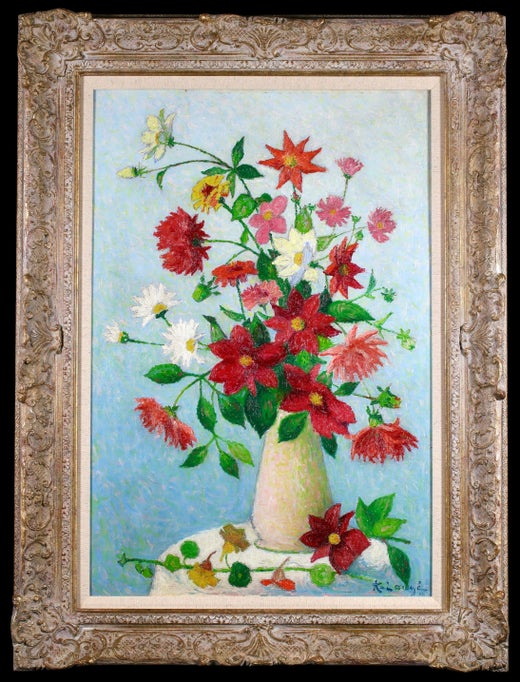
Achille Laugé was the son of well-to-do farmers who moved to Cailhau near Carcassonne, where he spent most of his life. Laugé began studies in Toulouse in 1878, and went to Paris in 1881. At the Ecole des Beaux-Arts he studied with Alexandre Cabanel and Jean-Paul Laurens. There, Antoine Bourdelle, whom Laugé had known in Toulouse, introduced him to Aristide Maillol, and the three maintained a long and fruitful friendship. In 1888, after seven years in Paris, including a term of military service, Laugé returned to the south and established himself at Carcassonne. Finally, in 1895, he returned to Cailhau where he spent the rest of his life. Laugé’s time in Paris spanned the critical years from 1886 to1888 (Seurat's La Grande Jatte was first exhibited amidst much controversy in 1886) and his contact with Neo-Impressionism should not be underestimated. In 1894, he exhibited at the Salon des Indépendants, as well as at a Toulouse exhibition with de Bonnard, Maurice Denis, Sérusier, Roussel, Toulouse-Lautrec and Vuillard. In addition, he held several one-man shows in Paris from 1907 to 1930. It was after his departure from Paris that Laugé developed his divisionist technique, following the lead of Seurat and the Pointillists. Although Laugé never adopted Seurat’s scientific attitude, his interest in the primacy and division of color resulted in work with a vivid, translucent palette. From 1888 until about 1896, Laugé composed his pictures witth small points of color. At the end of the century, he abandoned the dots and dabs and painted his landscapes, portraits, and still-lives with thin, systematically placed strokes resembling crosshatching. After 1905, he applied his pigments more freely, with enlarged strokes and thick impasto that brought him closer to a traditional impressionist technique whilst maintaining his ability to paint the translucence of southern light.
About the Seller
5.0
Vetted Professional Seller
Every seller passes strict standards for authenticity and reliability
Established in 1912
1stDibs seller since 2013
21 sales on 1stDibs
Typical response time: 8 hours
- ShippingRetrieving quote...Shipping from: New Orleans, LA
- Return Policy
More From This Seller
View AllAlmond Trees in Spring
By Achille Laugé
Located in New Orleans, LA
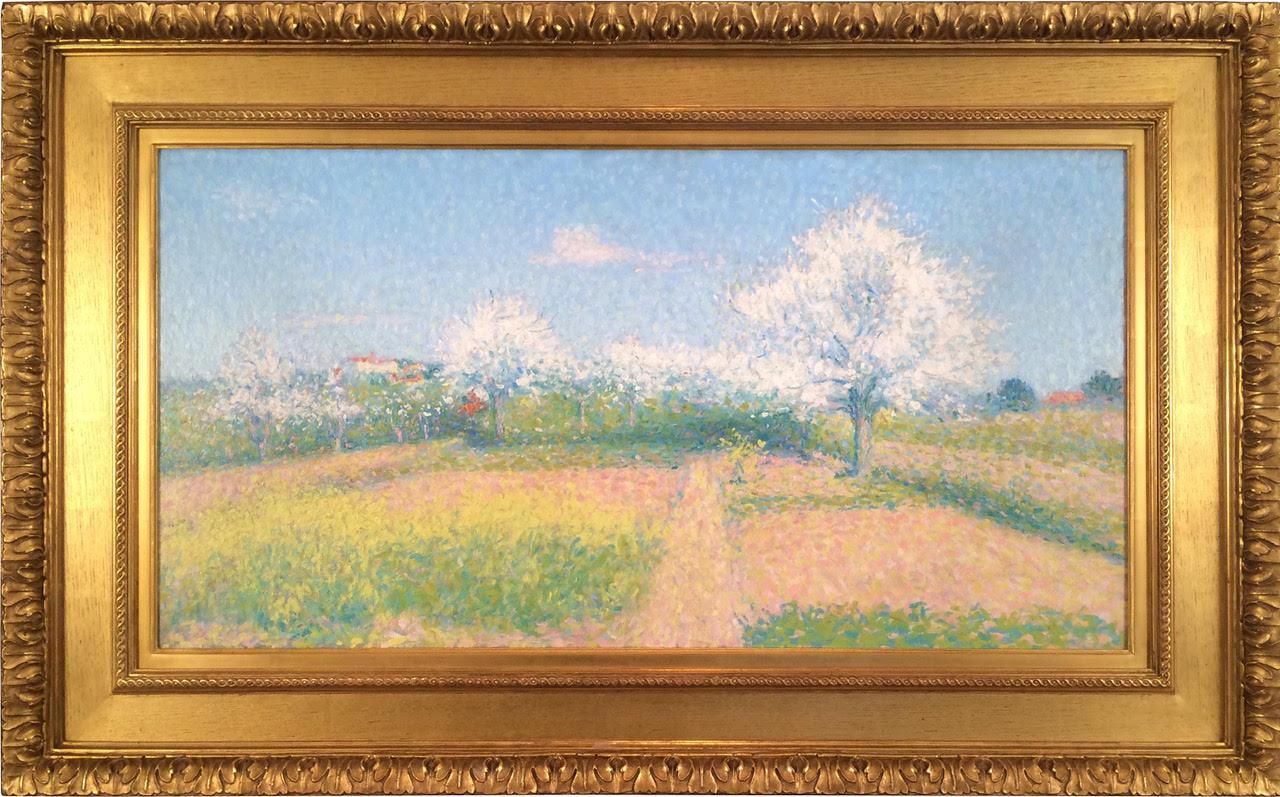
This Neo-Impressionist landscape by the French artist Achille Laugé captures an orchard in late spring in his celebrated, highly modern style. The work displays a thick impasto thanks to the artist's distinctive technique of applying his paint in quick dabs, a characteristic of his later works. One of the foremost painters of the Post-Impressionist period, Laugé’s works are beloved for his sensitivity to light, shade and tone, and his mastery of medium is clearly on display in Almond Trees...
Category
20th Century Post-Impressionist Landscape Paintings
Materials
Canvas, Oil
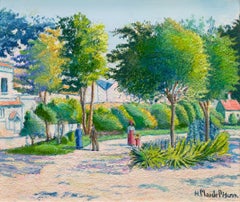
Le jardin municipal, Noisy-le-Sec by H. Claude Pissarro
By Hughes Claude Pissarro
Located in New Orleans, LA
Hugues Claude Pissarro
b.1935 French
Le jardin municipal, Noisy-le-Sec
(The Municipal Garden, Noisy-le-Sec)
Signed “H. Claude Pissarro” (lower right)
Oil on canvas
The Pissarro f...
Category
21st Century and Contemporary Post-Modern Landscape Paintings
Materials
Canvas, Oil
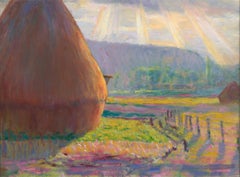
Grainstacks in plaine des Ajoux, Giverny by Theodore Earl Butler
By Theodore Earl Butler
Located in New Orleans, LA
Theodore Earl Butler
1861-1936 American
Grainstacks in plaine des Ajoux, Giverny
Oil on canvas
Theodore Earl Butler was one of the leading American Impressionists, known for his ...
Category
Late 19th Century Impressionist Landscape Paintings
Materials
Canvas, Oil
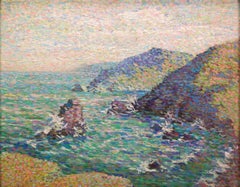
Les Falaises By Willy Schlobach
By Willy Schlobach
Located in New Orleans, LA
Willy Schlobach
1864-1951 Belgian
Les falaises
(The Cliffs)
Oil on canvas
Signed with artist’s monogram “W.S.” (lower right)
This coastal landscape showcases the bold palette and...
Category
20th Century Post-Impressionist Landscape Paintings
Materials
Canvas, Oil
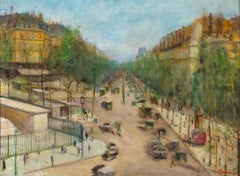
Les grands boulevards by Lucien Adrion
By Lucien Adrion
Located in New Orleans, LA
Lucien Adrion
1889-1953 I French
Les Grands Boulevards
Signed “Adrion” lower right
Oil on canvas
This magnificent painting, Les Grands Boulevards, was painted by Lucien Adrion, a French Post-Impressionist renowned for his evocative portrayals of French landscapes and Parisian life. This work captures the vibrant energy of a quintessential Parisian boulevard under a radiant blue sky. Pedestrians, cars and horse...
Category
20th Century Post-Impressionist Landscape Paintings
Materials
Canvas, Oil
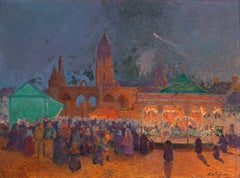
La Fête Foraine De Nuit À Batz-Sur-Mer By Ferdinand Du Puigaudeau
By Ferdinand du Puigaudeau
Located in New Orleans, LA
Ferdinand du Puigaudeau
1864-1930 French
La fête foraine de nuit à Batz-sur-Mer
(The Nighttime Fair at Batz-sur-Mer)
Signed "F. du Puigaudeau" (lower right)
Oil on canvas
Glowing...
Category
20th Century Post-Impressionist Landscape Paintings
Materials
Canvas, Oil
You May Also Like
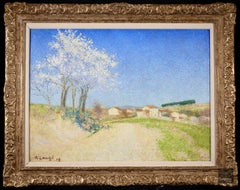
Belveze du Razes - Neo-Impressionist Pointillist Oil, Landscape by Achille Lauge
By Achille Laugé
Located in Marlow, Buckinghamshire
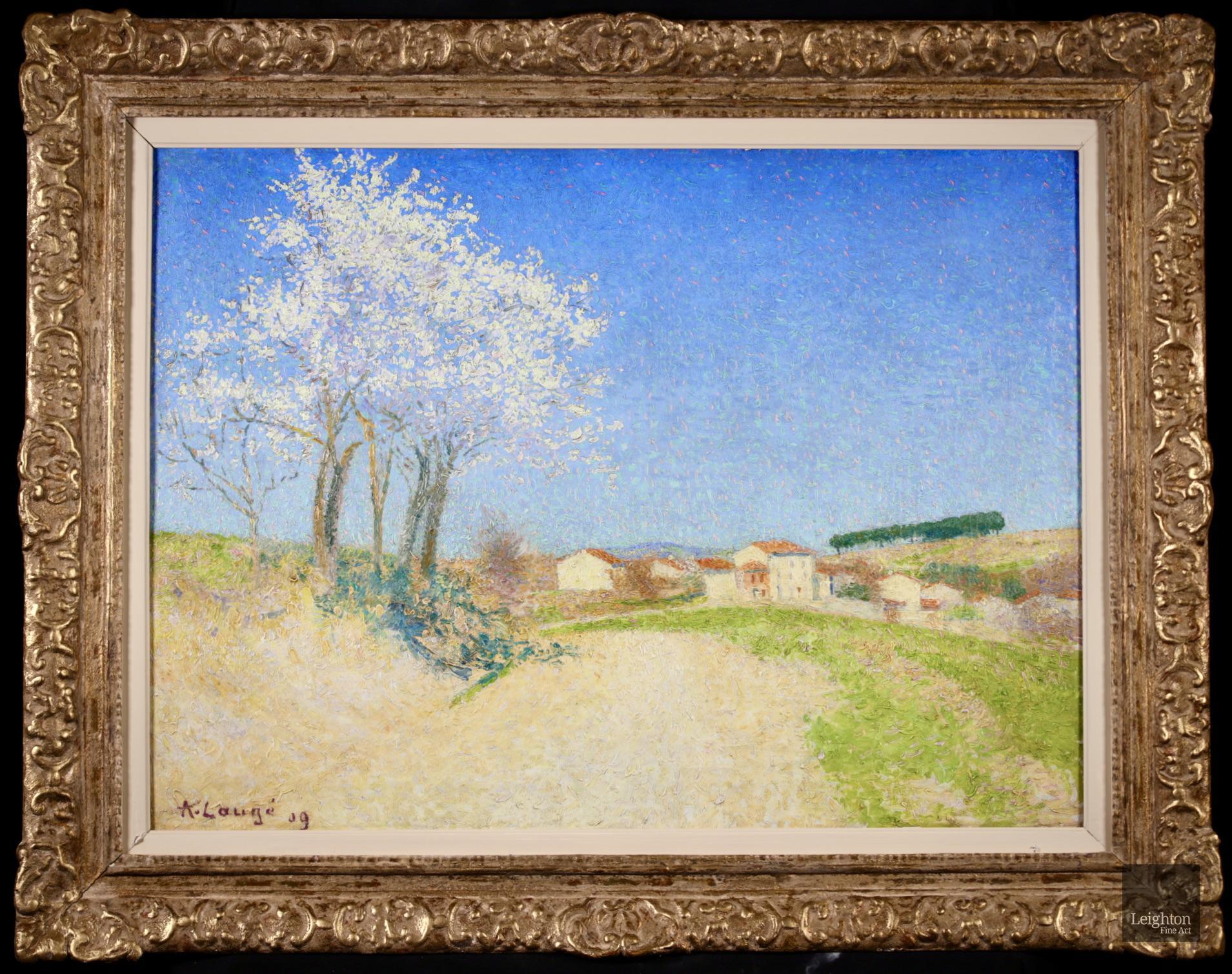
Stunning pointillist landscape oil on panel by French neo-impressionist painter Achille Lauge. The work depicts a path leading to the small village of Belveze du Razes in the South of France on a bright spring day. To the left are white blossom trees in bloom and the houses of the village can be seen in the distance.
Signature:
Signed and dated 1909 lower left
Dimensions:
Framed: 28"x36"
Unframed: 21"x29"
Provenance:
We kindly thank Mme. Nicole Tamburini for allowing us to state that the work is included in the Catalogue Raisonne of the artist which she is currently preparing.
A certificate of authenticity from Mme. Tamburini is available upon request.
Achille Laugé...
Category
Early 1900s Pointillist Landscape Paintings
Materials
Oil, Canvas
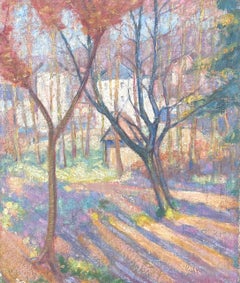
Fine Antique French Impressionist Oil Painting Woodland Gardens Old Stone House
Located in Cirencester, Gloucestershire
The Old Stone House
French Impressionist School, late 19th/ early 20th century
circle of Camille Pissarro (French, 1830-1903), unsigned
oil on canvas, unframed
canvas: 29 x 24 inches...
Category
Early 20th Century Impressionist Landscape Paintings
Materials
Oil
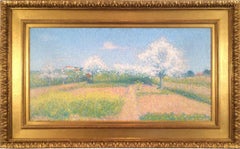
Verger de l’Ariste Oil on Canvas, French Landscape, Circa 1925, Signed
By Achille Laugé
Located in New York, NY
Provenance
Kaplan Gallery, London
Commander Jeoffroy Littleton Lowis, London (acquired from the above, 1966)
Acquired from the above by the present owner, 2006
Exhibited
London, Kap...
Category
1920s Pointillist Landscape Paintings
Materials
Canvas, Oil
Fine 1970
s French Post-Impressionist Signed Oil Flower Garden Cote d
Azur
Located in Cirencester, Gloucestershire
Flowers on the Cote d'Azur
French Post-Impressionist artist, indistinctly signed
circa 1970's
oil on canvas, unframed
canvas: 15 x 18 inches
Provenance: private collection, France
Co...
Category
Mid-20th Century Post-Impressionist Landscape Paintings
Materials
Oil

Le jardin de Lysou à Monaco by Lélia Pissarro - Oil Painting, Landscape
By Lelia Pissarro
Located in London, GB
Le jardin de Lysou à Monaco by Lélia Pissarro (b. 1963)
Oil on canvas
38 x 45.7 cm (15 x 18 inches)
Signed lower right, Lélia Pissarro
Signed and titled on the reverse
This work is ...
Category
21st Century and Contemporary Post-Impressionist Landscape Paintings
Materials
Canvas, Oil
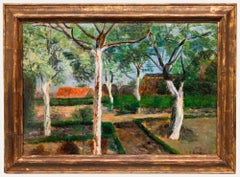
Anna Bornemann (1874-1956) - 1900 Oil, A View of the Garden
Located in Corsham, GB
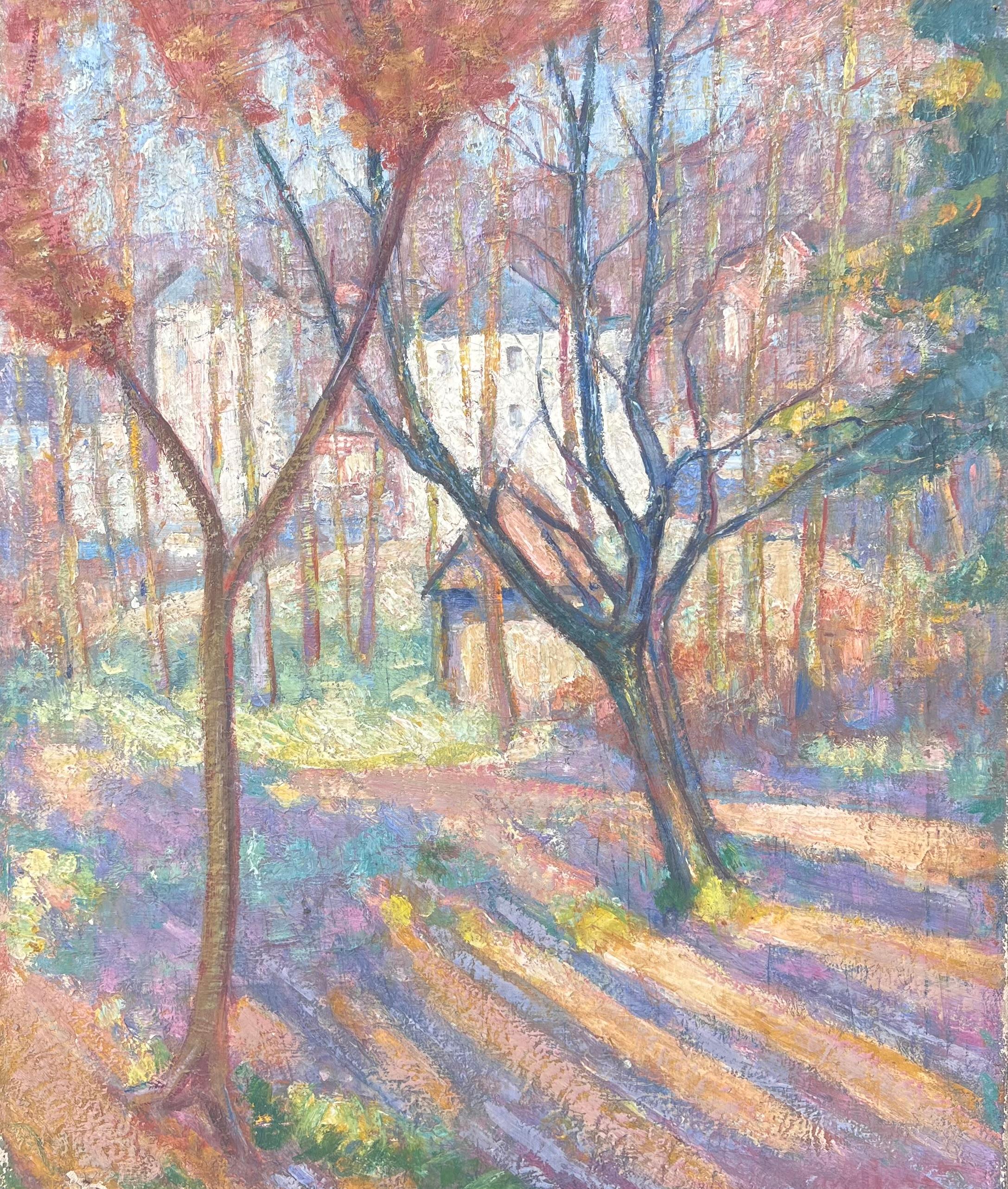
This delightful turn of the century landscape by the artist Anna Bornemann (1874-1956) depicts a serene garden scene featuring several skeletal trees with silvery bark set against a ...
Category
Early 20th Century Landscape Paintings
Materials
Oil
Read More
Paul Revere Crafted This Silver Coffee Pot 250 Years Ago
Perhaps best known as a Revolutionary War hero, Revere was also an accomplished silversmith, and this pot is now available on 1stDibs.
Degas Portrayed These Exuberant Ukrainian Dancers with ‘Orgies of Color’
Discovered in Parisian cabarets, the performers reenergized the artist’s practice.
More Ways To Browse
Maillol Aristide
Achille Lauge
Orchard Painting
Red Roof Painting
Rowing Art
Thames Oil Painting
20th Century Irish Artists
Alpine Landscape Painting
Beach Pastels
Elaine Gray
Gallery Provence
Landscape Oil Gilt Frame
Landscape Oil Painting Pacific
Monet Water Lilies
Naive Landscape Painting
Normandy Landscape Painting
Notre Dame Oil Paintings
Oil Derrick