Items Similar to Tree Landscape, Expressionist Oil on Panel, Signed, 1940s, Framed
Want more images or videos?
Request additional images or videos from the seller
1 of 12
Agda HolstTree Landscape, Expressionist Oil on Panel, Signed, 1940s, Framed1948
1948
$1,492.24
$2,487.0740% Off
£1,114.51
£1,857.5140% Off
€1,260
€2,10040% Off
CA$2,072.35
CA$3,453.9240% Off
A$2,225.19
A$3,708.6440% Off
CHF 1,197.33
CHF 1,995.5540% Off
MX$26,332.90
MX$43,888.1740% Off
NOK 15,084.19
NOK 25,140.3140% Off
SEK 13,757.62
SEK 22,929.3740% Off
DKK 9,602.72
DKK 16,004.5440% Off
About the Item
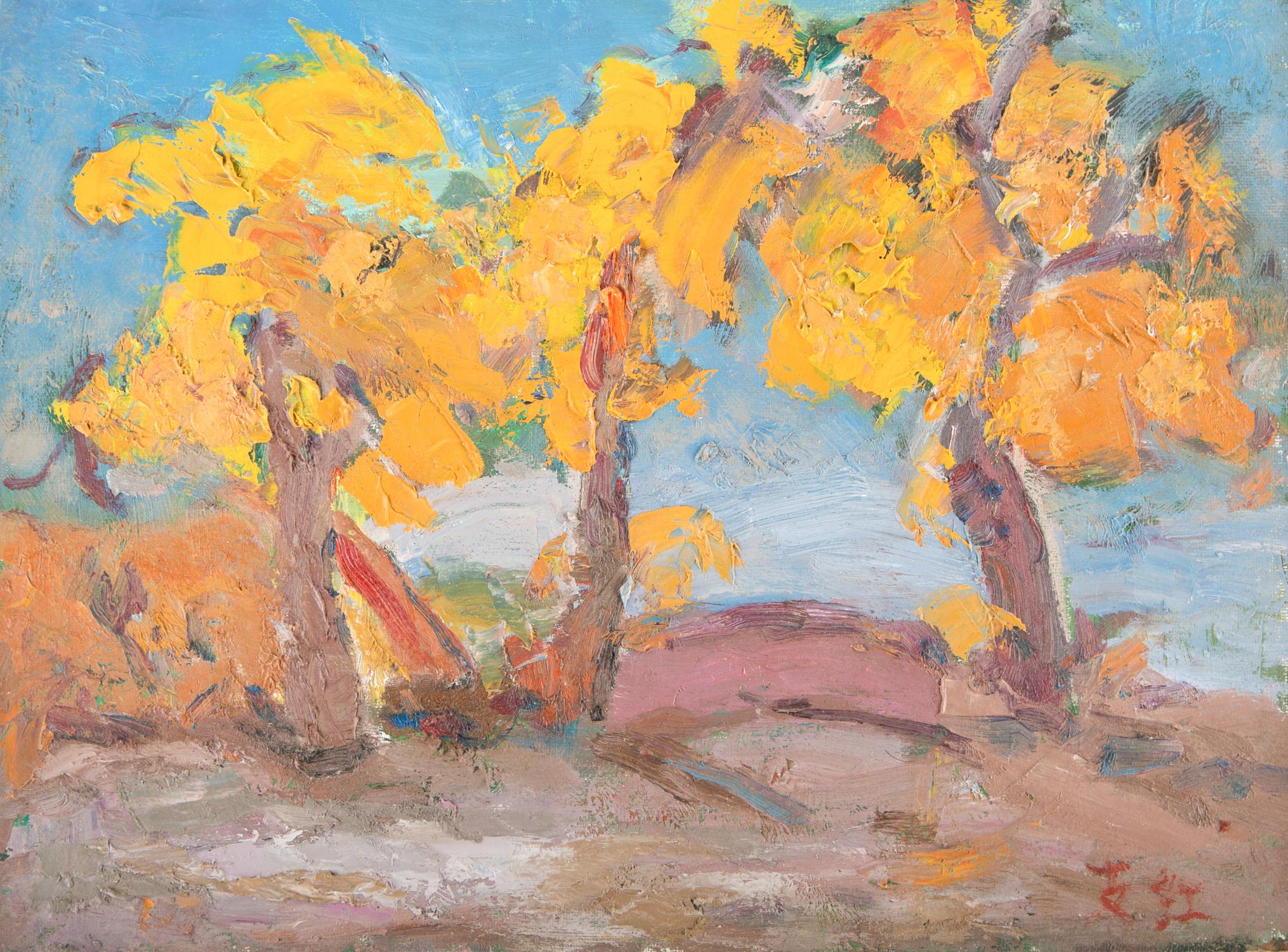
A vibrant painting depicting an avenue lined with poplar trees in fall colors, prominently featuring a very large, centrally placed yellow poplar. Possibly an American poplar. The artist, Agda Holst, has employed a diverse palette of colors to the poplars, creating a dynamic and colorful composition. This oil on panel is signed and dated by Holst in 1948. The work exemplifies her use of color and form, characteristics that defined her artistic practice throughout her career.
Agda Holst was a Swedish modernist painter known for her precise study of form, stylized compositions, and ability to merge structured geometry with expressive color. Her works, often still lifes, portraits, and figure studies, reflect a balance between naturalistic representation and modernist influences such as Cubism and New Objectivity.
Holst's artistic journey began in 1907 at the Académie Colarossi in Paris, where she studied under Christian Krohg. Seeking further refinement, she moved to Munich between 1910 and 1911, studying with Julius Exter, known for his teachings in portrait and genre painting. In 1911–1912, she returned to Paris to study under Kees van Dongen, whose bold use of color and strong contrasts left a lasting impression on her work. The early 1920s marked another period of study in Paris, this time under André Lhote, who instilled in her a structured approach to composition and geometric clarity.
Holst’s first public exhibition took place in 1916, when she displayed paintings in a bookstore window in Kristianstad. Her official debut followed at Skånes konstförening in Malmö. By the late 1920s, she had established herself as a professional artist, holding her first solo exhibition at Lund University’s Art Museum in 1927. This success led to portrait commissions.
Throughout her career, Holst exhibited widely, with solo shows in Skåne and participation in group exhibitions in Stockholm, Copenhagen, Bordeaux, and New York. In 1931, she held a significant solo exhibition at Malmö City Hall, followed by a show at Gothenburg’s Art Hall in 1932, where her self-portrait At the Easel received critical acclaim. Her works were also featured at the Salon des Indépendants in Bordeaux.
Despite being the only woman in the male-dominated artist collective Aura, founded in 1928, Holst was highly respected by her colleagues. Unlike many female artists of her time, she was treated as an equal by her male peers, who recognized her talent and professionalism.
Her work evolved throughout her career, moving from precisely structured portraits to more expressive and textured compositions. The late 1930s saw an increased focus on still lifes, where she explored the interplay of form and color in a Cubist-influenced style. Her 1948 painting of the poplar-lined avenue exemplifies her mature artistic voice, where vibrant hues and dynamic composition come together in a striking yet harmonious manner.
In 1945, Kristianstad’s museum held a retrospective exhibition celebrating 40 years of Holst’s work, tracing her artistic evolution from academic studies to modernist expression. By this time, she had gained the financial freedom to paint without commercial constraints, allowing her work to take on a more introspective and experimental tone. Many of her later works became increasingly expressive, with biblical themes, palette knife techniques, and sketch-like compositions.
In 1964, she was awarded Kristianstad’s first cultural prize, and in 1965, a retrospective exhibition at the city’s museum further solidified her legacy. As her eyesight deteriorated in later years, she adapted her technique, working more with pastels.
Agda Holst passed away in 1976 in her lifelong home in Kristianstad. Her influence on Swedish modernism remains significant, and her works continue to be displayed in posthumous exhibitions.
- Creator:Agda Holst (1886 - 1976, Swedish)
- Creation Year:1948
- Dimensions:Height: 25.2 in (64 cm)Width: 21.26 in (54 cm)Depth: 1.58 in (4 cm)
- Medium:
- Movement Style:
- Period:
- Condition:The painting is in very nice condition. A light surface cleaning is recommended. We can have our restorer to do this at no extra cost.
- Gallery Location:Stockholm, SE
- Reference Number:1stDibs: LU2608215822162
About the Seller
5.0
Gold Seller
Premium sellers maintaining a 4.3+ rating and 24-hour response times
1stDibs seller since 2023
34 sales on 1stDibs
Typical response time: <1 hour
- ShippingRetrieving quote...Shipping from: Stockholm, Sweden
- Return Policy
More From This Seller
View AllAfter the Storm, Naturalistic Oil Painting on Canvas, Signed, 1917
Located in Stockholm, SE
"After the Storm" is the title of this oil painting on canvas by the Swedish artist Hjalmar Berghcrantz (1889–1961). Signed and dated 1917. The artwork depicts a rugged landscape whe...
Category
1910s Naturalistic Landscape Paintings
Materials
Canvas, Oil
Southern Coast with Beach, Trees and Sailboat, Impressionistic Painting, 1920´s
Located in Stockholm, SE
A Southern Coastal Landscape by Charles Bisschops. This oil on canvas, signed L. Ch. Bisschops, depicts a southern coastal scene with a beach bordered by trees. Across the bay, mount...
Category
1920s Impressionist Landscape Paintings
Materials
Oil, Canvas
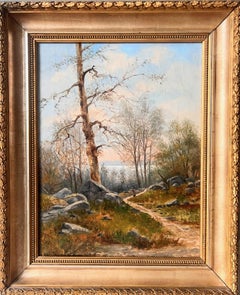
Swedish Landscape, Oil Painting, 19th Century, Framed
Located in Stockholm, SE
Autumn landscape attributed to Arvid Mauritz Lindström (1849-1923)
On a path winding between trees and stones beside a lake, a woman is walking. The work is painted in a relatively f...
Category
Late 19th Century Naturalistic Landscape Paintings
Materials
Oil, Canvas
$1,575 Sale Price
30% Off
Free Shipping
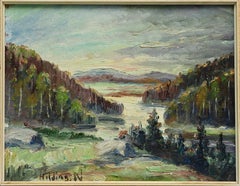
Mountain Landscape Painting, Oil on Panel, Northern Sweden
Located in Stockholm, SE
A mountainous landscape painted by Hilding Elof Nyman (1870 - 1937). Oil on panel. The motif is probably from Dalarna in Swedens north part were he spent periods of his life. Nyman ...
Category
Early 20th Century Impressionist Landscape Paintings
Materials
Oil, Panel
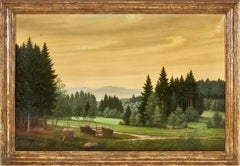
Twilight in the Forest Meadow, Oil on Canvas, Signed, 1920s, Framed
Located in Stockholm, SE
An expansive twilight landscape unfolds before you: a dark spruce forest opens into a quiet forest meadow, the silence punctuated only by the fading light. In the distance, the Bavar...
Category
1920s Other Art Style Landscape Paintings
Materials
Oil, Canvas
$1,740 Sale Price
30% Off
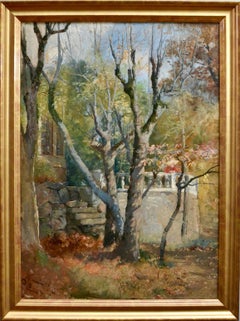
Autumn Mood in the Garden, Impressionist Oil on Canvas, 19th Century
Located in Stockholm, SE
The present painting, Autumn mood in the garden by the female artist Elisabeth Warling (1858–1915) is a fine example of her impressionistic works. Signed "Elisabeth Warling" and with...
Category
Late 19th Century Impressionist Landscape Paintings
Materials
Canvas, Oil, Panel
You May Also Like
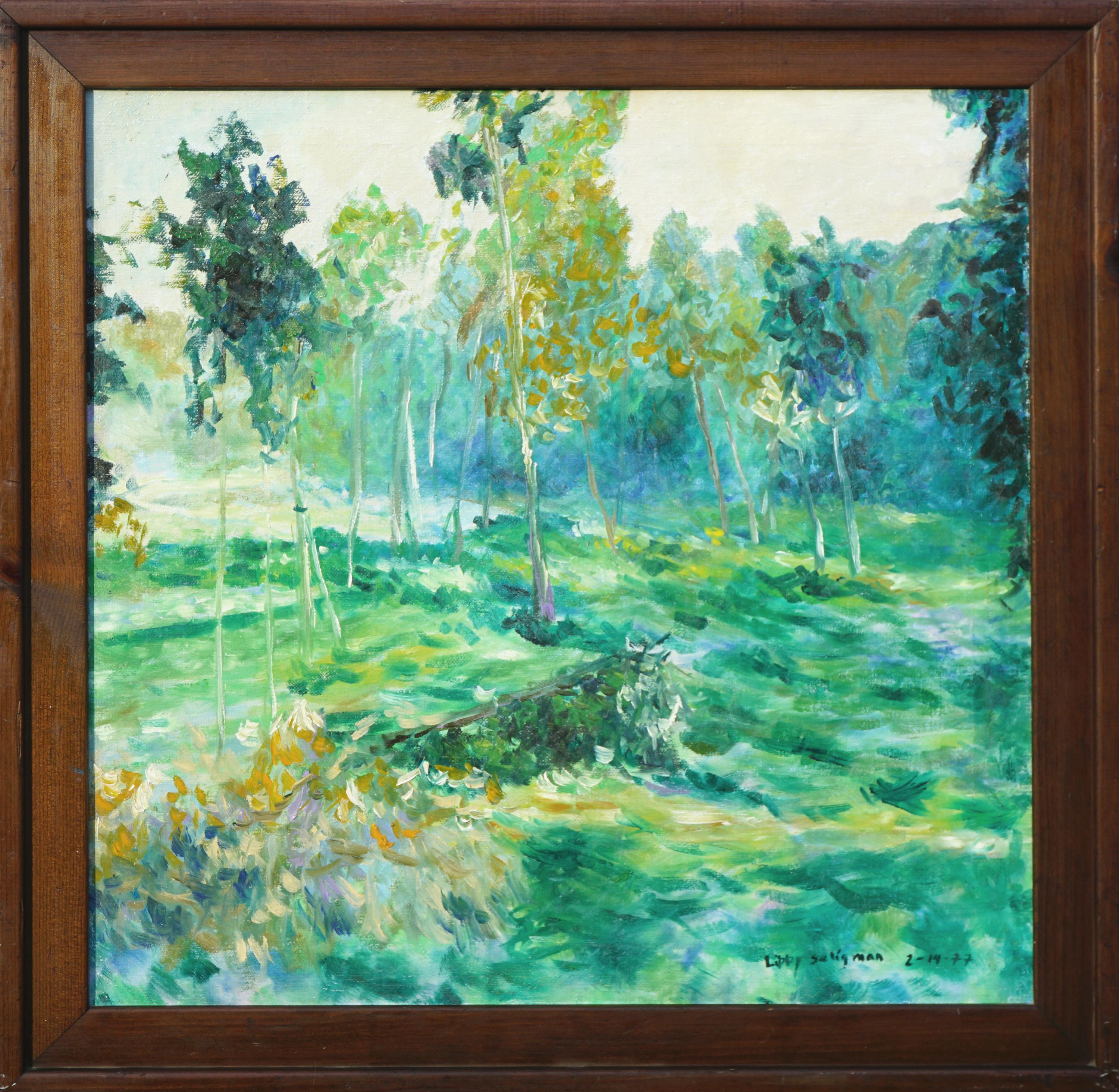
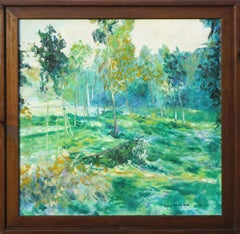
Vintage Abstracted Fauvist Birch Tree Landscape
By Libby Beth Seligman
Located in Soquel, CA
Vivid abstracted landscape in vibrant fauvist hues of birch trees in green field by Libby Beth Seligman (American, b. 1958), 1977. Signed and dated lower right corner. Presented in r...
Category
1970s Fauvist Landscape Paintings
Materials
Canvas, Oil
$1,440 Sale Price
20% Off
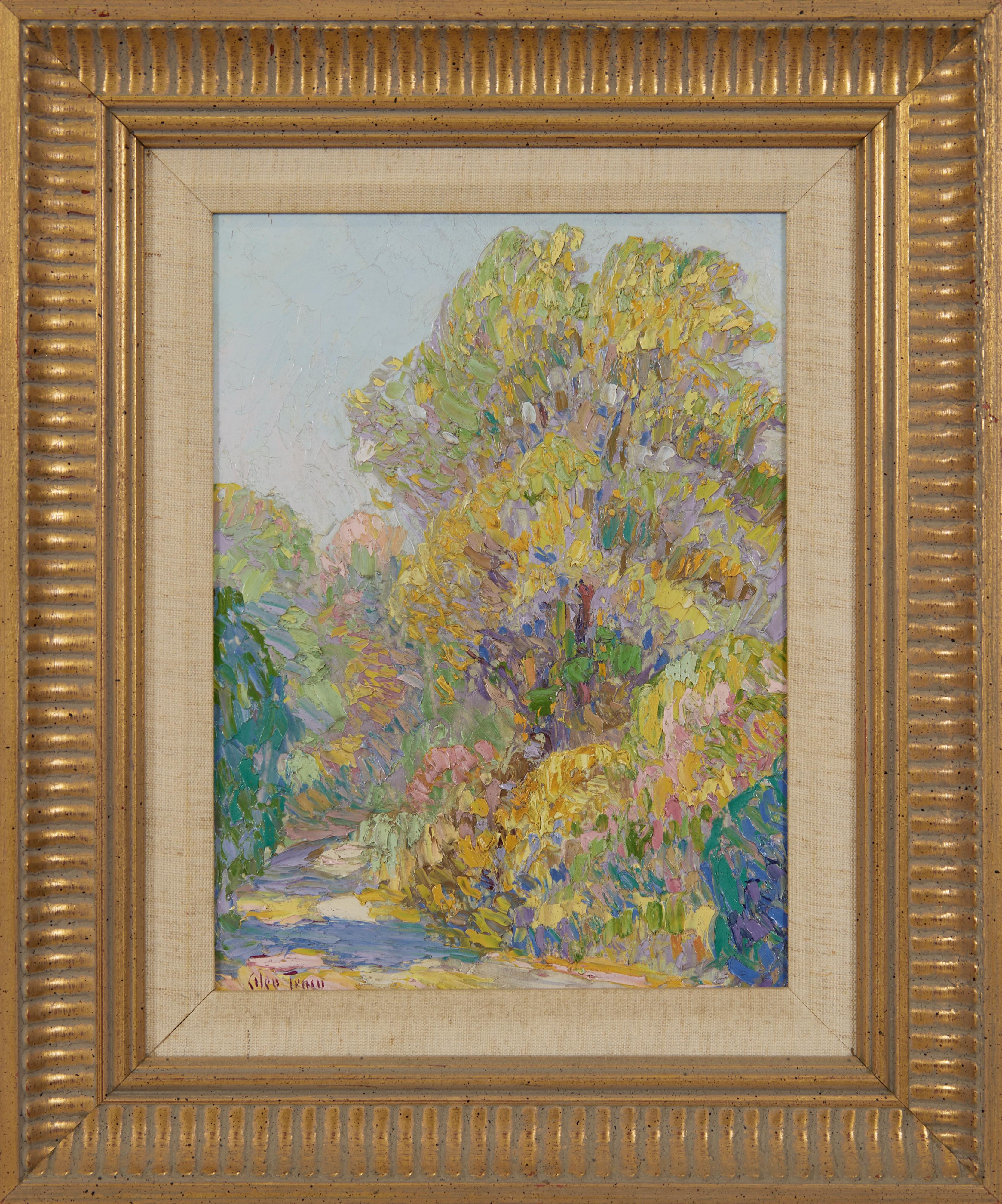
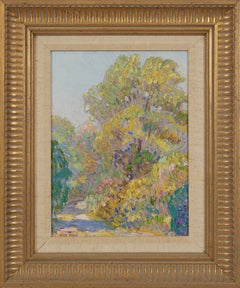
The Tulip Poplar on Salem Pike, Impressionist Tree Landscape
Located in Beachwood, OH
Glen Tracy (American, 1883-1956)
The Tulip Poplar on Salem Pike , 1920
Oil on board
Signed lower left, dated and titled verso
12 x 9 inches
17.25 x 14.5 inches framed
Since he studi...
Category
1920s American Impressionist Landscape Paintings
Materials
Oil
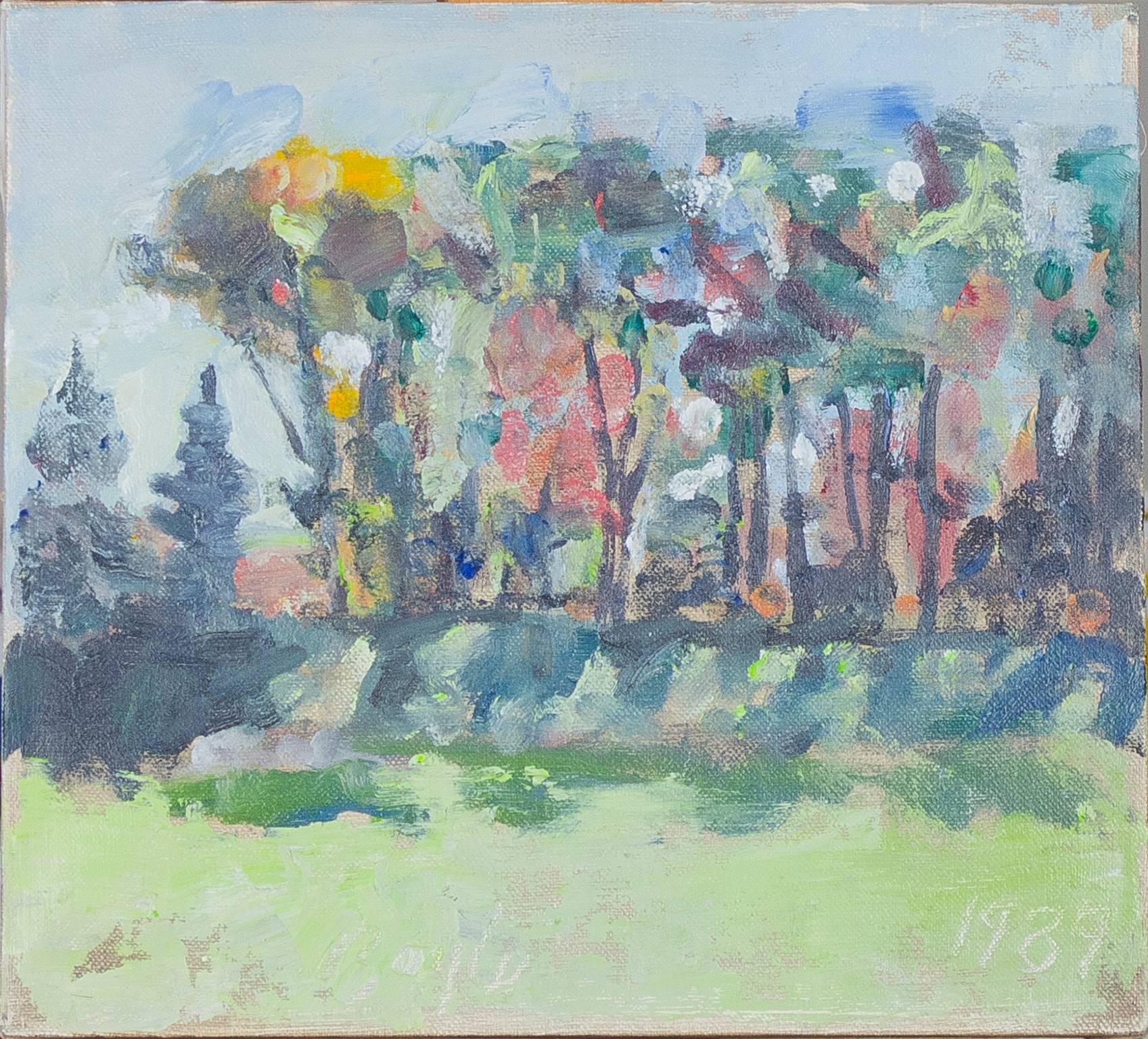
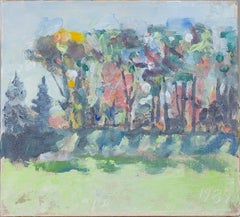
Contemporary landscape oil painting colorful expressionist trees forest sky
By Michael Boyle
Located in Milwaukee, WI
"Autumn Trees" is an original, unique landscape oil painting on canvas by Michael Boyle. The artist signed the piece lower right and dated it lower left. This piece depicts a line of...
Category
1980s Impressionist Landscape Paintings
Materials
Canvas, Oil
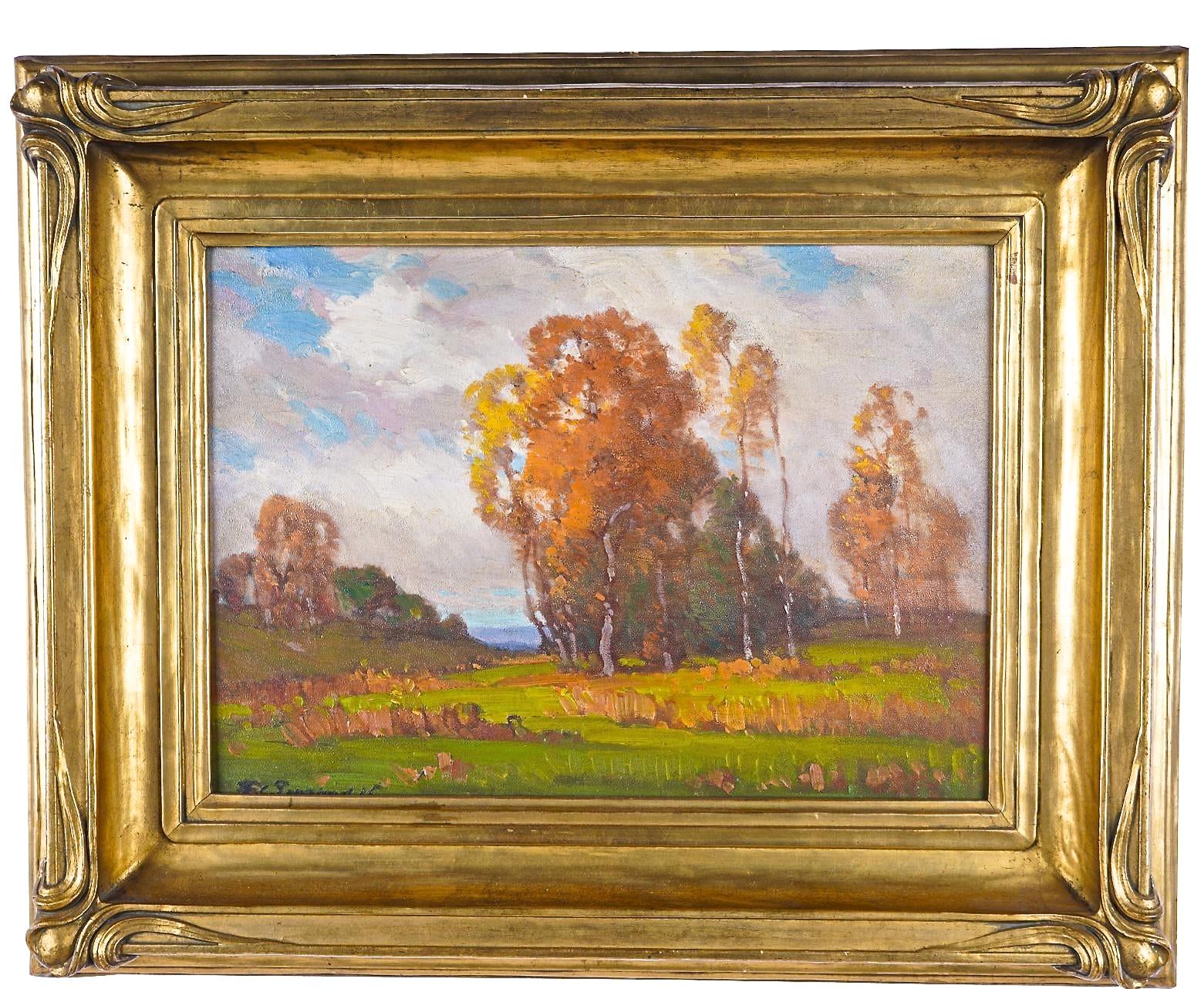
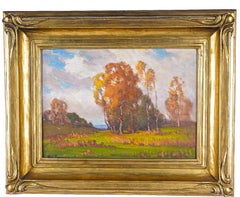
American Landscape With Birch Trees
Located in Lake Worth Beach, FL
Landscape signed lower left beautiful original gold leaf frame.
Frank Peyraud earned a lasting reputation for rural landscapes, especially snow scenes in broadly defined forms and glowing colors. Excepting a trip from 1921 to 1923 to Italy and Switzerland, he was based in Chicago, where a Registrar of the Chicago Art Institute in materials for a traveling exhibition, described him as the "dean of Chicago landscape artists." (Richter)
Peyraud was one of the first American painters to focus on the Midwestern landscape and did many river and farm scenes including his signature snowscapes. Many of his paintings reflected Impressionism, an abstract style executed with rapid technique and broken brushstrokes brought over from France towards the end of the 19th Century. Impressionism received much attention in Chicago in some of the artwork exhibited at the 1893 Exposition.
Of Peyraud and Impressionism, it was written that "he was the most successful of the progressive Chicago painters who experimented with impressionist approaches in the years following Exposition." He was credited with more discipline of execution than many of his peer impressionists and with a "valid impressionism", (Greenhouse) that conveyed poetic interpretations to what many persons regarded as very ordinary rural Illinois landscape. His snow scene haystack painting, Winter Light on the Farm, in the Marshall Collection of Peoria and exhibited at the Terra Museum, shows "crystalline atmosphere and fleeting light of a waning winter afternoon". (Greenwood) and seems to reference the serial haystack paintings by Claude Monet.
Many of Peyraud's works had luminous back-lighting, and careful arrangement of contrasting shapes, and a tone inviting the viewer into a "slightly enchanted world into which quotidian human elements rarely intrude." (Richter)
Peyraud was born in Bulle, Switzerland, and enrolled as an architecture student at the Ecole des Beaux-Arts in Paris. In 1881, at age 22 and an established architect in France, he emigrated to Chicago where he spent the remainder of his career. He found employment there as a cyclorama painter, which meant creating huge panoramic paintings in the round, "forerunner of the wide-screen motion picture." (Richter). In 1891, he became involved in retouching Paul Phillipoteaux's panorama, The Battle of Gettysburg, when it came to Chicago for exhibition He continued to work on panoramic and cycloramas spectacles including The Creation for the 1903 Louisiana Exposition. Spring Painted Desert in the Santa Fe Railroad Collection shows at least one trip West.
Peyraud also did mural painting, several of them in Peoria, Illinois including a series of allegorical murals with Hardesty Maratta in the Peoria at the newly-built Public Library. In Peoria, he also taught classes and gave lectures. In 1906, he married Elizabeth Krisher, a portrait painter, and illustrator.
Sources include:
Marianne Richter, Union League Club of Chicago Art Collection, "Frank Charles Peyraud...
Category
1940s Landscape Paintings
Materials
Oil, Board
Landscape With Birch Trees
Located in Lake Worth Beach, FL
Landscape signed lower left beautiful original gold leaf frame.
Frank Peyraud earned a lasting reputation for rural landscapes, especially snow scenes in broadly defined forms and glowing colors. Excepting a trip from 1921 to 1923 to Italy and Switzerland, he was based in Chicago, where a Registrar of the Chicago Art Institute in materials for a traveling exhibition, described him as the "dean of Chicago landscape artists." (Richter)
Peyraud was one of the first American painters to focus on the Midwestern landscape and did many river and farm scenes including his signature snowscapes. Many of his paintings reflected Impressionism, an abstract style executed with rapid technique and broken brushstrokes brought over from France towards the end of the 19th Century. Impressionism received much attention in Chicago in some of the artwork exhibited at the 1893 Exposition.
Of Peyraud and Impressionism, it was written that "he was the most successful of the progressive Chicago painters who experimented with impressionist approaches in the years following Exposition." He was credited with more discipline of execution than many of his peer impressionists and with a "valid impressionism", (Greenhouse) that conveyed poetic interpretations to what many persons regarded as very ordinary rural Illinois landscape. His snow scene haystack painting, Winter Light on the Farm, in the Marshall Collection of Peoria and exhibited at the Terra Museum, shows "crystalline atmosphere and fleeting light of a waning winter afternoon". (Greenwood) and seems to reference the serial haystack paintings by Claude Monet.
Many of Peyraud's works had luminous back-lighting, and careful arrangement of contrasting shapes, and a tone inviting the viewer into a "slightly enchanted world into which quotidian human elements rarely intrude." (Richter)
Peyraud was born in Bulle, Switzerland, and enrolled as an architecture student at the Ecole des Beaux-Arts in Paris. In 1881, at age 22 and an established architect in France, he emigrated to Chicago where he spent the remainder of his career. He found employment there as a cyclorama painter, which meant creating huge panoramic paintings in the round, "forerunner of the wide-screen motion picture." (Richter). In 1891, he became involved in retouching Paul Phillipoteaux's panorama, The Battle of Gettysburg, when it came to Chicago for exhibition He continued to work on panoramic and cycloramas spectacles including The Creation for the 1903 Louisiana Exposition. Spring Painted Desert in the Santa Fe Railroad Collection shows at least one trip West.
Peyraud also did mural painting, several of them in Peoria, Illinois including a series of allegorical murals with Hardesty Maratta in the Peoria at the newly-built Public Library. In Peoria, he also taught classes and gave lectures. In 1906, he married Elizabeth Krisher, a portrait painter, and illustrator.
Sources include:
Marianne Richter, Union League Club of Chicago Art Collection, "Frank Charles Peyraud...
Category
1940s Landscape Paintings
Materials
Oil, Board
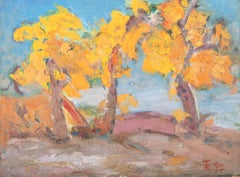
Populus 6
Located in New York, NY
Title: Populus 6
Medium: Oil on canvas
Size: 15.5"" x 11.75""
Frame: Framing options available!
Age: 2000s
Condition: Painting appears to be in excellent condition.
Note: This...
Category
21st Century and Contemporary Post-Impressionist Landscape Paintings
Materials
Oil
$1,000
More Ways To Browse
Vintage Panels
Cabin Impressionist
Contemporary Realism Seascape Painting
Corn Oil Painting
Costa Rica Painting
Dutch Oil Paintings Winter
English Seascape
Farm Horse Paintings
French Market Scene Painting
Grand Tetons
Impressionist Greece
Impressionist Sheep
Italian Lake Painting
Jill Jackson
Megan Eisenberg
Mid Century Stuart Painting
Miniature Churches
Navy Oil Painting 18th Century