Items Similar to "November" Bruce Crane, Tonalism Landscape Autumn Scene, American Impressionism
Want more images or videos?
Request additional images or videos from the seller
1 of 11
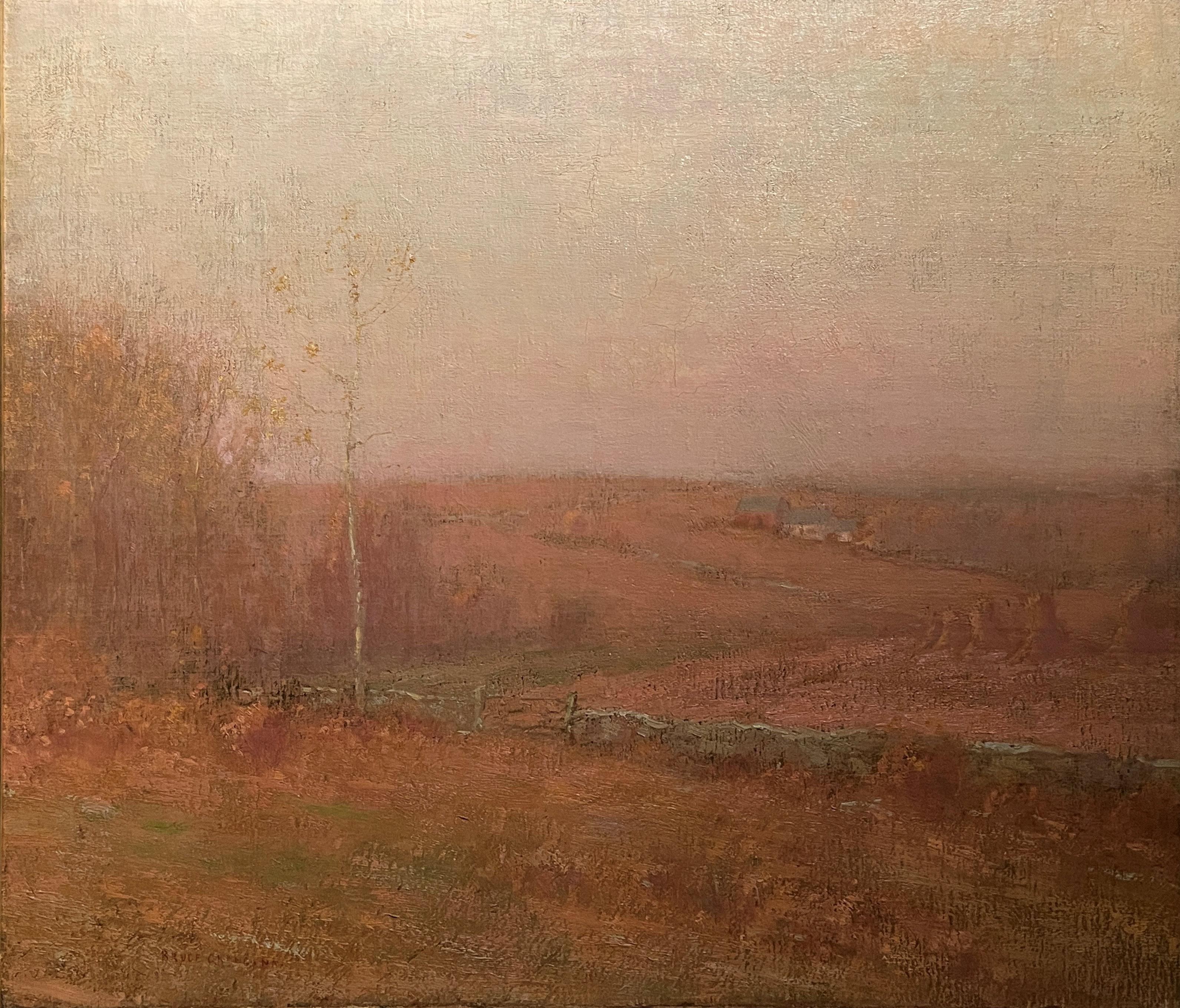
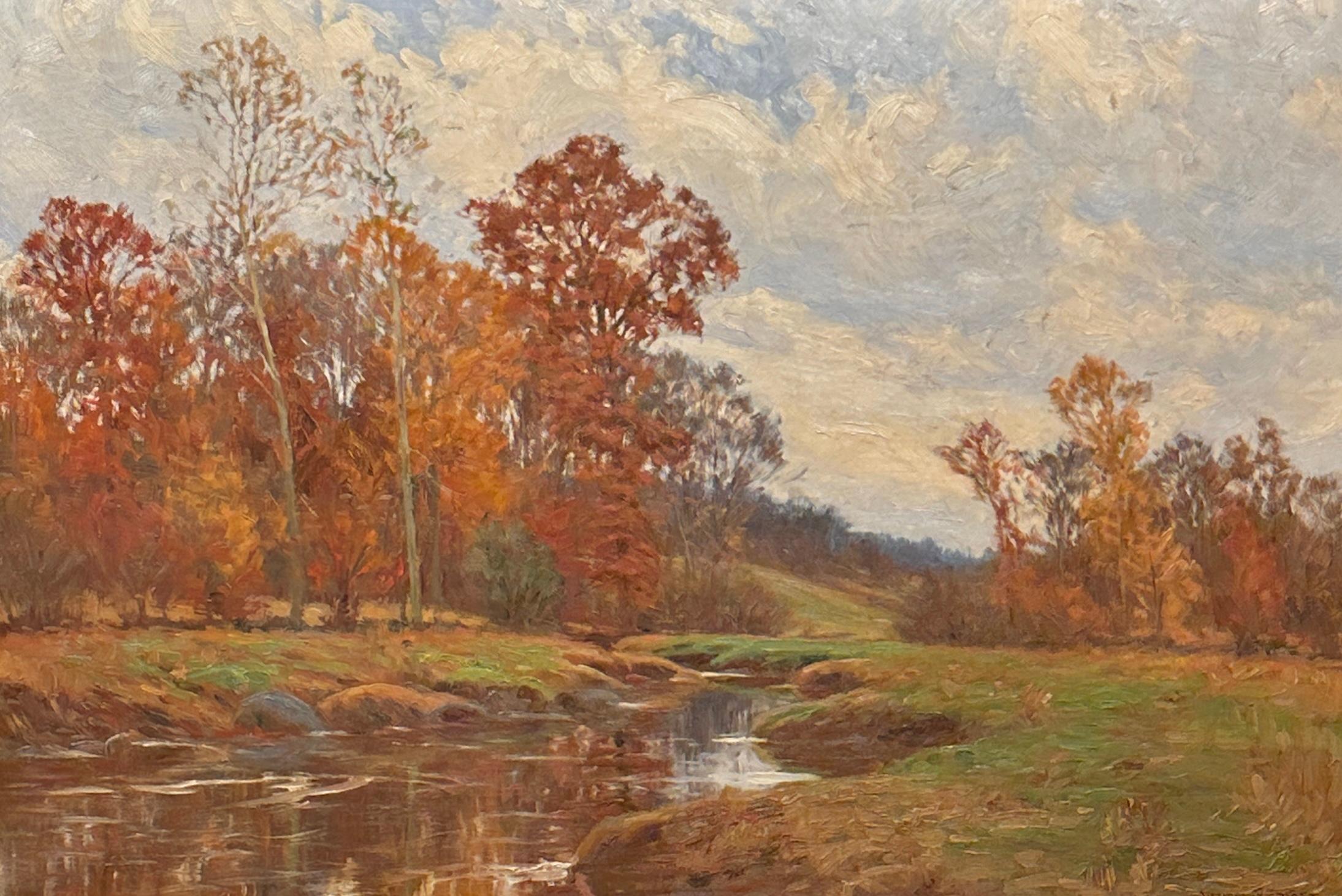
Bruce Crane"November" Bruce Crane, Tonalism Landscape Autumn Scene, American Impressionism
$15,000
£11,286.52
€13,039.38
CA$21,059.67
A$22,751.34
CHF 12,103.94
MX$273,760.61
NOK 153,261.43
SEK 140,161.75
DKK 97,410.65
About the Item
Bruce Crane (1857 - 1937)
November
Oil on canvas
25 x 30 inches
Signed lower right
Robert Bruce Crane was an American painter. He joined the Lyme Art Colony in the early 1900s. His most active period, though, came after 1920, when for more than a decade he did oil sketches of woods, meadows, and hills. He developed into a Tonalist painter under the influence of Jean-Charles Cazin at Grez-sur-Loing. Crane's mature works were nearly always fall and winter scenes. He usually painted in his studio in Bronxville, New York, where like many of the Tonalists he relied mostly on memories of his outdoor sketching experiences. Selected work can be found at the Florence Griswold Museum and the Newark Museum. He is a descendant of the Continental Congressman Stephen Crane.[1]
Bruce Crane's father, Solomon Crane, was an amateur artist himself and interested his son in the New York art scene from a young age. However, it was a summer trip to the Adirondacks that piqued Bruce's interest in painting after witnessing “a lot of young lady amateur (artists.)” At the age of seventeen around 1874 he moved with his family to Elizabeth, New Jersey where he worked as a draftsman for an architect. In hopes of starting a career in this field, he approached the famous artist Alexander Wyant and asked to start an apprenticeship with him. Wyant asked to see some of Crane's work, but Bruce did not believe that his skills were adequate enough to impress Wyant. Therefore, he declined the request and spent the next year improving his skills before he showed his work to Wyant and began to work with him. They remained friends until Wyant's death.
Bruce Crane began to then study at New York's Arts Student League and in 1876 he was featured for the first time in an exhibit at the National Academy of Design, submitting his painting called "Old Swedish Church, Philadelphia." Crane soon began to paint locations of East Hampton and Long Island, which brought him praise and critical approval, as well as a steady income.
In 1909 he won a bronze medal at the Carnegie Institute exhibition for his work November Hills, showing that he was still a force to be reckoned with. Throughout the first two decades of the 20th century, Crane won at least 10 major national and international awards. This included the Inness Gold Medal (1901), Gold metal at the St. Louis Exposition (1904), The Saltus Medal (1912), and the silver medal at the Panama-Pacific Exhibition (1915). From 1929 to 1933, Bruce Crane was the President of the famed Salmagundi Club of New York City (founded 1871) and its artist of the year in 1902. He was also associated with the Grand Central Art Galleries, participating in its 1933 members' drawing. In 1897, he was elected into the National Academy of Design as an Associate Academician, and became a full Academician in 1901.
- Creator:Bruce Crane (1857-1937, American)
- Dimensions:Height: 34 in (86.36 cm)Width: 39 in (99.06 cm)
- Medium:
- Movement Style:
- Period:
- Condition:
- Gallery Location:New York, NY
- Reference Number:1stDibs: LU1841210527522
Bruce Crane
Robert Bruce Crane was an American painter. He joined the Lyme Art Colony in the early 1900s. His most active period, though, came after 1920, when for more than a decade he did oil sketches of woods, meadows, and hills. He developed into a Tonalist painter under the influence of Jean-Charles Cazin at Grez-sur-Loing. Crane's mature works were nearly always fall and winter scenes. He usually painted in his studio in Bronxville, New York, where like many of the Tonalists he relied mostly on memories of his outdoor sketching experiences. Selected work can be found at the Florence Griswold Museum and the Newark Museum. He is a descendant of the Continental Congressman Stephen Crane.[1] Bruce Crane's father, Solomon Crane, was an amateur artist himself and interested his son in the New York art scene from a young age. However, it was a summer trip to the Adirondacks that piqued Bruce's interest in painting after witnessing “a lot of young lady amateur (artists.)” At the age of seventeen around 1874 he moved with his family to Elizabeth, New Jersey where he worked as a draftsman for an architect. In hopes of starting a career in this field, he approached the famous artist Alexander Wyant and asked to start an apprenticeship with him. Wyant asked to see some of Crane's work, but Bruce did not believe that his skills were adequate enough to impress Wyant. Therefore, he declined the request and spent the next year improving his skills before he showed his work to Wyant and began to work with him. They remained friends until Wyant's death. Bruce Crane began to then study at New York's Arts Student League and in 1876 he was featured for the first time in an exhibit at the National Academy of Design, submitting his painting called "Old Swedish Church, Philadelphia." Crane soon began to paint locations of East Hampton and Long Island, which brought him praise and critical approval, as well as a steady income. In 1909 he won a bronze medal at the Carnegie Institute exhibition for his work November Hills, showing that he was still a force to be reckoned with. Throughout the first two decades of the 20th century, Crane won at least 10 major national and international awards. This included the Inness Gold Medal (1901), Gold metal at the St. Louis Exposition (1904), The Saltus Medal (1912), and the silver medal at the Panama-Pacific Exhibition (1915). From 1929 to 1933, Bruce Crane was the President of the famed Salmagundi Club of New York City (founded 1871) and its artist of the year in 1902. He was also associated with the Grand Central Art Galleries, participating in its 1933 members' drawing. In 1897, he was elected into the National Academy of Design as an Associate Academician, and became a full Academician in 1901.
About the Seller
5.0
Platinum Seller
Premium sellers with a 4.7+ rating and 24-hour response times
Established in 2022
1stDibs seller since 2022
135 sales on 1stDibs
Typical response time: <1 hour
- ShippingRetrieving quote...Shipping from: New York, NY
- Return Policy
More From This Seller
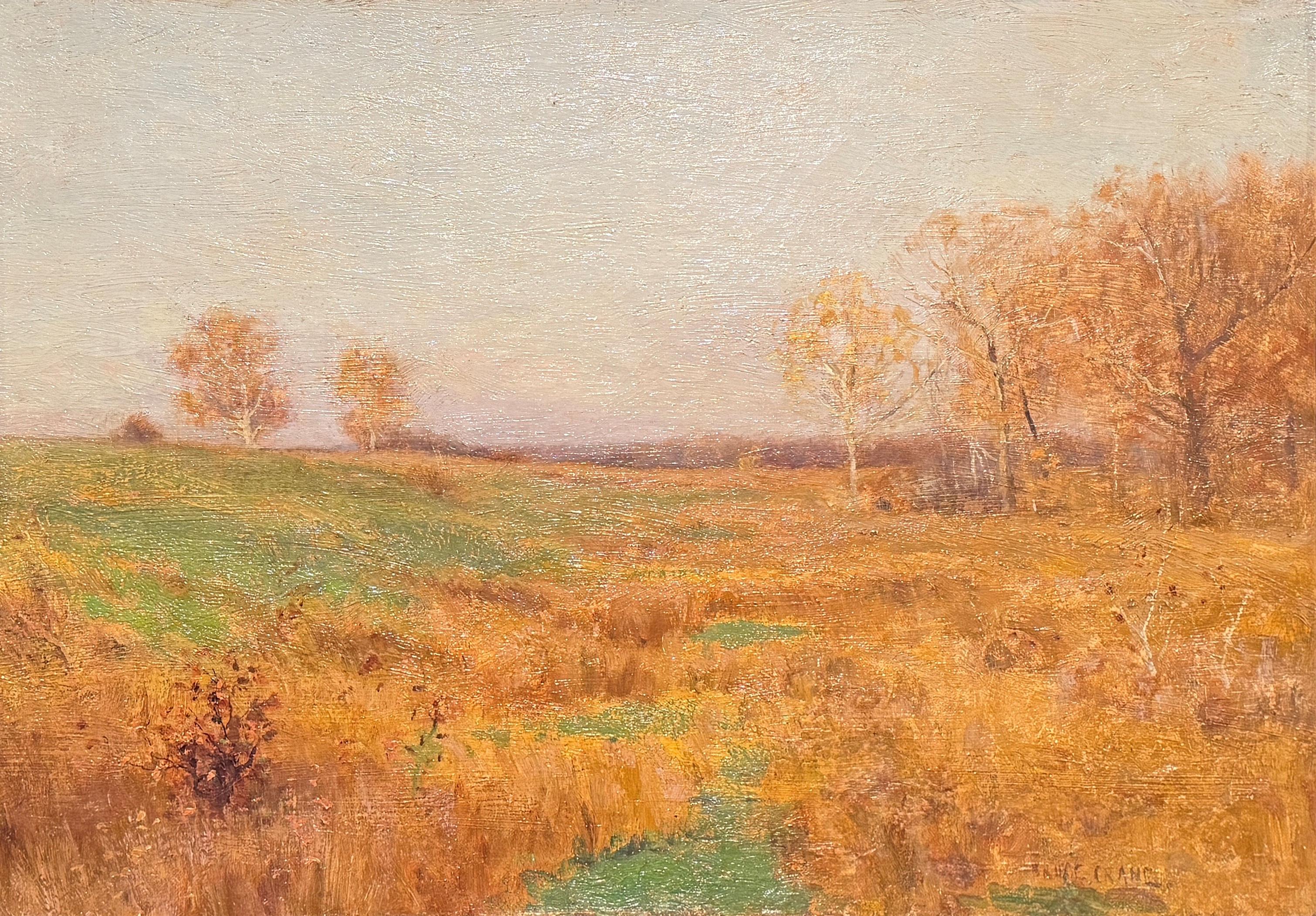
View All"Autumn Landscape, " Bruce Crane, Tonalist American Impressionist Fall Scene
By Bruce Crane
Located in New York, NY
Bruce Crane (1857 - 1937)
Autumn Landscape
Oil on canvas
25 x 30 inches
Signed lower right
Robert Bruce Crane was an American painter. He joined the Lyme Art Colony in the early 190...
Category
Early 20th Century Tonalist Landscape Paintings
Materials
Canvas, Oil
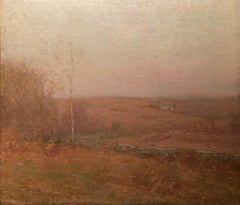
"Late Afternoon, " J. Francis Murphy Tonalist Summer / Autumn Landscape
By John Francis Murphy
Located in New York, NY
John Francis Murphy (American, 1853 - 1921)
Late Afternoon, 1895
Oil on canvas
14 x 19 inches
Signed and dated lower right
Housed in a reproduction fluted cove frame.
Provenance:
Kenneth Lux Gallery, Inc., New York
BNY Mellon, New York
Christie's New York, Living with Art, October 14, 2016, Lot 352
In his lifetime, John Francis Murphy (1853-1921) was known as “the American Corot.” He was renowned for his small, intimate views of nature, especially barren fields and farms, bare trees, and lonely marshland. More than a century later, the power of Murphy’s landscapes has not waned. One contemporary critic wrote, “It was Murphy’s unique accomplishment to achieve an absolute realism without a loss of that mystic, indefinable quality which transfigures realism.”
John Francis Murphy was born at Oswego, NY in 1853 but his family moved to Chicago in 1868 where he worked painting theater sets. Murphy was basically a self-taught artist; his only formal training was a few weeks of instruction at the Chicago Academy of Design.
In 1875, Murphy moved from Chicago to New York, eventually rooming with the painters Dennis Bunker...
Category
1890s Tonalist Landscape Paintings
Materials
Canvas, Oil
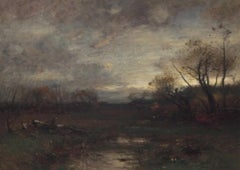
"Autumn Landscape" Bruce Crane, Bright Orange, Luminous, Tonalist Fall Scene
By Bruce Crane
Located in New York, NY
Bruce Crane
Autumn Landscape
Signed lower right
Oil on canvas
16 x 24 inches
Bruce Crane Was born in New York City, he studied with Alexander H. Wyant before attending the Art Stud...
Category
1910s American Impressionist Figurative Paintings
Materials
Canvas, Oil
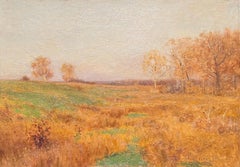
"Autumn, New England" Charles Warren Eaton, Tonalist Gloaming Sunset in Woods
By Charles Warren Eaton
Located in New York, NY
Charles Warren Eaton
Autumn, New England
Signed lower right
Oil on canvas
30 x 36 inches
Provenance
Private Collection, Connecticut
A contemporary critic wrote that the paintings o...
Category
Early 1900s Tonalist Figurative Paintings
Materials
Canvas, Oil
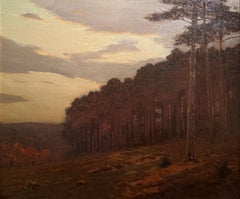
"Stone Wall, Autumn, " George Smillie, Tonalist Fall Landscape View
By George Henry Smillie
Located in New York, NY
George Henry Smillie (1840 - 1921)
Stone Wall, Autumn, 1879
Oil on canvas
9 1/2 x 15 inches
Signed and dated lower right
Provenance:
Skinner, Boston, September 19, 2014, Lot 389
The career of George Smillie (1840-1921) followed the arc of nineteenth-century U.S. landscape painting. Trained in the Hudson River School tradition, Smillie successfully adapted to changing U.S. tastes and growing interest in European trends. In the late 1800s, he moved to tonalist paintings full of brushwork and influenced by French Barbizon painting. By the end of his career, he had lightened his palette to produce works similar to those of the U.S. impressionists. Yet in all styles, he was never less than competent, and his tonalist work is among the best produced in the United States.
Like many nineteenth-century painters, George Smillie’s artistic training began with the study of printing. His father, James Smillie...
Category
1870s Tonalist Landscape Paintings
Materials
Canvas, Oil
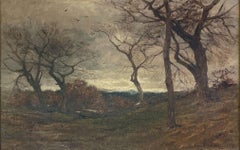
"Farmland Meadows" George Henry Smillie, Hudson River School, Sunset Landscape
By George Henry Smillie
Located in New York, NY
George Henry Smillie
Farmland Meadows, 1865
Signed and dated lower left
Oil on canvas
10 1/2 x 18 inches
Provenance
Private Collection, Langley, Washington
The career of George Sm...
Category
1860s Tonalist Figurative Paintings
Materials
Canvas, Oil
You May Also Like
"Fall Landscape"
By John Francis Murphy
Located in Lambertville, NJ
Jim’s of Lambertville is proud to offer this artwork by:
John Francis Murphy (1853 - 1921)
John Francis Murphy is increasingly recognized today as one of the leading American Tonal...
Category
Early 1900s Tonalist Landscape Paintings
Materials
Canvas, Oil
Autumn, 1923
By Bruce Crane
Located in Milford, NH
A splendid Autumn tonalist landscape by American artist Bruce (Robert Bruce) Crane (1857-1937). Crane was born in New York City, and as an artist, was influenced by the French Barbizon school of...
Category
1920s Tonalist Landscape Paintings
Materials
Canvas, Oil
William Merritt Post, Listed American Artist, New England Landscape
By William Merritt Post
Located in Rockport, MA
William Merritt Post (1856–1935) was an American tonalist and landscape painter celebrated for his atmospheric depictions of rural New England. Working in a tonal style, Post used mu...
Category
20th Century American Impressionist Landscape Paintings
Materials
Oil
"The Low Lands"
By John Francis Murphy
Located in Lambertville, NJ
Jim’s of Lambertville is proud to offer this artwork.
Signed and Dated Lower Left
John Francis Murphy (1853 - 1921)
John Francis Murphy is increasingly recognized today as one o...
Category
Early 1900s Tonalist Landscape Paintings
Materials
Canvas, Oil
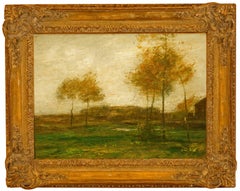
Chauncey Foster Ryder Landscape with Figures Oil Painting 1868-1949 Tonalist
By Chauncey Foster Ryder
Located in Chesterfield, NJ
CHAUNCEY FOSTER RYDER (American, 1868-1949),
Pasture Lands
oil/canvas signed LR 31.5 x 39.5 image, 40.5 x 48.5 framed
A wonderfully subtle tonalist painting by Ryder incorporating a farmer/farmhand probably moving cows about the pastures mid right in the scene. Ryder uses a subtle S design from lower left that zig zags up to the figure and cows. The painting shows Ryder's masterful use of abstract design and technique utilizing textures in his application of paint giving the painting life and interest.
Original frame, some craquelure in sky, old surface. Bears Newhouse Galleries, possibly NYC, label verso.
The painting hangs in my collection currently and would benefit from a cleaning and new varnish. It is a large museum quality oil painting.
SHIPPING-This will need In Home Delivery service as it is too large for me to pack. The handling time is listed as 10 days but is dependent on who 1stdibs hires and their schedule to pick up and deliver. 3 -7 weeks is listed in the shipping section for this service. Buyer can also arrange for their own pick up.
Bio-
Chauncey Foster Ryder (29 February 1868 – 18 May 1949)[1] was an early 20th century American Postimpressionist Tonalist landscape painter known for a green-gray palette termed 'Ryder green'.
Education and personal life
Ryder was born in 1868 in Danbury, Connecticut, but grew up mainly in New Haven.[2][3] He began studying painting as a boy. In his early twenties, he moved to Chicago to attend the Art Institute,[4] then Smith's Academy.[5] After only a year at the latter, he was hired as an instructor.[5]
In 1891, he married Mary Dole Keith.[5] In 1901, they moved to Paris, France, where Ryder continued his art education, studying with Jean-Paul Laurens at the Académie Julian. Ryder stayed in France for several years, living in an art colony at Étaples and exhibiting his work at the Paris Salon (1903–1909).[3] He took on occasional students, including American painter William Posey Silva...
Category
20th Century Tonalist Landscape Paintings
Materials
Oil
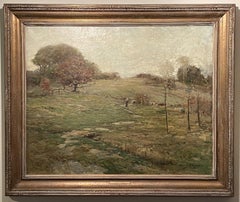
Tonalist Landscape
Located in Milford, NH
A fine tonalist landscape by American artist J. Francis Murphy (1853-1921). Murphy was born in Oswego, New York, he moved to Chicago in 1868, where his father was employed in the shipping industry. In Chicago, Murphy began working as a scene painter in a local theatre and was quickly promoted to lead his co-workers. Largely self-taught, his only training consisted of a few classes at the Chicago Academy of Design. There he became friends with Emil Carlsen and Theodore Robinson, and in 1873, Academy members elected him an Associate; a few weeks later, he became an Academician. His work was first exhibited at the National Academy of Design in 1876, where he was inducted eleven years later.He won numerous prizes, medals and honors for his landscape paintings, which are said to rank with those of George Inness, Alexander Wyant, and Homer Martin. Although his world was a limited one, his landscapes captured the forms of nature and the subtle nuances of the scene. Murphy was referred to as the "American Corot" because of his similarity to the painting style of Camille Corot (1796-1875), one of the original Barbizon...
Category
Early 1900s Tonalist Landscape Paintings
Materials
Canvas, Oil
More Ways To Browse
Antique Crane
Antique Winter Scene
Antique Pique
American Impressionism Painting
Lyme Art
Early Autumn Painting
20th Century Impressionism Paintings
Oil Paintings Cranes
Tonal Landscape Painting
Tonalism Landscape Painting
Framed Cranes Painting
Stephen Bruce
Robert Crane
19th Century Landscape Hudson River School Paintings
Sacre Coeur
Victorian Oil Signed Paintings
American Realism Art
New England Seascape Oil Painting