Want more images or videos?
Request additional images or videos from the seller
1 of 7
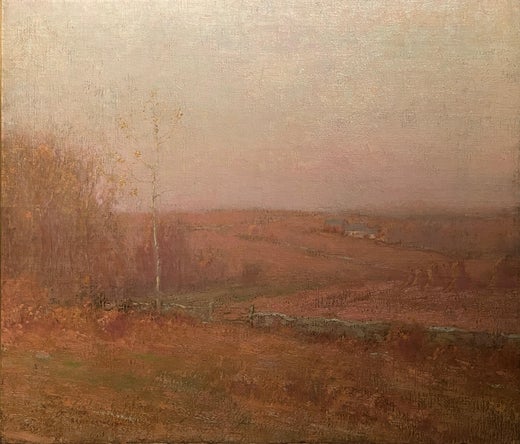
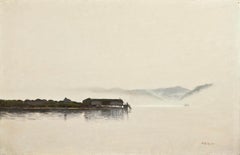
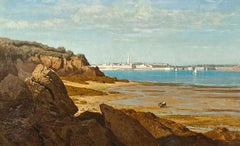
Bruce CraneRusset and GoldAfter 1884
After 1884
Price:$14,000
$17,500List Price
About the Item
- Creator:Bruce Crane (1857-1937, American)
- Creation Year:After 1884
- Dimensions:Height: 14 in (35.56 cm)Width: 20 in (50.8 cm)
- Medium:
- Movement Style:
- Period:
- Condition:
- Gallery Location:New York, NY
- Reference Number:Seller: APG 19847D.0051stDibs: LU232044943
Bruce Crane
Robert Bruce Crane was an American painter. He joined the Lyme Art Colony in the early 1900s. His most active period, though, came after 1920, when for more than a decade he did oil sketches of woods, meadows, and hills. He developed into a Tonalist painter under the influence of Jean-Charles Cazin at Grez-sur-Loing. Crane's mature works were nearly always fall and winter scenes. He usually painted in his studio in Bronxville, New York, where like many of the Tonalists he relied mostly on memories of his outdoor sketching experiences. Selected work can be found at the Florence Griswold Museum and the Newark Museum. He is a descendant of the Continental Congressman Stephen Crane.[1] Bruce Crane's father, Solomon Crane, was an amateur artist himself and interested his son in the New York art scene from a young age. However, it was a summer trip to the Adirondacks that piqued Bruce's interest in painting after witnessing “a lot of young lady amateur (artists.)” At the age of seventeen around 1874 he moved with his family to Elizabeth, New Jersey where he worked as a draftsman for an architect. In hopes of starting a career in this field, he approached the famous artist Alexander Wyant and asked to start an apprenticeship with him. Wyant asked to see some of Crane's work, but Bruce did not believe that his skills were adequate enough to impress Wyant. Therefore, he declined the request and spent the next year improving his skills before he showed his work to Wyant and began to work with him. They remained friends until Wyant's death. Bruce Crane began to then study at New York's Arts Student League and in 1876 he was featured for the first time in an exhibit at the National Academy of Design, submitting his painting called "Old Swedish Church, Philadelphia." Crane soon began to paint locations of East Hampton and Long Island, which brought him praise and critical approval, as well as a steady income. In 1909 he won a bronze medal at the Carnegie Institute exhibition for his work November Hills, showing that he was still a force to be reckoned with. Throughout the first two decades of the 20th century, Crane won at least 10 major national and international awards. This included the Inness Gold Medal (1901), Gold metal at the St. Louis Exposition (1904), The Saltus Medal (1912), and the silver medal at the Panama-Pacific Exhibition (1915). From 1929 to 1933, Bruce Crane was the President of the famed Salmagundi Club of New York City (founded 1871) and its artist of the year in 1902. He was also associated with the Grand Central Art Galleries, participating in its 1933 members' drawing. In 1897, he was elected into the National Academy of Design as an Associate Academician, and became a full Academician in 1901.
About the Seller
5.0
Recognized Seller
These prestigious sellers are industry leaders and represent the highest echelon for item quality and design.
Established in 1952
1stDibs seller since 2010
35 sales on 1stDibs
Associations
Art Dealers Association of America
Authenticity Guarantee
In the unlikely event there’s an issue with an item’s authenticity, contact us within 1 year for a full refund. DetailsMoney-Back Guarantee
If your item is not as described, is damaged in transit, or does not arrive, contact us within 7 days for a full refund. Details24-Hour Cancellation
You have a 24-hour grace period in which to reconsider your purchase, with no questions asked.Vetted Professional Sellers
Our world-class sellers must adhere to strict standards for service and quality, maintaining the integrity of our listings.Price-Match Guarantee
If you find that a seller listed the same item for a lower price elsewhere, we’ll match it.Trusted Global Delivery
Our best-in-class carrier network provides specialized shipping options worldwide, including custom delivery.You May Also Like
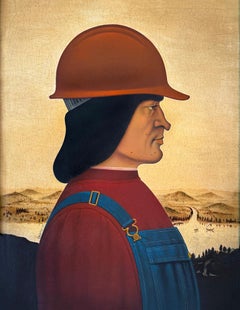
Parody Portrait: Piero della Francesca Italian Renaissance Hispanic Illustrator
Located in Miami, FL
This is a parody portrait of the famed Duke of Urbino, Federico da Montefeltro, by Piero della Francesca, in the Uffizi Galleries in Florence. Hispanic Illustrator Ignacio Gomez pain...
Category
1970s American Realist Portrait Paintings
Materials
Canvas, Oil
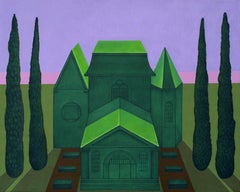
The Green House, Surreal Classic Architecture with Italian Cypress Trees
By John Hrehov
Located in Chicago, IL
A classical structure is cast in a green hue as the sun sets on this surreal scene by John Hrehov. The perfectly balance scene, with its formal gardens and Italian cypress trees add to the overall aesthetic. This piece is floated in a white wooden frame measuring 26h x 32w x 2d inches.
John Hrehov
The Green House
oil on canvas
24h x 30w in
60.96h x 76.20w cm
JHR024
John Hrehov
Education
1985 MFA-Painting, University of Illinois at Urbana-Champaign
1981 BFA-Painting, Cleveland Institute of Art, Cleveland, OH.
Solo Exhibitions
2017 John Hrehov, Paintings and Drawings. Tom Thomas Gallery, Indiana University East, Richmond, IN.
2012 Shades from White to Black, New Drawings. Denise Bibro Fine Art, New York, NY.
2011 John Hrehov: Charcoal. Indiana University - Purdue University Fort Wayne...
Category
2010s American Realist Landscape Paintings
Materials
Canvas, Oil
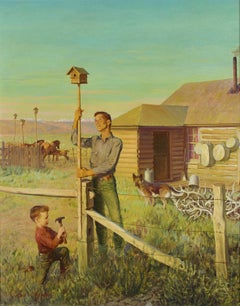
Putting Up Birdhouses, Original Cover for The Saturday Evening Post Cover
By John Ford Clymer
Located in Fort Washington, PA
The Saturday Evening Post cover, June 9, 1951
'John Clymer, while migrating through Wyoming in a motorcar, was amazed at the variety of birds that go there summers to keep house....
Category
1950s American Realist Landscape Paintings
Materials
Oil, Canvas
Scouting
By Frank Tenney Johnson
Located in Palm Desert, CA
"Scouting" is an oil on canvas painting by Frank Tenney Johnson. The framed piece measures 23 3/4 x 27 3/4 x 3 1/4 inches.
Johnson was well-known for his work of the American west, particularly for his portrayal of cowboys at night, lit by moonlight. Johnson utilized knives and fingers when painting, so his work is recognizable for its distinctive marks.
Provenance:
Biltmore Galleries, Scottsdale...
Category
Early 20th Century American Realist Landscape Paintings
Materials
Canvas, Oil
Apaches
By Olaf Wieghorst
Located in Palm Desert, CA
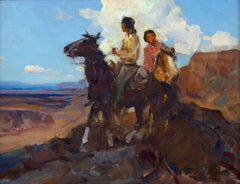
"Apaches" is an oil on canvas painting by Olaf Wieghorst. The painting is signed on the lower left, "O-Wieghorst". The framed piece measures 25 1/2 x 29 3/4 x 2 in.
“When the time comes for me to put away my palette and unsaddle my pony for the last time, I hope that my canvases will in some small measure add to the historical recording of an era, the cowboy, and the great American West.” ~ Olaf Wieghorst
Wieghorst worked with the mounted patrol of the 7th Cavalry Regiment of the United States Cavalry (1920-1922) with occasional interludes as a wrangler on ranches in the western states. Wherever he went, he sketched and painted the Western culture he loved, often selling his work as calendar and magazine illustrations.
His work appeared in Zane Grey...
Category
Early 20th Century American Realist Landscape Paintings
Materials
Canvas, Oil
Winter Wood
By Joseph Orr
Located in Missouri, MO
Joseph Orr
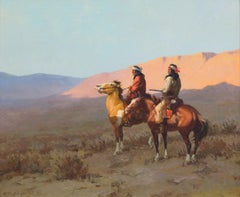
"Winter Wood"
Acrylic on Canvas
18 x 24
28 x 34 framed
Joseph Orr, from Missouri, has been painting professionally since 1972. He paints much o...
Category
21st Century and Contemporary American Realist Landscape Paintings
Materials
Canvas, Oil
Sunset
By James Fairman
Located in Missouri, MO
James Fairman
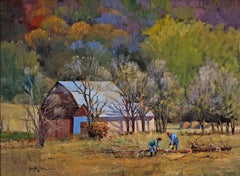
"Sunset" c. 1880
Oil on Canvas
Signed Lower Left
Site: 32.5 x 29.5 inches
Framed: 46 x 42 inches
James Fairman worked as a landscape painter, critic, lecturer, musicia...
Category
1880s American Realist Landscape Paintings
Materials
Canvas, Oil
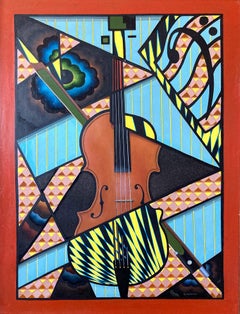
"Surrealist Violin" Photorealist Oil on Canvas Painting of Violin and Notes
Located in New York, NY
A surrealistic Nemethy from a brand new series which fuzes photorealism with surrealism in a most interesting current style. With the finest details, Nemethy creates an atmosphere th...
Category
2010s American Realist Landscape Paintings
Materials
Canvas, Oil
$4,000 Sale Price
20% Off
H 24 in W 18 in D 1 in
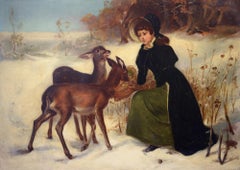
"Winter Deer, " American Realist, Landscape with Figure and Animals, MFA, Tate
By George Henry Boughton
Located in Wiscasset, ME
Though he was born in Norwich, England in 1833 and lived in London for the second half of his life, George Henry Boughton’s formative years as a self-taught artist began in Albany, New York, where his family settled in the 1830’s. Recognized as a leading landscape and genre painter in the United States and abroad, Boughton illustrated editions of Washington Irving’s Rip Van Winkle...
Category
Late 19th Century American Realist Landscape Paintings
Materials
Canvas, Oil
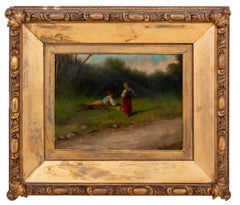
American School, Collecting Firewood, 19th C.
Located in Astoria, NY
American School, Collecting Firewood, Oil on Canvas, 19th century, unsigned, giltwood frame.
Image: 9" H x 12" W; frame: 17.25" H x 20" W.
Category
19th Century American Realist Figurative Paintings
Materials
Canvas, Oil
More From This Seller
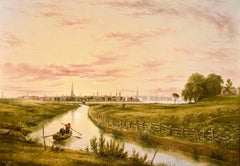
View AllNew York from Hoboken
By William Rickarby Miller
Located in New York, NY
Signed (at lower left): W.R. Miller/ 1851
Category
Mid-19th Century American Realist Landscape Paintings
Materials
Canvas, Oil
Fishing Camp on the Labrador Coast
By William Bradford
Located in New York, NY
In 1852, twenty-nine year old William Bradford was a failing shopkeeper in Fairhaven, Massachusetts. With a wife and child at home, Bradford, by his own admission, “spent too much time in painting to succeed” in business. Rescued from insolvency by his well-to-do in-laws, this is not the beginning of a narrative that generally leads to a happy ending. Not so with Bradford, who ultimately found international fame and fortune as a painter of arctic seascapes and dramatic marine paintings.
William Bradford, the artist, was a lineal descendant of the 17th-century Separatist leader William Bradford, a founder of the Plymouth Plantation, signer of the Mayflower Compact and Governor of the Plymouth Colony. Our Bradford born to a New Bedford ship outfitter in Fairhaven, Massachusetts By the nineteenth century, this line of Bradfords were Quakers, living on the tract purchased nearly two centuries earlier by their pilgrim ancestor. Fairhaven, across the mouth of the Acushnet River from the whaling center of New Bedford was described by a New York journalist in 1857 as “the Brooklyn of New Bedford” (Home Journal, January 3, 1857). Young Bradford displayed an early predilection for the arts, but his Quaker parents were disinclined to support this particular pursuit. After working in his father’s business and then for a dry goods merchant in New Bedford, by 1849 Bradford had set up in New Bedford as a “merchant tailor” offering outfits for “those going to California,” “seamen’s clothing,” custom-tailored “piece goods...
Category
19th Century American Realist Landscape Paintings
Materials
Canvas, Paper, Oil
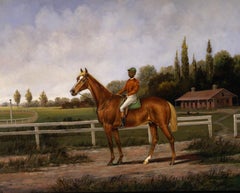
Chestnut Racehorse with a Jockey Up On a Training Strap
By Henry H. Cross
Located in New York, NY
It was Henry Cross's portraits of horses belonging to the prominent breeders and trainers of the second half of the nineteenth century that won the artist renown as an animal painter. Born and raised in upstate New York, Cross's proficiency in both drafting and caricature was revealed while he was still a student at the Binghamton Academy, New York. In 1852, when he was only fifteen years old, Cross joined a traveling circus that took him to Minneapolis, Minnesota, and to the first of many Indian encampments that he would draw upon for subject matter throughout his career. Biographers differ as to the year Cross left for Europe, however, he was in Paris from 1852 to 1853 or 1854, where he studied with Rosa Bonheur, a highly esteemed French painter of horses. Upon Cross's return to the United States he was commissioned to paint the studs of wealthy horsemen, including those of Commodore Cornelius Vanderbilt, Robert Bonner, the owner-publisher of The New York Ledger, and "Copper King" Marcus Daly, whose 18,000 acre stock farm was reputed to be the greatest and most valuable horse ranch in the world.
Although Cross received the highest pay of any equine artist of his day (up to $35,000. for one order, according to The Horse Review of April 10, 1918, p. 328), he frequently joined traveling circuses and painted the locales where they visited. He also painted portraits of notable contemporaries, such as President Abraham Lincoln, ex-president Ulysses S. Grant, King Edward VII of England, W. F. "Buffalo Bill...
Category
19th Century American Realist Animal Paintings
Materials
Canvas, Oil
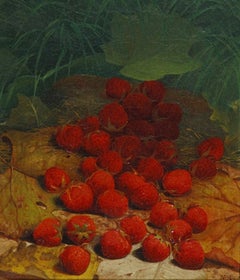
Strawberries Strewn on a Forest Floor
By William Mason Brown
Located in New York, NY
William Mason Brown was born in Troy, New York, where he studied for several years with local artists, including the leading portraitist there, Abel Buel Moore. In 1850, he moved to ...
Category
19th Century American Realist Landscape Paintings
Materials
Canvas, Oil
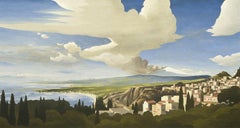
Mt. Etna from Taormina
By Thomas Fransioli
Located in New York, NY
Thomas Fransioli, born in 1906 in Seattle, Washington, trained as an architect at the University of Pennsylvania. He worked as an architect before his service in World War II. Largel...
Category
20th Century American Realist Landscape Paintings
Materials
Canvas, Oil
Saint-Malo, Brittany
By William Stanley Haseltine
Located in New York, NY
The career of William Stanley Haseltine spans the entire second half of the nineteenth century. During these years he witnessed the growth and decline of American landscape painting, the new concept of plein-air painting practiced by the Barbizon artists, and the revolutionary techniques of the French Impressionists, all of which had profound effects on the development of painting in the western world. Haseltine remained open to these new developments, selecting aspects of each and assimilating them into his work. What remained constant was his love of nature and his skill at rendering exactly what he saw. His views, at once precise and poetic, are, in effect, portraits of the many places he visited and the landscapes he loved.
Haseltine was born in Philadelphia, the son of a prosperous businessman. In 1850, at the age of fifteen, he began his art studies with Paul Weber, a German artist who had settled in Philadelphia two years earlier. From Weber, Haseltine learned about Romanticism and the meticulous draftsmanship that characterized the German School. At the same time, Haseltine enrolled at the University of Pennsylvania, and took sketching trips around the Pennsylvania countryside, exploring areas along the Delaware and Susquehanna rivers. Following his sophomore year, Haseltine transferred to Harvard University.
After graduating from Harvard in 1854, Haseltine returned to Philadelphia and resumed his studies with Weber. Although Weber encouraged Haseltine to continue his training in Europe, the elder Haseltine was reluctant to encourage his son to pursue a career as an artist. During the next year, Haseltine took various sketching trips along the Hudson River and produced a number of pictures, some of which were exhibited at the Pennsylvania Academy of the Fine Arts in the spring of 1855. Ultimately, having convinced his father that he should be allowed to study in Europe, Haseltine accompanied Weber to Düsseldorf.
The Düsseldorf Academy was, during the 1850s, at the peak of its popularity among American artists. The Academy’s strict course of study emphasized the importance of accurate draftsmanship and a strong sense of professionalism. Landscape painting was the dominant department at the Düsseldorf Academy during this period, and the most famous landscape painter there was Andreas Achenbach, under whom Haseltine studied. Achenbach’s realistic style stressed close observation of form and detail, and reinforced much of what Haseltine had already learned. His Düsseldorf training remained an important influence on him for the rest of his life.
At Düsseldorf, Haseltine became friendly with other American artists studying there, especially Emanuel Leutze, Worthington Whittredge, and Albert Bierstadt. They were constant companions, and in the spring and summer months took sketching trips together. In the summer of 1856 the group took a tour of the Rhine, Ahr, and Nahe valleys, continuing through the Swiss alps and over the Saint Gotthard Pass into northern Italy. The following summer Haseltine, Whittredge, and the painter John Irving returned to Switzerland and Italy, and this time continued on to Rome.
Rome was a fertile ground for artists at mid-century. When Haseltine arrived in the fall of 1857, the American sculptors Harriet Hosmer, Chauncey B. Ives, Joseph Mozier, William Henry Rinehart...
Category
19th Century American Realist Landscape Paintings
Materials
Canvas, Oil
Still Thinking About These?
All Recently ViewedRead More
With Works Like ‘Yours Truly,’ Arthur Dove Pioneered Abstract Art in America
New York gallery Hirschl & Adler is exhibiting the bold composition by Dove — who’s hailed as the first American abstract painter — at this year’s Winter Show.
Remarkably, Elizabeth Turk’s Sculptures Highlight the Lost Voices of Extinct Birds
In one of the first live and in-person exhibitions at a Manhattan gallery since last spring, the California-based sculptor gives the lost voices of endangered and extinct birds and animals a magnificent embodied form.