Want more images or videos?
Request additional images or videos from the seller
1 of 6
Cecil Crosley Bell"Red Ferry, Leaving Staten Island #2, " Cecil Bell, American Realist WPA Boat1960
1960
$12,000List Price
About the Item
- Creator:Cecil Crosley Bell (1906 - 1970, American)
- Creation Year:1960
- Dimensions:Height: 38 in (96.52 cm)Width: 42.75 in (108.59 cm)
- Medium:
- Movement Style:
- Period:
- Condition:
- Gallery Location:New York, NY
- Reference Number:1stDibs: LU1841211696102
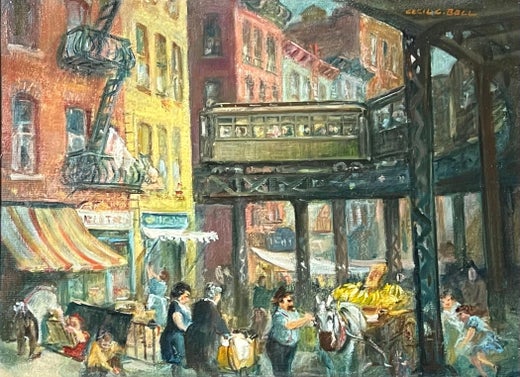
Cecil Crosley Bell
Cecil Crosley Bell was born on July 15, 1906, in Seattle. Bell studied printmaking at the Art Institute of Chicago before moving to New York to study at the Art Students League with John Sloan. Bell remained in New York, eventually settling in Staten Island with his wife. Most of his paintings depict famous locations around New York City. Bell died in New York in 1970. Largely unknown during his lifetime, in 1973 a retrospective of his work was held at The Museum of Modern Art, New York.
About the Seller
5.0
Platinum Seller
Premium sellers with a 4.7+ rating and 24-hour response times
Established in 2022
1stDibs seller since 2022
132 sales on 1stDibs
Authenticity Guarantee
In the unlikely event there’s an issue with an item’s authenticity, contact us within 1 year for a full refund. DetailsMoney-Back Guarantee
If your item is not as described, is damaged in transit, or does not arrive, contact us within 7 days for a full refund. Details24-Hour Cancellation
You have a 24-hour grace period in which to reconsider your purchase, with no questions asked.Vetted Professional Sellers
Our world-class sellers must adhere to strict standards for service and quality, maintaining the integrity of our listings.Price-Match Guarantee
If you find that a seller listed the same item for a lower price elsewhere, we’ll match it.Trusted Global Delivery
Our best-in-class carrier network provides specialized shipping options worldwide, including custom delivery.You May Also Like
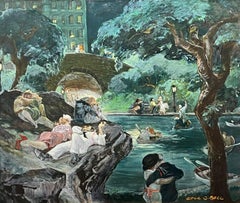
World War II Invades Central Park
By Cecil Crosley Bell
Located in Los Angeles, CA
World War II Invades Central Park, 1943, oil on canvas, signed lower right, 30 x 36 inches, literature: Barton, Phyllis, Cecil C. Bell, McGrew Color Graphics (Kansas City, MO, 1976),...
Category
1940s American Realist Landscape Paintings
Materials
Canvas, Oil
In the Distance
By Shirley Cean Youngs
Located in Greenwich, CT
American b. 1939
Renowned Impressionist painter Shirley Cean Youngs is a native New Yorker who now lives on a family compound in Connecticut surrounded by nature and those she loves...
Category
2010s American Realist Landscape Paintings
Materials
Canvas, Oil
The Artist
s Garden
, Munich Academy, Art Institute of Chicago, PAFA, Corcoran
By Julius Moessel
Located in Santa Cruz, CA
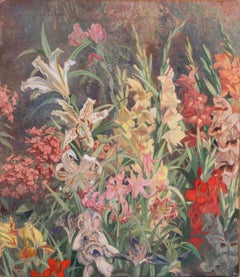
'The Artist's Garden' by Julius Moessel, 1943.
Munich Academy, Art Institute of Chicago, Philadelphia Academy of Fine Arts, Corcoran
-----
Signed lower left 'Moessel' for Julius Moe...
Category
1940s American Realist Still-life Paintings
Materials
Canvas, Oil
$5,000
H 30 in W 26 in D 0.75 in
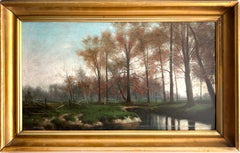
Stunning Antique American Oil Painting Lake Original Frame Signed Illegibly Rare
Located in Buffalo, NY
This tranquil landscape captures a sunlit autumn morning along a quiet stream. Delicate mist softens the background, while a weathered split-rail fence leads the eye through a grove ...
Category
Late 19th Century American Realist Landscape Paintings
Materials
Canvas, Oil
Tree Trunks Oil on Stretched Canvas 40" x 30" Light and Shadow The Meadows
Located in Houston, TX
Look for free shipping at checkout
Tree Trunks
Oil on Canvas
40″ x 30″
Tree Trunks is part of The Meadows which is an interpretation of the pine trees which are east of Taos, ...
Category
2010s American Realist Landscape Paintings
Materials
Cotton Canvas, Oil

$3,400
H 40 in W 30 in D 1 in
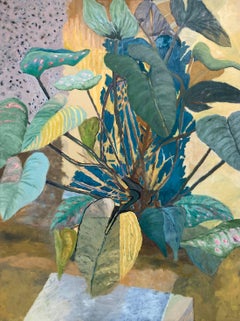
Anthurium Still Life Oil on Stretched Canvas 40" x 30" perspective
dimension
Located in Houston, TX
Anthurium Still Life
Oil on Canvas
40″ x 30″ framed by Texas artist Julie England
Look for free shipping at checkout
Anthurium Still Life was inspired by the idea of abstract ...
Category
2010s American Realist Still-life Paintings
Materials
Oil, Cotton Canvas
$3,200
H 30 in W 40 in D 1 in
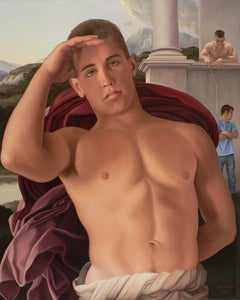
String Theory
By Wes Hempel
Located in Fairfield, CT
A walk through any major museum will reveal paintings that depict or legitimate only certain kinds of experience. Despite the good intentions of critical theorists questioning the va...
Category
2010s American Realist Nude Paintings
Materials
Canvas, Oil
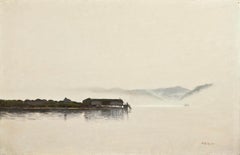
Fishing Camp on the Labrador Coast
By William Bradford
Located in New York, NY
In 1852, twenty-nine year old William Bradford was a failing shopkeeper in Fairhaven, Massachusetts. With a wife and child at home, Bradford, by his own admission, “spent too much time in painting to succeed” in business. Rescued from insolvency by his well-to-do in-laws, this is not the beginning of a narrative that generally leads to a happy ending. Not so with Bradford, who ultimately found international fame and fortune as a painter of arctic seascapes and dramatic marine paintings.
William Bradford, the artist, was a lineal descendant of the 17th-century Separatist leader William Bradford, a founder of the Plymouth Plantation, signer of the Mayflower Compact and Governor of the Plymouth Colony. Our Bradford born to a New Bedford ship outfitter in Fairhaven, Massachusetts By the nineteenth century, this line of Bradfords were Quakers, living on the tract purchased nearly two centuries earlier by their pilgrim ancestor. Fairhaven, across the mouth of the Acushnet River from the whaling center of New Bedford was described by a New York journalist in 1857 as “the Brooklyn of New Bedford” (Home Journal, January 3, 1857). Young Bradford displayed an early predilection for the arts, but his Quaker parents were disinclined to support this particular pursuit. After working in his father’s business and then for a dry goods merchant in New Bedford, by 1849 Bradford had set up in New Bedford as a “merchant tailor” offering outfits for “those going to California,” “seamen’s clothing,” custom-tailored “piece goods...
Category
19th Century American Realist Landscape Paintings
Materials
Canvas, Paper, Oil
James Jahrsdoerfer, "Fishing on Round Lake", Winter Ice Fishing Oil Painting
By James Jahrsdoerfer
Located in Saratoga Springs, NY
This piece, "Fishing on Round Lake", is an 11x14 landscape oil painting on canvas by artist James Jahrsdoerfer. Featured is an afternoon view onto a...
Category
2010s American Realist Landscape Paintings
Materials
Canvas, Oil
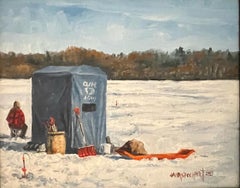
James JahrsdoerferJames Jahrsdoerfer, "Fishing on Round Lake", Winter Ice Fishing Oil Painting, 2013
$960 Sale Price
20% Off
H 11 in W 14 in
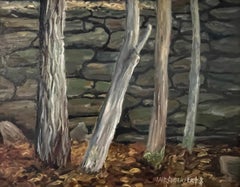
James Jahrsdoerfer, "Vermont Wall", Tree Rock Wall Oil Painting on Canvas
Located in Saratoga Springs, NY
This piece, "Vermont Wall" is a 12x16 oil painting on canvas by artist James Jahrsdoerfer featuring an up-close view of an old hand-built rock wal...
Category
1990s American Realist Landscape Paintings
Materials
Canvas, Oil
$1,200 Sale Price
20% Off
H 12 in W 16 in
More From This Seller
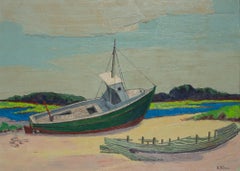
View All"Low Tide at Noon, Wellfleet, Massachusetts, " Ernest Fiene, WPA, Boat on Beach
By Ernest Fiene
Located in New York, NY
Ernest Fiene (1894 - 1965)
Low Tide at Noon, Wellfleet, Massachusetts
Oil on canvas
26 x 36 inches
Signed lower right
Ernest Fiene was born in Elberfeld, Germany in 1894. As a teenager, Fiene immigrated to the United States in 1912. He studied art at the National Academy of Design in New York City from 1914 to 1918, taking day classes with Thomas Maynard and evening classes with Leon Kroll. Fiene continued his studies at the Beaux-Arts Institute of Design in Paris from 1916 to 1918, adding classes in printmaking at the Art Students League in 1923.
Fiene began his career as an artist in 1919 with his first exhibition of watercolors at the MacDowell Club arranged by his mentor Robert Henri. In 1923 the Whitney Studio Club mounted a large exhibition of his works. The following year he had an exhibition at the New Gallery in New York, which completely sold out all fifty-two works, including paintings, watercolors, drawings, and etchings. With the proceeds of sales from the New Gallery exhibition, Ernest Fiene and his younger brother Paul, a sculptor, built studios in Woodstock, New York in 1925.
In the early Twenties Ernest Fiene painted mostly landscapes of Woodstock and both the Ramapo and Hudson River Valleys. He was the subject of the first monograph for the Younger Artists Series in 1922. Published in Woodstock, the series went on to include Alexander Brook, Peggy Bacon, and Yasuo Kuniyoshi. The book reproduced 1 illustration in color and another 27 reproductions in black and white. Around 1925 Fiene became fascinated with the intensity, excitement, and opportunities for color harmonies New York City offered as a subject. His paintings shifted to urban and industrial themes with architecture, industry, and transportation becoming his subjects.
By 1926 Fiene had attracted the dealer Frank K.M. Rehn, who gave him a one-man exhibition that year, which travelled to the Boston Arts Club. C.W. Kraushaar Galleries gave Fiene a one-man exhibition of urban, landscape, portrait, and still life paintings in 1927. Julianna Force, the director of the Whitney Studio Club and first director of the Whitney Museum of American Art, included two of Fiene's paintings in a fall exhibition in 1928. The Whitney Studio Club showed Fiene's paintings in a two-man exhibition with Glenn O. Coleman that year and acquired three of Fiene's paintings. Also in 1928 Fiene became affiliated with Edith Halpert's Downtown Gallery where he had an exhibition of 20 lithographs in the spring. Fiene sold his house in Woodstock in 1928 to spend more of his time in New York City.
With so many successful exhibitions, Fiene returned to Paris in 1928-29 where he rented Jules Pascin's studio and studied at the Académie de la Grande Chaumière. In France, Fiene painted both landscape and urban subjects developed from ideas influenced by Cubist geometry and the use of flat areas of broad color. Upon returning to New York in 1930, Fiene used this new approach to continue to paint New York skyscraper and waterfront subjects, as well as to begin a series of paintings on changing old New York based on the excavations for Radio City Music Hall and the construction of the Empire State Building. Frank K.M. Rehn Galleries exhibited this series, titled "Changing Old New York," in 1931. Fiene also has solo exhibitions at Rehn Galleries in 1930 and 1932. Fiene's oil paintings are exhibited at the Chicago Arts Club in 1930 as well.
Fiene was included in the Museum of Modern Art's exhibition Painting and Sculpture by Living Americans in December of 1931. Visiting New York, Henri Matisse saw the exhibition and called Fiene's Razing Buildings, West 49th Street the finest painting he had seen in New York. Fiene had two mural studies from his Mechanical Progress series exhibited at the Museum of Modern Art's exhibition Murals by American Painters and Photographers in 1932. Fiene sent View from my Window which depicts Fiene working on a lithograph stone while looking out his window to the newly completed Empire State Building to the Carnegie International in 1931. In 1932 Fiene participated in the first Biennial of American Painting at the Whitney Museum and his prints were included in exhibitions at the Downtown Gallery and the Wehye Gallery. In the same year, Fiene was awarded a Guggenheim fellowship to further study mural painting in Florence, Italy.
On his return from Italy in 1933 Fiene re-engaged himself in New York City life and won several public and private mural projects. Fiene resumed his active exhibition schedule, participating in two group exhibitions at the Whitney Museum and a one-man exhibition of recent paintings at the Downtown Gallery in January 1934. In 1933 he purchased a farm in Southbury, Connecticut, which added Connecticut scenes to his landscape subjects. This was also the year Fiene began to spend summers on Monhegan Island, Maine, where he painted seascapes, harbor scenes, and still lifes.
Fiene's landscape paintings attracted numerous commissions as part of the American Scene movement. From 1935-36 Fiene took an extended sketching trip through the urban, industrial, and farming areas of Pennsylvania and West Virginia. Most of the twenty-four Pennsylvania urban and rural paintings from this trip were featured in an exhibition held at the First National Bank in Pittsburgh in October of 1937 by the Pittsburgh Commission for Industrial Expansion. Fiene said of these works that he formed rhythm, opportunity for space and color, and integrity in the Pennsylvania mill and furnace paintings. Fiene received the silver medal for one of the Pittsburgh paintings...
Category
Mid-20th Century American Realist Landscape Paintings
Materials
Canvas, Oil
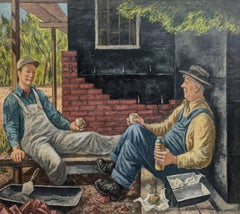
"Lunch Break” Fletcher Martin, Men Working, Bricklayers, WPA, American Scene
By Fletcher Martin
Located in New York, NY
Fletcher Martin
Lunch Break, circa 1940
Signed lower right
Oil on canvas
31 1/2 x 37 3/8 inches
When Fletcher Martin died in 1979, the New York Times entitled his obituary “Artist o...
Category
1940s American Realist Landscape Paintings
Materials
Canvas, Oil
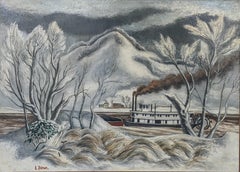
"Along the Kanahawa River, West Virginia, " Ernest Fiene, WPA Coal Steamboat
By Ernest Fiene
Located in New York, NY
Ernest Fiene
Along the Kanahawa River, West Virginia, 1936
Signed lower right
Oil on canvas
26 x 36 inches
Fiene made a series of paintings, drawings and lithographs which are based on his travels through Pennsylvania and West Virginia during the winter of 1935-36. The industrial areas of Pennsylvania and West Virginia are represented in numerous oils, among which are some of his most well-known. Fiene wrote of the trip, "The increasing snow and atmospheric conditions [in the Kanawha River valley} enhanced this mountainous coal mining country with a majestic beauty."
Winter on the River is Fiene's only American Artists Group print and there were only two lithographs produced from the West Virginia trip. The American Artists Group (AAG), under the direction of Carl Zigrosser, who was then working at New York's famed Weyhe Gallery, published ninety-three prints by over fifty artists in 1936 and 1937. Zigrosser's goal was to popularize contemporary American art through original prints offered at the low price of $2.75. The project was also a means to provide income for impoverished artists during the Depression. The prints were featured in many of the leading print exhibitions and publications of the period. The lithograph produced from this image is now in the collection of the Amon Carter Museum, Baltimore Museum of Art, Cleveland Museum of Art, Philadelphia Museum of Art, Pensacola Museum of Art, San Francisco Fine Arts Museum, Syracuse Museum, Yale University Art Museum.
Ernest Fiene was born in Elberfeld, Germany in 1894. As a teenager, Fiene immigrated to the United States in 1912. He studied art at the National Academy of Design in New York City from 1914 to 1918, taking day classes with Thomas Maynard and evening classes with Leon Kroll. Fiene continued his studies at the Beaux-Arts Institute of Design in New York from 1916 to 1918, adding classes in printmaking at the Art Students League in 1923.
Fiene began his career as an artist in 1919 with his first exhibition of watercolors at the MacDowell Club arranged by his mentor Robert Henri. In 1923 the Whitney Studio Club mounted a large exhibition of his works. The following year he had an exhibition at the New Gallery in New York, which completely sold out all fifty-two works, including paintings, watercolors, drawings, and etchings. With the proceeds of sales from the New Gallery exhibition, Ernest Fiene and his younger brother Paul, a sculptor, built studios in Woodstock, New York in 1925.
In the early Twenties Ernest Fiene painted mostly landscapes of Woodstock and both the Ramapo and Hudson River Valleys. The first monograph from the Younger Artists Series was published on Fiene in 1922. Published in Woodstock, the series went on to include Alexander Brook, Peggy Bacon, and Yasuo Kuniyoshi. The book reproduced 1 illustration in color and another 27 reproductions in black and white. Around 1925 Fiene became fascinated with the intensity, excitement, and opportunities for color harmonies New York City offered as a subject. His paintings shifted to urban and industrial themes with architecture, industry, and transportation becoming his subjects.
By 1926 Fiene had attracted the dealer Frank K.M. Rehn, who gave him a one-man exhibition that year, which travelled to the Boston Arts Club. C.W. Kraushaar Galleries gave Fiene a one-man exhibition of urban, landscape, portrait, and still life paintings in 1927. Julianna Force, the director of the Whitney Studio Club and first director of the Whitney Museum of American Art, included two of Fiene’s paintings in a fall exhibition in 1928. The Whitney Studio Club showed Fiene’s paintings in a two-man exhibition with Glenn O. Coleman that year and acquired three of Fiene’s paintings. Also in 1928 Fiene became affiliated with Edith Halpert’s Downtown Gallery where he had an exhibition of 20 lithographs in the spring. Fiene sold his house in Woodstock in 1928 to spend more of his time in New York City.
With so many successful exhibitions, Fiene returned to Paris in 1928-29 where he rented Jules Pascin's studio and studied at the Académie de la Grande Chaumière. In France, Fiene painted both landscape and urban subjects developed from ideas influenced by Cubist geometry and the use of flat areas of broad color. Upon returning to New York in 1930, Fiene used this new approach to continue to paint New York skyscraper and waterfront subjects, as well as to begin a series of paintings on changing old New York based on the excavations for Radio City Music Hall and the construction of the Empire State Building. Frank K.M. Rehn Galleries exhibited this series, titled “Changing Old New York,” in 1931. Fiene also has solo exhibitions at Rehn Galleries in 1930 and 1932. Fiene’s oil paintings are exhibited at the Chicago Arts Club in 1930 as well.
Fiene was included in the Museum of Modern Art’s exhibition Painting and Sculpture by Living Americans in December of 1931. Visiting New York, Henri Matisse saw the exhibition and called Fiene’s Razing Buildings, West 49th Street the finest painting he had seen in New York. Fiene had two mural studies from his Mechanical Progress series exhibited at the Museum of Modern Art’s exhibition Murals by American Painters and Photographers in 1932. Fiene sent View from my Window which depicts Fiene working on a lithograph stone while looking out his window to the newly completed Empire State Building to the Carnegie International in 1931. In 1932 Fiene participated in the first Biennial of American Painting at the Whitney Museum and his prints were included in exhibitions at the Downtown Gallery and the Wehye Gallery. In the same year, Fiene was awarded a Guggenheim fellowship to further study mural painting in Florence, Italy.
On his return from Italy in 1933 Fiene re-engaged himself in New York City life and won several public and private mural projects. Fiene resumed his active exhibition schedule, participating in two group exhibitions at the Whitney Museum and a one-man exhibition of recent paintings at the Downtown Gallery in January 1934. In 1933 he purchased a farm in Southbury, Connecticut, which added Connecticut scenes to his landscape subjects. This was also the year Fiene began to spend summers on Monhegan Island, Maine, where he painted seascapes, harbor scenes, and still lifes.
Fiene’s landscape paintings attracted numerous commissions as part of the American Scene movement. Through the fall and winter of 1935-36, Fiene took an extended sketching trip through the urban, industrial, and farming areas of Pennsylvania and West Virginia. Most of the twenty-four Pennsylvania urban and rural paintings from this trip were featured in an exhibition held at the First National Bank in Pittsburgh in October of 1937 by the Pittsburgh Commission for Industrial Expansion. Fiene said of these works that he formed rhythm, opportunity for space and color, and integrity in the Pennsylvania mill and furnace paintings. Fiene received the silver medal for one of the Pittsburgh paintings...
Category
1930s American Realist Landscape Paintings
Materials
Canvas, Oil
$8,000 Sale Price
20% Off
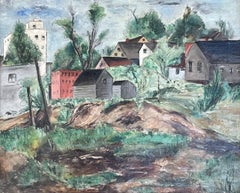
"Backyard, Staten Island, New York" Bumpei Usui, Japanase-American Landscape
Located in New York, NY
Bumpei Usui
Backyard, Staten Island, 1933
Signed lower right
Oil on canvas
20 x 24 inches
Provenance:
The artist's estate
Salander O'Reilly Galleries, New...
Category
1930s American Realist Landscape Paintings
Materials
Canvas, Oil
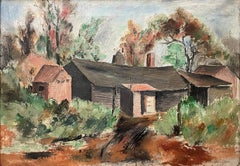
"Shanties in the Bronx, New York" Bumpei Usui, Japanase-American City Landscape
Located in New York, NY
Bumpei Usui
Shanties in the Bronx, 1933
Signed lower right
Oil on canvas
14 x 20 inches
Provenance:
The artist's estate
Salander O'Reilly Galleries, New Y...
Category
1930s American Realist Landscape Paintings
Materials
Canvas, Oil
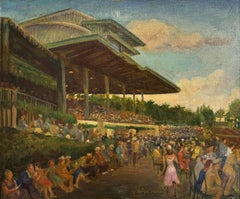
"Hialeah Park Race Track, Florida" Beatrix Sherman, American, Mid 20th Century
Located in New York, NY
Beatrix Sherman
Hialeah Park Race Track, Florida, 1947
Signed lower right
Oil on canvasboard
16 x 20 inches
Beatrix Sherman (1894-1975), who changed her first name from Beatrice by...
Category
1940s American Realist Figurative Paintings
Materials
Canvas, Oil, Board
Still Thinking About These?
All Recently ViewedMore Ways To Browse
Vintage California Monterey Pacific Grove Painting
W Lambert Bell
William Callcott Knell
David Leung
David Zak
Diego Beneitez
Douglas Wilson
Eva Hollyer
Exa Wall
Eyvind Earle Original
Famous Impressionist Paintings Signed
Fernando Zobel
Fredrick Stephens
G Wyatt Oil Landscape
George Albach
Georges Lachance
Isherwood James
John J Holmes