Items Similar to "Texas Pastoral Bluebonnet Scene" Framed Oil Painting Spring Wildflowers Farm
Video Loading
Want more images or videos?
Request additional images or videos from the seller
1 of 11
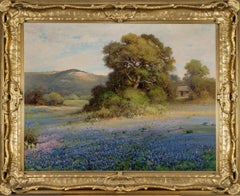
Dalhart Windberg"Texas Pastoral Bluebonnet Scene" Framed Oil Painting Spring Wildflowers Farm
$2,700
£2,049.79
€2,363.07
CA$3,819.52
A$4,112.06
CHF 2,202.09
MX$49,548.90
NOK 27,784.27
SEK 25,427.10
DKK 17,657.82
About the Item
Canvas size: 9 x 12 in.
Frame size: 17 x 19.5 in.
Signed, bottom left in red "Windberg"
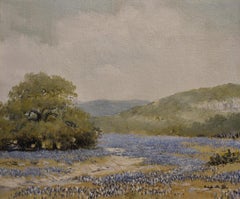
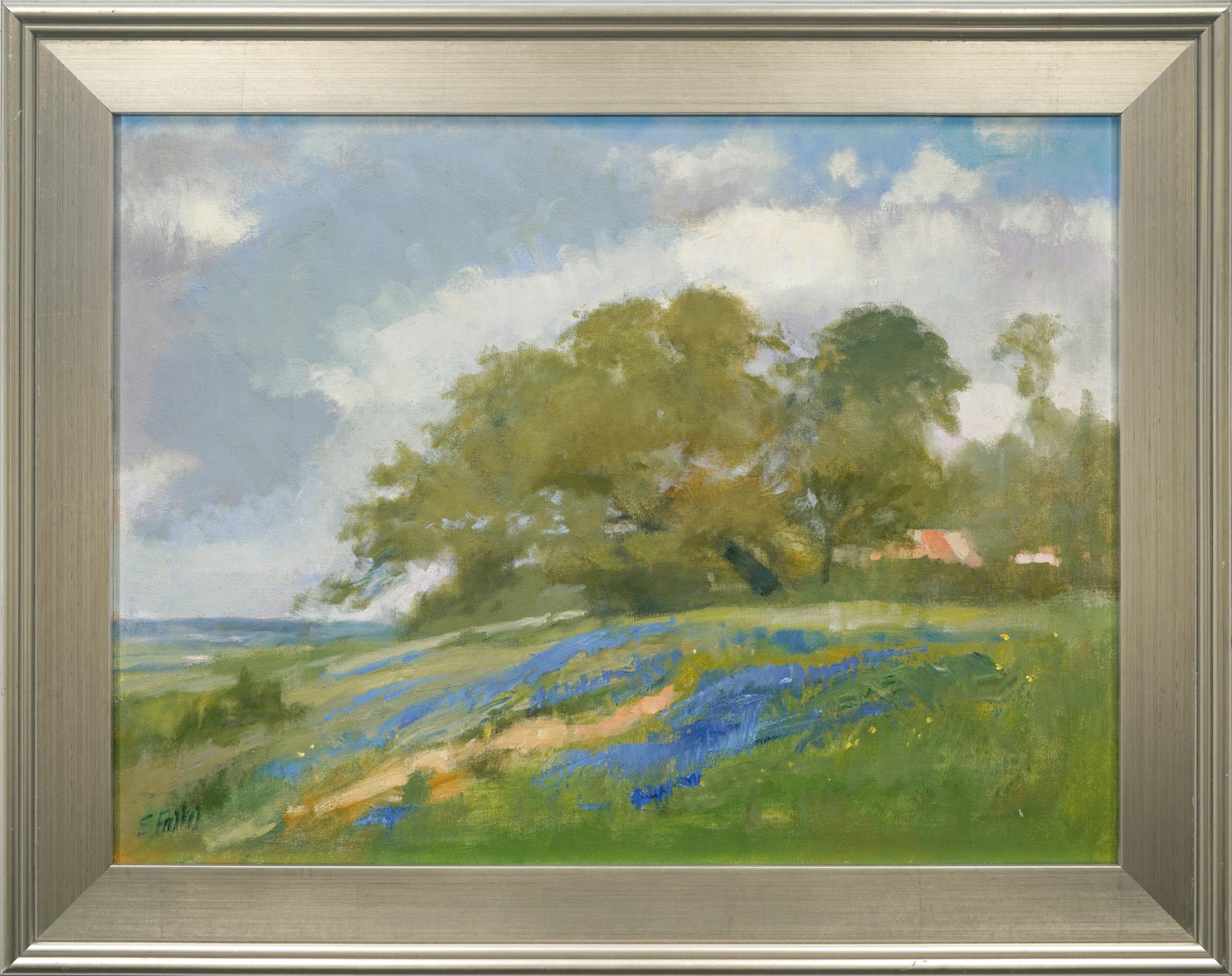
A serene, nostalgic scene that captures a Central Texas pastoral landscape with a soft, impressionistic touch. The foreground features by a gentle hillside covered in a thick carpet of bluebonnets and wildflowers, rendered textured brushstrokes in shades of blue, yellow, and green. A prickly pear cactus blooms yellow and orange among the bluebonnets. t the center the composition is a majestic live oak tree on the crest of the hill, its foliage painted in a mix of muted greens and browns. Tucked just behind the tree is a small, white cottage with a stone chimney, nestled into the landscape. The entire scene is bathed in a soft, hazy light, suggesting a spring morning under a pale blue sky with pink, sun-painted clouds.
The painting is ready to hang in an ornate, vintage frame with gold leaf finish. A brass plaque engraved "Windberg", names the artist and the bottom center of the frame.
- Creator:Dalhart Windberg (1933, American)
- Dimensions:Height: 9 in (22.86 cm)Width: 12 in (30.48 cm)
- Medium:
- Movement Style:
- Period:
- Condition:Painting itself is in perfect condition. The velvet liner on the vintage frame has some fraying at the corners. See photos.
- Gallery Location:Austin, TX
- Reference Number:Seller: MV-266491stDibs: LU1171217099712
About the Seller
4.9
Platinum Seller
Premium sellers with a 4.7+ rating and 24-hour response times
Established in 1964
1stDibs seller since 2019
144 sales on 1stDibs
Typical response time: <1 hour
- ShippingRetrieving quote...Shipping from: Austin, TX
- Return Policy
More From This Seller
View AllSpring Pastoral Landscape with Bluebonnets and Yellow Prickly Pear
By Robert Harrison
Located in Austin, TX
A luminous landscape painting depicting the Texas Hill Country in springtime, blanketed with bluebonnets and dotted with yellow, blooming prickly pear cactus in the foreground. A stately live oak tree...
Category
20th Century Landscape Paintings
Materials
Canvas, Oil
"Texas Hill Country Bluebonnet Landscape" Oil on Canvas Painting of Nature Scene
By Manuel Garza
Located in Austin, TX
Manuel Garza (American; 1940 - 2022)
Medium: Oil on Canvas
Canvas size: 16" x 20"
Frame Size: 20.5" x 24.5"
Signed, Lower Left: "Manuel Garza"
Category
Late 20th Century American Realist Landscape Paintings
Materials
Oil, Canvas
"Texas Hill Country Landscape With Cattle" oil painting of wildflowers, cactus
By Don Warren
Located in Austin, TX
Canvas Size: 12 x 16 in.
Frame Size: 20.5 x 24.5 in.
Signed, lower left: "Don Warren"
A serene, classic, and cheerful scene in the Texas Hill Country by Don Warren. The foreground i...
Category
1970s American Realist Landscape Paintings
Materials
Canvas, Oil
"Hill Country Landscape with a Creek" Texas Landscape in Summer
Located in Austin, TX
In this painting, 20th century artist Palmer Chrisman depicts a flowing Texas creek in the summer. This piece is executed in oil on canvas.
Canvas Size: 24 x 36 inches
Framed Size: 3...
Category
20th Century Landscape Paintings
Materials
Canvas, Oil
Pastoral Landscape with Windmill
Located in Austin, TX
By Rick Morris Patterson
Oil on Canvas
16" x 20"
Framed Size: 25.5" x 29"
This rural Texas landscape scene features cactus, an rustic windmill, and an old dirt road.
Category
20th Century American Realist Landscape Paintings
Materials
Canvas, Oil
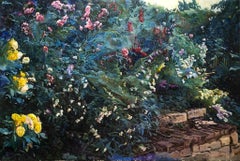
Flowers in Bloom Impressionist Scene
By Bartolome Sastre
Located in Austin, TX
By Bartolome Sastre
This vast and stunning floral scene depicts a wall of flowering plants with pink, purple, red, and yellow petals. The impressionist style gives the flowerbed a se...
Category
21st Century and Contemporary Impressionist Landscape Paintings
Materials
Canvas, Oil
You May Also Like
Spring in Weimer Texas Hill Country Bluebonnets, Oil Texas Landscape 18" x 24"
By Steve Parker
Located in Houston, TX
Spring in Weimer is painted from a plein aire study from a day in Weimar, Texas. This was painted in the spring when the bluebonnets are beginning to bloom. It is common for people t...
Category
2010s American Impressionist Landscape Paintings
Materials
Canvas, Oil
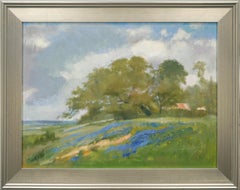
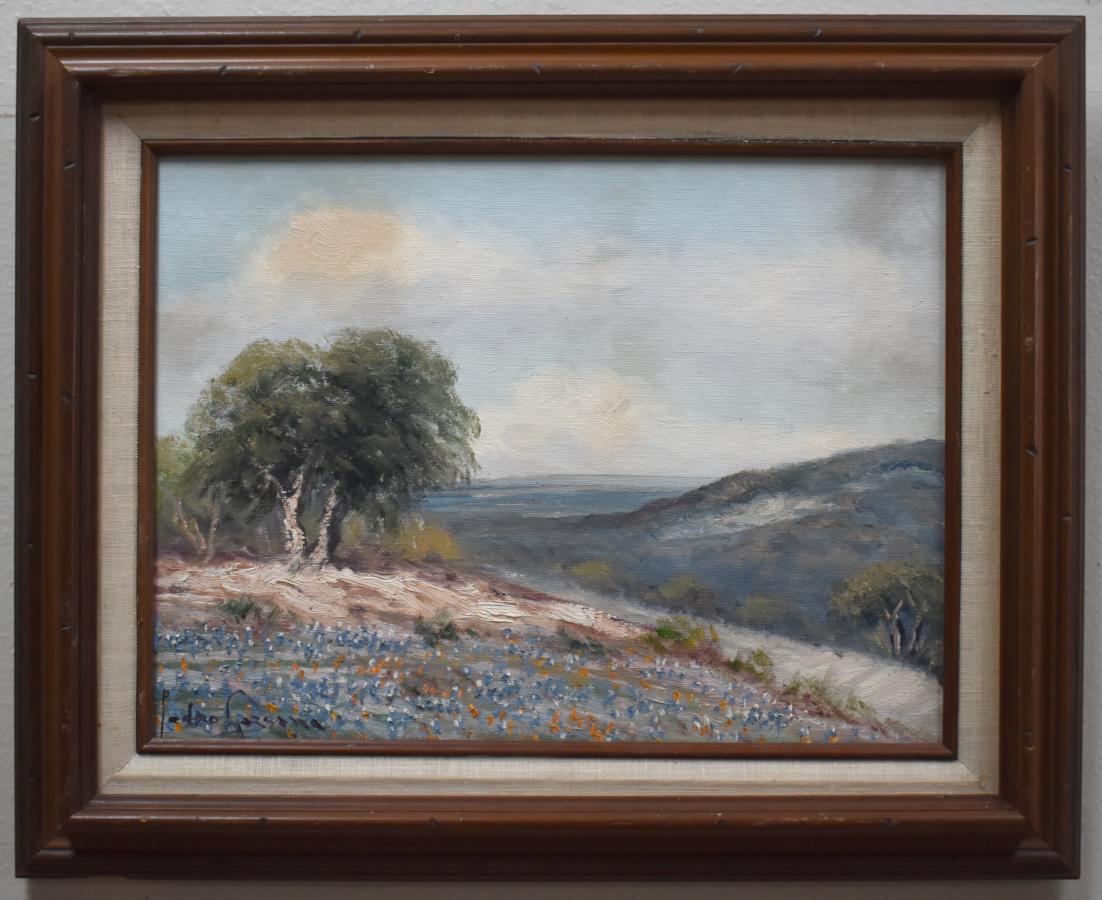
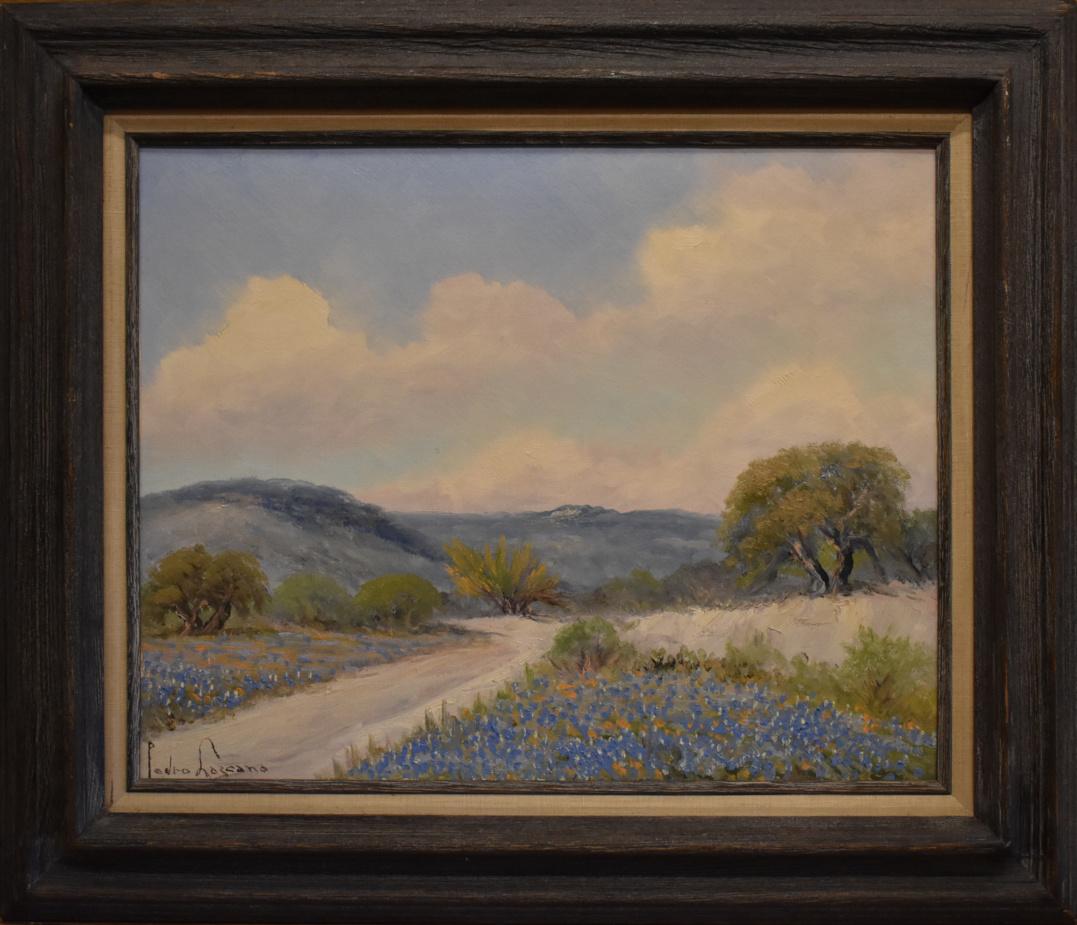
"BLUEBONNET HILLTOP" TEXAS HILL COUNTRY FRAMED 17.25 X 21.25
By Pedro Lazcano
Located in San Antonio, TX
Pedro Lazcano
(1909-1970)
San Antonio Artist
Image Size: 12 x 16
Frame Size: 17.25 x 21.25
Medium: Oil
"Bluebonnet Hill Top"
Pedro Lazcano (1909-1970)
I was always curious about Pedr...
Category
1960s Impressionist Landscape Paintings
Materials
Oil
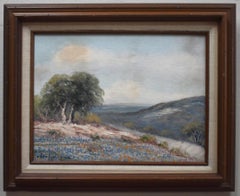
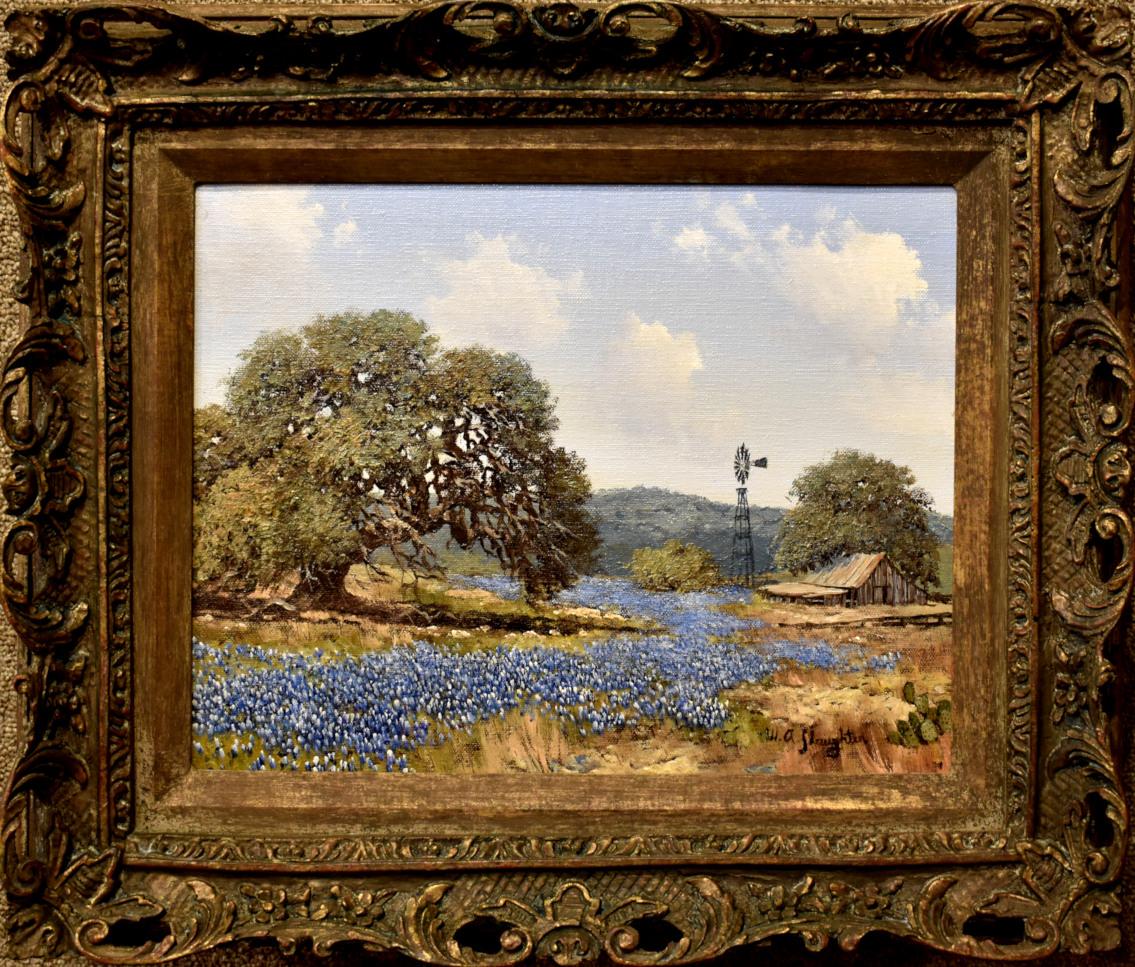
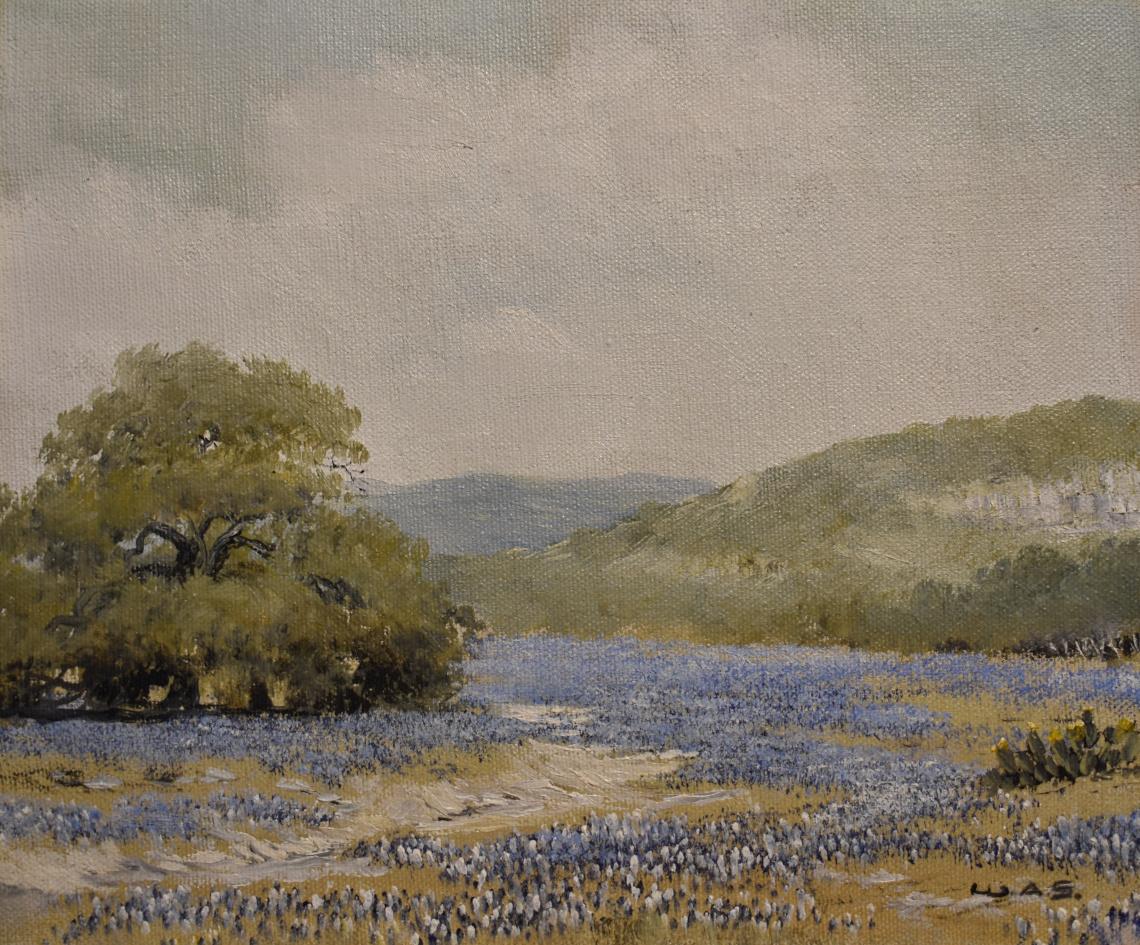
"BLUEBONNETS" TEXAS HILL COUNTRY WILDFLOWERS W.A. SLAUGHTER (1923-2003)
Located in San Antonio, TX
W. A. Slaughter
(1923 - 2003)
Dallas / San Antonio Artist
Image Size: 11 x 14
Frame Size: 17 x 19.5
Medium: Oil on Canvas
"Bluebonnets"
Biography
W. A. Slaughter (1923 - 2003)
Willia...
Category
1990s Impressionist Landscape Paintings
Materials
Oil

"BLUEBONNET AND HUISACHE" TEXAS HILL COUNTRY FRAMED 23 X 27
By Pedro Lazcano
Located in San Antonio, TX
Pedro Lazcano
(1909-1970)
San Antonio Artist
Image Size: 16 x 20
Frame Size: 23 x 27
Medium: Oil on Canvas
"Bluebonnet and Huisache" Texas Hill Country
Pedro Lazcano (1909-1970)
I wa...
Category
1960s Impressionist Landscape Paintings
Materials
Oil
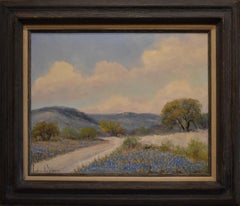
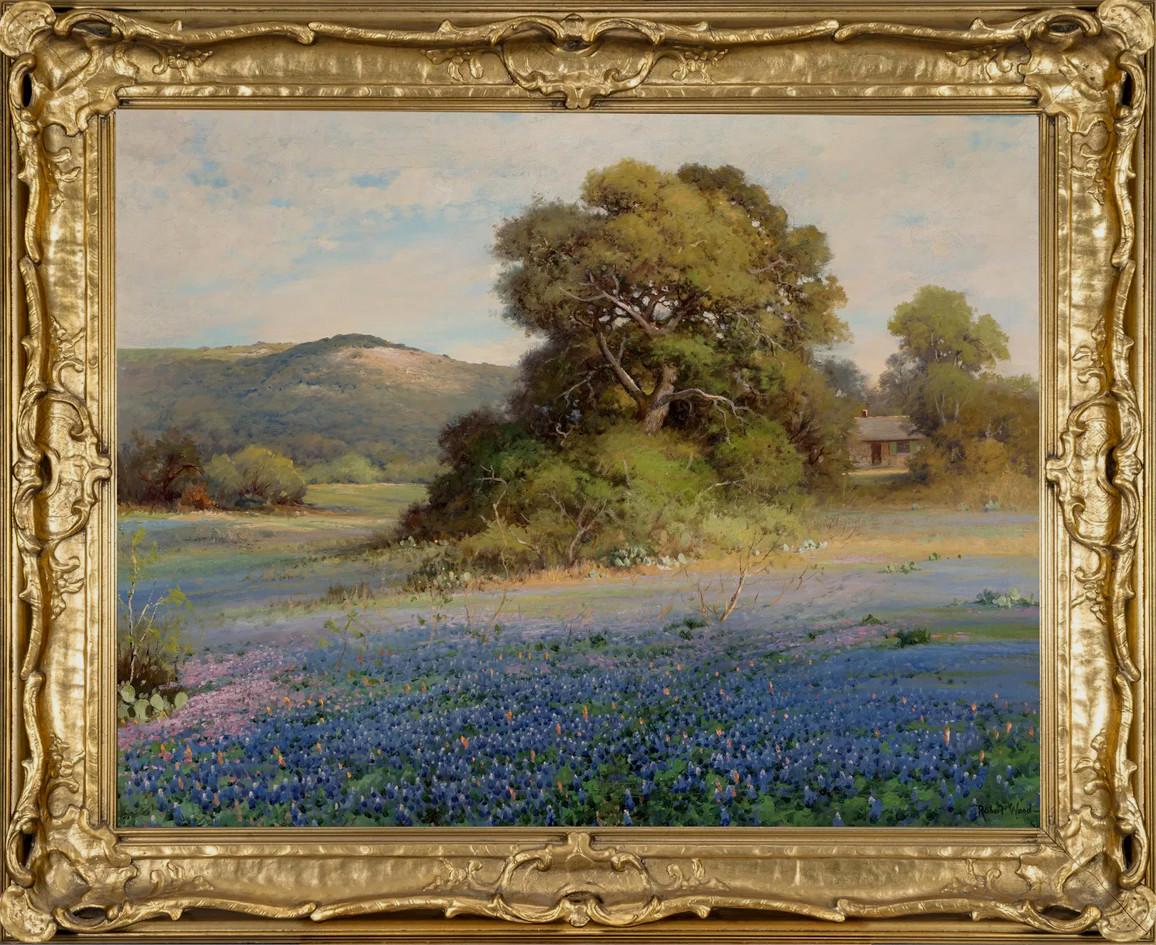
"BLUE HEAVEN" BLUEBONNET 1930s NEWCOMB MACKLIN FRAME 38 x 46 Framed Robert Wood
Located in San Antonio, TX
Robert Wood (G. Day)
(1889 -1979)
San Antonio Artist
Image Size: 28 x 36
Frame Size: 38 x 46
Medium: Oil on Canvas Signed Front
Signed
Titled on Verso
Newcomb Macklin Frame
Circa Late 1930s
"Blue Heaven" Bluebonnets
Biography
Robert Wood (G. Day) (1889 -1979)
A painter of realistic landscapes reflecting a vanishing wilderness in America, Robert Wood (not to be confused with Robert E. Wood) is reportedly one of the most mass-produced artists in the United States. His painting became so popular he was unable to meet all of the demands, and many of his works were reproduced in lithographs and mass distributed as prints, place mats, and wall murals by companies including Sears, Roebuck. He was born in Sandgate, Kent on the south coast of England near Dover, the son of W.L. Wood, a famous home and church painter who recognized and supported his son's talent. In fact, he forced his son to paint by keeping him inside to paint rather than playing with his friends. At age 12, Wood entered the South Kensington School of Art. As a youth, he came to the United States in 1910, having served in the Royal Army, and he never returned to England. He traveled extensively all over the United States, especially in the West, often in freight cars, and also painted in Mexico and Canada. His itinerant existence took him to Illinois where he worked as a farmhand, to Pensacola, Florida where he married, briefly in Ohio, Seattle, Washington, and Portland, Oregon. In 1912, he was in Los Angeles, and in the late 1920s and early 1930s, in San Antonio, Texas, where he lived and in 1928 exhibited in the "Texas Wildflower Competition." From San Antonio, he gained a national reputation for his strong colored, dramatic paintings. Some of that prestige has been credited to his association with Jose Arpa, prominent Texas artist. Wood also gave art lessons, and one of his students was Porfirio Salinas. During this period, Wood sometimes signed his paintings G. Day or Trebor, which is Robert spelled backwards. In 1941 he went to California and painted numerous desert and mountain landscapes and coastal scenes. He lived in Carmel for seven years, and then moved to Woodstock, New York, but he soon returned to California, settling first in Laguna Beach, then San Diego, and finally in the High Sierras, where he and his wife built a home and studio near Bishop and lived until his death in 1979. Robert Wood was born March 4, 1889, in Sandgate, England, a small town on the Kentish coast not far from the white cliffs of Dover. His father, W. J. Wood, was a successful painter who recognized Robert's unusual talent. At the age of twelve, his father enrolled Wood in art school in the small town of Folkstone. He then attended the South Kensington School of Art. While attending art school, Wood won four first awards and three second awards, one each year, a record. In 1910 after service in the Royal Army, nineteen-year-old Wood and his friend, Claude Waters, immigrated to America. Initially, he settled in Illinois and worked as a hired hand on a farm belonging to Water's uncle. He would then strike out on his own, living the life of an itinerant painter. Wood traveled as a hobo, hopping freight trains and selling or bartering small paintings to support him along the way. When times were hard, he worked at whatever job was available. In this manner, he saw most of the United States and fell in love with rural America. By 1912, Wood visited Los Angeles for the first time, arriving on the day of the Titanic tragedy. Later that year, he had met, courted and married young Eyssel Del Wagoner in Florida. The couple moved to Ohio where a daughter, Florence, was born. During World War I, the family moved to Seattle where a son, John Robert Wood, was born in 1919. In the early 1920's, the young Wood family was almost constantly on the move. They stayed for short periods in Kansas, Missouri, California and for a longer time in Portland, Oregon, where Wood's friend Claude Waters had settled. Wood's seemingly endless wanderings disrupted his family life and delayed his development as a painter. However, through his travels he developed an appreciation for the American landscape that would inspire him for the rest of his career. Although aware of the current movement away from traditional realism in American art, he elected to travel that solitary path and remain true to his own vision of American’s grandeur and beauty poetically translated through his landscape and seascape paintings. In 1923, the Wood family discovered the beautiful city of San Antonio, Texas and it was there that he and his family would finally settle. He studied briefly at the San Antonio Art School with Spanish colorist Jose Arpa y Perea (1860-1952), who had arrived in San Antonio that same year. In the latter part of the 1920’s, Jose Arpa’s influence quickly became evident. Wood after several years of experimentation was becoming fine easel painter, capable of great subtlety with a new mature original style. Like Texas painters Robert Onderdonk (1853-1917) and his son Julian Onderdonk (1882-1922), Robert Wood concentrated on the distinctive Texas landscape with its Red Oak trees and wildflowers that covered the hill country landscape. He developed a reputation for his scenes of Blue Bluebonnets, the state flower. In the spring, the Texas prairie is covered with wildflowers, especially in the hill country surrounding San Antonio and Austin. Wood incorporated native stone barns and rough wood farmhouses that added authenticity and romance to his compositions. In 1925, Wood was divorced from his wife. In 1932, he moved to the famous scenic loop on San Antonio's outskirts. While still living in Texas, he took extensive western sketching trips that brought him to California. It is evident that his 1930’s California...
Category
1930s Impressionist Landscape Paintings
Materials
Oil
"BLUEBONNETS" TEXAS HILL COUNTRY WILDFLOWERS W.A. SLAUGHTER (1923-2003)
Located in San Antonio, TX
W. A. Slaughter
(1923 - 2003)
Dallas / San Antonio Artist
Image Size: 11 x 14
Frame Size: 17 x 19.5
Medium: Oil on Canvas
"Bluebonnets"
Biography
W. A. Slaughter (1923 - 2003)
Willia...
Category
1970s Impressionist Landscape Paintings
Materials
Oil