Items Similar to "Along the Kanahawa River, West Virginia, " Ernest Fiene, WPA Coal Steamboat
Want more images or videos?
Request additional images or videos from the seller
1 of 7
Ernest Fiene"Along the Kanahawa River, West Virginia, " Ernest Fiene, WPA Coal Steamboat1936
1936
$8,000
$10,00020% Off
£6,103.80
£7,629.7520% Off
€6,948.70
€8,685.8720% Off
CA$11,244.09
CA$14,055.1120% Off
A$12,359.99
A$15,449.9920% Off
CHF 6,488.94
CHF 8,111.1720% Off
MX$146,969.20
MX$183,711.5020% Off
NOK 83,332.70
NOK 104,165.8820% Off
SEK 75,907.09
SEK 94,883.8620% Off
DKK 51,917.92
DKK 64,897.4020% Off
About the Item
Ernest Fiene
Along the Kanahawa River, West Virginia, 1936
Signed lower right
Oil on canvas
26 x 36 inches
Fiene made a series of paintings, drawings and lithographs which are based on his travels through Pennsylvania and West Virginia during the winter of 1935-36. The industrial areas of Pennsylvania and West Virginia are represented in numerous oils, among which are some of his most well-known. Fiene wrote of the trip, "The increasing snow and atmospheric conditions [in the Kanawha River valley} enhanced this mountainous coal mining country with a majestic beauty."
Winter on the River is Fiene's only American Artists Group print and there were only two lithographs produced from the West Virginia trip. The American Artists Group (AAG), under the direction of Carl Zigrosser, who was then working at New York's famed Weyhe Gallery, published ninety-three prints by over fifty artists in 1936 and 1937. Zigrosser's goal was to popularize contemporary American art through original prints offered at the low price of $2.75. The project was also a means to provide income for impoverished artists during the Depression. The prints were featured in many of the leading print exhibitions and publications of the period. The lithograph produced from this image is now in the collection of the Amon Carter Museum, Baltimore Museum of Art, Cleveland Museum of Art, Philadelphia Museum of Art, Pensacola Museum of Art, San Francisco Fine Arts Museum, Syracuse Museum, Yale University Art Museum.
Ernest Fiene was born in Elberfeld, Germany in 1894. As a teenager, Fiene immigrated to the United States in 1912. He studied art at the National Academy of Design in New York City from 1914 to 1918, taking day classes with Thomas Maynard and evening classes with Leon Kroll. Fiene continued his studies at the Beaux-Arts Institute of Design in New York from 1916 to 1918, adding classes in printmaking at the Art Students League in 1923.
Fiene began his career as an artist in 1919 with his first exhibition of watercolors at the MacDowell Club arranged by his mentor Robert Henri. In 1923 the Whitney Studio Club mounted a large exhibition of his works. The following year he had an exhibition at the New Gallery in New York, which completely sold out all fifty-two works, including paintings, watercolors, drawings, and etchings. With the proceeds of sales from the New Gallery exhibition, Ernest Fiene and his younger brother Paul, a sculptor, built studios in Woodstock, New York in 1925.
In the early Twenties Ernest Fiene painted mostly landscapes of Woodstock and both the Ramapo and Hudson River Valleys. The first monograph from the Younger Artists Series was published on Fiene in 1922. Published in Woodstock, the series went on to include Alexander Brook, Peggy Bacon, and Yasuo Kuniyoshi. The book reproduced 1 illustration in color and another 27 reproductions in black and white. Around 1925 Fiene became fascinated with the intensity, excitement, and opportunities for color harmonies New York City offered as a subject. His paintings shifted to urban and industrial themes with architecture, industry, and transportation becoming his subjects.
By 1926 Fiene had attracted the dealer Frank K.M. Rehn, who gave him a one-man exhibition that year, which travelled to the Boston Arts Club. C.W. Kraushaar Galleries gave Fiene a one-man exhibition of urban, landscape, portrait, and still life paintings in 1927. Julianna Force, the director of the Whitney Studio Club and first director of the Whitney Museum of American Art, included two of Fiene’s paintings in a fall exhibition in 1928. The Whitney Studio Club showed Fiene’s paintings in a two-man exhibition with Glenn O. Coleman that year and acquired three of Fiene’s paintings. Also in 1928 Fiene became affiliated with Edith Halpert’s Downtown Gallery where he had an exhibition of 20 lithographs in the spring. Fiene sold his house in Woodstock in 1928 to spend more of his time in New York City.
With so many successful exhibitions, Fiene returned to Paris in 1928-29 where he rented Jules Pascin's studio and studied at the Académie de la Grande Chaumière. In France, Fiene painted both landscape and urban subjects developed from ideas influenced by Cubist geometry and the use of flat areas of broad color. Upon returning to New York in 1930, Fiene used this new approach to continue to paint New York skyscraper and waterfront subjects, as well as to begin a series of paintings on changing old New York based on the excavations for Radio City Music Hall and the construction of the Empire State Building. Frank K.M. Rehn Galleries exhibited this series, titled “Changing Old New York,” in 1931. Fiene also has solo exhibitions at Rehn Galleries in 1930 and 1932. Fiene’s oil paintings are exhibited at the Chicago Arts Club in 1930 as well.
Fiene was included in the Museum of Modern Art’s exhibition Painting and Sculpture by Living Americans in December of 1931. Visiting New York, Henri Matisse saw the exhibition and called Fiene’s Razing Buildings, West 49th Street the finest painting he had seen in New York. Fiene had two mural studies from his Mechanical Progress series exhibited at the Museum of Modern Art’s exhibition Murals by American Painters and Photographers in 1932. Fiene sent View from my Window which depicts Fiene working on a lithograph stone while looking out his window to the newly completed Empire State Building to the Carnegie International in 1931. In 1932 Fiene participated in the first Biennial of American Painting at the Whitney Museum and his prints were included in exhibitions at the Downtown Gallery and the Wehye Gallery. In the same year, Fiene was awarded a Guggenheim fellowship to further study mural painting in Florence, Italy.
On his return from Italy in 1933 Fiene re-engaged himself in New York City life and won several public and private mural projects. Fiene resumed his active exhibition schedule, participating in two group exhibitions at the Whitney Museum and a one-man exhibition of recent paintings at the Downtown Gallery in January 1934. In 1933 he purchased a farm in Southbury, Connecticut, which added Connecticut scenes to his landscape subjects. This was also the year Fiene began to spend summers on Monhegan Island, Maine, where he painted seascapes, harbor scenes, and still lifes.
Fiene’s landscape paintings attracted numerous commissions as part of the American Scene movement. Through the fall and winter of 1935-36, Fiene took an extended sketching trip through the urban, industrial, and farming areas of Pennsylvania and West Virginia. Most of the twenty-four Pennsylvania urban and rural paintings from this trip were featured in an exhibition held at the First National Bank in Pittsburgh in October of 1937 by the Pittsburgh Commission for Industrial Expansion. Fiene said of these works that he formed rhythm, opportunity for space and color, and integrity in the Pennsylvania mill and furnace paintings. Fiene received the silver medal for one of the Pittsburgh paintings titled Frosty Morning at the Art Institute of Chicago in 1937.
The Colorado Springs Fine Arts Center invited Fiene to spend the summer of 1935 teaching there. He accepted and fit in painting trips through Colorado and New Mexico, including Taos and Santa Fe. In 1935, the Arts Center had an exhibition of his oils and watercolors. In August of that year the Denver Art Museum has an exhibition of thirty paintings and watercolors and purchased the painting Connecticut Hills, Winter. The Denver Art Museum held an exhibition of Fiene’s lithographs in 1937.
In 1937 Fiene also completed a mural for the Post Office in Canton, Massachusetts. In 1938 he completed a large four panel mural for the Department of the Interior Building in Washington, DC. Fiene's largest mural project was for the High School of Needle Trades, begun in 1937 and unveiled in 1940 after two and a half years of constant work.
Fiene had his largest exhibitions in 1940 with a total of 53 paintings and watercolors at his new dealer Associated American Artists. The exhibition includes Razing the Old Post Office, a New York subject which received a prize at the Carnegie International in 1939; Frosty Morning which received silver medal at the Art Institute of Chicago in 1937, and Spring Evening which received the W.A. Clark prize from the Corcoran Gallery in 1939.
Ernest Fiene participated in the American Tobacco Company’s series of tobacco paintings, commissioned from 1940 to 1942 by the company’s president George Washington Hill. American Tobacco sought the best artists of the time, including Ernest Fiene, Aaron Bohrod, Thomas Hart Benton, Doris Lee, George Schreiber and Frederick Taubes, to depict the entire tobacco production, from planting and harvesting to curing and auction. The paintings, which continued to arrive at American Tobacco until 1945, were used to decorate the company’s headquarters and in advertisements. American Tobacco described the commission as “a series of paintings of the tobacco country by America’s foremost artists.”
During the war years, much of Fiene’s commission work consisted of painting various phases of industry in relation to the war, such as the trips he took to Texas and Louisiana to record the operations of the oil industry. He also recorded the making of optical instruments at Abbott Laboratories in Corning, New York. These war industry paintings were exhibited in 1944 at the Associated American Artists gallery in New York City.
As a successful artist Fiene was in demand as a teacher. Fiene taught at Westchester County Center in New York from 1930 to 1931 and at the Cooper Union in New York from 1938 to 1939. At the Art Students League he taught a well-known Saturday class from 1939 until his death in 1965. Fiene also taught at the National Academy of Design from 1959 to 1964; he was elected an Academician there in 1952.
Fiene’s dealer during the 1950s and 1960s was Midtown Galleries in New York. In 1959 Midtown gave Fiene a solo exhibition of his most recent, more abstracted New York City subjects, which received glowing reviews. Fiene enjoyed widespread respect among the community of artists in America. Elected president of the Artists Equity Association in 1953, Fiene remained that organization’s president in an honorary capacity until his death in 1965.
He maintained a long time personal correspondence with the artists George Grosz, Jules Pascin, Gaston Lachaise, Stuart Davis, and Thomas Hart Benton.
Ernest Fiene’s work is included in numerous public collections, including the Brooklyn Museum; Art Institute of Chicago; Cleveland Museum of Art; Denver Art Museum; Los Angeles County Museum of Art; Museum of Fine Arts, Boston; Pennsylvania Academy of the Fine Arts; and the Whitney Museum of American Art.
- Creator:Ernest Fiene (1894-1965, American)
- Creation Year:1936
- Dimensions:Height: 34 in (86.36 cm)Width: 42 in (106.68 cm)
- Medium:
- Movement Style:
- Period:
- Condition:Small patch on the reverse.
- Gallery Location:New York, NY
- Reference Number:1stDibs: LU1841211648842
About the Seller
5.0
Platinum Seller
Premium sellers with a 4.7+ rating and 24-hour response times
Established in 2022
1stDibs seller since 2022
133 sales on 1stDibs
Typical response time: <1 hour
- ShippingRetrieving quote...Shipping from: New York, NY
- Return Policy
More From This Seller
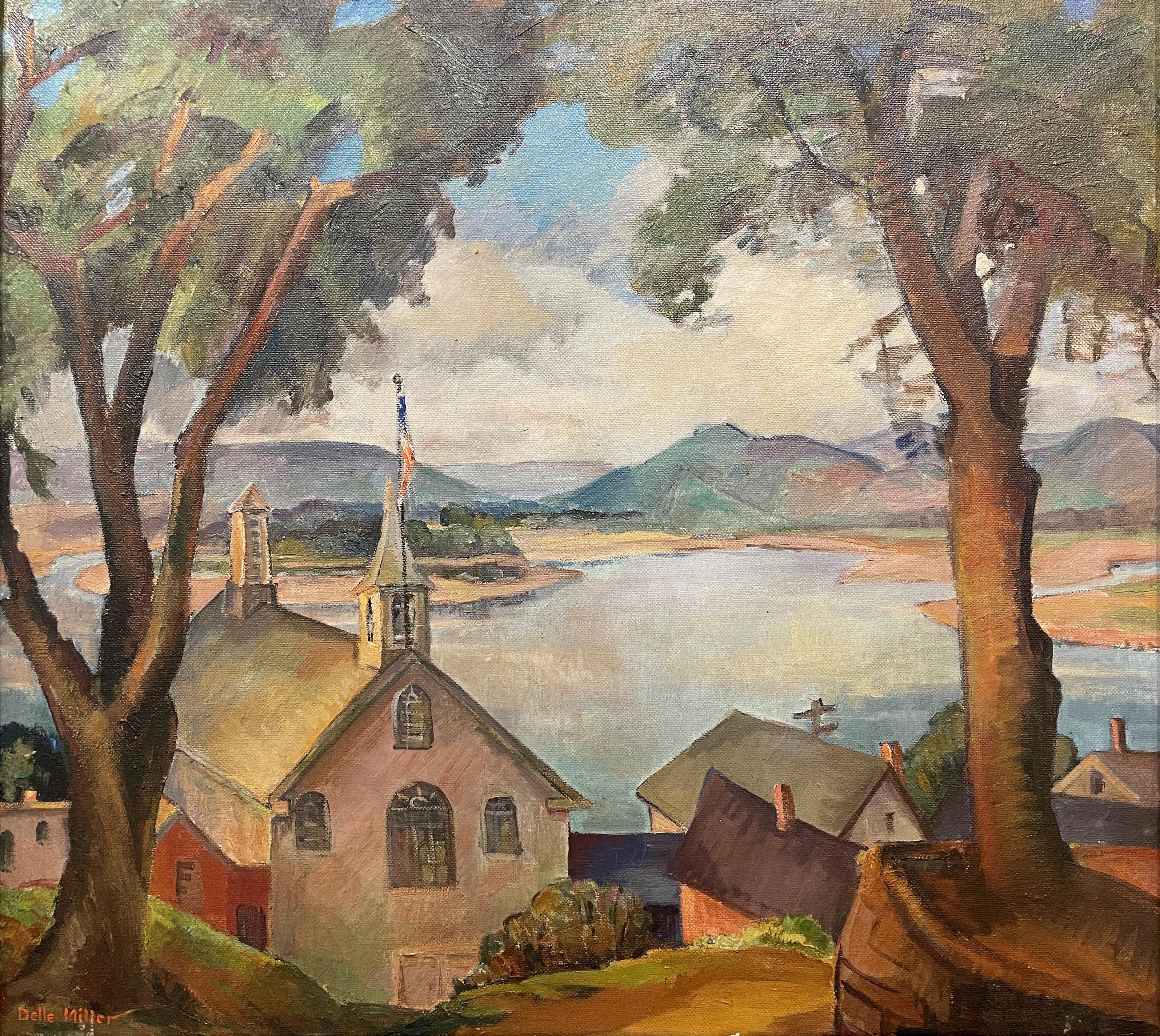
View All"On the Upper Mississippi" Delle Miller, Missouri Regionalist Landscape
Located in New York, NY
Delle Miller
On the Upper Mississippi, circa 1926
Signed lower left
Oil on canvas
26 1/8 x 29 1/8 inches
By 1909, Miller was an instructor at the Kansas...
Category
1920s American Modern Landscape Paintings
Materials
Canvas, Oil
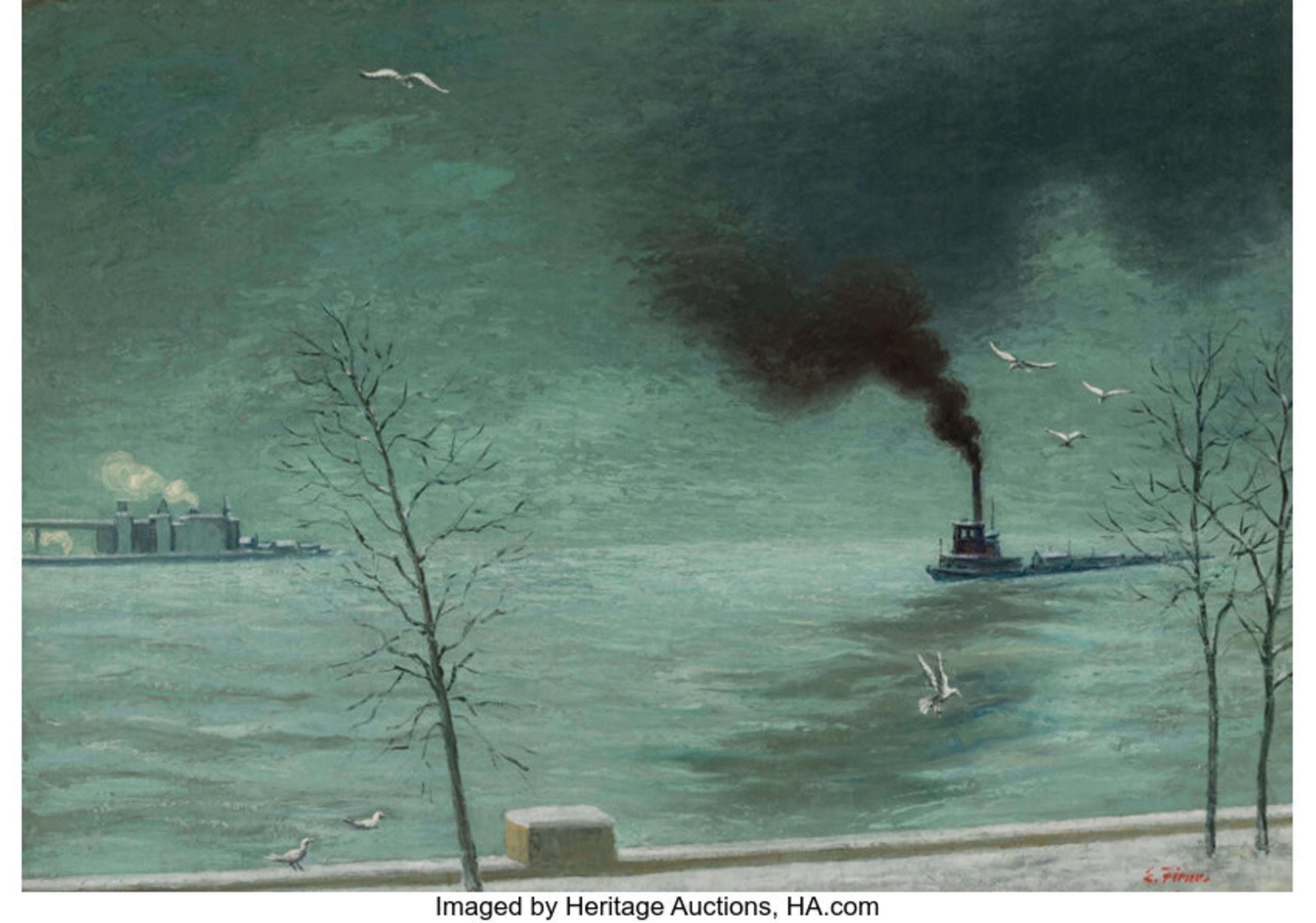
"Tugboat in New York Harbor" Ernest Fiene, Modernist, Cerulean Waterscape
By Ernest Fiene
Located in New York, NY
Ernest Fiene
Tugboat in New York Harbor
Signed lower right
Oil on canvas
24 1/2 x 34 1/2 inches
Ernest Fiene was born in Elberfeld, Germany in 1894. As a teenager, Fiene immigrated...
Category
1930s American Modern Landscape Paintings
Materials
Canvas, Oil
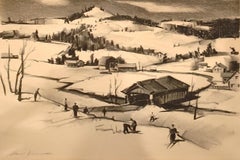
"The Slope Near the Bridge" Paul Sample, Mid-Century, American Snowy Landscape
By Paul Sample
Located in New York, NY
Paul Sample
The Slope Near the Bridge, 1950
Signed in pencil lower left
Lithograph on wove paper
Image 8 15/16 x 12 15/16 inches
Sheet 11 5/16 x 15 1/16 inches
From the edition of 25...
Category
1950s American Realist Figurative Prints
Materials
Paper, Lithograph
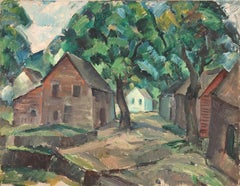
"Woodstock Landscape" Albert Heckman, WPA, Modernist, Farm, Barn, Rural Scene
By Albert Heckman
Located in New York, NY
Albert Heckman
Woodstock Landscape
Oil on board
12 x 16 inches
Albert Heckman was born in Meadville, Western Pennsylvania, 1893. He went to New York City to try his hand at the art...
Category
1940s American Modern Figurative Paintings
Materials
Oil, Board
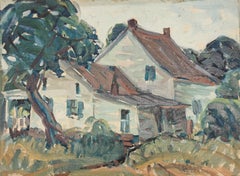
"Woodstock Landscape" Albert Heckman, WPA, American Modernist, New York
By Albert Heckman
Located in New York, NY
Albert Heckman
Woodstock Landscape
Oil on board
12 x 16 inches
Albert Heckman was born in Meadville, Western Pennsylvania, 1893. He went to New York City to try his hand at the art...
Category
1940s American Modern Figurative Paintings
Materials
Oil, Board
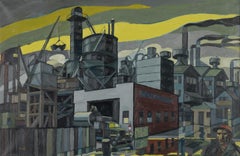
"Colonial Sand and Stone Company, New York, " Industrial WPA Scene, Precisionist
By William Sharp
Located in New York, NY
William Sharp (1900 - 1961)
Factory on the River
Oil on canvas
20 1/2 x 28 1/2 inches
Initialed lower left: WS
Provenance:
Estate of the artist
Private Collection, New York
Swann Auction Galleries, American Art, June 13, 2019, Lot 178
Private Collection, New York
Colonial Sand and Stone Co., founded by Generoso Pope, was once the country’s largest sand and gravel business, providing the concrete for much of New York City’s skyline, including the Empire State Building, Rockefeller Center, Radio City Music Hall, airports and subways.
William Sharp was born on June 13, 1900, in Lemberg, Austria, where he attended college and the Academy for Arts and Industry. He later studied in Kraków, Poland, and in Berlin and Munich, Germany. Sharp began his career as a designer of stained-glass windows and as a painter of murals. He served in the German army during World War I. After the war he became a newspaper artist in Berlin and a well-known etcher.
Sharp drew political cartoons that were bitterly critical of the growing Nazi movement. As the influence of National Socialism intensified, he began to contribute drawings, under a pseudonym, to publications that were hostile to Hitler. After Hitler assumed power, Sharp was confronted with these drawings and told that he would be sent to a concentration camp. However, in 1934, he escaped to the United States.
His first newspaper assignment in America was making courtroom sketches for The New York Mirror...
Category
Mid-20th Century American Realist Landscape Paintings
Materials
Canvas, Paint, Oil
You May Also Like
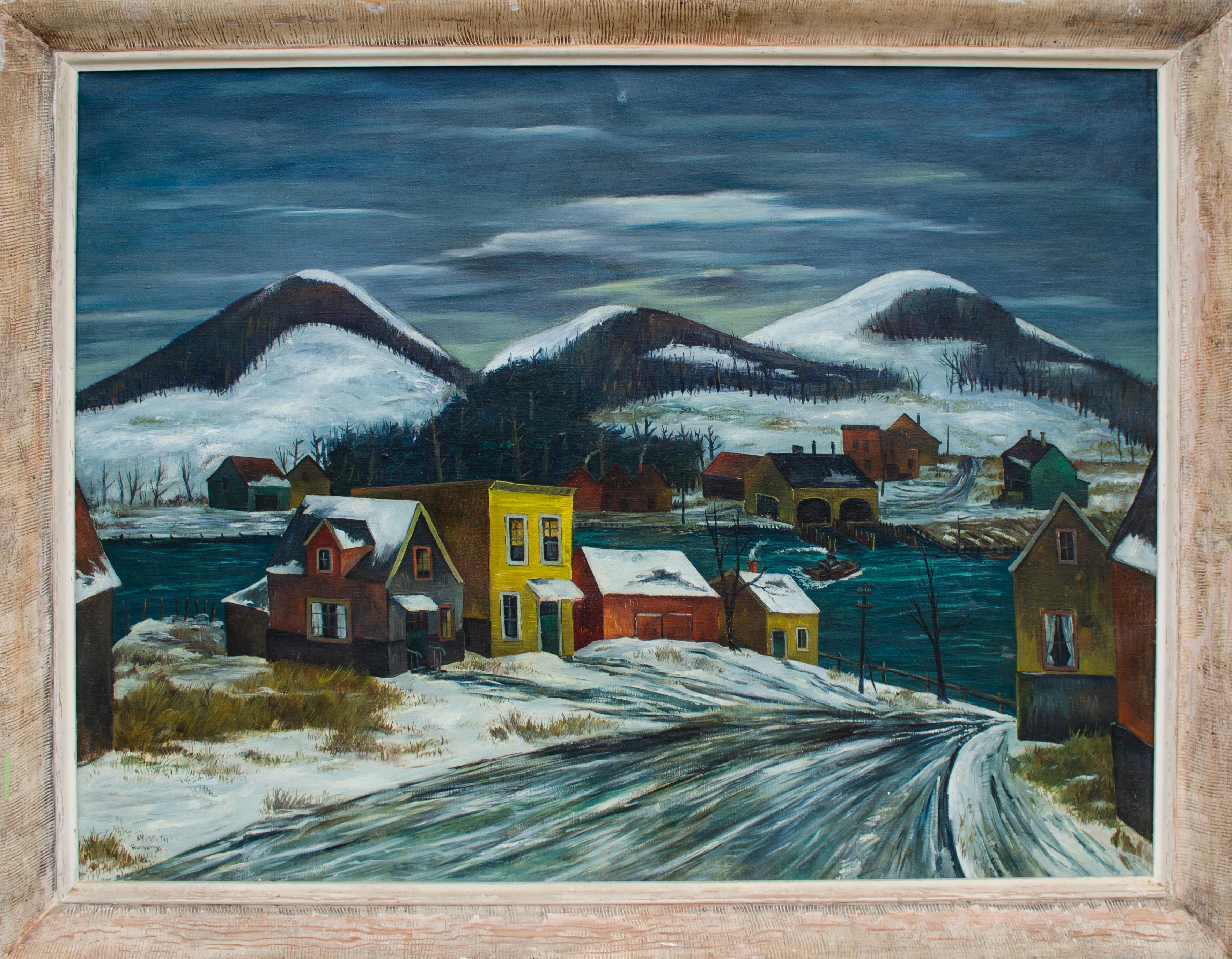
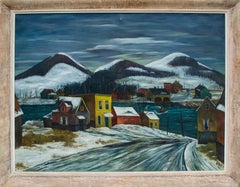
Charles Harsanyi Modernist Winter Scene, 1946, titled "The Ferry No 2"
Located in New York, NY
Charles Harsanyi (American, 1905-1973)
The Ferry No 2, 1946
Oil on board
40 x 52 in.
Framed: 46 x 58 in.
Signed and inscribed verso
Exhibited:
Grand Central Art Galleries, 1946
Charles E. Harsanyi was born in Tapolcza, Hungary in 1905. He studied at the Royal Academy in Budapest, Hungary with A. Bankhard from 1923 to 1928. Nineteen years later, in 1947, Harsanyi moved to the U. S., settling in Jackson Heights, New York.
The painter and drawing specialist became a member of numerous prestigious art clubs including the Salmagundi Club, The Society of Independent Artists and the Allied Artists of America. Harsanyi served as an awards director and chairman of admissions for the Audubon Artists Association during the 1950s.
Later in life after living in Stephentown, New York and Cape Coral...
Category
1940s American Modern Landscape Paintings
Materials
Oil, Board
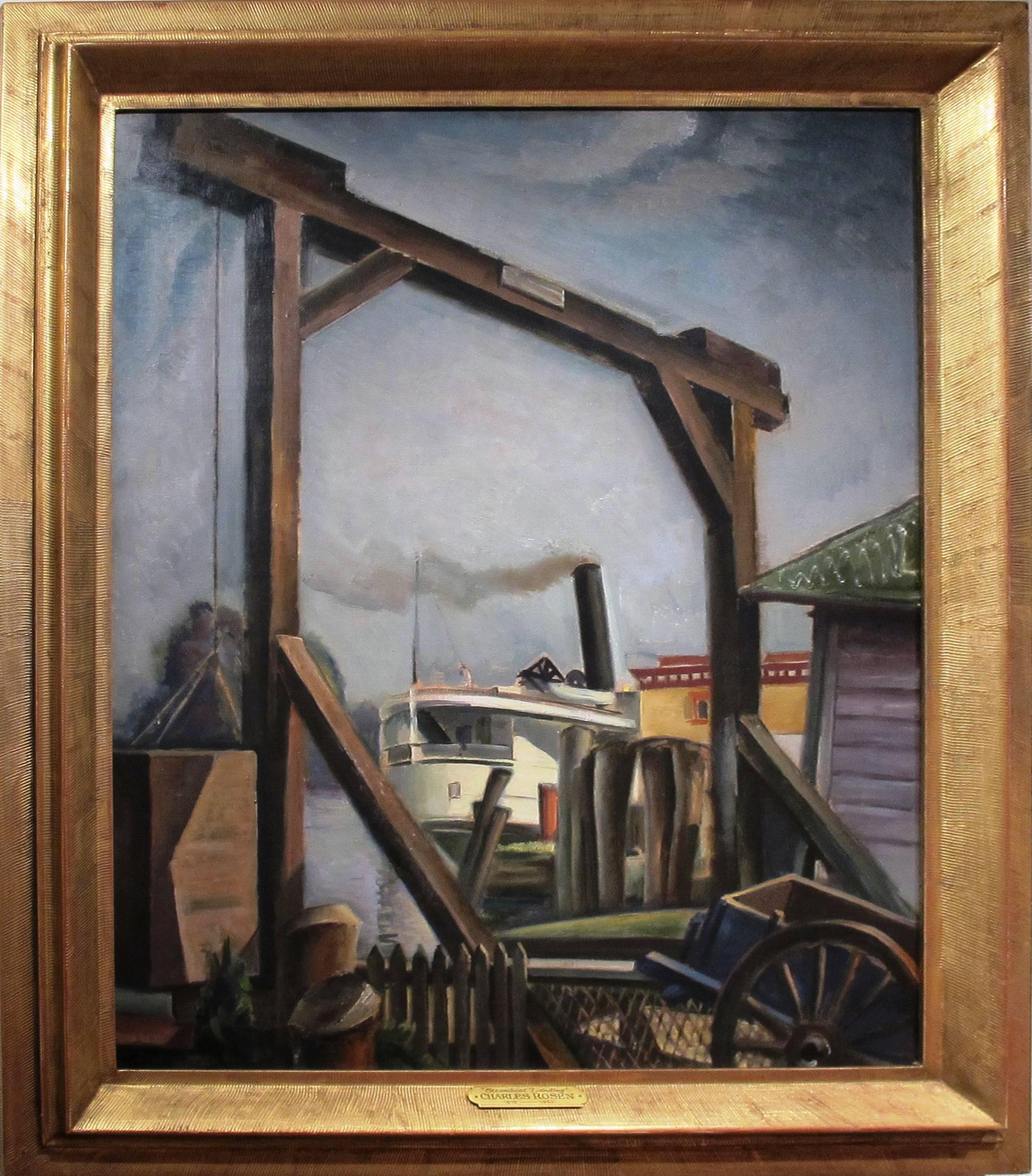
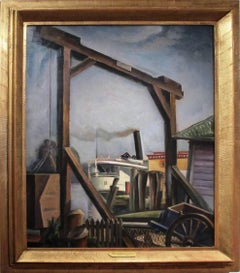
"Steamboat Landing"
By Charles Rosen
Located in Lambertville, NJ
Jim’s of Lambertville is proud to offer this artwork by:
Complemented by a hand carved and modernist style gilt frame.
Illustrated in "New Hope for American Art" by James Alterman...
Category
1930s American Modern Landscape Paintings
Materials
Canvas, Oil
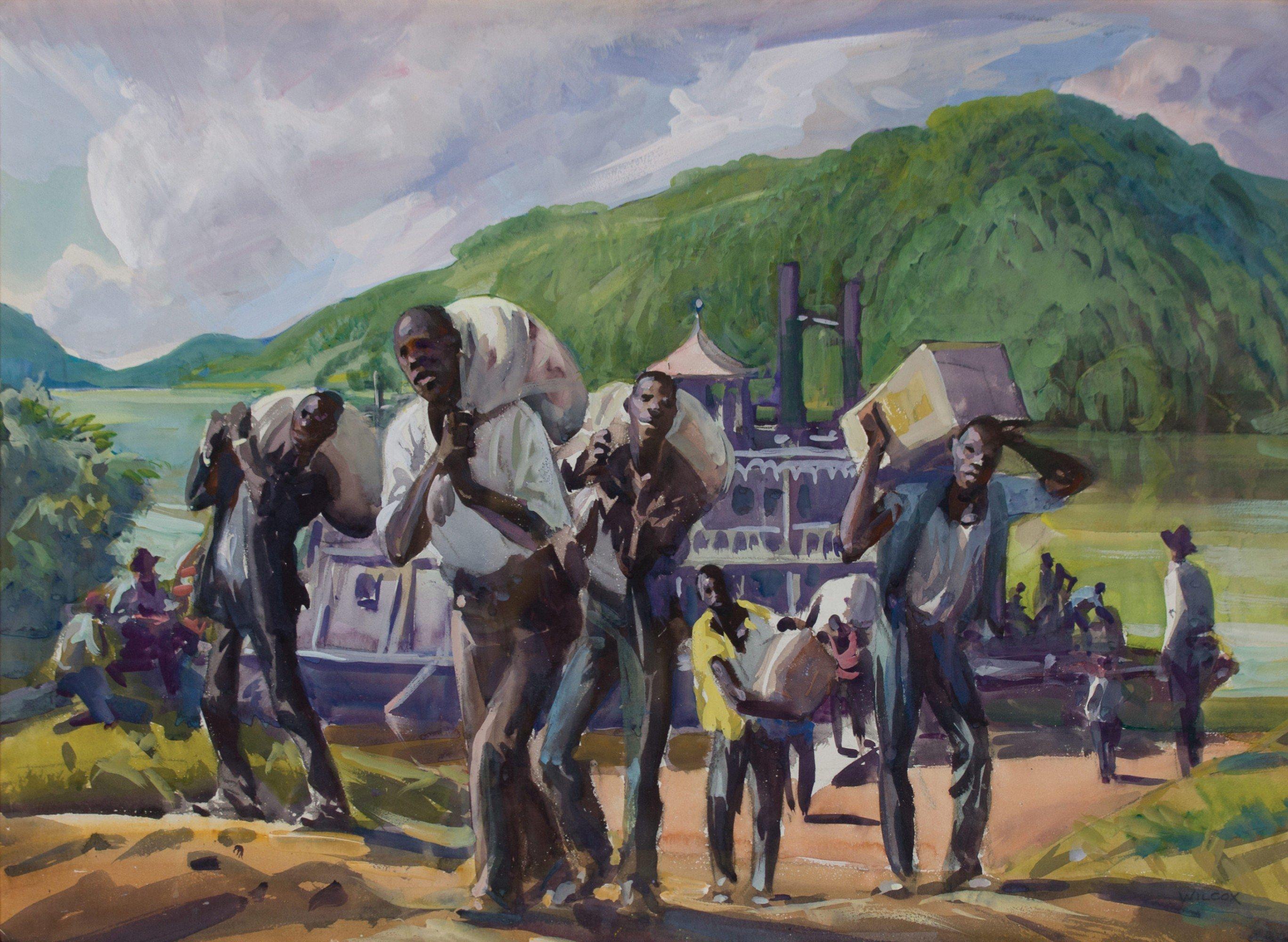
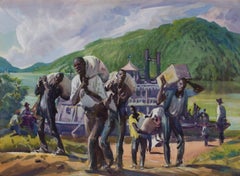
Stevedores, Ohio River, Early 20th Century Cleveland School Artist
By Frank Wilcox
Located in Beachwood, OH
Frank Nelson Wilcox (American, 1887-1964)
Stevedores, Ohio River, c. 1920
Watercolor on paper
Signed lower right
21.5 x 29. 5 inches
"The trip Otto Ege and I made from Pittsburgh to Marietta by riverboat and then by train to Mammoth Cave, was the next high spot in my artistic explorations. We saw something of the Old Southern river life on the way - the roustabouts, the showboat and river town life at Point Pleasant, and then to the sombre tonal mysteries of the Cave. These sights added much to my pictorial vocabulary..." - Frank Wilcox
Frank Nelson Wilcox (October 3, 1887 – April 17, 1964) was a modernist American artist and a master of watercolor. Wilcox is described as the "Dean of Cleveland School...
Category
1920s American Modern Landscape Drawings and Watercolors
Materials
Watercolor
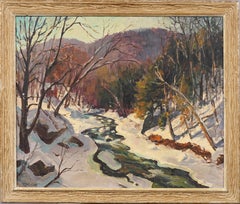
Antique American Impressionist "Chickley River" New England Landscape Painting
Located in Buffalo, NY
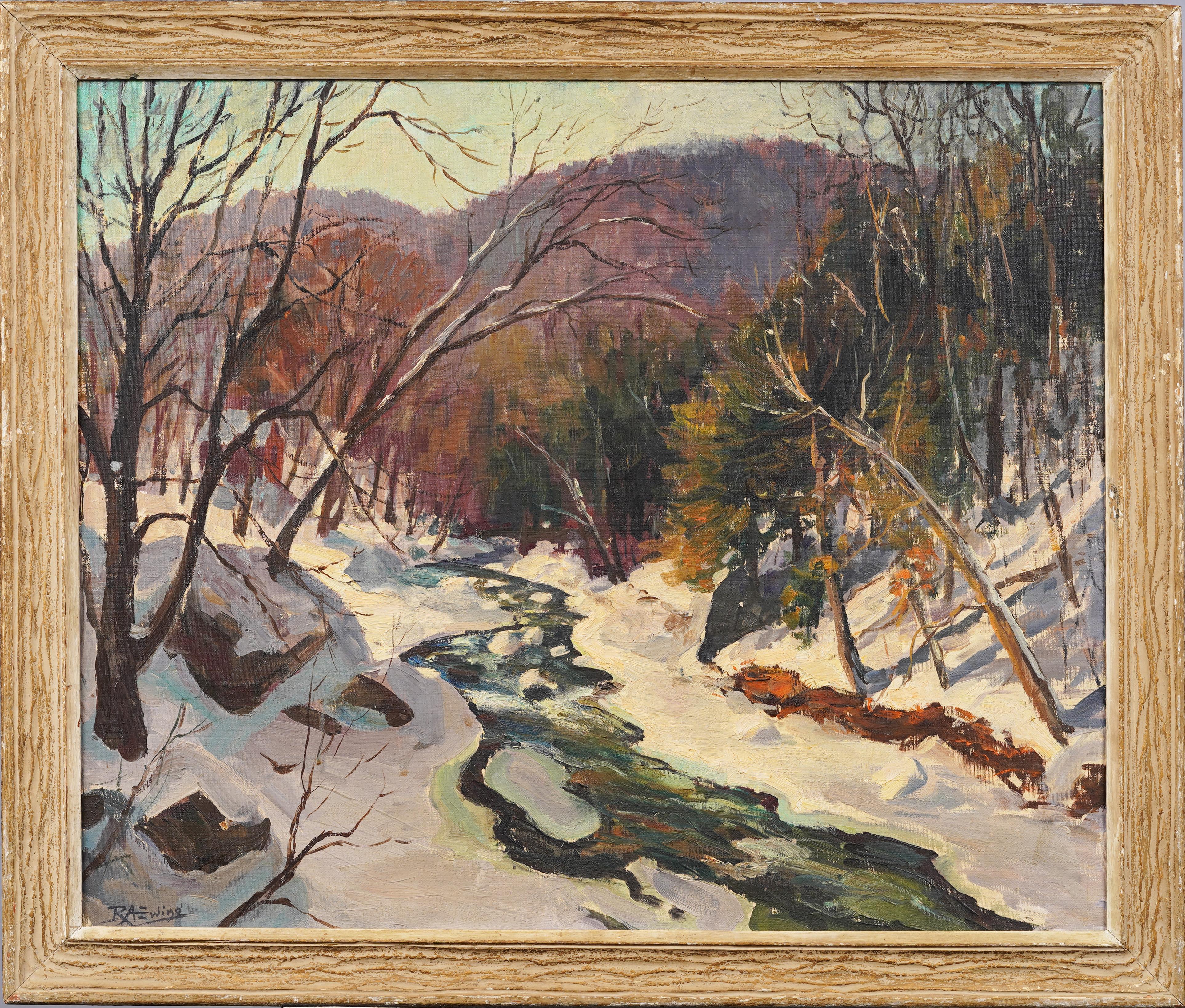
Large and finely painted American impressionist landscape oil painting by Raymond A. Ewing (1891 - 1976). Framed. Oil on canvas. Signed.
Category
1940s Impressionist Landscape Paintings
Materials
Canvas, Oil
American Regionalist Landscape Painting by Very Talented Mystery Artist Signed
Located in San Francisco, CA
American Regionalist Landscape Painting by Very Talented Mystery Artist
Signed Lower Right
Early 20th century
In good vintage condition with areas of paint loss
Oil on Canvas
...
Category
20th Century Landscape Paintings
Materials
Canvas, Oil
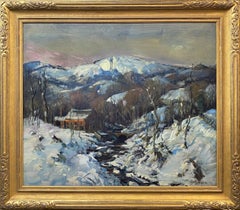
Snowy Banks of the River
By Arthur Clifton Goodwin
Located in Milford, NH
A fine mountainous winter landscape by American artist Arthur Clifton Goodwin (1864-1929). Born in Portsmouth, New Hampshire, Goodwin lived and worked most of his life in Massachuset...
Category
Late 19th Century American Impressionist Landscape Paintings
Materials
Canvas, Oil, Board
More Ways To Browse
Virginia Artists
Abbott Vintage
Paris Street Scene Painting Large Canvas Painting
Skyscraper New York
Matisse Exhibition
Pascin Jules
Vintage Fall Paintings
Painting Florence Italy
Radio City Music Hall Vintage
Empire State Building Vintage
Monhegan Island
Oil Paintings Virginia
French Architecture House Design Lithograph
Henri Studios
American West Paintings
Thomas Hart Benton Signed Lithograph
Coal Mining
Virginia Landscape Oil Painting