Items Similar to "Lunch Break” Fletcher Martin, Men Working, Bricklayers, WPA, American Scene
Want more images or videos?
Request additional images or videos from the seller
1 of 6
Fletcher Martin"Lunch Break” Fletcher Martin, Men Working, Bricklayers, WPA, American Scenecirca 1940
circa 1940
$11,500
£8,729.09
€10,010.08
CA$16,232.19
A$17,423.73
CHF 9,277.25
MX$206,364.55
NOK 117,239.02
SEK 107,071.92
DKK 74,779.82
About the Item
Fletcher Martin
Lunch Break, circa 1940
Signed lower right
Oil on canvas
31 1/2 x 37 3/8 inches
When Fletcher Martin died in 1979, the New York Times entitled his obituary “Artist of Action.” No three words better encapsulated Martin’s place in twentieth-century U.S. art. Not since George Bellows had any U.S. artist been so enraptured by rough and rugged masculinity. Martin carved out a name for himself by painting and illustrating men in combat, rodeos, racetracks, boxing matches, and saloons.
Fletcher Martin was born in 1904 in Palisade, Colorado, one of seven children of newspaperman Clinton Martin and his wife Josephine. He acquired a knowledge of the western United States as the family relocated to Idaho and Washington. Martin dropped out of high school at age 15 and was largely self-taught as an artist. He took on a series of odd jobs--migratory farmworker, light heavyweight boxer, lumberjack, and printer—that would later provide the subjects for some of his most evocative work. After serving in the Navy (1922-26), Martin settled in Los Angeles.
Working for the Federal Art Project of the Works Progress Administration enabled Martin to quit his job as a printer in 1935 and try a career in painting. He won several commissions to paint murals in the naturalistic American Scene style including one in Los Angeles and one in Kellogg, Idaho. Much of his work from this time reflected labor issues, often taking a pro-worker stance. Martin was active in the L.A. chapter of the anti-fascist American Artists Congress, serving as president in 1939. In 1938, the Museum of Modern Art bought his “Trouble in Frisco,” a porthole view of a striking longshoreman and a strikebreaker.
During World War II, Martin worked as an artist-correspondent for Life Magazine and made hundreds of sketches of U.S. soldier life. The 27 December 1943 issue of Life magazine featured 14 of his painting from the North African campaign, including the cover illustration. The feature helped to bring him national recognition. He subsequently made illustrations of wartime London and the 1944 Allied invasion of France.
In the 1950s, with the American Scene in eclipse, Martin dabbled in landscapes, abstractionism, and even ‘naïve’ images of women and children. Despite this slight turn to more decorative work, he still loved to paint manly sports, the more violent and dangerous, the better. Boxers remained a favorite subject, but cowboys and bullfighters also put in an appearance. Many of Martin’s most popular works were reproduced as woodcuts, lithographs, or silkscreens and appeared in countless taverns, restaurants, and basements across the United States.
Martin’s restlessness was legendary. After World War II, he settled in New York City in 1945 and then in Woodstock, NY. However, he traveled widely as a teacher and illustrator, usually remaining no more than a year or two at schools around the United States. Martin married five times as well as a famous relationship with movie star Sylvia Sidney; four of his marriages ended in divorce. At his death from a heart attack at 75 years of age, he was dividing his time between Mexico and a home in Sarasota, Florida.
Fletcher Martin remains well known for his images of soldiers in World War II and his depiction of boxing matches. Yet despite the violence inherent in his favorite subjects, he was able to depict the soldier, the worker, the sportsman or the everyday man with both strength and empathy.
- Creator:Fletcher Martin (1904-1979, American)
- Creation Year:circa 1940
- Dimensions:Height: 36.63 in (93.05 cm)Width: 42.25 in (107.32 cm)
- Medium:
- Movement Style:
- Period:
- Condition:
- Gallery Location:New York, NY
- Reference Number:1stDibs: LU1841211321372
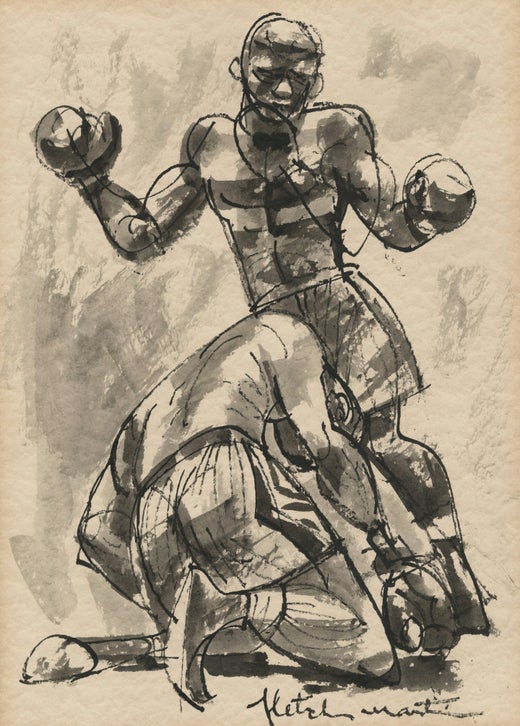
Fletcher Martin
Fletcher Martin was an American painter, illustrator, muralist and educator. He is best known for his images of military life during World War II and his sometimes brutal images of boxing and other sports. Martin was born in 1904 in Palisade, Colorado, one of seven children of newspaperman Clinton Martin and his wife Josephine. The family relocated to Idaho and later Washington. By the age of 12, he was working as a printer. He dropped out of high school and held odd jobs such as lumberjack and professional boxer. He served in the U.S. Navy, 1922–26. Martin's artistic skills were largely self-taught.
About the Seller
5.0
Platinum Seller
Premium sellers with a 4.7+ rating and 24-hour response times
Established in 2022
1stDibs seller since 2022
137 sales on 1stDibs
Typical response time: <1 hour
- ShippingRetrieving quote...Shipping from: New York, NY
- Return Policy
More From This Seller
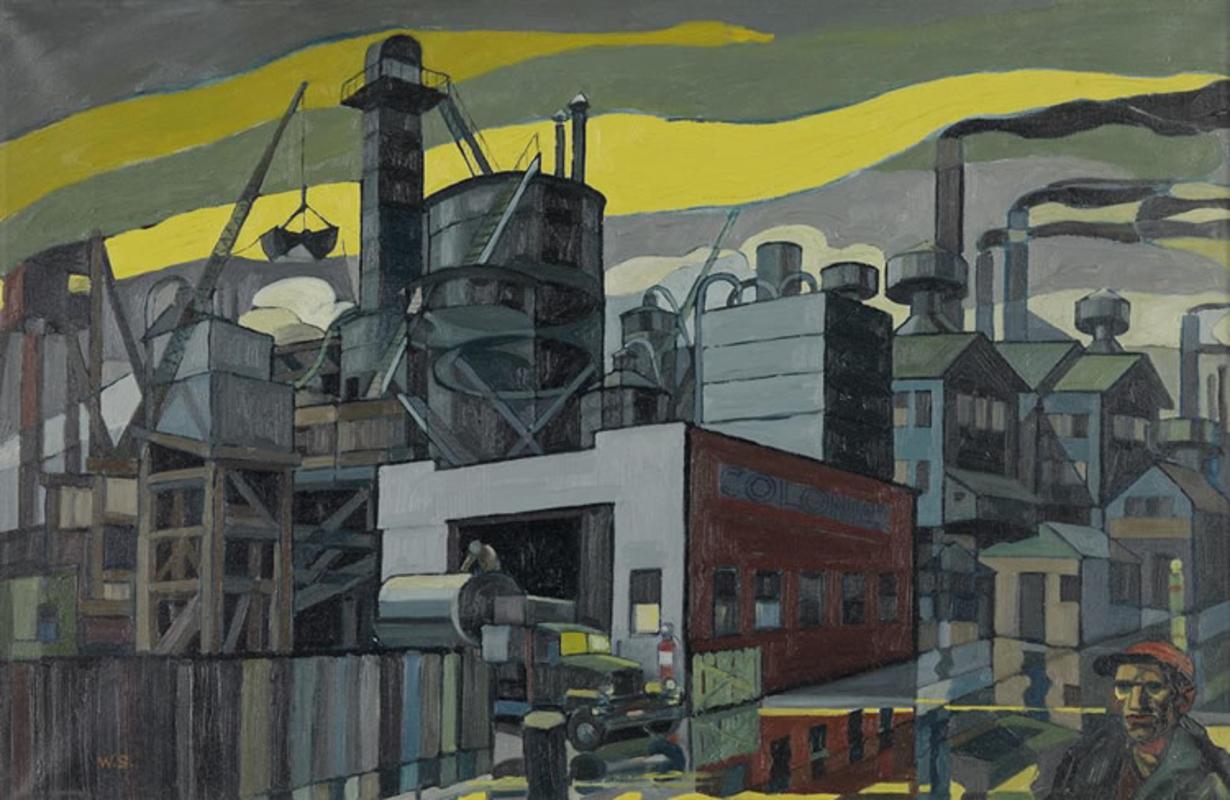
View All"Colonial Sand and Stone Company, New York, " Industrial WPA Scene, Precisionist
By William Sharp
Located in New York, NY
William Sharp (1900 - 1961)
Factory on the River
Oil on canvas
20 1/2 x 28 1/2 inches
Initialed lower left: WS
Provenance:
Estate of the artist
Private Collection, New York
Swann Auction Galleries, American Art, June 13, 2019, Lot 178
Private Collection, New York
Colonial Sand and Stone Co., founded by Generoso Pope, was once the country’s largest sand and gravel business, providing the concrete for much of New York City’s skyline, including the Empire State Building, Rockefeller Center, Radio City Music Hall, airports and subways.
William Sharp was born on June 13, 1900, in Lemberg, Austria, where he attended college and the Academy for Arts and Industry. He later studied in Kraków, Poland, and in Berlin and Munich, Germany. Sharp began his career as a designer of stained-glass windows and as a painter of murals. He served in the German army during World War I. After the war he became a newspaper artist in Berlin and a well-known etcher.
Sharp drew political cartoons that were bitterly critical of the growing Nazi movement. As the influence of National Socialism intensified, he began to contribute drawings, under a pseudonym, to publications that were hostile to Hitler. After Hitler assumed power, Sharp was confronted with these drawings and told that he would be sent to a concentration camp. However, in 1934, he escaped to the United States.
His first newspaper assignment in America was making courtroom sketches for The New York Mirror...
Category
Mid-20th Century American Realist Landscape Paintings
Materials
Canvas, Paint, Oil
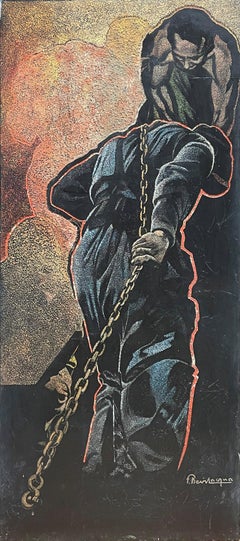
"Working Laborers, " Francis Bevilacqua, Soviet Cold War Art
Located in New York, NY
Francis Bevilacqua (American, b. 1911)
Working Laborers, n.d.
Oil and pigment on black granite
44 x 21 inches
Signed lower right
Born in 1911, Francis Bevilacqua was predominantly influenced by the 1930s. The period of the 1930s is epitomized by the conflict between many political ideologies, including Marxist Socialism, Capitalist Democracy, and the Totalitarianism of both Communism and Fascism. In the Soviet Union, Stalin’s government needed urgent funds to implement the rapid industrialization demanded by the first Five Year Plan. It initiated a secret strategy to sell off treasures from the State Hermitage Museum in Leningrad (St. Petersburg), including a primary list of two hundred and fifty irreplaceable paintings by the Old Masters, a number of which ended up in the collection of Andrew Mellon...
Category
Mid-20th Century Realist Figurative Paintings
Materials
Granite
"Lobstermen in Gloucester, Mass." Lionel Reiss WPA Social Realism Fishermen
By Lionel S. Reiss
Located in New York, NY
Lionel S. Reiss (1894 - 1988)
Lobstermen in Gloucester, Massachusetts, circa 1943
Watercolor on paper
Sight 17 1/2 x 23 inches
Signed lower left
Provenance:
Private Collection, Las Vegas, Nevada
In describing his own style, Lionel Reiss wrote, “By nature, inclination, and training, I have long since recognized the fact that...I belong to the category of those who can only gladly affirm the reality of the world I live in.” Reiss’s subject matter was wide-ranging, including gritty New York scenes, landscapes of bucolic Bucks County, Pennsylvania, and seascapes around Gloucester, Massachusetts. However, it was as a painter of Jewish life—both in Israel and in Europe before World War II—that Reiss excelled. I.B. Singer, the Nobel Prize winner for Literature, noted that Reiss was “essentially an artist of the nineteenth century, and because of this he had the power and the courage to tell visually the story of a people.”
Although Reiss was born in Jaroslaw, Poland, his family immigrated to the United States in 1898 when he was four years old. Reiss's family settled on New York City’s Lower East Side and he lived in the city for most of his life. Reiss attended the Art Students League and then worked as a commercial artist for newspapers and publishers. As art director for Metro-Goldwyn-Mayer, he supposedly created the studio’s famous lion logo.
After World War I, Reiss became fascinated with Jewish life in the ‘Old World.’ In 1921 he left his advertising work and spent the next ten years traveling in Europe, the Middle East, and North Africa. Like noted Jewish photographers Alter Kacyzne and Roman Vishniac, Reiss depicted Jewish life in Poland prior to World War II. He later wrote, “My trip encompassed three main objectives: to make ethnic studies of Jewish types wherever I traveled; to paint and draw Jewish life, as I saw it and felt it, in all aspects; and to round out my work in Israel.”
In Europe, Reiss recorded quotidian scenes in a variety of media and different settings such as Paris, Amsterdam, the Venice ghetto, the Jewish cemetery in Prague, and an array of shops, synagogues, streets, and marketplaces in the Jewish quarters of Warsaw, Lodz, Krakow, Lublin, Vilna, Ternopil, and Kovno. He paid great attention to details of dress, hair, and facial features, and his work became noted for its descriptive quality.
A selection of Reiss’s portraits appeared in 1938 in his book My Models Were Jews. In this book, published on the eve of the Holocaust, Reiss argued that there was “no such thing as a ‘Jewish race’.” Instead, he claimed that the Jewish people were a cultural group with a great deal of diversity within and between Jewish communities around the world. Franz Boas...
Category
1940s American Realist Landscape Paintings
Materials
Paper, Watercolor

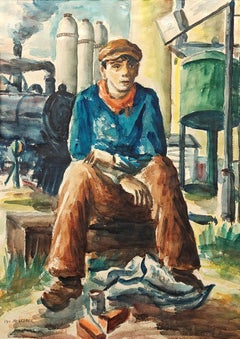
"Factory Boy with Locomotive" Paul Meltsner, 1930s Working WPA Portrait
By Paul Meltsner
Located in New York, NY
Paul Meltsner
Factory Boy with Locomotive, circa 1935
Signed lower left
Watercolor on paper
23 3/4 x 19 1/2 inches
Paul Meltsner sold his first painting when he was eight years old...
Category
1930s Realist Figurative Drawings and Watercolors
Materials
Paper, Watercolor
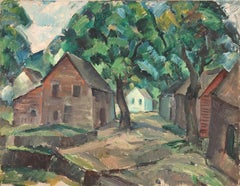
"Johnny Walker’s Place" Georgina Klitgaard, 1929 American Modernist Landscape
By Georgina Klitgaard
Located in New York, NY
Georgina Klitgaard
Johnny Walker’s Place, circa 1929
Signed lower right
Oil on canvas
34 x 42 inches
Georgina Klitgaard’s art has sometimes gotten lost in the critical propensity t...
Category
1920s American Modern Figurative Paintings
Materials
Oil
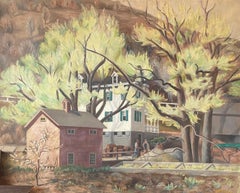
"Woodstock Landscape" Albert Heckman, WPA, Modernist, Farm, Barn, Rural Scene
By Albert Heckman
Located in New York, NY
Albert Heckman
Woodstock Landscape
Oil on board
12 x 16 inches
Albert Heckman was born in Meadville, Western Pennsylvania, 1893. He went to New York City to try his hand at the art...
Category
1940s American Modern Figurative Paintings
Materials
Oil, Board
You May Also Like
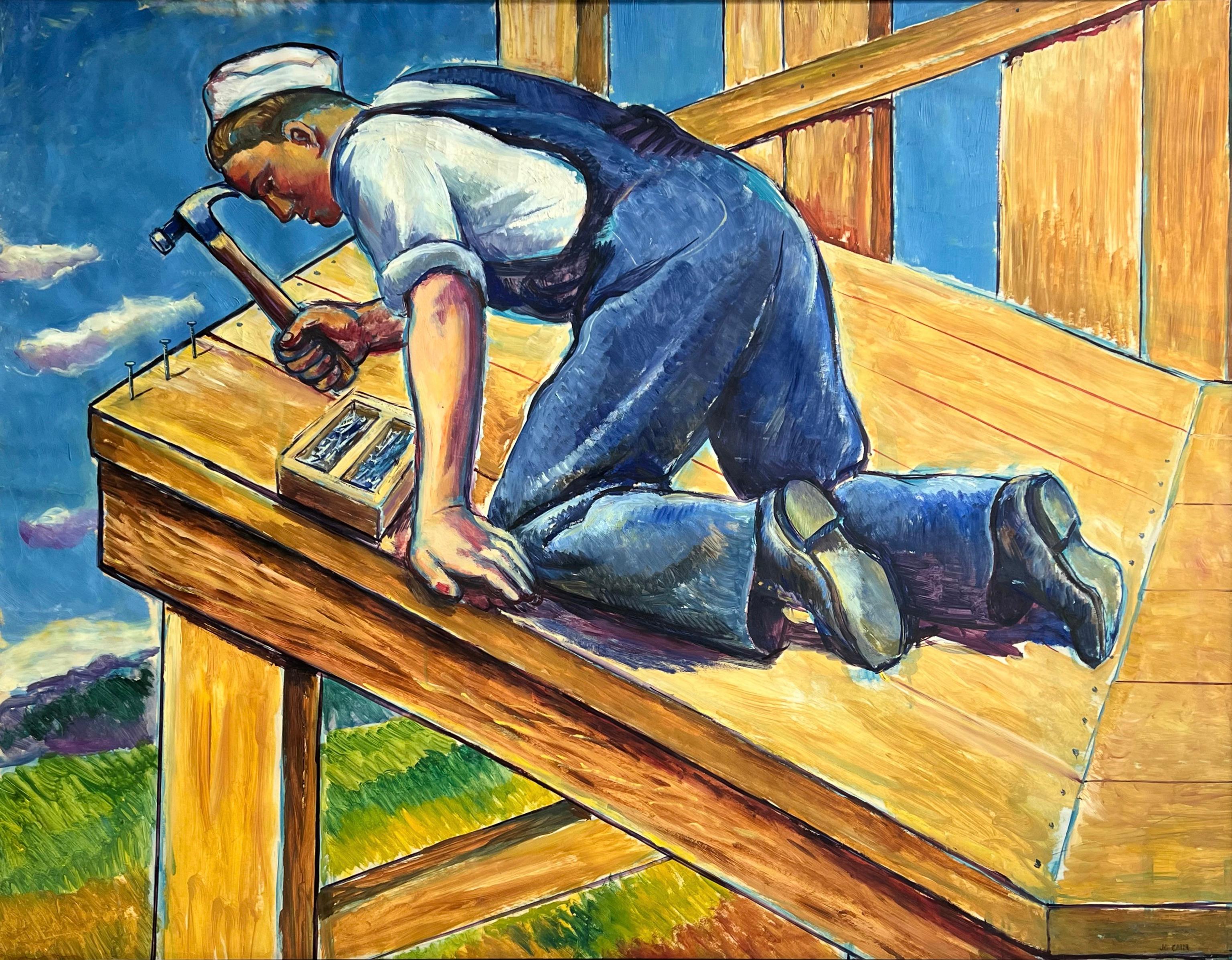
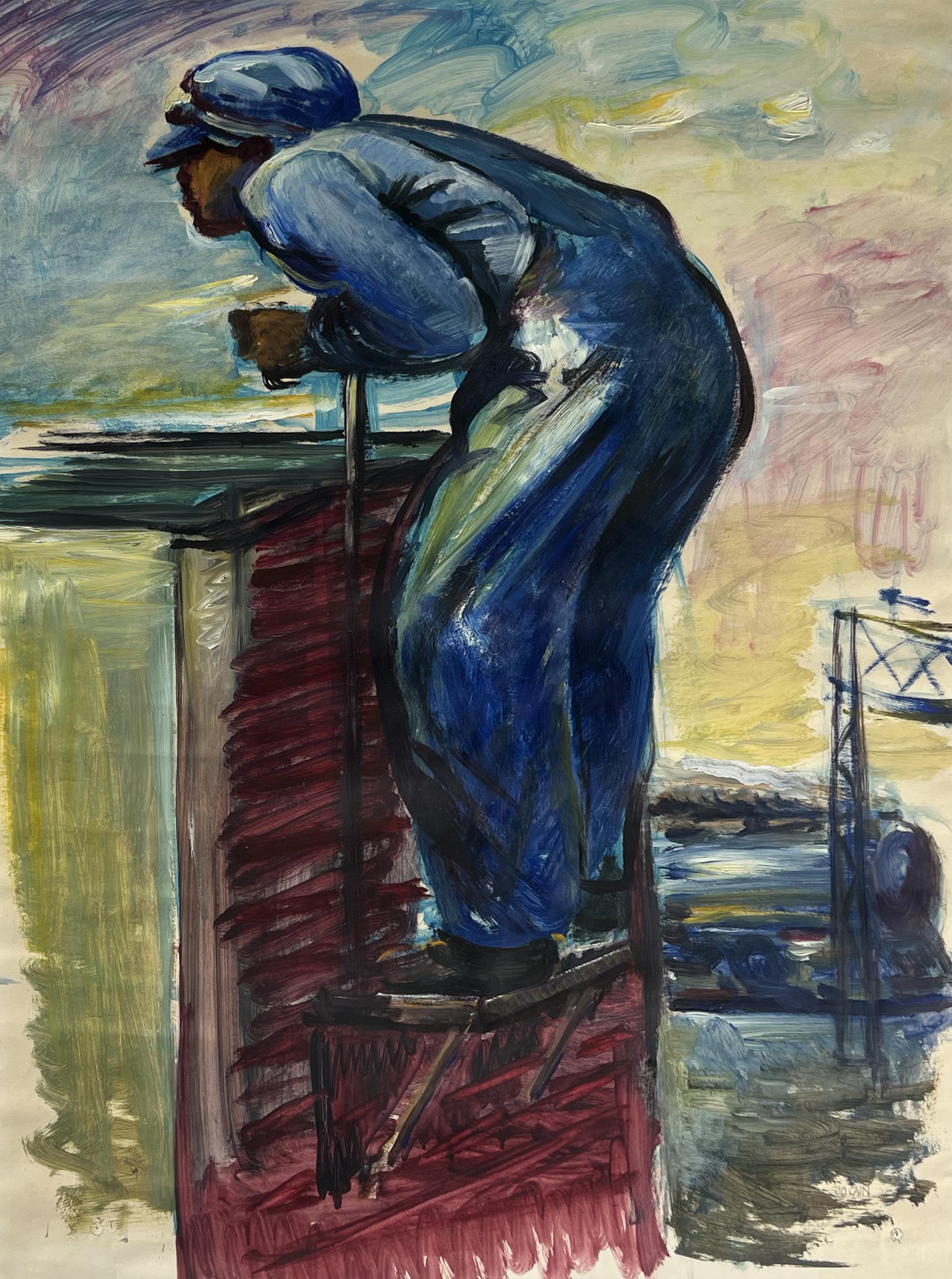
Industrial Man Working Mid 20th Century American Scene Social Realism Modern WPA
By Jo Cain
Located in New York, NY
Industrial Man Working Mid 20th Century American Scene Social Realism Modern WPA
Jo Cain (1904 - 2003)
Hammering Nails
39 x 50 ½ inches
Gouache on paper c. 19...
Category
1930s American Realist Figurative Drawings and Watercolors
Materials
Paper, Gouache
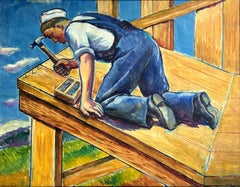
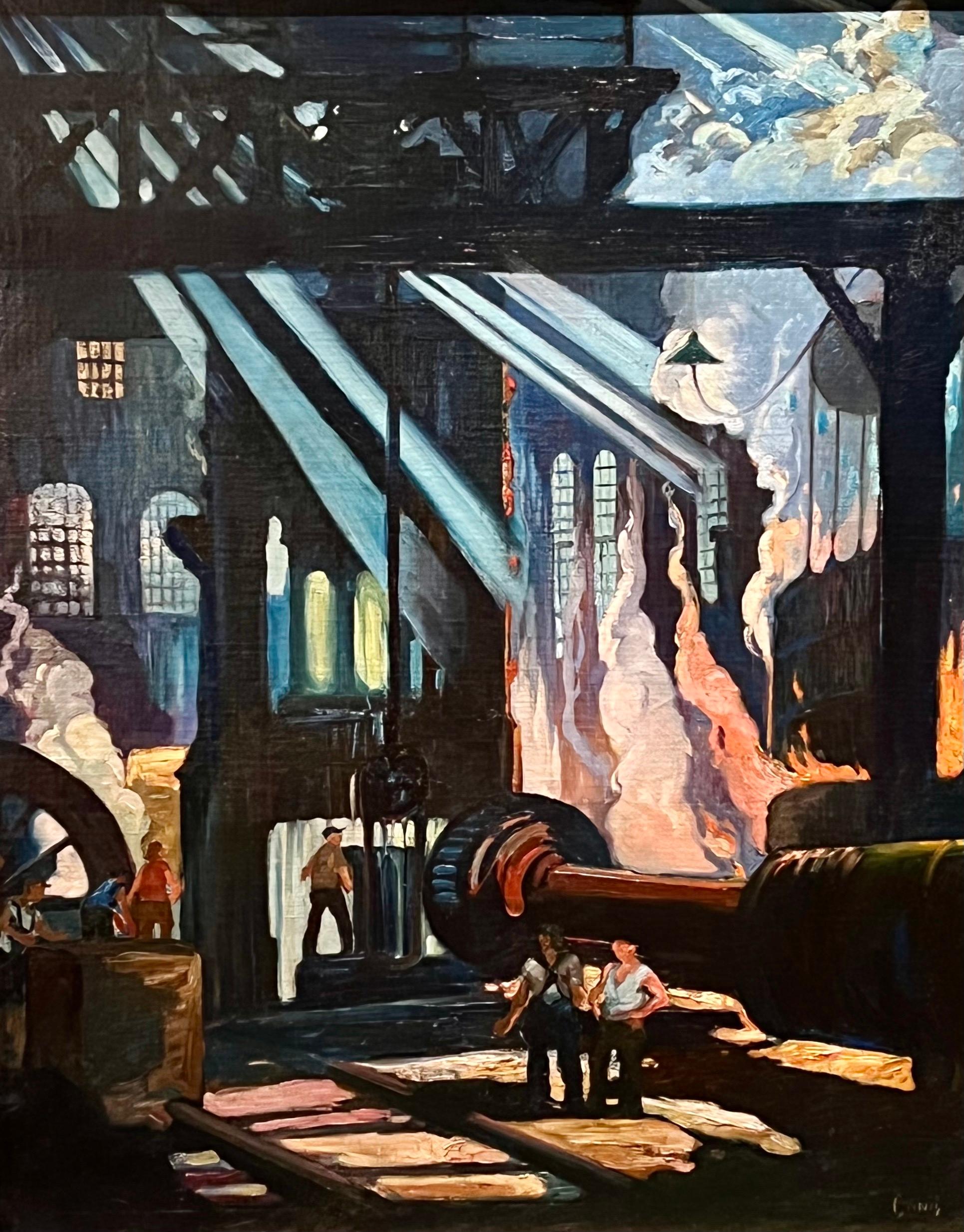
Industrial Mid-20th Century WPA Modern Men Working American Scene Social Realism
Located in New York, NY
Industrial Mid-20th Century WPA Modern Men Working American Scene Social Realism
George Pearse Ennis (American, 1884-1936)
"Forging a Gun Tube #1...
Category
1910s American Modern Interior Paintings
Materials
Canvas, Oil
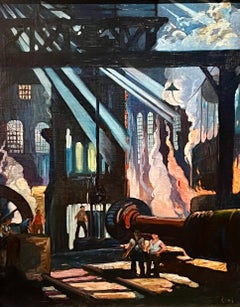
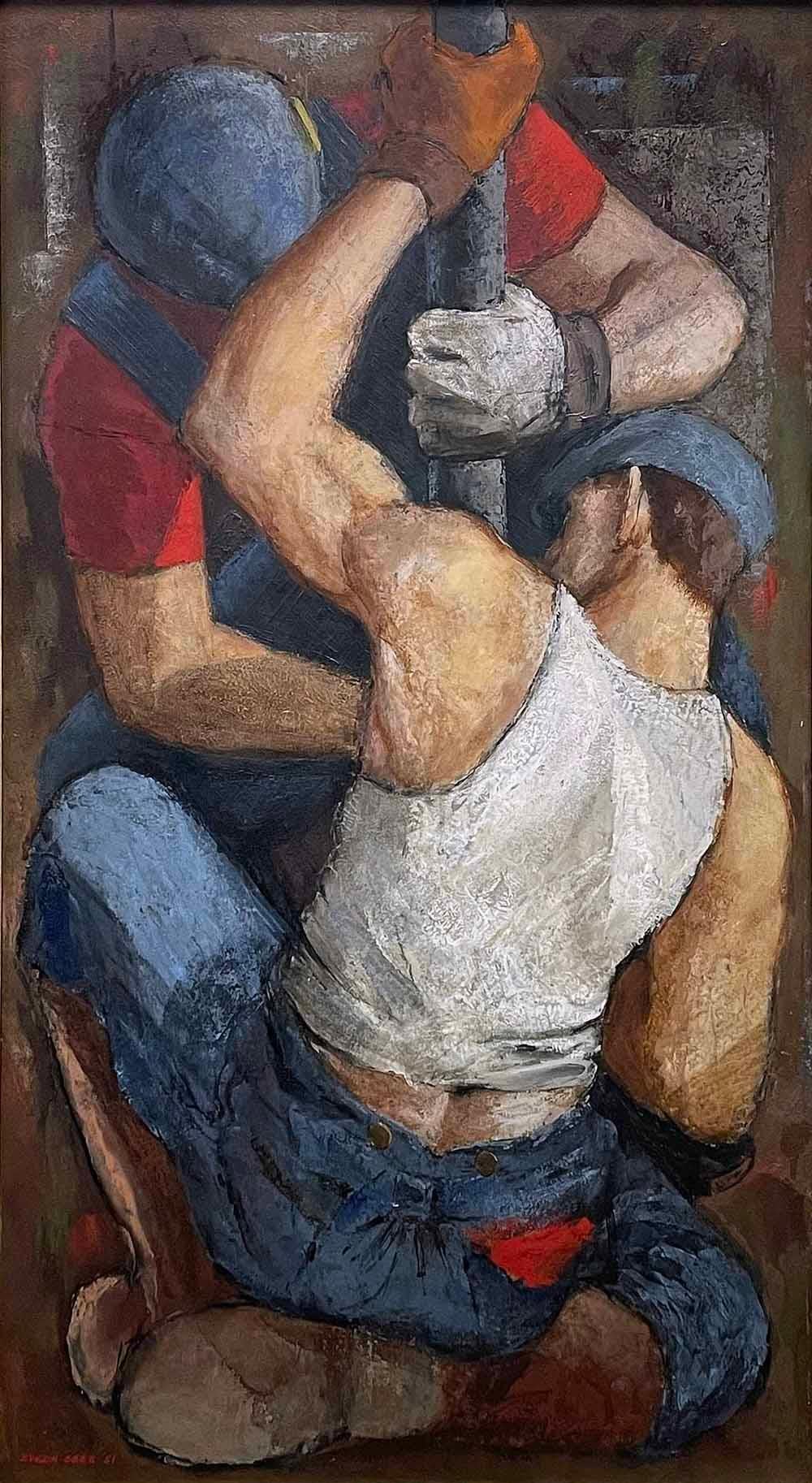
"Pipe Fitters", 1951 Paean to the Working Man by Gere, Wisconsin Painter
Located in Philadelphia, PA
Although this painting dates to 1951, a few years after the Works Progress Administration (WPA) period ended in the 1940s, this tight composition of two pipe fitters doing their work in a cramped space is very much akin to America's Depression-era murals that celebrated the American worker. The painter was Byron Gere...
Category
Vintage 1950s American Art Deco Paintings
Materials
Paint
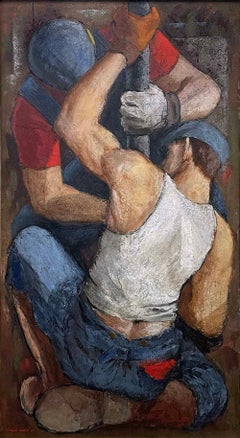
Railroad Worker Industrial WPA American Scene Mid Century Modern Social Realism
By Jo Cain
Located in New York, NY
Railroad Worker Industrial WPA American Scene Mid Century Modern Social Realism
Jo Cain (1904 - 2003)
Railroad worker
36 ¼ x 27 inches
Oil on paper c. 1930s
S...
Category
1930s American Realist Figurative Drawings and Watercolors
Materials
Paper, Oil
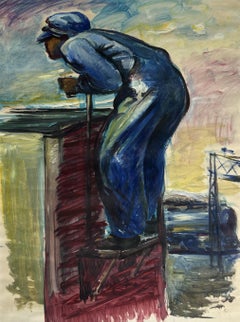
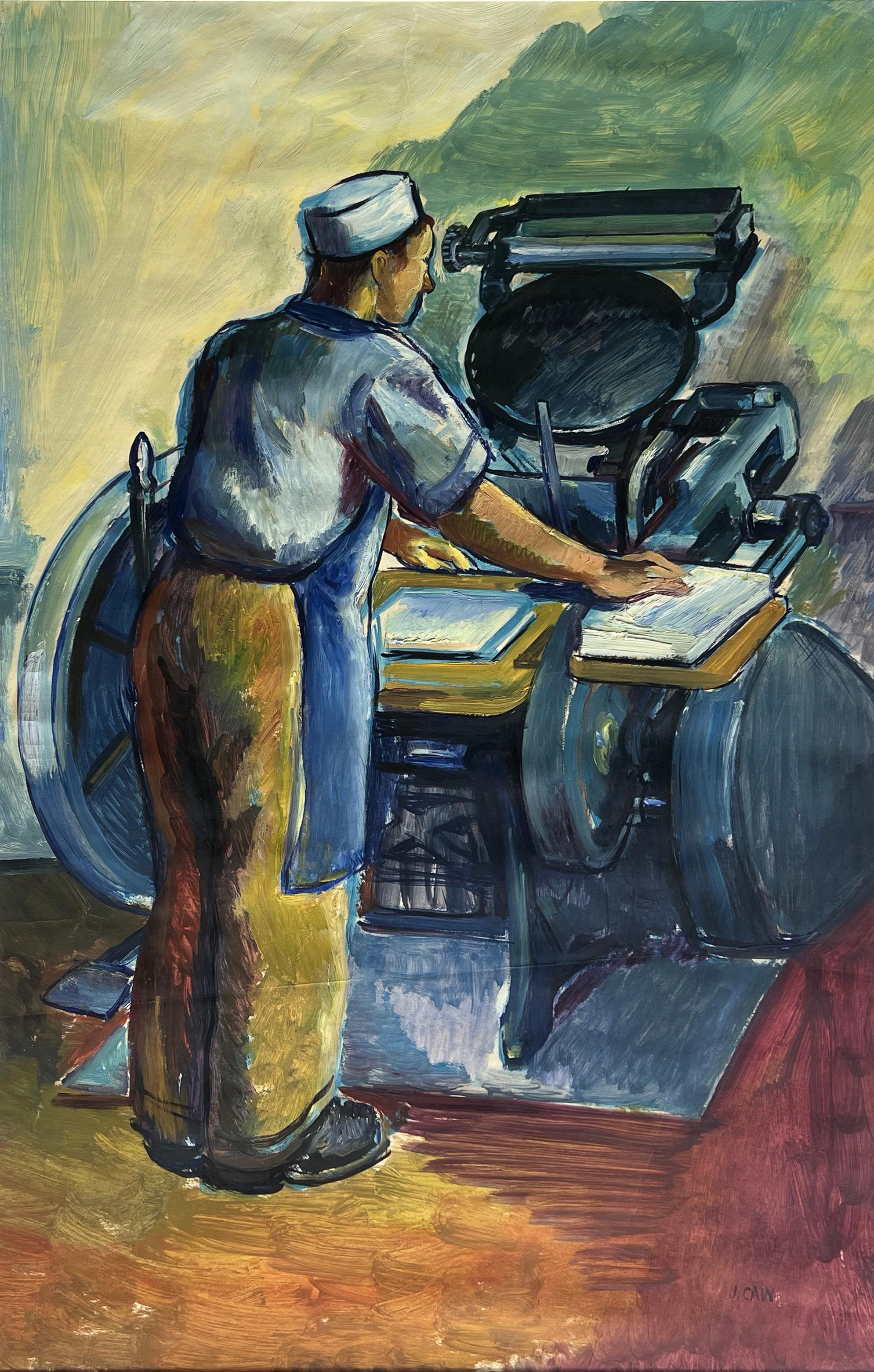
Working Man WPA Social Realism Industrial Modernism 20th Century American Scene
By Jo Cain
Located in New York, NY
Working Man WPA Social Realism Industrial Modernism 20th Century American Scene
Jo Cain (1904 - 2003)
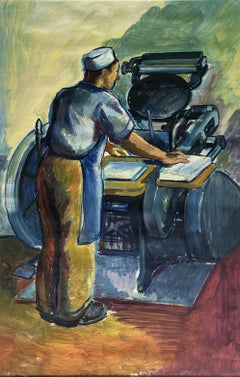
Printing Press
40 ½ x 26 inches (sight)
Oil o...
Category
1930s American Realist Figurative Drawings and Watercolors
Materials
Paper, Oil
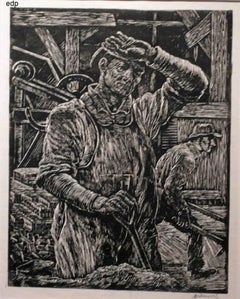
UNTITLED (TWO CONSTRUCTION WORKERS WITH BRICKS
By Albert Abramovitz
Located in Portland, ME
Abramovitz, Albert (American, born Latvia, 1879-1963).
UNTITLED (TWO CONSTRUCTION WORKERS WITH BRICKS).
Linoleum cut on wove paper, c. 1930s.
Si...
Category
1930s Figurative Prints
Materials
Linocut
More Ways To Browse
Vintage Bullfighter
Lumberjack Vintage
George Bellows Artists
Painting Men Working
Fletcher Oil
Oil Painting Of Houses
1895 Painting
Durand Paris
Snow In Oil Painting
Thatched Cottages
Channel Islands
Geneva Painting
Paintings Of Chicago
20th Century Oil Paintings Pond
Constable John
Desert Oil Painting
French Countryside Paintings
Flower Market