Want more images or videos?
Request additional images or videos from the seller
1 of 8
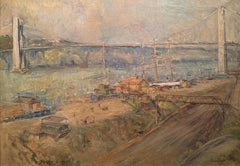
George Picken"Blackwell
s Island (Roosevelt Island, New York City), " George Picken, WPA Scene1928
1928
$7,500List Price
About the Item
- Creator:George Picken (1898 - 1971, American)
- Creation Year:1928
- Dimensions:Height: 28 in (71.12 cm)Width: 33 in (83.82 cm)
- Medium:
- Movement Style:
- Period:
- Condition:Lined. Hairline craquelure.
- Gallery Location:New York, NY
- Reference Number:1stDibs: LU184129923522
About the Seller
5.0
Platinum Seller
Premium sellers with a 4.7+ rating and 24-hour response times
Established in 2022
1stDibs seller since 2022
136 sales on 1stDibs
Authenticity Guarantee
In the unlikely event there’s an issue with an item’s authenticity, contact us within 1 year for a full refund. DetailsMoney-Back Guarantee
If your item is not as described, is damaged in transit, or does not arrive, contact us within 7 days for a full refund. Details24-Hour Cancellation
You have a 24-hour grace period in which to reconsider your purchase, with no questions asked.Vetted Professional Sellers
Our world-class sellers must adhere to strict standards for service and quality, maintaining the integrity of our listings.Price-Match Guarantee
If you find that a seller listed the same item for a lower price elsewhere, we’ll match it.Trusted Global Delivery
Our best-in-class carrier network provides specialized shipping options worldwide, including custom delivery.You May Also Like
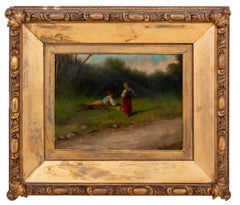
American School, Collecting Firewood, 19th C.
Located in Astoria, NY
American School, Collecting Firewood, Oil on Canvas, 19th century, unsigned, giltwood frame.
Image: 9" H x 12" W; frame: 17.25" H x 20" W.
Category
19th Century American Realist Figurative Paintings
Materials
Canvas, Oil
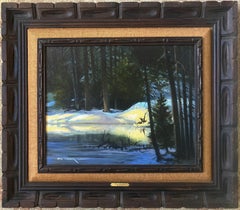
Deep Shadows
Located in San Francisco, CA
Artist: Bill Shaddix – American (1931- )
Title: Deep Shadows
Year: circa 1980
Medium: Oil on canvas
Size: 15.5 x 19.5 inches.
Framed size: 27 x 31 inches...
Category
Late 20th Century American Realist Landscape Paintings
Materials
Canvas, Oil
Red, Purple
Yellow Abstract Painting of Inside Antelope Canyon in Arizona USA
By Katarzyna Szulc
Located in Preston, GB
Red, Purple & Yellow Abstract Painting of Inside Antelope Canyon in Arizona USA by Polish Artist Katarzyna Szulc. This original oil painting is part of an inspired body of work based...
Category
2010s American Realist Landscape Paintings
Materials
Canvas, Paint, Cotton Canvas, Oil

$3,008 Sale Price
20% Off
H 36 in W 28 in D 1.75 in
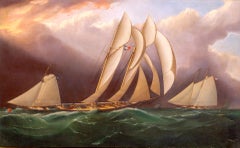
SAPPHO, DAUNTLESS and GRACIE Racing at Cape May 1871
By James Edward Buttersworth
Located in Costa Mesa, CA
James E. Buttersworth's most sought-after artworks emerge from his depictions of American racing yachts going head to head in the major regattas...
Category
1870s American Realist Paintings
Materials
Canvas, Oil
$84,000
H 29.19 in W 41.25 in
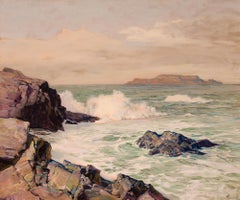
Distant Island
By Frederick Waugh
Located in Costa Mesa, CA
Frederick Waugh was a prolific seascape artist who generated 2,500 paintings of the sea and shore. Although it was never published, he penned a ten chapter book on marine painting. S...
Category
1920s American Realist Landscape Paintings
Materials
Canvas, Oil
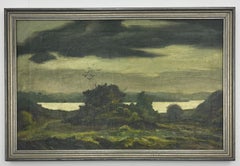
Realist Landscape Original Oil Painting- Small Green Tonal Midwestern Scene
Located in Marco Island, FL
This is a great American landscape painting by the artist, Clyde Singer. Gorgeous tonal shades of green and grey depict a stormy midwestern landscape.
Framed 16 x 24 inches
Canva...
Category
1940s American Realist Landscape Paintings
Materials
Canvas, Oil
$3,200
H 16 in W 24 in D 2 in
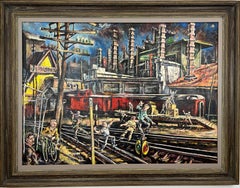
London Round House-Mid-Century Industrial American Scene Oil Painting
By Jack Steele
Located in Marco Island, FL
A mid-century American Realist scene of children playing on the railroad entitled, London Round House. The chaotic scene of children rambunctiously playing is suspected to be set in...
Category
1940s American Realist Landscape Paintings
Materials
Canvas, Oil
$14,000
H 52 in W 43 in D 3 in
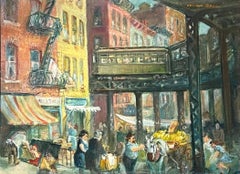
NYC EL American Scene Social Realism Mid 20th Century Modern WPA Era Figurative
By Cecil Crosley Bell
Located in New York, NY
NYC EL American Scene Social Realism Mid 20th Century Modern WPA Era Figurative
Cecil Bell (1906 – 1970)
Street Life Under the EL
22 x 30 inches
Oil on canvas, c. 1930s
Signed upper...
Category
1930s American Realist Landscape Paintings
Materials
Canvas, Oil
"Frozen Memories, " Oil on Canvas
By Bruno Surdo
Located in Chicago, IL
Chicago-based fine art painter Bruno A. Surdo is classically trained in drawing and oil painting in the tradition of Renaissance masters. With strong command of the human form, Surdo...
Category
21st Century and Contemporary American Realist Landscape Paintings
Materials
Oil, Canvas
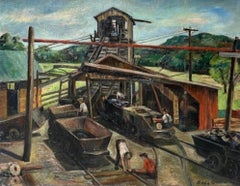
Industrial Railroad WPA Mid 20th Century American Scene Rural Modern Realism
By Louis Bosa
Located in New York, NY
Industrial Railroad WPA Mid 20th Century American Scene Rural Modern Realism
Large oil on canvas genre painting depicting laborers working on a railroad, with rural landscape in the...
Category
1940s American Realist Figurative Paintings
Materials
Canvas, Oil
$11,500
H 29 in W 35 in D 3 in
More From This Seller
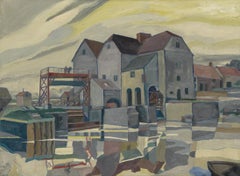
View All"Factory on the River" Modernist and Precisionist WPA Industrial New York Scene
By William Sharp
Located in New York, NY
William Sharp (1900 - 1961)
Factory on the River
Oil on canvas
17 1/2 x 23 1/4 inches
Initialed lower right: WS
Provenance:
Estate of the artist
Private Collection, New York
Swann Auction Galleries, American Art, June 13, 2019, Lot 178
William Sharp was born on June 13, 1900, in Lemberg, Austria, where he attended college and the Academy for Arts and Industry. He later studied in Kraków, Poland, and in Berlin and Munich, Germany. Sharp began his career as a designer of stained-glass windows and as a painter of murals. He served in the German army during World War I. After the war he became a newspaper artist in Berlin and a well-known etcher.
Sharp drew political cartoons that were bitterly critical of the growing Nazi movement. As the influence of National Socialism intensified, he began to contribute drawings, under a pseudonym, to publications that were hostile to Hitler. After Hitler assumed power, Sharp was confronted with these drawings and told that he would be sent to a concentration camp. However, in 1934, he escaped to the United States.
His first newspaper assignment in America was making courtroom sketches for The New York Mirror...
Category
Mid-20th Century American Realist Landscape Paintings
Materials
Canvas, Paint, Oil
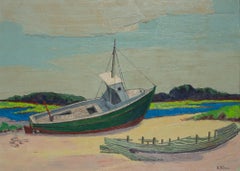
"Low Tide at Noon, Wellfleet, Massachusetts, " Ernest Fiene, WPA, Boat on Beach
By Ernest Fiene
Located in New York, NY
Ernest Fiene (1894 - 1965)
Low Tide at Noon, Wellfleet, Massachusetts
Oil on canvas
26 x 36 inches
Signed lower right
Ernest Fiene was born in Elberfeld, Germany in 1894. As a teenager, Fiene immigrated to the United States in 1912. He studied art at the National Academy of Design in New York City from 1914 to 1918, taking day classes with Thomas Maynard and evening classes with Leon Kroll. Fiene continued his studies at the Beaux-Arts Institute of Design in Paris from 1916 to 1918, adding classes in printmaking at the Art Students League in 1923.
Fiene began his career as an artist in 1919 with his first exhibition of watercolors at the MacDowell Club arranged by his mentor Robert Henri. In 1923 the Whitney Studio Club mounted a large exhibition of his works. The following year he had an exhibition at the New Gallery in New York, which completely sold out all fifty-two works, including paintings, watercolors, drawings, and etchings. With the proceeds of sales from the New Gallery exhibition, Ernest Fiene and his younger brother Paul, a sculptor, built studios in Woodstock, New York in 1925.
In the early Twenties Ernest Fiene painted mostly landscapes of Woodstock and both the Ramapo and Hudson River Valleys. He was the subject of the first monograph for the Younger Artists Series in 1922. Published in Woodstock, the series went on to include Alexander Brook, Peggy Bacon, and Yasuo Kuniyoshi. The book reproduced 1 illustration in color and another 27 reproductions in black and white. Around 1925 Fiene became fascinated with the intensity, excitement, and opportunities for color harmonies New York City offered as a subject. His paintings shifted to urban and industrial themes with architecture, industry, and transportation becoming his subjects.
By 1926 Fiene had attracted the dealer Frank K.M. Rehn, who gave him a one-man exhibition that year, which travelled to the Boston Arts Club. C.W. Kraushaar Galleries gave Fiene a one-man exhibition of urban, landscape, portrait, and still life paintings in 1927. Julianna Force, the director of the Whitney Studio Club and first director of the Whitney Museum of American Art, included two of Fiene's paintings in a fall exhibition in 1928. The Whitney Studio Club showed Fiene's paintings in a two-man exhibition with Glenn O. Coleman that year and acquired three of Fiene's paintings. Also in 1928 Fiene became affiliated with Edith Halpert's Downtown Gallery where he had an exhibition of 20 lithographs in the spring. Fiene sold his house in Woodstock in 1928 to spend more of his time in New York City.
With so many successful exhibitions, Fiene returned to Paris in 1928-29 where he rented Jules Pascin's studio and studied at the Académie de la Grande Chaumière. In France, Fiene painted both landscape and urban subjects developed from ideas influenced by Cubist geometry and the use of flat areas of broad color. Upon returning to New York in 1930, Fiene used this new approach to continue to paint New York skyscraper and waterfront subjects, as well as to begin a series of paintings on changing old New York based on the excavations for Radio City Music Hall and the construction of the Empire State Building. Frank K.M. Rehn Galleries exhibited this series, titled "Changing Old New York," in 1931. Fiene also has solo exhibitions at Rehn Galleries in 1930 and 1932. Fiene's oil paintings are exhibited at the Chicago Arts Club in 1930 as well.
Fiene was included in the Museum of Modern Art's exhibition Painting and Sculpture by Living Americans in December of 1931. Visiting New York, Henri Matisse saw the exhibition and called Fiene's Razing Buildings, West 49th Street the finest painting he had seen in New York. Fiene had two mural studies from his Mechanical Progress series exhibited at the Museum of Modern Art's exhibition Murals by American Painters and Photographers in 1932. Fiene sent View from my Window which depicts Fiene working on a lithograph stone while looking out his window to the newly completed Empire State Building to the Carnegie International in 1931. In 1932 Fiene participated in the first Biennial of American Painting at the Whitney Museum and his prints were included in exhibitions at the Downtown Gallery and the Wehye Gallery. In the same year, Fiene was awarded a Guggenheim fellowship to further study mural painting in Florence, Italy.
On his return from Italy in 1933 Fiene re-engaged himself in New York City life and won several public and private mural projects. Fiene resumed his active exhibition schedule, participating in two group exhibitions at the Whitney Museum and a one-man exhibition of recent paintings at the Downtown Gallery in January 1934. In 1933 he purchased a farm in Southbury, Connecticut, which added Connecticut scenes to his landscape subjects. This was also the year Fiene began to spend summers on Monhegan Island, Maine, where he painted seascapes, harbor scenes, and still lifes.
Fiene's landscape paintings attracted numerous commissions as part of the American Scene movement. From 1935-36 Fiene took an extended sketching trip through the urban, industrial, and farming areas of Pennsylvania and West Virginia. Most of the twenty-four Pennsylvania urban and rural paintings from this trip were featured in an exhibition held at the First National Bank in Pittsburgh in October of 1937 by the Pittsburgh Commission for Industrial Expansion. Fiene said of these works that he formed rhythm, opportunity for space and color, and integrity in the Pennsylvania mill and furnace paintings. Fiene received the silver medal for one of the Pittsburgh paintings...
Category
Mid-20th Century American Realist Landscape Paintings
Materials
Canvas, Oil
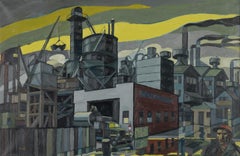
"Colonial Sand and Stone Company, New York, " Industrial WPA Scene, Precisionist
By William Sharp
Located in New York, NY
William Sharp (1900 - 1961)
Factory on the River
Oil on canvas
20 1/2 x 28 1/2 inches
Initialed lower left: WS
Provenance:
Estate of the artist
Private Collection, New York
Swann Auction Galleries, American Art, June 13, 2019, Lot 178
Private Collection, New York
Colonial Sand and Stone Co., founded by Generoso Pope, was once the country’s largest sand and gravel business, providing the concrete for much of New York City’s skyline, including the Empire State Building, Rockefeller Center, Radio City Music Hall, airports and subways.
William Sharp was born on June 13, 1900, in Lemberg, Austria, where he attended college and the Academy for Arts and Industry. He later studied in Kraków, Poland, and in Berlin and Munich, Germany. Sharp began his career as a designer of stained-glass windows and as a painter of murals. He served in the German army during World War I. After the war he became a newspaper artist in Berlin and a well-known etcher.
Sharp drew political cartoons that were bitterly critical of the growing Nazi movement. As the influence of National Socialism intensified, he began to contribute drawings, under a pseudonym, to publications that were hostile to Hitler. After Hitler assumed power, Sharp was confronted with these drawings and told that he would be sent to a concentration camp. However, in 1934, he escaped to the United States.
His first newspaper assignment in America was making courtroom sketches for The New York Mirror...
Category
Mid-20th Century American Realist Landscape Paintings
Materials
Canvas, Paint, Oil
"Building the Westside Highway" Frida Gugler, 1930s New York City Urban Scene
Located in New York, NY
Frida Gugler
Building the Westside Highway (Near the George Washington Bridge), circa 1935-37
Signed lower right
Oil on canvas
20 x 28 inches
Born in Milwaukee, Wisconsin, the pain...
Category
1930s American Realist Figurative Paintings
Materials
Canvas, Oil
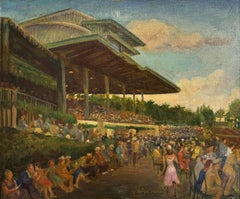
"Hialeah Park Race Track, Florida" Beatrix Sherman, American, Mid 20th Century
Located in New York, NY
Beatrix Sherman
Hialeah Park Race Track, Florida, 1947
Signed lower right
Oil on canvasboard
16 x 20 inches
Beatrix Sherman (1894-1975), who changed her first name from Beatrice by...
Category
1940s American Realist Figurative Paintings
Materials
Canvas, Oil, Board
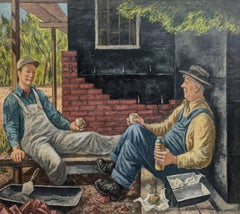
"Lunch Break” Fletcher Martin, Men Working, Bricklayers, WPA, American Scene
By Fletcher Martin
Located in New York, NY
Fletcher Martin
Lunch Break, circa 1940
Signed lower right
Oil on canvas
31 1/2 x 37 3/8 inches
When Fletcher Martin died in 1979, the New York Times entitled his obituary “Artist o...
Category
1940s American Realist Landscape Paintings
Materials
Canvas, Oil
Still Thinking About These?
All Recently ViewedMore Ways To Browse
Antique Viola
New Masses
Democratic Convention
George Picken Art
Hillier Parker
Holland Painting Of Boats
Hunting Scene Horse Hound
Idaho Landscape Painting
Impasto Painting Boat
Ireland Sketch
Irwin Whitaker
James Reynolds
Josep Maria Vayreda Canadell On Sale
Joshua Tree Painting
Jules Noel
Kansas Oil Painting
Kit Carson
La Montagne Painting