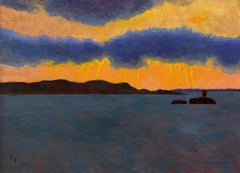
Items Similar to Sunset by Hilding Werner (1925) – Formerly Owner Sven-Göran “Svennis” Eriksson
Video Loading
Want more images or videos?
Request additional images or videos from the seller
1 of 14
Hilding WernerSunset by Hilding Werner (1925) – Formerly Owner Sven-Göran “Svennis” Eriksson1925
1925
$16,634.64
£12,452.84
€13,900
CA$22,899.66
A$25,033.81
CHF 13,244.02
MX$299,569.82
NOK 168,511.06
SEK 154,254.83
DKK 105,900.89
About the Item
Sunset (1925) depicts a serene lake in Värmland at the close of day, suffused with the golden light of dusk. In this composition, Werner captures one of his signature motifs: a broad, tranquil lake encircled by dense forested ridges and distant blue-tinged hills beneath a luminous twilight sky. Clouds gilded by the setting sun are mirrored in the still water, their reflections amplifying the scene’s radiant glow. A dark treeline in silhouette stretches along the horizon, its gentle ridge line framing the brilliance of the sky., The atmosphere is one of hushed tranquility and stämning (mood) nature presented in its most sublime and unspoiled aspect, entirely devoid of human figures, thereby emphasizing the landscape’s grandeur and spiritual resonance. Werner’s delicate handling of light and color is evident in the soft gradations of warm amber and cool blue hues, which convey not only the visual impression of sunset but also an emotional undertone of calm reflection.
The Artist
Hilding Werner was a Swedish landscape painter known for his romantic visions of the Värmland countryside. Active in the early 20th century, Werner played an important role in Swedish landscape painting of that era, as part of the late National Romantic movement. Born in the village of Kårud, Värmland in 1880, he maintained a lifelong connection to the region’s lakes and forests. Werner received his formal art education in Stockholm, enrolling in Richard Bergh’s progressive art school around 1900. Under Bergh – a leading figure of Swedish national romantic art – and other instructors like Anders Zorn and Nils Kreuger, Werner was encouraged to seek inspiration in Nordic nature and to internalize and “poeticize” its forms with feeling. This training instilled in him a deep appreciation for capturing the atmospheric mood of the Swedish landscape, a hallmark of Scandinavian painting at the time.
After his studies, Werner returned permanently to his native Värmland in 1907, establishing a studio in the rural village of Stömne. Back amid the wild forests and mirror-like lakes of western Sweden, he discovered the motifs that would define his oeuvre: panoramic vistas of vast lakes framed by woods and distant hills at dawn or dusk, as well as silent winter forests cloaked in snow. These subjects, often observed at twilight, allowed Werner to express what he called his “love and worship of Swedish nature.” He became essentially a romantic mood painter of his homeland, dedicated to portraying nature in tranquil, sublime moods. His landscapes typically omit human presence, focusing on nature’s grandeur and evoking a quasi-spiritual reverence for the land. In this respect, Werner’s art carried forward the 19th-century National Romantic ideal of finding national identity and solace in the Nordic wilderness.
Werner’s career in Värmland brought him into contact with the Rackstad colony (Racken Group) near Lake Racken outside Arvika – an influential artists’ community led by Gustaf Fjaestad, which was devoted to depicting the unspoiled Nordic landscape with spiritual and symbolic overtones. Werner shared with Fjaestad and his circle the conviction that nature harbored a spiritual essence best conveyed through art. Like those artists, he sought to infuse his landscapes with an almost mystical atmosphere, interpreting the scenery not just realistically but symbolically to communicate emotional or spiritual truths. Though friendly with Fjaestad, Werner remained something of a regional lone wolf; he never formally joined the Rackstad colony, preferring to work independently in his secluded studio while still drawing inspiration from their ideals. He later became one of the initiators of the Värmland Artists’ Association, further cementing his role as a key figure in the region’s art scene.
Stylistically, Hilding Werner’s work bridges late Scandinavian National Romanticism and early 20th-century Symbolism. His paintings are marked by a lyrical, often melancholy serenity and a deep patriotic love of the Swedish landscape, combined with a refined handling of light and color that reveals the influence of French Impressionism and Post-Impressionism. Werner was influenced by his mentor Richard Bergh and by contemporaries like Fjaestad, as well as by the earlier Swedish landscape master Otto Hesselbom, whose expansive horizons and twilight skies he often emulated. However, Werner’s technique was distinctly his own: he applied paint with a soft, skillful brushwork and nuanced color modulation that lent his canvases a particular sophistication and “fresh tidiness,” setting them apart within the Nordic landscape tradition. Critics have noted the saturated yet harmonious palettes in his scenes – for example, the use of violet and blue tones to impart a wistful, twilight mood – and the gentle, rounded forms that imbue his compositions with a dreamy, almost pantheistic lyricism.
Throughout his life, Werner remained profoundly devoted to the Värmland landscape. He seldom traveled abroad (aside from a brief study trip to the Netherlands in 1905), choosing instead to draw lifelong inspiration from Sweden’s own natural vistas. This steadfast focus on his native scenery was in line with a broader Scandinavian tradition of celebrating national identity through nature’s grandeur. Many of Werner’s works were acquired by collectors during his lifetime, attesting to their appeal. His legacy has since been honored with institutional recognition: the Värmlands Museum in Karlstad holds a collection of his art and mounted major retrospective exhibitions of his work in the 1950s and again in 2015. Today, Hilding Werner is esteemed as an important interpreter of the Nordic landscape – a painter who authentically captured the soul of Värmland with a reverent eye and masterful technique.
Title: Solnedgång (Sunset) 1925
oil on canvas
signed and dated 1925.
unframed 48 × 78 cm (18.9 × 30.7 in)
framed 58 × 88 cm (22.8 × 34.6 in)
Condition:
Professionally restored in 2025 by Sonia Leon.
Provenance:
Formerly in the Collection of Sven-Göran “Svennis” Eriksson, the internationally renowned Swedish football coach. (Certificate from the Eriksson family is included)
- Creator:Hilding Werner (1880 - 1944, Swedish)
- Creation Year:1925
- Dimensions:Height: 18.9 in (48 cm)Width: 30.71 in (78 cm)
- Medium:
- Movement Style:
- Period:
- Condition:Restoration 2025 by professional art conservator in Stockholm, the painting is in a very good condition with bright and clear colors. A new hand-made frame by Christer Björkman is included.
- Gallery Location:Stockholm, SE
- Reference Number:1stDibs: LU1445217146342
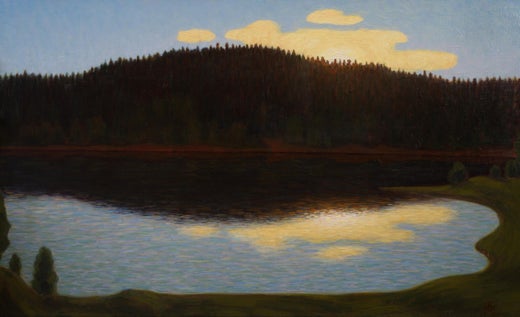
Hilding Werner (1880–1944) was a Swedish painter whose name is closely tied to the landscapes of Värmland. His lyrical depictions of lakes, forests, and skies at dawn or dusk capture the poetry of nature with quiet intensity, earning him a place among the most distinctive landscape painters of his generation. Werner was born in Kårud, Värmland, and grew up surrounded by the wilderness that would remain the central motif of his art. After secondary school in Karlstad, he moved to Stockholm in 1899 to pursue artistic training. He studied at Caleb Althin’s painting school and later at the Artists’ Association School (Konstnärsförbundet) under Richard Bergh. During this time, Werner also supported himself as a caricaturist for the satirical magazine Nya Nisse.
Influenced by Bergh and introduced to a circle of progressive artists through his cousin Bror Lindh, Werner absorbed ideas about painting directly from nature and imbuing landscapes with atmosphere and emotion. He briefly traveled to the Netherlands in 1905 but soon returned to Sweden, drawn back by the serenity of his native Värmland.
In 1907 Werner settled permanently in Stömne, on the shores of Hammartjärnet. There, he transformed a small lakeside cottage into his studio and devoted himself almost entirely to painting the surrounding countryside. His work focused on the subtle shifts of light across water, the silhouettes of pines against glowing skies, and the quiet stillness of snowy forests. Werner preferred transitional times of day—sunset, twilight, and pale winter afternoons—when nature seemed most contemplative. His brushwork, while rooted in careful observation, revealed a refined sensitivity to color and mood, creating landscapes at once intimate and expansive.
Werner’s career brought him into contact with several key figures of Swedish art. He was a friend of Gustaf Fjaestad, central to the Rackstad artists’ colony, and in 1912 visited Otto Hesselbom, whose grand vistas of lakes and skies inspired Werner to embrace more panoramic compositions. Yet his style remained distinct—gentler, more lyrical, and imbued with personal reflection.
Though he exhibited regularly with artists’ associations and local societies, Werner never sought the limelight and refrained from holding a solo exhibition during his lifetime. His modesty meant that wider recognition came only after his death, with a memorial exhibition at Värmlands Museum in 1946.
Today, Hilding Werner is celebrated as a painter who gave voice to the spirit of Värmland. His works are represented in museum and private collections, admired for their serene beauty and atmospheric depth. Collectors value not only his mastery of mood and light but also the authenticity of his vision: a life lived in harmony with the landscape he painted. His canvases remain timeless invitations into the quiet poetry of Sweden’s natural world.
About the Seller
5.0
Platinum Seller
Premium sellers with a 4.7+ rating and 24-hour response times
Established in 2020
1stDibs seller since 2020
221 sales on 1stDibs
Typical response time: 1 hour
Associations
International Confederation of Art and Antique Dealers
Associations
- ShippingRetrieving quote...Shipping from: Stockholm, Sweden
- Return Policy
More From This Seller
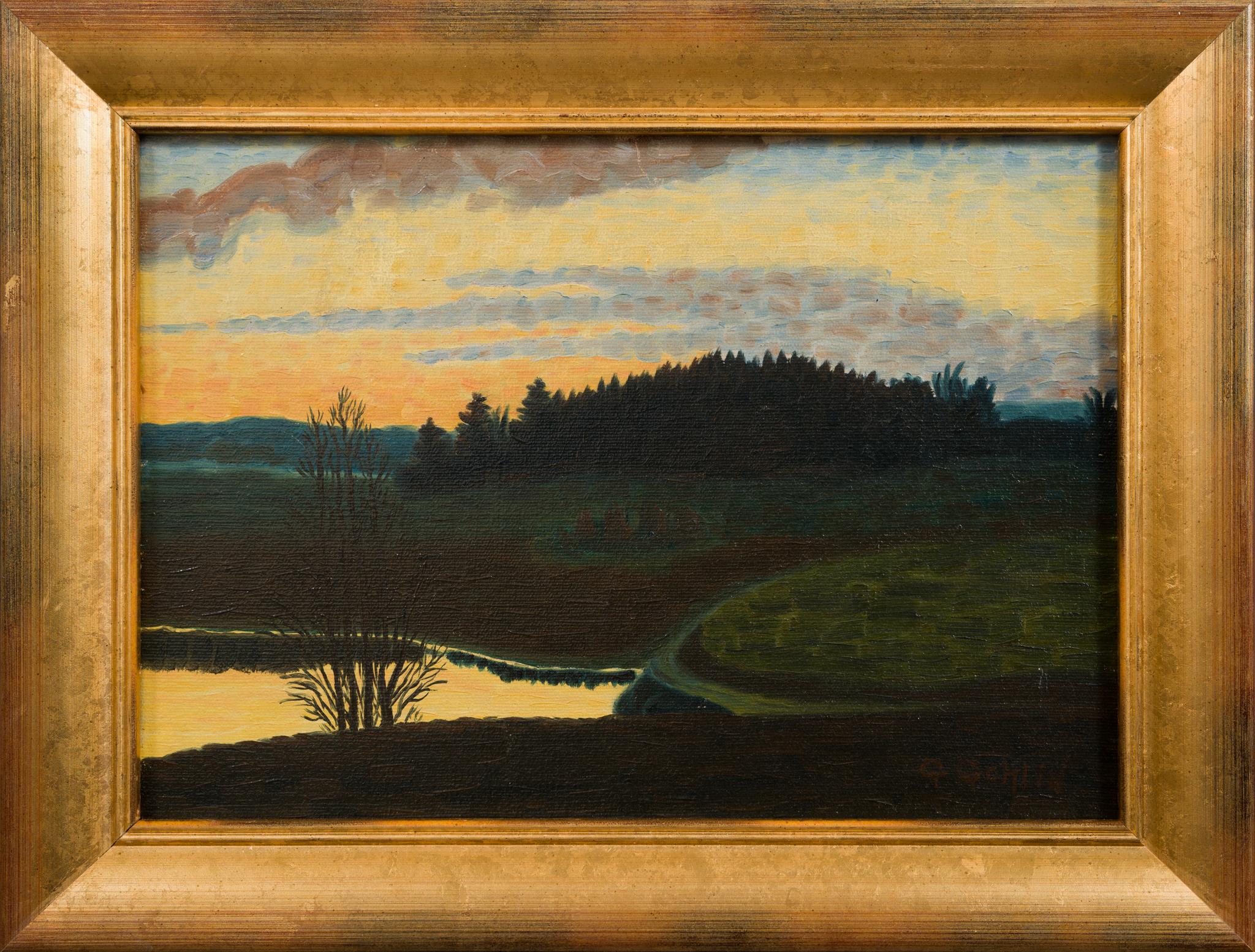
View AllEvening Glow by Swedish Artist Gustav Andreas Gehlin
Located in Stockholm, SE
Evening Glow by Gustav Andreas Gehlin
This exquisite oil painting, "Evening Glow," is a captivating work by the Swedish artist and photographer Gustav Andreas Gehlin. He studied un...
Category
Early 20th Century Landscape Paintings
Materials
Canvas, Oil
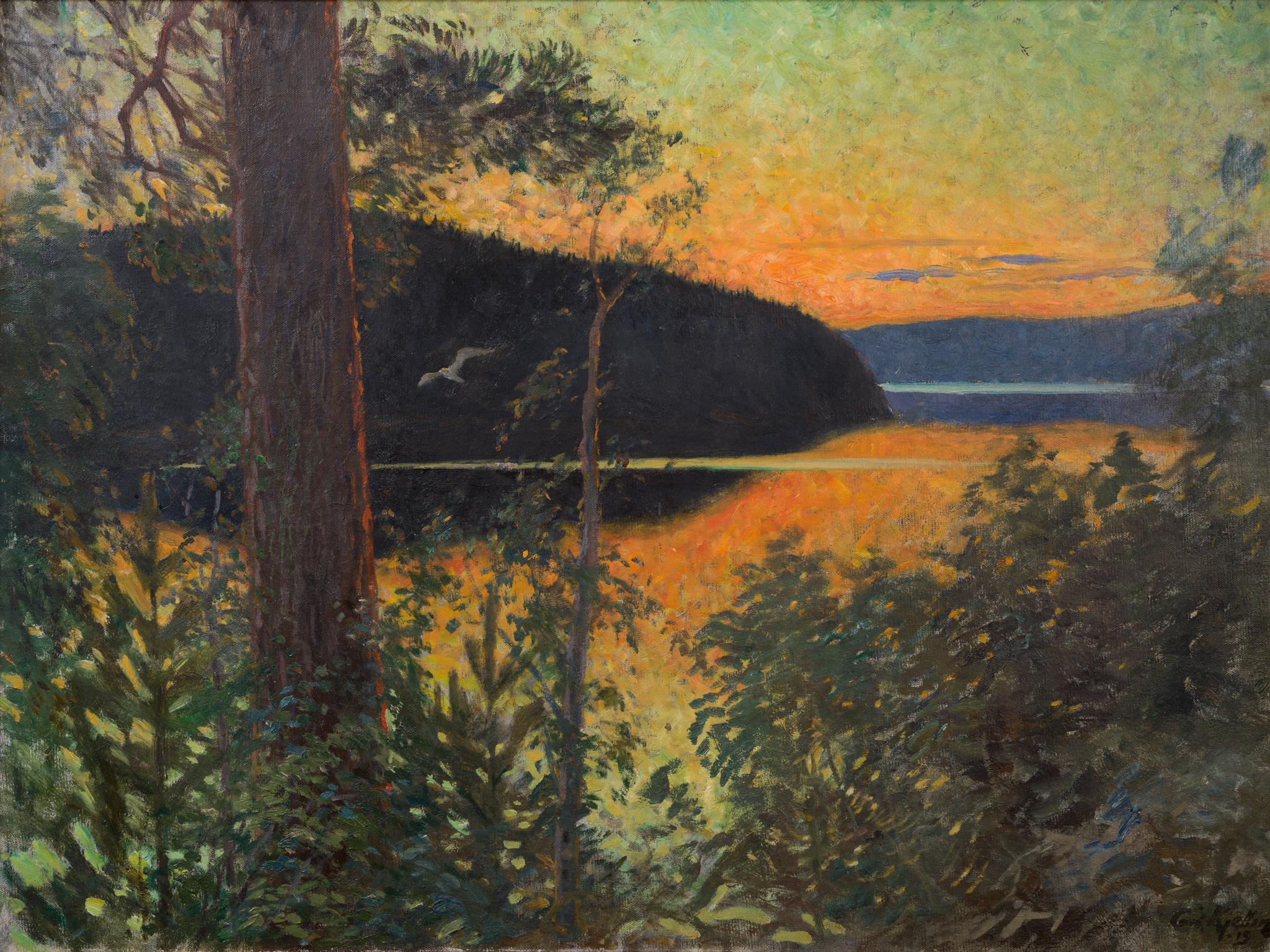
Sunset Over the Lake, 1919 by Swedish Artist Carl Kjellin (1862-1939)
Located in Stockholm, SE
"Sunset Over the Lake" by Carl Kjellin is a Nordic Light painting capturing the ephemeral beauty of a lake at sunset. The vibrant canvas, dominated by a b...
Category
1910s Post-Impressionist Landscape Paintings
Materials
Canvas, Oil
$4,595 Sale Price
20% Off
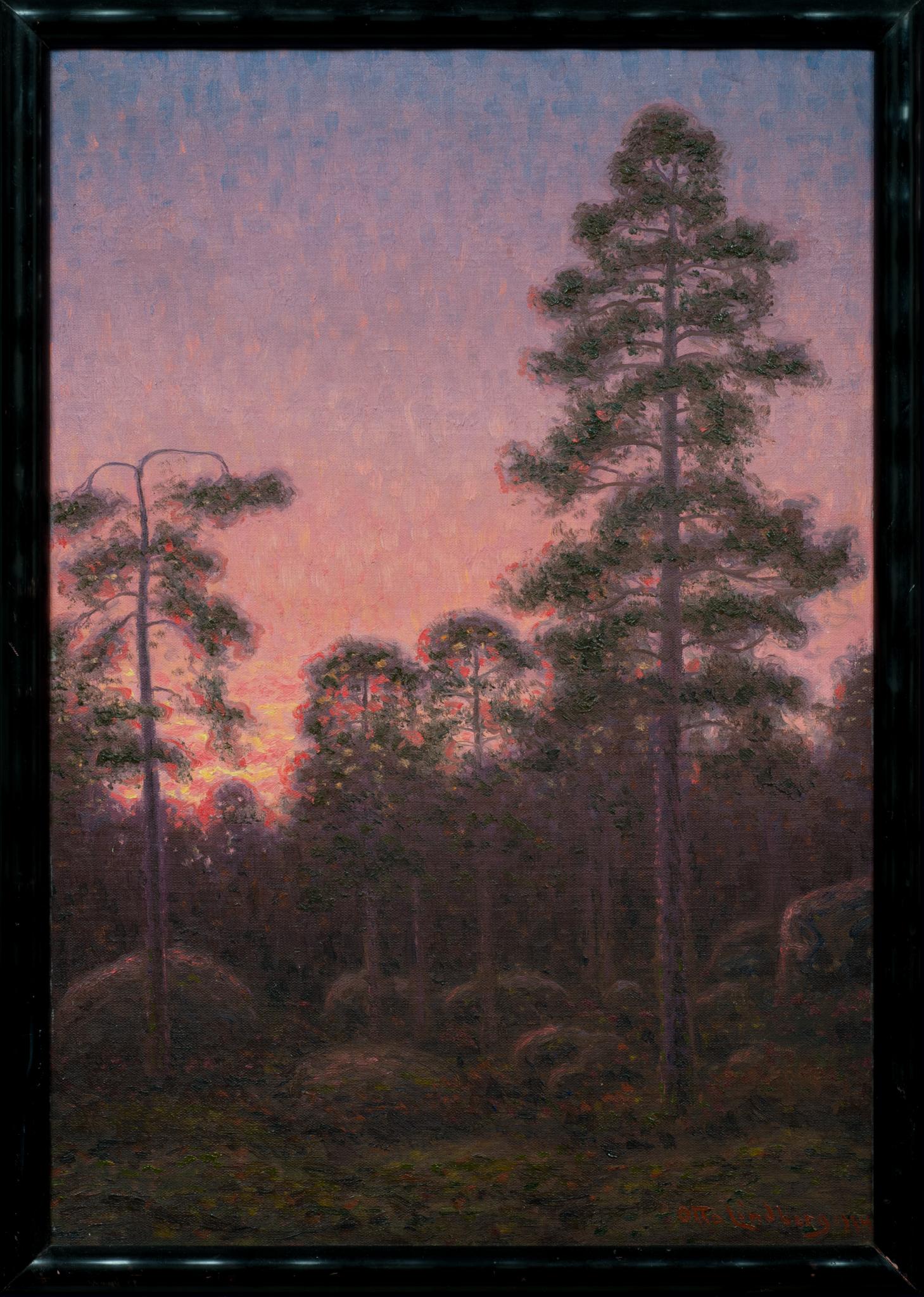
Forest at Sunset, 1934
Located in Stockholm, SE
This evocative landscape by Otto Lindberg captures the quiet beauty of a forest at dusk. The most striking feature is the luminous pink and violet glow of the fading sunlight, master...
Category
1930s Post-Impressionist Landscape Paintings
Materials
Canvas, Oil
Landscape from the North of Sweden by Swedish Artist Otto Lindberg, 1926
Located in Stockholm, SE
Otto Lindberg was a Swedish artist born in Söderhamn in 1880. Lindberg was known for his landscapes and marine paintings. He studied at the Royal Academy of Fine Arts in Stockholm an...
Category
1920s Post-Impressionist Landscape Paintings
Materials
Canvas, Oil
$2,776 Sale Price
20% Off
Twilight Reflections, Northern Lake
Located in Stockholm, SE
Oskar Lycke was a Swedish painter from Sundsvall whose work captured the quiet poetry of northern landscapes around the turn of the 20th century. Although largely self-taught, he was...
Category
1910s Post-Impressionist Landscape Paintings
Materials
Canvas, Oil, Board
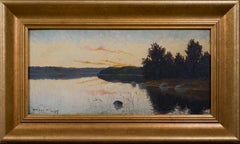
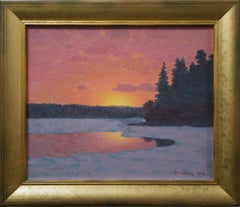
A Spring Sunset, Original Oil Painting from 1952
Located in Stockholm, SE
This exquisite painting by the artist Otto Lindberg (1880-1955) is a mesmerizing depiction of a spring sunset. Crafted in 1952, this piece stands as one of Lindberg's final paintings...
Category
1950s Romantic Landscape Paintings
Materials
Canvas, Oil
$1,819 Sale Price
20% Off
You May Also Like
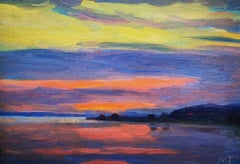
“Sunset”, post- impressionist Scandinavian landscape at sunset, oil on board
Located in Naples, Florida
A Swedish oil sketch of a vibrant dusk scene, signed with initial M.T.
This work would have been painted by an artist who almost certainly would have travelled to Paris to study t...
Category
20th Century Post-Impressionist Landscape Paintings
Materials
Oil, Board
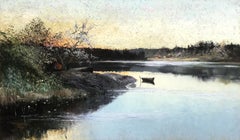
Lake Sunset
By Carl Brandt
Located in Naples, Florida
Lake Sunset
Category
Early 20th Century Landscape Paintings
Materials
Oil
$16,500
"Sun Setting Over the Lake" by Edvard Rosenberg
By Edvard Rosenberg
Located in Wiscasset, ME
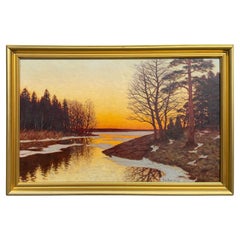
Oil on canvas, signed lower right. A luminous sunset or sunrise winter scene from Scandinavia. Measures 28" x 42" including the frame.
Edvard Axel Rosenberg (Swedish School, 1858-1934) In many ways Edward Rosenberg...
Category
Early 20th Century Swedish Victorian Paintings
Materials
Paint
Nordic Light over Lake and Mountains - Oil on Canvas Circa 1900
Located in Stockholm, SE
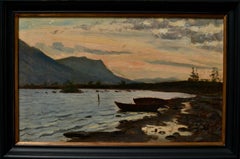
Oil study by a lake and mountains during sunset by Edward Rosenberg (1858-1934). This is a an oil study for a larger painting that Rosenberg did. A te...
Category
Early 20th Century Naturalistic Landscape Paintings
Materials
Canvas, Oil, Cardboard
Evening Atmosphere - Painting by D. Lukas-Larsen - Late 20th Century
Located in Roma, IT
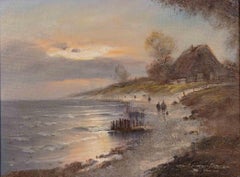
Evening Atmosphere on the coast is an original painting realized by Dieter Lukas-Larsen (1936 - 2001) in the late 20th Century.
Mixed colored oil painting on canvas.
Signed on the lower right margin.
This beautiful artwork shows an atmospheric coastal landscape in evening light mood with strollers on the beach and thatched house...
Category
Late 20th Century Naturalistic Figurative Paintings
Materials
Oil
Norway II, colorful sky sunrise sunset seascape nature
By Gregory Frux
Located in Brooklyn, NY
Dr. Rowland S. Russell PhD. writes about his experience directly witnessing Greg's practice as a “plein air” artist:
Whether he’s portraying quiet scenes from Brooklyn’s Prospect Park or the Botanical Gardens, intriguing remnants of New York’s varied industry (grain silos...
Category
2010s American Realist Landscape Paintings
Materials
Canvas, Oil