Want more images or videos?
Request additional images or videos from the seller
1 of 7
Early oil depicting the Great Fire of LondonCirca 1690
Circa 1690
$55,062.07List Price
About the Item
- Attributed to:Jan Griffier the Elder (1645 - 1718, Dutch)
- Creation Year:Circa 1690
- Dimensions:Height: 34.25 in (87 cm)Width: 49 in (124.46 cm)
- Medium:
- Movement Style:
- Period:
- Condition:Preserved in good condition, house in an ebonised and giltwood frame.
- Gallery Location:London, GB
- Reference Number:1stDibs: LU150727721402
About the Seller
5.0
Recognized Seller
These prestigious sellers are industry leaders and represent the highest echelon for item quality and design.
1stDibs seller since 2021
5 sales on 1stDibs
Authenticity Guarantee
In the unlikely event there’s an issue with an item’s authenticity, contact us within 1 year for a full refund. DetailsMoney-Back Guarantee
If your item is not as described, is damaged in transit, or does not arrive, contact us within 7 days for a full refund. Details24-Hour Cancellation
You have a 24-hour grace period in which to reconsider your purchase, with no questions asked.Vetted Professional Sellers
Our world-class sellers must adhere to strict standards for service and quality, maintaining the integrity of our listings.Price-Match Guarantee
If you find that a seller listed the same item for a lower price elsewhere, we’ll match it.Trusted Global Delivery
Our best-in-class carrier network provides specialized shipping options worldwide, including custom delivery.You May Also Like
Mercury and Io, a rediscovered painting by Jean-Baptiste Marie Pierre (ca. 1740)
Located in PARIS, FR
We would like to thank Mr. Nicolas Lesur for confirming the autograph nature of the entire composition after a direct examination of the painting on November 27, 2024.
This painting...
Category
1740s Old Masters Figurative Paintings
Materials
Canvas, Oil
Landscape Near Felday, Surrey
By Abraham Hulk the Younger
Located in Hillsborough, NC
Dutch/English artist Abraham Hulk the Younger (1851-1922) is most known for landscapes of the British countryside. This work is one of a pair (the second work is also available by s...
Category
Late 19th Century Old Masters Landscape Paintings
Materials
Canvas, Oil
$1,960 Sale Price
30% Off
H 27 in W 22.75 in D 2.13 in
Period Marine Landscape Credited to Warren Sheppard
By Warren W. Sheppard
Located in Roma, IT
This beautiful painting, due to its very high quality of execution, style and era, can be referred to the great artist Warren Sheppard, who specialized in seascapes.
Of great evocati...
Category
19th Century Old Masters Landscape Paintings
Materials
Canvas, Oil
$3,362
H 15.75 in W 21.46 in D 2.76 in
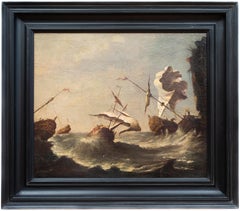
Shipping in Stormy Waters, Attributed to Italian Artist Francesco Guardi
By Francesco Guardi
Located in Stockholm, SE
The splendour of the tragic sea
Francesco Guardi and maritime painting in Venetian art
No Venetian painter was a stranger to the sea. After all, Venice was not only one of the most prominent ports of the Mediterranean, but indeed a city literally submerged in the ocean from time to time. Curiously however, the famous Venetian school of painting showed little interest in maritime motifs, favouring scenes from the iconic architecture of the city rather than seascapes. That is why this painting is a particularly interesting window into not only the painter Francesco Guardi himself – but to the significance of the element of water in art history, in absence as well as in the centre of attention.
Whether it be calm, sunny days with stunning views of the palaces alongside the canals of Venice or – more rarely – stormy shipwrecking tragedies at sea, water as a unifying element is integral to the works of painter Francesco Guardi (1712–1793). During his lifetime, Venetian art saw many of its greatest triumphs with names like Tiepolo or Canaletto gaining international recognition and firmly establishing Venice as one of the most vibrant artistic communities of Europe. While the city itself already in the 18th century was something of an early tourist spot where aristocrats and high society visited on their grand tour or travels, the artists too contributed to the fame and their work spread the image of Venice as the city of romance and leisure to an international audience, many of whom could never visit in person.
Still today, the iconic image of Venice with its whimsical array of palaces, churches and other historic buildings is much influenced by these artists, many of whom have stood the test of time like very well and remain some of the most beloved in all of art history. It was not primarily subtility, intellectual meanings or moral ideals that the Venetian art tried to capture; instead it was the sheer vibrancy of life and the fast-paced city with crumbling palaces and festive people that made this atmosphere so special. Of course, Venice could count painters in most genres among its residents, from portraiture to religious motifs, history painting and much else. Still, it is the Vedutas and views of the city that seems to have etched itself into our memory more than anything else, not least in the tradition of Canaletto who was perhaps the undisputed master of all Venetian painters.
Born into his profession, Francesco lived and breathed painting all his life. His father, the painter Domenico Guardi (1678–1716) died when Francesco was just a small child, yet both he and his brothers Niccolò and Gian Antonio continued in their fathers’ footsteps. The Guardi family belonged to the nobility and originated from the mountainous area of Trentino, not far from the Alps. The brothers worked together on more challenging commissions and supported each other in the manner typical of family workshops or networks of artists. Their sister Maria Cecilia married no other than the artist Giovanni Battista Tiepolo himself, linking the family to the most renowned Venetian name of the time. During almost a decade, Guardi worked in the studio of Michele Giovanni Marieschi, sometimes simply known as Michiel, a painted similar in both style and motif. Canaletto is, however, the artist Guardi is most often compared to since they shared a mutual fascination for depicting the architecture and cityscape of Venice.
During the course of his career, Guardi tried his hand in many different genres. He was as swift in painting landscapes, Vedutas of Venice, sacred motifs, interiors and architectural compositions as he was in a number of other motifs. His style is typical of the Venetian school but also distinct and personal once we look a little closer. There is an absolute certainty in the composition, the choice of which sometimes feels like that of a carefully calculated photograph – yet it is also very painterly, in the best sense of the word: fluid, bold, sensitive and full of character. The brushwork is rapid, intense, seemingly careless and extraordinarily minute at the same time; fresh and planned in a very enjoyable mixture. His interiors often capture the breath-taking spacious glamour of the palaces and all their exquisite decor. He usually constructed the motif through remarkably simple, almost spontaneous yet intuitively precise strokes and shapes. The result was a festive, high-spirited atmospheric quality, far away from the sterile and exact likeness that other painters fell victim to when trying to copy Canaletto.
The painting here has nothing of the city of Venice in it. On the contrary, we seem to be transported far away into the solitary ocean, with no architecture, nothing to hold on to – only the roaring sea and the dangerous cliffs upon which the ships are just moments away from being crushed upon. It is a maritime composition evoking both Flemish and Italian precursors, in the proud tradition of maritime painting that for centuries formed a crucial part of our visual culture.
This genre of painting is today curiously overlooked, compared to how esteemed and meaningful it was when our relationship to the sea was far more natural than it is today. When both people and goods travelled by water, and many nations and cities – Venice among them – depended entirely on sea fare, the existential connection to the ocean was much more natural and integrated into the imagination. The schools and traditions of maritime art are as manifold as there are countries connected to the sea, and all reflect the need to process the dangers and wonders of the ocean.
It could symbolize opportunity, the exciting prospects of a new countries and adventures, prospering trade, beautiful scenery as well as war and tragedy, loss of life, danger and doom. To say that water is ambivalent in nature is an understatement, and these many layers were something that artists explored in the most wondrous ways. Perhaps it takes a bit more time for the modern eye to identify the different nuances and qualities of historic maritime paintings, they may on first impression seem hard to differentiate from each other. But when allowing these motifs to unfold and tell stories of the sea in both fiction and reality – or somewhere in between – we are awarded with an understanding of how the oceans truly built our world.
In Guardi’s interpretation, we see an almost theatrically arranged shipwrecking scene. No less than five ships are depicted right in the moment of utter disaster. Caught in a violent storm, the waves have driven them to a shore of sharp cliffs and if not swallowed by the waves, crushing against the cliffs seems to be the only outcome. The large wooden ships are impressively decorated with elaborate sculpture, and in fact relics already during Guardi’s lifetime. They are in fact typical of Dutch and Flemish 17th century ships, giving us a clue to where he got the inspiration from. Guardi must have seen examples of Flemish maritime art, that made him curious about these particular motifs. One is reminded of Flemish painters like Willem van de Velde and Ludolf Backhuysen, and this very painting has indeed been mistakenly attributed to Matthieu van Plattenberg...
Category
18th Century Old Masters Landscape Paintings
Materials
Canvas, Oil
$70,858
Free Shipping
H 25.79 in W 29.14 in
Shepherd with Sheep, Cows and a Goat in a Landscape by Jan Frans Soolmaker
Located in Stockholm, SE
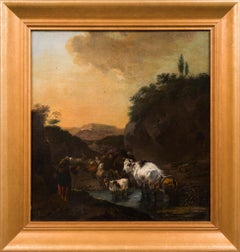
This painting depicts a pastoral scene that is attributed to the artist Jan Frans Soolmaker, an artist known for his Italianate landscapes and scenes that often feature equestrian and Arcadian elements. The painting is not signed but is attributed to Soolmaker, relating it to a known signed work by the artist that was sold at Sotheby’s London in 1999.
The scene is suffused with the warm glow of a setting or rising sun, casting a soft light that is characteristic of Soolmaker’s landscapes. It shows a shepherd guiding a group of cattle across a shallow stream, with the animals taking center stage in the composition. The animals are rendered with careful attention to their forms and the play of light on their bodies, which is a hallmark of Soolmaker's work. The landscape is composed of a rocky terrain with trees and shrubbery, creating a sense of depth and natural beauty that invites the viewer to explore the scene further.
The background suggests a vast, open landscape with distant mountains, which adds to the Italianate feel of the painting. The sky is dramatic, with clouds catching the light of the sun, contributing to the overall serene yet dynamic atmosphere of the work.
The provenance of the painting is notable, having been in the possession of significant historical figures such as Swedish Prince Fredrik Adolf, and later The collection of Pär Ulmgren, The collection of Gösta Stenman, and Engineer and politician Gustaf Henry Hansson.
Potential buyers have the option of choosing between a newly made gold frame or an older brown frame, which allows for personalization in how the work is presented.
Soolmaker’s work is often compared to that of Dutch painter Nicolaes Berchem, whose style he emulated. Soolmaker's landscapes reflect a similar sensitivity to light and composition, making his works sought after for their beauty and historical significance. Despite the smaller body of work left by Soolmaker, due to his short career, his paintings are valued for their craftsmanship and the legacy of the artist’s brief but impactful contribution to the Dutch Italianate landscape genre.
Information:
Jan Frans Soolmaker (Flanders 1635‑1685)
Shepherd with Sheep...
Category
17th Century Old Masters Animal Paintings
Materials
Canvas, Oil
$4,323 Sale Price
20% Off
H 22.05 in W 20.87 in
Italian Capriccio with Ruins Venice - 18th Century Oil on Canvas
By Gaetano Vetturali (Lucca, 1701-1783)
Located in Stockholm, SE
A Venetian capriccio view with classical architectural ruins and in the background the church of San Giorgio Maggiore and the Church of Santa Maria della Salute next to the Grand Can...
Category
1770s Old Masters Landscape Paintings
Materials
Canvas, Oil

$6,485
H 28.15 in W 22.45 in D 1.58 in
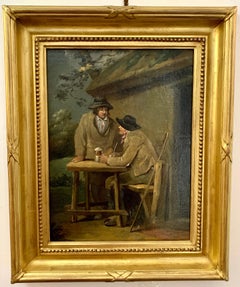
19th Century English Antique, Two Country farmers drinking beer in a landscape
By George Morland
Located in Woodbury, CT
Attributed to George Morland.
19th Century English Antique, Two Country farmers drinking beer in a landscape.
Wonderful early 19th-century original oil on canvas.
A classic 'Morland' composition as the painter was a big fan of English Pub scenes...
Category
Early 1800s Old Masters Figurative Paintings
Materials
Canvas, Oil
$2,765 Sale Price
30% Off
Free Shipping
H 20 in W 16 in
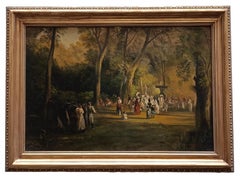
LANDSCAPE - Mario Locatelli -Posillipo School Oil on Canvas Painting
By Mario Locatelli
Located in Napoli, IT
Landscape - Mario Locatelli Italia 2004 - Oil on canvas cm.80x110
Gold leaf gilded wooden frame available on request
Mario Locatelli’s painting depicts a rural scene, of an authentic...
Category
Early 2000s Old Masters Paintings
Materials
Canvas, Oil
$4,683
H 23.63 in W 35.44 in
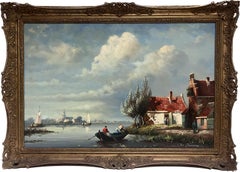
Large Traditional Dutch River Landscape with Old Town
Houses Signed Oil
Located in Cirencester, Gloucestershire
Landscape in Holland (titled verso)
Dutch School, 20th century
signed oil painting on canvas, framed
framed: 30 x 42 inches
canvas: 24 x 36 inches
provenance: private collection, Eng...
Category
Late 20th Century Old Masters Landscape Paintings
Materials
Oil, Canvas
$3,303
H 30 in W 42 in
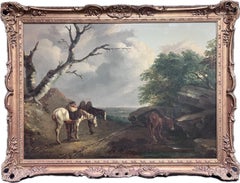
Huge 1800
s English Oil Painting Man with Horses Resting Panoramic Country View
By Thomas Barker of Bath
Located in Cirencester, Gloucestershire
Pausing for a Rest
English School, circa 1800, unsigned
the painting is very close to the works of Thomas Barker of Bath (English 1769-1847)
oil on canvas, framed
framed: 29 x 39 inc...
Category
Early 19th Century Old Masters Landscape Paintings
Materials
Oil, Canvas
$3,358
H 29 in W 39 in D 1 in
More From This Seller
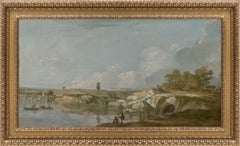
View AllThe Valley of the River Severn with a distant view of Shrewsbury
By Richard Wilson
Located in London, GB
Oil on canvas
20 x 37 ¼ inches; 50.8 x 94.6 cm
Framed dimensions: 67.5 x 110.5 cm
Not signed
c.1744-1745
Collections:
Possibly John Charles Middleton (1757-1793);
Revd Frederick M...
Category
18th Century Old Masters Landscape Paintings
Materials
Canvas, Oil
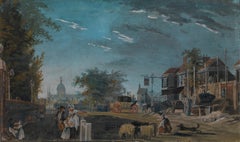
18th century view of the Elephant and Castle in London
Located in London, GB
Collections:
With Martyn Gregory;
Judy Egerton, 1984, acquired from the above;
By descent to 2014.
Exhibited:
London, Martyn Gregory, Exhibition of English & Continental Watercolours, 1984, no. 94.
London, Lowell Libson...
Category
18th Century Old Masters Landscape Paintings
Materials
Gouache, Vellum
Alfred Baldwin, Esq.
By Edward John Poynter
Located in London, GB
Oil on unlined canvas, stamped
26 x 21¼ inches; 66.5 x 54 cm
Framed dimensions: 95.5 x 83.5 cm
‘Wood & Co 190 Brompton Road London SW’
Signed with monogram and dated ‘1878’, centr...
Category
19th Century Old Masters Portrait Paintings
Materials
Canvas, Oil
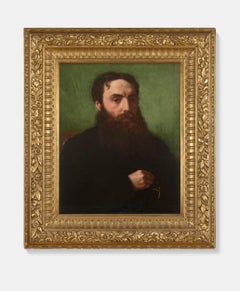
Sir Charles Frederick
Located in London, GB
Oil on canvas
50 x 40 inches; 127 x 101.6 cm
Framed dimensions: 151.5 x 127 cm
Inscribed on plinth: ‘VOTIS X ET XX’
Not signed
Painted c.1748
Collections:
Christie’s London, 23rd...
Category
18th Century Old Masters Portrait Paintings
Materials
Canvas, Oil
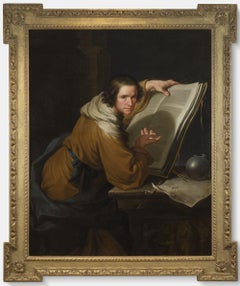
Self-Portrait
By John Hamilton Mortimer
Located in London, GB
Oil on canvas
30 x 25 ⅛ inches; 762 x 638 mm
Verso: after Sir Joshua Reynolds, a self-portrait
Not signed
Painted c. 1758
Collections:
Philip Gell (1775–1842), Hopton Hall, Derbyshire;
By inheritance at Hopton Hall to his daughter, Isabella, who married William Pole Thornhill, who renounced Hopton and its contents in favour of his kinsman, Henry Chandos-Pole-Gell (1829–1902);
By descent to his son, Brigadier General Harry Chandos-Pole-Gell (1872–1934), who sold Hopton Hall in 1918 and moved the family to Newnham Hall, Northamptonshire;
By descent to his son, Lt Colonel John Chandos-Pole (1909–1993), Newnham Hall;
Thence by descent until 2015, when acquired
By descent to 2015;
Lowell Libson
Jonny Yarker Ltd.
Literature:
Algernon Graves and Walter V. Cronin, A History of the works of Sir Joshua Reynolds P.R.A., London, 1901, IV, p. 1394.
David Manning...
Category
18th Century Old Masters Portrait Paintings
Materials
Canvas, Oil
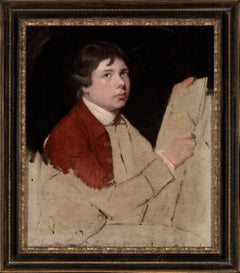
A young couple returning from the fields
Located in London, GB
Oil on panel
13 ⅜ x 9 ⅞ inches; 34 x 25 cm
Framed dimensions: 43.4 x 34.3 cm
Not signed
c. 1730s
Collections:
James Brydges, Duke of Chandos;
Chandos sale, Christopher Cock, Lond...
Category
18th Century Old Masters Figurative Paintings
Materials
Panel, Oil