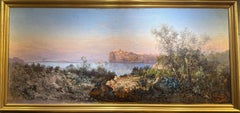
Items Similar to Twilight in Gibraltar, Romantic Landscape Painting, Late 19th Century
Want more images or videos?
Request additional images or videos from the seller
1 of 9
Laurits Bernhard HolstTwilight in Gibraltar, Romantic Landscape Painting, Late 19th CenturyLate 19th century
Late 19th century
$4,308.92
£3,201.63
€3,600
CA$5,902.33
A$6,439.12
CHF 3,415.18
MX$77,576.91
NOK 43,345.26
SEK 39,683.76
DKK 27,424.35
About the Item
This atmospheric marine painting, Twilight in Gibraltar, is a characteristic work by the Danish artist Lauritz (Laurits) Bernhard Holst (1848–1934), whose oeuvre is closely associated with late 19th and early 20th-century maritime subjects. The composition presents the Rock of Gibraltar rising monumentally from the sea, silhouetted against a softly fading twilight sky. The restrained palette and subtle gradations of light evoke the calm transition between day and night, a moment frequently explored by marine painters of the period.
In the distance, several ships glide across the horizon, while in the foreground a small sailing boat has shipped its oars, moving quietly across the still water. In front of the rock, a late 19th century battleship is anchored, most likely belonging to the British Royal Navy. Its presence underscores Gibraltar’s strategic importance as a naval stronghold and adds a sense of scale and historical specificity to the composition.
The canvas is marked a tergo with “Kensington Fine Art Society, South Kensington, 26 Alfred Place West”, indicating that the work was either exhibited or handled through this London art society. This situates the painting within the British exhibition context in which Holst was active during his career.
The Kensington Fine Art Society was an influential London exhibition venue active in the late 19th and early 20th centuries. Located in South Kensington, an area closely associated with museums, cultural institutions, and artistic life, the society played a significant role in promoting contemporary painters working outside the Royal Academy.
Lauritz B. Holst (1848–1934) was a Danish marine painter whose career unfolded largely outside Denmark and whose artistic identity was shaped by travel, maritime culture, and long residence abroad. Although largely self-taught, he received his earliest instruction as a boy from his elder brother Peter, a former academy student, and later spent a period apprenticed to a painter in Copenhagen. This practical and experiential training remained a defining feature of his art.
In 1868 Holst travelled to America and Mexico, visiting numerous cities and spending the longest period in Chicago, where he became a member of the Chicago Academy. After a brief return to Denmark in the early 1870s, settling temporarily in Hellebæk, he lived in England from 1873 to 1878 (Scarborough), followed by several years back in Denmark at Maryhill in Helsingør (1878–83). From 1883 until his death, Holst was permanently based in England, first in Chelsea and South Kensington until 1896, and thereafter in Bournemouth. During the winter of 1898–99 he travelled to Egypt, further expanding his visual repertoire.
Holst’s marine paintings were especially admired in England and America, where his fresh handling and carefully orchestrated compositions of seascapes and harbours found considerable acclaim, more so than in Denmark during his lifetime. His works were frequently executed on commission for the English and Danish royal houses, and his reputation was such that he was appointed marine painter to the Tsar of Russia. Exhibitions at Charlottenborg (1873–91), the Paris Salon (1878), the Royal Academy in London (between 1878 and 1902), as well as exhibitions in Paris, Cairo, and London, attest to his international standing.
Seen against the backdrop of Gibraltar as an imperial maritime node, the painting can be understood not merely as a topographical view, but as a reflection of late nineteenth century naval modernity and imperial presence. In Holst’s hands, such locations become stages where geography, power, and the sea converge, captured with the authority of an artist whose career was deeply embedded in the maritime world he depicted.
The present painting should most likely be dated to the years 1883-1896, during Holst’s London years, when his engagement with international maritime subjects was at its height.
Gibraltar around the turn of the twentieth century was a small yet strategically vital place, a British stronghold at the gateway to the Mediterranean that combined military discipline, cosmopolitan everyday life, and geopolitical tension.
Since 1713, Gibraltar had belonged to Great Britain, and by around 1900 the Rock was one of the empire’s most important naval bases. Its position at the entrance to the Mediterranean made it crucial for controlling maritime traffic between the Atlantic and the Mediterranean, especially after the opening of the Suez Canal in 1869. The Royal Navy used Gibraltar as a coaling station, repair harbour, and military headquarters, giving the territory a distinctly martial character.
Despite its small size, Gibraltar had a remarkably diverse population. Daily life was dense and intense. Housing was often cramped within the old fortifications, and sanitary conditions could be poor. At the same time, trade flourished: dutyfree status turned Gibraltar into a lively marketplace for goods such as tobacco, alcohol, and colonial products.
The British garrison dominated the urban landscape. Relations with Spain were ambivalent. The border with the Spanish town of La Línea functioned both as a zone of contact and a political flashpoint. Many Spaniards crossed the border daily to work in Gibraltar, while the British presence was widely perceived in Spain as a national humiliation. Around 1900, the question of Gibraltar’s sovereignty was already charged, even if the conflict had not yet reached the intensity it would acquire later in the twentieth century.
Around 1900, Gibraltar stood between eras. Steamships had replaced sailing vessels, the telegraph connected the Rock to London and the wider world, and the self confidence of the empire remained strong. At the same time, cracks were beginning to show: social tensions, technological change, and the geopolitical forces that would soon lead to the First World War. Gibraltar at the turn of the century was therefore more than a military outpost, it was a concentrated reflection of the British Empire’s global role, captured on a single, massive rock.
- Creator:Laurits Bernhard Holst (1848 - 1934, Danish)
- Creation Year:Late 19th century
- Dimensions:Height: 25.6 in (65 cm)Width: 41.74 in (106 cm)Depth: 1.97 in (5 cm)
- Medium:
- Movement Style:
- Period:
- Condition:In good condition but a surface cleaning is recommended. Present frame with damages and change of frame is recommended. Only inner part of frame visible in photos. We can arrange the cleaning and a new frame if wanted.
- Gallery Location:Stockholm, SE
- Reference Number:1stDibs: LU2608217424802
About the Seller
5.0
Gold Seller
Premium sellers maintaining a 4.3+ rating and 24-hour response times
1stDibs seller since 2023
33 sales on 1stDibs
Typical response time: <1 hour
- ShippingRetrieving quote...Shipping from: Stockholm, Sweden
- Return Policy
More From This Seller
View AllSunset at Kullen, Romantic Oil on Canvas, Signed, 1883, Framed
Located in Stockholm, SE
Sunset at Kullen near Mölle in the very south of Sweden.
Between two steep cliffs, a narrow stony beach unfolds, offering a tranquil vantage point over a still sea toward Denmark. T...
Category
1880s Romantic Landscape Paintings
Materials
Canvas, Oil
$2,513 Sale Price
25% Off
Sunset behind the Trees, Romantic 19th Century Oil on Canvas, Framed
Located in Stockholm, SE
Carl Frederik Aagaard, Sunset over Dyrehaven. Signed C.F. Aagaard. Oil on canvas laid on card box panel. 22×32 cm without frame. A tergo written:...
Category
1860s Romantic Landscape Paintings
Materials
Canvas, Oil
$1,711 Sale Price
35% Off
Free Shipping
Fall Landscape with Stream - 19th Century Oil on canvas
Located in Stockholm, SE
Arvid Mauritz Lindström (1849–1923), a Fall Landscape
The painting presents a vast autumn landscape illuminated by the soft glow of a setting sun. At the center, a stream winds its w...
Category
Late 19th Century Naturalistic Landscape Paintings
Materials
Canvas, Oil
$5,445 Sale Price
30% Off
Coastal View with Fishermen - 19th Century Oil on Canvas
Located in Stockholm, SE
Coastal landscape with fishermen hanging their nets, signed and dated “Colin Hunter 1878”, oil on canvas.
This evocative coastal scene with a cloudy sky depicts fishermen at work alo...
Category
1870s English School Landscape Paintings
Materials
Oil, Canvas
Seascape with Sailboat - Early 20th Century Mixed Media
Located in Stockholm, SE
This atmospheric seascape signed and dated by Carl Lindqvist (1856–1941) shows a wind-tossed coast under dramatic skies, where dark clouds part to reveal sun-tinted light on the hori...
Category
1910s Other Art Style Mixed Media
Materials
Paper, Watercolor, Gouache

Italian Capriccio - 18th Century Oil on Panel.
Located in Stockholm, SE
An Italian veduta scene by Marten J. Waefelaers (1748–1799), signed and dated “M.J. Waefelaers 1791” lower left, oil on panel. (The signature is a bit hidden behind the frame). The g...
Category
1790s Flemish School Landscape Paintings
Materials
Oil, Wood Panel
You May Also Like
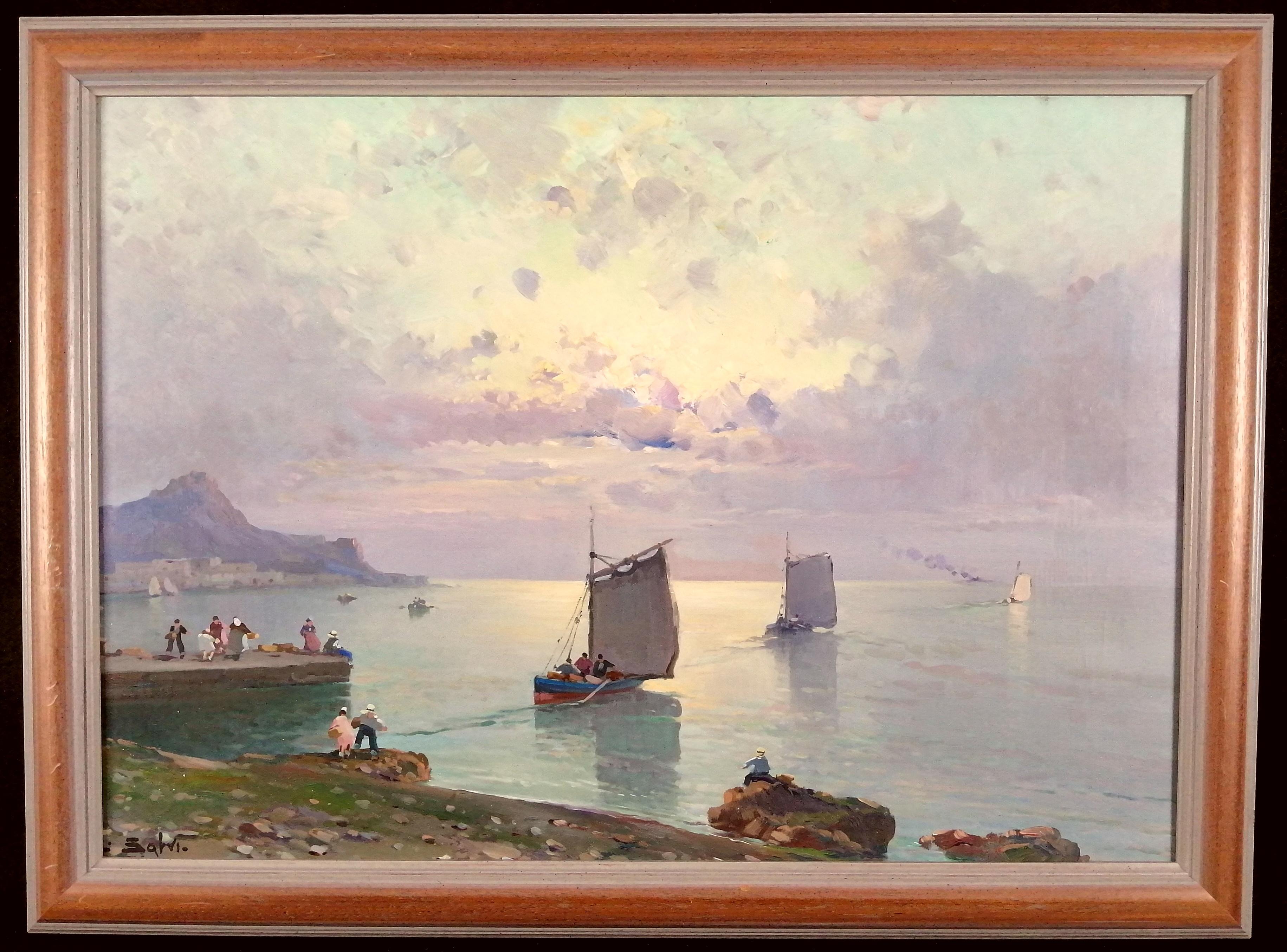
Sunset on the Coast - Early 20th Century Italian Seascape Oil on Canvas Painting
Located in Sevenoaks, GB
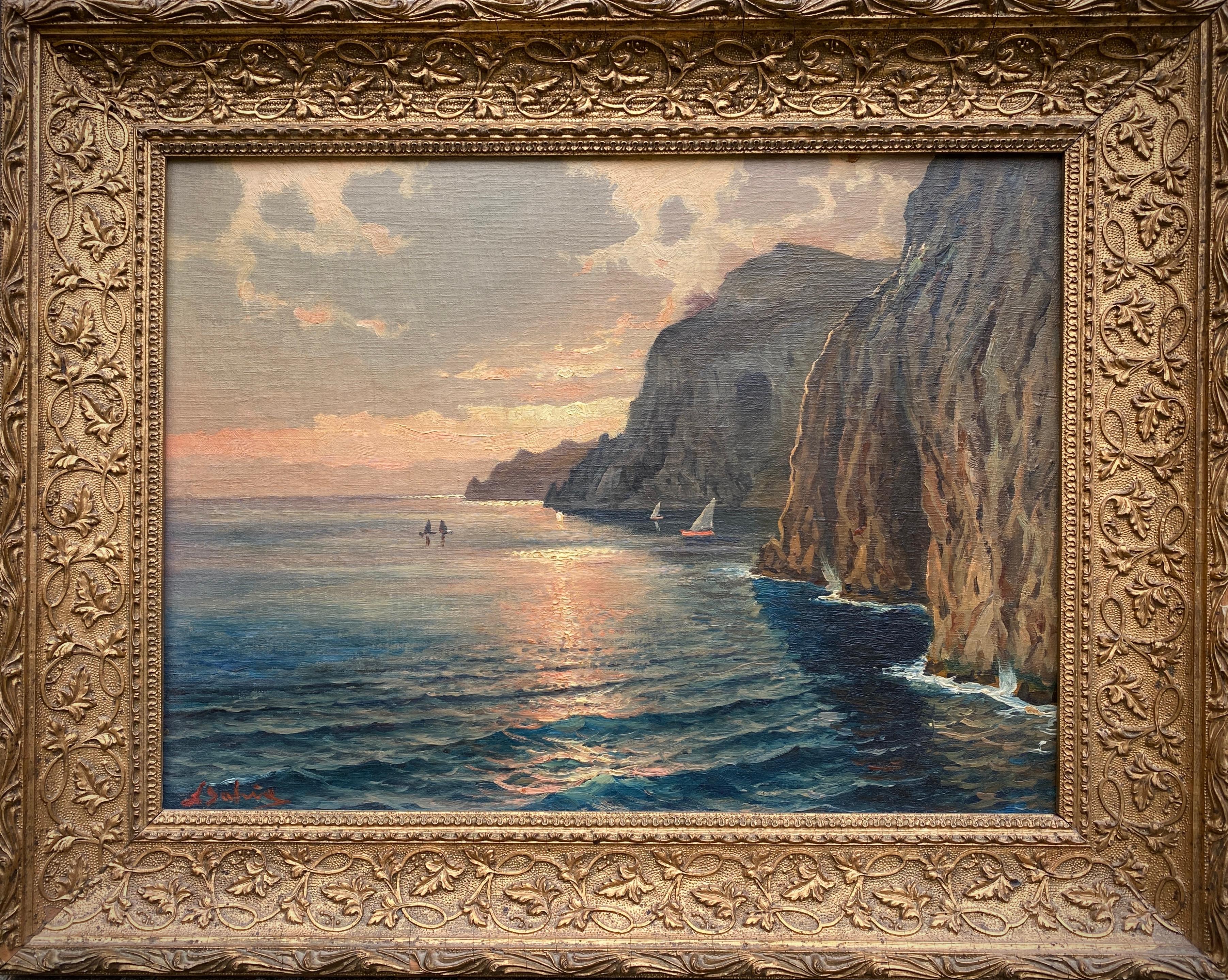
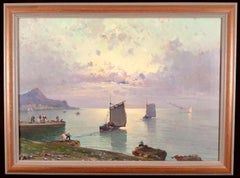
A beautiful 1930's Italian oil on canvas depicting sunset on the coast with sailing boats and figures on the shore, by Luigi Salvi.
Excellent quality and condition work, signed lowe...
Category
1930s Landscape Paintings
Materials
Canvas, Oil
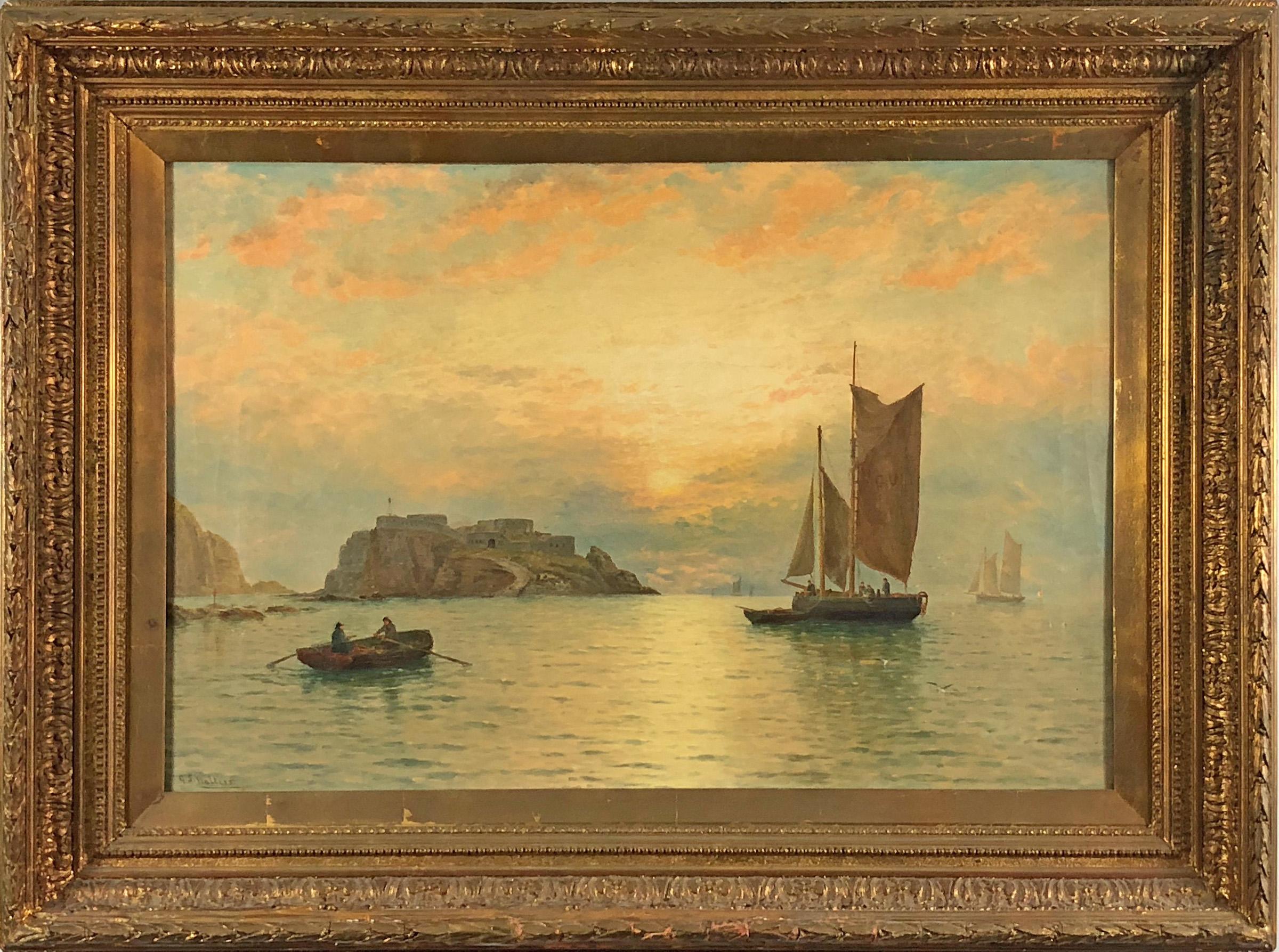
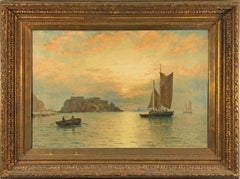
Sunset on the Midway
By George Stanfield Walters
Located in Missouri, MO
George Stanfield Walters (1838-1924)
"Sunset on the Midway" c. 1880s
Oil on Canvas
Signed
Canvas: approx 25 x 36 inches
Framed Size: approx. 31 x 42 inches
George Walters - George Stanfield Walters was born in 1838 and died in 1924.
A marine and coastal painter. He was grandson to ship portraitist Miles Walters,
and son and pupil of Samuel Walters...
Category
Mid-19th Century Victorian Landscape Paintings
Materials
Canvas, Oil
Price Upon Request
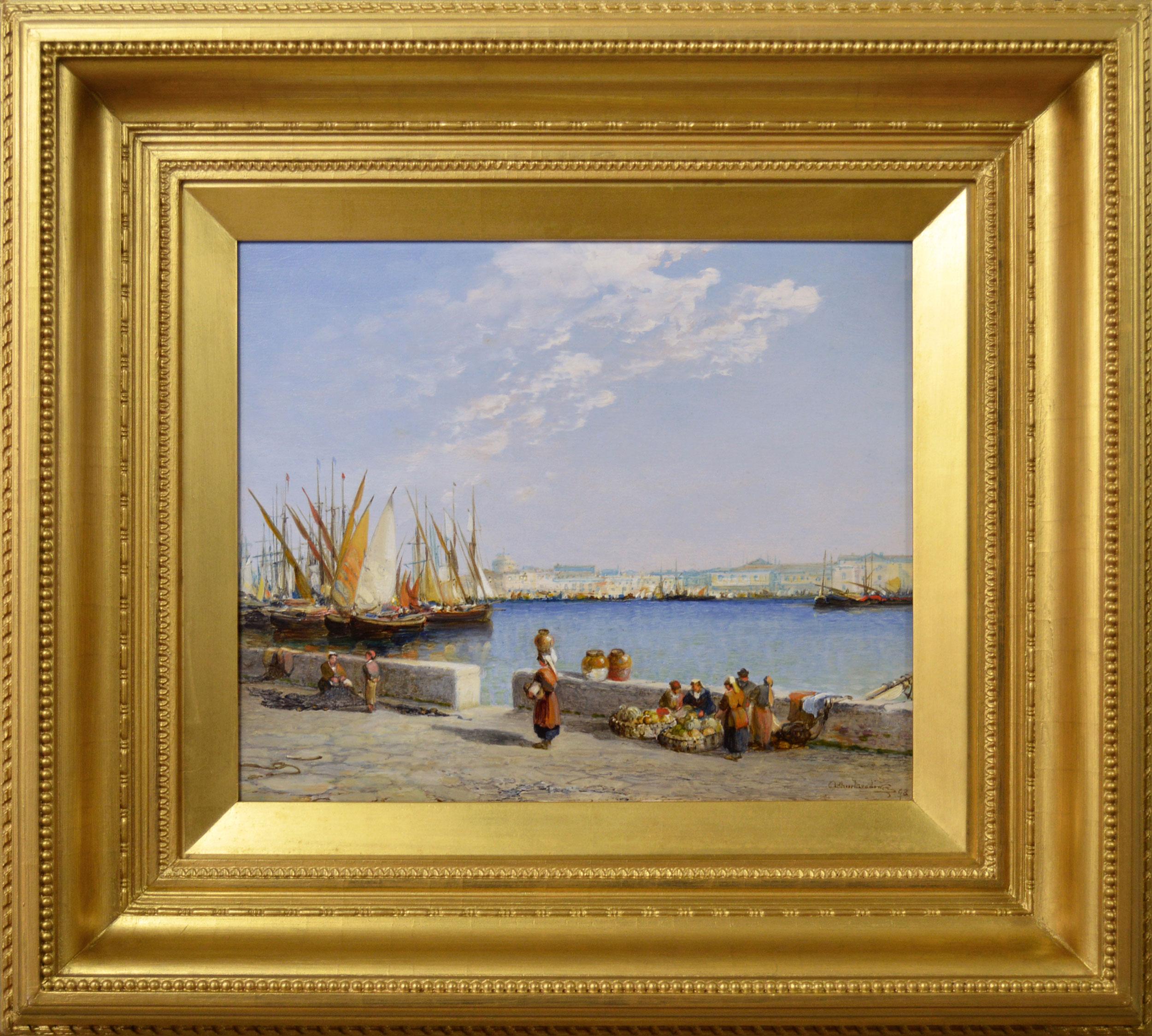
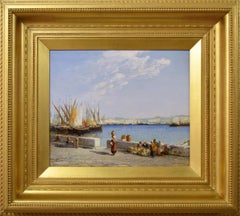
19th Century Italian townscape coastal oil painting of Livorno, Gulf of Genoa
By Arthur Joseph Meadows
Located in Nr Broadway, Worcestershire
Arthur Joseph Meadows
British, (1843-1907)
Livorno, Gulf of Genoa
Oil on panel, signed & dated (18)98, with signed & inscribed label on reverse
Image size: 9.75 inches x 11.75 inches
Size including frame: 17.75 inches x 19.75 inches
An attractive townscape depicting fruit sellers at the port of Livorno, Italy by Arthur Joseph Meadows. The scene shows the view looking across from the harbour wall to the church of Santa Caterina...
Category
19th Century Victorian Landscape Paintings
Materials
Oil, Panel
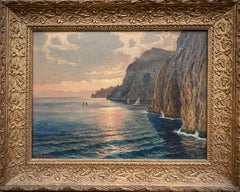
View of Capri, Artist 20th century, European School
Located in Knokke, BE
Artist 20th century
European School
20th century
View of Capri
Signature: Signed bottom left, illegible signature
Medium: Oil on canvas
Dimensions: Image size 30 x 40 cm, frame size...
Category
20th Century Impressionist Landscape Paintings
Materials
Canvas, Oil
View of the Gulf of Naples from Capodimonte - Oil Painting - 19th Century
By Camillo de Vito
Located in Roma, IT
View of the Gulf of Naples from Capodimonte is an oil on canvas realized by a follower of Camillo De Vito.
Not signed.
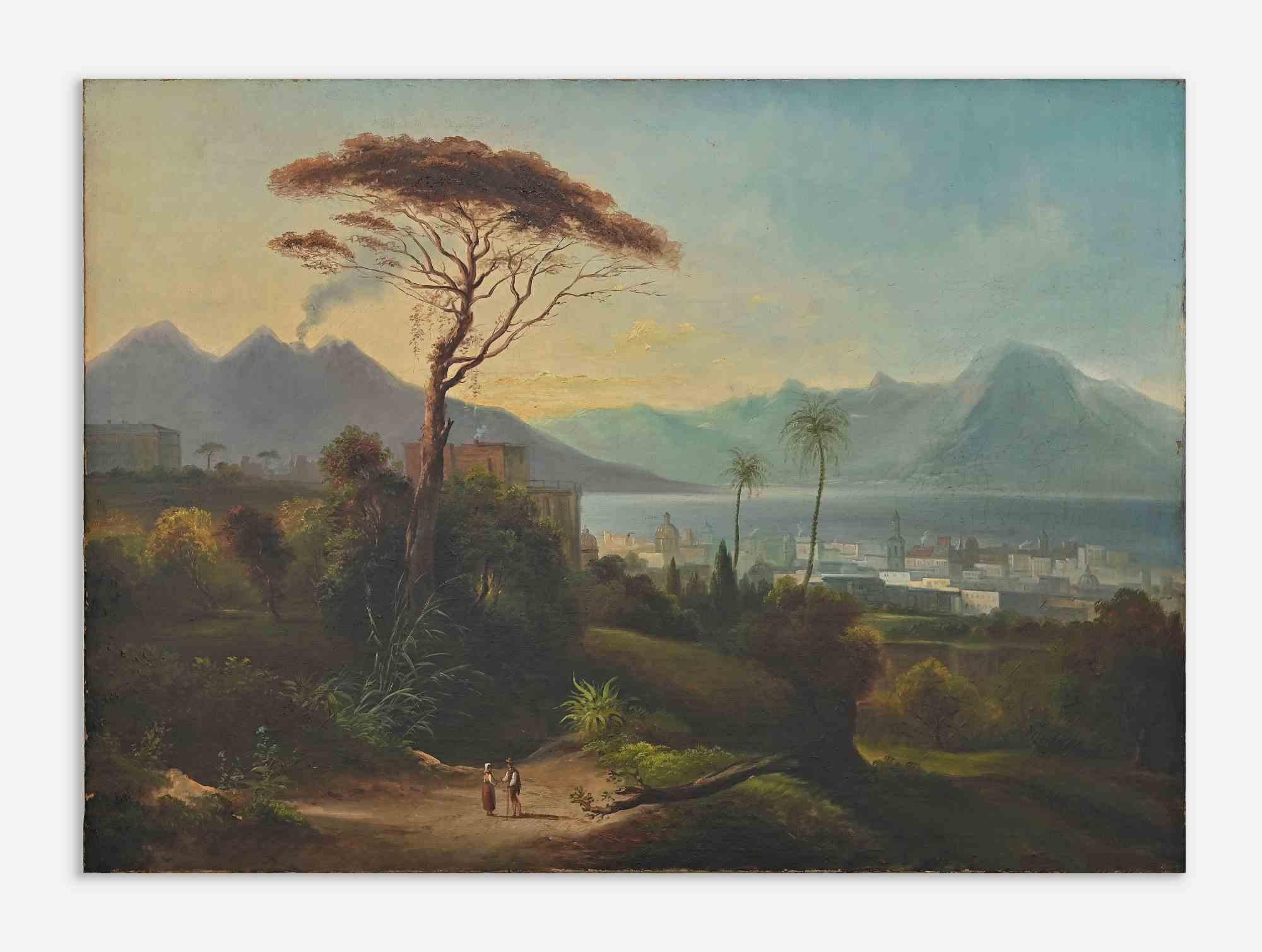
The Gulf of Naples, including a ...
Category
19th Century Modern Landscape Paintings
Materials
Paint, Oil, Canvas
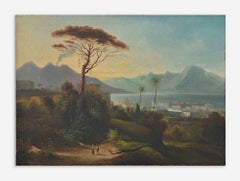
Sunset Landscape With the View of Procida Island Bay of Naples
Located in Rome, IT
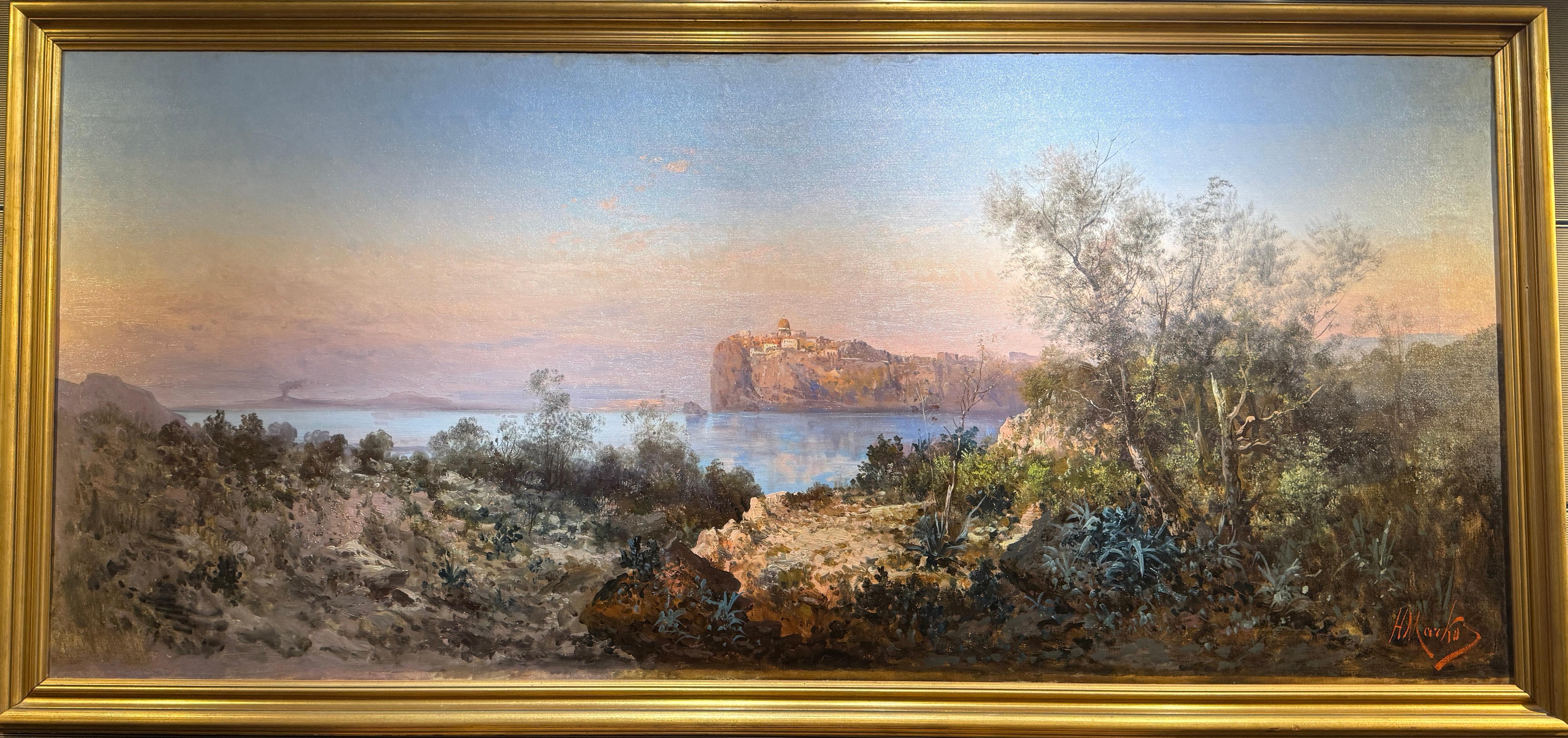
Sunset Landscape with the view of Procida Island Bay of Naples. Signed by Henry Marko' painter active in Italian landscape oil on canvas .
Amazing decoration for your interior.
Me...
Category
Late 19th Century Landscape Paintings
Materials
Oil