Want more images or videos?
Request additional images or videos from the seller
1 of 9
Martin GrelleMartin Grelle, Clear Waters, Western Art Horse
Rider in Stream Mountains1990
1990
Price:$28,500
$37,000List Price
About the Item
- Creator:Martin Grelle (American)
- Creation Year:1990
- Dimensions:Height: 28 in (71.12 cm)Width: 22 in (55.88 cm)Depth: 3 in (7.62 cm)
- More Editions Sizes:Image Size: 28 x 22 Frame Size: 38 x 32Price: $37,000
- Medium:
- Movement Style:
- Period:
- Framing:Frame IncludedFraming Options Available
- Condition:Please visit my 1stdibs storefront for other Texas and American Art.
- Gallery Location:San Antonio, TX
- Reference Number:1stDibs: LU769315001082
About the Seller
5.0
Vetted Professional Seller
Every seller passes strict standards for authenticity and reliability
Established in 1974
1stDibs seller since 2017
104 sales on 1stDibs
Authenticity Guarantee
In the unlikely event there’s an issue with an item’s authenticity, contact us within 1 year for a full refund. DetailsMoney-Back Guarantee
If your item is not as described, is damaged in transit, or does not arrive, contact us within 7 days for a full refund. Details24-Hour Cancellation
You have a 24-hour grace period in which to reconsider your purchase, with no questions asked.Vetted Professional Sellers
Our world-class sellers must adhere to strict standards for service and quality, maintaining the integrity of our listings.Price-Match Guarantee
If you find that a seller listed the same item for a lower price elsewhere, we’ll match it.Trusted Global Delivery
Our best-in-class carrier network provides specialized shipping options worldwide, including custom delivery.You May Also Like
Moonlight and Mist
By Eliot Clark
Located in Greenville, DE
New York City artist Eliot Candee Clark was well known for his impressionist landscapes. He was the son of painter Walter Clark. Many of his paintin...
Category
Early 20th Century Impressionist Landscape Paintings
Materials
Canvas, Oil

Riverscape Impressionist Oil Painting by George Thompson Pritchard, Framed
By George Thompson Pritchard
Located in Encino, CA
Untitled Riverscape, an original oil on canvas by George Thompson Pritchard, is a piece for the true collector. An impressively calming nature of this plein-air painting draws you in...
Category
1930s Impressionist Landscape Paintings
Materials
Oil, Canvas
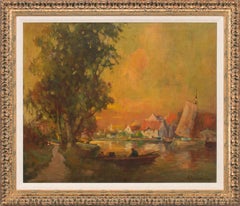
$8,000
H 31.375 in W 36.5 in D 2.25 in
Impressionist Parisian Street Scene in Autumn contemporary
By Antoine Blanchard
Located in Hillsborough, NC
Beautifully painted, this is a contemporary work in the style of French impressionist artist Antoine Blanchard. In rich impasto brushstokes, the Parisian cityscape shows the vitality...
Category
20th Century Impressionist Landscape Paintings
Materials
Canvas, Oil
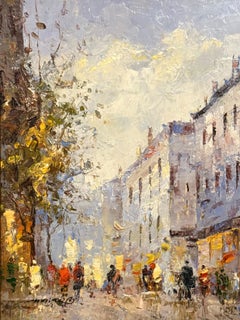
$703 Sale Price
20% Off
H 15.75 in W 11.5 in D 2.25 in
View of St Mark’s from Venetian Lagoon, impasto ships contemporary
By Luigi Pagan
Located in Hillsborough, NC
Venice in vivid impressionist color and impasto textured paint, this mid-century oil painting is attributed to Luigi Pagan (1907-1980), born in Venice and known for his many painting...
Category
Mid-20th Century Impressionist Landscape Paintings
Materials
Oil, Canvas
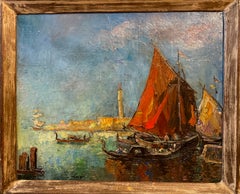
$1,200
H 17.5 in W 21.5 in D 1 in
Edinburgh Town circa 1930
By Charles Eddowes Turner
Located in Hillsborough, NC
Famous Edinburgh scene with the foggy Castle on the Mount from the North Bridge, and a bustling city scene below. Impressionist style, dating to mid 1920s/1930s, presenting a glimps...
Category
1930s Impressionist Figurative Paintings
Materials
Canvas, Oil
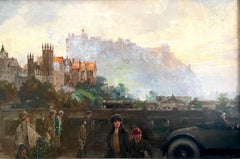
$3,255 Sale Price
30% Off
H 28 in W 38 in D 1 in
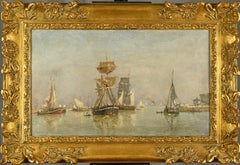
Voilier en rade d
Honfleur
By Alexandre Louis Dubourg
Located in LE HAVRE, FR
Louis-Alexandre DUBOURG (1821 - 1891)
Voilier en rade d'Honfleur
Oil on canvas
Painting dimensions: 33 x 55 cm
Framed dimensions: 47.5 x 70 cm
Signed lower right
Provenance:
- Galer...
Category
1870s Impressionist Landscape Paintings
Materials
Canvas, Oil
“Bermuda Coast” Henrietta Dunn Mears American Impressionist Oil on Board Signed
By Henrietta Dunn Mears
Located in Yardley, PA
A vibrant Bermuda seascape depicting the rocky shoreline with turquoise waters breaking against sunlit boulders beneath a sweeping tree. Mears uses bold, textured brushstrokes and a ...
Category
20th Century American Impressionist Landscape Paintings
Materials
Oil, Board
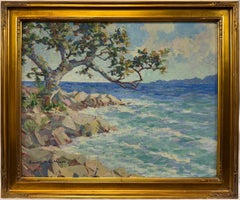
$1,950
H 19.5 in W 23.5 in D 1 in
“Untitled (Low Country Home)” American Impressionist Spanish Moss South Carolina
Located in Yardley, PA
An exceptional work by George Waller Parker (1888-1957) of a home in the South Carolina Lowcountry.
Perhaps the best example of Parker’s work to be offered in recent decades, this w...
Category
Early 20th Century American Impressionist Landscape Paintings
Materials
Oil, Board

“Covered Bridge, Kingston, NY, 1927” by Walter Koeniger, Snowy Winter Landscape
By Walter Koeniger
Located in Yardley, PA
Known for his evocative, snow-covered landscapes, Koeniger brings this subject to life with his bold, confident brushwork and keen eye for natural light. The composition centers arou...
Category
1920s American Impressionist Landscape Paintings
Materials
Canvas, Oil
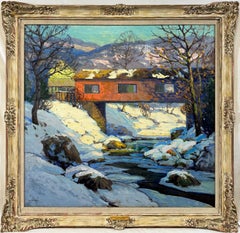
Walter Koeniger“Covered Bridge, Kingston, NY, 1927” by Walter Koeniger, Snowy Winter Landscape, 1927
$9,500
H 42.75 in W 44.5 in D 2.5 in
American Impressionist Painting - Boating Party, Sudbury River near Boston, Mass
Located in Baltimore, MD
This bright and cheerful painting is notated as “A Boating Party - Sudbury River”. It is by listed American artist Henry Orne Rider (1860-1943). Born in Salem, Massachusetts, Rider ...
Category
Early 20th Century American Impressionist Landscape Paintings
Materials
Oil
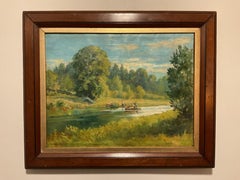
$1,200
H 19 in W 23 in D 2 in
More From This Seller
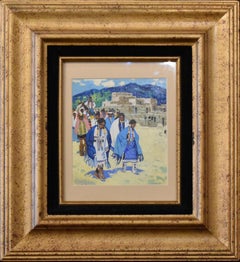
View All"PUEBLO" NATIVE AMERICAN MARCH IN FRONT OF PUEBLO ARIZONA ARTIST
Located in San Antonio, TX
Ross Stefan
(1934-1999)
Arizona / Wisconsin Artist
Image Size: 7.5 x 6.5
Frame Size: 18 x 16
Medium: Oil
"Pueblo"
Biography
Ross Stefan (1934-1999)
Born in...
Category
20th Century Impressionist Figurative Paintings
Materials
Oil
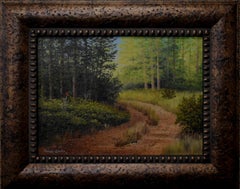
"REDBIRD ROAD" EAST TEXAS LANDSCAPE WITH CARDINAL
By Manuel Garza
Located in San Antonio, TX
Manuel Garza
(Born 1949)
Texas Artist
Image Size: 9 x 12
Frame Size: 14 x 17
Medium: Oil
"Redbird Road"
Biography
Manuel Garza (Born 1949)
Growing up in Central Texas, Manuel Garza i...
Category
20th Century Impressionist Landscape Paintings
Materials
Oil
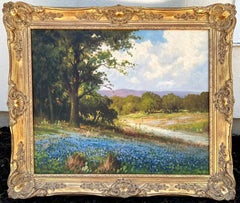
"Bluebonnets Texas Hill Country"
Located in San Antonio, TX
Robert Wood (G. Day)
(1889 -1979)
San Antonio Artist
Image Size: 20 x 24
Frame Size: 29 x 33
Medium: Oil
Signed Lower left
"Bluebonnet"
Biography
Robert Wood (G. Day) (1889 -1979)
A painter of realistic landscapes reflecting a vanishing wilderness in America, Robert Wood (not to be confused with Robert E. Wood) is reportedly one of the most mass-produced artists in the United States. His painting became so popular he was unable to meet all of the demands, and many of his works were reproduced in lithographs and mass distributed as prints, place mats, and wall murals by companies including Sears, Roebuck. He was born in Sandgate, Kent on the south coast of England near Dover, the son of W.L. Wood, a famous home and church painter who recognized and supported his son's talent. In fact, he forced his son to paint by keeping him inside to paint rather than playing with his friends. At age 12, Wood entered the South Kensington School of Art. As a youth, he came to the United States in 1910, having served in the Royal Army, and he never returned to England. He traveled extensively all over the United States, especially in the West, often in freight cars, and also painted in Mexico and Canada. His itinerant existence took him to Illinois where he worked as a farmhand, to Pensacola, Florida where he married, briefly in Ohio, Seattle, Washington, and Portland, Oregon. In 1912, he was in Los Angeles, and in the late 1920s and early 1930s, in San Antonio, Texas, where he lived and in 1928 exhibited in the "Texas Wildflower Competition." From San Antonio, he gained a national reputation for his strong colored, dramatic paintings. Some of that prestige has been credited to his association with Jose Arpa, prominent Texas artist. Wood also gave art lessons, and one of his students was Porfirio Salinas. During this period, Wood sometimes signed his paintings G. Day or Trebor, which is Robert spelled backwards. In 1941 he went to California and painted numerous desert and mountain landscapes and coastal scenes. He lived in Carmel for seven years, and then moved to Woodstock, New York, but he soon returned to California, settling first in Laguna Beach, then San Diego, and finally in the High Sierras, where he and his wife built a home and studio near Bishop and lived until his death in 1979. Robert Wood was born March 4, 1889, in Sandgate, England, a small town on the Kentish coast not far from the white cliffs of Dover. His father, W. J. Wood, was a successful painter who recognized Robert's unusual talent. At the age of twelve, his father enrolled Wood in art school in the small town of Folkstone. He then attended the South Kensington School of Art. While attending art school, Wood won four first awards and three second awards, one each year, a record. In 1910 after service in the Royal Army, nineteen-year-old Wood and his friend, Claude Waters, immigrated to America. Initially, he settled in Illinois and worked as a hired hand on a farm belonging to Water's uncle. He would then strike out on his own, living the life of an itinerant painter. Wood traveled as a hobo, hopping freight trains and selling or bartering small paintings to support him along the way. When times were hard, he worked at whatever job was available. In this manner, he saw most of the United States and fell in love with rural America. By 1912, Wood visited Los Angeles for the first time, arriving on the day of the Titanic tragedy. Later that year, he had met, courted and married young Eyssel Del Wagoner in Florida. The couple moved to Ohio where a daughter, Florence, was born. During World War I, the family moved to Seattle where a son, John Robert Wood, was born in 1919. In the early 1920's, the young Wood family was almost constantly on the move. They stayed for short periods in Kansas, Missouri, California and for a longer time in Portland, Oregon, where Wood's friend Claude Waters had settled. Wood's seemingly endless wanderings disrupted his family life and delayed his development as a painter. However, through his travels he developed an appreciation for the American landscape that would inspire him for the rest of his career. Although aware of the current movement away from traditional realism in American art, he elected to travel that solitary path and remain true to his own vision of American’s grandeur and beauty poetically translated through his landscape and seascape paintings. In 1923, the Wood family discovered the beautiful city of San Antonio, Texas and it was there that he and his family would finally settle. He studied briefly at the San Antonio Art School with Spanish colorist Jose Arpa y Perea (1860-1952), who had arrived in San Antonio that same year. In the latter part of the 1920’s, Jose Arpa’s influence quickly became evident. Wood after several years of experimentation was becoming fine easel painter, capable of great subtlety with a new mature original style. Like Texas painters Robert Onderdonk (1853-1917) and his son Julian Onderdonk (1882-1922), Robert Wood concentrated on the distinctive Texas landscape with its Red Oak trees and wildflowers that covered the hill country landscape. He developed a reputation for his scenes of Blue Bluebonnets, the state flower. In the spring, the Texas prairie is covered with wildflowers, especially in the hill country surrounding San Antonio and Austin. Wood incorporated native stone barns and rough wood farmhouses that added authenticity and romance to his compositions. In 1925, Wood was divorced from his wife. In 1932, he moved to the famous scenic loop on San Antonio's outskirts. While still living in Texas, he took extensive western sketching trips that brought him to California. It is evident that his 1930’s California...
Category
1950s Impressionist Landscape Paintings
Materials
Oil
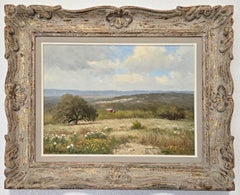
"RED BARN RANCH" 1959 TEXAS HILL COUNTRY LANDSCAPE WILDFLOWERS PORFIRIO SALINAS
By Porfirio Salinas
Located in San Antonio, TX
Porfirio Salinas
(1910-1973)
San Antonio Artist
Image Size: 12 x 16
Frame Size: 19 x 23 Hand Carved "Melvin" Frame
Medium: Oil on Canvas Signed Lower Left
1959
"Red Barn Ranch" Texa...
Category
1950s Impressionist Landscape Paintings
Materials
Oil
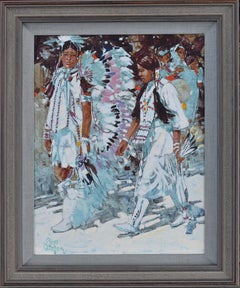
"INDIAN MAIDENS" NATIVE AMERICAN ARIZONA ARTIST
Located in San Antonio, TX
Ross Stefan
(1934-1999)
Arizona / Wisconsin Artist
Image Size: 16 x 12
Frame Size: 19 3/4 x 15 3/4
Medium: Oil on Canvas
"Indian Maidens"
Biography
Ross St...
Category
20th Century Impressionist Figurative Paintings
Materials
Oil
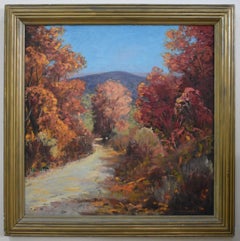
"LOST MAPLES TEXAS"
Located in San Antonio, TX
Carl Hoppe
1897-1981
San Antonio Artist
Image Size: 28 x 28
Frame Size: 33.5 x 33.5
Medium: Oil on canvas
Signed Lower Right
"Lost Maples" Texas
Biography
Carl Hoppe 1897-1981
Carl Thomas Hoppe, born 22 August 1897 in San Antonio, TX, son of German immigrants August and Teresa Hoppe, died 15 January 1981 in San Antonio at age 83 [San Antonio Express-News, 16 January 1981]. A resident of the Alamo Heights district, his primary employment was salesman at Joske's Department Store in San Antonio [San Antonio City Directory]. In the 1920s, he married Frances Rose, but they apparently had no surviving children.
He was active as an artist in the mid 1900s through at least the 1960s. He is best known for landscapes in an impressionistic style. He signed his works with a simple "C. Hoppe" and sometimes included a brief descriptive phrase on the back of the painting or in pen & ink on a paper label with an inscription about the painting or the person to whom it was presented.
Some of his original frames appear to be home-crafted. He is reported to have studied under several more-notable Texas artists who worked in the San Antonio area, including Porfirio Salinas, Robert Wood, Jose Arpa, and Julian Onderdonk.
Upon opening an exhibit of his works at the Panhandle-Plains Historical Museum in Canyon, Texas in 1997, the museum curator stated "Hoppe's high place in the Hill Country art...
Category
1950s American Impressionist Landscape Paintings
Materials
Oil
Still Thinking About These?
All Recently ViewedMore Ways To Browse
Vintage Crow Art
Mountain Stream Painting
Michael West
Western Horse Painting
American Indian Artists
American Indian Bronze
Western Horse Oil Painting
Texas Ranger
Western Mountain Art
Bronze Cowboy
Harvey Johnson
Joe Beeler
Bettina Steinke
George Phippen
Ray Swanson
Herb Mignery
19th Century Paris Paintings
Bruges Painting