Want more images or videos?
Request additional images or videos from the seller
1 of 10
Patricia Waldrip-Taylor"Meadow Oak" Modern Bright Abstract Landscape Painting
Price:$1,710
$1,800List Price
About the Item
- Creator:Patricia Waldrip-Taylor (1940)
- Dimensions:Height: 47 in (119.38 cm)Width: 53.5 in (135.89 cm)Depth: 1.75 in (4.45 cm)
- Medium:
- Movement Style:
- Period:
- Condition:
- Gallery Location:Houston, TX
- Reference Number:Seller: CA105.2020.0729.21331stDibs: LU55136539322
About the Seller
5.0
Gold Seller
Premium sellers maintaining a 4.3+ rating and 24-hour response times
Established in 1969
1stDibs seller since 2014
888 sales on 1stDibs
Typical response time: 11 hours
Authenticity Guarantee
In the unlikely event there’s an issue with an item’s authenticity, contact us within 1 year for a full refund. DetailsMoney-Back Guarantee
If your item is not as described, is damaged in transit, or does not arrive, contact us within 7 days for a full refund. Details24-Hour Cancellation
You have a 24-hour grace period in which to reconsider your purchase, with no questions asked.Vetted Professional Sellers
Our world-class sellers must adhere to strict standards for service and quality, maintaining the integrity of our listings.Price-Match Guarantee
If you find that a seller listed the same item for a lower price elsewhere, we’ll match it.Trusted Global Delivery
Our best-in-class carrier network provides specialized shipping options worldwide, including custom delivery.You May Also Like
Doledrum ( Industrial Environmental Pollution
Located in Miami, FL
Out of many come one. A huge back mountain is formed out of scores of gas spewing smokestacks. The foreboding back mass fills most of the pictorial area. As one gets closer to the canvas, the complexity of the mass if revealed in low on contrast as we see the diverse variety of the stacks with accompanying petrochemical architecture. Above the stacks, plums of air pollutants like sulfur dioxide and nitrogen oxides rise gracefully into the atmosphere. The artist focuses less on the by-product of the stacks and more on his giant pollution machine that he has so astutely rendered. The work is mostly monochromatic but the artist has indicted a red tonality of a sunset/sunrise that offsets the charcoal blacks and grays.
______________________________________________
Submitted by Tamarind Institute
Ian Davis...
Category
Early 2000s American Modern Landscape Paintings
Materials
Canvas, Acrylic
Abstracted Landscape in Acrylic on Wrapped Canvas
By Ilana Ingber
Located in Soquel, CA
Abstracted Landscape in Acrylic on Wrapped Canvas
Vibrant landscape by Ilana Ingber (American, b. 1984). A golden field stretches out towards the horizon, where silhouettes of trees...
Category
2010s American Modern Abstract Paintings
Materials
Canvas, Acrylic, Stretcher Bars
Coral Reef Original Abstracted Composition
Located in Soquel, CA
Original Abstracted Composition of Coral Reef by Dave Francis
Unique and vivid abstracted composition of coral reef by California artist Charles "Dave" Francis (American, 1951-2018)...
Category
Late 20th Century American Modern Abstract Paintings
Materials
Paper, Acrylic, Laid Paper
$1,200
H 24 in W 30 in D 0.25 in
Cosmos and Tree Original Abstracted Composition
Located in Soquel, CA
The Cosmos and Tree - Original Abstracted Composition by Dave Francis
Unique and thought-provoking abstracted composition with cosmos and oak tree by California artist Charles "Dave...
Category
Late 20th Century American Modern Abstract Paintings
Materials
Acrylic, Laid Paper, Paper
$1,200
H 30 in W 24 in D 0.25 in
Shanty Town
By Robert Noel Blair
Located in Buffalo, NY
You are viewing a modernist American acrylic painting depicting a charming but rundown seaside town at night.
Robert Noel Blair (American, 1912-2003) was an American artist, paint...
Category
1950s American Modern Landscape Paintings
Materials
Acrylic, Archival Paper
Untitled from the Westwood Paintings
By William Tillyer
Located in London, GB
William Tillyer
Untitled (The Westwood Paintings)
1989
Acrylic on canvas
61 x 71.1 cms (24 x 28 ins)
WT9778
Category
1980s American Modern Abstract Paintings
Materials
Acrylic
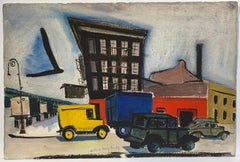
North on West Street (West Side Highway NYC Cityscape)
By De Hirsch Margules
Located in Wilton Manors, FL
De Hirsh Margules (1899-1965). North on West Street , 1939. Watercolor on Arches wove paper. Signed and dated in pencil by artist lower margin. Sheet measures 15 x 22 inches. Framed measurement: 27 x 34 inched. Incredibly vibrant and saturated color with no fading or toning of sheet.
Provenance: Babcock Galleries, NYC
De Hirsh Margules (1899–1965) was a Romanian-American "abstract realist" painter who crossed paths with many major American artistic and intellectual figures of the first half of the 20th century. Elaine de Kooning said that he was "[w]idely recognized as one of the most gifted and erudite watercolorists in the country". The New York Times critic Howard Devree stated in 1938 that "Margules uses color in a breath-taking manner. A keen observer, he eliminates scrupulously without distortion of his material." Devree later called Margules "one of our most daring experimentalists in the medium"
Margules was also a well-known participant in the bohemian culture of New York City's Greenwich Village, where he was widely known as the "Baron" of Greenwich Village.[1] The New York Times described him as "one of Greenwich Village's best-known personalities" and "one of the best known and most buoyant characters about Greenwich Village.
Early Life
De Hirsh Margules was born in 1899 in the Romanian city of Iași (also known as Iasse, Jassy, or Jasse). When Margules was 10 weeks old, his family immigrated to New York City. Both of his parents were active in the Yiddish theater, His father was Yekutiel "Edward" Margules, a "renowned Jewish actor-impresario and founder of the Yiddish stage." Margules' mother, Rosa, thirty-nine years younger than his father, was an actress in the Yiddish theater and later in vaudeville. Although Margules appeared as a child actor with the Adler Family[11] and Bertha Kalich, his sister, Annette Margules, somewhat dubiously continued in family theater and vaudeville tradition, creating the blackface role of the lightly-clad Tondelayo (a part later played on film Hedy Lamarr) in Earl Carroll's 1924 Broadway exoticist hit, White Cargo. Annette herself faced stereotyping as an exotic flower: writing about her publicist Charles Bouchert stated that "Romania produces a stormy, temperamental type of woman---a type admirably fitted to portray emotion." His brother Samuel became a noted magician who appeared under the name "Rami-Sami." Samuel later became a lawyer, representing magician Horace Goldin, among others. A family portrait including a young De Hirsh, a portrait of Rosa and Annette together, and individual photos of Rosa and Edward can be found on the Museum of the City of New York website.
At around age 9 or 10, Margules took art classes with the Boys Club on East Tenth Street, and his first taste of exhibition was at a student art show presented by the club. By age 11, he had won a city-wide prize (a box camera) at a children's art show presented by the department store Wanamakers.
As a young teenager, Margules was already displaying a characteristic kindness and loyalty. Upon hearing that two friends (one of them was author Alexander King), were in trouble for breaking a school microscope, the nearly broke Margules gave them five dollars to repair the microscope . Margules had to approach a wealthy man that Margules had once saved on the subway from a heart attack. Margules didn't reveal the source of the five dollars to King until twenty-five years later.
In his late teens, Margules studied for a couple of months in Pittsburgh with Edwin Randby, a follower of Western painter Frederic Remington. Thereafter he pursued a two-year course of studies in architecture, design and decoration at the New York Evening School of Art and Design, while working as a clerk during the day at Stern's Department Store. He was encouraged in these artistic pursuits by his neighbor, the painter Benno Greenstein (who later went by the name of Benjamin Benno).
Artistic career
In 1922, Margules began work as a police reporter for the City News Association of New York .Margules then considered himself something of an expert on art, and the painter Myron Lechay is said to have responded to some unsolicited analysis of his work with the remark "Since you seem to know so much about it, why don't you paint yourself?" This led to study with Lechay and a flurry of painting.
Margules' first show was in 1922 at Jane Heap's Little Review Gallery. Thereafter Margules began to participate in shows with a group including Stuart Davis, Jan Matulka, Buckminster Fuller (exhibiting depictions of his "Dymaxion house") in a gallery run by art-lover and restaurateur Romany Marie on the floor above her cafe.
Jane Heap, left, with Mina Loy and Ezra Pound
During the 1920s, Margules traveled outside of the country a number of times. In 1922, with the intent of reaching Bali, he took a job as a "'wiper on a tramp steamer where [he] played nursemaid to the engine." He reached Rotterdam before he turned back. He would return to Rotterdam shortly thereafter.
In 1927, Margules took a lengthy leave of absence from his day job as a police reporter in order to travel to Paris, where he "set up a studio in Montmartre's Place du Tertre, on the top floor of an almost deserted hotel, a shabby establishment, lacking both heat and running water." He studied at the Louvre and traveled to paint landscapes in provincial France and North Africa.
Margules also joined the "Noctambulist" movement and experimented with painting and showing his artwork in low light.Jonathan Cott wrote that:
the painter De Hirsch Margulies sat on the quays of the Seine and painted pictures in the dark. In fact, the first exhibition of these paintings, which could be seen only in a darkened room, took place in [ Walter Lowenfels'] Paris apartment.
Elaine de Kooning remarked that studying the works of the Noctambulists confirmed Margules' "direction toward the use of primary colors for perverse effects of heavy shadow."
It was also in Paris that Margules initially conceived his idea of "Time Painting", where a painting is divided into sectors, each representing a different time of day, with color choices meant to evoke that time of day.
In Paris, his social circle included Lowenfels, photographer Berenice Abbott, publisher Jane Heap, composer George Anthiel, sculptor Thelma Wood, painter André Favory, writer Norman Douglas, writer and editor George Davis, composer and writer Max Ewing, and writer Michael Fraenkel.
Upon his return to New York in 1929, Margules attended an exhibition of John Marin's paintings.
While at the exhibition, he "launched into an eloquent explanation of Marin to two nearby women", and was overheard by an impressed Alfred Stieglitz. The famous photographer and art promoter invited Margules to dine with his wife, the artist Georgia O'Keeffe, and his assistant, painter Emil Zoler. Stieglitz thereafter became a friend and mentor to Margules, becoming for him "what Socrates was to his friends."
Alfred Stieglitz
Stieglitz introduced Margules to John Marin, who quickly became the most important painterly influence upon Margules. Elaine de Kooning later noted that Margules was "indebted to Marin and through Marin to Cézanne for his initial conceptual approach - for his constructions of scenes with no negative elements, for skies that loom with the impact of mountains." Margules himself said that Marin was his "father and ... academy." The admiration was by no means unreciprocated: Marin said that Margules was "an art lover with abounding faith and sincerity, with much intelligence and quick seeing." Stieglitz also introduced Margules to many other artistic and intellectual figures in New York.
With the encouragement of Alfred Stieglitz, Margules in 1936 opened a two-room gallery at 43 West 8th Street called "Another Place." Over the following two years there were fourteen solo exhibitions by Margules and others, and the gallery was well-respected by the press. It was in this gallery that the painter James Lechay, Myron's brother, exhibited his first painting.
In 1936, Margules first saw recognition by major art museums when both the Museum of Modern Art and the Museum of Fine Arts, Boston purchased his works.
In 1942, Margules gave up working as a police reporter, and apparently dedicated himself thereafter solely to an artistic vocation.
"The Baron of Greenwich Village"[edit]
Margules made his mark not only as an artist, but also as an outsized personality known throughout Greenwich Village and beyond.
To local residents, Margules was known as the "Baron", after Baron Maurice de Hirsch, a prominent German Jewish philanthropist. Margules was easily recognizable by the beret he routinely wore over his long hair. Writer Charles Norman said that he "dressed with a flair for sloppiness."
He was said to "know everybody" in Greenwich Village, to the extent that when the novelist and poet Maxwell Bodenheim was murdered, Margules was the first one the police sought to identify the body. Margules' letters show him interacting with art world figures such as Sacha Kolin, John Marin and Alfred Stieglitz, as well as with prominent figures outside the art world such as polymath Buckminster Fuller and writer Henry Miller.
Most of his friends and acquaintances found Margules a generous and voluble man, given to broadly emotionally expressive gestures and acts of kindness and loyalty. In 1929, he exhibited an example of this loyalty and fellow-feeling when he appeared in court to fight what the wrongful commitment of his friend, writer and sculptor Alfred Dreyfuss, who appeared to have been a victim of an illicit attempt to block an inheritance.
The Greenwich Village chronicler Charles Norman described the bone-crushing hugs that Margules would routinely bestow on his friends and acquaintances, and speaks of the "persuasive theatricality" that Margules seemed to have inherited from his actor parents. Norman also wrote about Margules' routine acts of kindness, taking in homeless artists, constantly feeding his friends and providing the salvatory loan where needed. Norman also notes that Margules was blessed with a loud and good voice, and was apt to sing an operatic air without provocation.
The writer and television personality Alexander King said
I think the outstanding characteristics of my friend's personality are affirmation, emphasis, and overemphasis. He chooses to express himself predominantly in superlatives and the gestures which accompany his utterances are sometimes dangerous to life and limb. Of the bystanders, I mean.
King also spoke with affectionate amusement about Margules' pride in his cooking, speaking of how "if he should ever invite you to dinner, he may serve you a hamburger with onions, in his kitchen-living room, with such an air of gastronomic protocol, such mysterious hints and ogliing innuendoes, as if César Ritz and Brillat-Savarin had sneaked out, only a moment before, with his secret recipe in their pockets."
Margules was such a memorable New York personality that comic book writer Alvin Schwartz imagined him at the Sixth Avenue Cafeteria in a risible yet poignant debate with Clark Kent about whether Superman had the ability to stop Hitler.
Margules' entrenchment in the Greenwich Village milieu can be seen in a photograph from Fred McDarrah's "Beat Generation Album" of a January 13, 1961 writers' and poets' meeting to discuss "The Funeral of the Beat Generation", in Robert Cordier [fr]'s railroad flat at 85 Christopher Street. Among the people in the same photograph are Shel Silverstein...
Category
1930s American Modern Abstract Paintings
Materials
Watercolor, Rag Paper
$3,750 Sale Price
50% Off
H 15 in W 22 in
Large Hudson River Figurative Modernist Landscape Oil Painting Edward Avedisian
By Edward Avedisian
Located in Surfside, FL
Edward Avedisian ( 1936-2007 )
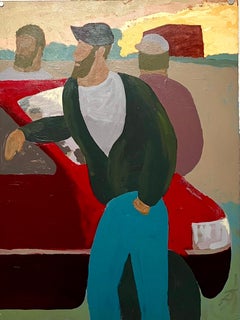
Gouache or oil on paper, 3 guys around a car,
hand signed in paint lower left,
Measures 30"x 22.5"
Edward Avedisian (June 15, 1936, Lowell, Massac...
Category
20th Century American Modern Landscape Paintings
Materials
Oil, Gouache, Archival Paper
Mid Century Palace of Fine Arts, San Francisco Landscape
Located in Soquel, CA
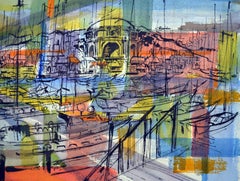
Palace of Fine Arts, San Francisco by Garrett Price (American, 1896-1979). Signed "Garrett" lower right. Unframed. Image size, 11.75"H x 15.25"W. G...
Category
1950s American Modern Abstract Paintings
Materials
Paper, Watercolor
1955 View of Ajax Mountain in Aspen, Colorado by Artist Harold Haydon
By Harold Haydon
Located in Chicago, IL
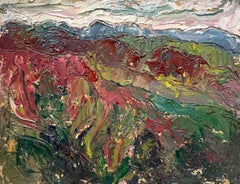
A small, vibrant 1950s Mid-Century Modern mountain landscape painting depicting Aspen, Colorado by famed Chicago artist Harold Haydon. Titled "Western Vi...
Category
1950s American Modern Landscape Paintings
Materials
Oil, Board
$850
H 10.75 in W 11.75 in
More From This Seller
View All"Promises Kept" Large Blue Tonal Surrealist Painting
By David True
Located in Houston, TX
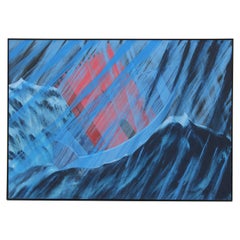
Large-scale blue abstract painting of a stormy seascape. This painting features mainly deep blue tones and a coral colored castle. Framed in a black floating frame. Signed by the art...
Category
Late 20th Century Modern Abstract Paintings
Materials
Acrylic
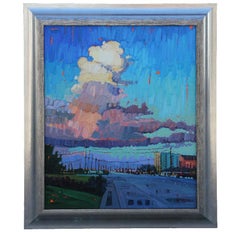
"High Clouds" Impressionist Style Landscape Painting
By Rene Wiley-Janota
Located in Houston, TX
Impressionistic style landscape painting of a street in Galveston, Texas. The painting is framed in a silver frame. The artist signed the work in the bottom corner.
Dimensions without Frame: H 20in x W 16in.
Artist Biography: René Wiley...
Category
21st Century and Contemporary Modern Landscape Paintings
Materials
Acrylic
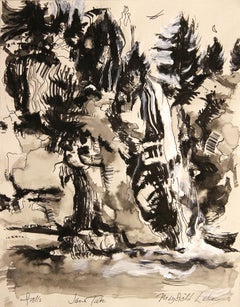
“Falls: Mayfield Lake” Black, White,
Gray Modern Abstract Waterfall Landscape
Located in Houston, TX
Modern abstract black, white, and gray landscape painting by American artist Jane Tate. The work features a central waterfall cascading down to the pools bel...
Category
Early 2000s Modern Landscape Paintings
Materials
Acrylic, Ink, Watercolor
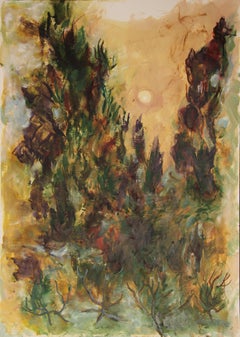
Modern Abstract Green and Purple Wild Brush Landscape Painting of Sun and Trees
Located in Houston, TX
Modern abstract green and purple toned landscape painting by American artist Jane Tate. The work features a wild grove of trees and brush with the sun framed...
Category
Early 2000s Modern Landscape Paintings
Materials
Acrylic
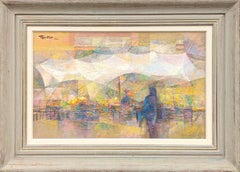
"Market Tents" Modern Abstract Pastel Toned Cubist Style Street Scene
By Romeo Tabuena
Located in Houston, TX
Modern abstract pastel toned street scene by Philippine-born artist Romeo Tabuena. The work features a street scene with shadow figures browsing under a white tarp. Signed and dated in the front upper left corner. Currently hung in a grey toned frame.
Dimensions Without Frame: H 19.75 in. x W 31.75 in.
Artist Biography: Romeo Tabuena is a Philippine-born painter rooted in Eastern sensibility. He has been a resident of Mexico for more than four decades.
Born in Lloilo in 1921, he studied architecture at the Mapua Institute of Technology and a fine arts course, majoring in painting, at the University of the Philippines. He also studied at the Art Students League in New York and at the Academie de la Grande Chaumiere in Paris.
Tabuena decided to settle in Mexico and to make it the base of his painting career. But he has maintained links with his native country through participation in its major art projects, and despite his long residence in Mexico, he has retained his Philippine citizenship.
One of his major works since 1957 is a government-commissioned mural, Filipiniana, at the Philippine Embassy in Washington D.C. His other exhibits include a ten-year retrospective show in 1959 at the Philippine Art Gallery in Manila. In 1962, his successful one-man show, which was sponsored by the Philippine Government at the International Salon of the Palace of Fine Arts in Mexico City, "further elevated the status of Philippine painting...
Category
1970s Modern Abstract Paintings
Materials
Acrylic, Board
$8,000 Sale Price
33% Off
"The Red Dome with Tan Border" Modern Abstract Cubist Inspired City Landscape
Located in Houston, TX
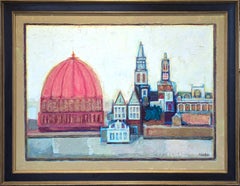
Modern city landscape painting by the iconic Houston based artist David Adickes. The work features the titular red domed building set against a variety of other European style buildi...
Category
2010s Modern Landscape Paintings
Materials
Acrylic
Still Thinking About These?
All Recently ViewedMore Ways To Browse
Taylor Vintage Landscape
William Steeple Davis
Wyoming Landscape Paintings
18 Th Century Oil On Canvas
Albert Van Nesse Greene
Alberta Painting
Anna Hills
Antique Paintings Australia
Bright Colors Landscape Paintings
California Desert Painting
Calle Paint
Canaletto Oil
Carmel Valley Painting
Charles Brooking
Circa 1915 Paintings
Coopers Beach
Donegal Oil Painting
Dutch Marine Paintings