1740s Landscape Paintings
to
1
2
Overall Width
to
Overall Height
to
584
3,097
17,852
27,954
365
371
582
670
731
935
987
1,096
1,033
954
317
2
2
2
2
2
2
1
1
2
2
Period: 1740s
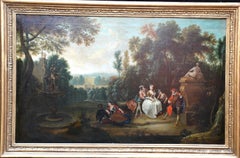
Fete Champetre - Garden Party - French 18thC figurative landscape oil painting
Located in Hagley, England
This charming 18th century French Old Master oil painting is attributed to circle of Joseph Frans Nollekens. Painted circa 1740 it is described as a fete champetre - a form of entertainment in the 18th century, taking the form of a garden party. They were often elegant affairs and became very popular in 18th French paintings. Antoine Watteau invented the genre, from around 1710 and they were also included as a category in the French Academy. In this painting, several well dressed figures are sat in the foreground by a fountain and statue, being entertained by a musician. Beyond, a wide avenue of trees leads towards a very grand country house with countryside beyond. There is superb detail in the figures and their colourful clothing. The brushwork in the trees and sky is also superb. This is a charming example of an 18th century fete champetre and of a French Old Master oil painting.
Provenance. Gloucester estate.
Condition. Oil on canvas. Image size 49 inches by 30 inches and in good condition.
Frame. Housed in a fine gilt frame, 56 inches by 37 inches and in good condition.
Josef Frans Nollekens or Joseph Frans Nollekens (1702–1748)[2] was a Flemish painter who was principally active in England where he is often referred to as "Old Nollekens" to distinguish him from his famous son, the sculptor Joseph Nollekens. He painted conversation pieces, galant companies and fêtes champêtres in the style of Watteau, genre scenes as well as portraits. He was also active as a picture restorer.
A fête champêtre was a form of entertainment in the 18th century, taking the form of a garden party. This form of entertainment was particularly practised by the French court, where in the Gardens of Versailles and elsewhere areas of the park were landscaped with follies, pavilions, and temples to accommodate such festivities. The term is a French expression, very literally translating as "party in the fields", meaning a "pastoral festival" or "country feast" and in theory was a simple form of entertainment, perhaps little more than a picnic or informal open air dancing. In practice, especially in the 18th century, the simplicity of the event was often contrived. A fête champêtre was often a very elegant form of entertainment involving on occasions whole orchestras hidden in trees, with guests sometimes in fancy dress. Such events became a popular subject in French 18th-century painting, representing a glamourized aristocratic form of pastoral, with "scenes of well dressed dalliance in a park setting". Antoine Watteau invented the genre, from around 1710, and is its best exponent, imitated by others such as Nicolas Lancret and Jean-Baptiste Pater...
Category
Old Masters 1740s Landscape Paintings
Materials
Oil

$17,547 Sale Price
20% Off
Mercury and Io, a rediscovered painting by Jean-Baptiste Marie Pierre (ca. 1740)
Located in PARIS, FR
We would like to thank Mr. Nicolas Lesur for confirming the autograph nature of the entire composition after a direct examination of the painting on November 27, 2024.
This painting...
Category
Old Masters 1740s Landscape Paintings
Materials
Canvas, Oil

Related Items
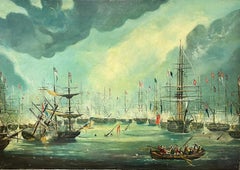
Naval Battle Engagement at Sea Large Busy Battle Scene Many Ships, Signed Oil
Located in Cirencester, Gloucestershire
English School, early 20th century
signed
oil painting on canvas, unframed
canvas: 17 x 24 inches
provenance: private collection, Eng;and
condition: good and sound condition, minor ...
Category
Old Masters 1740s Landscape Paintings
Materials
Oil, Canvas
$1,535 Sale Price
20% Off
H 17 in W 24 in
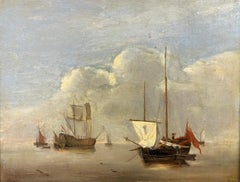
Shipping in Calm Waters, 18th Century Dutch Oil on Wood Panel, Man o War
Located in Cirencester, Gloucestershire
Shipping in Calm Waters
Dutch School, 18th century
oil painting on wood panel
panel: 10 x 12.75 inches
framed: 14 x 17 inches
condition: very good, minor evidenc...
Category
Old Masters 1740s Landscape Paintings
Materials
Oil, Wood Panel
$2,412 Sale Price
20% Off
H 14 in W 17 in D 1 in
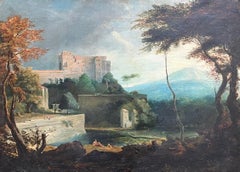
Antique English Grand Tour Old Master Oil Figures Classical Arcadian Landscape
Located in Cirencester, Gloucestershire
Classical Landscape
English School, early 19th century, unsigned
oil on canvas, unframed
canvas : 19 x 27 inches
Provenance: private collection, UK
Condition: The painting is in very...
Category
Old Masters 1740s Landscape Paintings
Materials
Canvas, Oil
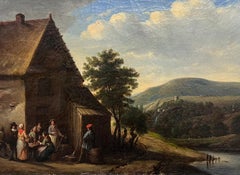
Figures Chatting outside Village Tavern in Mountain Landscape, Period Oil
By 19th century Dutch or Flemish school
Located in Cirencester, Gloucestershire
Dutch/ Flemish School, early 1800's
oil on canvas, framed
framed: 19 x 24 inches
canvas: 13.5 x 18.5 inches
provenance: private collection, France
condition: good and sound condition...
Category
Old Masters 1740s Landscape Paintings
Materials
Oil, Canvas
$1,420 Sale Price
20% Off
H 19 in W 24 in
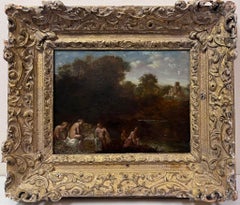
Fine 17th Century Dutch Old Master Oil Bathers by Wooden Pool Carved Wood Frame
Located in Cirencester, Gloucestershire
Bathers by the Woodland Pool
Dutch School, 17th century
circle of Cornelis van Poelenburgh (1594-1667)
oil on copper, framed
framed: 13 x 15 i...
Category
Old Masters 1740s Landscape Paintings
Materials
Oil
$4,112 Sale Price
20% Off
H 13 in W 15 in
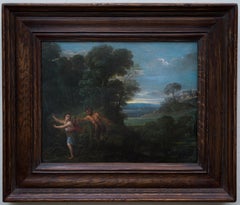
Landscape With Pan and Syrinx, Flemish School From the 1600s, Oil on Copper
Located in Stockholm, SE
Flemish School, 1600s
Landscape With Pan and Syrinx
painted around the 1600s
oil on copper
19 x 23.5 cm
frame 29 x 34 cm
Hand-made oak frame by Swedish frame maker Christer Björkma...
Category
Old Masters 1740s Landscape Paintings
Materials
Copper
$5,344
H 11.42 in W 13.39 in
Early 1800
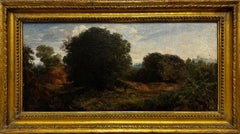
s English Oil Painting Figure in Rural Woodland Landscape, original
By circle of John Constable
Located in Cirencester, Gloucestershire
Artist: English School, early 1800's, circle of John Constable (British 1776-1837)
Title: The Woodland Path
Medium: oil on canvas, framed, unsigned
Size: 12 x 22 inches
Picture: 9 x 18 inches
Provence: from a private collection in East Anglia...
Category
Old Masters 1740s Landscape Paintings
Materials
Canvas, Oil
$3,728 Sale Price
20% Off
H 12 in W 22 in D 1 in
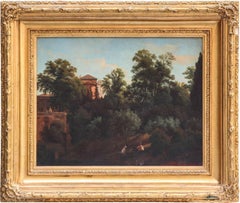
19th Century Roman Landscape oil on canvas with Giltwood Frame
Located in Rome, IT
Amaizing 19' century Roman landscape depicting a part of Villa Borghese with Trinità dei Monti.
With a finely carved gilt wood coeval frame.
Measurements with frame cm 65 x78 wit...
Category
Old Masters 1740s Landscape Paintings
Materials
Oil
$5,344
H 25.6 in W 30.71 in D 1.97 in
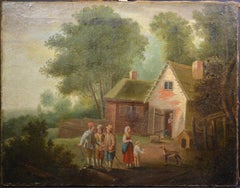
1790 Antique Oil Painting Dutch Style Village Genrе Scene Djurgarden Sweden
Located in Stockholm, SE
This rare 1790 oil painting depicts a village landscape in the Old Masters genre tradition. The composition shows peasants gathered near a cottage su...
Category
Old Masters 1740s Landscape Paintings
Materials
Canvas, Wood, Oil
$630
H 20.6 in W 26.7 in D 0.5 in
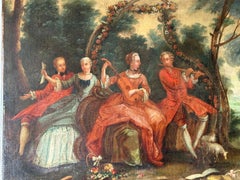
18th century French Garden or Féte a Bride and musicians playing music
Located in Woodbury, CT
This enchanting 18th-century French fête galante captures the elegance and joy of aristocratic leisure, set amidst a lush garden adorned with flowers. A scene of refined celebration,...
Category
Old Masters 1740s Landscape Paintings
Materials
Canvas, Oil
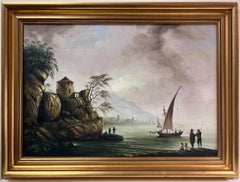
Fishing at Dawn Old Trading Port with Many Figures Large Oil Painting
Located in Cirencester, Gloucestershire
Fishing at Dawn
English artist after an earlier work (see inscription verso)
signed oil painting on canvas, framed
inscribed verso
framed: 23 x 31 inches
canvas: 18 x 26inches
proven...
Category
Old Masters 1740s Landscape Paintings
Materials
Canvas, Oil
$1,974 Sale Price
20% Off
H 23 in W 31 in
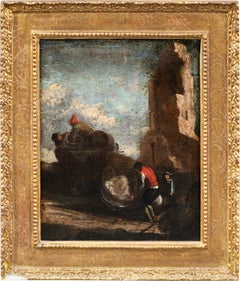
Antique Roman painter - 18th century landscape painting - Wanderers - Italy
Located in Varmo, IT
Roman painter (18th century) - Landscape with Wayfarers.
43.5 x 34.5 cm unframed, 58.5 x 49.5 cm with frame.
Ancient oil painting on canvas, in a carved and gilded wooden frame (no...
Category
Old Masters 1740s Landscape Paintings
Materials
Canvas, Oil
$1,187 Sale Price
44% Off
H 23.04 in W 19.49 in
Previously Available Items
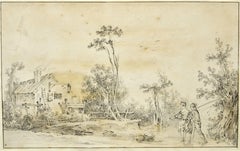
A rural landscape, a drawing partly attributed to Francois Boucher
Located in PARIS, FR
Provenance:
• Bought from Sicart in Lyon by the Marquis de Chennevières (1820 - 1899) - Chennevières Collection (stamped lower left - Lugt 2072)
• Inscribed on the back of the mount "Salle 10/Delestre, 27 February 1899”
• Sold in Paris at the Hôtel Drouot during the second Chennevières sale (4 to 7 April 1900, n°44) as François Boucher - number 44 (sold for 18 francs to Roblin)
• Sold in Paris at the Hôtel Drouot, 4 and 5 March 1901, n°12 as François Boucher
Bibliography: this drawing is cited by Chennevières in "Une collection de dessins d'artistes français" (chapter XVIII, page 24-25) and is number 1033 of the Catalogue de la Collection Chennevières compiled by Louis-Antoine Prat with the collaboration of Laurence Lhinares.
This well-documented drawing was given to Boucher by the Marquis de Chennevières, one of the most important collectors of drawings at the end of the 19th century. While the landscape is reminiscent of Boucher's other landscape drawings, our drawing was probably modified at a later stage by the addition of the two figures in the right foreground and by the slight enhancement of the horizon line behind them.
1. François Boucher, the master of French rocaille
The extraordinary career of Francois Boucher was unmatched by his contemporaries in versatility, consistency, and output. For many, particularly the writers and collectors who led the revival of interest in the French rococo during the last century, his sensuous beauties and plump cupids represent the French eighteenth century at its most typical. His facility with the brush, even when betraying the occasional superficiality of his art, enabled him to master every aspect of painting – history and mythology, portraiture, landscape, ordinary life and, as part of larger compositions, even still life. He had been trained as an engraver, and the skills of a draftsman, which he imbued in the studio of Jean-Francois Cars (1661 – 1738), stood him in good stead throughout his career; his delightful drawings are one of the most sought-after aspects of his oeuvre.
As a student of Francois Lemoyne (1688 - 1737), he mastered the art of composition. The four years he spent in Italy, from 1727-1731, educated him in the works of the masters, classics, and history, that his modest upbringing had denied him.
On his return to Paris in 1734, he gained full membership of the Royal Academy of Painting and Sculpture with his splendid Rinaldo and Armida (Paris, Musée du Louvre). Although, throughout his career, he occasionally painted subjects taken from the Bible, and would always have considered himself first as a history painter, his own repertoire of heroines, seductresses, flirtatious peasant girls and erotic beauties was better suited to a lighter, more decorative subject matter. His mastery of technique and composition enabled him to move from large scale...
Category
Old Masters 1740s Landscape Paintings
Materials
Chalk
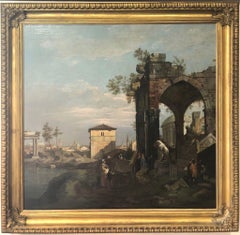
Oil Painting Studio Canaletto: Neoclassical Scene with Architectural Ruins
By Giovanni Antonio Canal (Canaletto)
Located in London, GB
Studio of Giovanni Antonio Canal, called Il CANALETTO (Venice 1697 – 1768)
An Architectural Capriccio with figures amongst ruins
oil on canvas
88 x 92 cm. (34⅝ x 36¼ in.)
Provenan...
Category
Rococo 1740s Landscape Paintings
Materials
Oil
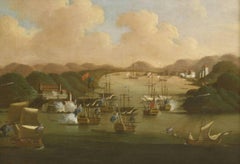
The capture of Porto Bello, 21st November 1739 , large oil painting on canvas
By Studio of Samuel Scott
Located in Cirencester, Gloucestershire
Very fine 18th century oil painting on canvas, depicting the famous 'Capture of Porto Bello', on the 21st November, 1739. The painting itself was painted circa 1740 and is from the studio of Samuel Scott (London 1703-1772 Bath).
Painted with exceptional quality and intricate detailing, capturing not only superb maritime detailing to the ships, but the artist has caught the atmosphere and drama of this important and historical naval engagement.
The capture of Porto Bello (properly Puerto Bello) was part of a campaign known as 'The War of Jenkins' Ear', which was fought against Spain in the West Indian colonies and was in effect an early stage of the War of the Austrian Succession, 1740-48.
When Robert Jenkins, a merchant sea captain, had his ear cut off by a Spanish officer at Havana in 1731 it led to calls in Parliament for war with Spain. During a House of Commons debate in the summer of 1739, Captain Edward Vernon claimed he could take the Spanish town of Porto Bello - a source of Spanish depredation on British shipping on the north side of the Isthmus of Darien between Columbia and Panama - with only six ships of the line. He was promoted to vice-admiral and given the six ships so that he could carry out his promise. These were the 'Burford', Vernon's flagship, and the 'Hampton Court', both of 70 guns; the 'Worcester', 'Strafford' and 'Princess Louisa', all of 60 guns, and the 'Norwich', 50 guns.
Vernon's squadron sighted Porto Bello on the night of 20 November 1739. The main obstacle to overcome was the Iron Castle, or 'Castillo de Ferro', at the northern entrance to the harbour, which they attacked at 2.00 p.m. on 21 November and a ferocious battle ensued. When the enemy fire gradually lessened, Vernon signalled for his manned boats to land beneath the walls of the castle. On the morning of 22 November the Spanish governor, Don Francisco Martinez de Retez, sent a flag of truce and accepted the Vice-Admiral's terms of surrender.
Public money found in the garrison was distributed by Vernon among his men and the fortifications were then demolished. The surrender terms stated that Vernon received shipping and ten thousand dollars from the treasury as well as brass ordnance. He was also successful in demanding from Panama the release of some South Sea Company men who were imprisoned there.
The present composition can be compared with the larger version currently housed in the National Maritime Gallery at Greenwich, London, which is an autograph work by Samuel Scott.
In the representation of the event, with its distorted perspective, draws on the tradition of bird's-eye-view, 17th-century topographical landscape painting. Scott belonged to the first generation of British marine painters, who worked in the tradition of the van de Veldes and the other Dutch artists who came to practice in London from the 1670s. His reputation chiefly rests on his topographical views of London but he was a very good marine painter, who accepted commissions like this and whose artistic and social skills eclipsed - at least in business terms - those of his slightly earlier contemporary Peter Monamy. He was notably averse to travelling by sea himself but produced many small drawings and watercolours to be incorporated later as details into his oils, such as men rowing...
Category
Old Masters 1740s Landscape Paintings
More Ways To Browse
Alfred Bachmann
Alfred Emile Leopold Stevens
Amsterdam Cityscape Paintings
Andre Beauce
Auseklis Ozols
Bardone Oil Paintings
Barge Board
Besse Raymond
Birch Trees Forest Painting
Bolton Abbey
Boothbay Harbor Paintings
Borlase Smart
British Naive Paintings
Bruno Cote
Calderon Landscape
California Beach Scene Art
California Oil Painting 1940s
Campbell Scotland Painting