Video Loading
Want more images or videos?
Request additional images or videos from the seller
1 of 6
Régis François GignouxWatercolor of Natural Bridge, VAc. 1842
c. 1842
$14,000List Price
About the Item
- Creator:Régis François Gignoux (1816-1882, French)
- Creation Year:c. 1842
- Dimensions:Height: 7.13 in (18.12 cm)Width: 5.63 in (14.31 cm)
- Medium:
- Movement Style:
- Period:
- Condition:
- Gallery Location:Fredericksburg, VA
- Reference Number:1stDibs: LU2574213155302
About the Seller
5.0
Vetted Professional Seller
Every seller passes strict standards for authenticity and reliability
Established in 2001
1stDibs seller since 2023
21 sales on 1stDibs
Typical response time: 2 hours
Authenticity Guarantee
In the unlikely event there’s an issue with an item’s authenticity, contact us within 1 year for a full refund. DetailsMoney-Back Guarantee
If your item is not as described, is damaged in transit, or does not arrive, contact us within 7 days for a full refund. Details24-Hour Cancellation
You have a 24-hour grace period in which to reconsider your purchase, with no questions asked.Vetted Professional Sellers
Our world-class sellers must adhere to strict standards for service and quality, maintaining the integrity of our listings.Price-Match Guarantee
If you find that a seller listed the same item for a lower price elsewhere, we’ll match it.Trusted Global Delivery
Our best-in-class carrier network provides specialized shipping options worldwide, including custom delivery.You May Also Like
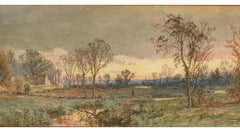
Twilight on the Sawmill River
By Jasper Francis Cropsey
Located in New York, NY
Signed and dated lower right: J.F. Cropsey 1887
Category
19th Century Hudson River School Landscape Paintings
Materials
Paper, Watercolor
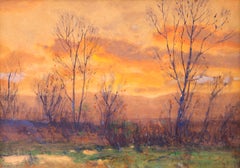
Sunset Along the Front Range, Colorado, 1900s Traditional Landscape Painting
By Charles Partridge Adams
Located in Denver, CO
This stunning, original signed landscape watercolor on paper painting by Charles Partridge Adams (1858-1942) captures the breathtaking beauty of a Colorado sunset along the Front Ran...
Category
Early 20th Century Hudson River School Landscape Drawings and Watercolors
Materials
Watercolor
$4,500
H 14.5 in W 17.5 in D 0.75 in
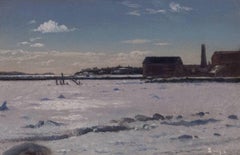
Fairhaven Harbor (Old Tack Works Wharf)
By William Bradford
Located in New York, NY
Signed lower right: Bradford
Category
19th Century Hudson River School Landscape Paintings
Materials
Paper, Oil, Board
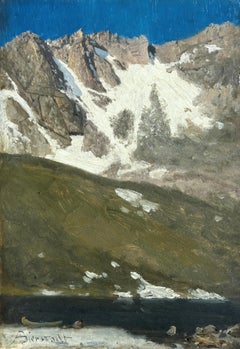
"Mt. Rosalie, Colorado" Albert Bierstadt, Western American Mountain Landscape
By Albert Bierstadt, 1830-1902
Located in New York, NY
Albert Bierstadt
Mt. Rosalie, Colorado, circa 1863
Signed lower left: ABierstadt; inscribed on verso: Mt. Rosalie / Colorado
Oil on paper
13 1/4 x 9 1/2 inches
Provenance
Private Co...
Category
1860s Hudson River School Figurative Paintings
Materials
Paper, Oil
Early 20th Century Plein Air Study for Homesteader Colorado Mountain Painting
By Frank Tenney Johnson
Located in Soquel, CA
Robert Azensky Fine Art is pleased to offer original 1909 sketch study of oil painting "Homesteader Colorado Mountain" painting by Frank Tenney Johnson.
It's always special to see the evolution of a painting through the plein air sketches ("studies") by the artist prior to its painting. Frank Tenney Johnson traveled throughout the Colorado Rockies sketching and painting western landscapes and native American and cowboy figurative art.
Medium: Charcoal on paper
Signature: Lower left corner
Date: "1909" below signature
Condition: Tonal aging and minor edge wear consistent with age and use. See images.
Presented in black painted wood frame
Mat size: 14"H x 11"W
Paper size: 9"H x 6"W
Image size (visible with mat): 8"H x 5.25"W
Frank Tenney Johnson was born in Coucil Bluffs, Iowa, in 1874 not far from the Overland Trail. During his childhood, he saw the steady stream of people heading west in all forms of horse-drawn conveyance. This early exposure to the American West was critical in leading Johnson towards the Western landscape as an inspiration for his work. The resulting body of work is a moody and romantic depiction of a long-gone America, rendered in a style that has become practically a genre all its own.
At the age of ten, Johnson moved from Iowa to Milwaukee, WI. There, he took an apprenticeship with F.W. Heinie, a prominent panoramic painter. After a year with Heinie, Johnson apprenticed for Richard Lorenz, a painter and former Texas Ranger who specialized in depictions of horses and western scenes. It was probably during his time with Lorenz that Johnson decided to focus on western subjects himself. He also started illustrating for regional papers and publications, in order to save money for further training.
Further training, as with many of the artists who populated New Mexico in the early twentieth century, took place at the Art Students League in New York, where Robert Henri, William Merritt Chase, John Twachtman, Kenneth Hayes Miller and F. Louis Mora were in the process of teaching perhaps the last great batch of pre-modernists. Though highly stimulated by the training, Johnson was only able to stay for five months, after which he returned to Milwaukee to work and save money in an effort to return to New York. He was able to do so after a time and, upon returning, established an important professional relationship with Emerson Hough, the editor of "Field & Stream" magazine.
At Hough's urging (and on Hough's dime), Johnson traveled to Hayden, Colorado, where he tagged along with a group of cowpunchers in order to sketch their way of life. Though primarily an artist, Johnson also wrote accounts of his time in Colorado for "Field & Stream." After Colorado came Cheyenne, Wyoming, where Johnson attended a "Frontier Days" celebration; after Wyoming, Johnson traveled to New Mexico, where he observed the Navajos and their threatened way of life. This trip changed Johnson from an academic artist with an appreciation for the west to a truly western artist.
Of particular interest to him, in stark contrast to other western artists of the time like Frederic Remington and C.M. Russell, were the more quotidian scenes of the West. Specifically, Johnson focused upon scenes featuring horses, especially at night. Johnson painted a great number of pieces that featured horses tied up outside of saloons, inns or trading posts for the night, the moonlit night punctuated by the warm glow from the lamps inside. In this, he can be considered a pioneer, as his night pieces still serve as the archetype for such work in western art.
Johnson became quite successful through his work for "Field & Stream." He was chosen to illustrate books by the prominent writer Zane Grey, and his gallery shows sold briskly. In fact, one particular show, at the Grand Central Art Galleries at the Biltmore Hotel in New York, sold out opening night. In fact, one man had bought out the entire show: Amon Carter. Having achieved financial security and comfort, Johnson followed his good friend Clyde Forsythe to Alhambra, CA, where the two established residency and shared a studio.
California treated Johnson well. He and Forsythe founded the gallery at the Los Angeles Biltmore...
Category
Early 1900s Hudson River School Landscape Paintings
Materials
Oil Crayon, Laid Paper
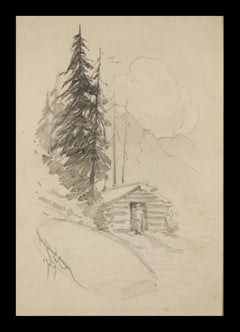
$1,700
H 15 in W 12 in D 0.5 in
New England Sunrise, 1910 by Lockwood DeForest (American, 1850-1932)
Located in New York, NY
"New England Sunrise," 1910 by Hudson River School painter Lockwood DeForest (American, 1850-1932) is oil on artists card-stock and measures 9.75 x 14 inches. The work is signed by DeForest and dated Sept. 17, 1910 at lower left. The work is framed in an elegant, period appropriate frame, and ready to hang.
Lockwood de Forest was born in New York in 1850 to a prominent family. He grew up in Greenwich Village and on Long Island at the family summer estate in Cold Spring Harbor. As was customary for a cultivated family in the Gilded Age, the de Forests made frequent trips abroad. Excursions to the great museums, which were prominent on the de Forests agenda, deepened the young Lockwood's familiarity with European painting and sculpture. Though he had begun drawing and painting somewhat earlier, it was during a visit to Rome in 1868 that nineteen-year-old de Forest first began to study art seriously, taking painting lessons from the Italian landscapist Hermann David Salomon Corrodi (1844–1905). More importantly, on the same trip, Lockwood met one of America’s most celebrated painters, (and his maternal great-
uncle by marriage) Frederic Edwin Church (1826–1900), who quickly became his mentor. DeForest accompanied Church on sketching trips around Italy and continued this practice when they both returned to America in 1869. Early on in his career, de Forest made a habit of recording the date and often the place of his oil sketches, as to create a visual diary of his travels. Lockwood’s profession as a landscape painter can be primarily attributed to Frederic E. Church and his belief in the young artist’s talent.
De Forest often visited Church in the Hudson River community of Catskill where, in addition to sketching trips and afternoons of painting, he assisted with the architectural drawings and planning of Olana. In 1872, de Forest took a studio at the Tenth Street Studio Building in New York. During these formative years de Forest counted among his friend’s artists such as Sanford Robinson Gifford (1823–80), George Henry Yewell (1830–1923), John Frederick Kensett (1816–72), Jervis McEntee (1828–91), and Walter Launt Palmer (1854–1932).
Over the next decade de Forest experienced success as a painter. He exhibited for the first time at the National Academy of Design in 1872, and made two more painting trips abroad, in 1875–76 and 1877–78, traveling to the major continental capitals but also the Middle East and North Africa. His trip to the Middle East and the library at Church’s home, Olana, established his interest in design during his mid-twenties. From about 1878 to 1902, landscape painting was overshadowed by his activities and preoccupation with East Indian architecture and décor, a style that became quite fashionable in late nineteenth century America. From 1879-1883, de Forest founded Associated Artists along with Louis Comfort Tiffany, Candace Wheeler...
Category
Early 20th Century Hudson River School Landscape Paintings
Materials
Oil, Board
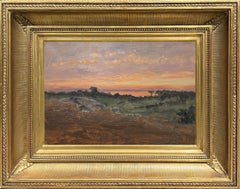
$15,000
H 9.75 in W 14 in
Gordon Setter in a Landscape by Otto Norquist (American: 1859-1906)
Located in New York, NY
Otto Norquist (1859-1906)
"Gordon Setter in a Landscape, 1890"
Oil on canvas
22 x 27 inches
Signed and dated 1890, lower right
Otto Norquist was born in...
Category
Late 19th Century Hudson River School Landscape Paintings
Materials
Oil, Canvas
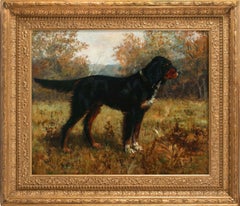
$12,500
H 22 in W 27 in
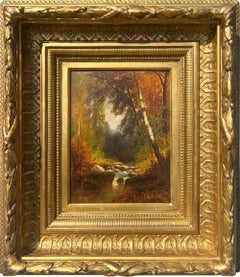
Adirondack Stream by Hudson River artist Joseph Antonio Hekking (1830-1903)
By Joseph Antonio Hekking
Located in New York, NY
Painted by Hudson River School artist Joseph Antonio Hekking (1830-1903), "Adirondack Stream in Fall" is oil on board and measures 8.5 x 6.5 inches. The painting is signed at the low...
Category
19th Century Hudson River School Landscape Paintings
Materials
Oil, Board
Watering the Cows, 1883 by American artist Xanthus Russell Smith (1839-1929)
By Xanthus Russell Smith
Located in New York, NY
Hudson River School artist Xanthus Russell Smith's (1845-1933) "Watering the Cows," is oil on panel, measures 10 x 8 inches, and is signed, titled and dated 1883 on the verso. The wo...
Category
19th Century Hudson River School Landscape Paintings
Materials
Oil, Panel
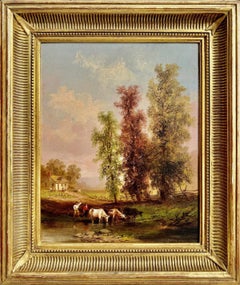
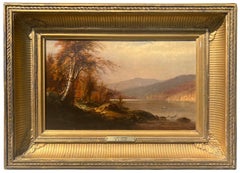
Lake George by Hudson River School artist William Richardson Tyler (1825-1896)
Located in New York, NY
Hudson River School artist William Richardson Tyler's (1825-1896) "Lake George," is oil on canvas and measures 8 x 13 inches. The painting is signed at the lower center and signed an...
Category
19th Century Hudson River School Landscape Paintings
Materials
Canvas, Oil
More From This Seller
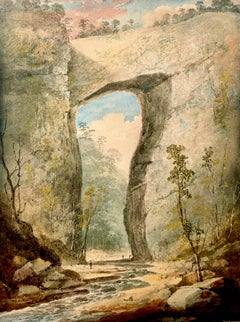
View AllWatercolor Landscape of Natural Bridge, Virginia
By William Guy Wall
Located in Fredericksburg, VA
William Guy Wall, a renowned artist of the early 19th century, is celebrated for his exquisite landscape paintings, and particularly with this watercolor. This painting, titled, "Nat...
Category
Early 19th Century Hudson River School Landscape Paintings
Materials
Paper, Watercolor
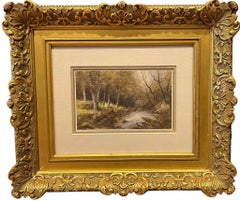
Hudson River School Watercolor Titled Fishing the Creek
By David Johnson
Located in Fredericksburg, VA
David Johnson was born in 1827 in New York City. Beginning in 1845, he studied for two years in the antique school of the National Academy of Design. His classmates and colleagues in...
Category
Late 19th Century Hudson River School Landscape Paintings
Materials
Paper, Watercolor
Oil Water Landscape with Mountains
By Alfred Thompson Bricher
Located in Fredericksburg, VA
Alfred Thompson Bricher, an American artist celebrated for his exquisite marine and landscape paintings, created "Boats Sailing Between Mountains." This piece exemplifies Bricher’s m...
Category
Late 19th Century Hudson River School Landscape Paintings
Materials
Paper, Oil
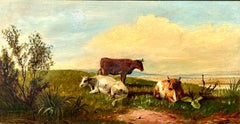
Cows Grazing in Field
By George Wright
Located in Fredericksburg, VA
This serene Hudson River School painting by George Wright captures a peaceful moment of pastoral life, where three cows rest and graze under a wide, luminous sky. The composition gen...
Category
Late 19th Century Hudson River School Landscape Paintings
Materials
Canvas, Oil
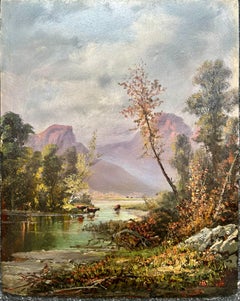
Mountain Stream
By Henry Boese
Located in Fredericksburg, VA
In Mountain Stream, Henry Boese presents a majestic and serene vision of the American wilderness. A crisp, rushing stream flows through the heart of the composition, cascading over r...
Category
Mid-19th Century Hudson River School Landscape Paintings
Materials
Oil, Board
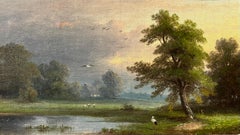
Landscape of Pond and Field After Rain Titled "Cranes After the Rain"
Located in Fredericksburg, VA
This serene landscape by a Hudson River School artist captures the quiet tension between storm and calm, rendered with luminous color and delicate brushwork. A soft sunset glows behi...
Category
Late 19th Century Hudson River School Landscape Paintings
Materials
Oil, Board
Still Thinking About These?
All Recently ViewedMore Ways To Browse
Antique Bridges
Mount Washington
Frederic Church
Meyer Fine Art
Regis Gignoux Painting
H Bayer
Jules Lefebvre
Oil Painting Edgar
Oil Painting Grass
Scottish Impressionist
Terrace Painting
The Franklin Mint
Used Fishing Nets
Venice Italy Oil Painting
Vintage Paint Palette
17th Century Figures
19th Century Venice Painting
Cabin Painting