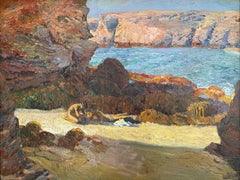
Items Similar to Bathers by Richard E. Miller
Want more images or videos?
Request additional images or videos from the seller
1 of 9
Richard MillerBathers by Richard E. MillerEarly 20th Century
Early 20th Century
$88,500
£67,501.65
€76,868.06
CA$124,369.49
A$135,642.41
CHF 71,854.20
MX$1,626,159.89
NOK 915,103.10
SEK 836,793.87
DKK 574,279.69
About the Item
Richard E. Miller
1875-1943 American
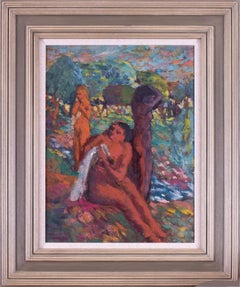
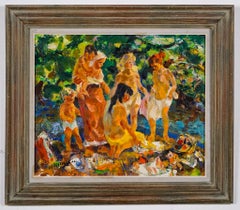
Bathers
Oil on canvas on board
Emanating the radiant beauty that defines American Impressionism, Bathers captures Richard Edward Miller at his expressive best. Painted during a period shaped by his time among the celebrated Giverny Colony, the work blends atmospheric color, lyrical brushwork and an instinctive sensitivity to light. Its romantic tone and refined handling highlight Miller’s role as one of the most compelling American painters to absorb and evolve the lessons of French Impressionism.
In this striking composition, Miller bathes his figures in a warm, glowing light that reveals their elegance and ease. Soft contours and textured strokes create a painterly surface that feels immediate and alive. The shimmering palette of the distant water recalls the brilliance of Monet’s Giverny pools, while the intimate poses of the women subtly echo Degas’s iconic bathers. The result is a composition that feels timeless yet intensely personal, animated by Miller’s distinctive touch.
Miller developed his distinctive artistic voice during his time in Paris at the end of the 19th century, where he was immersed in the vibrant artistic circles of the period. Unlike many American artists who merely adopted European styles, Miller cultivated a personal approach to Impressionism that would define his oeuvre. This evolution reached its peak when he settled in Giverny, France—the legendary artist colony where Claude Monet and numerous other luminaries lived and worked.
Born in St. Louis, Missouri, Richard Edward Miller emerged as one of America's most significant Impressionist painters through his extraordinary sensitivity to light and feminine beauty. After training at Washington University's School of Fine Arts, Miller moved to Paris for nearly fifteen years, where his technical virtuosity earned him acceptance at the prestigious Paris Salon by 1901, and eventually to Giverny, where his mature style fully flourished. Following his return to America during World War I, he taught at the Pennsylvania Academy of Fine Arts before settling in Provincetown, Massachusetts, garnering numerous accolades, including gold medals at the St. Louis Universal Exposition (1904) and Panama-Pacific International Exposition (1915). Today, his works grace the permanent collections of prestigious institutions, including the Metropolitan Museum of Art, the Art Institute of Chicago and the Smithsonian American Art Museum.
Early 20th century
Canvas: 19 1/2" high x 27 1/4" wide (49.53 x 69.22 cm)
Frame: 26 1/2" high x 34 1/4" wide x "1 1/2 deep (67.31 x 87 x 3.81 cm)
Provenance:
Private collection
Sale: Christie's New York, November 30, 1999
Private collection, Nova Scotia
M.S. Rau, New Orleans
- Creator:Richard Miller (1875 - 1943, American)
- Creation Year:Early 20th Century
- Dimensions:Height: 26.5 in (67.31 cm)Width: 34.25 in (87 cm)Depth: 1.5 in (3.81 cm)
- Medium:
- Movement Style:
- Period:
- Condition:
- Gallery Location:New Orleans, LA
- Reference Number:Seller: 32-18251stDibs: LU18617354592
About the Seller
5.0
Vetted Professional Seller
Every seller passes strict standards for authenticity and reliability
Established in 1912
1stDibs seller since 2013
20 sales on 1stDibs
Typical response time: 3 hours
- ShippingRetrieving quote...Shipping from: New Orleans, LA
- Return Policy
More From This Seller
View AllThe Bather by Childe Hassam
By Childe Hassam
Located in New Orleans, LA
Childe Hassam
1859-1935 American
The Bather
Signed and dated “Childe Hassam” (lower right)
Oil on canvas
Considered by many to be America’s foremost Impressionist painter, Childe Hassam composed his tranquil and intimate oil on canvas The Bather in the early years of the 20th century. The creation of the artwork aligns with a period of Hassam’s career where the artist’s palette was transforming, matching ever closer with the pale and pastel hues of French Impressionists like Claude Monet. Even the subject — a nude woman — represents a greater alignment with the Impressionist project, as artists of the movement and their non-mythological and non-biblical nudes still generated cries of indecency. With Hassam’s signature brushwork and attention to color, The Bather serves as a dream-like vision, serene and sensuous, of a young woman bathing in a lush forest.
While the artist's skill for landscape painting is on display, it is Hassam's command of form, light and color that brings this canvas to life. He creates a captivating composition, placing the nude subject in the bottom left of the canvas. The soft, undulating curves of the woman's body in contrapposto and the glow of her fair skin are balanced by the strong verticals and deep earth tones of the tall trees to her right. Hassam delicately frames the nude in the vivid blues of the distant water, building luminous color that further draws the viewer’s eye and results in a somewhat voyeuristic appeal — endowing his nude with both a natural innocence and an intentional sensuality.
Born in Dorchester, Massachusetts, Childe Hassam began his artistic career as a freelance illustrator, working for national publications such as Harper’s Weekly, Scribner’s Monthly, and The Century. His first solo exhibition of watercolors took place in Boston in 1883, and he quickly catapulted onto the international scene, winning a bronze medal at the Exposition Universelle in Paris in 1889. The year before the present work was created, he received the Webb Prize from the Society of American Artists for another landscape painted at Gloucester. Hassam would receive numerous other awards throughout his career, most notably the Gold Medal for Distinguished Services to Fine Art from the American Dealers Association. A true master, Hassam depicted a way of life characteristic of both American and French society, and his work elucidates a critical chapter in American art history. Today, his work resides in the Oval Office of the White House and in numerous important museums, including the Metropolitan Museum of Art in New York, the National Gallery of Art in Washington, DC and the Museum of Fine Arts in Boston, among others.
This painting will be included in Stuart P. Feld's and Kathleen M. Burnside's forthcoming catalogue raisonné of the artist's work.
Circa 1905
Canvas: 24 1/2“ high x 20 18” wide
Frame: 35 7/8“ high x 31 1/4” wide x 3 1/4“ deep
Provenance:
Private Collection of William Young...
Category
20th Century Impressionist Nude Paintings
Materials
Canvas, Oil
Young Woman in Interior by Richard E. Miller
By Richard Edward Miller
Located in New Orleans, LA
Richard E. Miller
1875-1943 American
Young Woman in Interior
Signed "Miller" (lower right)
Oil on canvas
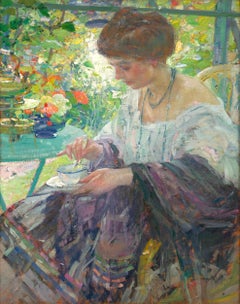
Richard E. Miller's Young Woman in Interior exemplifies the artist's exce...
Category
20th Century Impressionist Figurative Paintings
Materials
Canvas, Oil
Nude No. 2 by Louis Ritman
By Louis Ritman
Located in New Orleans, LA
Louis Ritman
1889-1963 American
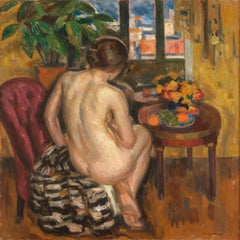
Nude No. 2
Signed "L. Ritman" (lower right)
Oil on canvas
This vibrant nude by famed American artist Louis Ritman epitomizes the artist's talent ...
Category
20th Century Post-Impressionist Nude Paintings
Materials
Canvas, Oil
Wind on the Beach by Gino Piccioni
Located in New Orleans, LA
Gino Piccioni
1873-1941 Italian
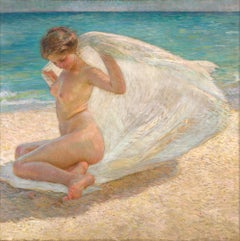
Wind on the Beach
Signed "G. Piccioni" (lower right)
Oil on canvas
One of Italy's most significant Post-Impressionist figures, Gino Piccioni devel...
Category
20th Century Post-Impressionist Nude Paintings
Materials
Canvas, Oil
At the Mirror
By Frederick Carl Frieseke
Located in New Orleans, LA
the most important American Impressionists of his age. While many of his contemporaries focused on the landscape, Frieseke gained his inspiration from the figural, and in particular the theme of femininity. His works capture female figures engaging in traditionally feminine roles — strolling in the garden or posed in a domestic interior. At the Mirror...
Category
Early 20th Century Impressionist Nude Paintings
Materials
Oil, Canvas

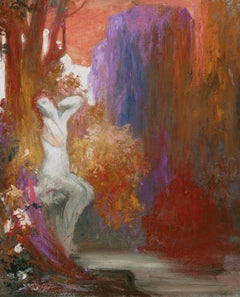
Ondine
By Pierre Marcel-Béronneau
Located in New Orleans, LA
Mystical and mysterious, a mythological Ondine rests beside an ethereal forest pond in this majestic, original oil on canvas by French Symbolist Pierre-Amédée Marcel-Béronneau. A stu...
Category
20th Century Symbolist Nude Paintings
Materials
Canvas, Oil
You May Also Like
American oil painting
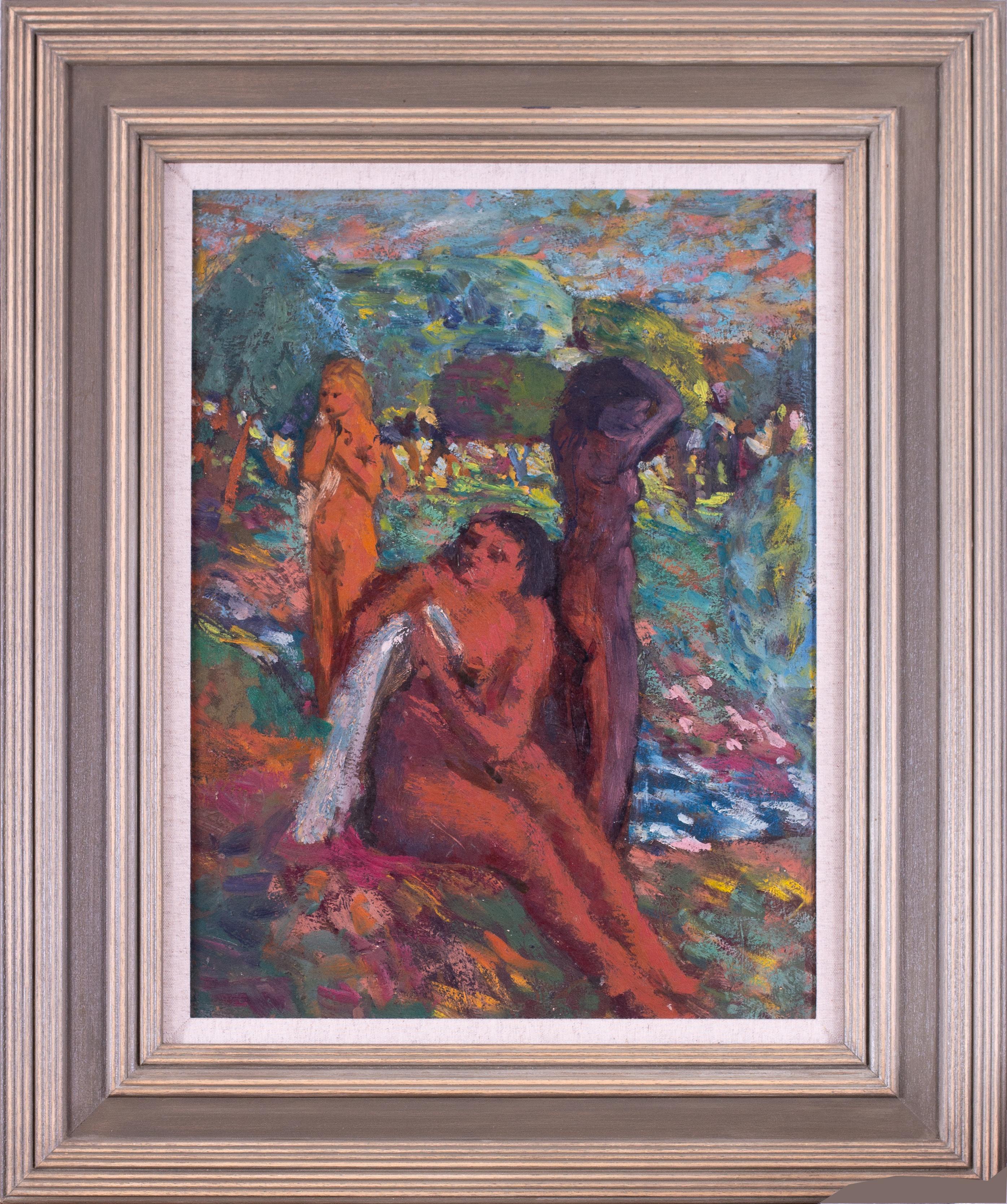
Bathers II
by Frederick Little Packer
Located in Petworth, West Sussex
Frederick Little Packer (American, 1886–1956)
Bathers II
Oil on board
Signed and inscribed with title (on a label, on the reverse)
19 ¾ x 15 in. (50.2 x 38.3 cm)
Radiant and rhythmic...
Category
20th Century Post-Impressionist Figurative Paintings
Materials
Oil, Board
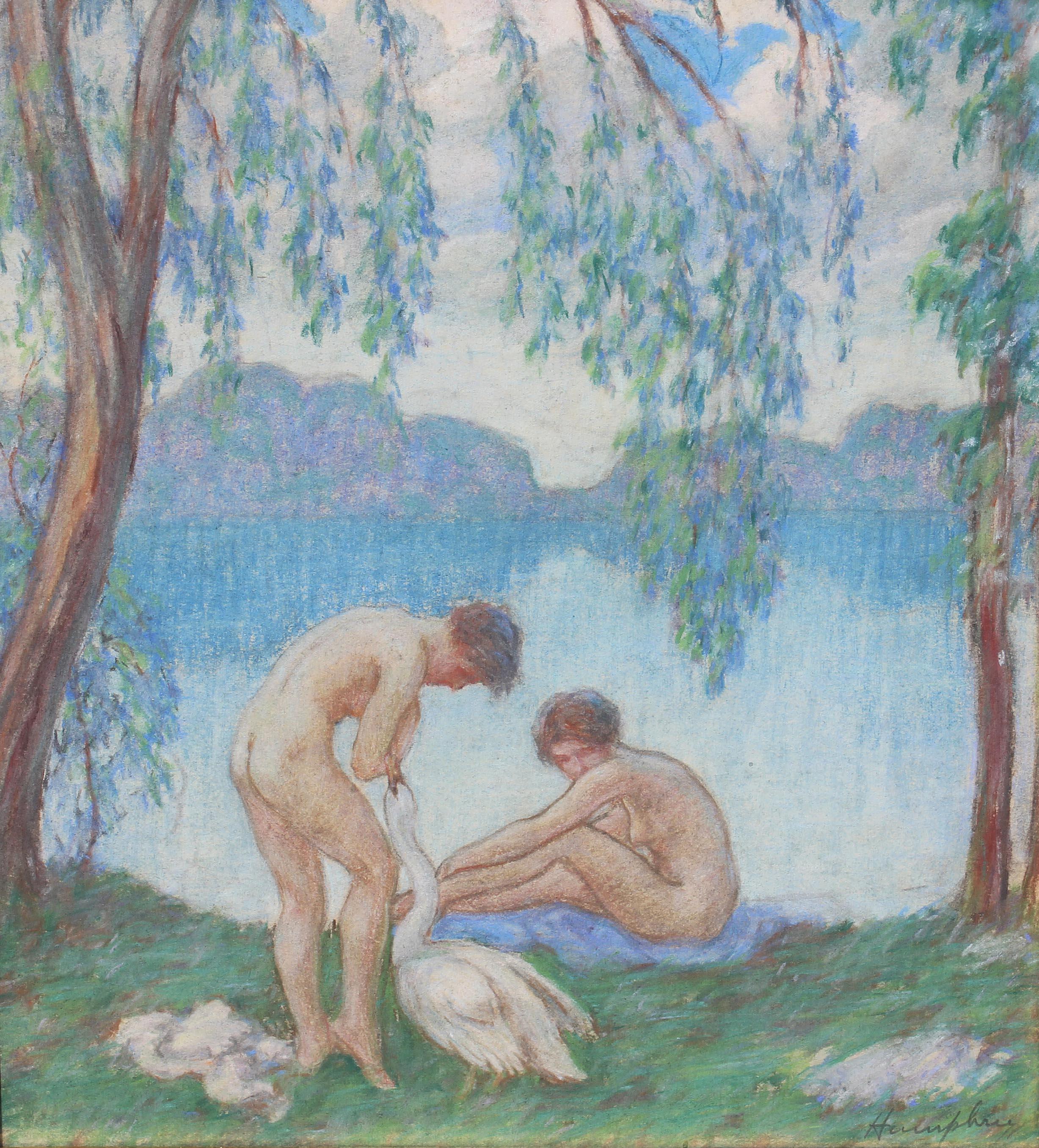
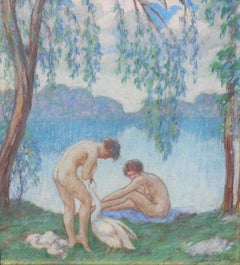
Impressionist Painting Nude Bathers by David Humphrey
By David Humphrey
Located in Rochester, NY
Nude bathers, fine early 20th century impressionist painting by David Humphrey (American 1872-1950.) Pastel on paper.
Humphrey was born in Elkhorn, Wiscons...
Category
Early 20th Century Art Nouveau Figurative Paintings
Materials
Pastel
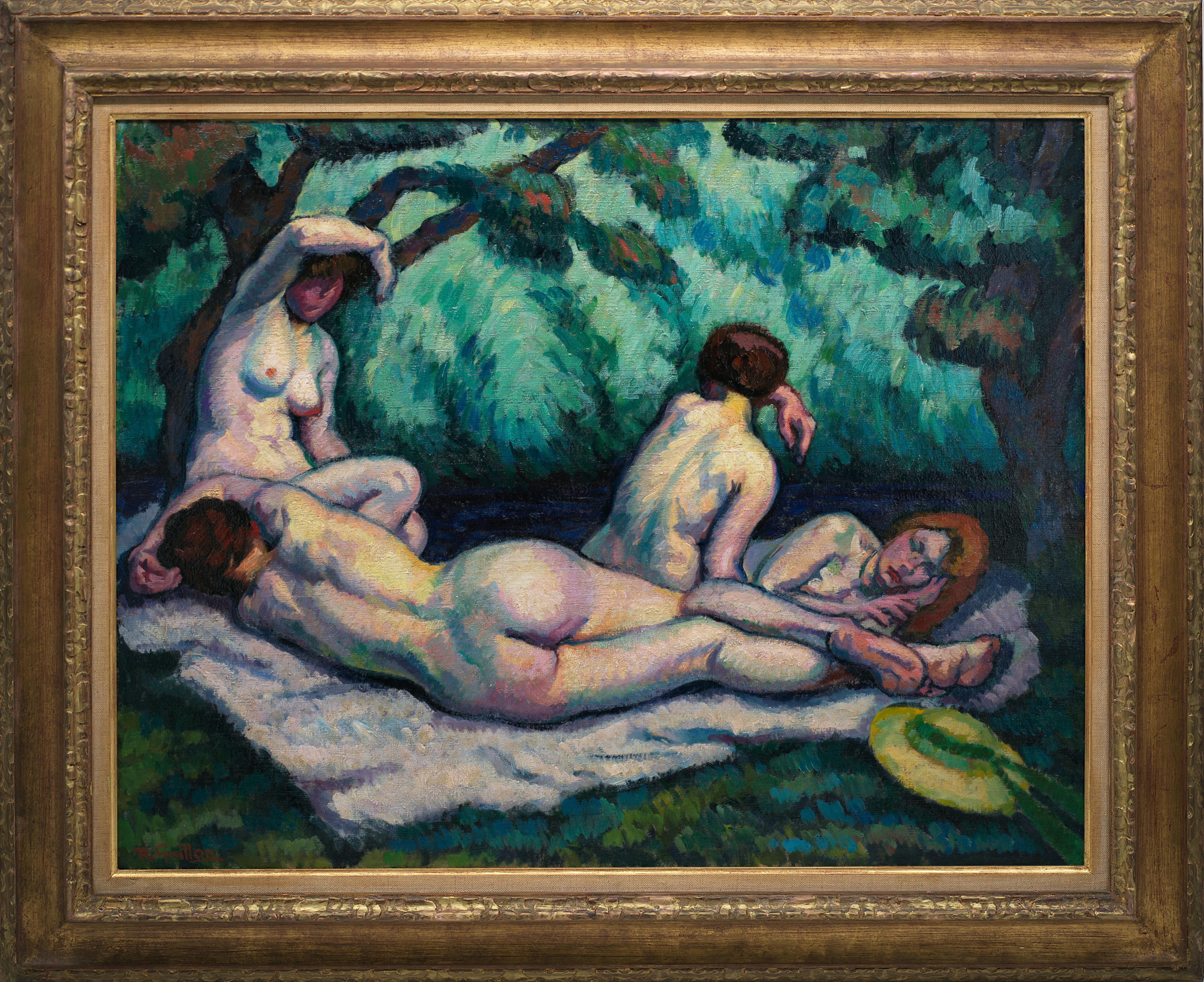
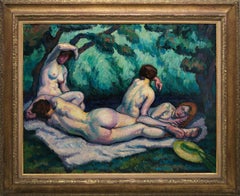
Bathers, Oil on Canvas, 1914
By Roger Grillon
Located in Saint Amans des cots, FR
Oil on canvas by Roger GRILLON (1881-1938), France, 1914. "Bathers". With frame: 114x94 cm - 44.9x37 inches ; without frame: 92x73cm - 36.2x28.75 inches. 30F format. Signed lower lef...
Category
1910s Impressionist Figurative Paintings
Materials
Canvas, Oil
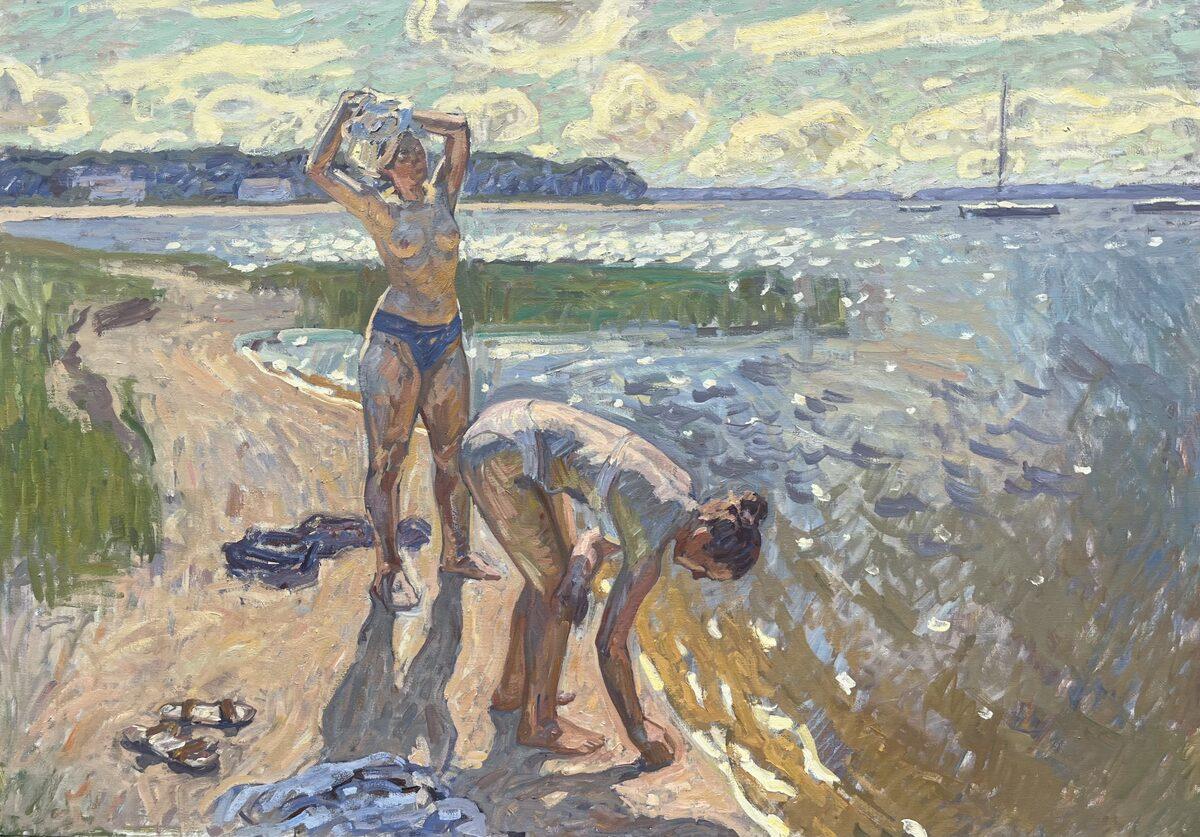
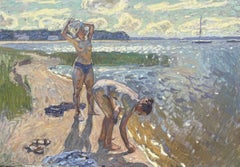
”Bathers (Inspired by Plastov)” figurative oil painting; two women on beach
By Ben Fenske
Located in Sag Harbor, NY
An oil painting by contemporary painter Ben Fenske, a seascape set in Sag Harbor, The Hamptons. Painted en plein air amongst the elements of wind, sun, and sea salt in the air. Fensk...
Category
21st Century and Contemporary American Impressionist Nude Paintings
Materials
Canvas, Oil
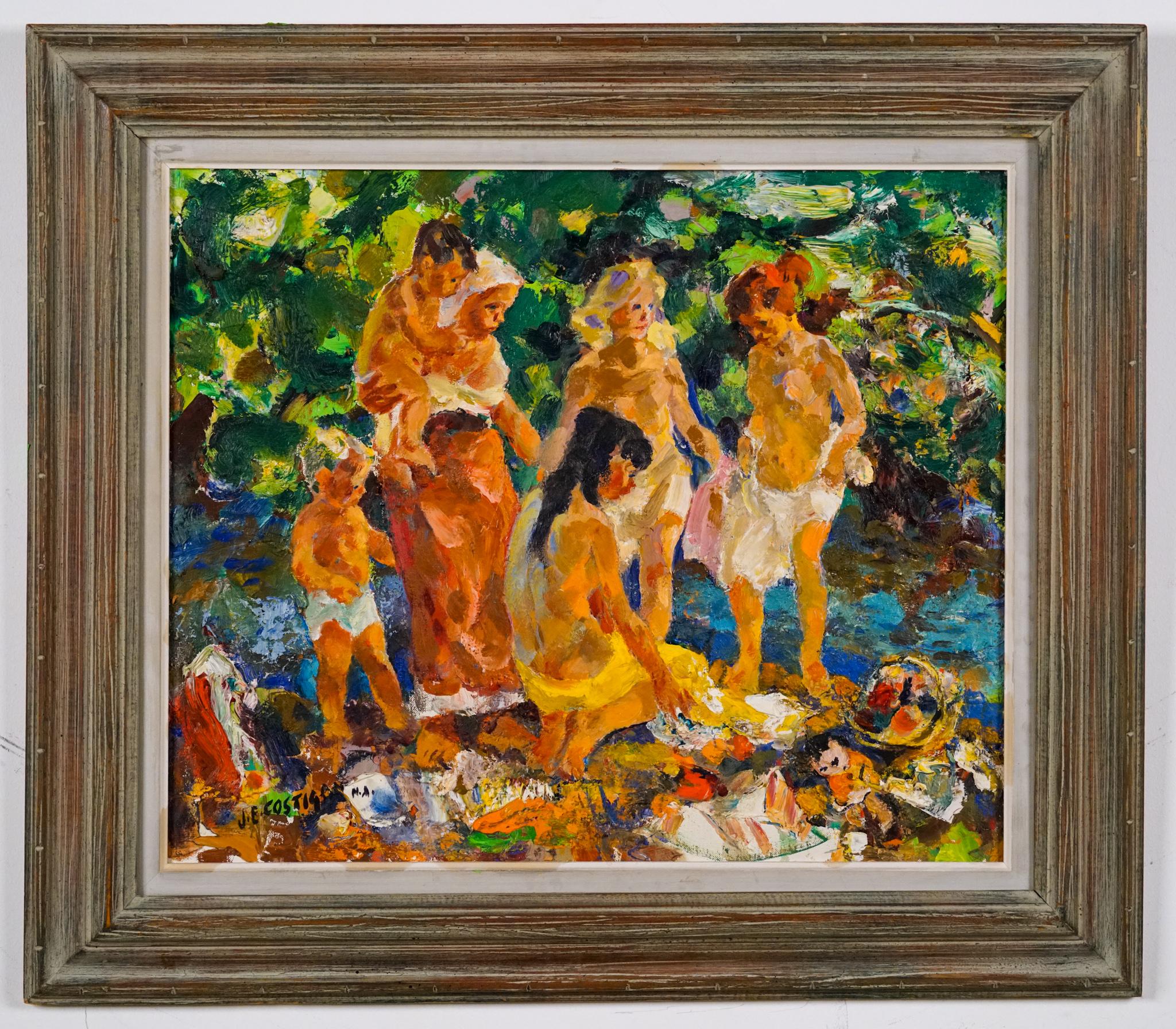
Bathers
By John Edward Costigan
Located in Sheffield, MA
John Edward Costigan, N.A.
American, 1888-1972
Bathers
Oil on canvas
Signed ‘J.E. Costigan N.A.’ lower left
20 by 24 in. W/frame 26 by 30 in.
John Costigan was born of Irish-American parents in Providence, Rhode Island, February 29, 1888. He was a cousin of the noted American showman, George M. Cohan, whose parents brought the young Costigan to New York City and was instrumental in starting him on a career in the visual arts. They were less successful in encouraging him to pursue formal studies at the Art Students League (where, however, he later taught) than in exposing him to the commercial art world through the job they had gotten him with the New York lithographing firm that made their theatrical posters.
At the H. C. Miner Lithographing Company, Costigan worked his way up from his entry job as a pressroom helper, through various apprenticeships, to the position of sketch artist. In the latter capacity he was an uncredited designer of posters for the Ziegfeld Follies and for numerous silent films. Meanwhile, he had supplemented his very meager formal studies in the fine arts with a self-teaching discipline that led to his first professional recognition in 1920 with the receipt of prizes for an oil painting and watercolor in separate New York exhibitions.
A year earlier, Costigan had wed professional model Ida Blessin, with whom he established residence and began raising a family in the sleepy little rural New York hamlet of Orangeburg, the setting for the many idyllic farm landscapes and wood interiors with which he was to become identified in a career that would span half a century.
John Costigan’s first national recognition came in 1922 with his winning of the coveted Peterson Purchase prize of the Art Institute of Chicago for an oil on canvas, “Sheep at the Brook.” It marked the start of an unbroken winning streak that would gain him at least one important prize per year for the remainder of the decade. The nation’s art journalists and critics began to take notice, making him the recurring subject of newspaper features and magazine articles. The eminent author and critic Edgar Holger Cahill was just a fledgling reporter when he wrote his first feature, “John Costigan Carries the Flame,” for Shadowland Magazine in 1922. Costigan had his first one-man show of paintings at the Rehn Gallery on New York’s 5th Avenue in November, 1924, to be followed less than three years later by another at the Art Institute of Chicago. In addition, Costigan’s work has been—and continues to be included, side-by-side with that of some of America’s most high-profile artists, in museum and gallery exhibitions throughout the country. His renown had peaked in the early 1930s, by which time his work had been honored with nearly every major award then being bestowed in the fine arts and had been acquired for the permanent collections of several prestigious American museums, including New York’s Metropolitan (which only recently, in 1997, deaccessioned his “Wood Interior,” acquired in 1934).
Although Costigan’s celebrity had ebbed by the late 1930s, the Smithsonian Institution saw fit in 1937 to host an exhibition exclusively of his etchings. And, in 1941, the Corcoran Gallery (also Washington, D.C.) similarly honored him for his watercolors. (Another Washington institution, the Library of Congress, today includes 22 Costigan etchings and lithographs in its permanent print collection.)
During World War II, Costigan returned briefly to illustrating, mainly for Bluebook, a men’s pulp adventure magazine. A gradual revival of interest in his more serious work began at the end of the war, culminating in 1968 with the mounting of a 50-year Costigan retrospective at the Paine Art Center and Arboretum in Oshkosh, Wisconsin. Oils, watercolors and prints were borrowed from museums and private collections throughout the country, and the exhibition was subsequently toured nationally by the Smithsonian Institution.
John Costigan died of pneumonia in Nyack, NY, August 5, 1972, just months after receiving his final prestigious award —the Benjamin West Clinedinst Medal of the Artist’s Fellowship, Inc., presented in general recognition of his “...achievement of exceptional artistic merit...” in the various media he had mastered in the course of his career.
This painting depicts one of the artist's favorite themes --the farm family bathing...
Category
1950s Post-Impressionist Figurative Paintings
Materials
Oil
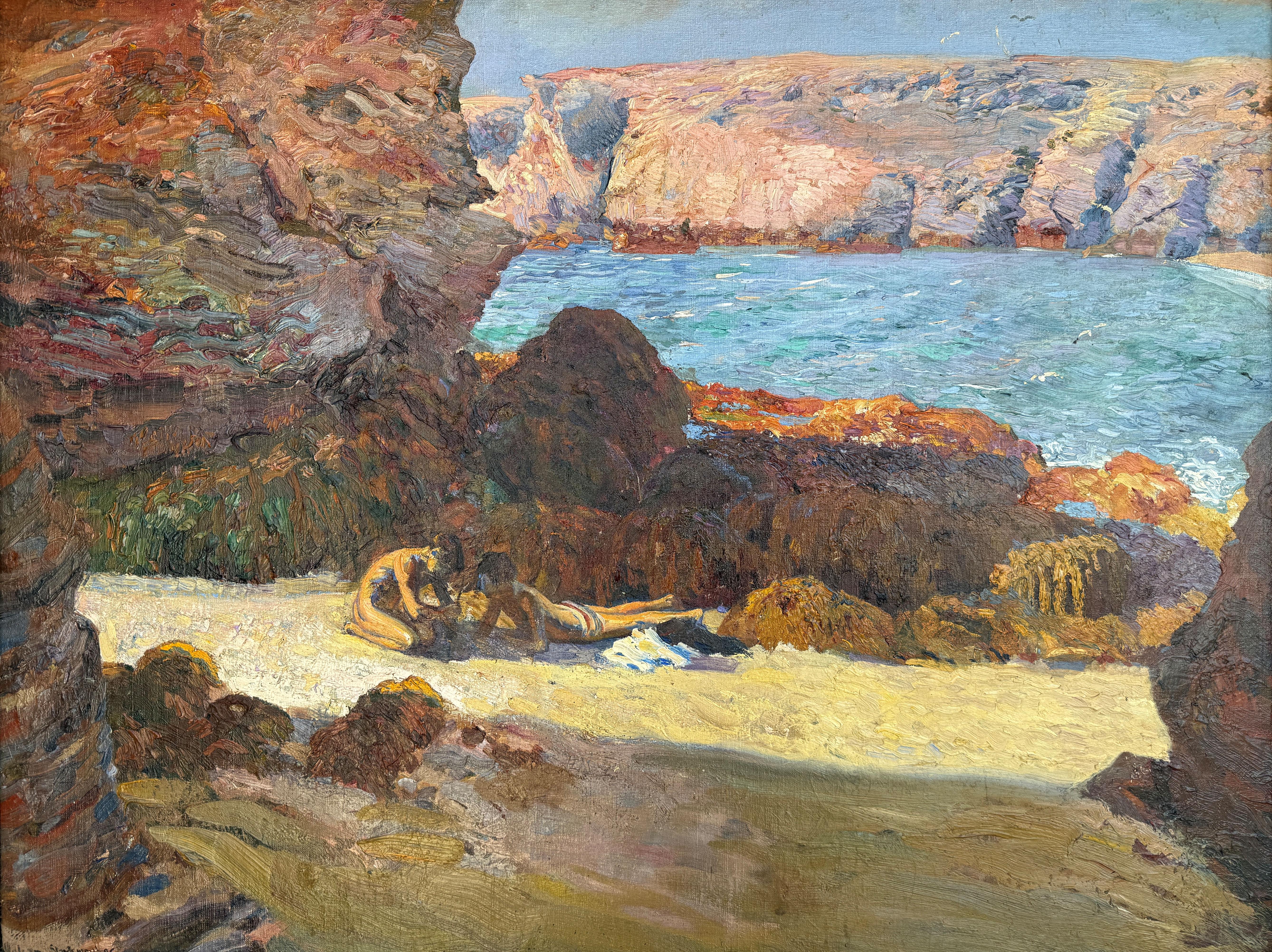
"Bathing Hour, Belle-en-Mer, France" William Edward Bloomfield Starkweather
By William Edward Bloomfield Starkweather
Located in New York, NY
William Edward Bloomfield Starkweather
Bathing Hour, Belle-en-Mer, France, 1908
Signed lower left
Signed, titled and dated on verso
Oil on canvas
27 x 36 inches
Provenance
Estate of...
Category
Early 1900s American Impressionist Figurative Paintings
Materials
Canvas, Oil