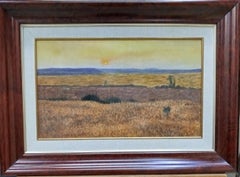
Items Similar to Champ de Blé au Vivarais (Wheat Field in Vivarais)
Want more images or videos?
Request additional images or videos from the seller
1 of 5
Robert DeborneChamp de Blé au Vivarais (Wheat Field in Vivarais)
$54,561.87
£40,000
€46,461.34
CA$75,172.61
A$81,986.30
CHF 43,430.81
MX$982,899.30
NOK 553,115.47
SEK 505,783.05
DKK 347,111.68
About the Item
Robert Deborne
Champ de Blé au Vivarais (Wheat Field in Vivarais)
1870-1944
Oil on canvas, signed lower right
Image size: 27 x 41 inches (68.5 x 104 cm)
Hand made giltwood frame
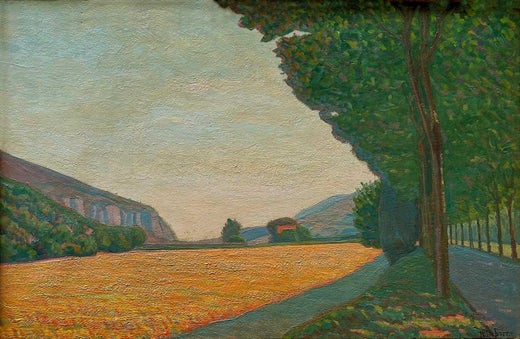
Deborne typically painted his landscapes in plein air, an approach that is readily apparent within this work. It is possible to envisage the artist sat by the side of the road, in the shadow of the trees that line it, painting the field of wheat in front of him. The wheat's vibrant golden hue connotes a summer time scene, Deborne's favourite season in which to paint. The impasto used to render the crop field helps to create a degree of tangibility, in which one can imagine the coarse ears of wheat and strawy stems. As with a few of his other paintings, Deborne employs the Impressionist cropping technique, intended to mimic photography, to enhance the notion that this is a fleeting instant in time as opposed to a perfectly constructed composition. The sky in this work is also beautiful, with a beautiful mix of blues, yellows and pinks creating a majestic rendition of a summer sky. The way that the mountains in the background of the painting appear slightly lighter in colour reflects Deborne's diligent attention to rendering the affects of sunlight on his beloved landscape of Vivarais.
Robert Deborne
Robert François Abel Deborne was born in 1870 in Viviers, a small cathedral city in the south of France. His father was a wealthy landowner and his mother was a member of a prestigious wine producing dynasty, located in nearby Gigondas. Little is known about Deborne’s childhood, but given his parentage it is likely to have been a comfortable one. He attended school in Viviers and then went to the École Nationale Supérieure des Beaux-Arts in Lyon. Here he resided in the Rue Fournet in the Brotteaux district.
In 1900, Deborne moved to Meudon, a suburb in Paris. Here he married Marie Morel and they had two children Jacques (1904 – 1976) and May (dates unknown).
At the Paris Salon of 1903, Deborne exhibited a nude study entitled Femme au Miroir, which has sadly since been lost. In 1905, he participated in the Salon d’Automne, a breakaway exhibition established by Renoir and Rodin as a rival to the summer Salon, which many artists felt had become too bureaucratic and conservative. At this very Salon, in 1905, the Fauvism movement was sensationally launched - a movement that Deborne was part of.
The Deborne family moved to Corsica in 1911, but the happiness was not to last. Shortly before the First World War, Deborne abandoned his family on the island and returned to his birthplace in Viviers. Here, he was able to pursue his passion for painting without encumbrance or distraction.
He exhibited many times at the Salon du Sud-Est over the following years, mainly landscapes of Vivarais and the neighbouring Rhone regions. There is no evidence that Deborne followed any profession at all, preferring instead to dedicate his life to his painting. Given his wealthy background, it is no great surprise that he felt no need to host solo exhibitions or engage with any patrons or dealers during his lifetime, as he had no need to earn his living. A legacy from a maiden aunt named Anna Barruol (on the wine-producing side of the family) also helped in this regard, enabling him to set up a studio at number 4, Avenue de la Station in Viviers in 1929.
Leading a rather solitary existence, Deborne was often to be seen carrying his easel, canvas and paintbox down the quiet country lanes of Viviers , apparently usually under the shelter of an oversized hat. He mainly stayed within the Vivirais region, with occasional excursions to the banks of the Rhone nearer to the location of his maternal family’s chateau and vineyards. He painted en plein air, returning again and again to the same locations to capture the differences in the seasons. In fact, all his known paintings only depict the various landscapes during the spring, summer and autumn – there are no known winter scenes. This seasonal approach is also part of the reason that Deborne did not exhibit at the Paris Salon and instead favoured the Salon d’Automne. The Paris Salon took place in summer, when Deborne was on his painting excursions in his local area. One of his few companions on these expeditions was the Post-Impressionist artist Paul Signac, who became close friends with Deborne after they exhibited together at the Salon du Sud-Est. Signac would often visit Deborne in Viviers, where he would reside at the Villa les Maraniousques.
In 1942, the Nazi forces occupied Viviers. Deborne hid his works in his studio, but passed away in July of 1944, only two months before the liberation of his hometown. His works remained safely hidden in his workshop for over 80 years, until the artist’s grandson stumbled across Deborne’s hidden trove. It is perhaps for this reason that Deborne’s works have been neglected by the Post-Impressionist canon.
- Creator:Robert Deborne (1870 - 1944, French)
- Dimensions:Height: 27 in (68.58 cm)Width: 41 in (104.14 cm)
- Medium:
- Movement Style:
- Period:
- Condition:
- Gallery Location:London, GB
- Reference Number:1stDibs: LU52417339612
Robert Deborne Robert Deborne was born in 1870 in Viviers, a small cathedral town in the South of France. Little is known of the finer details of Deborne’s life and he remains rather an enigma. He was the son of a rich farmer, which gave him the opportunity to concentrate on his painting without financial pressures. Indeed, he was so dedicated that he abandoned his family just before the First World War, enabling him to focus completely on his work. Despite his prolificacy, he decided never to hold a solo exhibition nor had any connection with an art dealer to sell his works, although he exhibited often at the Salon d’Automne in Paris (becoming a member in 1923) and the Salon du Sud-Est. A noted talent in his day, Deborne exhibited with major artists at the Salon du Sud-Est. This salon exhibition was on during the winter, which was perfect for Deborne as he was able to paint all summer, his preferred season. The Salon was a forum for unknown, innovative, emerging artists. His paintings were hung alongside works by Paul Cézanne, Henri Matisse, Paul Gaugin, Georges Rouault, André Derain, Albert Marquet, Felix Vallotton and Edouard Vullard, to name but a few. Deborne was exhibiting at the Salon du Sud-Est in 1905, the year when the press coined the then rather disparaging term of ‘Fauves’ (French for ‘wild beasts’) to describe artists using strong, separate, unnatural colours in a representational manner, moving away from the realism of impressionism. The phrase stuck and the new movement of Fauvism was recognised, of which Deborne was certainly a part and influenced by. Deborne had a close friendship with Paul Signac with whom he exhibited on several occasions at the Salon de Sud-Est. Signac spent some time in Viviers with Deborne, and the two are known to have been together on the banks of the Rhône, sketching and painting. He mostly painted scenes of Viviers, his home town on the Rhône and its environs. He also featured Nebbio in Corsica in many of his paintings. His works are very much centered on these places that he loved, and his depictions of the Rhône, its banks and the hills beside it are poetically marked by variations in time, weather and season. He was particularly fond of painting at dawn and dusk. Robert Deborne returned to the same landscapes again and again, portraying them from different perspectives and in changing light. This was a deliberate choice – he wanted to share the beauty of these inspiring places that were immediately before him. Vivarais to Deborne was what the Montagne Sainte-Victoire was for Cézanne or the banks of the Creuse were for Guillaumin. These landscapes were his life, and every brushstroke illuminates the beauty of these places for others to experience.
About the Seller
5.0
Gold Seller
Premium sellers maintaining a 4.3+ rating and 24-hour response times
Established in 2007
1stDibs seller since 2014
85 sales on 1stDibs
Typical response time: 3 hours
- ShippingRetrieving quote...Shipping from: London, United Kingdom
- Return Policy
More From This Seller
View AllPaysage du Vivarais avec une Ferme, French Post-Impressionist, Signed Painting
Located in London, GB
Oil on canvas, signed bottom right
Image size: 26 1/4 x 19 3/4 inches (41.5 x 50 cm)
Hand made gilt frame
Provenance
Artist's Estate
This work is sold with a certificate of authe...
Category
Early 20th Century Post-Impressionist Landscape Paintings
Materials
Canvas, Oil
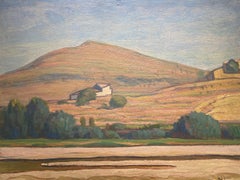
Paysage du Viviers, French Post-Impressionist Oil Painting
Located in London, GB
Robert Deborne
French 1870 - 1944
Viviers
Oil on canvas, signed lower right
Image size: 25 3/4 x 20 1/2 inches
Gilt frame
Robert Deborne (1870-1944) ...
Category
Late 19th Century Post-Impressionist Landscape Paintings
Materials
Canvas, Oil
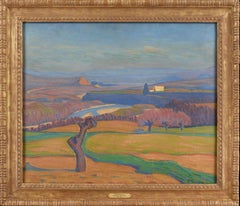
Ferme à Vivarais (Farm in Vivarais)
Located in London, GB
Robert Deborne
Ferme à Vivarais (Farm in Vivarais)
1870-1944
Oil on board, signed lower right
Image size: 20 1/3 x 26 3/4 inches (51.8 x 68 cm)
Contemporary-style hand-made frame
Th...
Category
Early 20th Century Post-Impressionist Landscape Paintings
Materials
Oil, Board
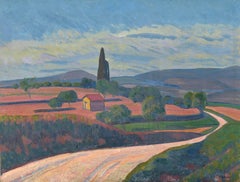
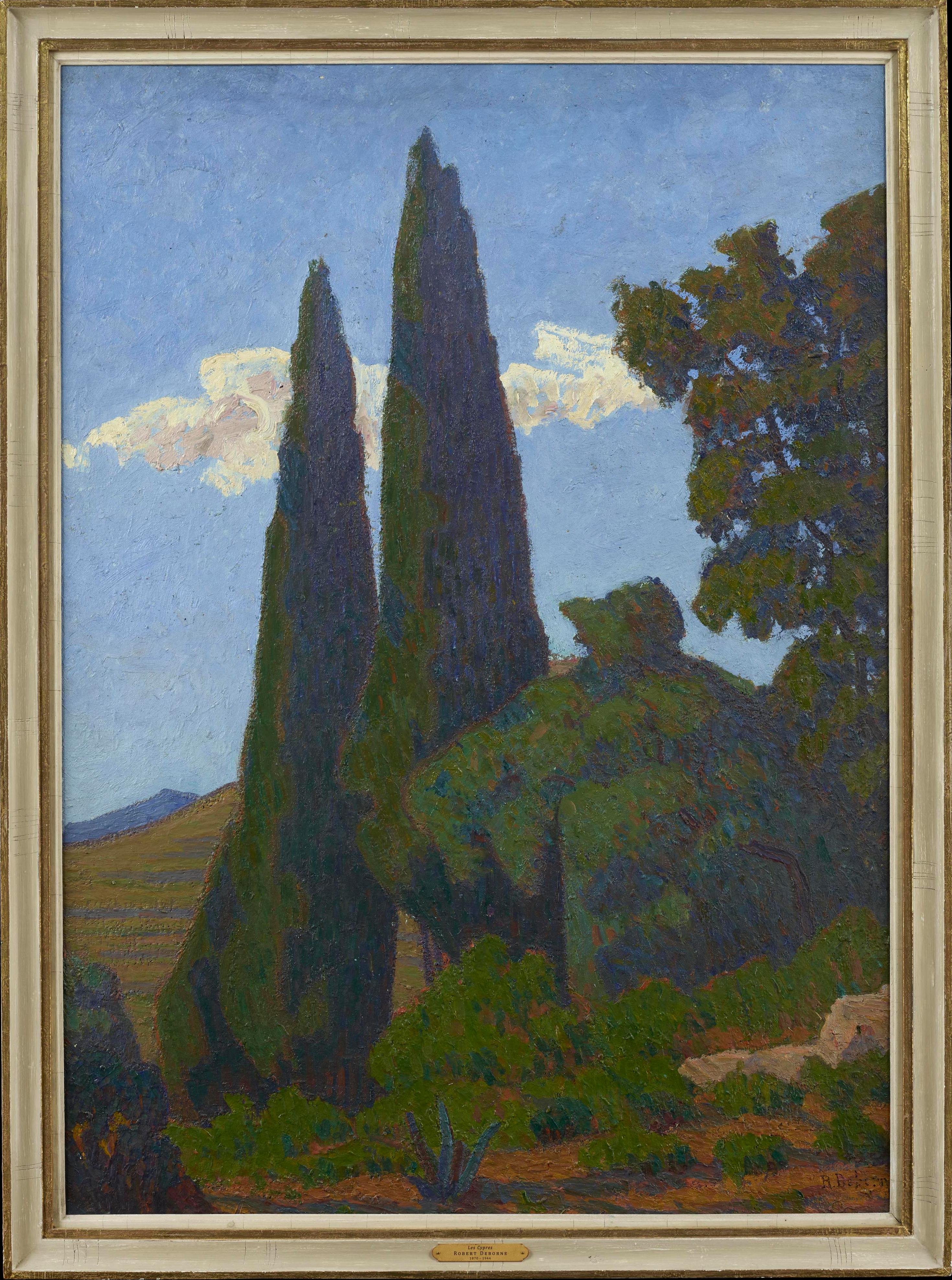
Les Cypres, French Post-Impressionist Landscape Painting, Signed
Located in London, GB
Robert Deborne
Les Cypres (The Cypresses)
1870 - 1944
Oil on canvas, signed lower right
Image size: 30 x 41 1/3 inches (76 x 105 cm)
Contemporary style handmade frame
This work is d...
Category
Early 20th Century Post-Impressionist Landscape Paintings
Materials
Canvas, Oil
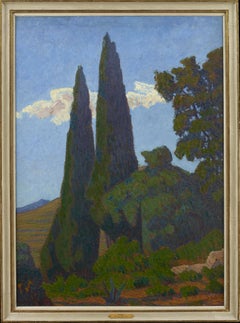
Route de Montagne
Located in London, GB
Robert Deborne
Route de Montagne
Oil on canvas, signed lower right
Image size: 21 1/3 x 25 1/2 inches (54.3 x 65 cm)
Original gilt frame
Provenance
Artist’s Estate
This work depict...
Category
Early 20th Century Impressionist Landscape Paintings
Materials
Canvas, Oil
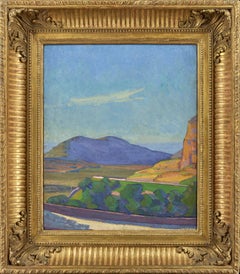
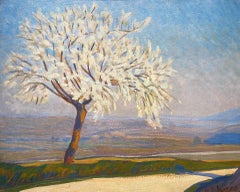
Arbre en Fleurs, Oil Landscape, French Post-Impressionist
Located in London, GB
Oil on board, mounted on panel, signed lower right
Image size: 19 x 23 (48 x 58 cm)
Contemporary style handmade frame
£10,000
Provenance
Artists Estate
The Artist
Robert Deborne...
Category
Early 20th Century Post-Impressionist Landscape Paintings
Materials
Oil, Board
You May Also Like
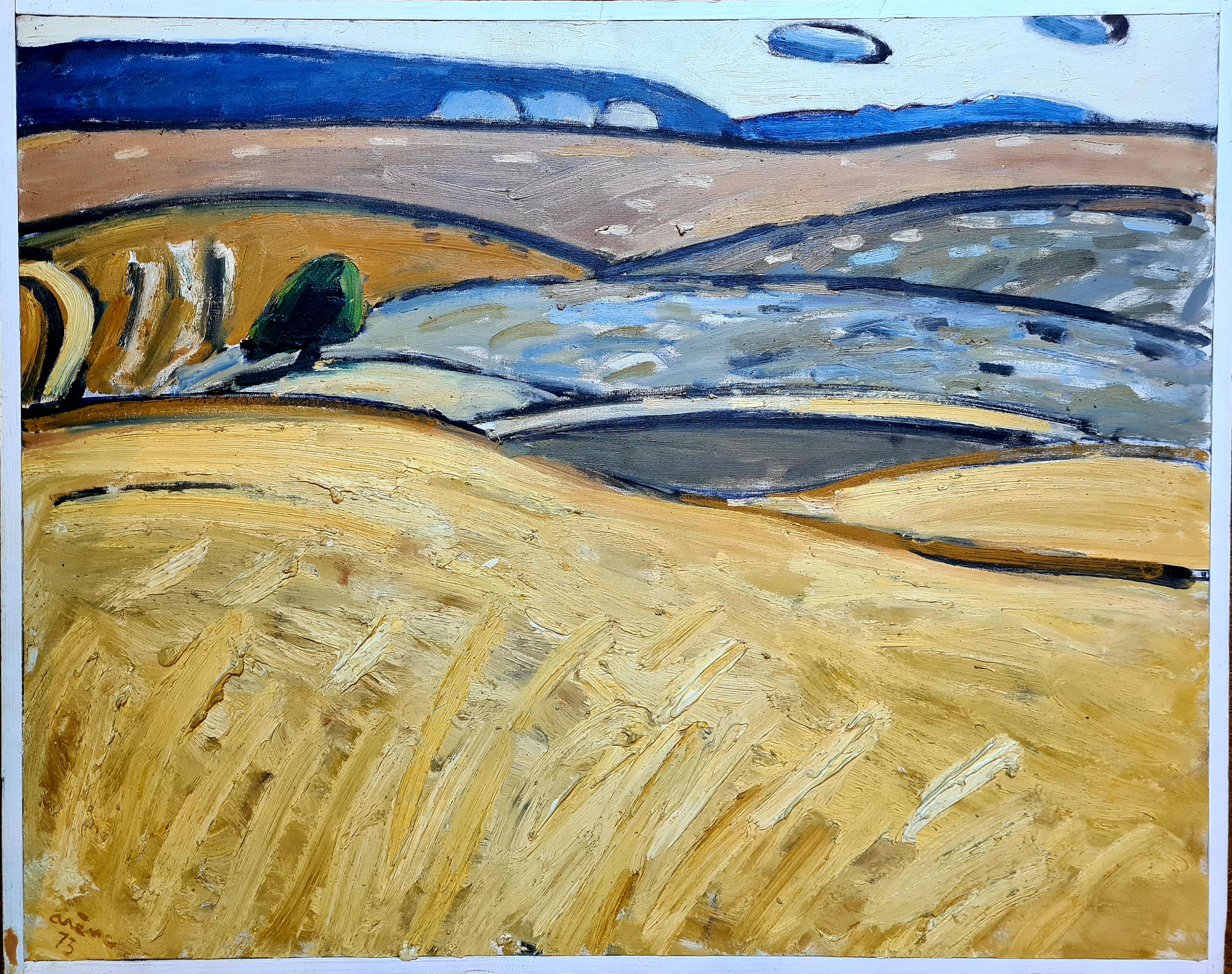
The Corn Field, Mid Century French Expressionist Landscape, Blés a Vincelles
Located in Cotignac, FR
Large French Expressionist oil on canvas painting of a golden cornfield and landscape beyond by Jean Arène. Signed and dated bottom left. The painting is titled to the back stretcher...
Category
Mid-20th Century Expressionist Landscape Paintings
Materials
Canvas, Oil
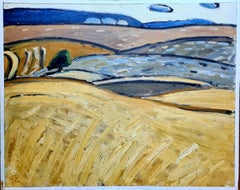
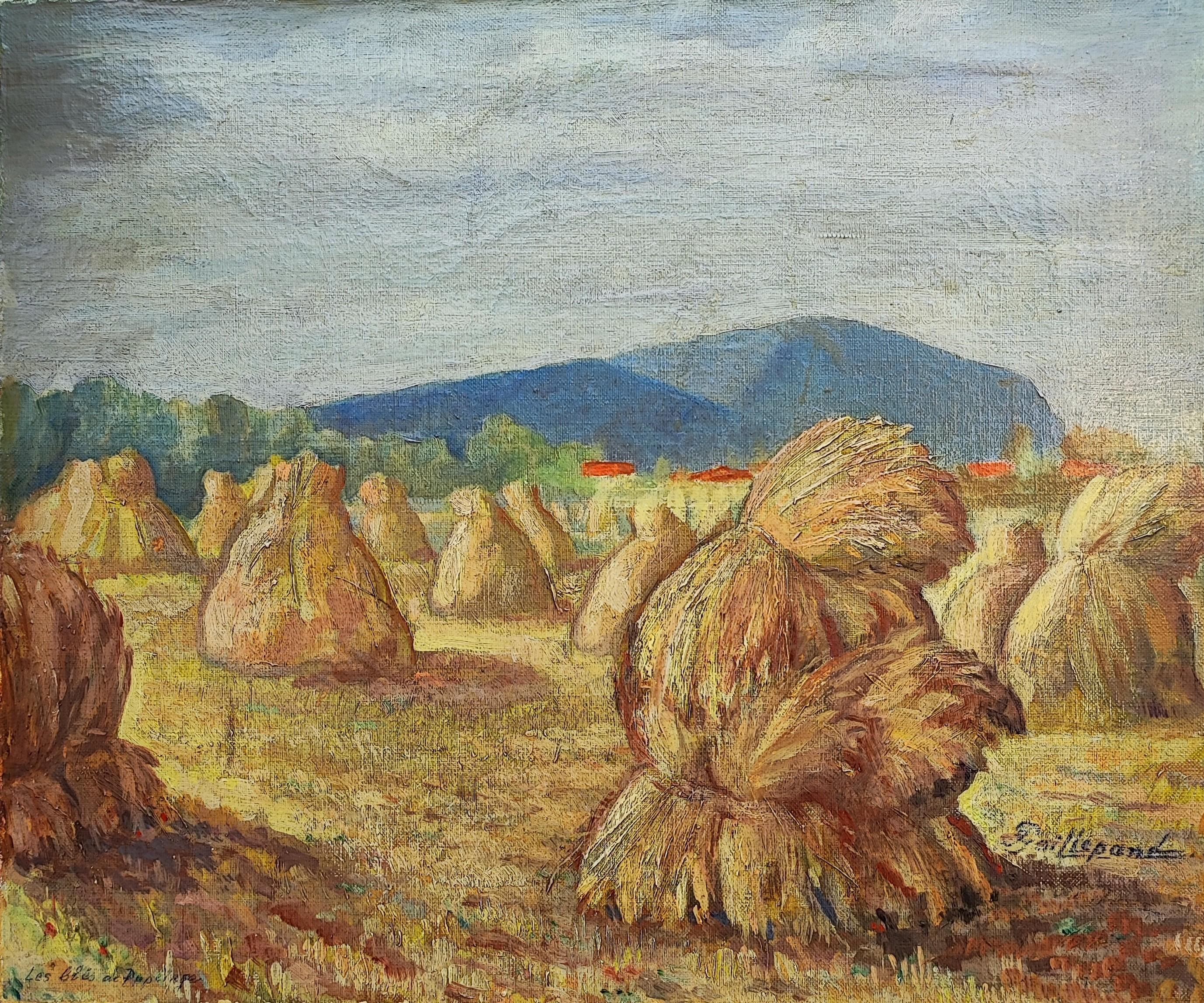
Wheat from Puplinge, Geneva
Located in Genève, GE
Work on canvas
Category
Mid-20th Century Landscape Paintings
Materials
Oil
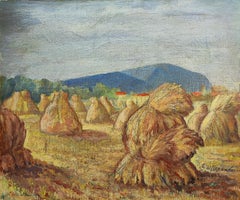
French Open Field Landscape Post Impressionist Signed Oil
By Josine Vignon
Located in Cirencester, Gloucestershire
Open Landscape
by Josine Vignon (French 1922-2022)
signed on front and back
oil painting on canvas, unframed
canvas: 18 x 24 inches
Colors: Green colors, beige, orange, brown, grey...
Category
Mid-20th Century Post-Impressionist Landscape Paintings
Materials
Canvas, Oil
Mid 20th Century 1950
s French Post-Impressionist Oil September Rural Farm Field
Located in Cirencester, Gloucestershire
Septembre, 1959
by Regine David (female French artist, 1910-2018)
oil painting on board, unframed
measures: 13 x 16 inches
condition: the painting is in very sound and presentable co...
Category
Mid-20th Century Post-Impressionist Landscape Paintings
Materials
Oil
Contemporary French Impressionist Oil Golden Wheat Fields
Trees Landscape
Located in Cirencester, Gloucestershire
Golden Fields
by Georges Bordonave (French contemporary)
signed oil painting on canvas, unframed
dated 1996
canvas: 13 x 16 inches
condition: very good
provenance: from a large priva...
Category
Late 20th Century Impressionist Landscape Paintings
Materials
Oil
Torne. sown fields. original painting
Located in CORAL GABLES - MIAMI, FL
ALBERT TORNE
He was born in Tortosa in 1960. He lives in Rasquera, a little village on the south of Catalonia, Tarragona province. Rafael Kyoga-Berliner, the well-known art critic, s...
Category
1990s Post-Impressionist Landscape Paintings
Materials
Acrylic