Want more images or videos?
Request additional images or videos from the seller
1 of 6
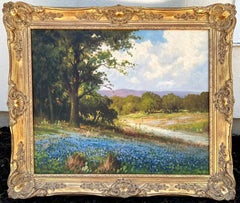
Robert William Wood"Buckeye Bluebonnet"Circa 1930
Circa 1930
$2,200List Price
About the Item
- Creator:Robert William Wood (1889-1979, American)
- Creation Year:Circa 1930
- Dimensions:Height: 14 in (35.56 cm)Width: 18 in (45.72 cm)Depth: 3 in (7.62 cm)
- Medium:
- Movement Style:
- Period:
- Condition:Please check our 1stdibs Store Front for additional goodies.
- Gallery Location:San Antonio, TX
- Reference Number:1stDibs: LU76933052203
About the Seller
5.0
Vetted Professional Seller
Every seller passes strict standards for authenticity and reliability
Established in 1974
1stDibs seller since 2017
104 sales on 1stDibs
Typical response time: 1 hour
Authenticity Guarantee
In the unlikely event there’s an issue with an item’s authenticity, contact us within 1 year for a full refund. DetailsMoney-Back Guarantee
If your item is not as described, is damaged in transit, or does not arrive, contact us within 7 days for a full refund. Details24-Hour Cancellation
You have a 24-hour grace period in which to reconsider your purchase, with no questions asked.Vetted Professional Sellers
Our world-class sellers must adhere to strict standards for service and quality, maintaining the integrity of our listings.Price-Match Guarantee
If you find that a seller listed the same item for a lower price elsewhere, we’ll match it.Trusted Global Delivery
Our best-in-class carrier network provides specialized shipping options worldwide, including custom delivery.You May Also Like
Home Safe
By James Gale Tyler
Located in Greenville, DE
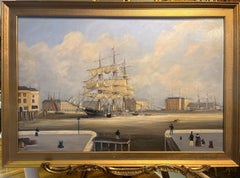
Very well executed seascape. Alternate title "In Point" inscribed on the rear. 17 x 15in in frame, including linen liner. ...
Category
Late 19th Century Impressionist Landscape Paintings
Materials
Oil, Board
New Castle Street Scene
Located in Greenville, DE
An excellent example of Doragh's best work. The scene is believed to be New Castle, Delaware circa 1920. The painting has been professionally restored. The ...
Category
1920s Impressionist Landscape Paintings
Materials
Canvas, Oil
Moonlight and Mist
By Eliot Clark
Located in Greenville, DE
New York City artist Eliot Candee Clark was well known for his impressionist landscapes. He was the son of painter Walter Clark. Many of his paintin...
Category
Early 20th Century Impressionist Landscape Paintings
Materials
Canvas, Oil

Still is the Night
By George Lambert
Located in Greenville, DE
George Lambert (1863-1946) *
Alternate title for painting is "Stonington Lighthouse". Signed lower right. Beautiful example of Lambert's best work. Painted very much in the style and...
Category
Early 20th Century Impressionist Landscape Paintings
Materials
Oil, Panel
Bronx River Reflections
By Ernest Lawson
Located in Greenville, DE
Excellent example of Lawson's work. Wonderful, thick impasto. Signed lower right. 31 x 37 1/4 in excellent condition frame.
Category
Early 20th Century Impressionist Landscape Paintings
Materials
Canvas, Oil
Bucks County Bridge
Located in Greenville, DE
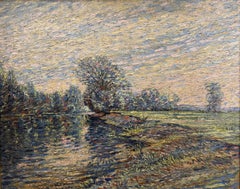
Outstanding work by Bucks County artist David Hahn. The winter scene is of Bucks County Bridge painted with heavy imposto.
Category
Late 20th Century Impressionist Landscape Paintings
Materials
Masonite, Oil
Riverscape Impressionist Oil Painting by George Thompson Pritchard, Framed
By George Thompson Pritchard
Located in Encino, CA
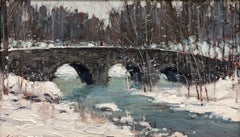
Untitled Riverscape, an original oil on canvas by George Thompson Pritchard, is a piece for the true collector. An impressively calming nature of this plein-air painting draws you in...
Category
1930s Impressionist Landscape Paintings
Materials
Oil, Canvas
$8,000
H 31.375 in W 36.5 in D 2.25 in
CLAUDE MONET Style 19th CENTURY IMPRESSIONISM OLD MASTER OIL PAINTING
By (after) Claude Monet
Located in Ferndown, GB
OIL PAINTING Antique 19th Century Fine Quality Piece Gold Gilt frame
OLD MASTER OIL PAINTING BRITISH SCHOOL 19th Century in a Gold Frame
Description.
19th century Piece
“Good C...
Category
Mid-19th Century Impressionist Landscape Paintings
Materials
Oil
LARGE FINE OIL PAINTING By Robert Bradley NAVY ADMIRALTY NICE GOLD GILT FRAME
Located in Ferndown, GB
OIL PAINTING LARGE ROBERT BRAMLEY (NAVY ADMIRALTY 20th CENTURY
Very good condition for age , (see pictures)
FINE RARE MARTINE PAINTING ORIGINAL
OLD MASTER 19th Century STYLE OIL ...
Category
20th Century Impressionist Landscape Paintings
Materials
Oil
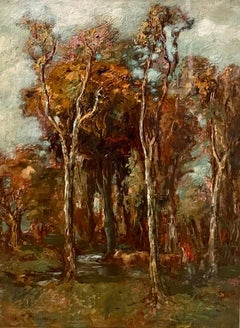
Scottish 19th century impressionist oil painting in autumn, Driving Cattle
Located in Hillsborough, NC
Period impressionist painting, 'Driving Cattle' is by Scottish 19th century artist William Mouncey (1852-1901). His characteristic style ...
Category
19th Century Impressionist Landscape Paintings
Materials
Canvas, Oil
$2,242 Sale Price
25% Off
H 22 in W 17.5 in D 2 in
More From This Seller
View All" Summer Evening Southwest Texas " 1909 Texas Hill Country Julian Onderdonk
By Julian Onderdonk
Located in San Antonio, TX
Julian Onderdonk "Summer Evening S. W. Texas" Texas Hill Country
(1882 - 1922)
San Antonio Artist
Image Size: 9 x 12
Frame Size: 15 x 18
Medium: Oil on panel
Dated 1909
"Summer Evening S. W. Texas"
"A Texas Painter Worked Under the Radar in New York," By Eve M. Kahn, March 6, 2014, The New York Times
Onderdonk, a San Antonio native who died of an intestinal ailment in 1922, at 40, is best known for painting swaths of Texas bluebonnets. Those canvases can bring more than $500,000 each, while his New York scenes usually end up in the five-figure range.
Onderdonk’s parents were painters in San Antonio, and in 1901, when he was a teenager, they sent him to New York for training. Through 1909, he lived in various Manhattan apartments and Staten Island houses. He then returned to Texas, but continued to spend months at a time in New York.
In 1902 he had married a Manhattan teenage neighbor, Gertrude Shipman. While she focused on raising their daughter, Adrienne, and worrying about their strained finances, “he created more than 600 works of art, often producing a painting or two a day,”
Eyewitnesses recorded his prolific pace in New York, but Onderdonk works bearing those dates rarely turn up. The puzzling gap in his productivity is explained in family correspondence that the Bakers uncovered: The artist admits that he was signing pieces with pseudonyms. He mostly used Chas. Turner and Chase Turner and occasionally resorted to Elbert H. Turner and Roberto Vasquez.
Julian Onderdonk was the son of the important Texas landscapist, Robert Onderdonk. He was the father's pupil at age 16. Sponsored by a Texas patron, he studied at the Art Students League in New York when he was 19, the pupil of Kenyon Cox, Frank DuMond, and Robert Henri. He also studied with William Merritt Chase on Long Island. In 1902, having lost his Texas patron because he married, he asked $18 for 12 paintings at a Fifth Avenue dealer in New...
Category
Early 1900s Impressionist Landscape Paintings
Materials
Oil
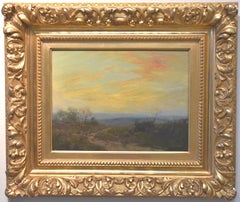
"A Glowing Day South West Texas" Date: 1910. Exquisite Sky in this Texas piece
By Julian Onderdonk
Located in San Antonio, TX
Julian Onderdonk
(1882 - 1922)
San Antonio Artist
Image Size: 6 x 9
Frame Size: 10.75 x 13.75
Medium: Oil
Dated 1910
"A Glowing Sky" SW Texas
Julian Onderdonk (1882 - 1922)
Known as...
Category
1910s Impressionist Landscape Paintings
Materials
Oil
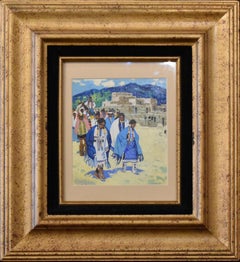
"PUEBLO" NATIVE AMERICAN MARCH IN FRONT OF PUEBLO ARIZONA ARTIST
Located in San Antonio, TX
Ross Stefan
(1934-1999)
Arizona / Wisconsin Artist
Image Size: 7.5 x 6.5
Frame Size: 18 x 16
Medium: Oil
"Pueblo"
Biography
Ross Stefan (1934-1999)
Born in...
Category
20th Century Impressionist Figurative Paintings
Materials
Oil
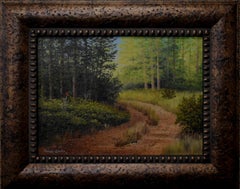
"REDBIRD ROAD" EAST TEXAS LANDSCAPE WITH CARDINAL
By Manuel Garza
Located in San Antonio, TX
Manuel Garza
(Born 1949)
Texas Artist
Image Size: 9 x 12
Frame Size: 14 x 17
Medium: Oil
"Redbird Road"
Biography
Manuel Garza (Born 1949)
Growing up in Central Texas, Manuel Garza i...
Category
20th Century Impressionist Landscape Paintings
Materials
Oil
"DON ANTONIO
S GATE" CALIFORNIA, Bougainvillea, ADOBE MANSION. ARIZONA ARTIST
Located in San Antonio, TX
Ross Stefan
(1934-1999)
Arizona / Wisconsin Artist
Image Size: 24 x 30
Frame Size: 32 x 40
Medium: Oil Signed Lower Right
"Don Antonio's Gate" Bougainvillea Jose Antonio Aguirre (1...
Category
20th Century Impressionist Landscape Paintings
Materials
Oil

"Bluebonnets Texas Hill Country"
Located in San Antonio, TX
Robert Wood (G. Day)
(1889 -1979)
San Antonio Artist
Image Size: 20 x 24
Frame Size: 29 x 33
Medium: Oil
Signed Lower left
"Bluebonnet"
Biography
Robert Wood (G. Day) (1889 -1979)
A painter of realistic landscapes reflecting a vanishing wilderness in America, Robert Wood (not to be confused with Robert E. Wood) is reportedly one of the most mass-produced artists in the United States. His painting became so popular he was unable to meet all of the demands, and many of his works were reproduced in lithographs and mass distributed as prints, place mats, and wall murals by companies including Sears, Roebuck. He was born in Sandgate, Kent on the south coast of England near Dover, the son of W.L. Wood, a famous home and church painter who recognized and supported his son's talent. In fact, he forced his son to paint by keeping him inside to paint rather than playing with his friends. At age 12, Wood entered the South Kensington School of Art. As a youth, he came to the United States in 1910, having served in the Royal Army, and he never returned to England. He traveled extensively all over the United States, especially in the West, often in freight cars, and also painted in Mexico and Canada. His itinerant existence took him to Illinois where he worked as a farmhand, to Pensacola, Florida where he married, briefly in Ohio, Seattle, Washington, and Portland, Oregon. In 1912, he was in Los Angeles, and in the late 1920s and early 1930s, in San Antonio, Texas, where he lived and in 1928 exhibited in the "Texas Wildflower Competition." From San Antonio, he gained a national reputation for his strong colored, dramatic paintings. Some of that prestige has been credited to his association with Jose Arpa, prominent Texas artist. Wood also gave art lessons, and one of his students was Porfirio Salinas. During this period, Wood sometimes signed his paintings G. Day or Trebor, which is Robert spelled backwards. In 1941 he went to California and painted numerous desert and mountain landscapes and coastal scenes. He lived in Carmel for seven years, and then moved to Woodstock, New York, but he soon returned to California, settling first in Laguna Beach, then San Diego, and finally in the High Sierras, where he and his wife built a home and studio near Bishop and lived until his death in 1979. Robert Wood was born March 4, 1889, in Sandgate, England, a small town on the Kentish coast not far from the white cliffs of Dover. His father, W. J. Wood, was a successful painter who recognized Robert's unusual talent. At the age of twelve, his father enrolled Wood in art school in the small town of Folkstone. He then attended the South Kensington School of Art. While attending art school, Wood won four first awards and three second awards, one each year, a record. In 1910 after service in the Royal Army, nineteen-year-old Wood and his friend, Claude Waters, immigrated to America. Initially, he settled in Illinois and worked as a hired hand on a farm belonging to Water's uncle. He would then strike out on his own, living the life of an itinerant painter. Wood traveled as a hobo, hopping freight trains and selling or bartering small paintings to support him along the way. When times were hard, he worked at whatever job was available. In this manner, he saw most of the United States and fell in love with rural America. By 1912, Wood visited Los Angeles for the first time, arriving on the day of the Titanic tragedy. Later that year, he had met, courted and married young Eyssel Del Wagoner in Florida. The couple moved to Ohio where a daughter, Florence, was born. During World War I, the family moved to Seattle where a son, John Robert Wood, was born in 1919. In the early 1920's, the young Wood family was almost constantly on the move. They stayed for short periods in Kansas, Missouri, California and for a longer time in Portland, Oregon, where Wood's friend Claude Waters had settled. Wood's seemingly endless wanderings disrupted his family life and delayed his development as a painter. However, through his travels he developed an appreciation for the American landscape that would inspire him for the rest of his career. Although aware of the current movement away from traditional realism in American art, he elected to travel that solitary path and remain true to his own vision of American’s grandeur and beauty poetically translated through his landscape and seascape paintings. In 1923, the Wood family discovered the beautiful city of San Antonio, Texas and it was there that he and his family would finally settle. He studied briefly at the San Antonio Art School with Spanish colorist Jose Arpa y Perea (1860-1952), who had arrived in San Antonio that same year. In the latter part of the 1920’s, Jose Arpa’s influence quickly became evident. Wood after several years of experimentation was becoming fine easel painter, capable of great subtlety with a new mature original style. Like Texas painters Robert Onderdonk (1853-1917) and his son Julian Onderdonk (1882-1922), Robert Wood concentrated on the distinctive Texas landscape with its Red Oak trees and wildflowers that covered the hill country landscape. He developed a reputation for his scenes of Blue Bluebonnets, the state flower. In the spring, the Texas prairie is covered with wildflowers, especially in the hill country surrounding San Antonio and Austin. Wood incorporated native stone barns and rough wood farmhouses that added authenticity and romance to his compositions. In 1925, Wood was divorced from his wife. In 1932, he moved to the famous scenic loop on San Antonio's outskirts. While still living in Texas, he took extensive western sketching trips that brought him to California. It is evident that his 1930’s California...
Category
1950s Impressionist Landscape Paintings
Materials
Oil