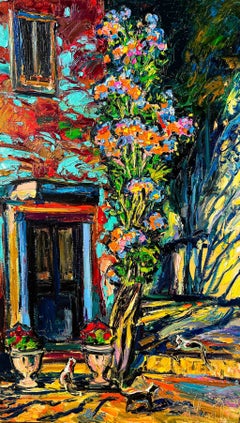
Items Similar to "DON ANTONIO
S GATE" CALIFORNIA, Bougainvillea, ADOBE MANSION. ARIZONA ARTIST

Want more images or videos?
Request additional images or videos from the seller
1 of 6
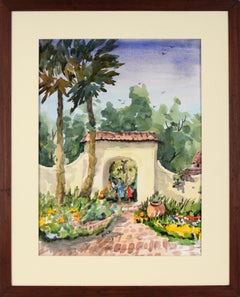
Ross Stefan"DON ANTONIO
S GATE" CALIFORNIA, Bougainvillea, ADOBE MANSION. ARIZONA ARTIST20th century
20th century
$8,900
£6,724.45
€7,709.88
CA$12,420.97
A$13,514.96
CHF 7,156.01
MX$162,594.24
NOK 90,865.33
SEK 83,135.42
DKK 57,603.54
About the Item
Ross Stefan
(1934-1999)
Arizona / Wisconsin Artist
Image Size: 24 x 30
Frame Size: 32 x 40
Medium: Oil Signed Lower Right
"Don Antonio's Gate" Bougainvillea Jose Antonio Aguirre (1793-1860)
Don Antonio Aguirre
San Diego Merchant and Ranchero
Jose Antonio Aguirre (1793-1860)
A native of Basque, Spain, born about 1793. At the time of the Mexican revolution, he was a merchant at Guaymas. Remaining loyal to Spain, he was driven out of Mexico and settled in Upper California. Owned brigs Leonidas and Joven Guipuzoana, and engaged in coast, Island, and China trade. On arrival of the Hijar colony at San Diego in 1834, gave a ball in Hijar’s honor. It was at this ball that certain modern dances are said to have been first introduced into California. He divided his residence between San Diego and Santa Barbara, at which latter place he owned the finest residence in 1842. In 1843, he was grantee of the Tejon rancho. In 1848 and 1849, engaged in trade with William Heath Davis, and in 1850 lie and Davis, with four others, founded new San Diego. He was at San Diego April 1, 1850, and appears in a list of the voters at Old Town. In September of the latter year, he served on the first grand jury in San Diego County under American rule. He married Francisca, daughter of Prefect Jose Antonio Estudillo, of San Diego, and after her death married her sister Maria del Rosario Estudillo. He was a large man and on that account was sometimes called “Aguirron” (big Aguirre). He was a fine type of the old Spanish merchant and left a large estate to his widow and four children. A son, Miguel Aguirre, lives in the neighborhood of the San Jacinto rancho. A daughter was married to Francisco Pico and lives in the same vicinity. His widow married Colonel Manuel A. Ferrer, of San Diego.
[from Smythe, William Ellsworth. History of San Diego, 1542-1908. San Diego: History Co., 1907. (pages 161-162)]
1. Don Antonio Aguirre Marker
Inscription. Don Jose Antonio Aguirre built his adobe mansion on this site on or just prior to 1868. Because the Casa de Aguirre was one of the first houses in Old Town, the Aguirre – Antonio, his wife Rosaria and their many children – are considered to be one of San Diego’s founding families. Don Antonio was a wealthy merchant and rancher who contributed greatly to the development of San Diego. Locally, he owned several ships and warehouses and imported goods from Peru and China in trade for cowhides and tallow. Later, Aguirre became one of the largest landowners in California when he developed a successful ranching enterprise. Born in Spain, he also held Mexican and American citizenship in his lifetime. In 1850 he partnered with William Heath Davis to develop New Town San Diego. Aguirre was known for his charity and funded many projects including the construction of the Old Adobe Chapel on Conda Street, where he is buried.
Aguirre was born in San Sebastian, Spain, but left the Basque Country, for North America at the age of 15, settling in New Orleans, Louisiana. He became a citizen of first Mexico and then the United States as national powers rose and fell on the continent. He was a merchant in Guaymas, Mexico, then moved to Alta California, becoming a shipowner and trader. He divided his residence between San Diego and Santa Barbara, where he was said in 1842 to own the finest residence in town. He established a warehouse at La Playa, the beach near San Diego where ships would anchor for trading. He exported hides and tallow from San Diego, while importing luxury goods for the Californios such as silks, satins and embroidered shawls. In the late 1830s he became a partner in his trading activities with another Spaniard, Miguel Pedrorena, who later became his brother-in-law. He soon became one of the most prosperous merchants in Alta California.
He became friends with the established Californio families, and in 1841 he married María Francisca Estudillo, eldest daughter of Jose Antonio Estudillo, a prominent landowner. He and Francisca settled into the grand home he had built in Santa Barbara, but Francisca died within the year, in October 1842, during what would have been the birth of their first child. Aguirre was never to live there again, although he maintained ownership of the house. He took to trading up and down the coast and spent more and more of his time in San Diego.
Aguirre received half of the Rancho El Tejon Mexican land grant in 1843. In 1846 he married Francisca's sister, María del Rosario Estudillo, and they settled in San Diego. They were generally referred to as Don Antonio and Doña Rosario. Their San Diego home was completed in 1851. His wife was the grantee of Rancho San Jacinto Sobrante. Aguirre also owned portions of Santa Cruz Island and Rancho San Pedro, making him one of the largest landowners in Alta California in the late 1840s. In 1853, José Antonio Aguirre bought Rancho San Jacinto Nuevo y Potrero from the estate of Miguel Pedrorena.
In 1850, Aguirre joined William Heath Davis and Miguel Pedrorena (who was married to another Estudillo sister, Antonia) in an attempt to establish a new town, south of the existing town of San Diego and closer to San Diego Bay
In 1858, Aguirre bought the land and paid for the construction of an adobe church in San Diego. At the time there were only private chapels (in Casa de Estudillo and Casa de Aguirre) since the Presidio church and the Mission church were both in ruins.
José Antonio Aguirre died July 31, 1860. He was buried in the confessional of the church he had donated to the town.
Personal life
María del Rosario Estudillo de Aguirre, of the Estudillo family of California, married José Antonio Aguirre after the death of her sister María Francisca Estudillo, his first wife.
In 1841, José Antonio Aguirre married María Francisca Estudillo, eldest daughter of prominent landowner Jose Antonio Estudillo, of the Estudillo family of California. He and María del Rosario Aguirre had four surviving children: Miguel (born August 25, 1849); María de los Dolores del Rosario (born August 6, 1851, later married to Francisco Pico); José Antonio (born August 1, 1853, died February 3, 1855); another son also named José Antonio (born 1856); and Martin Geronimo (born September 21, 1858). On the day of José Sr.'s death, July 31, 1860, another daughter named Maria Antonia was born, but she died in November 1861.
Legacy
His San Diego home, Casa de Aguirre, still stands in Old Town San Diego State Historic Park. It has been restored and contains museum displays and a gift shop. The church he built, known as the Old Adobe Chapel, was bulldozed in the 1930s due to street realignment, but was rebuilt in 1937. It contains many artifacts from the original chapel including Aguirre's tombstone.
Biography
Ross Stefan (1934-1999)
Born in Milwaukee, Wisconsin, Ross Stefan became a painter of western scenes in traditional style. His subjects are Southwestern desert and mountain landscapes and stereotypical figures of that part of the country.
He had his first one-man show at age 13 and then living in Wisconsin, was much influenced by a studio visit to Dan Muller, an illustrator.
In 1953, when he was a teenager, he moved to Tucson, Arizona with his family, and his father worked in advertising, which furthered Stefan's interest in illustration art. He studied art and philosophy at the University of Arizona and did part-time sketching for the Tucson newspaper.
Norman Rockwell was one of his early heroes. Encouraged by Ivan Rosequist, pioneer Arizona art dealer in Tucson, Stefan quit his unproductive activities in the University of Arizona art department and set out on his own as a fine artist.
Source:
Peggy and Harold Samuels, "The Illustrated Biographical Encyclopedia of Artists of the American West"
Ross Stefan was born in 1934 in Milwaukee, Wisconsin. His father, who worked in advertising, introduced him to art at a young age, and young Ross Stefan had his first one-man show at the age of 13. His first (and perhaps only) major influence was the noted Wisconsin illustrator Dan Muller, a visit to whose studio marked a major developmental turning point in his career.
Due to ill health, Ross Stefan moved to southern Arizona in 1953, where he became an art student at the University of Arizona. In his spare time, Stefan worked as an illustrator for the Tucson Daily Citizen, using a melding of his own self-taught style with that of his early muse, Norman Rockwell. This foray into paid work convinced Ross Stefan to quit his studies at the University and begin painting full-time in 1955 in a studio and gallery he established in Tubac. It was also in 1955 that Ross Stefan first traveled out into the desert to spend time with
Fame came to Ross Stefan in 1971, when his one-man show in New York City virtually sold out on opening night. From that point onward, Stefan's work was amongst the most coveted and best collected in the state of Arizona, with major retrospectives of his work at the Phippen Museum, the Harmsen Collection, the Denver Art Museum, the Pierce Western Collection, the Phoenix Art Museum and the Sangre de Cristo Arts Center.
Ross Stefan's work is often described as "Southwestern Impressionist", a reduction that takes into account his broad strokes and heightened color palette without considering the proportional accuracy and spatial realism of his landscapes, figures and architectural depictions. Ross Stefan's scenes of pueblo life and the southern Arizona landscape are still archetypes of the genre, and his legacy is secure as one of the leading Arizona artists of the twentieth century.
Born on June 13, 1934 in Milwaukee, Wisconsin, Ross Stefan developed a love for the arts at an early age. His father, who worked in advertising, provided Stefan with just the right amount of art to wet his lips. By the age of 13 Stefan debuted his first one-man show. Soon after, because of a health, he moved to southern Arizona.
Engulfed in the love for the western atmosphere, Stefan began sketching landscapes. He has been called a self-taught artist, but got encouragement from the Wisconsin Illustrator, Dan Muller on several visits.
Stefan became an art student at the University of Arizona. During his education he did part time sketching for the Tuscan Newspaper. He thrived on the works of his early muse, Norman Rockwell, as an inspiration in technique. It is rumored that Ivan Rosequist of the Rosequist Gallery in Tucson was the encouragement that Stefan needed to blossom as an artist to his fullest potential.
Whether or not Rosequist was that influence, by 1955 Ross Stefan took the leap, and began painting full time with a studio and gallery in Tubac, Arizona. That same year, Stefan stayed with the Navajos, using the land and the people as his ongoing trademark.
His paintings became a sensation. In 1971, his New York One-Man Show consisting of 16 oils of Southwestern landscapes and figures, proved to be quite successful with a virtual sell-out the first night. By his brush strokes, which are airy and wide, he has gained the reputation as an impressionist artist. His painting demonstrates the development of color, which has been called the highlight of impressionist art.
- Creator:Ross Stefan
- Creation Year:20th century
- Dimensions:Height: 24 in (60.96 cm)Width: 30 in (76.2 cm)Depth: 4 in (10.16 cm)
- More Editions Sizes:Image Size: 24 x 30 Frame Size: 32 x 40Price: $8,900
- Medium:
- Movement Style:
- Period:
- Framing:Frame IncludedFraming Options Available
- Condition:Please visit my storefront for more vintage and mid-century artwork. Please check my extensive inventory. With two large galleries in Texas I have approximately 1500 paintings, sculptures, Pottery.
- Gallery Location:San Antonio, TX
- Reference Number:1stDibs: LU769317292472
About the Seller
5.0
Vetted Professional Seller
Every seller passes strict standards for authenticity and reliability
Established in 1974
1stDibs seller since 2017
104 sales on 1stDibs
Typical response time: <1 hour
- ShippingRetrieving quote...Shipping from: Fredericksburg, TX
- Return Policy
More From This Seller
View All"JUST ENOUGH SHADE" ARIZONA ARTIST ROSS STEFAN (1934-1999) WESTERN HORSES MORE
Located in San Antonio, TX
Ross Stefan
(1934-1999)
Image Size: 16 x 25
Frame Size: 26 x 34
Medium: oil on canvas
"Just Enough Shade"
Born in Milwaukee, Wisconsin, Ross Stefan became a painter of western scenes...
Category
20th Century Impressionist Landscape Paintings
Materials
Oil
"FRESH FLOWERS" MEXICAN FLOWER VENDOR GOING TO MARKET 51 X 41 FRAMED
By John Austin Hanna
Located in San Antonio, TX
John Austin Hanna
Born 1942
Fredericksburg Artist
Image Size: 40 x 30
Frame Size: 51 x 41
Medium: Oil on Canvas
1996
"Fresh Flowers"
Biography
John Austin Hanna Born 1942
John Austin Hanna - Fredericksburg, Texas John graduated from Texas Tech University with a degree in Advertising Art & Design. As a 20-year illustrator in New York and Dallas he has been published in several magazines such as Automotive Quarterly, Car and Driver...
Category
20th Century American Impressionist Landscape Paintings
Materials
Oil
"PATIO Y CASAS" CATALONIA SPAIN OIL APPLIED BY PALETTE KNIFE TEXAS ARTIST 1975
By Jose Vives-Atsara
Located in San Antonio, TX
Jose Vives-Atsara
(1919-2004)
San Antonio Artist
Image Size: 16 x 20
Frame Size: 22 x 26
Medium: Oil on Canvas
1975 Signed Lower Left
"Patio Y Casas" Catalonia, Spain
Biography
Jose ...
Category
20th Century Impressionist Landscape Paintings
Materials
Oil
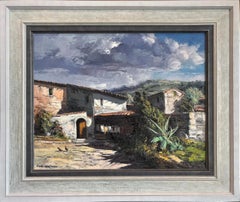
"Mission San Jose" San Antonio Texas
By Jeanette Milam Jones
Located in San Antonio, TX
Jeannette Milam Jones (1903-1999)
San Antonio Artist
Image Size: 11.5 x 14.25
Frame Size: 16 x 19
Medium: Oil
"Mission San Jose"
Biography
Jeannette Milam Jones (1903 - 1989)
The following information is from Susan
Soderstrom, whose family was a neighbor of the artist in San Antonio,
Texas and who found this information about Jeanette Jones among her
deceased mother's papers.
"A native of Uvalde, TX, window of Lucian T. Jones, Sr., and Mother of Lucian T. Jones, Jr. and Bruce Milam Jones.
She
studied with Harry Anthony de Yong, Henry Lee...
Category
1960s Impressionist Landscape Paintings
Materials
Oil
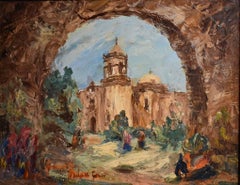
"Home Corral" Very early Wieghorst California Western Painting awesome colors
By Olaf Wieghorst
Located in San Antonio, TX
Olaf Wieghorst
(1899 - 1988)
California, New York, New Mexico, Arizona, Texas Artist
Image Size: 20 x 24
Frame Size: 29.5 x 33
Medium: oil
1946
"Home Corral" California Olaf Wieghorst
Without a doubt one of if not the most colorful Wieghorst paintings ever done. Signed lower left. Titled on verso. Dated on verso.
In very nice condition. Has been professionally cleaned. Has very fine craquelure in the tree branches and a small spot below the horse that is really only visible if you are extremely close to the painting or with magnification. One of his finest paintings. Also please view my other Wieghorst from the same estate. I have included close up photos as well as photos taken in natural light, spot light and fluorescent lighting.
Olaf Wieghorst
(1899 - 1988)
California, New York, New Mexico, Arizona, Texas Artist
Image Size: 20 x 24
Frame Size: 29.5 x 33
Medium: oil
"Home Corral"
Dated 1946
Biography
Olaf Wieghorst (1899 - 1988)
Born in Viborg, Denmark, Olaf Wieghorst was a child acrobatic performer from the age of nine when he began appearances at Tivoli Theater in Copenhagen and later toured Europe. He also learned horseback riding working on a stock farm, and horses became a major focus of his admiration and later his painting.
In 1918, he arrived in the United States, having worked as a cabin boy on a steamer. He served in the 5th U.S. Cavalry on the Mexican border in the days of Pancho Villa. He later recalled a favorite horse from that period and said that riding through El Paso in 1921, the horse fell on his ankle and broke it. The outfit was heading to Douglas, Arizona, and not wanting to be left behind with his injury, he stayed on the horse which carried him all the way through the New Mexico desert on one of the hottest days of the year. The horse died during the night, having expended all his energy on saving Wieghorst. He later wrote that when the Cavalry discarded the use of horses, "they took the soul out of that great branch of the service" ("Widening Horizons").
He wandered extensively through the West sometimes on horseback, finding work in Arizona and New Mexico as a cowboy. Then he went to New York and served as a mounted policeman until 1944, spending most of his time on a horse named Rhombo patrolling the Central Park bridle paths and saving many people injury from runaway horses. He began painting in his spare time, and he was successful enough that his work was represented by the Grand Central Art Galleries of the Biltmore Hotel.
In 1944, he settled in El Cajon, California. His paintings include cowboys, horses, and Indians in landscape, but there is little if any collectible art of his done during his early days in the West. His primary output came after his return to California when he began painting cowboys and horses extensively. He did numerous horse portraits, spending time on ranches studying their unique personalities. He painted celebrity horses including Roy Rogers' Trigger, Gene Autry's Champion and Tom Morgan's stallion.
He was a large, powerful, handsome, and very personable man.
Source:
Kathleen Wade
Olaf Carl Wieghorst (1899-1988)
He arrived in the U.S. in 1918, joining the U.S.
Cavalry, & patrolled the Mexico border in New Mexico & Arizona . When he mustered out of the army, he drifted, ending up as a wrangler on
the Cunningham Ranch near Alma, New Mexico.
By the mid-twenties,
Wieghorst was in New York City, working as a mounted policeman - his
relationships with the many horses that were a part of his life became
the common denominator of his paintings. Living in California by the end
of WWII, he began a career that spiraled to success, in part due to his
engaging personality.
His paintings have appeared in numerous solo
& retrospective exhibitions including the National Cowboy &
Western Heritage Museum, Oklahoma City (1974), The Tucson Museum of Art,
Arizona (1981), & the San Diego Historical Society, California
(2002).
His work was the subject of the 1970 biography, "Olaf Wieghorst"
by William Reed...
Category
1940s Impressionist Landscape Paintings
Materials
Oil
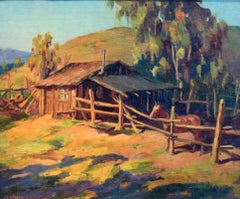
"LAS GOLONDRINAS" SANTA FE NEW MEXICO UNFRAMED
Located in San Antonio, TX
Cynthia Wiggins
Austin Artist
Image Size: 12 x 16
Frame Size: Unframed
Medium: Oil on Canvas
"Las Golondrinas" Santa Fe
Category
20th Century Impressionist Landscape Paintings
Materials
Oil
You May Also Like
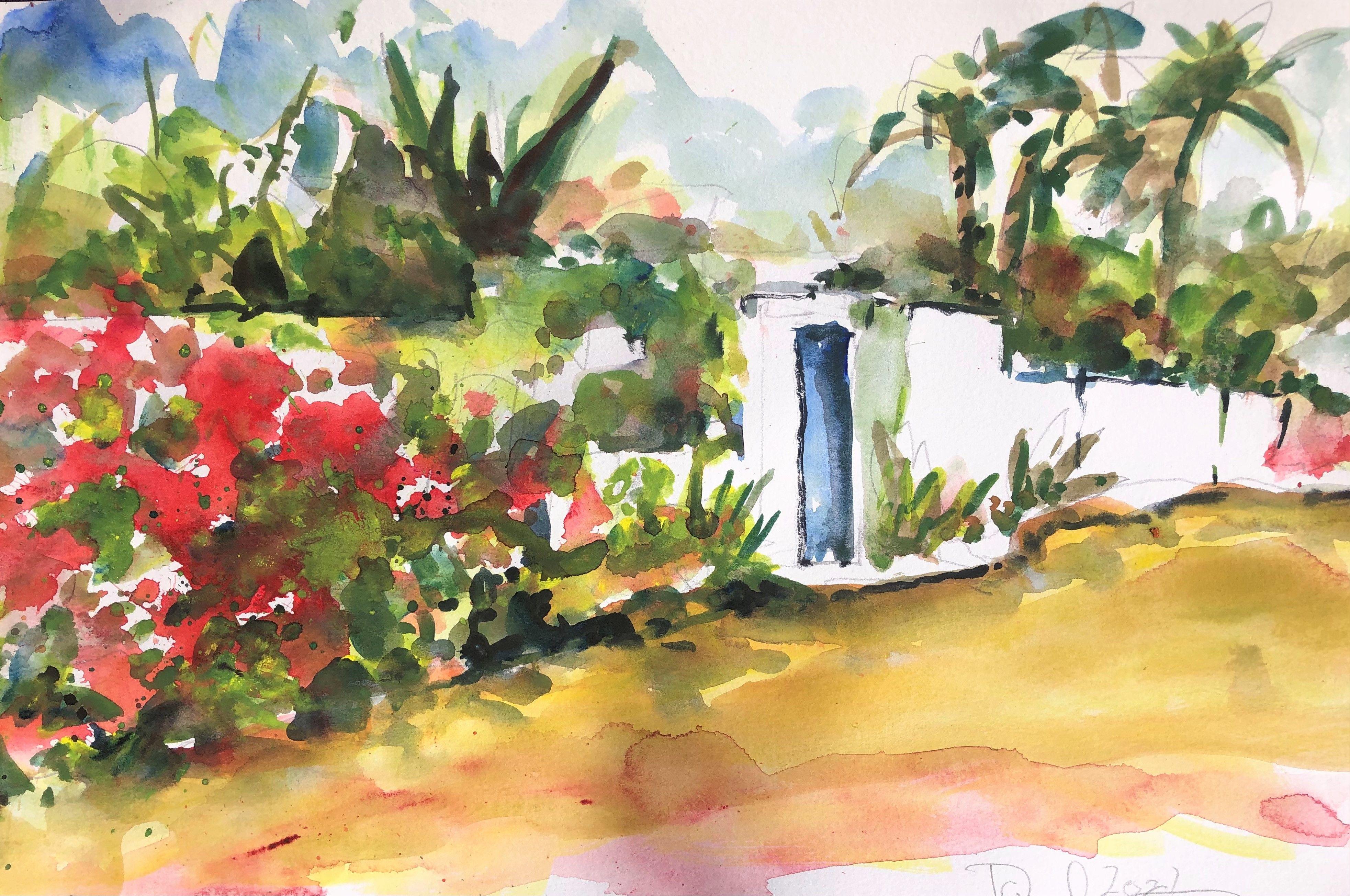
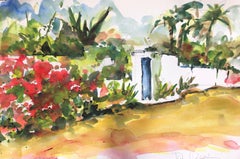
Santa Paula Bougainvillea, Painting, Watercolor on Watercolor Paper
By Daniel Clarke
Located in Yardley, PA
The bougainvillea wears your fragrance the scent a silent comfort in my often quiet days I enjoy our conversation while the magenta of its leaves paints a beautiful picture ...
Category
21st Century and Contemporary Impressionist Drawings and Watercolor Pain...
Materials
Watercolor
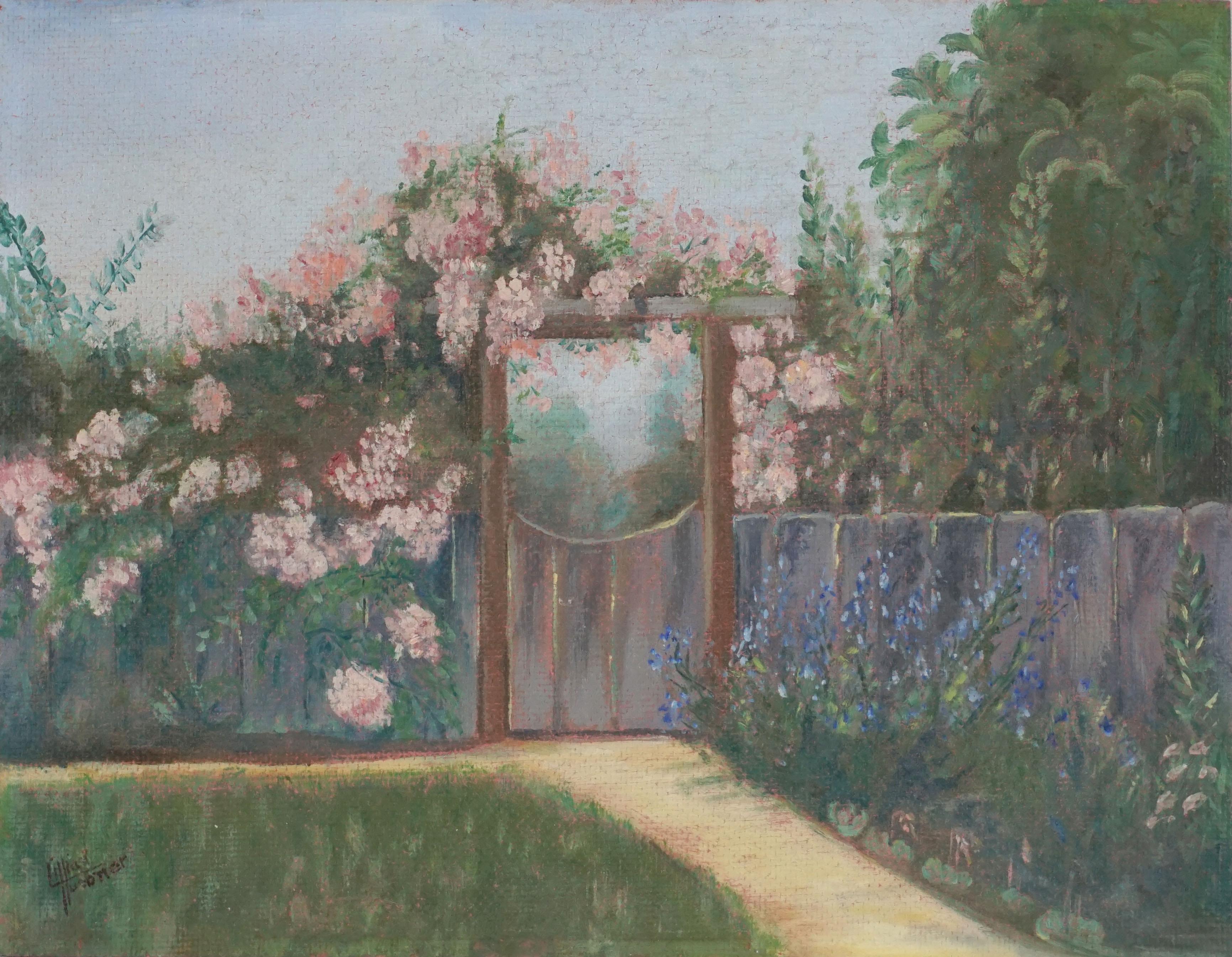
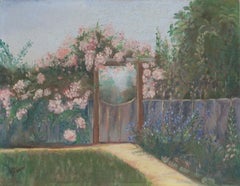
Mid Century California Garden Landscape -- The Friendly Gate
Located in Soquel, CA
Charming mid century landscape with Cecil Brunner roses, larkspur and foxglove titled "The Friendly Gate" by Lillian Mae Grooms Huebner (American, 1892-1976), circa 1950. Condition: ...
Category
1950s Impressionist Landscape Paintings
Materials
Masonite, Oil
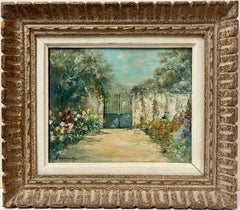
1950
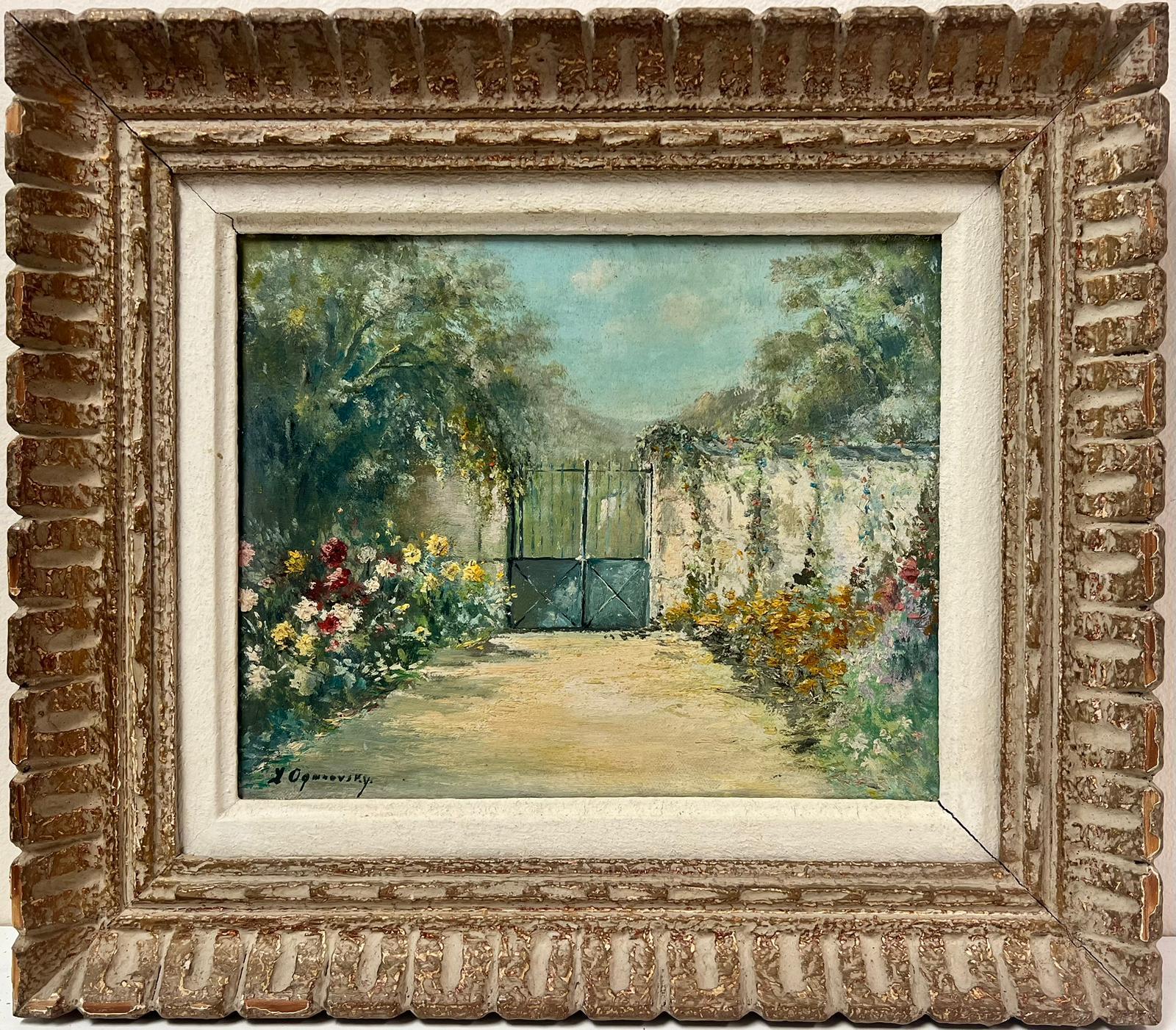
s French Signed Post Impressionist Oil Country House Gates
Garden
Located in Cirencester, Gloucestershire
French School, mid 20th century
Post Impressionist work in beautiful, original frame typical of the Montparnasse style.
signed oil painting on canvas, framed
framed: 14 x 15.5 inches
canvas : 9 x 11 inches
provenance: private collection
condition: very good and sound condition
Montparnasse picture frames...
Category
Mid-20th Century Impressionist Landscape Paintings
Materials
Oil, Canvas
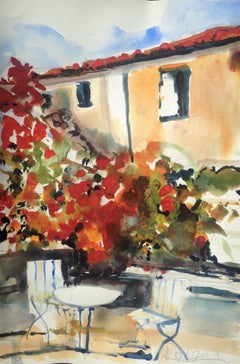
Majorca Bougainvillea, Painting, Watercolor on Watercolor Paper
By Daniel Clarke
Located in Yardley, PA
Beautiful Bougainvilleas Blooming all over Throughout my garden In vivid white And pleasing pink You appeal me so much Though not at all fragrant You appear Magnificent in m...
Category
2010s Impressionist Drawings and Watercolor Paintings
Materials
Watercolor
The Mission Entrance - Watercolor on Heavy Paper
By Gladys Louise Bowman Fies
Located in Soquel, CA
Colorful watercolor of mission entrance by Gladys Louise Bowman Fies (American, 1909-2005).
Vibrant watercolor of a California Mission. Two people are walking through the entrance,...
Category
1970s Impressionist Landscape Paintings
Materials
Paper, Watercolor
Oleander in the old town of Marmaris, Painting, Oil on Canvas
Located in Yardley, PA
A wondrous oleander bathing in the rays of the setting sun reminds me of the wonderful days when I was young. My grandmother and I loved to walk along thes...
Category
21st Century and Contemporary Impressionist Paintings
Materials
Oil