Items Similar to "Master Ship"
Want more images or videos?
Request additional images or videos from the seller
1 of 9
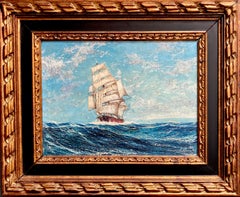
Thomas Tubby"Master Ship"unknown
unknown
$3,800
£2,859.25
€3,303.31
CA$5,335.12
A$5,763.67
CHF 3,066.33
MX$69,352.69
NOK 38,826.23
SEK 35,507.64
DKK 24,677.36
About the Item
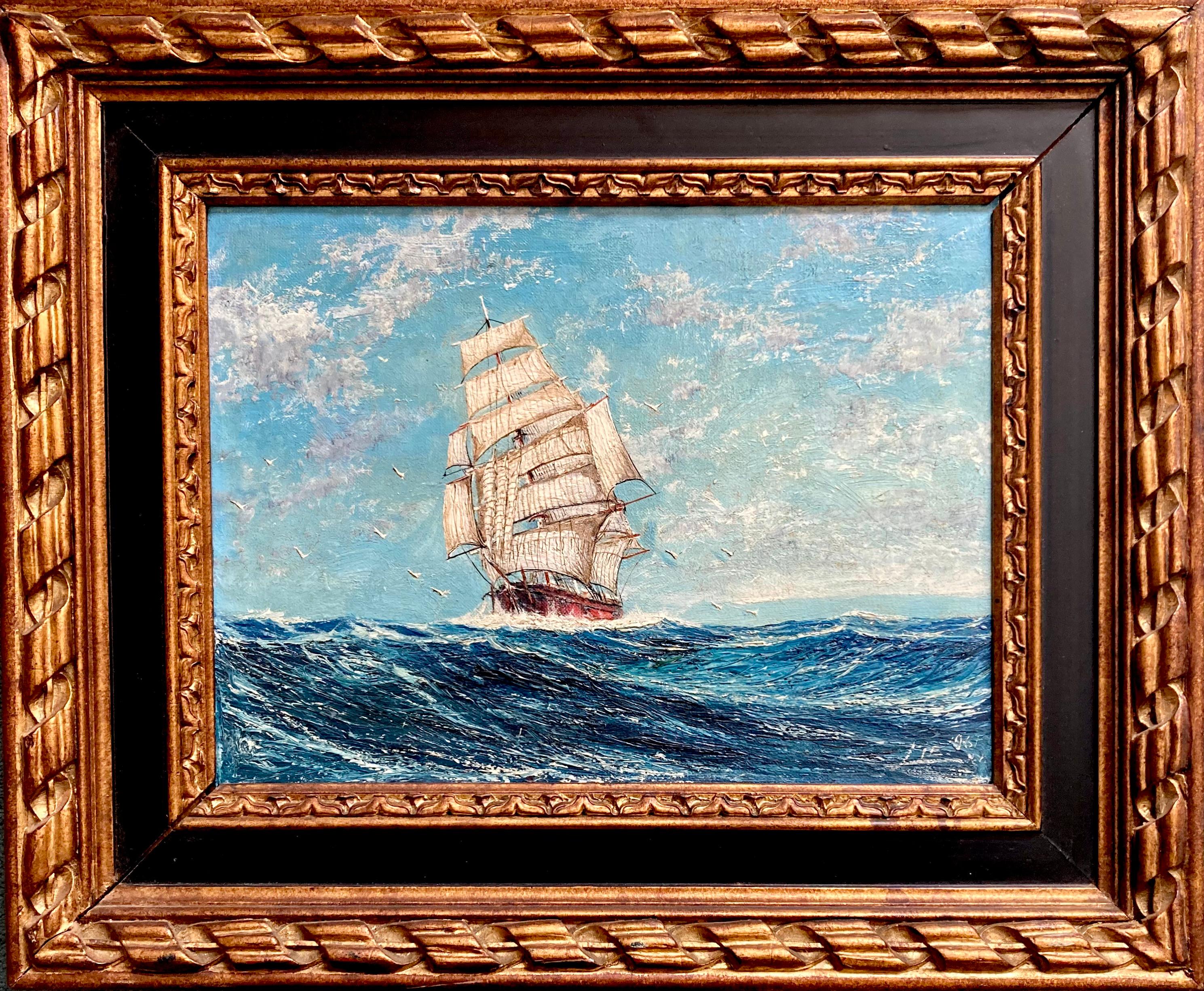
“Master Ship” watercolor on paper by American artist Josiah Thomas Tubby (1875- 1958). In “Soloman” hand-carved and gilded frame.
- Creator:Thomas Tubby (1875 - 1958, American)
- Creation Year:unknown
- Dimensions:Height: 26 in (66.04 cm)Width: 34.25 in (87 cm)Depth: 2.25 in (5.72 cm)
- Medium:
- Period:
- Condition:
- Gallery Location:Los Angeles, CA
- Reference Number:1stDibs: LU2563216079172
About the Seller
5.0
Vetted Professional Seller
Every seller passes strict standards for authenticity and reliability
1stDibs seller since 2023
- ShippingRetrieving quote...Shipping from: Los Angeles, CA
- Return Policy
More From This Seller
View AllUntitled
Located in Los Angeles, CA
Italian, hand painted, oil on canvas landscape with hand painted border. See other painting in separate listing that creates a pair.
Category
18th Century Landscape Paintings
Materials
Canvas, Oil
$6,800
Untitled
Located in Los Angeles, CA
Italian, hand painted, oil on canvas landscape with hand painted border. See other painting in separate listing that creates a pair.
Category
18th Century Landscape Paintings
Materials
Canvas, Oil
$6,800
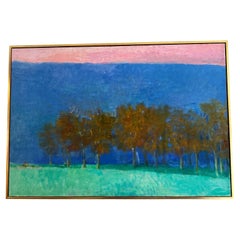
Corps de Ballet
By Wolf Kahn
Located in Los Angeles, CA
Signed, original, 1994, oil–on-canvas painting, Corps de Ballet by significant
American artist, Wolf Kahn (b. 1927). Winner: Fulbright and Guggenheim
Fellowships. Award in Art from...
Category
Late 20th Century Landscape Paintings
Materials
Canvas, Oil
$185,000
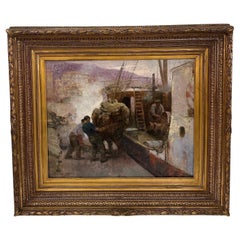
Debardeurs au Travail
Located in Los Angeles, CA
A hand-carved, gilt-wood framed oil on canvas “Debardeurs au Travail” by Belgium artist, Jacques Madyol (1871-1950). Madyol was a painter of genre scenes and portraits. He was also a...
Category
Early 20th Century Figurative Paintings
Materials
Canvas, Oil
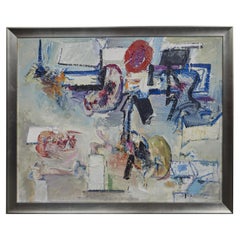
Oil on Canvas by Hans Burkhardt
By Hans Burkhardt
Located in Los Angeles, CA
Framed oil on canvas by Swiss-American abstract expressionist artist Hans Burkhardt (1904-1994). Signed and dated in lower right corner, 1967.
Silver gilt wood frame.
Category
Mid-20th Century Paintings
Materials
Canvas, Oil
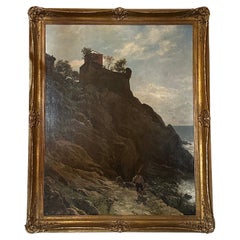
Untitled
Located in Los Angeles, CA
Large, oil on canvas by German artist Paul von Ravenstein (1854-1938). Signed lower left corner. Framed in a hand-carved, gilt-wood frame. Ravenstein studied the changes in color c...
Category
Late 19th Century Landscape Paintings
Materials
Canvas, Oil
You May Also Like
Period Marine Landscape Credited to Warren Sheppard
By Warren W. Sheppard
Located in Roma, IT
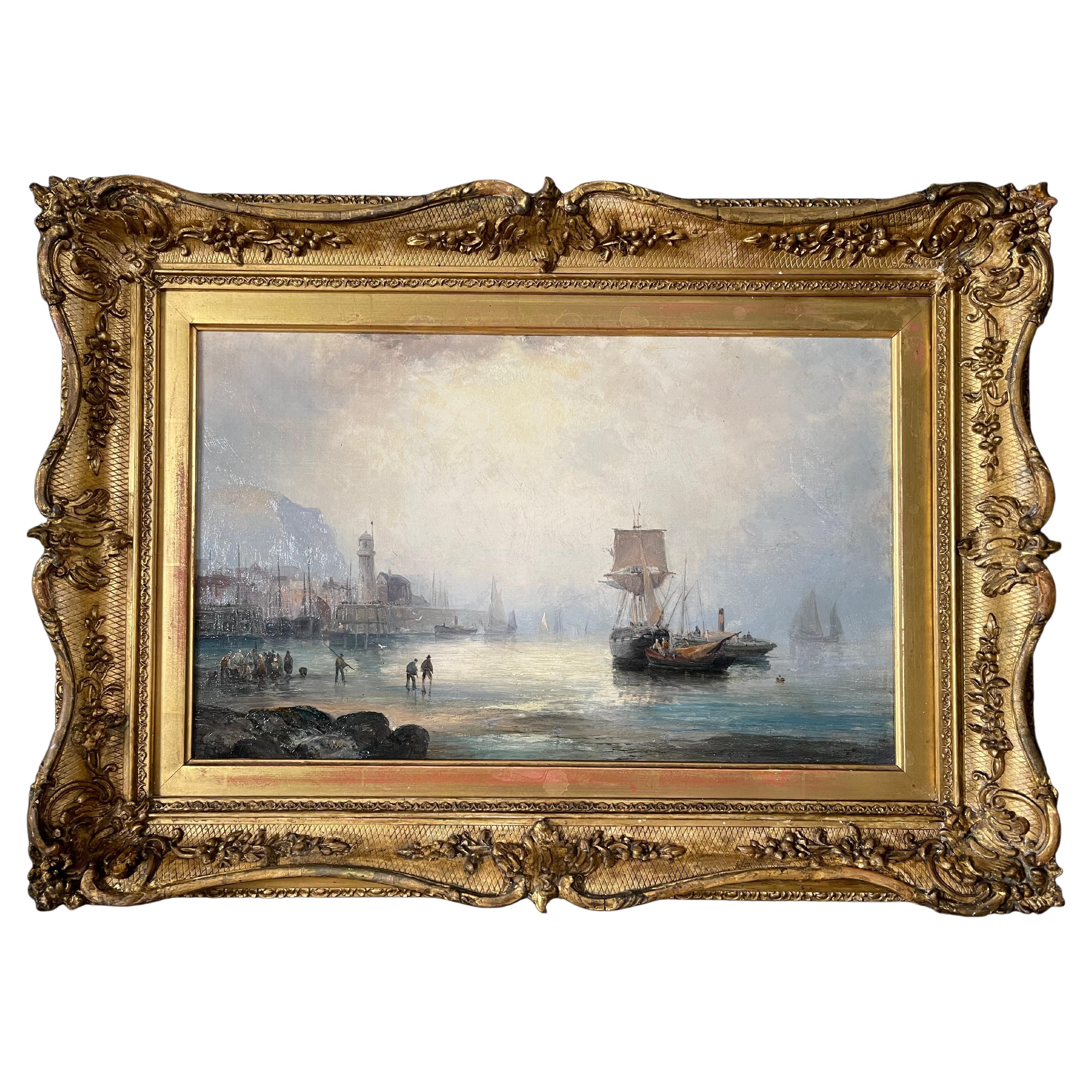
This beautiful painting, due to its very high quality of execution, style and era, can be referred to the great artist Warren Sheppard, who specialized in seascapes.
Of great evocati...
Category
19th Century Old Masters Landscape Paintings
Materials
Canvas, Oil
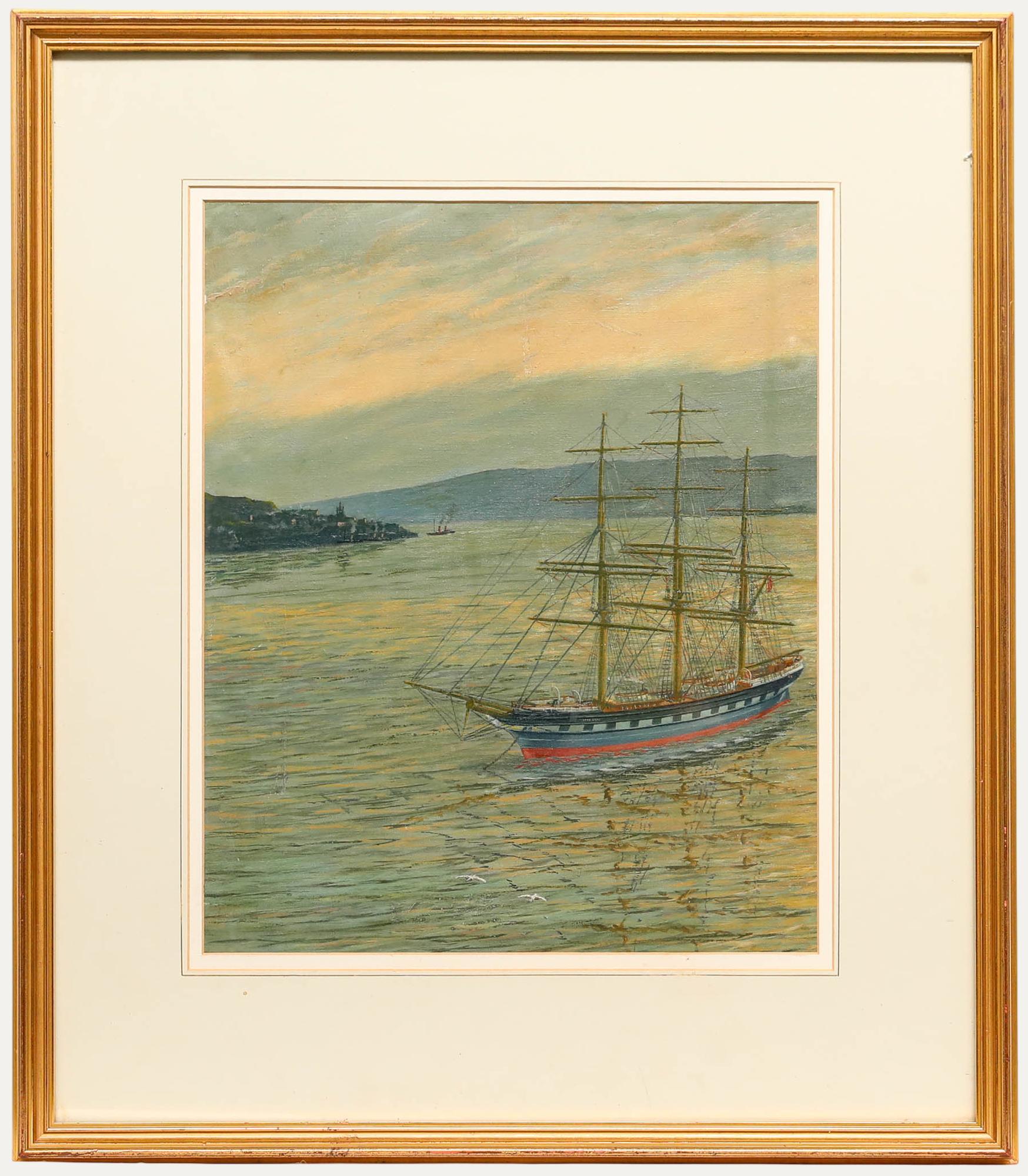
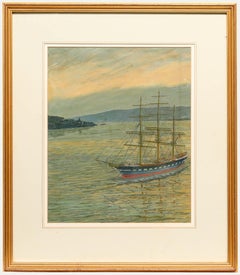
Framed 20th Century Oil - Sailing Ship at Anchor
Located in Corsham, GB
This atmospheric maritime scene captures a majestic sailing ship at anchor in a tranquil estuary, its tall masts silhouetted against a golden sky. The artist masterfully renders the ...
Category
20th Century Figurative Paintings
Materials
Oil
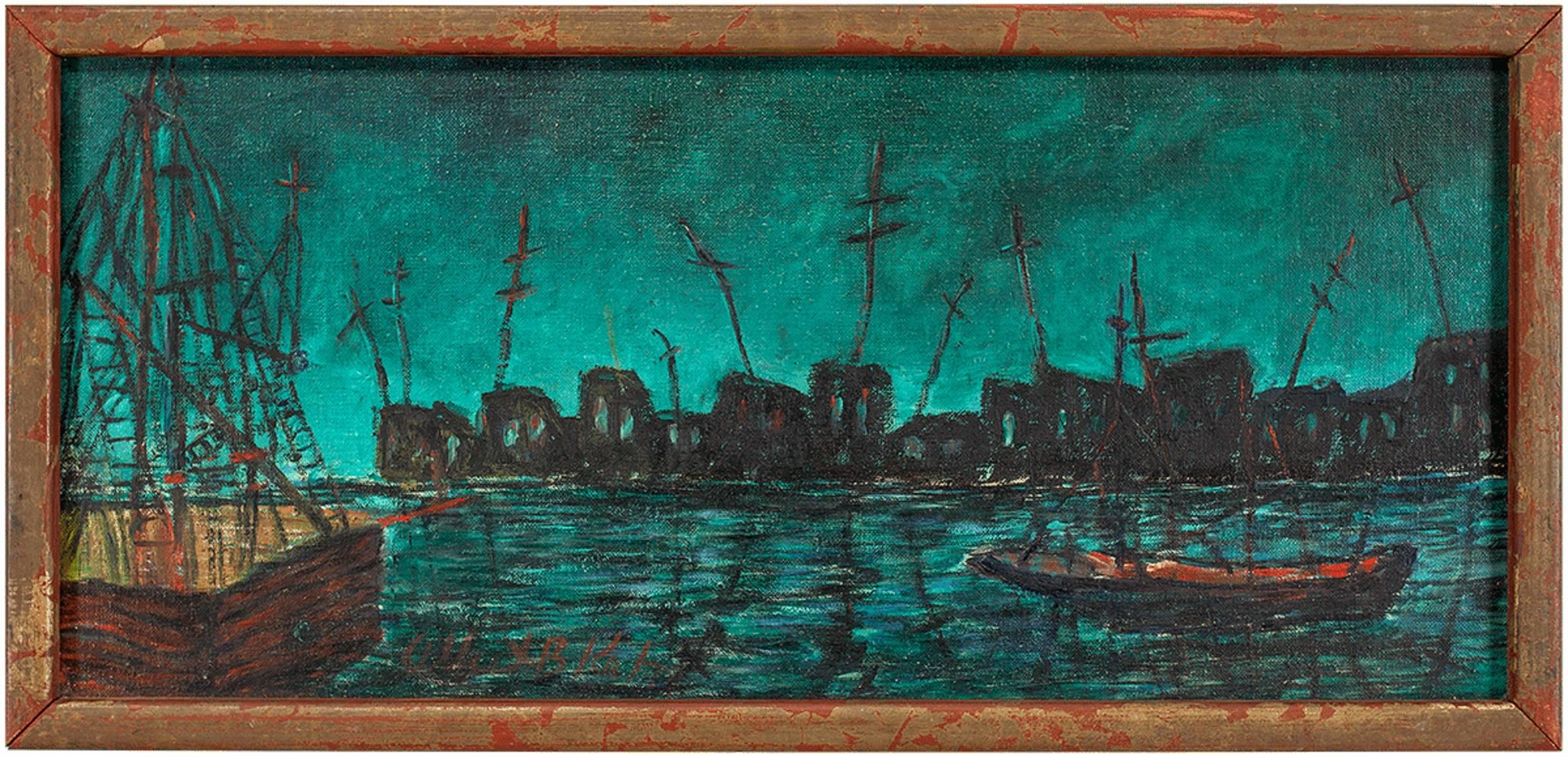
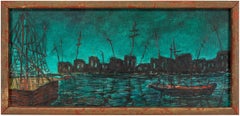
Sailing Ships
Located in Surfside, FL
Maritime Impressionist painting in somber night sky colors.
Category
Mid-20th Century Modern Landscape Paintings
Materials
Canvas, Oil
$650
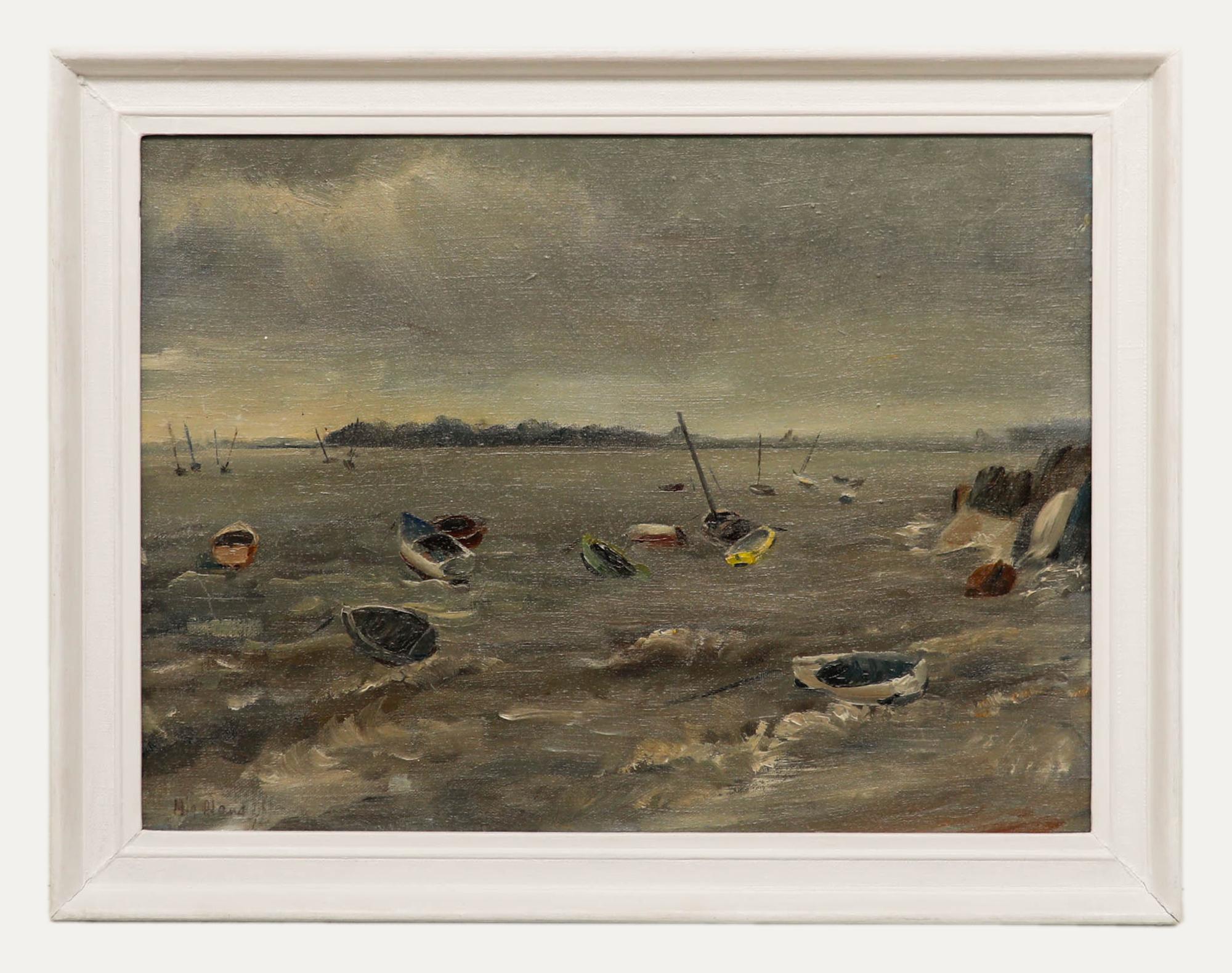
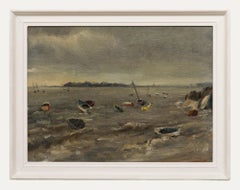
Framed 20th Century Oil - Bobbing Boats
Located in Corsham, GB
Seascape in oil. Presented in a white painted frame. Indistinctly signed in the lower left and dated 1976. On canvas board.
Category
20th Century Figurative Paintings
Materials
Oil
$308 Sale Price
20% Off
Sailing"
Located in Warren, NJ
Frame: 23 x 19 x 2
Picture: 12 x 16
Frame has minor wear.
original oil on board
Category
1960s Paintings
Materials
Board
Modern French Painting Signed Marine Landscape
By Moya Dyring
Located in Roma, IT
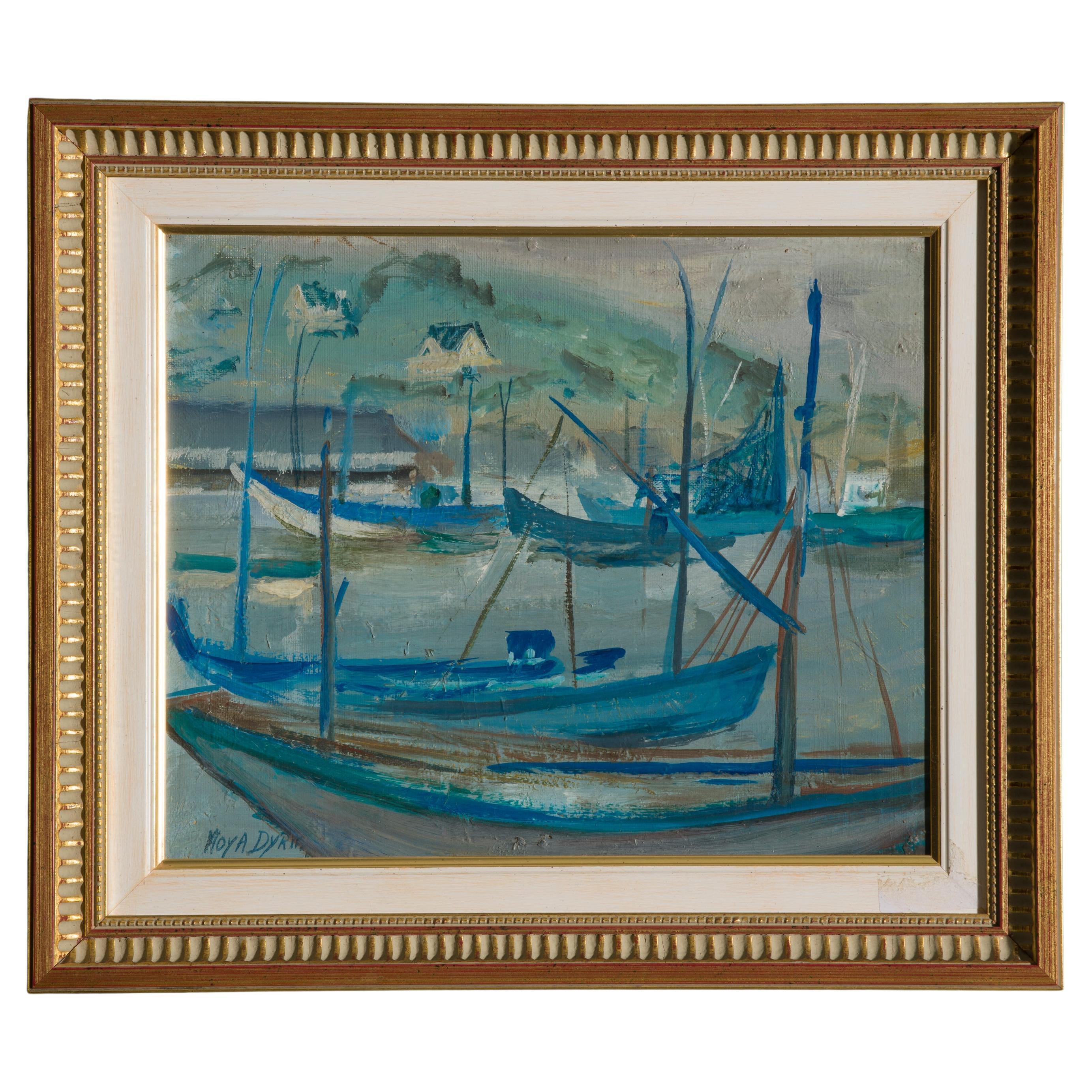
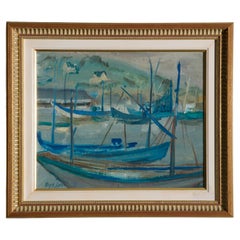
Beautiful and evocative oil painting by the great French school modern artist Moya Dyring specializing in marinas.
It depicts a harbor with boats probably from the French Riviera painted with great intensity but giving, at the same time, a sweet sense of serenity.
Moya Claire Dyring was born in Coburg, Victoria in 1909.
She produced drawings, oil paintings and pastels.
She was one of the first women artists to embrace Modernism and exhibit cubist paintings in Melbourne.
For several years she was a member of the modern art community known as the Heide Circle, named after the home of art collectors John and Sunday Reed, and now the Heide Museum of Modern Art.
Every item of our Gallery, upon request, is accompanied by a certificate of authenticity issued by Sabrina Egidi official Expert in Italian furniture for the Chamber of Commerce of Rome and for the Rome Civil Courts.
Dyring then travelled to the USA and France, where she lived most her life. Her work is held in the Heide Museum as well as the National Gallery of Australia.
One of her earliest works in cubist in style, Melanctha, 1934, was acquired by Sunday Reed.
In 1934 Dyring also painted Portrait of Sunday Reed which went into the Reed's collection, along with a cubist style Portrait of a Woman from the same year.
While her early works were figurative or cubist, in France she turned to landscape as she travelled to various towns throughout France.
In her later years, unable to travel freely, she painted children against the backdrop of Paris.
As time passed, she was largely glossed over and not included in major exhibitions of artists, especially women artists, of the 30s, 40, and 50s.
In 2002, at the University of Melbourne, Gaynor Patricia Cuthbert delved into her life and work for a doctoral thesis, helping to bring back attention to her work.
Collection
The Heide Museum of Modern Art holds many paintings and drawings, some acquired through the John and Sydney Reed collection.
The National Gallery of Australia, Canberra includes one drawing.
The Art Gallery of New South Wales holds multiple works.
Third child of Carl Peter Wilhelm Dyring, medical practitioner, and his second wife Dagmar Alexandra Esther, née Cohn, both Victorian born. Moya was educated (1917-27) at Firbank Church of England Girls' Grammar School, Brighton.
After visiting Paris in 1928, she studied (1929-32) at the National Gallery schools, Melbourne, and shared fellow student Sam Atyeo's interest in artistic innovation.
Classical modernism engaged her attention in the early 1930s.
She painted at the George Bell school and studied under Rah Fizelle in Sydney; Mary Alice Evatt and Cynthia Reed were her colleagues.
For several months in 1937 she took charge of Heide, the home and garden of John and Sunday Reed, at Bulleen, Melbourne.
The Reeds were pivotal both to her sympathy for modernism and her belief in congenial fellowship.
She enjoyed something of the intense relationship with Sunday Reed that the latter would subsequently extend to Joy Hester.
In June Dyring held an exhibition, opened by H. V. Evatt, at the Riddell Gallery, Melbourne.
Less enthusiastic than the Reeds and the Evatts about her art, Basil Burdett wrote of her 'somewhat incoherent interpretation of modern ideas', although he did acknowledge that her work had 'audacity of colour and a certain monumental feeling for form . . . qualities rare enough in Australian painting'.
In August Dyring embarked for Panama whence she travelled by bus to New York, breaking her journey to view major galleries.
She had intended to paint in the United States of America, but disliked the work of contemporary American artists and sailed for France.
In 1938 she was based in Paris, taking advantage of Atyeo's contacts within the avant-garde.
She studied at the Académie Colarossi, the Académie de la Grande Chaumière and with Andre Lhote, although by October she denounced him as a 'racketeer'.
In 1939 Dyring and Atyeo settled on a farm at Vence, France; inspired by memories of Heide, they grew fruit and flowers.
Sam accepted a commission to decorate a house in Dominica, West Indies, leaving Moya at Vence.
Evacuated to Australia via South Africa, where she painted and searched for tribal art, she then journeyed to Dominica and married Atyeo.
They were not happy, neither painted and Dyring was ill. Evatt offered Atyeo work and Dyring accompanied him to the U.S.A.
She viewed art, painted occasionally and claimed to have exhibited in Washington in 1943.
After World War II Evatt found Sam various postings, while Moya returned to Paris to pursue a full-time career in art.
They were to be divorced in 1950.
From about 1946 Dyring's art was more personal than innovative.
She gained a considerable reputation among French regionalist and nationalist artists for her sympathetic appreciation of provincial scenes and life.
Bernard Smith placed her in the French tradition of intimiste painters.
In 1948 she leased and renovated an apartment on the Ile St Louis, which, as Chez Moya, became a centre for Australians who enjoyed her hospitality, cooking and practical assistance.
She revisited Australia and exhibited in various cities in 1950, 1953, 1956, 1960 and 1963; the press carried her reports of Parisian cultural life.
Dyring held a solo exhibition in London in December 1949 and was in close contact with expatriate Australians, among them Loudon Sainthill...
Category
1950s Modern Landscape Paintings
Materials
Wood, Oil
$1,436 Sale Price
20% Off
More Ways To Browse
Vintage Ships
Carved And Gilded Frame
Istanbul Painting
James Brown Artist
Jenkins Oil
Kite Flying
Moon Tree Art
Moonrise Painting
Most Popular Paintings
Parson Oil
Robertson Artist
Santa Fe Railroad
Schooner Oil Painting
Ships At Sea Painting
Snow Paris
St Tropez Painting
Temper Painting
Very Large Landscape Painting