Want more images or videos?
Request additional images or videos from the seller
1 of 9
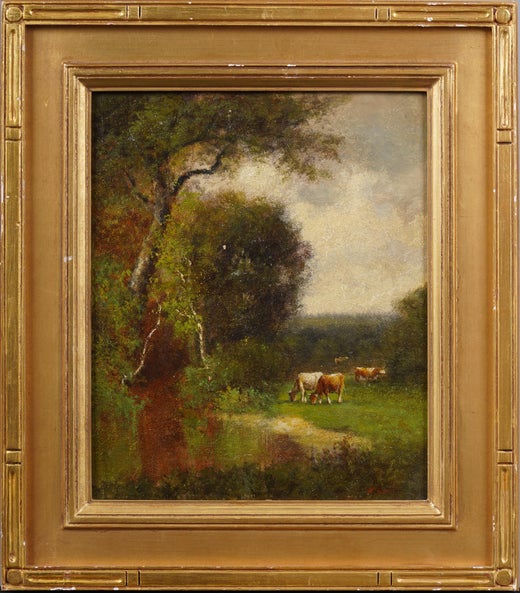
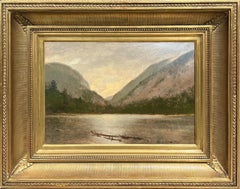
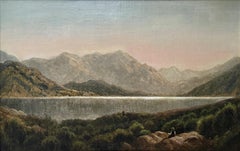
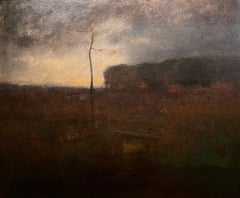
William Hart"Summer Landscape on the River, " William Hart, Hudson River School, Catskills
$7,000List Price
About the Item
- Creator:William Hart (1823 - 1894)
- Dimensions:Height: 10 in (25.4 cm)Width: 13.5 in (34.29 cm)
- Medium:
- Movement Style:
- Period:
- Condition:
- Gallery Location:New York, NY
- Reference Number:1stDibs: LU1841210631392
William Hart
Born in Scotland, William Hart emigrated with his family to New York on the ship Camillus in 1830. He became known for serene, bucolic and romantic landscapes. Many of his paintings had cattle and realistic figures diminished in the landscape, a motif he began in the late 1880s. Hart was a second generation "Hudson River School" painter. George Inness and Asher Durand were major influences, although he was basically self-taught.
About the Seller
5.0
Platinum Seller
Premium sellers with a 4.7+ rating and 24-hour response times
Established in 2022
1stDibs seller since 2022
132 sales on 1stDibs
Authenticity Guarantee
In the unlikely event there’s an issue with an item’s authenticity, contact us within 1 year for a full refund. DetailsMoney-Back Guarantee
If your item is not as described, is damaged in transit, or does not arrive, contact us within 7 days for a full refund. Details24-Hour Cancellation
You have a 24-hour grace period in which to reconsider your purchase, with no questions asked.Vetted Professional Sellers
Our world-class sellers must adhere to strict standards for service and quality, maintaining the integrity of our listings.Price-Match Guarantee
If you find that a seller listed the same item for a lower price elsewhere, we’ll match it.Trusted Global Delivery
Our best-in-class carrier network provides specialized shipping options worldwide, including custom delivery.You May Also Like
New England Sunrise, 1910 by Lockwood DeForest (American, 1850-1932)
Located in New York, NY
"New England Sunrise," 1910 by Hudson River School painter Lockwood DeForest (American, 1850-1932) is oil on artists card-stock and measures 9.75 x 14 inches. The work is signed by DeForest and dated Sept. 17, 1910 at lower left. The work is framed in an elegant, period appropriate frame, and ready to hang.
Lockwood de Forest was born in New York in 1850 to a prominent family. He grew up in Greenwich Village and on Long Island at the family summer estate in Cold Spring Harbor. As was customary for a cultivated family in the Gilded Age, the de Forests made frequent trips abroad. Excursions to the great museums, which were prominent on the de Forests agenda, deepened the young Lockwood's familiarity with European painting and sculpture. Though he had begun drawing and painting somewhat earlier, it was during a visit to Rome in 1868 that nineteen-year-old de Forest first began to study art seriously, taking painting lessons from the Italian landscapist Hermann David Salomon Corrodi (1844–1905). More importantly, on the same trip, Lockwood met one of America’s most celebrated painters, (and his maternal great-
uncle by marriage) Frederic Edwin Church (1826–1900), who quickly became his mentor. DeForest accompanied Church on sketching trips around Italy and continued this practice when they both returned to America in 1869. Early on in his career, de Forest made a habit of recording the date and often the place of his oil sketches, as to create a visual diary of his travels. Lockwood’s profession as a landscape painter can be primarily attributed to Frederic E. Church and his belief in the young artist’s talent.
De Forest often visited Church in the Hudson River community of Catskill where, in addition to sketching trips and afternoons of painting, he assisted with the architectural drawings and planning of Olana. In 1872, de Forest took a studio at the Tenth Street Studio Building in New York. During these formative years de Forest counted among his friend’s artists such as Sanford Robinson Gifford (1823–80), George Henry Yewell (1830–1923), John Frederick Kensett (1816–72), Jervis McEntee (1828–91), and Walter Launt Palmer (1854–1932).
Over the next decade de Forest experienced success as a painter. He exhibited for the first time at the National Academy of Design in 1872, and made two more painting trips abroad, in 1875–76 and 1877–78, traveling to the major continental capitals but also the Middle East and North Africa. His trip to the Middle East and the library at Church’s home, Olana, established his interest in design during his mid-twenties. From about 1878 to 1902, landscape painting was overshadowed by his activities and preoccupation with East Indian architecture and décor, a style that became quite fashionable in late nineteenth century America. From 1879-1883, de Forest founded Associated Artists along with Louis Comfort Tiffany, Candace Wheeler...
Category
Early 20th Century Hudson River School Landscape Paintings
Materials
Oil, Board
$15,000
H 9.75 in W 14 in
Adirondack Stream by Hudson River artist Joseph Antonio Hekking (1830-1903)
By Joseph Antonio Hekking
Located in New York, NY
Painted by Hudson River School artist Joseph Antonio Hekking (1830-1903), "Adirondack Stream in Fall" is oil on board and measures 8.5 x 6.5 inches. The painting is signed at the low...
Category
19th Century Hudson River School Landscape Paintings
Materials
Oil, Board
Dusk Forest Scene, Catskills by Lockwood DeForest (American, 1850-1932)
Located in New York, NY
"Dusk Forest Scene, Catskills," 1875 by Hudson River School painter Lockwood DeForest (American, 1850-1932) is oil on artists card-stock and measures 9.5 x 7 inches. The work is signed by DeForest, and dated May 13, 1875 at lower right. The work is framed in an elegant, period appropriate frame, and ready to hang.
Lockwood DeForest was born in New York in 1850 to a prominent family. He grew up in Greenwich Village and on Long Island at the family summer estate in Cold Spring Harbor. As was customary for a cultivated family in the Gilded Age, the DeForests made frequent trips abroad. Excursions to the great museums, which were prominent on the DeForests agenda, deepened the young Lockwood's familiarity with European painting and sculpture. Though he had begun drawing and painting somewhat earlier, it was during a visit to Rome in 1868 that nineteen-year-old DeForest first began to study art seriously, taking painting lessons from the Italian landscapist Hermann David Salomon Corrodi (1844–1905). More importantly, on the same trip, Lockwood met one of America’s most celebrated painters, (and his maternal great-
uncle by marriage) Frederic Edwin Church (1826–1900), who quickly became his mentor. DeForest accompanied Church on sketching trips around Italy and continued this practice when they both returned to America in 1869. Early on in his career, de Forest made a habit of recording the date and often the place of his oil sketches, as to create a visual diary of his travels. Lockwood’s profession as a landscape painter can be primarily attributed to Frederic E. Church and his belief in the young artist’s talent.
DeForest often visited Church in the Hudson River community of Catskill where, in addition to sketching trips and afternoons of painting, he assisted with the architectural drawings and planning of Olana. In 1872, DeForest took a studio at the Tenth Street Studio Building in New York. During these formative years DeForest counted among his friend’s artists such as Sanford Robinson Gifford (1823–80), George Henry Yewell (1830–1923), John Frederick Kensett (1816–72), Jervis McEntee (1828–91), and Walter Launt Palmer (1854–1932).
Over the next decade DeForest experienced success as a painter. He exhibited for the first time at the National Academy of Design in 1872, and made two more painting trips abroad, in 1875–76 and 1877–78, traveling to the major continental capitals but also the Middle East and North Africa. His trip to the Middle East and the library at Church’s home, Olana, established his interest in design during his mid-twenties. From about 1878 to 1902, landscape painting was overshadowed by his activities and preoccupation with East Indian architecture and décor, a style that became quite fashionable in late nineteenth century America. From 1879-1883, de Forest founded Associated Artists along with Louis Comfort Tiffany, Candace Wheeler...
Category
19th Century Hudson River School Landscape Paintings
Materials
Oil, Board
Hudson Highlands by Lockwood DeForest (American, 1850-1932)
Located in New York, NY
"Hudson Highlands," by Hudson River School painter Lockwood DeForest (American, 1850-1932) is oil on artists card-stock and measures 9.5 x 14 inches. The work is framed in an elegant, period appropriate frame, and ready to hang.
Lockwood de Forest was born in New York in 1850 to a prominent family. He grew up in Greenwich Village and on Long Island at the family summer estate in Cold Spring Harbor. As was customary for a cultivated family in the Gilded Age, the de Forests made frequent trips abroad. Excursions to the great museums, which were prominent on the de Forests agenda, deepened the young Lockwood's familiarity with European painting and sculpture. Though he had begun drawing and painting somewhat earlier, it was during a visit to Rome in 1868 that nineteen-year-old de Forest first began to study art seriously, taking painting lessons from the Italian landscapist Hermann David Salomon Corrodi (1844–1905). More importantly, on the same trip, Lockwood met one of America’s most celebrated painters, (and his maternal great-
uncle by marriage) Frederic Edwin Church (1826–1900), who quickly became his mentor. DeForest accompanied Church on sketching trips around Italy and continued this practice when they both returned to America in 1869. Early on in his career, de Forest made a habit of recording the date and often the place of his oil sketches, as to create a visual diary of his travels. Lockwood’s profession as a landscape painter can be primarily attributed to Frederic E. Church and his belief in the young artist’s talent.
De Forest often visited Church in the Hudson River community of Catskill where, in addition to sketching trips and afternoons of painting, he assisted with the architectural drawings and planning of Olana. In 1872, de Forest took a studio at the Tenth Street Studio Building in New York. During these formative years de Forest counted among his friend’s artists such as Sanford Robinson Gifford (1823–80), George Henry Yewell (1830–1923), John Frederick Kensett (1816–72), Jervis McEntee (1828–91), and Walter Launt Palmer (1854–1932).
Over the next decade de Forest experienced success as a painter. He exhibited for the first time at the National Academy of Design in 1872, and made two more painting trips abroad, in 1875–76 and 1877–78, traveling to the major continental capitals but also the Middle East and North Africa. His trip to the Middle East and the library at Church’s home, Olana, established his interest in design during his mid-twenties. From about 1878 to 1902, landscape painting was overshadowed by his activities and preoccupation with East Indian architecture and décor, a style that became quite fashionable in late nineteenth century America. From 1879-1883, de Forest founded Associated Artists along with Louis Comfort Tiffany, Candace Wheeler...
Category
19th Century Hudson River School Landscape Paintings
Materials
Oil, Board
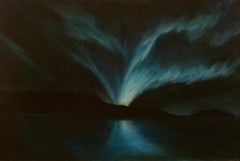
Lights of the Aurora
By William Bradford
Located in New York, NY
Signed lower right: W Bradford
Category
Late 19th Century Hudson River School Landscape Paintings
Materials
Oil, Board
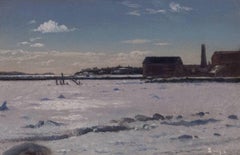
Fairhaven Harbor (Old Tack Works Wharf)
By William Bradford
Located in New York, NY
Signed lower right: Bradford
Category
19th Century Hudson River School Landscape Paintings
Materials
Paper, Oil, Board
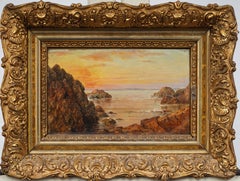
Antique American Hudson River School Luminous Coastal Sunset Seascape Painting
Located in Buffalo, NY
Signed and dated K. W. Newhall 1881, this luminous seascape by American painter Kate White Newhall (1840–1917) captures a dramatic coastal scene at sunset with refined academic techn...
Category
1880s Hudson River School Landscape Paintings
Materials
Oil, Board
$1,420 Sale Price
20% Off
H 9 in W 12.5 in D 2 in
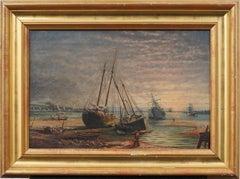
Antique American Sunset Seascape Giltwood Framed New England Harbor Oil Painting
Located in Buffalo, NY
Antique American sunset seascape oil painting. Oil on board. Signed. Framed. Measuring: 18 by 24 inches overall, and 12.25 by 18 painting alone.. In excellent original condition. Ha...
Category
1850s Hudson River School Figurative Paintings
Materials
Oil, Board
$2,475
H 18 in W 24 in D 2 in
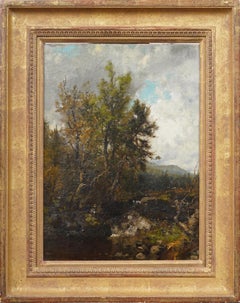
Antique American Hudson River School Mountain Landscape Framed Signed Painting
By George Herbert McCord
Located in Buffalo, NY
This atmospheric 19th-century oil painting by George H. McCord (1848–1909) depicts a wooded riverbank under a dynamic sky, rendered with the crisp naturalism and luminist subtlety as...
Category
1870s Hudson River School Landscape Paintings
Materials
Oil, Board
$3,475
H 22 in W 17 in D 2 in
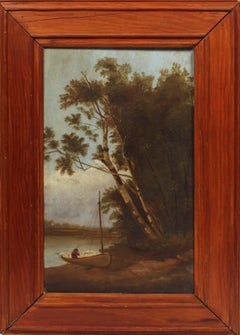
Hudson River School Original American Oil Painting Canoe Framed Trees 19th C
Located in Buffalo, NY
A tranquil and atmospheric landscape evocative of the Hudson River School, Boat Along the Hudson captures the poetic stillness of early American wilderness painting. A lone figure re...
Category
1890s Hudson River School Landscape Paintings
Materials
Oil, Board
More From This Seller
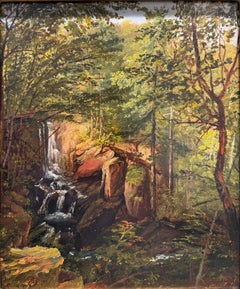
View All"Janetta Falls, New Jersey" Jasper F. Cropsey, Hudson River Wooded Landscape
By Jasper Francis Cropsey
Located in New York, NY
Jasper F. Cropsey
Janetta Falls, New Jersey, circa 1846
Signed J.F. Cropsey
Oil on canvas
12½ x 10¾ inches
Provenance
Private Collection, New York, 1930s
Thence by descent to the pr...
Category
1840s Hudson River School Figurative Paintings
Materials
Canvas, Oil
"View of Upper Ausable Lake" John Bunyan Bristol, Glowing Atmospheric Landscape
By John Bunyan Bristol
Located in New York, NY
John Bunyan Bristol
View of Upper Ausable Lake
Signed lower right
Oil on canvas
18 x 30 inches
Provenance
Wynant D. Vanderpoel III (1939-2018), New York and Palm Beach
Estate of the...
Category
1870s Hudson River School Figurative Paintings
Materials
Canvas, Oil
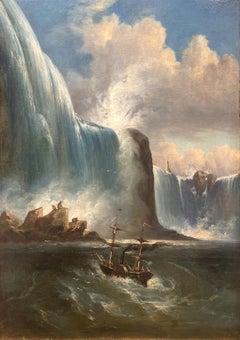
"Niagara Falls" Victor de Grailly, Hudson River School, New York Landscape
By Victor de Grailly
Located in New York, NY
Victor de Grailly
Niagara Falls, circa 1840-45
Oil on canvas
28 7/8 x 21 1/4 inches
Provenance:
Mark Borghi Fine Art, New York
Private Collection, Nyack, New York
Little is known a...
Category
1840s Hudson River School Landscape Paintings
Materials
Canvas, Oil
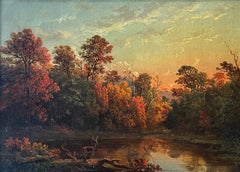
"Sunset, Indian Summer" DeWitt Clinton Boutelle, Hudson River School Landscape
Located in New York, NY
DeWitt Clinton Boutelle
Sunset, Indian Summer, 1848-49
Signed and dated lower left
Oil on canvas
12 x 16 inches
DeWitt Clinton Boutelle was b...
Category
1840s Hudson River School Figurative Paintings
Materials
Canvas, Oil
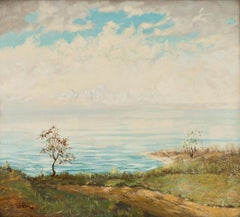
"Western Lake Landscape, " John Fery, Hudson River School View
By John Fery
Located in New York, NY
John Fery (1859 - 1934)
Western Lake Landscape, circa 1920
Oil on canvas
21 x 23 1/4 inches
Signed lower left
Provenance:
Private Collection, New York
Born in Austria, John Fery earned a strong reputation for dramatic paintings of western mountain landscape in the United States. Glacier National Park in northwest Montana was a popular subject for him.
He was raised in a prominent, wealthy family that lived on an estate about nineteen miles northeast of Salzburg. His mother was Hungarian, and his father was born in Bohemia. S ome sources have written that he studied art in Dusseldorf, Germany with Peter Jansen, and also in Munich, Venice and Karlsruhe. But his "name does not appear in the records of the major art schools in any of these places, nor is there any record of his name at either the Vienna or Budapest academies." (Merrill 26) It is possible, however, that he received private instruction, and because of the sophistication of his painting, sources think it unlikely that he was self taught.
An early interest in wilderness scenery led him to painting American landscapes and hunting scenes. In the mid 1880s, he came to America and lived in the German community in Milwaukee, and then in 1886, brought his family to the United States. His wife, Mary Rose Kraemer (1862-1940), was born in Switzerland, and they had one child born near Munich and two others born in the United States. From 1886 to 1888, they lived in New York, and by 1890, Fery had made his first trip West.
He visited Yellowstone Park in 1891, and indicated in his writings that he had been there even earlier. From 1892 to 1893, he led European nobility on hunting expeditions to the American Northwest, made possible by the completion of the Northern Pacific Railroad...
Category
1920s Hudson River School Landscape Paintings
Materials
Canvas, Oil
$9,600 Sale Price
20% Off
"A Cloudy Day, " View of Montclair, New Jersey, Tonalist, Barbizon Scene
By George Inness
Located in New York, NY
George Inness (1825 - 1894)
A Cloudy Day, 1886
Oil on canvas
25 x 30 inches
Signed and dated lower center
Provenance:
The artist
Estate of the above
Fifth Avenue Galleries, New York, Executor's Sale of Paintings by the Late George Inness, N.A., February 12 - 14, 1895, Lot 132
Joseph H. Spafford, acquired from the above
Mrs. Spafford, by bequest from the above
Leroy Ireland, New York, 1951
Ernest Closuit, Fort Worth, Texas
Meredith Long & Company, Houston, Texas, circa 1960
Private Collection
Shannon's Fine Art, American and European Fine Art Auction, October 27, 2016, Lot 42
Exhibited:
New York, American Fine Arts Society, Exhibition of the Paintings Left by the Late George Inness, December 27, 1894, no. 90.
Literature:
LeRoy Ireland, The Works of George Inness: An Illustrated Catalogue Raisonne, Austin, Texas, 1965, p. 336, no. 1324, illustrated.
Michael Quick, "George Inness: A Catalogue Raisonne," Vol. II, New Brunswick, New Jersey, 2007, pp. 282-83, 311, no. 966, illustrated.
George Inness, one of America's foremost landscape painters of the late nineteenth century, was born in 1825 near Newburgh, New York. He spent most of his childhood in Newark, New Jersey. He was apprenticed to an engraving firm until 1843, when he studied art in New York with Regis Gignoux, a landscape painter from whom he learned the classical styles and techniques of the Old Masters. In 1851, sponsored by a patron, Inness made a fifteen-month trip to Italy. In 1853 he traveled to France, where he discovered Barbizon landscape painting, leading him to adopt a style that used looser, sketchier brushwork and more open compositions, emphasizing the expressive qualities of nature.
After working in New York from 1854 to 1859, he moved to Medfield, Massachusetts, and four years later to New Jersey, where through a fellow painter he began to experiment with using glazes that would allow him to fill his compositions with subtle effects of light. Duncan Phillips remarked on Inness’s mellow light as a unifying force, saying, “…he was equipped to modernize the grand manner of Claude and to apply the methods of Barbizon to American subjects."
At this time also, Inness developed an interest in the religious theories of Emanuel Swedenborg...
Category
1880s Hudson River School Landscape Paintings
Materials
Canvas, Paint, Oil
Still Thinking About These?
All Recently ViewedMore Ways To Browse
William Hart
Hudson River Painters
Hart Oil Paintings
Catskills Painting
Deauville Vintage
Landscape Paintings 19th Century French Unknown
Cornwall Painting
Modern Cityscape Paintings
30x40 Painting
Barn Oil Painting
Bucolic Landscape
Creek Paintings
Painters Palette
New Mexican Artist
New Mexico Artists
1926 Paintings
Pont Aven
Blossom Oil Painting